

Key Takeaways
Trends, crimes, and ideas spread like viruses — and can tip overnight
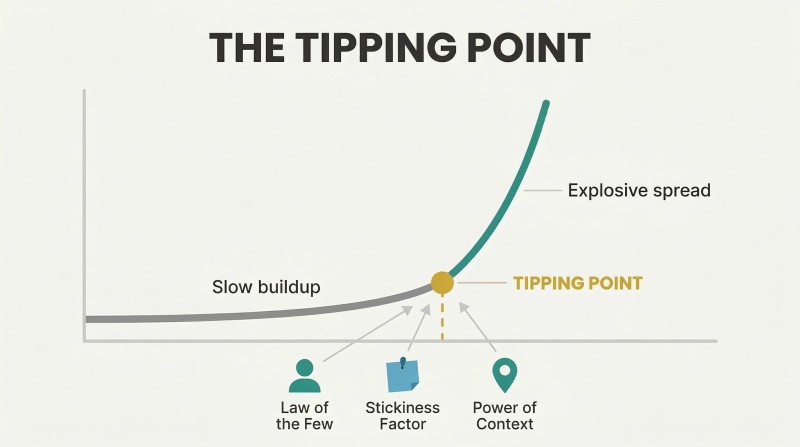
The Tipping Point is the moment of critical mass when something crosses a threshold and spreads explosively. Hush Puppies went from 30,000 pairs sold to 430,000 in a single year — triggered by a handful of Manhattan hipsters. New York City murders plunged 64.3% in five years, from 2,154 to 770. Neither change was gradual. Both tipped.
Gladwell argues all epidemics share three traits: contagiousness, the ability of small causes to produce huge effects, and the fact that change happens at one dramatic moment rather than slowly. A piece of paper folded fifty times would reach the sun — our brains can't intuit geometric progression. Three rules govern every Tipping Point: the Law of the Few (who spreads it), the Stickiness Factor (what makes the message stick), and the Power of Context (the environment that enables it).
Epidemics hinge on three rare personality types, not the masses
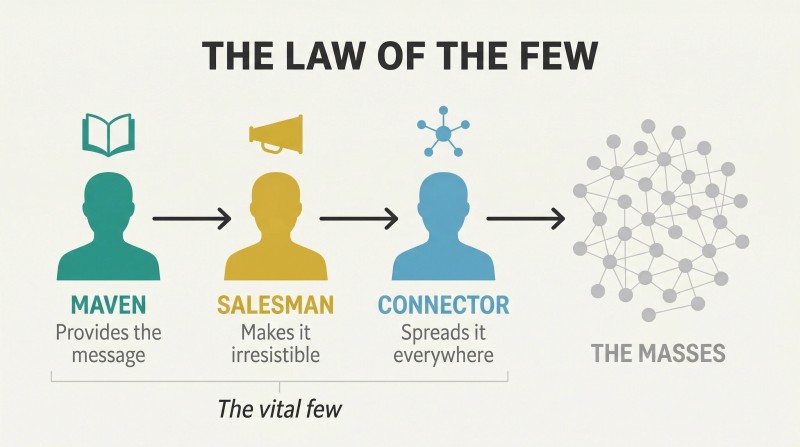
The Law of the Few holds that a disproportionately small number of exceptional people launch epidemics. Gladwell names three types:
1. Connectors — people who bridge many social worlds (Roger Horchow maintained 1,600 contacts; Lois Weisberg belonged to eight distinct Chicago subcultures)
2. Mavens — obsessive information gatherers who share what they learn (Mark Alpert remembered coffee prices from a decade earlier and saved a colleague $15,000 on a house)
3. Salesmen — charismatic persuaders who draw others into their rhythm (financial planner Tom Gau scored 116 out of 117 on a charisma test)
Paul Revere's midnight ride succeeded because he was both a Connector and a Maven. William Dawes carried the identical message on a parallel route — but nobody remembers him, because he lacked Revere's extraordinary social gifts.
Your acquaintances unlock more opportunities than your close friends
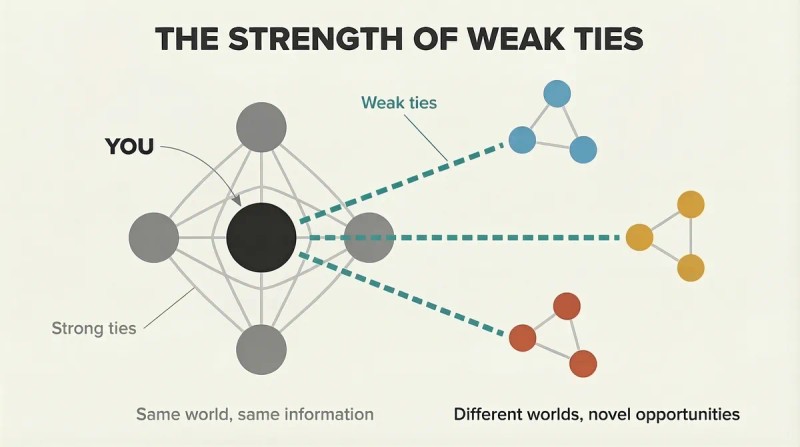
Weak ties beat strong ties. Sociologist Mark Granovetter studied how professionals in Boston found jobs: 56% used personal connections, but of those, only 16.7% saw their contact regularly. Over half connected through someone they saw only "occasionally." Granovetter called this the strength of weak ties — your friends inhabit the same world you do, so they know mostly what you already know. Acquaintances inhabit different worlds, giving you access to novel information.
Stanley Milgram's famous chain-letter experiment confirmed the pattern. Letters mailed from Omaha to a Boston stockbroker arrived in about five or six steps — but half of all letters funneled through just three people. Six degrees of separation works not because we're all equally connected, but because a handful of Connectors serve as the hubs linking everyone else.
A newscaster's smile can sway an election — persuasion is mostly nonverbal
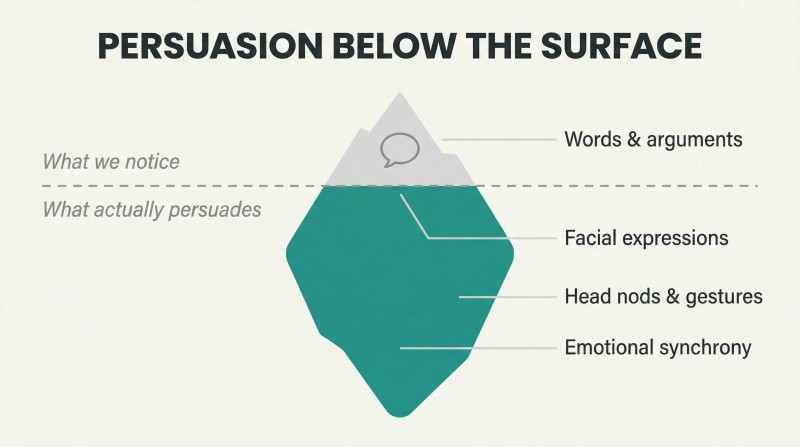
Subtle cues dwarf rational arguments. Psychologist Brian Mullen found that ABC anchor Peter Jennings showed significantly more positive facial expressions when discussing Reagan than Mondale — and in every city studied, ABC viewers voted Republican in far greater numbers than CBS or NBC viewers. In another experiment, students told to nod their heads while listening to an editorial wanted tuition to rise to $646; head-shakers wanted it to drop to $467. Neither group realized their movements influenced their opinions.
Psychologist Howard Friedman demonstrated that emotionally expressive people can transfer their moods to less expressive strangers in just two minutes of silent proximity. Salesmen like Tom Gau don't just argue better — they pull others into their emotional rhythm through micro-movements, vocal cadence, and facial expressiveness, creating what researchers call interactional synchrony.
Don't shout louder — add a map, a gold box, a small practical trigger
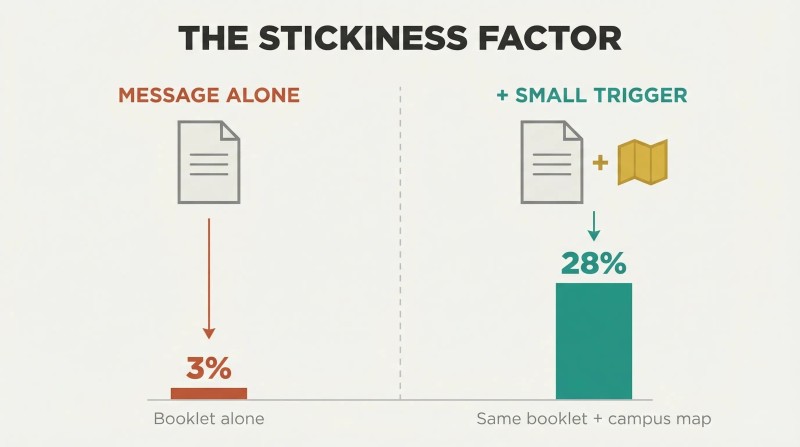
The Stickiness Factor says messages need specific tweaks to become memorable and actionable — not bigger budgets or scarier warnings. Howard Levanthal gave Yale seniors booklets about tetanus: only 3% got a shot, whether the booklet was terrifying or mild. But when he added a simple campus map with clinic hours, vaccination rates jumped to 28%. The students already knew where the clinic was. The map just made abstract health advice feel personally actionable.
Direct marketer Lester Wunderman proved the same point against Madison Avenue giant McCann Erickson. McCann ran slick prime-time TV spots for Columbia Record Club. Wunderman ran cheap late-night ads with one addition: a tiny gold box hidden in magazine coupons that viewers had to find. Wunderman's markets saw response rates jump 80% versus McCann's 19.5%. The gold box turned passive viewers into active participants.
Blue's Clues beat Sesame Street by repeating each episode five times
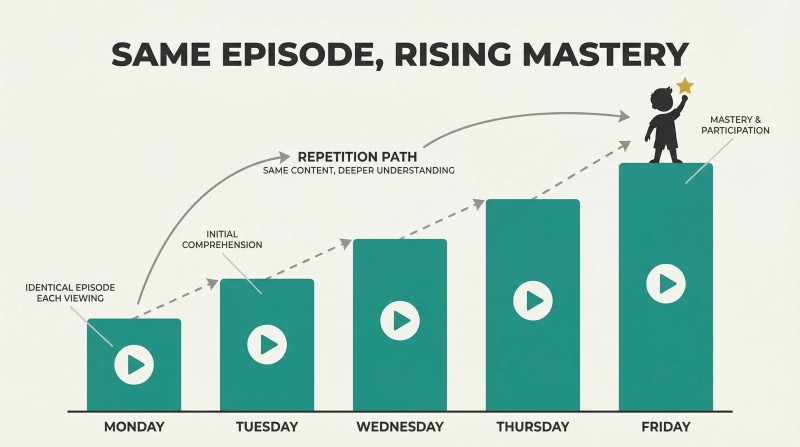
Nickelodeon's Blue's Clues aired the same episode Monday through Friday — an idea so counterintuitive that producers had to be convinced. But comprehension and enthusiasm increased with each repeat viewing. Preschoolers don't seek novelty; they seek understanding. This mirrors what Sesame Street discovered with the James Earl Jones effect: when Jones slowly recited the alphabet repeatedly over years, children progressed from echoing him, to anticipating each letter, to predicting the sequence before letters appeared.
Blue's Clues also abandoned Sesame Street's magazine format for a single narrative with deliberate pauses for audience participation. It tested every episode three times before airing, compared to Sesame Street's testing of a third of episodes once. The result: Blue's Clues scored higher on attention tests and produced measurably stronger cognitive gains. Stickiness isn't about cleverness — it's about relentless, research-driven iteration.
Scrub the graffiti to stop the murders — small signals cascade
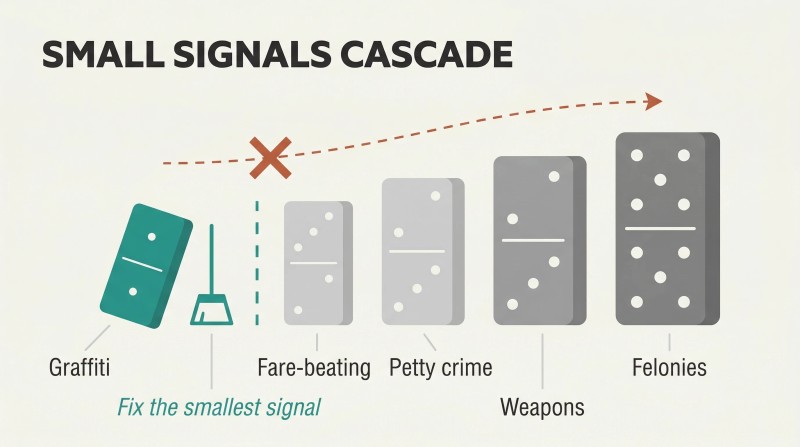
Broken Windows theory argues that visible disorder — graffiti, broken windows, fare-beating — signals that nobody is in charge, inviting worse crimes. In the mid-1980s, New York's subway had 15,000 felonies a year, graffiti on every car, and 170,000 daily fare-beaters. Transit director David Gunn spent six years scrubbing graffiti train by train, refusing to let any "reclaimed" car be vandalized again.
Police chief William Bratton then cracked down on fare-beaters using plainclothes teams and a retrofitted bus as a mobile station house. One in seven arrestees had outstanding warrants; one in twenty carried weapons. Subway felonies dropped 75% by decade's end. When Bratton became citywide police chief, the same quality-of-life strategy was applied to squeegee men, public urination, and minor property damage. New York became the safest big city in America — not through sweeping social reform, but through small environmental fixes.
We systematically blame personality for what context causes
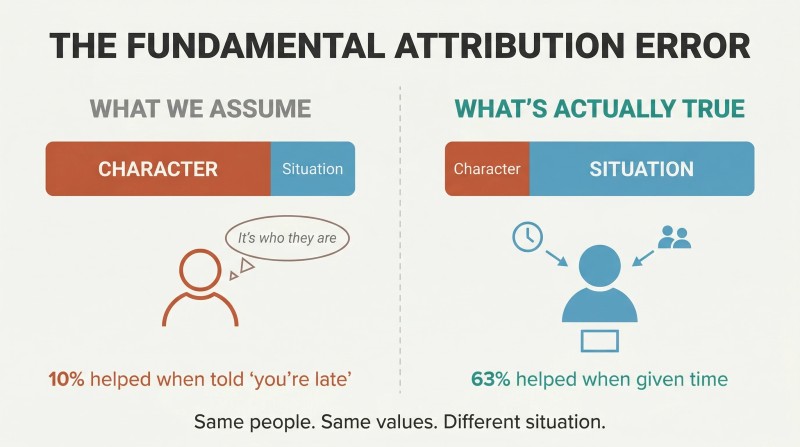
Psychologists call it the Fundamental Attribution Error: we overestimate the role of character traits and underestimate the power of situations. Princeton researchers Darley and Batson told seminary students to prepare a talk, then walk to another building. Along the way, each passed a groaning man slumped in an alley. Of those told "you're late," only 10% stopped. Of those with time to spare, 63% helped. Even seminarians about to speak on the Good Samaritan parable literally stepped over the victim.
Philip Zimbardo's Stanford Prison Experiment showed the same pattern in starker terms: randomly assigned "guards" became sadistic within days, while "prisoners" had emotional breakdowns. The experiment was stopped after six days. Hartshorne and May tested 11,000 schoolchildren and found cheating was situation-specific — a child might cheat on math but not spelling. Honesty isn't a fixed trait; it depends on circumstances.
Keep groups under 150 — beyond that, peer pressure evaporates
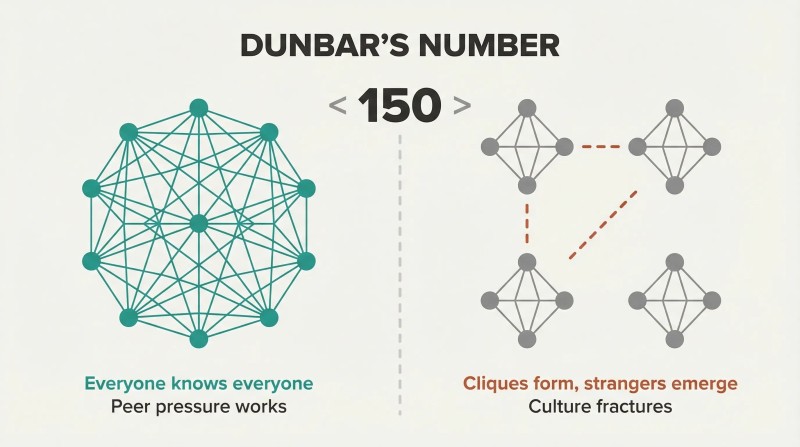
Anthropologist Robin Dunbar calculated that the human neocortex can handle genuine social relationships with a maximum of about 147.8 people — roughly 150. This limit appears everywhere: hunter-gatherer villages average 148.4 members, military fighting units cap near 200, and the Hutterites have split their agricultural colonies at 150 for centuries.
Gore Associates, the billion-dollar maker of Gore-Tex, built its culture around this number. No plant exceeds 150 employees. There are no titles, no bosses, no org charts — just "associates" and "sponsors." When parking lots overflow, they build a new plant, sometimes within sight of the old one. The result: 35 consecutive years of profitability and turnover one-third the industry average. Below 150, people develop transactive memory — knowing who knows what — enabling informal coordination that replaces bureaucracy. Above 150, cliques form, strangers emerge, and the culture fractures.
Translate fringe ideas for mainstream audiences to cross the chasm
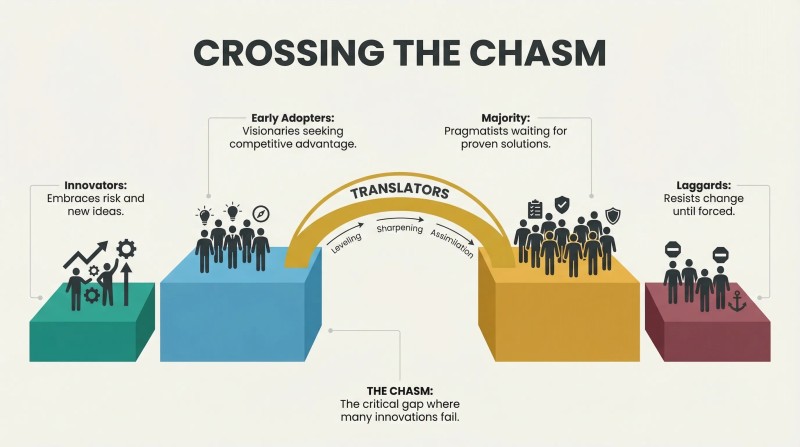
Ideas spread through society in a sequence: Innovators adopt first, then Early Adopters, then the Majority, then Laggards. But business consultant Geoffrey Moore identified a chasm between Adopters and Majority — their mindsets are fundamentally incompatible. Innovators embrace risk; the Majority demands proof. Connectors, Mavens, and Salesmen serve as translators, performing what rumor researchers call leveling (dropping confusing details), sharpening (emphasizing key points), and assimilation (fitting ideas into familiar frames).
Shoe brand Airwalk rode this process from $16 million to $175 million in three years. Ad agency Lambesis tracked Innovator trends — Tibetan monks, kung fu movies, retro country club culture — and translated them into mainstream-friendly ads. But when Airwalk stopped giving specialty shops exclusive products, the Innovators abandoned the brand. The translation pipeline broke, and the epidemic collapsed.
What spreads an epidemic and what makes it stick are different problems
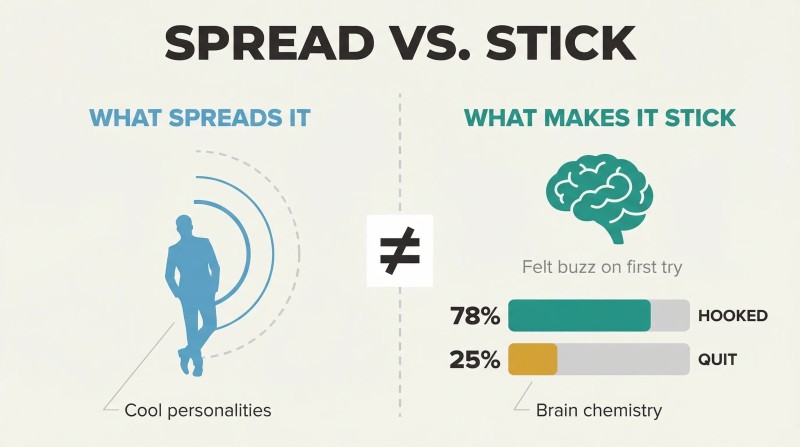
Contagiousness and stickiness require separate strategies. Teen smoking spreads because certain rebellious, extroverted, risk-taking personalities — the smoking equivalent of Salesmen — give peers "permission" to experiment. These are the kids with leather jackets, early sexual experience, and a defiance that adolescents find magnetic. But whether smoking sticks depends on brain chemistry: 78% of eventual heavy smokers reported a pleasurable buzz from their first cigarette, versus only 25% of those who never smoked again.
Genetic variation explains the difference. Mouse studies showed that tolerance for nicotine almost perfectly predicted voluntary nicotine consumption. "Chippers" — people who smoke fewer than five cigarettes daily without becoming addicted — appear to lack the genes that make nicotine maximally rewarding. Nicotine addiction experts proposed a stickiness Tipping Point: reduce nicotine per cigarette below the addiction threshold so teens can still experiment — as they inevitably will — without getting hooked.
Analysis
The Tipping Point is a rare achievement in popular social science: it introduced a genuine conceptual framework — not merely a collection of anecdotes — that reshaped how millions think about change. The phrase 'tipping point' entered common English largely through this book, becoming shorthand for the threshold moment when momentum shifts. Gladwell's core innovation is the epidemiological metaphor itself: by reframing fashion trends, crime waves, and children's television as viral phenomena governed by the same laws as measles, he gives readers a diagnostic toolkit rather than mere inspiration.
The book's most counterintuitive contribution is its treatment of context. The Power of Context sections — Broken Windows, the Fundamental Attribution Error, the Stanford Prison Experiment — collectively mount an assault on Western individualism's most sacred assumption: that character is destiny. Gladwell argues, with considerable evidence, that we are far more situational creatures than we admit. This insight has practical teeth: changing environments (cleaning subways, shrinking group sizes) can be more effective than changing minds.
The framework's vulnerability, however, lies in its post-hoc flexibility. Nearly any social phenomenon can be retroactively explained through some combination of the right people, the right message, and the right environment. This makes the theory descriptively powerful but predictively weak — it is easier to explain an epidemic after it tips than to engineer one in advance. Several of the studies Gladwell relies on, including the Stanford Prison Experiment and the bystander effect research, have faced methodological challenges in the replication crisis era.
Still, the framework's utility outweighs its limitations. The Connector / Maven / Salesman taxonomy remains the most accessible model for understanding word-of-mouth dynamics. The Rule of 150 has influenced organizational design from startups to the military. And the Stickiness Factor anticipated by two decades the obsession with engagement metrics that now dominates digital marketing. Gladwell's lasting gift is not a predictive algorithm but a diagnostic vocabulary — one that makes the invisible architecture of social change legible to anyone willing to look.
Review Summary
The Tipping Point explores how ideas and trends spread like epidemics, focusing on three key factors: the law of the few, the stickiness factor, and the power of context. Readers found Gladwell's writing style engaging and his examples fascinating, though some criticized his reliance on anecdotes and loose interpretation of research. The book's concepts resonated with many, particularly in marketing and social sciences. While some found it groundbreaking, others felt the ideas were obvious or oversimplified. Overall, it remains a thought-provoking and influential work that sparked widespread discussion.
People Also Read



Glossary
Tipping Point
Threshold moment of explosive changeThe moment of critical mass—the threshold, the boiling point—when an idea, trend, or behavior crosses a line and spreads rapidly through a population. Analogous to the moment water turns to ice at 32 degrees: a tiny change in conditions produces a dramatic transformation in outcome. Gladwell applies this concept beyond disease to fashion, crime, and social movements.
Law of the Few
Rare people drive epidemicsThe first of three rules of epidemics, stating that social epidemics are driven by the efforts of a small number of exceptional people. In any epidemic, a tiny percentage of participants do the majority of the work—an extreme version of the 80/20 principle. The 'few' fall into three categories: Connectors, Mavens, and Salesmen.
Connectors
Social hubs bridging many worldsPeople with an extraordinary knack for making social connections across many different worlds, subcultures, and niches. They know far more people than average and maintain a large number of weak ties. Their value lies not just in the quantity of people they know but in the diversity—spanning industries, communities, and social strata. Roger Horchow and Lois Weisberg are Gladwell's primary examples.
Mavens
Information specialists who proactively shareFrom Yiddish for 'one who accumulates knowledge.' Mavens are people who gather detailed information about products, prices, or places and feel compelled to share it with others—not to show off, but to help. They keep the marketplace honest by spotting false promotions and spreading word about genuine deals. Unlike experts, Mavens are motivated socially rather than by subject-matter passion alone.
Salesmen
Charismatic persuaders of the unconvincedPeople with extraordinary natural persuasive ability who can convince others when rational arguments fall short. Their power comes less from what they say than from nonverbal communication—facial expressiveness, vocal range, interactional synchrony, and emotional contagion. They unconsciously draw others into their rhythms and moods. Gladwell's primary example is financial planner Tom Gau, who scored 116 out of 117 on a charisma test.
Stickiness Factor
What makes messages memorable and actionableThe second rule of epidemics: there are specific, often small and counterintuitive ways to make a contagious message memorable enough to spur action. Stickiness is about the message itself rather than the messenger. It often requires not bigger budgets or louder repetition but subtle tweaks in presentation—like adding a campus map to a health pamphlet or a gold box to a magazine coupon.
Power of Context
Environment shapes epidemic behaviorThe third rule of epidemics: human behavior is exquisitely sensitive to environmental conditions. Epidemics are shaped by the time, place, and circumstances in which they occur. This principle holds that small changes in context—cleaning graffiti, cracking down on fare-beating, adjusting group size—can produce dramatic shifts in behavior, sometimes overriding personality and personal history.
Broken Windows theory
Disorder signals permission for crimeCriminological theory developed by James Q. Wilson and George Kelling arguing that visible signs of disorder—a broken window left unrepaired, graffiti, aggressive panhandling—signal that no one is in charge and invite increasingly serious crimes. Applied in New York City's subway system and city-wide policing strategy in the 1990s, it is Gladwell's primary illustration of the Power of Context.
Rule of 150
Maximum size for cohesive groupsThe principle, derived from anthropologist Robin Dunbar's research on primate neocortex size, that 150 represents the maximum number of people with whom a human can maintain genuine social relationships. Beyond this threshold, groups lose the informal peer pressure and personal loyalty that hold them together, requiring formal hierarchies instead. The Hutterites and Gore Associates both use this limit to structure their organizations.
Fundamental Attribution Error
Overrating character, underrating contextA well-documented cognitive bias in which people overestimate the importance of personality traits and underestimate the importance of situational factors when explaining others' behavior. Gladwell uses this concept to argue that the Power of Context is so difficult to accept precisely because our brains are wired to reach for character-based explanations, even when environmental explanations are more accurate.
Transactive memory
Shared memory distributed across peopleA concept from psychologist Daniel Wegner describing the implicit joint memory system that develops among people who know each other well. Rather than each person remembering everything, the group distributes memory responsibilities based on expertise—one person remembers finances, another technology, another schedules. Gladwell uses this to explain why Gore Associates' small-plant strategy creates superior organizational efficiency.
Strength of weak ties
Acquaintances provide more novel informationA concept coined by sociologist Mark Granovetter describing the paradox that casual acquaintances are often more valuable than close friends for accessing new information, job opportunities, and ideas. Because close friends inhabit the same social world, they tend to know the same things. Acquaintances, by definition, occupy different worlds and thus serve as bridges to novel information and opportunities.
Chippers
Non-addicted regular light smokersSmokers who consume no more than five cigarettes per day, at least four days a week, without becoming addicted. Their smoking varies day to day, often includes days of abstinence, and they experience almost no withdrawal symptoms. Research by Saul Shiffman suggests chippers never escalated their habit—they are 'developmentally retarded' smokers whose genetic makeup allows nicotine pleasure without full addiction.
FAQ
What's "The Tipping Point" about?
- Concept of Tipping Points: "The Tipping Point" by Malcolm Gladwell explores how small actions at the right time, in the right place, and with the right people can create a tipping point for change.
- Three Rules of Epidemics: The book introduces three rules of epidemics: the Law of the Few, the Stickiness Factor, and the Power of Context, which explain how trends spread.
- Diverse Examples: Gladwell uses examples from fashion, crime, and public health to illustrate how these principles apply to various social phenomena.
Why should I read "The Tipping Point"?
- Understanding Social Change: The book provides insights into how small changes can lead to significant social transformations, valuable for marketing, sociology, or psychology enthusiasts.
- Practical Applications: It offers practical advice on creating and controlling social epidemics, useful for business leaders, educators, and policymakers.
- Engaging Storytelling: Gladwell's engaging writing style and use of real-world examples make complex theories accessible and interesting.
What are the key takeaways of "The Tipping Point"?
- Law of the Few: A small number of people, known as Connectors, Mavens, and Salesmen, play a crucial role in spreading ideas and trends.
- Stickiness Factor: For an idea to spread, it must be memorable and impactful, which can be achieved through small but significant changes in presentation.
- Power of Context: The environment and circumstances play a critical role in tipping social epidemics, as demonstrated by the Broken Windows theory in crime reduction.
What is the Law of the Few in "The Tipping Point"?
- Key Influencers: The Law of the Few suggests that a small number of people with unique social gifts are responsible for the spread of ideas and trends.
- Connectors, Mavens, Salesmen: These individuals are categorized as Connectors (who know many people), Mavens (who accumulate knowledge), and Salesmen (who persuade others).
- Social Epidemics: These people are crucial in starting social epidemics because they have the ability to reach and influence a large number of people.
What is the Stickiness Factor in "The Tipping Point"?
- Memorable Messages: The Stickiness Factor refers to the quality of a message that makes it memorable and capable of creating change.
- Small Changes, Big Impact: Small adjustments in how information is presented can significantly enhance its stickiness, as seen in the success of "Sesame Street" and "Blue’s Clues."
- Practical Examples: The book illustrates this concept with examples like the gold box in direct marketing and the map in the tetanus shot study.
What is the Power of Context in "The Tipping Point"?
- Environmental Influence: The Power of Context emphasizes that human behavior is sensitive to and strongly influenced by environmental factors.
- Crime Reduction Example: The Broken Windows theory demonstrates how addressing minor crimes and signs of disorder can lead to a significant reduction in serious crime.
- Epidemic Tipping: Contextual changes, even small ones, can tip an epidemic, as seen in the dramatic drop in New York City crime rates in the 1990s.
How does "The Tipping Point" explain crime reduction in New York City?
- Broken Windows Theory: The book attributes the decline in crime to the application of the Broken Windows theory, which focuses on maintaining order and addressing minor offenses.
- Subway System Cleanup: Initiatives like cleaning graffiti and cracking down on fare evasion helped change the environment and reduce crime.
- Contextual Tipping: These efforts created a tipping point by altering the context in which crime occurred, leading to a broader decline in criminal behavior.
How does "The Tipping Point" relate to marketing and business?
- Understanding Consumer Behavior: The book provides insights into how trends spread, which is valuable for marketers looking to create viral campaigns.
- Influence of Key Individuals: Identifying and leveraging Connectors, Mavens, and Salesmen can help businesses reach a wider audience and increase their impact.
- Enhancing Stickiness: By making small changes to how products or messages are presented, businesses can increase their stickiness and improve customer engagement.
How can I apply the concepts from "The Tipping Point" in my own life?
- Identify Key Influencers: Recognize the Connectors, Mavens, and Salesmen in your network and leverage their influence to spread your ideas or products.
- Focus on Stickiness: Make your messages memorable and impactful by paying attention to how they are presented and received.
- Consider the Context: Be aware of the environmental factors that may influence behavior and look for ways to create a context that supports your goals.
What are some examples from "The Tipping Point"?
- Hush Puppies Revival: The resurgence of Hush Puppies shoes in the mid-1990s is an example of a tipping point, driven by a few influential people in the fashion industry.
- New York City Crime Drop: The dramatic decline in crime in New York City during the 1990s is attributed to small changes in policing and the environment, illustrating the Power of Context.
- Sesame Street's Success: The show's ability to educate children effectively is an example of the Stickiness Factor, where the content was crafted to be engaging and memorable.
What are the best quotes from "The Tipping Point" and what do they mean?
- "The Tipping Point is the biography of an idea": This quote encapsulates the book's exploration of how small changes can lead to significant social transformations.
- "Ideas and products and messages and behaviors spread just like viruses do": Gladwell draws a parallel between social epidemics and viral infections, emphasizing the contagious nature of trends.
- "The Power of Context says that human beings are a lot more sensitive to their environment than they may seem": This highlights the importance of environmental factors in shaping human behavior and tipping social epidemics.
How does "The Tipping Point" explain social epidemics?
- Combination of Factors: Social epidemics occur when the right combination of people, message, and context come together to create a tipping point.
- Role of Key Individuals: Connectors, Mavens, and Salesmen play a crucial role in spreading ideas and behaviors, acting as catalysts for change.
- Importance of Context and Stickiness: The environment and the stickiness of the message are equally important in determining whether an idea will tip into a widespread phenomenon.
About the Author
Other books by Malcolm Gladwell





Download PDF
Download EPUB
.epub digital book format is ideal for reading ebooks on phones, tablets, and e-readers.








































