


Key Takeaways
Your body solves the puzzle 70 cards before your mind does
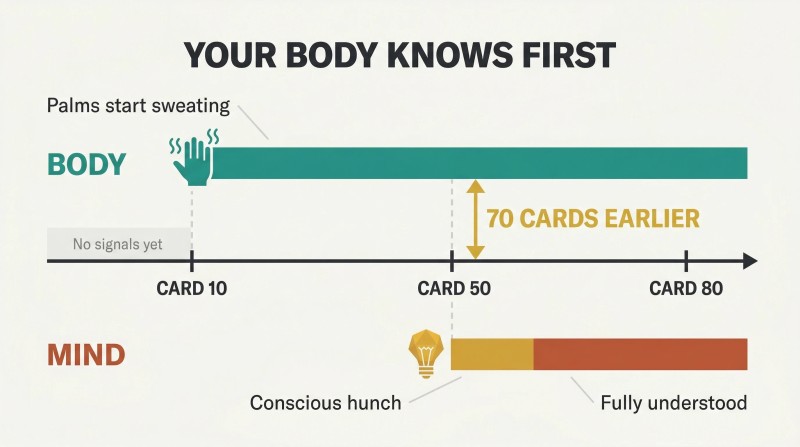
The Iowa gambling experiment demonstrated this dramatically. Researchers gave subjects four decks of cards — two red (high rewards but devastating losses) and two blue (steady, modest payouts). Most people developed a conscious hunch about the red decks around card 50 and fully figured out the game by card 80. But sensors measuring palm sweat told a different story: stress responses to the red decks began by card 10, and behavior started shifting in tandem.
Gladwell calls this the adaptive unconscious — not Freud's dark cellar of repressed desires, but a rapid computer that quietly processes data and sends signals through indirect channels like sweaty palms. Your brain reaches conclusions before it tells you it's reaching conclusions. That engine powers every gut feeling you've ever had.
Two seconds of observation can outperform months of analysis
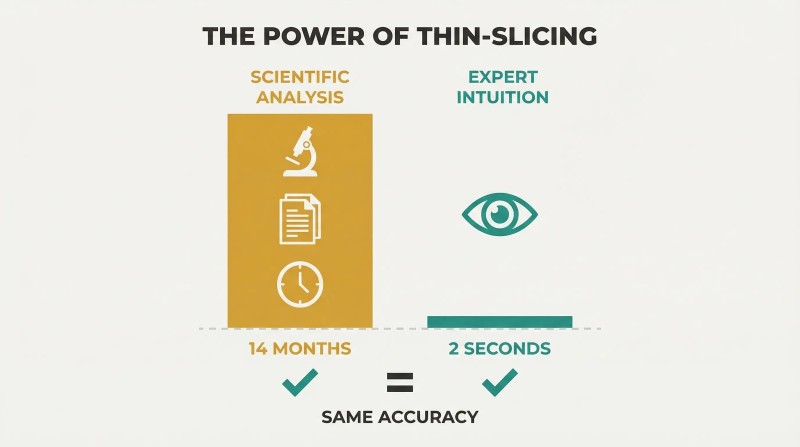
The Getty Museum's kouros scandal crystallized this idea. Fourteen months of scientific analysis — electron microscopes, mass spectrometry, X-ray diffraction — concluded a rare Greek marble statue was authentic. But when art historians saw it, they recoiled instantly. One felt 'intuitive repulsion.' Another's first word was 'fresh' — wrong for a 2,000-year-old sculpture. The kouros turned out to be a forgery.
Gladwell calls this ability thin-slicing: the unconscious detection of patterns from razor-thin slivers of experience. Psychologist Nalini Ambady found that students watching just two-second silent video clips of professors rated their teaching effectiveness almost identically to students who'd taken the full semester course. The unconscious doesn't need more data — it needs the right data.
To predict divorce, ignore the fights — watch for contempt
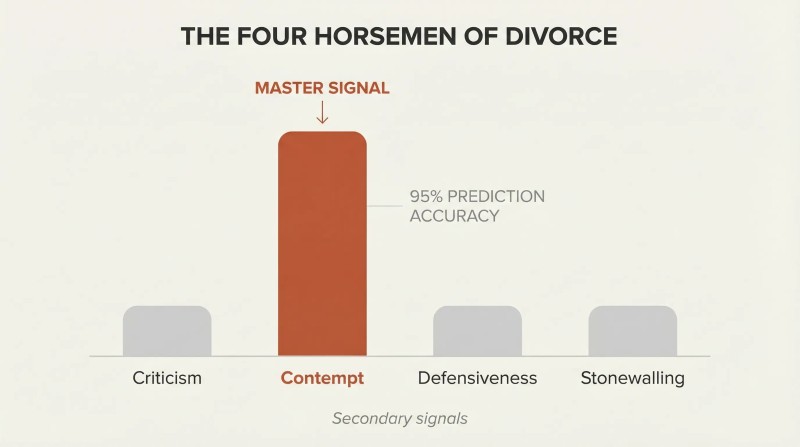
Psychologist John Gottman has recorded over 3,000 couples in his 'love lab,' coding every second of their interaction across 20 emotional categories. From one hour of conversation, he predicts divorce with 95% accuracy; from fifteen minutes, about 90%. His secret: radical editing. He doesn't track everything — he zeroes in on the Four Horsemen: defensiveness, stonewalling, criticism, and contempt.
Of these, contempt is the master signal. It's qualitatively worse than criticism because it communicates superiority and exclusion — putting your partner on a lower plane. A marriage needs at least a 5-to-1 ratio of positive to negative emotion to survive. When contempt enters, it poisons everything — even, Gottman found, the body's ability to fight infection.
Judge people by their rooms, not their résumés
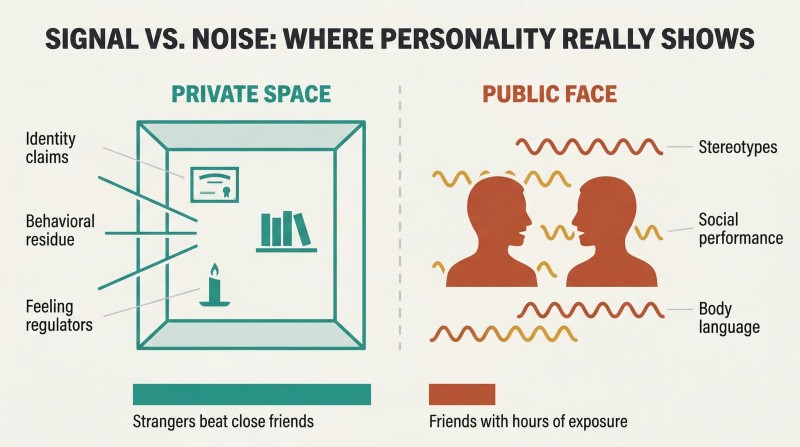
Psychologist Samuel Gosling had strangers spend just 15 minutes in college students' dorm rooms, then rate the occupants' personalities. Close friends also rated the same students. The strangers beat friends on three of five Big Five personality dimensions — conscientiousness, emotional stability, and openness to experience. Rooms reveal three types of clues:
1. Identity claims — a diploma on the wall
2. Behavioral residue — alphabetized CDs or laundry on the floor
3. Thought and feeling regulators — scented candles, decorative pillows
Meeting face-to-face introduces noise — stereotypes about physical appearance, social performance, confusing body language. A personal space strips that interference away and lets the signal through.
Extra information makes you confident, not correct
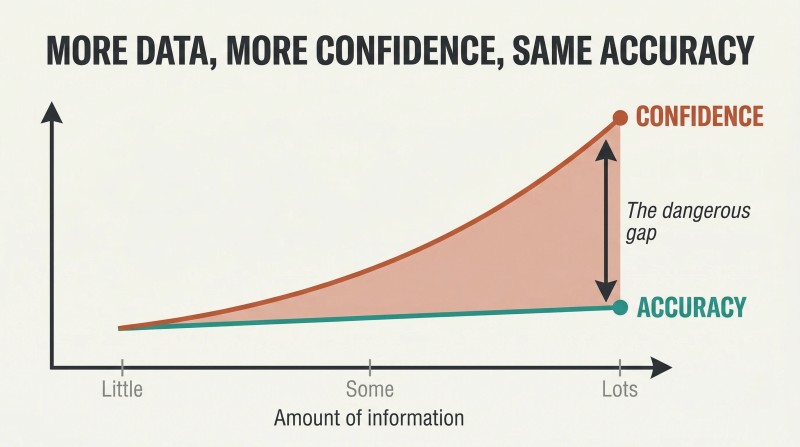
Cardiologist Lee Goldman built a heart-attack algorithm using only the ECG plus three risk factors: unstable angina, fluid in the lungs, and blood pressure below 100. At Cook County Hospital, this stripped-down tool was 70% better than doctors at ruling out non-heart-attacks and over 95% accurate for serious cases — versus 75 – 89% for physicians relying on their full judgment.
The same pattern doomed the Pentagon's Blue Team in a $250 million war game. Drowning in 40,000-entry databases and real-time battlefield displays, they froze when the enemy struck unconventionally. Psychologist Stuart Oskamp found that giving clinicians more patient data raised their confidence dramatically while accuracy stayed flat at roughly 30%. More information fed the illusion of understanding.
Looks override logic — beware the Warren Harding Error
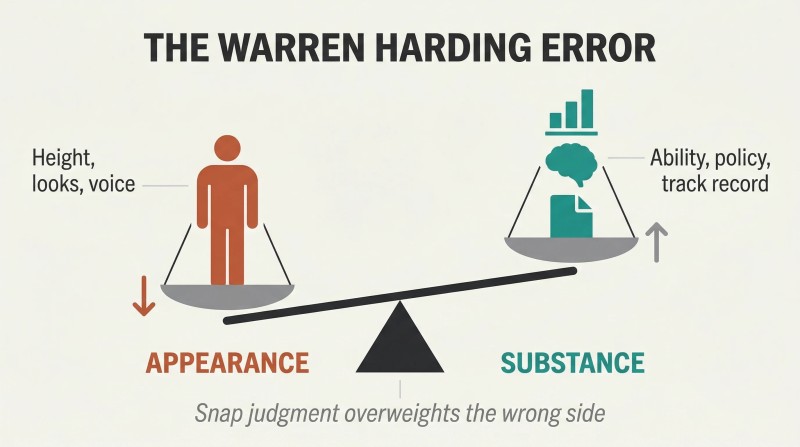
Warren Harding became the 29th U.S. President largely because he looked the part — tall, bronze-complexioned, with a magnificent voice. He was intellectually mediocre, vague on policy, and is now ranked among the worst presidents ever. This is Gladwell's Warren Harding Error: when someone's physical appearance short-circuits deeper assessment of their actual abilities.
The bias pervades corporate America. Among Fortune 500 CEOs, 58% are six feet or taller versus just 14.5% of American men generally. Researcher Ian Ayres sent matched testers — identical credentials, clothing, and cover stories — to 242 Chicago car dealerships. Black men received initial price quotes $962 higher than white men. The Implicit Association Test shows that over 80% of people carry unconscious pro-white associations, often contradicting their stated beliefs.
Explaining your snap judgments destroys their accuracy
Tennis coach Vic Braden correctly predicted 16 of 17 double faults at a tournament — yet couldn't explain how. Nearly every pro insists they roll their wrists at impact; digitized video proves they don't. Gladwell names this the storytelling problem: we fabricate confident explanations for unconscious processes that happen behind what he calls a locked door.
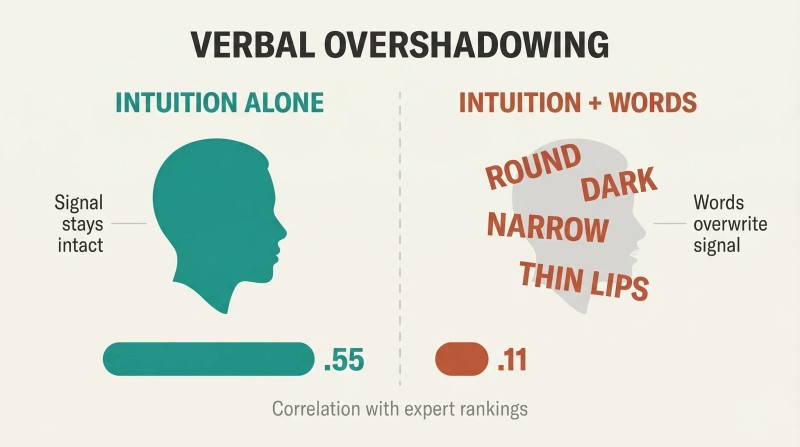
Forced explanation actively degrades performance. Psychologist Jonathan Schooler discovered verbal overshadowing: describing a face in words impairs your ability to recognize it later. When students were asked to write out their jam preferences, their rankings collapsed — from a .55 correlation with expert assessments to a meaningless .11. Introspection didn't illuminate the unconscious; it overwrote it.
Create structure so split-second decisions become reliable
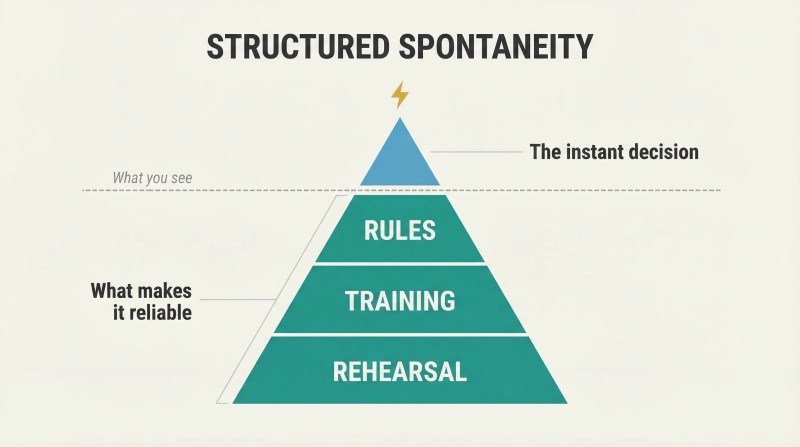
Improv comedy looks random but is governed by strict rules — the most important being agreement, where every actor accepts whatever is offered. When one actor says 'I'll have to amputate' and the other says 'You can't,' the scene dies. When both accept, comedy erupts. The cast of one improv group compared their art to basketball: spontaneous decisions flowing from hours of structured rehearsal.
Paul Van Riper applied the same principle in the Pentagon's Millennium Challenge war game. He gave his Red Team general intent and let field commanders act autonomously — no committees, no acronym-laden matrixes. His unconventional fleet sank 16 American ships in one hour. Goldman's heart-attack algorithm works the same way: by limiting inputs to a few key signals, it frees ER doctors to focus on what actually matters.
People confuse 'unfamiliar' with 'bad' — innovation suffers
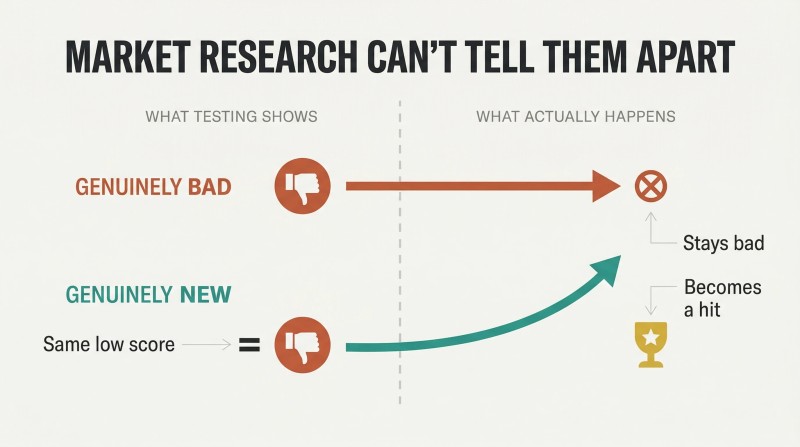
Herman Miller's Aeron chair scored above 8 on comfort but below 6 on aesthetics. One staffer mocked it as 'the chair of death.' Focus groups demanded traditional cushioning. Herman Miller launched anyway — and it became the best-selling chair in company history. Aesthetic scores eventually climbed to 8.
The pattern repeats across industries. All in the Family scored in the low 40s in market testing; a good comedy scores in the mid-70s. It became one of TV's greatest hits. Musician Kenna was loved by every industry expert who heard him but scored 1.3 in consumer research. Sensation transference — where packaging impressions bleed into product perception — further muddles things. Market research reliably captures reactions to the familiar but consistently fails to distinguish genuine dislike from the discomfort of encountering something new.
Extreme stress causes temporary mind-blindness — slow down
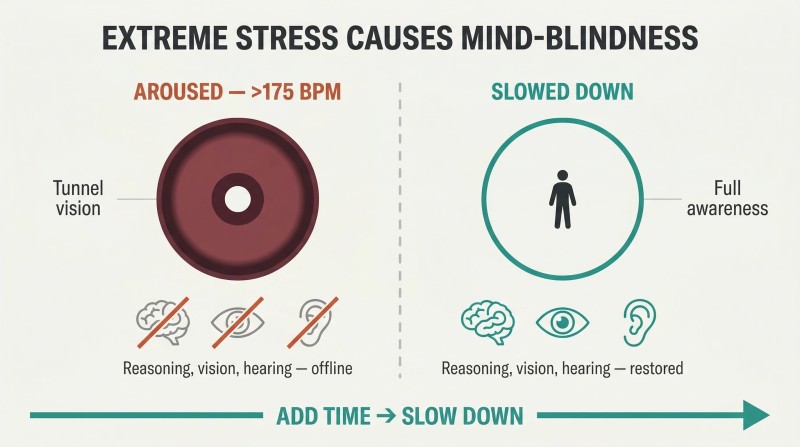
In February 1999, four NYPD officers fired 41 shots at Amadou Diallo, an unarmed immigrant reaching for his wallet on his own stoop. They mistook his terror for danger, his wallet for a gun. Under extreme stress, heart rates spike past 175 beats per minute and the forebrain — the seat of empathy, reasoning, and complex judgment — shuts down. Vision narrows to a tunnel. Officers in shootings consistently report not hearing their own gunfire.
The remedy is structural. Police departments that banned high-speed chases saw brutality cases plummet. Switching to one-officer patrol cars — which forces officers to slow down and wait for backup rather than charge in with false bravado — dramatically reduced both complaints and civilian injuries. Time is the antidote to temporary mind-blindness.
Build screens between your judgments and your biases
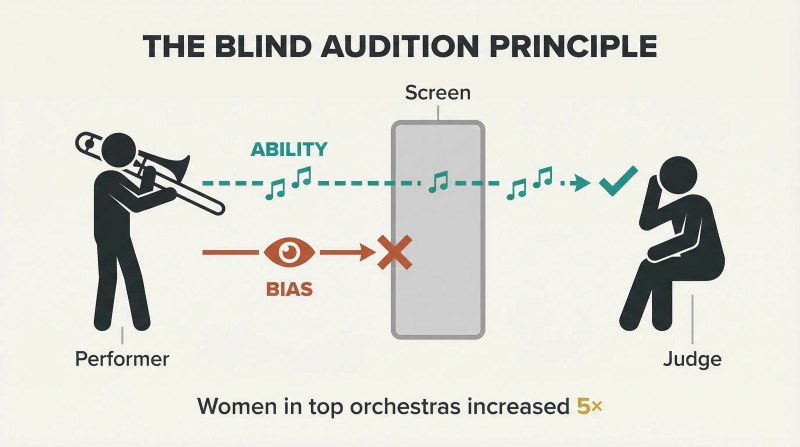
Until the 1970s, top U.S. orchestras hired almost no women. Conductors believed women couldn't play 'masculine' instruments like trombone. Then blind auditions arrived: screens hid performers, carpet muffled footsteps, numbers replaced names. Women in top orchestras increased fivefold.
Trombonist Abbie Conant won the Munich Philharmonic audition behind a screen. The music director cried 'That's who we want!' — then was stunned when she stepped out. He spent years trying to demote her because he 'needed a man.' She fought thirteen years in court to win equal treatment. The screen revealed the truth about her ability; removing it revealed the judges' biases. Wherever snap judgments matter — hiring, medicine, policing — build the equivalent of a screen.
Analysis
Blink occupies a fascinating position in the popular psychology canon. Published as Kahneman and Tversky's heuristics-and-biases research was filtering into mainstream consciousness, Gladwell's adaptive unconscious maps roughly onto what would later be popularized as System 1 thinking — fast, automatic, pattern-matching. But where Kahneman catalogs the systematic errors of fast thinking, Gladwell insists that under proper conditions, rapid cognition rivals or exceeds deliberation. Both perspectives are correct, and the productive tension between them is precisely where Blink's enduring value resides.
The book's most durable contribution is its insistence that snap judgments are neither mystical gifts nor cognitive noise — they are skills shaped by environment and expertise. The Goldman algorithm, the blind audition screen, and Van Riper's command philosophy all demonstrate that the quality of rapid cognition depends less on the individual than on the structures surrounding the decision. This is genuinely radical: it reframes intuition from an innate talent into a design problem.
Gladwell's weakest move is his occasional conflation of expert and novice intuition. The art historians who spotted the fake kouros had decades of deep domain knowledge; the speed-daters making snap romantic judgments had none. Gladwell treats both as examples of the same faculty, but expertise research suggests they operate through fundamentally different mechanisms. Expert thin-slicing is compressed pattern recognition built on massive experiential databases. Novice thin-slicing is far more vulnerable to exactly the biases Gladwell warns about — the Warren Harding Error, IAT-measurable prejudice, sensation transference.
The dual prescription nonetheless holds: trust rapid cognition within your domain of genuine expertise, and build structural safeguards everywhere else — screens for auditions, algorithms for emergency rooms, time buffers for police encounters. The book's deepest and most uncomfortable insight is that the gap between our stated values and our unconscious associations is not a character flaw to be confessed but an engineering problem to be solved through environmental design rather than mere good intentions.
Review Summary
Readers find Blink to be an engaging exploration of rapid decision-making, praising Gladwell's storytelling and diverse examples. While some criticize the lack of concrete advice, many appreciate the book's thought-provoking nature. Critics argue it oversimplifies complex psychological concepts, but most agree it's an entertaining and accessible introduction to the topic of intuitive thinking.
People Also Read
Glossary
Thin-slicing
Pattern detection from minimal experienceThe unconscious ability to find patterns in situations and behavior based on very narrow slices of experience. Gladwell uses the term to describe how we make sophisticated judgments from minimal data — like predicting divorce from three minutes of conversation or spotting a forged statue in a single glance — by unconsciously filtering for the most diagnostic signals.
Adaptive unconscious
Rapid unconscious processing systemA sophisticated, rapid information-processing system in the brain, distinct from Freud's unconscious. Rather than a dark cellar of repressed desires, it functions like a powerful computer that quickly and quietly processes data needed to function — sizing up situations, warning of danger, and initiating action — often without any input from conscious awareness. The term comes from psychologist Timothy Wilson.
Warren Harding Error
Appearance short-circuits deeper assessmentA failure of rapid cognition in which a person's physical appearance — height, attractiveness, voice, bearing — is so striking that it overrides evaluation of actual abilities. Named after Warren Harding, who became U.S. President largely because he looked presidential despite being intellectually mediocre. Gladwell applies the concept broadly to hiring bias, racial prejudice, and height discrimination in corporate leadership.
Four Horsemen
Gottman's top divorce predictorsJohn Gottman's term for the four emotional behaviors most predictive of divorce: defensiveness, stonewalling, criticism, and contempt. Of these, contempt — communicating superiority and exclusion — is the single most destructive. Gottman uses these markers, coded second-by-second from videotaped couple interactions, to predict marital outcomes with up to 95% accuracy from just one hour of conversation.
Verbal overshadowing
Words impair nonverbal memoryA phenomenon discovered by psychologist Jonathan Schooler in which putting a nonverbal experience into words impairs subsequent performance on tasks involving that experience. Describing a face reduces the ability to recognize it later; writing explanations for jam preferences destroys alignment with expert assessments. The verbal description displaces the richer, more accurate sensory memory stored in the unconscious.
Implicit Association Test (IAT)
Measures unconscious bias via speedA computer-based test developed by Anthony Greenwald, Mahzarin Banaji, and Brian Nosek that measures unconscious associations by timing how quickly people sort words into paired categories. Faster sorting indicates stronger mental links between the concepts. The Race IAT reveals that over 80% of test-takers show pro-white associations, often contradicting their consciously stated beliefs about racial equality.
Sensation transference
Packaging impressions change product perceptionA concept coined by marketing pioneer Louis Cheskin describing how people unconsciously transfer impressions from a product's packaging to the product itself. On an unconscious level, people don't separate the container from the contents. Yellow-colored margarine tastes better than white; brandy from an ornate bottle tastes better than from a plain one — even when the contents are identical. The product is the package and the product combined.
Storytelling problem
Fabricating reasons for unconscious decisionsGladwell's term for the human tendency to fabricate plausible-sounding explanations for unconscious mental processes. Because snap judgments occur behind a 'locked door' in the mind, people invent reasons when asked to explain them — reasons that are often wrong. Tennis pros claim they roll their wrists at impact (they don't), and speed-daters describe wanting traits they don't actually select for in the moment.
Micro expressions
Fleeting involuntary facial emotion leaksFleeting, involuntary facial expressions lasting only a fraction of a second, identified and catalogued by psychologist Paul Ekman. These tiny muscular movements reveal genuine emotions that a person may be consciously trying to suppress. Ekman found micro expressions of despair in a suicidal patient who claimed to feel better, and 'duping delight' — a flash of smugness — in spy Kim Philby during a televised denial of treason.
Duchenne smile
Genuine smile involving eye musclesA genuine smile involving both the zygomatic major muscle (which pulls up the corners of the lips) and the orbicularis oculi muscle around the eye. Named after nineteenth-century French neurologist Guillaume Duchenne. Unlike a voluntary social smile, the eye muscle component is nearly impossible to produce on demand, making the Duchenne smile a reliable indicator of authentic positive emotion. As Duchenne wrote, it 'does not obey the will.'
FAQ
What's Blink: The Power of Thinking Without Thinking about?
- Focus on Rapid Cognition: The book explores "thin-slicing," the ability to make quick judgments based on limited information, often as accurate as those made through extensive deliberation.
- Real-World Examples: Gladwell uses case studies, like the Getty kouros and psychologist John Gottman's work, to show how first impressions can lead to success or failure.
- Dual Decision-Making Systems: It contrasts conscious, analytical thinking with rapid, intuitive thinking, highlighting when to trust instincts.
Why should I read Blink by Malcolm Gladwell?
- Understanding Decision-Making: Gain insights into how decisions are made and the factors influencing judgments, useful in personal and professional contexts.
- Practical Applications: Learn to improve decision-making skills by recognizing intuition's power and avoiding overthinking pitfalls.
- Engaging Narrative: Gladwell's storytelling makes complex psychological concepts accessible and relatable, keeping readers engaged.
What are the key takeaways of Blink?
- Power of First Impressions: First impressions can be powerful and accurate, as shown by art experts recognizing a fake statue instantly.
- Thin-Slicing Explained: "Thin-slicing" is making quick judgments based on limited information, effective in high-pressure situations.
- Caution Against Bias: Warns of snap judgments leading to biases, like the Warren Harding error, where superficial traits mislead us.
What is "thin-slicing" in Blink?
- Definition of Thin-Slicing: It's the ability to find patterns in situations and behavior based on narrow slices of experience, allowing quick assessments.
- Examples of Thin-Slicing: Illustrated through examples like John Gottman's marital success predictions and the Iowa gambling experiment.
- Implications for Decision-Making: Helps recognize the value of instincts and improve quick, effective decision-making.
What is the "Warren Harding error" mentioned in Blink?
- Definition of the Error: It's the tendency to judge abilities based on appearance or superficial traits, not actual qualifications.
- Historical Context: Warren Harding was elected president largely due to his appearance, despite being ineffective.
- Consequences of the Error: Highlights dangers of relying on first impressions, leading to poor decisions in hiring and leadership.
How does Blink explain the role of the unconscious in decision-making?
- Adaptive Unconscious Defined: Introduces the adaptive unconscious, processing information quickly for snap judgments based on limited data.
- Examples of Unconscious Processing: Iowa gambling experiment shows decisions made on gut feelings before reasoning is articulated.
- Implications for Everyday Life: Understanding the adaptive unconscious helps trust instincts and value quick decision-making.
What is the significance of the Implicit Association Test (IAT) in Blink?
- Purpose of the IAT: Measures unconscious biases by assessing speed of associating concepts like race and gender with attributes.
- Findings from the IAT: Reveals many hold implicit biases influencing behavior and decision-making, regardless of conscious beliefs.
- Impact on Society: Highlights need to recognize and address unconscious biases for equality and fairness in hiring and interactions.
How does Blink address the issue of bias in decision-making?
- Recognition of Bias: Biases often stem from rapid cognition and first impressions, leading to unfair judgments based on stereotypes.
- Examples of Bias: Uses examples like the Warren Harding error and IAT findings to show biases affecting decisions in various areas.
- Strategies to Combat Bias: Suggests awareness and active counteraction of biases to improve decision-making and promote fairness.
How does Blink relate to the concept of expertise?
- Expertise Enhances Rapid Cognition: Experts make accurate snap judgments due to extensive experience, honing intuition through practice.
- Training and Practice Matter: Expertise involves interpreting and responding quickly to complex situations, not just knowledge.
- Examples of Expert Intuition: Professionals like doctors and art critics rely on instincts, showing experience leads to accurate judgments.
What role does stress play in decision-making according to Blink?
- Impact of Stress on Cognition: High-stress situations impair judgment, narrowing focus and leading to hasty decisions.
- Examples of Stress-Induced Errors: Police officers misreading intentions due to stress illustrate how it clouds judgment.
- Managing Stress for Better Decisions: Training and preparation help manage stress, improving decision-making under pressure.
How does Blink suggest we can improve our snap judgments?
- Practice and Training: Experience and training enhance accurate snap judgments, refining intuition and decision-making skills.
- Creating the Right Environment: Controlling decision-making context improves outcomes by minimizing distractions and biases.
- Reflecting on Past Decisions: Analyzing past decisions helps recognize patterns and improve future decision-making processes.
What are the best quotes from Blink and what do they mean?
- "Decisions made very quickly...": Highlights the book's thesis that rapid cognition can be as effective as analytical thinking.
- "You can’t judge a book by its cover.": Reinforces looking beyond superficial traits to understand true character and capability.
- "The mind operates most efficiently...": Underscores the adaptive unconscious's role in making quick, effective decisions.
About the Author
Other books by Malcolm Gladwell

Download PDF
Download EPUB
.epub digital book format is ideal for reading ebooks on phones, tablets, and e-readers.








































