

Key Takeaways
Fix your character before your tactics, or trust collapses
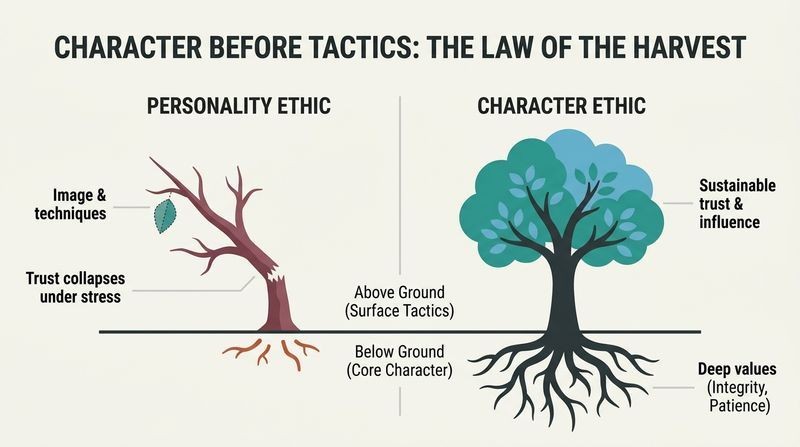
Personality tricks fail without character. Covey studied 200 years of American success writing and found a sharp divide. The first 150 years championed the Character Ethic: integrity, humility, courage, justice, patience, the Golden Rule. After World War I, the literature shifted to the Personality Ethic: charm, image, positive-attitude slogans, and influence techniques.
These surface skills work in one-shot encounters, but they crumble in long-term relationships. If your character is duplicitous, even flawless communication reads as manipulation. Covey compares shortcuts to cramming for an exam versus farming: you cannot skip planting season and cram a harvest in autumn. The Law of the Harvest governs human relations. What you are speaks louder than anything you say.
What's striking is how this 1989 diagnosis anticipated the influencer economy, where personal branding often outruns substance. Aristotle's rhetoric already ranked ethos (credibility) above logos (logic), so Covey stands on ancient ground. Yet the binary can be overstated. Research on thin-slicing by psychologist Nalini Ambady shows first impressions carry real predictive weight, meaning surface signals are not pure noise. Skills and character reinforce each other rather than compete. Still, the core warning holds: trust compounds slowly and evaporates instantly, and no technique survives a reputation for insincerity.
You see the world as you are, not as it is
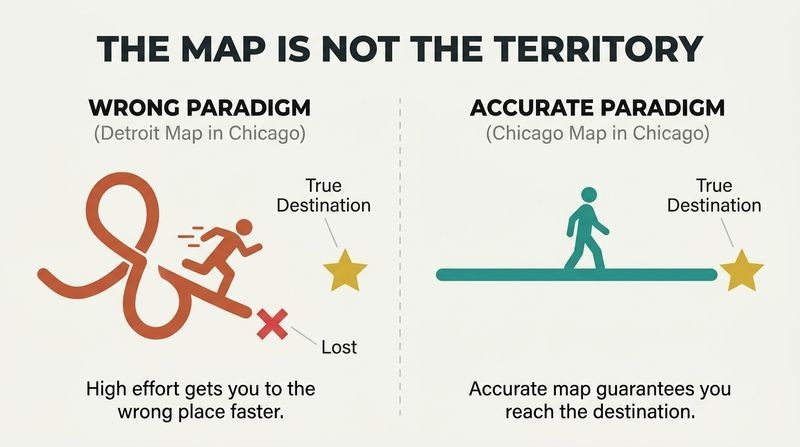
Paradigms are mental maps. A paradigm is the lens through which you interpret reality, and Covey insists the map is never the territory. Trying to navigate life with faulty assumptions is like using a Detroit street map to find an address in Chicago: working harder or thinking positively only gets you to the wrong place faster.
He demonstrates this with a famous sketch that reads as either a young woman or an old crone depending on conditioning. Two honest people can view identical facts and disagree, both correct. His most vivid example: a father lets his children run wild on a subway, and Covey's irritation dissolves the instant he learns the man's wife died an hour ago. The facts never changed; his paradigm did.
This is Thomas Kuhn's paradigm-shift concept, borrowed from the history of science, applied to daily life. Modern cognitive science backs Covey hard: confirmation bias, naive realism, and motivated reasoning all confirm humans mistake their interpretation for objective truth. The subway story is essentially a lesson in the fundamental attribution error, where we blame others' character while excusing our own circumstances. One caveat worth noting: recognizing that perceptions differ does not mean all maps are equally accurate. Covey guards against relativism by anchoring to principles, but the tension between empathy and truth-seeking deserves ongoing attention.
Between what happens and your response lies your freedom
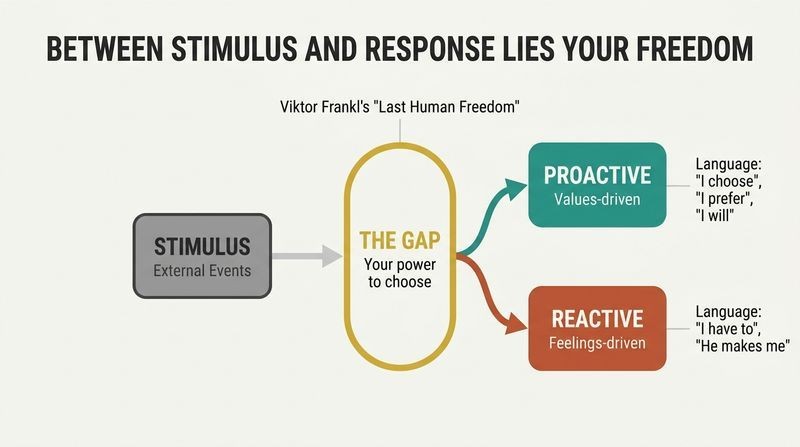
Proactivity means owning your response. Covey anchors his first habit in Viktor Frankl, the psychiatrist who survived Nazi death camps. Stripped of everything, Frankl discovered the last human freedom: choosing his attitude toward suffering. Between stimulus and response sits a gap, and in that gap lives your power to choose.
Proactive people subordinate feelings to values; reactive people let weather, moods, and other people's behavior run their lives. Covey dissects language as a tell: "I have to," "he makes me so mad," and "if only" signal reactivity, while "I choose," "I prefer," and "I will" signal ownership. He reframes responsibility as response-ability, the ability to choose your response. A nurse in his seminar realized she had chosen her own misery and walked out feeling released from prison.
Frankl's logotherapy and Covey's proactivity both reject psychic determinism, the Freudian idea that childhood scripts govern everything. This aligns with modern cognitive behavioral therapy, which teaches that thoughts mediate between events and emotions. The Stoics said it two millennia earlier: Epictetus argued we are disturbed not by events but by our judgments about them. One honest tension: trauma research shows the stimulus-response gap can narrow dramatically under stress, and telling abuse survivors they simply chose their feelings risks cruelty. Covey's own examples lean heroic. The principle empowers, but compassion should temper its application.
Pour energy into what you can influence, not what you fear
Two circles reveal your effectiveness. Covey draws a large Circle of Concern holding everything you care about, from your health to the national debt, and inside it a smaller Circle of Influence holding what you can actually affect. Where you focus determines your growth.
Reactive people obsess over the outer circle, cataloguing others' faults and circumstances beyond control. That negative energy plus neglect shrinks their influence. Proactive people work the inner circle, and their competence, positive energy, and results steadily expand it. Covey illustrates with an executive who ignored his dictatorial boss's flaws and instead anticipated his needs, delivering analysis and recommendations unbidden. His influence grew until no decision was made without him. Gandhi did the same, expanding his sway among field laborers while critics stayed in the debating chambers.
This maps neatly onto psychology's locus of control, where an internal locus correlates with higher achievement and resilience. It also echoes the Serenity Prayer, which Covey quotes directly. The Gandhi and executive examples are inspiring but survivorship-flavored: for every quiet influence-builder who wins, some are simply overlooked or exploited. Structural barriers, discrimination, and genuine powerlessness are real, and the framework can slide toward victim-blaming if applied naively. The strongest reading is diagnostic, not moralistic: auditing where your emotional energy actually goes often reveals it is squandered on complaint rather than construction.
Draft your own eulogy to clarify what actually matters
Begin with the end in mind. Covey opens Habit 2 by asking you to imagine your own funeral three years out and to consider what you would want a family member, friend, colleague, and community member to say about you. Those answers reveal your true definition of success, often startlingly different from the ladder you are frantically climbing.
All things are created twice: first mentally, then physically. Builders blueprint before they hammer; effective people script their lives before living them. The tool is a personal mission statement, a written constitution rooted in changeless principles that becomes the criterion for every major decision. Without one, you live by default, running scripts handed down by family, society, and circumstance. Anwar Sadat rescripted a lifelong hatred of Israel from a prison cell and rewrote Middle East history.
The funeral exercise is a memento mori, the ancient practice of contemplating death to sharpen priorities, now validated by research on mortality salience and terror management theory. Peter Drucker's distinction between leadership (doing right things) and management (doing things right) underpins Covey's insistence that no efficiency compensates for climbing the wrong wall. A modern extension: behavioral economists note we are terrible affective forecasters, poor at predicting what will fulfill us, so the funeral test cleverly bypasses momentary desires to access deeper values. The risk is that a mission statement becomes shelf decoration; its power lies entirely in repeated review and revision.
Schedule your priorities instead of prioritizing your schedule
Quadrant II is where effectiveness lives. Covey plots activities on two axes, urgent and important, creating four quadrants. Quadrant I is urgent and important (crises). Quadrant III is urgent but unimportant (most interruptions). Quadrant IV is neither (time-wasting). Quadrant II is important but not urgent: relationship-building, planning, prevention, renewal, and genuine growth.
Most people drown in Quadrants I and III, then escape to IV. The effective devote themselves to Quadrant II, which shrinks crises before they erupt. Because these activities never scream for attention, acting on them requires proactivity and the courage to say no. Covey's key move: organize weekly, not daily, anchoring each week to your roles and a few results per role. Saying no to the good frees you for the best, powered by a bigger yes burning inside.
The urgent-important matrix predates Covey (attributed to Eisenhower), but he popularized its practical use. It resonates with Parkinson's Law and with modern deep-work advocates like Cal Newport, who argue shallow urgent tasks crowd out the cognitively demanding work that creates real value. Behavioral science adds nuance: present bias makes humans systematically overweight the urgent and underweight the important, which is precisely why Quadrant II requires deliberate structure rather than willpower. One limitation in the digital age: the sheer volume of Quadrant III notifications has exploded since 1989, making the discipline harder and Covey's weekly-planning remedy arguably insufficient without aggressive environmental design.
Independence is the halfway point, not the summit
Interdependence beats independence. Covey maps growth along a Maturity Continuum with three stages: dependence (the paradigm of you, where others must care for me), independence (the paradigm of I, self-reliance), and interdependence (the paradigm of we, combining talents to achieve more together). Culture worships independence, but Covey argues it is merely a way station.
Life is fundamentally interdependent. To pursue maximum results through independence alone is like playing tennis with a golf club, the tool mismatched to reality. Crucially, only truly independent people can choose interdependence; dependent people cannot, because they lack the character to contribute. This is why the private victories of Habits 1 through 3 must precede the public victories of Habits 4 through 6. You cannot harvest before you plant.
This directly challenges the rugged-individualist mythology dominant in Western, especially American, self-help. Contemporary research vindicates Covey: studies on collective intelligence show group performance depends more on social sensitivity and turn-taking than on individual IQ. Attachment theory offers a parallel arc, where secure autonomy enables genuine intimacy, while the anxiously dependent cannot form healthy bonds. The sequencing insight is the sharp edge here: our era often skips straight to collaboration and teamwork rhetoric without cultivating the self-mastered individuals who make teams work. Covey's warning that counter-dependent rebellion masquerades as independence remains a shrewd diagnosis of much modern posturing.
Deposit trust in relationships before you need to withdraw
The Emotional Bank Account governs trust. Covey's central relationship metaphor: every interaction is a deposit or withdrawal in an account measuring how safe someone feels with you. Courtesy, kindness, keeping commitments, and understanding build reserves; discourtesy, betrayal, and broken promises drain them. When the balance is high, communication is easy and mistakes are forgiven. When overdrawn, you walk on landmines and every word is measured.
He names six deposits:
1. Understanding the individual (what matters to them, not to you)
2. Attending to little kindnesses and courtesies
3. Keeping commitments
4. Clarifying expectations up front
5. Showing personal integrity, especially loyalty to the absent
6. Apologizing sincerely when you withdraw
One son cried in bed asking if his father would cover him with a coat, revealing that the biggest deposits are often the smallest gestures.
The banking metaphor has become organizational-psychology canon and prefigures John Gottman's research on marriage, which found stable couples maintain roughly a five-to-one ratio of positive to negative interactions, an empirical version of Covey's ledger. The loyalty-to-the-absent principle is especially shrewd: gossip feels like a bonding deposit but is actually a withdrawal, because listeners correctly infer you will betray them too. One subtlety worth flagging: the metaphor can encourage transactional score-keeping, the opposite of the unconditional love Covey elsewhere champions. The healthiest reading treats deposits as expressions of genuine care, not currency banked for future leverage.
Seek agreements where both parties genuinely win, or walk away
Win-Win is abundance, not compromise. Covey identifies six interaction paradigms: Win-Win, Win-Lose, Lose-Win, Lose-Lose, Win, and Win-Win or No Deal. Most people are scripted for Win-Lose by families, grading curves, sports, and law, all zero-sum arenas. But in interdependent reality, a win extracted at another's expense poisons the relationship and becomes a long-term loss.
Win-Win flows from an Abundance Mentality, the conviction that there is plenty for everyone, versus the Scarcity Mentality that treats life as one fixed pie. The liberating addition is No Deal: if you cannot find a mutually good solution, you agree to disagree without resentment. A software executive walked away from an $84,000 contract when the client's team resisted, then three months later signed a $240,000 deal with that same client. Character (integrity, maturity, abundance) makes it possible.
This overlaps with Fisher and Ury's Getting to Yes, which Covey cites, and with game theory, where repeated interactions reward cooperation over one-shot defection (Axelrod's tournaments famously crowned tit-for-tat). The Abundance versus Scarcity framing has since been echoed by Carol Dweck's growth mindset and by research showing that zero-sum thinking correlates with lower well-being and trust. The No Deal option is the genuinely underrated piece: negotiation literature confirms that a strong walkaway alternative (BATNA) is the single greatest source of bargaining power. The caveat: some arenas truly are competitive, and Covey concedes Win-Lose has its place in genuinely zero-sum contests.
Listen to understand, not to reply, before you counsel
Diagnose before you prescribe. Covey opens Habit 5 with an optometrist who hands you his own glasses because they work for him. Absurd in medicine, yet we do it constantly in conversation, dispensing advice before understanding the problem. Most people listen at one of four low levels (ignoring, pretending, selective, attentive) rather than the fifth: empathic listening.
Empathic listening means entering another's frame of reference to grasp how they feel and see, not mimicking words like a parrot. Since communication is estimated to be only 10 percent words, 30 percent sounds, and 60 percent body language, you listen with eyes and heart too. This gives people psychological air, a need Covey ranks just below physical survival. A real estate deal collapsing was saved when the seller simply sought first to understand the buyer's concerns, then earned the right to be understood through ethos, pathos, logos.
Covey drew on Carl Rogers' client-centered therapy, which established that reflecting feeling, not just content, unlocks openness. The psychological-air concept aligns with self-determination theory's finding that feeling understood satisfies a core human need. His caution against technique-only reflective listening is prescient: people detect performed empathy instantly, and it backfires. The ethos-pathos-logos sequence borrows Aristotle to argue that credibility and emotional attunement must precede logic, a reversal of how most professionals present. One limitation: the 10-30-60 statistic derives from Albert Mehrabian's narrow studies on emotional messaging and is routinely over-generalized. The underlying point stands regardless: understanding must precede advising.
Treat differences as raw material, not obstacles, for better answers
Synergy makes one plus one equal more. Covey defines synergy as the whole exceeding the sum of its parts, and calls it the crowning habit that tests all the others. Its essence is valuing differences: mental, emotional, psychological. When you genuinely believe another person's contrary view holds something you lack, you say "Good, you see it differently, help me see what you see."
He illustrates with a husband wanting a fishing vacation and a wife wanting to visit her ailing mother. Instead of splitting the difference (compromise, where one plus one equals one and a half), they synergize toward a Third Alternative better than either original plan. Synergy requires high trust plus empathic listening. Insecure people crave cloning and sameness; secure people harness diversity. Sameness is not oneness, and uniformity is not unity.
The Third Alternative concept anticipates integrative negotiation and design thinking, both of which generate novel options rather than dividing fixed value. Research on cognitive diversity supports Covey: heterogeneous teams outperform homogeneous ones on complex problems, provided psychological safety exists (Amy Edmondson's work), which is precisely Covey's trust precondition. The animal-school fable he cites, where a duck fails at running and a rabbit at swimming, is a sharp critique of forcing uniform standards onto diverse strengths. One honest limit: synergy is genuinely hard and time-intensive, and Covey's examples always resolve triumphantly. In practice many differences remain irreconcilable, which is why he wisely keeps No Deal on the table.
Renew four dimensions daily or your other habits decay
Sharpen the saw. Covey's final habit is the story of a man exhausted from sawing a tree who has no time to sharpen his blade. Habit 7 is preserving and enhancing your greatest asset, yourself, across four dimensions:
1. Physical (exercise, nutrition, rest)
2. Spiritual (meditation, values, nature, inspiration)
3. Mental (reading, writing, planning, learning)
4. Social/Emotional (empathy, service, deep relationships)
This is pure Quadrant II work, important but never urgent, which is why it gets neglected until crisis forces it. Covey prescribes a Daily Private Victory: at least one hour daily renewing the first three dimensions. Renewal is synergistic; improving one dimension lifts the others, and each pass around the habits happens on a higher plane. This creates an upward spiral of learning, committing, and doing, guided by an educated conscience.
Decades of research validate each dimension: aerobic exercise boosts cognition and mood, contemplative practice reduces stress reactivity, lifelong learning protects against cognitive decline, and strong social ties predict longevity as powerfully as any lifestyle factor (Holt-Lunstad's meta-analyses). Covey essentially prescribed holistic self-care before the term existed. The upward-spiral image parallels the compounding logic now central to habit science. A modern caveat: the one-hour daily prescription assumes a degree of autonomy over one's schedule that caregivers, shift workers, and the economically precarious may lack. The principle of balanced, proactive renewal survives that critique; the specific dosage is a privilege-dependent ideal worth adapting.
Analysis
Covey's 1989 work is a thesis-driven synthesis dressed as a practical manual, and its enduring power comes from an architectural claim most self-help ignores: effectiveness is sequential and organic, not modular. You cannot cherry-pick habits any more than you can harvest before planting. The seven habits form a deliberate progression from dependence through independence to interdependence, with renewal encircling all. This structure is the book's real intellectual contribution, more than any single habit.
What distinguishes Covey from the Dale Carnegie tradition he critiques is his insistence on the Character Ethic over the Personality Ethic. He argues that natural laws, or principles, govern human effectiveness as reliably as gravity governs physics, and that alignment with them (not clever technique) produces lasting results. This is essentially a moral-realist position smuggled into a business book, and it explains both the work's gravitas and its occasional preachiness.
The book's weaknesses are instructive. Its relentless optimism about proactivity can shade into victim-blaming, underweighting structural constraints, trauma, and genuine powerlessness. Its examples always resolve triumphantly, a survivorship bias that flatters the framework. The one-hour Daily Private Victory presumes schedule autonomy many lack. And the sharp Character-versus-Personality binary underplays how surface skills and deep character actually co-develop.
Yet the core diagnoses have aged remarkably well. The urgent-important matrix predicted our notification-saturated attention crisis. The Emotional Bank Account prefigured Gottman's empirical marriage research. Win-Win maps onto game theory's cooperation findings. Empathic listening echoes both Rogers and self-determination theory. Covey intuited, without the data, much of what behavioral and social science later confirmed. Read today, the book functions best not as a productivity system but as a philosophy of self-governance: an argument that inner integrity precedes outer influence, and that we change our circumstances most powerfully by changing ourselves first. That Inside-Out thesis remains its most durable gift.
Review Summary
The 7 Habits of Highly Effective People receives mixed reviews. Many readers find it transformative, praising its practical advice on personal growth and effectiveness. They appreciate the emphasis on character, principles, and interdependence. Critics argue it's repetitive, outdated, and filled with corporate jargon. Some find the religious undertones off-putting. The book's impact is undeniable, with millions of copies sold worldwide. Readers generally agree that the habits, while simple, require significant effort to implement. The writing style and examples are considered dated by some, but the core principles remain relevant.
People Also Read




FAQ
What's The 7 Habits of Highly Effective People about?
- Focus on Personal Change: The book emphasizes personal development and effectiveness through seven key habits, advocating for an "Inside-Out" approach where true change starts from within.
- Character vs. Personality Ethics: Covey contrasts character ethics, which focus on integrity and humility, with personality ethics, which emphasize superficial traits and quick fixes.
- Principle-Centered Living: It promotes living according to timeless principles that govern human effectiveness, rather than being swayed by external circumstances or societal pressures.
Why should I read The 7 Habits of Highly Effective People?
- Timeless Principles: The book offers insights applicable across personal, professional, and relational contexts, fostering long-term success and fulfillment.
- Practical Framework: Covey provides a structured approach to personal effectiveness, making it easier to implement the habits in daily life for improved productivity and relationships.
- Self-Reflection and Growth: It encourages deep self-reflection, helping individuals identify their values and align their actions, empowering them to take control of their lives.
What are the key takeaways of The 7 Habits of Highly Effective People?
- Seven Habits Framework: The book outlines seven habits essential for personal and interpersonal effectiveness, each building upon the previous one.
- Inside-Out Approach: True change must start from within, focusing on personal character and values rather than external circumstances.
- P/PC Balance: The concept of balancing immediate results with long-term growth and sustainability is crucial for achieving lasting success.
What are the seven habits outlined in The 7 Habits of Highly Effective People?
- Habit 1: Be Proactive: Take responsibility for your life and actions, emphasizing choice and initiative.
- Habit 2: Begin with the End in Mind: Define a clear vision of your goals and values to guide your actions.
- Habit 3: Put First Things First: Prioritize tasks based on importance rather than urgency, focusing on long-term goals.
- Habit 4: Think Win-Win: Foster a mindset of mutual benefit in all interactions.
- Habit 5: Seek First to Understand, Then to Be Understood: Practice empathic listening to truly understand others.
- Habit 6: Synergize: Leverage diverse perspectives to create better solutions.
- Habit 7: Sharpen the Saw: Engage in regular self-renewal across various dimensions to maintain effectiveness.
What is the Inside-Out approach in The 7 Habits of Highly Effective People?
- Self-Reflection First: Emphasizes starting with self-awareness and personal values before addressing external issues.
- Character Development: Focuses on building character and integrity as the foundation for effective living.
- Long-Term Change: Promotes sustainable change rooted in personal growth rather than superficial fixes.
How does the concept of the Emotional Bank Account work in The 7 Habits of Highly Effective People?
- Trust Representation: It's a metaphor for the level of trust in a relationship, where positive interactions are deposits and negative interactions are withdrawals.
- Building Trust: Consistent deposits through kindness and understanding increase trust, easing conflict navigation.
- Impact on Relationships: A high balance allows for greater flexibility and understanding, while a low balance leads to defensiveness.
What is the Quadrant II paradigm mentioned in The 7 Habits of Highly Effective People?
- Focus on Importance: Quadrant II activities are important but not urgent, emphasizing proactive planning over reactive crisis management.
- Time Management Matrix: Covey categorizes tasks into four quadrants based on urgency and importance, encouraging prioritization of Quadrant II tasks.
- Long-Term Benefits: Engaging in Quadrant II activities reduces urgent crises and enhances overall effectiveness.
What does it mean to be proactive according to The 7 Habits of Highly Effective People?
- Taking Responsibility: Being proactive means taking responsibility for your own life and choices.
- Choosing Your Response: Proactive individuals understand they have the power to choose their responses to external stimuli.
- Focusing on Solutions: They focus on what they can influence rather than what they cannot control.
How can I apply the P/PC Balance in my life?
- Understanding P and PC: Balance between production (P) and production capability (PC) is crucial for sustainable success.
- Investing in Growth: Invest time and resources in personal development, relationships, and self-care to sustain effectiveness.
- Evaluating Decisions: Consider both immediate results and long-term implications to support short-term achievements and long-term growth.
How do I create a personal mission statement as suggested in The 7 Habits of Highly Effective People?
- Identify Your Values: Reflect on your core values and what is most important to you in life.
- Write It Down: Draft a personal mission statement that encapsulates your values, goals, and vision for your life.
- Review and Revise: Regularly review and revise your mission statement to ensure it remains relevant and aligned with your evolving values.
What role does synergy play in The 7 Habits of Highly Effective People?
- Creative Cooperation: Synergy emphasizes the value of diverse perspectives in problem-solving.
- Third Alternatives: Encourages seeking solutions better than either party's original proposal, fostering collaboration.
- Building Relationships: Enhances relationships by creating a culture of trust and open communication.
How does Habit 7, "Sharpen the Saw," contribute to overall effectiveness in The 7 Habits of Highly Effective People?
- Self-Renewal Importance: Emphasizes the need for regular self-renewal in various dimensions to maintain effectiveness.
- Balanced Approach: Engaging in activities that sharpen the saw leads to a holistic approach to growth.
- Foundation for Other Habits: Prioritizing self-renewal ensures individuals remain effective and resilient in their pursuits.
About the Author
Other books by Stephen R. Covey

Download PDF
Download EPUB
.epub digital book format is ideal for reading ebooks on phones, tablets, and e-readers.








































