

Summary Temporarily Unavailable
This summary is temporarily unavailable and is currently being updated. You can still explore the FAQs and other metadata below.
Key Takeaways
You already run Game; the only question is whether it works
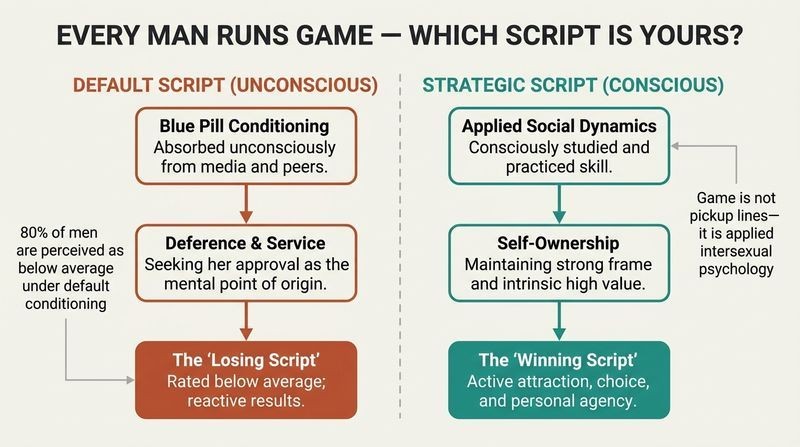
Tomassi's opening provocation is that every man already has a system for attracting women, absorbed unconsciously from mothers, teachers, and media. Most men learned what he calls Blue Pill conditioning: make women your mental point of origin, defer to their approval, and prove your worth through respect and service. He argues this is a losing script.
He cites blunt marketplace statistics to make the stakes vivid: women rate roughly 80% of men as below average in attractiveness, and only about 4.5% of men prompt a woman to initiate contact. Game, in his definition, is not pickup lines but applied social skill grounded in intersexual psychology. The uncomfortable premise: doing what you have always done keeps getting you what you have always gotten, which for most men is very little.
The claim that everyone already has a strategy echoes behavioral science: humans run automatic scripts absorbed through social learning, rarely examined. That framing is genuinely useful. The 4.5% and 80% figures come from dating-app studies (notably OkCupid's internal data), which measure swipe behavior in a hyper-visual, low-context environment, not real-world attraction. Treating app rejection rates as universal biological truth overstates the case. Still, the core move, forcing men to audit an invisible operating system rather than blame luck, mirrors cognitive behavioral therapy's premise that unexamined automatic thoughts drive outcomes. The diagnosis is sharper than the statistics supporting it.
Red Pill is the theory; Game is the field experiment that proves it
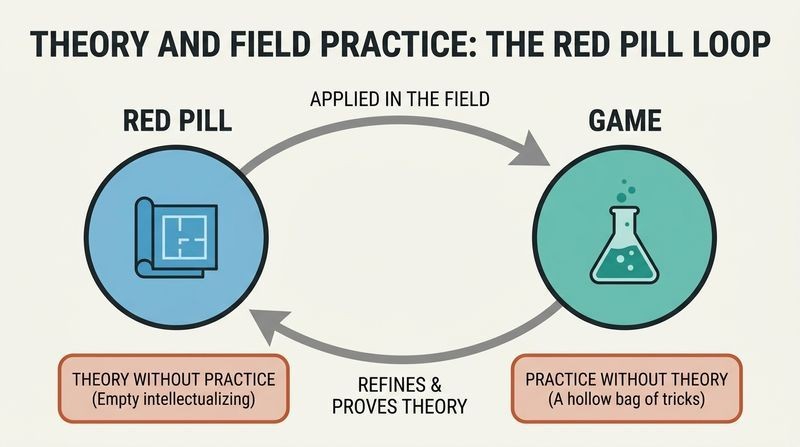
Tomassi draws a sharp line between two ideas people conflate. Red Pill is what he calls a praxeology, a loose developing science of how the sexes actually behave, concerned with what is rather than what should be. Game is the practice, the applied social skills tested in real interactions.
He credits the early-2000s pickup-artist forums with something academia could never do: run thousands of uncontrolled real-world seduction experiments, free of the ethical constraints and ideological filters of social science. The data those men gathered, he argues, hardened into Red Pill principles. Each feeds the other. Theory without field practice is empty; practice without theory is a bag of tricks. He insists Game is an art requiring calibration and improvisation, not a mathematical formula you memorize, and warns it cannot cure clinical social disorders.
The theory-versus-practice distinction is intellectually honest and worth borrowing. But celebrating pickup forums as superior to social science because they lacked ethical constraints is a double-edged boast. Uncontrolled anecdotes with no control groups, no randomization, and heavy survivorship bias are exactly what produce confident-sounding folk wisdom that collapses under scrutiny. Field observation generates hypotheses; it does not confirm them. The stronger version of Tomassi's point is that lived experience surfaces phenomena lab studies miss, a fair critique of WEIRD-sample psychology. Evolutionary psychology does support several claims here, but the epistemology, treating accumulated forum lore as more valid than peer review, is the weakest link.
Demonstrate value through action; never argue your case to a woman
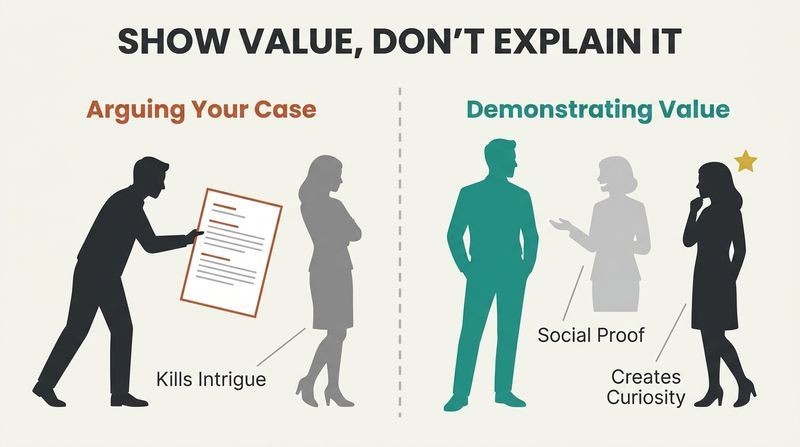
No man has ever reasoned a woman into bed, Tomassi argues, yet average men keep trying, listing their virtues like a resume. He contrasts Displaying value (Instagram shots of borrowed Lamborghinis, easily faked) with Demonstrating value, which he abbreviates DHV: conveying status, preselection, and social dominance through story and behavior so a woman infers your worth herself.
The mechanism is what he calls preselection: if other women visibly want a man, he becomes more attractive to all women. He frames the ideal as speaking without speaking, dropping subtle cues rather than boasting. The goal is to make her curious enough to enter your frame and figure you out. Explaining your value kills the intrigue and signals neediness. Win through what she observes, never through the argument you deliver.
The underlying principle, that inferred information is more persuasive than asserted information, is well supported outside seduction. Marketers call it show-don't-tell; negotiators know that a conclusion someone reaches themselves feels more true than one handed to them. Preselection maps onto documented mate-choice copying in several species and some human studies, where women rate a man as more desirable when shown he is chosen by other women. The weakness is the slide toward manufacturing false signals. There is real tension between Tomassi's own advice to demonstrate authentic value and his acknowledgment that impressions can be faked, a tension between building substance and performing it that he never fully resolves.
Shit tests are invitations to play, not problems to solve
Tomassi describes shit tests as women's evolved, often unconscious probes of a man's confidence, options, and authenticity, comparable to how men reflexively notice attractive bodies. Crucially, you never permanently pass one; even a decades-long wife keeps testing. The failure mode is treating tests as pass-fail exams and responding with defensive logic or explanation.
His recommended tool is Agree and Amplify: when she accuses or challenges, sarcastically agree and exaggerate to absurdity, turning her energy back on her like judo. He distinguishes active tests (deliberate, common in bars) from passive tests (subconscious, rooted in long-term relationship insecurity). The deeper rule: women would rather play the game than have it explained. Naming the test out loud, he warns, kills attraction because it exposes the very dynamic she needs to remain unspoken.
The judo framing is genuinely useful conflict-de-escalation advice that generalizes beyond dating: meeting provocation with playful non-reactivity defuses power struggles in workplaces and families too. It resembles improv comedy's yes-and principle and paradoxical intervention in family therapy. The evolutionary framing, that testing screens for a partner's stability under pressure, is plausible but unfalsifiable as stated, since any female behavior can be retrofitted as a test. The most defensible kernel is emotional: many people probe partners for security, and calm confidence reassures better than defensive explanation. Attributing all of it to hardwired hypergamous filtering treats a broad human relational pattern as a female-specific biological mechanism, which overreaches the evidence.
Cultivate abundance because scarcity thinking sabotages every approach
Tomassi argues that most men operate from sexual scarcity, treating every interested woman as a unique snowflake sent by fate. This mindset inflates women's value, breeds neediness, and destroys the calibration Game requires. His antidote is Plate Theory, dating multiple women non-exclusively, not to rack up conquests but to internalize genuine options.
He adds a strategic timeline: women's peak sexual market value spans roughly ages 18 to 28, while men can build value well into their 30s and beyond. His controversial counsel is that men should not consider serious commitment before 30, because they mature into their leverage later. He also cites the finding that men overestimate women's interest while women underestimate men's, arguing this asymmetry is exactly how scarcity gets reinforced in the average man's psychology.
The psychological core is sound and echoes negotiation research: the party who needs the deal least holds the power, and perceived alternatives (a strong BATNA) change behavior even before they are used. Confidence born of genuine options is more durable than affirmations. The gendered SMV timeline is the contested part. It compresses women to fertility windows and men to resource accumulation, a framing that fits some evolutionary models but ignores enormous variance, changing life scripts, and the fact that attraction is not purely age-indexed. The abundance principle stands on its own without the demographic determinism; a person with options simply carries themselves differently, regardless of the market theory attached.
Hypergamy runs on two tracks: Alpha Fucks and Beta Bucks
Hypergamy is Tomassi's signature concept: women's evolved mating strategy of seeking the best available combination of genetic quality (short-term sexual arousal) and provisioning security (long-term investment). The shorthand is Alpha Fucks, Beta Bucks, the exciting lover versus the dependable provider. Ideally both live in one man; historically women often split them across different men or life phases.
He stresses hypergamy never seeks its own level: women pursue a better-than-equal exchange, which is why, he claims, they rate 80% of men as below average. It operates, he says, at a low background hum, satisfied while a woman's partner is high-value, alarmed when a higher-value man appears. He insists all women are hypergamous to the same biological degree; culture and self-control only modulate how it gets expressed, not whether it exists.
Alpha Fucks, Beta Bucks is a folk compression of dual mating strategy theory (Gangestad and Simpson), which does have empirical support around ovulatory shifts in preference, though effect sizes are modest and replication has been contested. The framework's real weakness is its totalizing certainty: declaring all women hypergamous to an identical biological degree converts a statistical tendency into an iron law, immune to counterexample. Men also show documented preferences for youth and attractiveness, so treating status-seeking as uniquely female ignores that both sexes optimize on different axes. The concept illuminates a real pattern in mate preferences while smuggling in a determinism that better evolutionary psychologists explicitly reject.
Frame is the relationship's dominant reality; enter yours, not hers
Frame is Tomassi's term for whose worldview and priorities govern a relationship. The related idea, mental point of origin, is what you instinctively consider first in any decision. The Blue Pill man makes the woman his point of origin; the Red Pill man makes himself his own. He argues women genuinely desire to enter a worthy man's frame, and that even fiercely independent women crave a stable masculine reality to relax into.
He illustrates with a mundane example: his wife wanted a new bed, he simply said no, and the conflict instantly shifted from furniture to who holds authority. His maxim: no amount of negotiated sex is worth surrendering frame. He also warns against negotiating desire, since genuine attraction cannot be bargained into existence; it flows from demonstrated value, not from pleading or compromise.
Frame overlaps with well-studied ideas: internal locus of control, self-differentiation in Bowen family systems theory, and the observation that people with a clear sense of self are less reactive and often more magnetic. That anyone who orients their entire life around a partner tends to become less attractive to that partner is a real and cross-culturally observed relational paradox. The overreach is prescriptive rigidity. Framing every disagreement, even about a bed, as a dominance contest can curdle into control and treats healthy negotiation as weakness. Mature partnerships blend leadership with genuine mutuality; the research on lasting relationships (Gottman) favors influence-sharing over one partner permanently holding the frame.
Get in the gym: looks are the one lever fully in your control
Tomassi punctures the comforting myth that women care less about looks than men do. He argues the opposite: women's standard of idealized male beauty (broad shoulders, V-taper, jawline) has stayed constant for millennia, while men fetishize enormous physical variety in women. His evidence includes a study by Haselton and Frederick in which women rated built and toned male body types highest, and muscular men reported more partners, more affairs, and more short-term success.
His practical point is empowering rather than fatalistic: with roughly 75% of Americans overweight, simply getting into elite shape vaults a man past most competitors. He frames the holy trifecta as Money, Muscles, and Game, advising you have two but that Game matters most. Physique, though, is the fastest lever because it is entirely within your direct control.
This is among the book's more empirically grounded sections. The Haselton-Frederick research does exist and found muscularity correlated with mating success, and physical attractiveness reliably predicts dating outcomes for both sexes. The reframe from doom to agency is psychologically smart: fixating on immutable features (height, bone structure) breeds despair, while emphasizing the controllable (body composition) motivates action, consistent with self-efficacy research. The counterpoint is that muscularity's advantage is strongest for short-term attraction; long-term partner selection weights kindness, stability, and compatibility heavily in large cross-cultural surveys. Tomassi's own trifecta concedes this. Fitness is necessary and underrated, but the book occasionally lets the vivid body-type data overshadow the multi-factor reality.
Read the zone: the workplace is never a sexual arena
Tomassi argues modern life has split social spaces into sexual zones (clubs, bars, apps) and asexual zones (offices, campuses) where any romantic overture is policed as harassment. Situational awareness, borrowed from combat and negotiation, means reading the environment, the target, and the social group before acting, because the same behavior that charms in one zone gets you fired or labeled a creep in another.
His blunt rule: never run Game at work, even if you own the business. His definition of the Creep is illuminating: creepiness, in women's reports, is less about the act than about a man perceived as below her attraction threshold presuming intimacy, or failing to take a hint. Arousal, he notes, forgives behavior that would otherwise register as creepy. The safest posture in ambiguous zones is calibrated restraint, not memorized routines.
The zone framework is a shrewd sociological observation that transcends its dating context: norms are radically context-dependent, and misreading which script applies is a common social failure. The insight that creepiness is partly a status judgment, the identical approach welcomed from one man and alarming from another, is uncomfortable but has some support in perception research on how attractiveness colors interpretation of intent. Where it needs balance: this can slide into implying women's boundaries are merely about a man's rank rather than genuine discomfort or safety. Both are true simultaneously. Persistence past a clear no is not a status problem; it is a consent problem, and the workplace caution is simply sound professional ethics.
Stoke jealousy deliberately: a woman cannot love a man she cannot lose
Tomassi makes his most counterintuitive claim: jealousy is a tool, not a threat to avoid. He distinguishes envy (wanting what you never had) from jealousy (fearing loss of what you thought you'd secured). His maxim: women don't want a man who cheats, but they love a man who could. Never dissuade a woman's jealousy; let it remind her of your value.
He connects this to preselection and FOMO (fear of missing out), arguing a woman won't fully invest emotionally until she has felt the possibility of losing you to a rival. He cites the mate-guarding research showing partnered women socially avoid ovulating rival women, but only when their own partner is highly desirable. His practical version is passive Dread: not staging fake flirtations, but simply not shutting down the natural interest other women show you.
The mate-guarding study (Krems and colleagues) is real and its finding is genuinely interesting: guarding intensity tracks partner desirability, implying jealousy is a value-signal. The distinction between envy and jealousy is philosophically clean and useful. The hazard is dosage and ethics. Deliberately inducing jealousy is associated in relationship research with lower trust, higher conflict, and insecure attachment dynamics, the opposite of the secure bond most people want. Tomassi's softer passive version, not performing indifference to your own desirability, is defensible and honest. The harder version, manufacturing rivals, risks building a relationship on anxiety rather than security. Intermittent-reinforcement attraction is powerful and also a known ingredient in unstable, sometimes toxic pairings.
Blue Pill idealism can literally kill men; rebuilding beats erasing
The book's darkest and most humane chapter confronts male suicide, noting men die by suicide roughly 3.5 to 5 times more often than women, with 7 in 10 suicides being men aged 45 to 65. Tomassi introduces being Zeroed Out: the catastrophic erasure of a man's accumulated equity, status, marriage, career, and identity, often triggered by divorce, the leading precursor.
His argument is that men conditioned to build their entire self-worth on Blue Pill relational equity (the belief that dutiful provisioning earns lasting love) are destroyed when that equity evaporates. He tells of his brother-in-law, who hanged himself after his life plan collapsed, and a reader who canceled his planned suicide after discovering this material. His thesis: Game is sometimes not about sex but about survival, giving men an identity resilient enough to be rebuilt from zero.
The suicide statistics are accurate and the male midlife crisis around divorce, isolation, and lost role is a documented public-health tragedy that mainstream discourse underserves. The insight that men who anchor identity entirely in external roles are fragile when those roles vanish aligns with research on identity foreclosure and the protective value of diversified sources of meaning. Where care is needed: framing women or feminism as the primary cause of male suicide oversimplifies a multifactorial phenomenon involving mental illness, addiction, means access, and help-seeking norms. Tomassi's constructive prescription, build a self not wholly dependent on a partner's validation, is genuinely therapeutic and consistent with what clinicians recommend, whatever one thinks of the surrounding ideology.
Stop finding yourself; build yourself deliberately from scratch
Tomassi's closing thesis rejects the popular language of self-discovery as passive fantasy. Men, he argues, don't find themselves; they build themselves through acts of will, based on realistic assessments of who they are and the conditions they face. Personality, he insists, is malleable, not fixed, and the fear that changing yourself is inauthentic is itself a trap.
He recounts his own arc: a Blue Pill teenager, a rock-scene Player in his twenties, a near-Omega trapped four years by a girlfriend with borderline personality disorder, and finally a Red Pill Lesser Alpha. His final maxim is that at some point Game must stop being an act and become you, so internalized that there is no performance to maintain. The book ends on its governing metaphor: he hands you the brushes and paint, but you are the blank canvas that must be filled.
The build-don't-find framing is a strong finish and aligns with a growing body of personality science showing traits are more plastic across adulthood than once believed; deliberate practice and role adoption can shift measured personality over months. It resonates with existentialist philosophy (Sartre's you are what you make yourself) and with narrative-identity research showing people who author an agentic life story report greater well-being. The tension the book never quite dissolves is between authenticity and performance: if you construct a persona to attract others, when does it become the real you? Tomassi's answer, through repetition it stops being a mask, is essentially the behaviorist and Aristotelian view that we become what we habitually do.
Analysis
This is the fifth volume of a self-help series functioning as a philosophy-of-seduction manual, explicitly positioned as the missing textbook of Game. Structurally it is an anthology of loosely connected essays organized into five parts, moving from mindset (Rules of Engagement) through tactics, dynamics, maintenance, and social theory. Its audience is men steeped in what the author calls the Manosphere. The summarizing challenge is threefold: the book mixes genuinely useful social-psychological observation with contestable evolutionary determinism and ideologically loaded framing; it is repetitive, circling the same maxims across chapters; and its most valuable insights sit beside claims that are empirically shaky or ethically fraught.
Intellectually, the work is strongest as a critique of a specific socialization pattern: men taught to seek validation through self-abnegation, deference, and the belief that virtue earns desire. That critique has real teeth and overlaps with mainstream findings on locus of control, self-differentiation, and the paradox that neediness repels. Tomassi's demonstrate-don't-explicate principle, his abundance-versus-scarcity psychology, his emphasis on fitness as controllable agency, and his humane attention to male suicide are the parts most likely to help a reader regardless of politics.
The weaknesses are epistemological and ethical. The book treats accumulated pickup-forum anecdote as more valid than peer-reviewed science, then selectively invokes evolutionary psychology when convenient. It converts statistical tendencies (dual mating strategy, ovulatory preference shifts) into universal laws applied to all women identically, a move working evolutionary psychologists reject. Its instrumental view of relationships, jealousy as a lever, frame as permanent dominance, optimizes short-term attraction dynamics that relationship science associates with instability and low trust. The framing is adversarial by design; Tomassi explicitly calls male and female mating strategies at war.
Read critically, it offers a coherent, sometimes bracing psychology of male self-authorship wrapped in a deterministic gender theory that deserves skepticism. The tools outlast the ideology.
Last updated:
Report IssueReview Summary
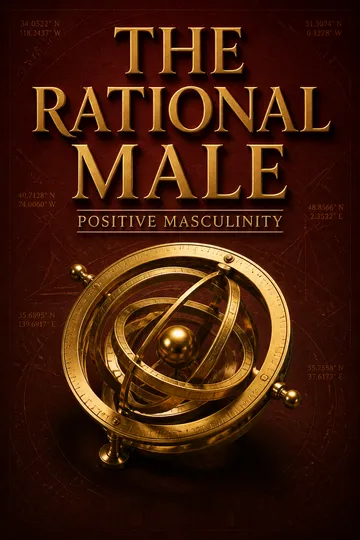
The Rational Male - The Players Handbook receives mostly positive reviews, with readers praising its insights into intersexual dynamics and personal growth. Many consider it essential reading for men, offering valuable perspectives on relationships and self-improvement. Critics argue it's misogynistic and oversimplified. Supporters appreciate its practical advice on confidence, social dynamics, and understanding female behavior. Some readers find it repetitive or too long, while others view it as a comprehensive guide to modern dating and masculinity. Overall, it's a polarizing book that sparks strong reactions.
People Also Read







FAQ
What's The Rational Male - The Players Handbook about?
- Focus on Male Dynamics: The book explores male-female relationship dynamics from a male perspective, examining concepts like hypergamy and attraction.
- Game Theory: It introduces "Game," strategies men can use to navigate dating and relationships effectively.
- Red Pill Philosophy: Rooted in the "Red Pill" philosophy, it encourages men to see gender dynamics realistically, beyond societal narratives.
Why should I read The Rational Male - The Players Handbook?
- Gain Insight: It provides valuable insights into the complexities of dating and relationships, helping men understand women's motivations.
- Empowerment: The book equips men with knowledge and strategies to improve their dating lives, promoting self-awareness and growth.
- Challenge Norms: It challenges conventional wisdom about masculinity and relationships, encouraging a more authentic approach to dating.
What are the key takeaways of The Rational Male - The Players Handbook?
- Understanding Hypergamy: Recognizes women's tendency to seek higher-status partners, aiding men in making informed dating choices.
- Frame Control: Emphasizes maintaining control of one's personal narrative and values in relationships.
- Avoiding Self-Deprecation: Advises against self-deprecating behavior, promoting confidence and self-assuredness.
What is the "Red Pill" philosophy in The Rational Male by Rollo Tomassi?
- Reality Over Ideals: Encourages men to see the realities of female nature and societal expectations, challenging traditional romantic ideals.
- Empowerment Through Knowledge: Aims to empower men by equipping them with knowledge to make informed decisions in their romantic lives.
- Challenging Conditioning: Promotes questioning commonly held beliefs about relationships, advocating for a realistic approach to dating.
How does Rollo Tomassi define ONEitis in The Rational Male?
- Unhealthy Obsession: Describes ONEitis as an unhealthy fixation on a single individual, leading to emotional dependency.
- Soul-Mate Myth: Argues that the belief in a singular "soul mate" is a myth that hinders personal growth.
- Impact on Relationships: Suggests that ONEitis creates an imbalance of power and can sabotage potential relationships.
What is Plate Theory in The Rational Male?
- Abundance Mindset: Encourages men to maintain multiple romantic interests to foster confidence and avoid neediness.
- Avoiding ONEitis: By dating multiple women, men can prevent unhealthy fixation on one partner.
- Dynamic Dating Strategy: Suggests that having multiple options increases a man's value and desirability.
What is the Cardinal Rule of Relationships according to The Rational Male?
- Power Dynamics: States that "the person with the most power is the one who needs the other the least," emphasizing self-reliance.
- Avoiding Neediness: Encourages men to cultivate interests outside relationships, enhancing attractiveness.
- Maintaining Control: Understanding this dynamic helps men navigate relationships without becoming overly dependent.
How does The Rational Male - The Players Handbook address hypergamy?
- Understanding Hypergamy: Explains it as a woman's instinctual drive to seek the best possible mate, often of higher status.
- Implications for Men: Suggests men should improve their value in the sexual marketplace to attract quality partners.
- Navigating Relationships: Understanding hypergamy helps men position themselves effectively in relationships.
What is the definition of "Game" in The Rational Male - The Players Handbook?
- Seduction Strategies: Refers to strategies and techniques men use to attract women and navigate relationships.
- Psychological Dynamics: Highlights the importance of confidence, social proof, and creating attraction.
- Adaptability: Stresses the need for adaptability to different social contexts and individual women.
What does the author mean by "frame" in The Rational Male - The Players Handbook?
- Personal Narrative: Refers to the beliefs, values, and perceptions that influence behavior and decision-making.
- Control of Frame: Emphasizes prioritizing one's own values and desires over those of a partner.
- Fluid Dynamics: Frame can shift based on circumstances, allowing effective relationship navigation.
What are some of the best quotes from The Rational Male and what do they mean?
- "Women get the men they deserve.": Emphasizes personal responsibility in partner choices, reflecting one's own value.
- "You cannot negotiate genuine Desire.": Stresses that true attraction cannot be forced or bargained for.
- "Rejection is better than Regret.": Encourages embracing rejection as a natural part of dating, avoiding unhealthy relationships.
How can I apply the concepts from The Rational Male - The Players Handbook in my dating life?
- Develop Self-Awareness: Understand your own value and what you bring to relationships, navigating dating with confidence.
- Practice Frame Control: Maintain control of your frame, being clear about your values and desires.
- Embrace Game: Learn and practice Game principles, understanding attraction dynamics and adapting your approach.
About the Author
Rollo Tomassi is a prominent figure in the manosphere and Red Pill community. He is best known for his "The Rational Male" series of books, which explore intersexual dynamics from an evolutionary psychology perspective. Tomassi's work focuses on male sexual strategy, hypergamy, and challenging societal narratives about relationships. He maintains a popular blog and YouTube channel where he discusses these topics. While controversial, Tomassi is considered influential in certain male-oriented online communities. His writing style is described as direct and unapologetic, often challenging mainstream views on gender relations and masculinity.



Download PDF
Download EPUB
.epub digital book format is ideal for reading ebooks on phones, tablets, and e-readers.








































