Key Takeaways
Frame isn't a mask you wear — it's the skeleton beneath your skin
“A codependent man who buckles every time his wife gets mad has frame, it's just that he's submitted to his wife's stronger one.”
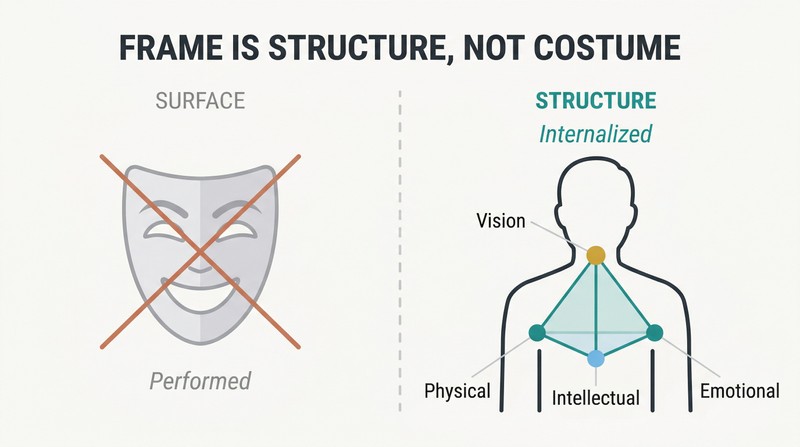
Stone defines frame not as a technique or performance, but as your deep narrative — the collection of mental models through which you process and react to reality. This book is explicitly "not a book on truth, but a book on utility." Frame is structured as a tetrahedron: three base pillars (physical, intellectual, emotional) supporting a fourth element, your vision. Everyone has frame — even weak men — it's just that some frames serve their owner and others serve someone else's.
The chain that builds it: work → self-respect → options → authority → expectations → investment. Pick-up artists once tried "frame control" — wearing confidence like a costume. Stone argues you must internalize it until your worldview becomes who you are, not something you perform and put down between interactions.
Lift heavy weights — the one prescription every man agreed on
“Atlas didn't ask for a lighter load, but stronger shoulders.”
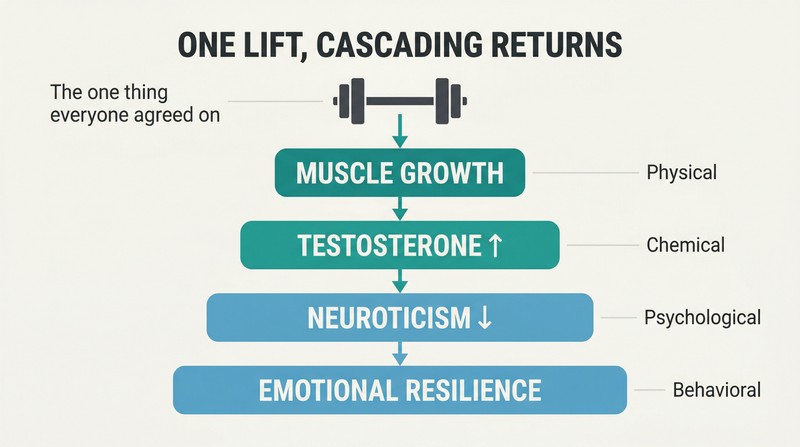
The universal consensus. Out of thousands of men with hundreds of opinions, the only thing everyone agreed on was lifting heavy. Not cardio, not sports, not rock climbing — compound barbell lifts like Stronglifts 5x5. The benefits cascade: muscle growth increases testosterone, which mutes neuroticism, which makes emotional resilience easier. For codependent men, the gym is often the first time they've prioritized themselves. Your phone is off; your time is yours.
Convert vague goals into binary numbers. "I want to get jacked" means nothing. "I need 600 extra kcal daily to gain 2 pounds of muscle per month" is measurable. You hit your calories or you didn't. You made weight or you didn't. This binary accountability becomes your first real experience with self-actualization — and the template for every other pillar of frame.
Surrendering to avoid her anger guarantees you'll get more of it
“It turns out women mess with you because they know they can.”
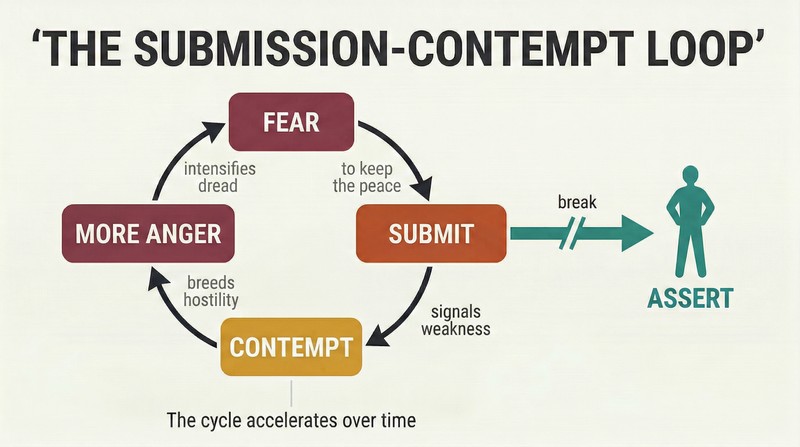
The emasculation paradox is a devastating feedback loop: men who fear their wife's emotional reactions submit to keep the peace, but submission signals weakness, breeding contempt and making outbursts more frequent. Seventy percent of divorces are initiated by women — not because all women are greedy, but because supplicative men present as targets. The sweet girlfriend who became a contemptuous wife didn't change; the man stopped being assertive after marriage.
Assertiveness is the antidote. Psychologist Kevin Dutton's research shows observers could predict robbery targets just from body language. Relationships work identically. Media oversaturates rare horror-story divorces — what Stone calls threatpoint — creating a cooling effect that makes submission seem rational when it's actually the fastest path to the outcome men are desperately trying to avoid.
Trees grown without wind snap — women are your wind
“Without successfully dealing with women, you become stubborn, not strong, and nothing affects you.”
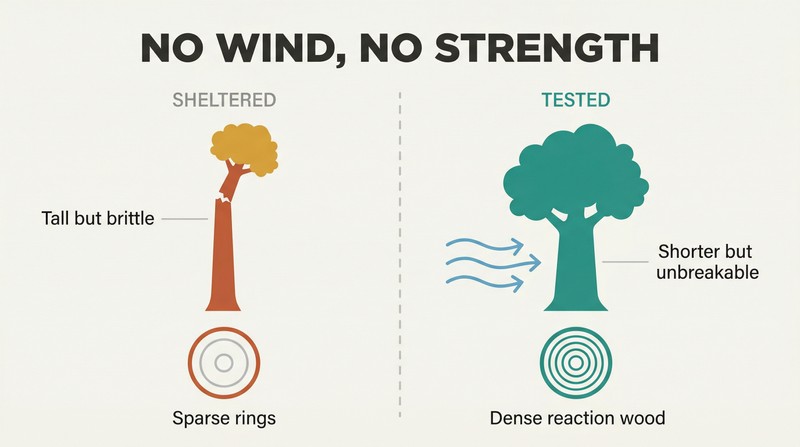
The biosphere lesson. The University of Arizona built a sealed biosphere to study ecosystems. Trees inside grew faster than wild trees — but their wood was fragile and they toppled constantly. The missing ingredient was wind. Wild trees develop "reaction wood" — denser, stronger cellulose — because wind constantly tries to push them over. Stone calls this the oak model: women's emotional challenges are the wind that builds masculine resilience.
Oak versus granite. A single man can develop useful mental models, but without a partner's relentless frame-testing, he becomes granite — rigid rather than strong. Frame isn't built by avoiding conflict; it's forged through successfully weathering it. Every fight you handle well grows another ring of reaction wood. A man who retreats from testing never develops the very quality that would make him unshakeable.
Reframe dark triad traits as masculine tools, not character flaws
“No man comes to strong frame except by dark triad.”
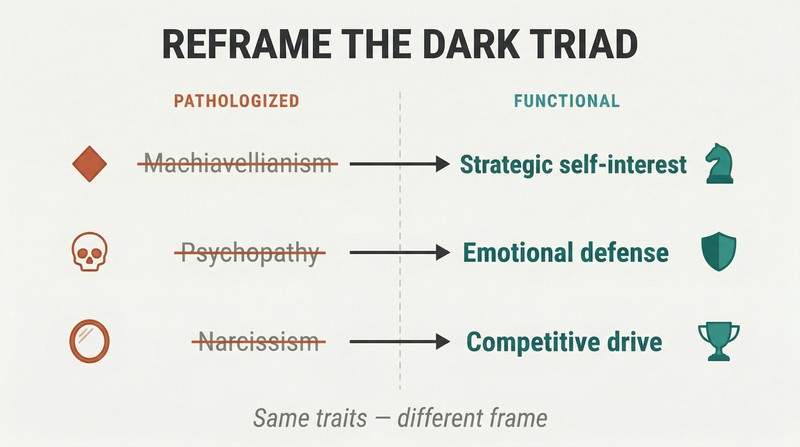
Dark triad rebranded. Stone argues Machiavellianism, psychopathy, and narcissism are masculine behavior pathologized by a culture hostile to masculinity. Machiavellianism is strategic self-interest — not evil scheming. Emulated psychopathy is the ability to mute empathy when it's weaponized against you — not cruelty, but defense. Healthy narcissism is the competitive drive to prove capability through achievement, unlike unhealthy narcissism where identity is invented and requires constant fuel from others.
The killology parallel. The military couldn't teach soldiers psychopathy but trained them to bypass civilian instincts — using silhouette targets instead of bullseyes so soldiers wouldn't connect distant figures with human beings. Similarly, you can desensitize yourself to rejection by breaking intimidating interactions into discrete, learnable steps. The fear becomes manageable when all you see is the next silhouette.
Men argue for truth, women for status — stop playing her game
“Actions are always honest. Words are always dishonest.”
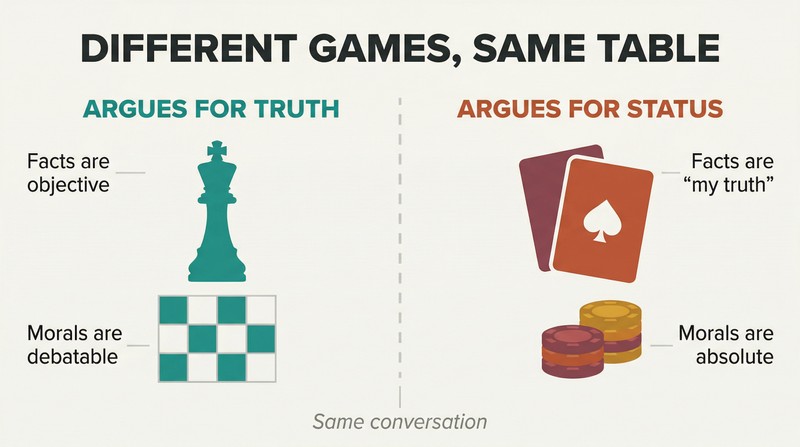
A fundamental disconnect. Men bring factual objectivity and moral subjectivity to arguments — truth is singular, but right and wrong depend on who benefits. Women bring factual subjectivity and moral objectivity — truth is "my truth," but morality is universal and non-negotiable. Men argue to discover what's accurate; women argue to establish who's higher status. Every argument ending with character attacks isn't a tangent — for her, your character is the entire point.
Read the subtext. Stone maps conversations onto two axes: status (higher/lower) and harmony (cooperative/adversarial), creating four quadrants of closed communication. Women speak almost exclusively in closed communication — language establishing hierarchy rather than exchanging information. The man who responds to emotional outbursts with logical explanations is playing chess while she's playing poker.
Covert contracts — the nice guy's hidden deal — repel everyone
“If you treat a woman like a celebrity, she'll treat you like a fan.”
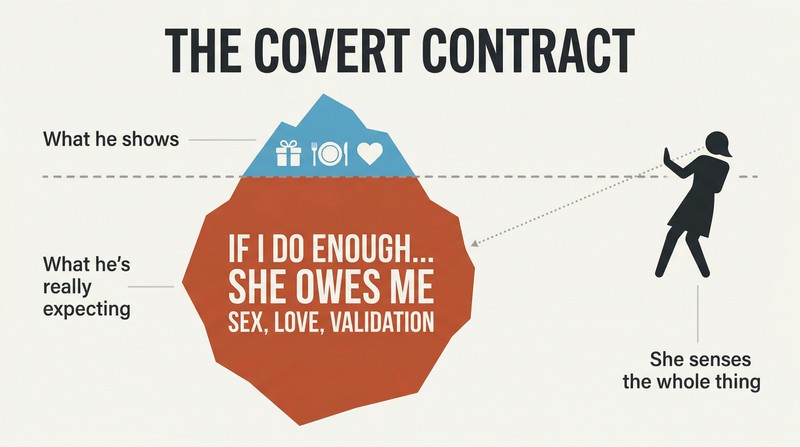
The unspoken bargain. A covert contract, coined by Dr. Robert Glover, is the nice guy's secret arrangement: "If I do enough for her without asking, she'll read my mind and give me what I want." Men give backrubs expecting sex. They buy dinners hoping for love. Nothing is spoken aloud because verbalizing risks rejection — which the nice guy's limbic brain processes as abandonment by mom.
Women sense the strings. That vague "creepy" feeling women can't articulate is the covert contract leaking through. These patterns trace to failed parenting strategies where boys learned to manage mom's unpredictable moods as a survival strategy, then replicated that template with every woman afterward. The fix is blunt: if you'd resent her for not reciprocating your gift, don't give it. Dinner dates are a reward for good behavior, not an interview for sex.
When she pushes, repeat your boundary — never defend or explain
“You lose because you give up too easily.”
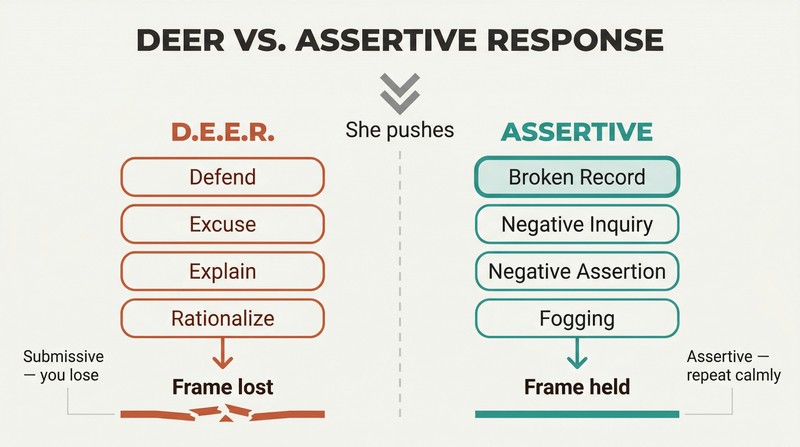
DEER kills frame. Defending, Excusing, Explaining, and Rationalizing are submissive reactions to frame challenges. When your wife demands you justify a decision, she isn't seeking information — she's testing whether you'll submit to her as an authority. Stone's primary tool is Broken Record: state your boundary calmly, without elaboration, and repeat until compliance. "We aren't doing that." Again. And again.
Four assertiveness tools work together:
1. Broken Record — repeat the boundary, ignore all tangents and frame-shifting
2. Negative Inquiry — "What specifically should I change?" forces articulation or reveals venting
3. Negative Assertion — own mistakes without groveling: "Damn, didn't realize how late it was"
4. Fogging — acknowledge feelings without confirming accusations: "If I were cheating, you'd be the first to know"
If you don't know which tool to use, shut up. You won't win, but you won't lose either.
Women adapt to the strongest frame in the room
“Valuable men are the containers and women are the water that fills the space they are given.”
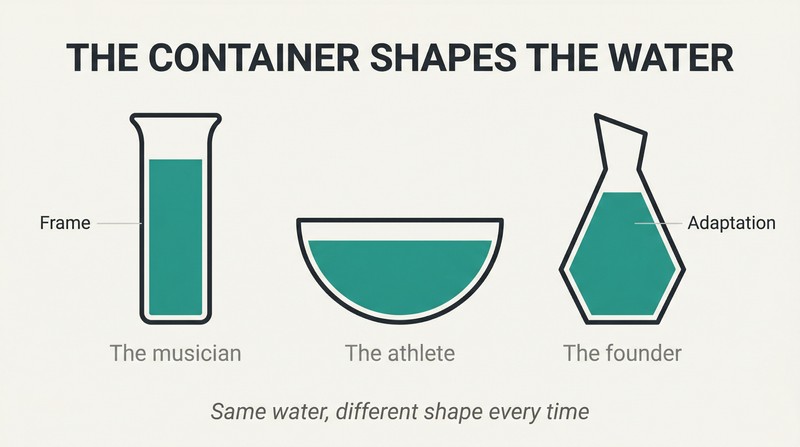
The mirroring effect. Women adopt the hobbies, interests, and values of men they're attracted to — not deliberately, but instinctively. When she dates a musician, she genuinely loves music. When she dates a climber, she genuinely loves climbing. Stone frames this as healthy borderline personality — the feminine counterpart to masculine narcissism. She's not lying; she truly believes each new interest is her own. When they break up, those interests vanish.
Value dictates everything. High-value men don't adapt to please women; women adapt to them. Low-value men conform to women's preferences, which signals low status. When a man is valuable, even rough edges look charismatic. When he's not, even kindness looks desperate. Stone's blunt rule: if a woman is being shitty to you, she's reflecting your own low value back at you.
Build a vision worth following, then never ask permission to lead
“If you think the problem is she doesn't let you lead, then you aren't in a place to lead yet.”
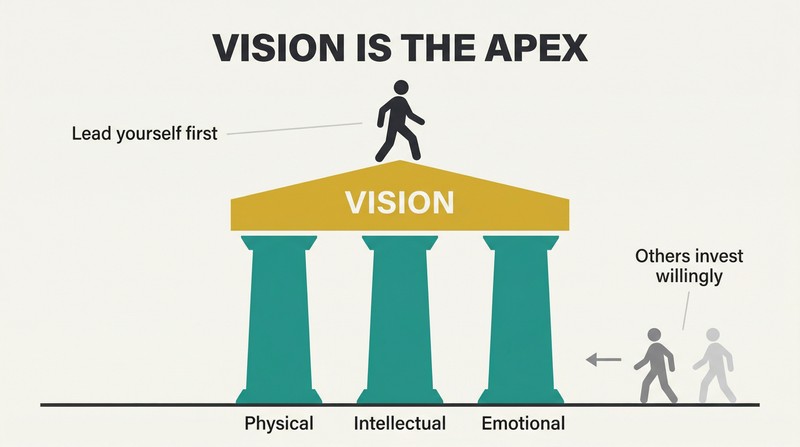
Vision is the apex. The three pillars — physical, intellectual, emotional — form a stable base, but without a compelling vision they support nothing. Vision isn't a five-year plan; it's a manifested idea of future growth that inspires others to invest in you. Steve Jobs attracted talent because Apple had vision, not because he offered the highest salary. Your relationship works identically: unless your wife sees an intended destination on the horizon, she has nothing to emotionally invest in.
The Tom Sawyer principle. Mark Twain's Tom made whitewashing look so enjoyable that other boys paid to paint his fence. Leadership works the same way. You lead yourself first — doing what needs doing, on your timeline, to your standard — and she either follows because your life looks worth joining, or she doesn't, and you find someone who sees the value.
Analysis
Stone's Praxeology: Frame is the systematization of a decade's crowdsourced male wisdom from anonymous internet forums — a strange provenance for a book containing genuinely useful psychological frameworks. The work sits at a fascinating intersection: part evolutionary psychology, part Stoic philosophy, part relationship guide, drawing from military strategy (OODA loops ), behavioral economics (praxeology), and clinical psychology (Glover's Nice Guy paradigm, Smith's assertiveness training). The tetrahedron framework — physical, intellectual, emotional pillars supporting vision — provides more structured architecture for male self-improvement than most competing works in the genre.
The book's central insight — that frame is identity rather than performance — represents a meaningful philosophical advance over pick-up artistry's 'frame control.' Where PUA taught men to wear confidence like a costume, Stone argues the costume must become the skeleton. This maps onto established research on self-schema and identity-behavior feedback loops, even if Stone would never cite it in those academic terms. The work's greatest strengths are its practical tools: the assertiveness framework (Broken Record, Fogging, Negative Inquiry, Negative Assertion) is borrowed from Manuel Smith but applied with real-world specificity that clinical settings rarely achieve. The emasculation paradox captures a genuine relational dynamic that psychology has documented but rarely articulated so bluntly. The OODA loop application to personal development is genuinely novel.
Its biggest limitation is frequent conflation between evolutionary tendencies and individual behavior — blanket statements about women that treat statistical distributions as universal rules. The dark triad reframing is provocative and partially correct (healthy assertiveness has been pathologized), but risks providing rhetorical cover for genuinely harmful behavior in readers who lack the calibration Stone insists upon. He acknowledges this implicitly with his 'tools are amoral' caveat, but the line between strategic self-interest and manipulation blurs frequently throughout.
What elevates the book above its genre peers is its explicit rejection of ideology: use what works, discard what doesn't, write in pencil not ink. In a space crowded with gurus selling certainty, Stone's insistence on praxeology over dogma is refreshingly honest — even when his specific prescriptions are not for everyone.
Review Summary
Praxeology, Volume 1 receives high praise for its insightful content on masculinity, self-improvement, and relationships. Readers appreciate the practical tools, engaging writing style, and comprehensive approach to personal development. The book is lauded for its depth, real-life examples, and fresh perspective on male-female dynamics. However, some reviewers criticize the numerous grammatical errors and typos, suggesting the need for better editing. Despite these technical issues, most readers find the book valuable and recommend it as a must-read for men seeking personal growth and better relationships.
People Also Read

 Immersive
 Immersive
 Immersive

Glossary
Frame
Your deep narrative and identityThe totality of how a person conceptualizes, processes, and reacts to the world. Not a technique or performance but an internalized worldview. Structured as a tetrahedron with physical, intellectual, and emotional pillars supporting a vision. Everyone has frame; the question is whether yours serves you or someone else.
Tetrahedron of Frame
Four-part framework for self-actualizationA three-sided triangular pyramid organizing frame's components: the physical pillar (fitness, style, hygiene), intellectual pillar (mental models, strategy), and emotional pillar (assertiveness, shedding nice guy behaviors) form the base, supporting the apex—vision, a man's coherent goals and purpose.
OODA Loop
Iterative decision-making cycleObserve, Orient, Decide, Act—a process developed by Air Force strategist John Boyd, adapted for personal development. After acting, you observe results and repeat the loop. The faster you iterate, the faster you calibrate. Stone considers this the core process for applying mental models to real life rather than just reading about them.
Covert Contract
Unspoken expectation of reciprocityCoined by Dr. Robert Glover in No More Mr. Nice Guy. An unverbalized arrangement where a man performs acts of service or generosity with the hidden expectation of receiving validation, sex, or love in return—without ever stating the expectation. When unfulfilled, it breeds resentment. Women sense these contracts as 'creepy' without being able to articulate why.
DEER
Submissive verbal response patternAcronym for Defend, Excuse, Explain, Rationalize—the four submissive responses men default to when their decisions are challenged. DEERing signals that the challenger holds authority over the man's choices. Stone treats it as the verbal signature of weak frame and the primary behavior to eliminate.
Emasculation Paradox
Submission breeds the feared outcomeThe feedback loop where men submit to women's emotional demands to avoid conflict, but that submission signals weakness, breeds contempt, and makes the feared outcome (divorce, loss of respect) more likely. Originally articulated by author Keoni Galt. Stone considers it one of the most destructive patterns in modern marriages.
Broken Record
Boundary enforcement through repetitionAn assertiveness tool from Manuel Smith's When I Say No I Feel Guilty, adapted by Stone for relationship frame. The technique involves calmly repeating your stated boundary without anger, elaboration, or engagement with tangential arguments. Prevents frame-shifting—where women redirect conversations to find manipulative openings.
Fogging
Acknowledge feelings without validating accusationsAn assertiveness technique for responding to emotional accusations without either confirming the accusation or invalidating the accuser's feelings. Example: responding to 'Are you cheating?' with 'If I were, you'd be the first to know' rather than defensive denial, which paradoxically solidifies suspicion in her mind.
The Hamster
Women's emotional feedback loopA mental model describing how women process emotions through verbalization in a cyclical pattern—like a hamster spinning on a wheel. When women lack social outlets to process feelings, they babble and probe. Men with strong frame can provide a narrative that leads women off the wheel; men without frame get drawn into it.
Dancing Monkey Attraction Programme
Checklist self-improvement for sexStone's derisive term for men who treat self-improvement as a to-do list aimed at earning sex rather than building genuine frame. These men lift, dress better, and flirt—but as performances to fulfill a covert contract with their wives rather than as expressions of an authentic identity. Typically flames out after about two years.
Whisper's Rule
Translating women's advice accuratelyA mental model for interpreting female advice by inserting 'I want to feel like' or 'I want people to think' before any statement. 'Just be yourself' becomes 'I want to feel like you're just being yourself.' Named after the pseudonymous author Whisper, it reframes women's solipsistic advice as descriptions of desired outcomes rather than actionable instructions.
Rule Zero
Male-centric strategy and identityThe foundational and only rule of Stone's framework: male-centric sexual strategy and a positive male identity. Anyone involving themselves in this space for any other reason—ideology, morality, someone else's benefit—is shown the door. All other concepts in the book serve this singular principle of rational male self-interest.
FAQ
What's "Praxeology, Volume 1: Frame" about?
- Self-Actualization Focus: The book is centered on self-actualization for the modern man, emphasizing the development of a strong personal frame.
- Praxeology Approach: It uses praxeology, the study of human action, to explore intersexual dynamics and personal development without ideological bias.
- Four Pillars of Frame: The book outlines the Tetrahedron of Frame, which includes the Physical, Intellectual, Emotional, and Vision pillars.
- Practical Guidance: It provides practical advice and mental models for men to improve their lives, relationships, and self-perception.
Why should I read "Praxeology, Volume 1: Frame"?
- Objective Insights: The book offers an objective look at male self-improvement, avoiding moral judgments and focusing on what works.
- Comprehensive Framework: It provides a comprehensive framework for understanding and improving various aspects of life, from physical fitness to emotional resilience.
- Actionable Advice: Readers receive actionable advice and strategies that can be tailored to individual situations and goals.
- Unique Perspective: The book combines elements of psychology, sociology, and personal development in a unique way that challenges conventional self-help narratives.
What are the key takeaways of "Praxeology, Volume 1: Frame"?
- Frame is Essential: Developing a strong personal frame is crucial for self-actualization and effective interaction with others.
- Four Pillars: The Tetrahedron of Frame—Physical, Intellectual, Emotional, and Vision—provides a structured approach to personal development.
- Praxeology Over Ideology: The book emphasizes a praxeological approach, focusing on practical actions and outcomes rather than ideological beliefs.
- Self-Responsibility: It encourages taking responsibility for one's actions and decisions, fostering independence and self-reliance.
How does Rian Stone define "Frame" in the book?
- Conceptualization of Frame: Frame is described as the way one conceptualizes, processes, and reacts to the world, forming the foundation of personal decisions and actions.
- Not Stoicism or Dominance: Frame is not about being stoic or dominant; it's about having a deep narrative that guides one's life.
- Internalized Identity: It is not something you do but who you are, reflecting your values and vision.
- Foundation for Vision: Frame supports the development of a personal vision, guiding life choices and interactions.
What is the Tetrahedron of Frame?
- Four Pillars: The Tetrahedron of Frame consists of the Physical, Intellectual, Emotional, and Vision pillars.
- Physical Pillar: Focuses on physical health, fitness, and appearance as foundational elements of self-respect and authority.
- Intellectual Pillar: Involves internal growth, problem-solving, and developing mental models for better decision-making.
- Emotional Pillar: Addresses emotional resilience, self-awareness, and the ability to manage instincts and emotions effectively.
What is Praxeology, according to Rian Stone?
- Study of Human Action: Praxeology is the study of human action and conduct, focusing on practical outcomes rather than ideological ideals.
- Hypothetical Imperatives: It involves hypothetical imperatives, guiding actions based on desired outcomes rather than moral judgments.
- Objective Analysis: Praxeology emphasizes objective analysis of actions and their consequences, allowing for adaptable and effective strategies.
- Contrast with Ideology: Unlike ideological approaches, praxeology does not prescribe a single "right" way but offers tools for individual decision-making.
How does "Praxeology, Volume 1: Frame" address the concept of masculinity?
- Masculine Behaviors: The book explores masculine behaviors through the lens of the Dark Triad personality traits—narcissism, psychopathy, and Machiavellianism.
- Healthy Narcissism: It encourages embracing healthy narcissism as a natural part of masculinity, focusing on self-improvement and confidence.
- Critique of Modern Views: The book critiques modern views that villainize masculinity, advocating for a balanced understanding of masculine traits.
- Tool for Self-Improvement: Masculinity is presented as a tool for self-improvement, not as a fixed identity or societal role.
What are the Dark Triad personality traits, and how are they relevant in the book?
- Three Traits: The Dark Triad consists of narcissism, psychopathy, and Machiavellianism, each with specific characteristics.
- Practical Application: The book discusses how these traits can be harnessed positively for personal development and relationship management.
- Narcissism: Encourages healthy narcissism, focusing on self-confidence and self-worth derived from achievements.
- Machiavellianism and Psychopathy: These traits are explored for their strategic and emotional resilience benefits, not as negative or harmful behaviors.
How does the book suggest handling relationships and intersexual dynamics?
- Understanding Dynamics: It emphasizes understanding the underlying motivators of male and female behaviors in relationships.
- Avoiding Covert Contracts: The book advises against covert contracts, where unspoken expectations lead to resentment and conflict.
- Assertiveness and Boundaries: Encourages assertiveness and setting clear boundaries to maintain respect and attraction in relationships.
- Vision and Leadership: Suggests that having a clear vision and leading by example are key to successful relationships.
What is the "Emasculation Paradox" mentioned in the book?
- Definition: The Emasculation Paradox describes how men who submit to their partners to avoid conflict often end up losing respect and facing the very issues they sought to avoid.
- Supplicating Behavior: Supplicating behavior leads to a loss of attraction and respect, undermining the relationship.
- Assertiveness as a Solution: The book suggests assertiveness and maintaining personal boundaries as solutions to this paradox.
- Impact on Relationships: Understanding and addressing the Emasculation Paradox is crucial for maintaining healthy and balanced relationships.
What role does "Vision" play in "Praxeology, Volume 1: Frame"?
- Vision as a Pillar: Vision is the final pillar of the Tetrahedron of Frame, representing the culmination of personal development.
- Guiding Life Choices: It involves setting a clear direction and purpose for one's life, guiding decisions and actions.
- Inspiring Others: A strong vision can inspire others to follow and support, enhancing personal and professional relationships.
- Dynamic and Adaptable: Vision is not static; it can evolve as one grows and changes, reflecting new goals and aspirations.
What are the best quotes from "Praxeology, Volume 1: Frame" and what do they mean?
- "Frame. Just. Is.": This quote emphasizes that frame is an inherent part of one's identity, not a behavior or tactic to be adopted temporarily.
- "From your work comes self-respect.": Highlights the importance of action and achievement in building self-worth and confidence.
- "You belong to you.": Encourages self-ownership and responsibility, rejecting external validation and control.
- "The only person you wear perfume for is you.": Suggests that personal choices should be made for oneself, not to please or impress others.

Download PDF
Download EPUB
.epub digital book format is ideal for reading ebooks on phones, tablets, and e-readers.








































