


Key Takeaways
That baffling emotional storm is a test you didn't know you were taking
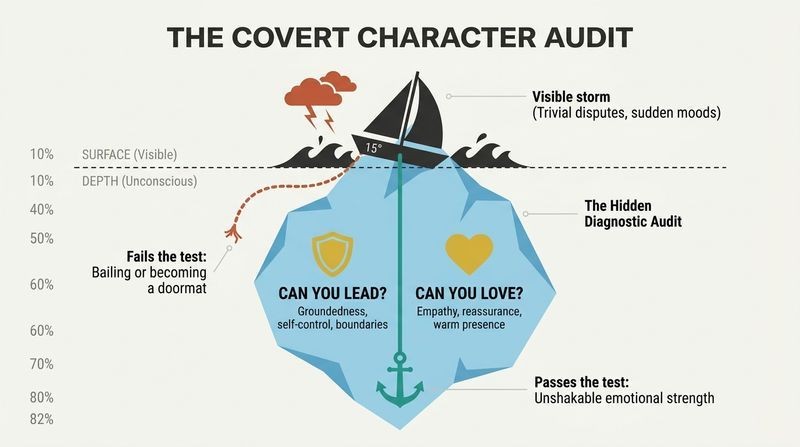
Women subconsciously audit your character. Bryans opens with three men: Richard bails whenever a woman turns moody, Mark is the doormat husband whose wife has lost all attraction, and David weathers his wife's storms and stays adored and desired. The difference isn't looks or income. It's how each responds to a woman's covert probing of two questions: can you lead, and can you love?
The trap is invisible on both sides. When she explodes over something trivial and your apologies only make it worse, you failed a pop quiz you never studied for. Most women don't consciously know they test either. Bryans frames this as the murky underside of gender dynamics, and warns that once you see it, you cannot unsee it.
The book's thesis mirrors what attachment researchers call proximity-seeking behavior: partners probe for responsiveness under stress. Bryans dresses this in provocative language, but the underlying observation (that conflict often masks a bid for reassurance) is echoed by John Gottman's research on how couples handle emotional bids. The framing is unabashedly traditionalist, assuming a man-leads dynamic, which limits its scope. Still, the core reframe is useful across relationships: hostility is frequently a coded request rather than a literal grievance. Reading emotional outbursts as data rather than personal attacks is a skill with applications far beyond romance.
Learn the three tests: congruence, compliance, and commitment
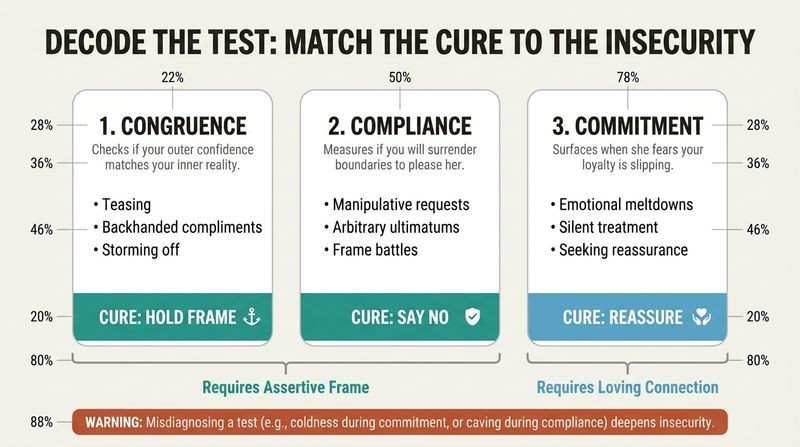
Each test probes a different fear. Bryans splits female testing into three categories:
1. Congruence tests check whether your outer confidence matches your inner reality (teasing, backhanded compliments, storming off to see if you chase).
2. Compliance tests measure how much you'll surrender your boundaries to please her (small manipulative requests, ultimatums).
3. Commitment tests surface when she fears your loyalty is slipping (emotional meltdowns, silent treatment).
The cure differs per test. Congruence and compliance tests demand assertiveness: hold your frame, say no. Commitment tests demand the opposite: warmth, reassurance, and demonstrated love. Misdiagnose and you fail. A man who acts cold during a commitment test, or caves during a compliance test, deepens the very insecurity she's trying to soothe.
This diagnostic split is the book's most practical contribution. It functions like a triage system: identify which need is failing before choosing a response, rather than defaulting to one style. The insight parallels situational leadership theory, where effective leaders flex between directive and supportive modes based on the follower's state. The weakness is attribution: Bryans reads nearly all difficult behavior as a test, which risks pathologizing legitimate complaints. A partner asking you to come home earlier may simply want you home earlier. The framework works best when paired with genuine curiosity about what the person actually needs.
Testing is her lie detector because words can be faked
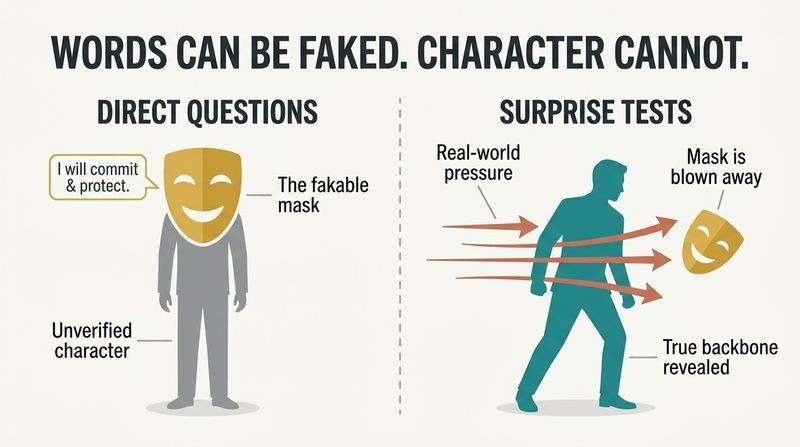
A test extracts truth that questions can't. Bryans argues women test because direct questions invite lies. Ask a man if he makes good money, if he's a good lover, if he'll be a good father, and he can simply say yes. A test reveals character under pressure, like a professor giving an exam instead of trusting students to self-report what they learned. The catch: her tests are surprise pop quizzes, not scheduled finals.
It's a survival filter. He frames it as weeding out three dangerous types: the weak man with no backbone, the wavering man who can't commit, and the predatory man with malevolent intent. Historically, a woman betting wrong risked her safety and her children's. More interest and investment means more testing, not less.
The evolutionary framing is standard mate-selection psychology: costly-to-fake signals reveal genuine quality, an idea drawn from Amotz Zahavi's handicap principle in biology. There is real logic in preferring behavior over self-report, since actions are harder to counterfeit than claims. The scientific caveat is that evolutionary storytelling is easy to construct and hard to falsify, and the book presents it as settled fact. It also universalizes: not every woman operates from survival anxiety, and cultural context shapes mate preferences heavily. Read as a useful heuristic about revealed versus stated preferences, it holds; read as biological destiny, it overreaches.
Judge her request by matching its tone against its content
Borrow the four-box filter. Bryans adapts relationship author Athol Kay's model for deciding when to comply. Cross a request's reasonableness with its tone:
1. Reasonable request, reasonable tone: just help her (pass the flour). Reward good behavior.
2. Reasonable request, disrespectful tone: a congruence test. Say you'll help once she asks respectfully.
3. Unreasonable request, pleasant tone: a compliance test. Don't cave just because she asked sweetly.
4. Unreasonable request, hostile tone: verbal abuse. Refuse, and disengage until she resets.
Exception: mission-critical tasks. Paying bills, home emergencies, and family crises get done regardless of whether it's a test, not out of submission but commitment to the greater good.
This grid is the book's cleanest decision tool because it prevents the two failure modes it targets: reflexive obedience and reflexive defiance. By separating what is asked from how it is asked, it lets a man reward civility while refusing manipulation, which is emotionally intelligent boundary-setting. The framework resembles assertiveness training used in clinical psychology, distinguishing aggressive, passive, and assertive responses. One risk: labeling a request unreasonable is subjective and can become a license to dismiss valid needs. The mission-critical carve-out is important, acknowledging that principled flexibility is not weakness, which softens the book's harder edges.
Refuse the bait: her jab is usually not about you
Recognize the setup and stay silent. Bryans describes moments when a pleasant conversation suddenly curdles: her tone sharpens, alarm bells ring in your gut, and you sense a fight you cannot win. That snarky, non-question remark is bait designed to trigger guilt, shame, or anger so you chase, apologize, or blow up. His counsel: do not acknowledge it exists. Note that a genuine question can't be ignored, but a barbed statement can.
Depersonalize in the moment. The mental key is repeating that her insecurity is hers, not your failure. You are not responsible for managing every mood swing. When you stay composed, you can see the test clearly and address the real issue later, when she's emotionally balanced rather than looking for a reaction.
This maps onto Stephen Karpman's drama triangle, where taking the bait casts you as either persecutor or rescuer in a script with no winning move. The strategic non-response is essentially emotional non-reactivity, a concept central to Murray Bowen's family systems therapy, where the differentiated self stays connected without absorbing another's anxiety. The advice is sound psychology repackaged. The danger lies in overuse: chronically ignoring a partner's distress as mere bait can slide into stonewalling, which Gottman identifies as corrosive to relationships. The book's own qualifier, revisit the issue when calm, is what keeps this from becoming avoidance.
Disarm a verbal jab by agreeing then exaggerating it absurdly
Turn her sting into playfulness. For congruence tests delivered as teasing, Bryans recommends agreeing with her provocation, then amplifying it to comic extremes. Called arrogant? Grin and say you've heard that before. Accused of always being late? Only when picking up beautiful women. Agreeing signals you're unshaken; exaggerating exposes how absurd the jab was. Done with self-amused confidence, it sparks attraction instead of an argument.
The three-word neutralizer. When she's on a hostile tirade purely to rattle you, let her finish, meet her eyes, and calmly ask, "Are you done?" This refuses to play her game. If it calms her, welcome her back warmly. If she escalates, walk away. Both tools only work if she's genuinely testing, not voicing a real unmet need.
The agree-and-amplify technique is lifted from improv comedy's yes-and principle and from pickup-artist communities, but its deeper mechanism is paradoxical: refusing to defend against an accusation removes its power, a move therapists call not taking the bait or reactance reduction. Humor as de-escalation is well supported; couples who can joke mid-conflict recover faster. The riskier tool is "Are you done?" which can read as contemptuous dismissal, and contempt is the single strongest predictor of divorce in Gottman's longitudinal work. The book hedges by distinguishing tests from real needs, but in practice that line is blurry, and misreading genuine pain as theatrics can wound.
Stop lying to dodge her disapproval; it quietly kills attraction
Little white lies signal a boy, not a man. Bryans lists the cowardly classics: "I'll be there soon," "I already did it," "It didn't cost that much," "I'm fine." Each dodges a woman's reaction, and each betrays that her mood, not your principles, governs your honesty. If you edit the truth to avoid her wrath, you've made her your mommy and yourself the child she cannot respect or desire.
Hold your position without cruelty. He recounts refusing to buy a Black Friday TV his wife lobbied for. He stuck to his frugality, explained calmly, and she ended up thankful and more trusting of his judgment. The paradox: telling a woman no, and meaning it, often raises your attractiveness rather than lowering it. Seek her advice, but never make her approval your compass.
The claim that honesty and firmness generate attraction aligns with research on authenticity and trust: reliability under the temptation to appease builds what economists call credible commitment. A partner who never risks disapproval also never demonstrates a spine worth trusting. The distinction between seeking advice and seeking approval is genuinely wise, echoing the difference between consultative and codependent decision-making. The blind spot is that Bryans frames nearly every accommodation as capitulation, underweighting that healthy partnerships involve mutual influence. Gottman found that men who accept influence from their wives have more stable marriages. Standing firm on frugality is principle; standing firm on everything is rigidity dressed as strength.
When she says "I'm hungry," she's asking you to decide
Lead by acting, not by asking. Some tests, Bryans argues, are engineered to expose a man who won't decide. When your girlfriend says she's hungry with a full fridge, or asks what's for dinner, she often wants you to take the wheel. The passing move is decisiveness: "Grab your shoes, let's go eat," or "I'm craving steak tonight." She rarely cares about the specific choice; she craves the experience of being led.
Do more, ask less. Rather than asking if she wants a massage, announce you're giving her one. Bryans calls this making mistakes of ambition over mistakes of apathy. If she doesn't want it, she'll say so, but she'll respect the initiative. The caveat he adds: leave room for her input, and never bully. Decisiveness attracts; domineering repels.
There is behavioral truth here: chronic decision-deferral ("whatever you want, honey") offloads cognitive and emotional labor onto a partner, breeding resentment, a dynamic well documented in research on the mental load. Taking initiative can genuinely relieve that burden. The generalization is the problem. Reading "I'm hungry" as a leadership test assumes a fixed gender script, when the statement may just be information. The healthier universal principle buried inside is proactivity: contributing decisions rather than always outsourcing them. Modern relationship research favors flexible role-sharing over fixed hierarchy, so the actionable kernel (be decisive, reduce your partner's load) survives even if the traditionalist packaging does not.
Show vulnerability from strength, and reject her rejection
Open the door yourself, don't have it kicked in. Bryans separates healthy vulnerability from leaky weakness. A man in control chooses when to let a woman in ("I need to get something off my chest") rather than constantly spilling under every stress. He cites the film 8 Mile: Eminem's character disarms his rivals by rapping his own humiliations first, leaving them no ammunition. Owning your flaws aloud beats hiding them.
Meet abandonment fears with steady love. A woman scarred by a父 who left or a brutal breakup may test by pushing you away, half-hoping you'll stay. When she snaps "I'm leaving for my parents'," the weak man says "fine" and the wimp begs. The strong response rejects the rejection: "No, this is your home, and I want to work through this because I love you." Firm and tender at once.
The insight that vulnerability lands differently depending on established trust is supported by disclosure research: self-disclosure builds intimacy when reciprocal and well-timed, but backfires when premature or one-sided. Brené Brown's work reframes vulnerability as courage, which complements Bryans's point that chosen openness signals strength while involuntary leaking signals instability. "Rejecting her rejection" resembles what attachment therapists do with the push-pull of anxious attachment: providing a secure base that disconfirms the fear of abandonment. The caution Bryans himself raises is vital: without boundaries this becomes enabling, and pursuing someone who genuinely wants distance can shade into disrespect for their autonomy.
Anchor your worth in principles, not in her approval
Frame is the integrity of your own mind. Bryans's deepest layer argues that communication tricks are mere training wheels. The real fix is becoming congruent at the core: a man whose actions flow from unbending principles. He quotes Emerson's Self-Reliance on keeping the independence of solitude amid the crowd. When your self-worth is welded to your relationship's health, her every bad mood collapses you.
Build the man and the tests fade. He confesses melting down at a couples' trivia game because he'd tied his ego to appearing to have a perfect marriage. The remedy is self-improvement: fitness, career, character. A woman struggles to disrespect a man who leads himself well, and she tests less because she trusts more. As he puts it, women treat you how you treat you. Become genuinely secure and the games lose their grip.
This closing reframe rescues the book from pure tactics. The principle that self-esteem should be internally sourced rather than contingent on a partner echoes Nathaniel Branden's work on self-esteem and Ryan and Deci's self-determination theory, where autonomy and internal locus of control predict wellbeing. The trivia-game confession humanizes the author and illustrates ego-contingency vividly. The claim "women treat you how you treat you" is a memorable oversimplification: self-respect shapes how you enforce boundaries, but it does not guarantee others reciprocate, and abusive dynamics are not cured by the victim's self-improvement. Read as a call to build a life of intrinsic worth, though, it is the book's most durable and least gendered advice.
Analysis
Bruce Bryans's 2014 self-help book is a thesis-driven manual arguing that women subconsciously test men to verify two capacities: leadership and love. Structured across eight chapters moving from why women test, to how, to communication tactics, to inner character work, it targets men who lean toward people-pleasing passivity and want a traditionalist, man-leads dynamic. Its strength is a genuinely useful diagnostic: the congruence, compliance, and commitment taxonomy, plus the Athol Kay tone-versus-content grid, give readers a decision framework rather than vague encouragement.
The book sits squarely in the neo-masculine, red-pill-adjacent genre, sharing DNA with pickup-artist material (frame, agree-and-amplify) and evolutionary mate-selection psychology. Its intellectual borrowings are notable: Stephen Covey's active listening, Dale Carnegie, Emerson's Self-Reliance, and Athol Kay's fitness-test model. Bryans's contribution is synthesis and accessibility, translating these into blunt, memorable scripts.
The central limitation is interpretive overreach. By framing most difficult female behavior as a test to be passed rather than a communication to be understood, the book risks teaching men to dismiss legitimate grievances as manipulation. This can inoculate against genuine accountability. Gottman's research would flag several recommended moves (the dismissive "Are you done?", refusing to ever sleep elsewhere, reading every request as a power play) as potential vectors for contempt and stonewalling, the strongest divorce predictors.
The biology is presented as settled when it is contested, and the rigid gender essentialism (equal but different, women want to submit) will alienate readers outside that worldview. Yet the book's final turn redeems much of it: the argument that tactics are hollow without authentic self-worth, principled living, and genuine self-improvement points toward internal-locus psychology that is broadly validated. Stripped of its provocations, the durable message is that emotional non-reactivity, honest boundaries, and self-respect improve relationships, advice that transcends its polarizing packaging.
Review Summary
What Women Want When They Test Men receives mostly positive reviews, with readers praising its insights into female psychology and relationship dynamics. Many found it helpful in understanding women's behavior and improving their relationships. Some criticize it for being overly simplistic or potentially reinforcing toxic masculinity. The book's main message is that women test men to assess their strength and leadership qualities, and men should maintain their masculinity while being understanding of women's emotional needs. Some readers recommend it for both men and women seeking relationship advice.
People Also Read









Glossary
Congruence test
Checks if confidence is realAny conscious or subconscious behavior a woman uses to see whether a man's outward presentation matches his true inner self. Examples include teasing, backhanded compliments, or storming off to see if he chases. Bryans says these are best passed through calm assertiveness and, ultimately, by actually becoming congruent rather than performing confidence.
Compliance test
Measures how much you'll surrenderA subtype of testing where a woman makes small or large requests, sometimes manipulative, to gauge how far a man will bend his own boundaries to please her. The passing response is refusing to comply automatically or demanding an equal exchange, which paradoxically signals high self-worth rather than neediness.
Commitment test
Probes your loyalty and loveA test that surfaces when a woman fears a man's devotion is slipping, often shown through emotional meltdowns, silent treatment, or neediness. Unlike congruence tests, these require warmth and reassurance to pass, not assertiveness. Bryans warns that acting cold or amused during one deepens her insecurity and pushes her toward exiting.
Frame
Your self-belief and mental integrityThe set of core self-beliefs through which a man interprets events and defines the outside world in relation to himself. A strong frame means unshakable conviction in one's values regardless of others' opinions. Bryans treats maintaining frame as central to passing tests: responding from a position of self-approval rather than seeking a woman's approval.
Poking the bear
Provoking a man for passionBryans's term for when a wife or girlfriend deliberately irritates a passive man to provoke a strong, assertive, often sexual response. He argues some women unconsciously trigger conflict because intense emotion translates into passionate intimacy, and suggests men preemptively supply that intensity to reduce the need for provocation.
Ignore the bait
Refuse to react to jabsA communication tactic for handling barbed, non-question remarks designed to trigger guilt, shame, or anger. Because it is a statement rather than a question, a man can decline to acknowledge it entirely, stay composed, remind himself the insecurity is hers, and address the underlying issue later when she is calmer.
Agree and exaggerate
Disarm teasing with amplified humorA technique for disarming congruence tests delivered as teasing or insults. The man first agrees with the provocation, then playfully exaggerates it to absurdity, delivered with self-amused confidence. This empathizes with her point while exposing the statement's absurdity, sparking attraction instead of an argument. Bryans notes it only works when the remark is genuinely a test.
Three-Word Neutralizer
Calmly asking 'Are you done?'Bryans's response to a hostile emotional tirade meant to make a man lose composure. After she finishes, he meets her eyes and calmly asks "Are you done?", refusing to play the game. It either de-escalates her aggression, after which he welcomes her back warmly, or escalates it, in which case he walks away.
FAQ
What's "What Women Want When They Test Men" about?
- Understanding Female Behavior: The book explores the concept of women testing men to assess their capability to lead and love. It delves into the subconscious nature of these tests and how they affect relationships.
- Three Male Archetypes: It introduces three male characters—Richard, Mark, and David—to illustrate different responses to female behavior and the outcomes of these interactions.
- Decoding Tests: The book aims to help men decode female behavior, pass these tests, and attract women through authenticity and strong personal boundaries.
- Gender Dynamics: It discusses the traditional male-female dynamics and how understanding these can lead to more fulfilling relationships.
Why should I read "What Women Want When They Test Men"?
- Improve Relationships: The book provides insights into improving romantic relationships by understanding and responding to female tests effectively.
- Self-Improvement: It encourages men to develop strong personal boundaries and self-confidence, which are attractive traits to women.
- Practical Advice: Offers practical advice on how to handle various situations with women, from dating to long-term relationships.
- Empowerment: Empowers men to take leadership roles in relationships, which can lead to more balanced and satisfying partnerships.
What are the key takeaways of "What Women Want When They Test Men"?
- Women Test Subconsciously: Women often test men subconsciously to assess their strength and reliability, which is crucial for relationship success.
- Authenticity is Key: Being authentic and having strong personal boundaries are essential for passing these tests and maintaining attraction.
- Leadership and Love: Women desire men who can lead confidently and love passionately, balancing assertiveness with empathy.
- Continuous Testing: Understanding that women will continue to test men throughout relationships, and learning to handle these tests is vital.
How does Bruce Bryans suggest men handle female tests?
- Stay Calm and Confident: Respond to tests with calmness and confidence, showing that you are in control of your emotions.
- Set Boundaries: Establish and maintain strong personal boundaries to communicate self-respect and assertiveness.
- Be Authentic: Be genuine in your interactions, as authenticity is more attractive than trying to please or impress.
- Lead with Empathy: Balance leadership with empathy, understanding her needs while maintaining your own principles.
What are the different types of tests women use according to Bruce Bryans?
- Congruence Tests: These tests assess if a man's external behavior matches his internal beliefs and confidence.
- Compliance Tests: Women use these to see how much a man is willing to please her, often through requests or ultimatums.
- Commitment Tests: These tests gauge a man's emotional investment and loyalty, especially when a woman feels insecure.
- Emotional Tests: Women may exhibit emotional behavior to see if a man can handle her emotions and remain steadfast.
What is the "Tough But Tender Approach" in "What Women Want When They Test Men"?
- Balance of Strength and Empathy: This approach involves being firm in your boundaries while showing empathy and understanding.
- Encourage Communication: Promote open communication to address her needs and insecurities without compromising your principles.
- Lead with Compassion: Maintain leadership in the relationship by being compassionate and addressing issues with care.
- Avoid Enabling: Do not enable negative behavior; instead, encourage growth and maturity in the relationship.
How does Bruce Bryans define a "Congruence Test"?
- Consistency Check: A congruence test checks if a man's external actions align with his internal beliefs and confidence.
- Non-Verbal and Verbal: These tests can be non-verbal, like a woman storming off, or verbal, like teasing or insults.
- Challenge to Assertiveness: They challenge a man's assertiveness and ability to maintain his frame under pressure.
- Training Wheels: While communication strategies can help, true success comes from being genuinely congruent.
What advice does Bruce Bryans give for communicating with a testing woman?
- In Control, Not Controlling: Be in control of your emotions and responses without trying to control her.
- Agree and Exaggerate: Disarm her tests by agreeing with her and exaggerating the statement in a playful manner.
- Ignore the Bait: Avoid reacting to provocative statements designed to elicit an emotional response.
- Use the Three-Word Neutralizer: Calmly ask, "Are you done?" to defuse hostile or disrespectful behavior.
What role does authenticity play in "What Women Want When They Test Men"?
- Core Attraction Factor: Authenticity is crucial for attracting and maintaining a woman's interest and respect.
- Avoiding Facades: Men should avoid putting on a facade to please women, as this leads to incongruence and failure.
- Building Trust: Being genuine helps build trust and allows for deeper emotional connections.
- Foundation for Leadership: Authenticity is the foundation for effective leadership in a relationship, balancing strength with vulnerability.
How does Bruce Bryans suggest men build a better self-image?
- Develop Strong Principles: Live by unbending principles that guide decision-making and build self-esteem.
- Focus on Personal Growth: Invest in personal development to increase overall well-being and social value.
- Redefine Self-Worth: Base self-worth on personal achievements and values, not on external validation or relationship status.
- Embrace Vulnerability: Accept and express vulnerabilities honestly, which can strengthen relationships and self-confidence.
What are the best quotes from "What Women Want When They Test Men" and what do they mean?
- "Women want to be loved by a man who leads." This quote encapsulates the book's core message that women desire men who can confidently lead and love them.
- "Let her emotions wash over you like a crashing wave against an immovable rock." It emphasizes the importance of maintaining composure and strength in the face of emotional challenges.
- "A man’s principles are like streetlights that guide him along the dark, narrow paths of life." This highlights the significance of living by principles to navigate life's challenges and maintain integrity.
- "You won’t attract what you want, you’ll attract that which you are." This quote underscores the importance of self-improvement and authenticity in attracting the right partner.
How does "What Women Want When They Test Men" address the concept of leadership in relationships?
- Leadership Role: The book emphasizes the importance of men taking a leadership role in relationships, which is attractive to women.
- Balance of Power: It discusses the balance between being a caring lover and a firm leader, which is ideal for a healthy relationship.
- Decision-Making: Men are encouraged to make decisions confidently and assertively, which reassures women of their strength.
- Empathy and Understanding: Leadership is not about control but about understanding and meeting the needs of both partners.
About the Author
Other books by Bruce Bryans




Download PDF
Download EPUB
.epub digital book format is ideal for reading ebooks on phones, tablets, and e-readers.








































