

Key Takeaways
Women name 237 reasons for sex, from boredom to touching God
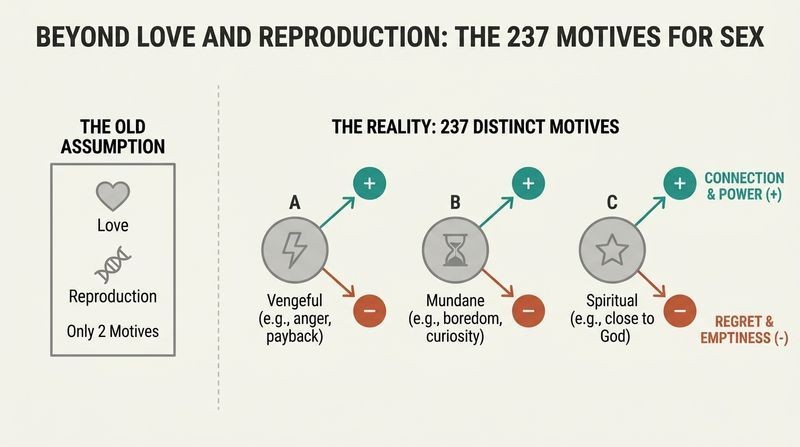
Sex is not one motive but hundreds. When psychologists Cindy Meston and David Buss surveyed over 1,000 women, they catalogued 237 distinct reasons for having sex, then clustered them statistically. The range shatters the old assumption that women have sex only for love or reproduction. Motives spanned the mundane (relieving boredom), the spiritual (feeling closer to God), the altruistic (boosting a partner's confidence), and the vengeful (punishing a cheating husband or giving an enemy a disease).
Success and failure appeared in every category. For each motive, some women reported ecstatic, connecting experiences and others reported loneliness and regret. The same act that made one woman feel powerful and desirable left another feeling emptier than before. The book's project is to map this psychological terrain honestly, using women's own words alongside laboratory science.
What's striking is how this inventory dismantles a cultural cliche without replacing it with another. Rather than arguing women are secretly like men or secretly romantic, the authors insist on irreducible complexity. The approach echoes Kinsey's mid-century cataloguing impulse but adds evolutionary theory as an organizing lens. One limitation worth naming: self-report studies capture what women are willing to disclose, not necessarily what drives them unconsciously. The heavily self-selected online sample (women who answered an ad about sexual motivation) may overrepresent the sexually adventurous or reflective. Still, as a corrective to reductive narratives, the sheer breadth of documented motives is genuinely clarifying.
Women can literally smell genetic compatibility in a man's sweat
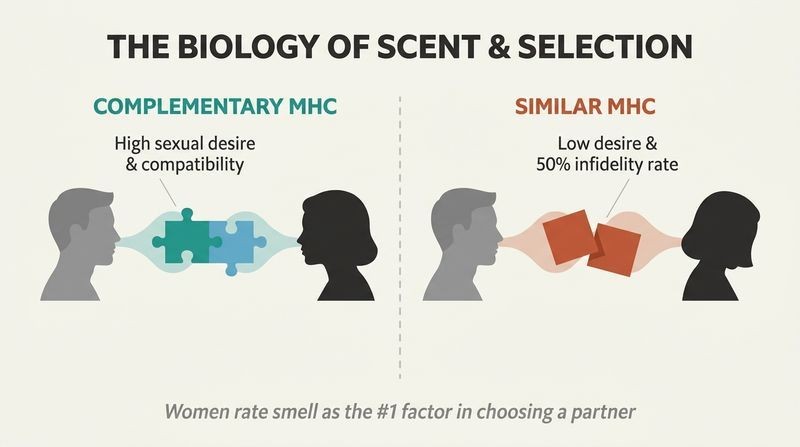
Scent ranks above sight for women choosing lovers. Brown University research using a sensory survey found women rate smell as the single most important sense in picking a partner. The deeper reason emerged from immunology. Genes in the major histocompatibility complex (MHC) govern disease resistance, and children benefit when parents have dissimilar versions. In a Brazilian study, women sniffed cotton pads worn by men and consistently preferred the odor of men whose MHC genes complemented their own, recoiling from those too genetically similar.
The stakes are real, not academic. When couples shared too many MHC genes, women reported wanting sex less, fantasizing more about other men, and cheating more often (a 50% infidelity rate among couples sharing half their MHC alleles). Women also smell body symmetry, a marker of good genes, most keenly during their fertile window.
The MHC findings are among the most replicated in human attraction research, though the famous sweaty T-shirt studies have faced scrutiny over sample sizes and whether hormonal contraception scrambles the effect (some studies suggest the pill reverses women's preferences, with unclear consequences for real mate choice). The evolutionary logic is elegant: disgust and desire operating as an unconscious genetic screening system. A fascinating downstream question the book raises but cannot resolve: if women choose partners while on hormonal birth control and later stop, does attraction shift? This intersects with pharmacology, epigenetics, and relationship stability in ways science is only beginning to probe.
Women's mate preferences flip across the ovulation cycle
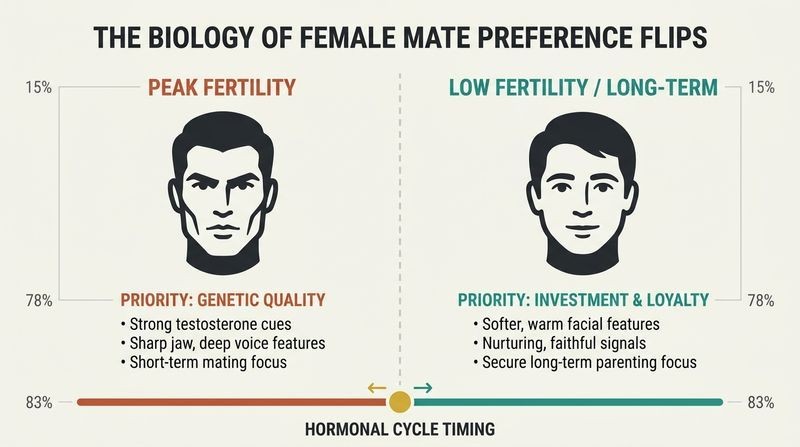
Two men live in every woman's ideal. Studies where women rated male faces at different cycle points revealed a dual strategy. Near ovulation, when conception is possible, women found highly masculine faces, deep voices, and bold movements sexiest, prizing testosterone-shaped cues that signal genetic health. During infertile phases and when evaluating husbands, they preferred slightly softer, less masculine faces that predict loyalty and good fathering.
This resolves an evolutionary tradeoff. Highly masculine men make less faithful partners, so women face a choice: genes or investment. The compromise strategy is to pair long-term with a devoted, less masculine man while occasionally being drawn to masculine men at peak fertility. DNA studies show roughly 12% of children are fathered by someone other than the mother's long-term partner. Near ovulation, women also dress more revealingly and shop for sexier clothing.
The ovulatory shift hypothesis was a hot research program in the 2000s, but replication has been contentious. Large preregistered studies since have found the effect smaller and less reliable than early work suggested, and some meta-analyses dispute it entirely. The 12% cuckoldry figure is also now considered too high; genetic studies of Western populations often find rates closer to 1 to 3%. That said, the core insight, that female desire is not static but hormonally modulated, remains valuable and underappreciated. The dual-strategy framing productively challenges the assumption that anyone has a single fixed 'type,' even if the magnitudes deserve skepticism.
Genital arousal and feeling turned on are separate systems in women
The body and mind do not sync. This is why Viagra, which reliably produces erections by increasing genital blood flow, flopped for women's desire problems. The drug can engorge a woman's clitoral and vaginal tissue, yet she may feel nothing psychologically. Men receive constant, visible feedback from erections that converts physical events into mental desire. Women get little genital feedback, so arousal must often be built rather than triggered.
This decoupling explains much about women's sexuality. Orgasm is easier alone than partnered (61% versus 29% in one survey of 1,600 women) because self-touch teaches the exact map no partner can guess. Orgasm can arise from clitoral, vaginal, cervical, breast, or even purely mental stimulation, and occurs during sleep, proving genitals are not required at all. Distraction, especially guilt, is the number one orgasm killer.
The physiological-psychological disconnect is one of the book's most practically useful teachings, and it has clinical weight. Meston's own lab work on arousal non-concordance anticipated what researcher Emily Nagoski later popularized: that a woman's genital response does not reliably indicate what she wants or enjoys, a fact with serious implications for how consent and desire are understood. The finding also reframes 'directed masturbation' therapy, with its near-100% success rate for anorgasmia, as skill-building rather than fixing something broken. Freud's century-old claim that clitoral orgasms were 'immature' did real damage; the lab evidence that all orgasms are physiologically equivalent is quietly liberating.
Falling in love mimics OCD, cocaine, and mental illness in the brain
Passionate love is a neurochemical disorder that feels wonderful. Italian researchers found that people freshly, obsessively in love had serotonin levels about 40% lower than normal, matching those of untreated obsessive-compulsive disorder patients. A year later, once the intense phase passed, their serotonin normalized. Brain scans of new lovers showed activity resembling a cocaine high, with reward centers blazing and critical-thinking regions dimming (which may explain why the smitten seem to lose their judgment).
Love may be commitment insurance. Evolutionary logic suggests this temporary madness evolved to bond partners long enough to raise vulnerable offspring. Because human ovulation is concealed and a single sex act conceives only 3 to 4% of the time, ancestral men had to stick around. Love, triggered by one specific person and reinforced by sex hormones like oxytocin, made abandonment less likely.
The love-as-addiction framework, developed by Fisher, Liebowitz, and others, has become mainstream neuroscience, and functional imaging broadly supports the dopamine-reward overlap. The serotonin-OCD parallel is more tentative and rests on small samples, but it offers a testable and provocative bridge between affective neuroscience and psychiatry. What deserves emphasis is the time-limited nature: the brain cannot sustain that hyperdopaminergic state, which reframes the near-universal 'the spark faded' complaint as biology, not failure. The concealed-ovulation-drives-pair-bonding argument is one of several competing theories (others stress paternity confusion as protection against infanticide), so it should be held as plausible, not settled.
Some brains are wired to find monogamy rewarding, others aren't
Two nearly identical voles reveal the biology of fidelity. Prairie voles form lifelong pair-bonds, share nests, and co-parent. Montane voles, sharing 99% of the same genes, are promiscuous and neglectful. The difference lies in oxytocin and vasopressin: faithful prairie voles have denser bonding-hormone receptors, located crucially in the same brain regions rich in dopamine reward receptors. For them, sex with a familiar mate is chemically rewarding. Scientists turned faithful voles promiscuous by blocking these receptors, and turned promiscuous voles into devoted partners by adding the bonding gene.
Humans may split the same way. Meston's lab scanned self-identified monogamous and non-monogamous men. Monogamous men's reward centers lit up for both erotic and tender bonding images; non-monogamous men's brains responded only to the erotic ones, staying dark for emotional connection.
The vole research by Young, Insel, and Lim is landmark neuroscience, and the gene-transfer experiments are genuinely astonishing demonstrations of how a single receptor distribution can reshape social behavior. Extending this to humans is where caution is warranted: Meston's brain-imaging study was small, preliminary, and men-only, so 'prairie men versus montane men' remains a hypothesis dressed as a finding. Human pair-bonding is culturally scaffolded in ways vole behavior is not. Still, the broader point, that capacity for monogamy may vary neurologically rather than being purely a matter of willpower or morality, has real implications for how couples understand mismatched needs without assigning blame.
Female sexual competition is subtle, vicious, and aimed at reputation
Darwin missed half the battle. He stressed male-male combat but overlooked how intensely women compete for mates, usually through covert tactics rather than antlers. Women compete on two fronts. First, they enhance appearance: American women spend roughly ten times what men do on looks, and near ovulation they dress more provocatively and shop for sexier items, especially when attractive rivals are present.
Second, they wage reputational warfare. Because men prize fidelity, calling a rival promiscuous makes her less desirable as a long-term mate. The English language holds dozens of slurs for sexually active women and few for men, and research shows women enforce this double standard more fiercely than men do. Girls avoid befriending those labeled 'sluts' to protect themselves by association. Mate poaching, luring away someone's partner, is attempted by over half of both sexes.
Anne Campbell's work on female indirect aggression, which the book draws on, reshaped how psychology understands competition, showing that gossip and social exclusion are strategic weapons, not petty noise. The reputational double standard is corroborated cross-culturally and has a coldly logical evolutionary explanation, yet it also perpetuates real harm, which the science describes without endorsing. A useful tension: some feminist scholars argue slut-shaming is socially constructed patriarchal control, while evolutionary psychologists see women as active enforcers pursuing their own reproductive interests. Both can be true. The mate-poaching statistics (roughly 60% of men, 53% of women attempting it) suggest romantic 'ownership' is far more precarious than couples like to believe.
Women weaponize jealousy on purpose, but it usually backfires
Provoking a partner's jealousy is a deliberate strategy. Women report intentionally sparking jealousy far more than men (31% versus 17%), usually by mentioning other men's interest or flirting openly. The tactic is not random: it appears mostly when a woman is the more committed partner in a lopsided relationship. It serves three functions: raising her perceived desirability, testing his commitment through his reaction, and increasing his devotion, since men commit harder to women other men want.
Having sex with others to provoke jealousy almost always fails. Because people demand fidelity in long-term mates (women rank it second only to honesty), sleeping with someone else to make a partner jealous tends to destroy trust rather than rekindle desire. Jealousy itself, far from being mere insecurity, functions as an evolved alarm system alerting people to genuine relationship threats.
The reframing of jealousy from character flaw to functional adaptation, associated with Buss's broader work, is well supported and clinically useful, though it sits uncomfortably beside the fact that male jealousy is the leading cause of intimate-partner violence worldwide. The book holds both truths, which is honest. Paul Ekman's concept of 'Othello's error,' mistaking a true emotion for evidence of a specific cause, is a valuable addition here, applicable well beyond romance to any high-stakes suspicion. The asymmetry in the jealousy-evocation data (deployed by the less-powerful partner) fits social exchange theory: those with fewer alternatives resort to riskier manipulation.
Consenting to unwanted sex feels fine or awful depending on your motive
Mismatched desire is the norm, not the exception. In long-term couples someone usually wants sex when the other does not, and one study found 84% of wives and 64% of husbands regularly comply anyway. What determines whether this leaves a woman satisfied or resentful is not the act but the motivation behind it.
Approach motives feel good, avoidance motives corrode. Psychologists distinguish approach-motivated sex (done to pursue something positive, like making a partner happy or feeling like a good mate) from avoidance-motivated sex (done to dodge something negative, like a fight, guilt, or fear of abandonment). Only about a third of people report emotional distress from consensual unwanted sex, and the happy ones acted from approach motives. Sometimes starting from sexual neutrality even jump-starts genuine desire once skilled foreplay begins.
The approach-avoidance distinction, drawn from Emily Impett and Letitia Peplau's research, is the most actionable idea in this section and generalizes far beyond sex to sacrifice in any relationship. It aligns with self-determination theory's finding that autonomously motivated behavior sustains wellbeing while pressured behavior depletes it. The practical upshot: the question is not whether to compromise but why. One caveat the book handles carefully: the line between approach-motivated compliance and subtle coercion can blur, and 'I did it to avoid his three-day sulk' is closer to the corrosive end than partners may want to admit. Naming the motive honestly is the real skill.
Women hold economic power in sex because eggs are scarce and sperm cheap
Biology makes women the valued resource. A woman is born with a fixed supply of large, nutrient-rich eggs and invests nine months per child; a man produces about 85 million sperm daily. This asymmetry, reflected even in donor markets (egg donation starts around $5,000, sperm donation around $35), means women's sexuality is scarce and men compete for access. Anthropologist Donald Symons surveyed cultures worldwide and found gifts flow from men to women for sex in every single society; not one reversed the pattern.
This power takes many forms. From hunter-gatherers trading meat for sex, to sugar-daddy arrangements, to the 9% of elite university women who admitted trading sex for tangible goods, to friends-with-benefits (60% of college students), women leverage sexual value. Men's sexual overperception bias and desire for variety keep demand perpetually high.
The sexual economics framework, rooted in Trivers's parental investment theory and developed by Baumeister and Vohs into an explicit 'sexual marketplace' model, is powerful but contested. Critics note it can naturalize transactional dynamics that are also heavily shaped by economic inequality: where women lack financial independence, 'choosing' to trade sex is constrained, not empowered. The book's own cross-cultural data support this, showing Swedish women (economically independent) devalued virginity while women in poorer, patriarchal societies could not afford to. So the 'power' is real but conditional. The framework best explains courtship gift-giving; it strains when applied to love, which resists reduction to exchange.
Sex is medicine: it kills migraines, eases cramps, and extends life
Orgasm is a fast, free painkiller. During sex, oxytocin triggers endorphins, the body's morphine-like chemicals. In a study of 58 female migraine sufferers, nearly half got relief from orgasm; G-spot stimulation raised pain thresholds by about 40%, and during orgasm women tolerated 75% more pain. Sex during menstruation shortens periods and lowers endometriosis risk by clearing the uterus through contractions.
Regular sex correlates with longevity and health. A study of elderly Taiwanese found women having sex more than weekly were nearly twice as likely to be alive 14 years later. Sex boosts immune antibodies (IgA) at moderate frequency, improves sleep via prolactin, and one provocative study suggested semen's hormones (absorbed vaginally) had antidepressant effects, with condom-users reporting more depression. For women, longevity tracked sexual quality, not just frequency.
These health-benefit findings range from solid to speculative, and readers should calibrate accordingly. The pain-relief and prolactin-sleep links are physiologically grounded. The longevity correlations are observational and plagued by reverse causation: healthy, happy people have more sex, so sex may be a marker rather than a cause. The semen-antidepressant study by Gallup is genuinely provocative but has never been well replicated and confounds condom use with relationship type and STI risk, so 'semen as medicine' should be filed under intriguing hypothesis, not prescription. What holds up robustly across epidemiology is simpler: satisfying intimacy correlates with better health outcomes, consistent with the loneliness-mortality literature.
Sex can never cure loneliness, only reveal the intimacy you crave
Casual sex sought to fill emptiness usually deepens it. Many women in the study had sex specifically to escape loneliness, and their accounts converge on a hard lesson: it rarely works. One woman described sleeping with someone so she would not feel 'unlovable,' only to feel worse, the relationship ending weeks later. Another put it precisely: sex is a symptom of intimacy but cannot create it.
The dark side is real and common. Beyond loneliness, the book confronts deception (81% of online daters lie; 71% of men admit exaggerating feelings to get sex), coercion, and rape (roughly 15% of women in a national survey). Women evolved defenses: superior reading of nonverbal cues, a commitment-skepticism bias that discounts easy declarations of love, and insistence on longer courtship to weed out deceivers. Emotional connection, not the act itself, is what women overwhelmingly seek.
Ending on loneliness reframes the entire 237-motive catalogue: beneath adventure, revenge, barter, and duty runs a recurring hunger for connection that sex alone cannot satisfy. This resonates with attachment theory and with the robust epidemiological finding that loneliness rivals smoking as a mortality risk. The commitment-skepticism bias, from Martie Haselton's error-management theory, is an elegant piece of evolutionary reasoning: when the cost of being deceived (unwanted pregnancy, abandonment) exceeds the cost of wrongly rejecting a sincere man, natural selection favors skepticism. The book's willingness to place rape and deception alongside pleasure and transcendence, rather than sanitizing the subject, is what gives its portrait of female sexuality its unusual honesty.
Analysis
This is a science trade book, not self-help, though readers will mine it for practical wisdom. Structurally it is a hybrid: an anthology of 237 sexual motives organized into thematic chapters, welded to two theoretical engines that occasionally grind against each other. Cindy Meston brings clinical sexual psychophysiology (what happens in the body and lab), while David Buss brings evolutionary psychology (why these mechanisms exist). The tension between proximate and ultimate explanation is the book's intellectual signature and its chief difficulty to summarize, because nearly every phenomenon gets both a hormonal and an adaptationist account.
The book's great strength is its refusal of two competing cliches: that women have sex for love and men for pleasure, and that all sexuality is pure social construction. By foregrounding women's verbatim testimony beside controlled experiments, it achieves a texture rare in either popular science or feminist writing. The voices prevent the theory from feeling deterministic; the theory prevents the voices from feeling anecdotal.
Methodologically, readers should apply calibrated skepticism. Much of the cited work comes from the 2000s heyday of evolutionary psychology and ovulatory-shift research, a literature since battered by the replication crisis. The MHC sweaty-T-shirt studies, cycle-dependent preference shifts, and the semen-antidepressant claim are all more contested now than the confident 2009 prose suggests. The self-selected online sample also skews toward the sexually reflective and adventurous.
Yet the durable contributions survive scrutiny: the physiological-psychological arousal disconnect (which reshaped consent discourse), the approach-versus-avoidance framework for compliance, the reframing of jealousy and love as functional rather than pathological, and above all the empirical demolition of the single-motive myth. What lingers is the closing insight that beneath even the most instrumental or vengeful reasons runs a search for connection that sex, for all its power, cannot manufacture. The book succeeds less as a final word than as the most comprehensive map yet drawn of genuinely uncharted territory.
Review Summary
Why Women Have Sex explores the complex reasons behind female sexual behavior through scientific studies and personal accounts. Readers praised its comprehensive approach, covering evolutionary, biological, and psychological perspectives. Many found it enlightening and insightful, though some criticized its narrow sample demographics and heteronormative focus. The book's discussion of topics like sexual motivation, attraction, and relationship dynamics resonated with many readers. While some felt it lacked new information, others appreciated its scientific rigor and engaging presentation of women's sexual experiences.
People Also Read








Glossary
MHC (major histocompatibility complex)
immune genes detectable by smellA cluster of genes on chromosome 6 governing immune function. Because children benefit when parents carry dissimilar versions, women unconsciously prefer the body odor of MHC-dissimilar men and are repelled by MHC-similar ones. Couples sharing many MHC alleles showed reduced female desire, more fantasizing about others, and higher infidelity rates.
Dual mating strategy
loyal husband, masculine loverThe theory that women resolve the tradeoff between good genes and good parenting by pairing long-term with a sexually loyal, investing (less masculine) man while being drawn to highly masculine men, who signal genetic health but less fidelity, especially near ovulation when conception is likely.
Sexual overperception bias
men overreading women's sexual interestMen's evolved tendency to interpret ambiguous friendly cues (a smile, a touch, prolonged eye contact) as sexual interest. This bias, combined with men's desire for variety, keeps demand for women's sexuality high and gives women leverage in sexual economics, sometimes exploited via 'bait and switch' tactics.
Approach versus avoidance motives
pursuing good versus dodging badA distinction predicting emotional outcomes of consensual unwanted sex. Approach-motivated sex pursues a positive goal (pleasing a partner, feeling like a good mate) and tends to feel satisfying. Avoidance-motivated sex dodges a negative outcome (a fight, guilt, abandonment) and more often produces shame, resentment, and regret.
Commitment skepticism bias
women discounting men's love declarationsAn evolved defense, from Martie Haselton's error-management theory, causing women to underestimate men's stated commitment. Because being deceived (risking pregnancy or abandonment) historically cost more than wrongly doubting a sincere man, selection favored skepticism that forces men to prove commitment over time rather than through easy words.
Coolidge effect
renewed arousal from novel partnersThe phenomenon, named after a Calvin Coolidge anecdote, whereby introducing a new sexual partner renews arousal. Documented strongly in male rats and, in lab studies using erotic images, more pronounced in men than women, who habituated less to a repeated couple. Linked to dopamine's role in reward.
Sexual economics
women's sexuality as scarce resourceFramework holding that because eggs are scarce and men desire sex more variably and readily, women's sexuality functions as a valuable resource men pay for via gifts, status, or commitment. Supported by cross-cultural evidence that gifts flow from men to women for sex in every studied society.
FAQ
What's Why Women Have Sex about?
- Exploration of Motivations: The book investigates the diverse reasons women engage in sexual activity, revealing 237 distinct motivations through research involving over three thousand individuals.
- Dual Perspectives: Co-authors Cindy M. Meston and David M. Buss use clinical and evolutionary psychology to provide a comprehensive understanding of women's sexuality.
- Real Experiences: It includes detailed accounts of women's sexual encounters, offering insights into their motivations and the complexities of their sexual psychology.
Why should I read Why Women Have Sex?
- Scientific Research: The book is based on rigorous scientific research, providing a credible source for understanding women's sexual behavior.
- Challenges Stereotypes: It challenges common misconceptions about women's sexuality, encouraging readers to rethink their assumptions.
- Practical Insights: Readers can gain valuable insights into their own sexual motivations and those of their partners, fostering better communication and understanding.
What are the key takeaways of Why Women Have Sex?
- Diverse Motivations: Women have sex for various reasons, including pleasure, emotional connection, revenge, and duty, which can coexist in different contexts.
- Evolutionary Impact: Evolutionary psychology helps explain women's sexual behavior, highlighting traits and preferences developed to enhance reproductive success.
- Complex Relationships: The book emphasizes the complexities of sexual relationships, including emotional bonds, competition, and societal expectations.
What are the best quotes from Why Women Have Sex and what do they mean?
- “Sex is for pleasure, he was a sure thing.”: Highlights that many women engage in sex primarily for physical pleasure, challenging stereotypes about emotional connections.
- “I wanted to win.”: Illustrates the competitive nature of sexual relationships, where attracting a desirable partner can drive behavior.
- “I had sex to express love.”: Emphasizes the connection between sex and emotional intimacy, suggesting it as a means of communicating love.
What are the main reasons women have sex according to Why Women Have Sex?
- Pleasure and Gratification: Physical pleasure is a top reason for many women engaging in sexual activity.
- Emotional Connection: Sex is often sought to express love and deepen emotional bonds with partners.
- Competition and Revenge: Some women use sex to compete with rivals or exact revenge, reflecting complex social dynamics.
How does evolutionary psychology explain women's sexual motivations in Why Women Have Sex?
- Adaptive Functions: Women's sexual psychology has evolved to solve adaptive problems related to reproduction and mate selection.
- Mate Selection: Preferences for partners with good health and genetic quality are influenced by evolutionary drives.
- Sexual Competition: Women engage in competition to secure desirable mates, using various strategies to attract partners.
How do societal expectations influence women's sexual behavior in Why Women Have Sex?
- Cultural Norms: Societal norms shape women's perceptions of their sexual roles, impacting their choices.
- Reputation and Judgment: Women navigate social landscapes where their sexual reputations are scrutinized, affecting behavior.
- Changing Attitudes: Evolving attitudes toward women's sexuality allow for more exploration and freedom.
What role does emotional bonding play in women's sexual experiences as discussed in Why Women Have Sex?
- Intimacy and Connection: Emotional bonding is a significant motivator for many women in sexual activity.
- Sex as Communication: Sex serves as a powerful form of communication, expressing love and attachment.
- Impact on Satisfaction: A strong emotional bond enhances sexual satisfaction and desire.
How does Why Women Have Sex address the topic of sexual consent and unwanted sex?
- Consent Dynamics: The book explores complexities of consent, especially in unwanted sex situations.
- Emotional Consequences: Women may experience mixed feelings, including guilt or regret, after unwanted sex.
- Communication Importance: Advocates for open communication about desires and boundaries to prevent misunderstandings.
What are the different motivations for women to have sex discussed in Why Women Have Sex?
- Emotional Connection: Many women seek intimacy and bonding through sexual encounters.
- Curiosity and Exploration: Engaging in sex out of curiosity about their bodies or to explore sexuality.
- Social Acceptance: Some women feel pressured to have sex to fit in or enhance social status.
How does Why Women Have Sex explore the relationship between sex and health?
- Physical Health Benefits: Sexual activity is linked to improved immune function, reduced stress, and pain relief.
- Mental Health Connection: Sex can alleviate depression and anxiety symptoms, enhancing mood through hormones.
- Stress Relief: Many women use sex as a way to cope with stress and promote relaxation.
What are the implications of sexual coercion discussed in Why Women Have Sex?
- Understanding Coercion: Sexual coercion can blur lines between consent and pressure in various contexts.
- Psychological Impact: Coercion can lead to long-term psychological effects, including trust issues and guilt.
- Cultural Context: Societal norms contribute to the prevalence of coercion, highlighting the need for discussions on consent.
Download PDF
Download EPUB
.epub digital book format is ideal for reading ebooks on phones, tablets, and e-readers.








































