

Key Takeaways
Unregulated capitalism is uniquely brutal to women; socialism can soften it
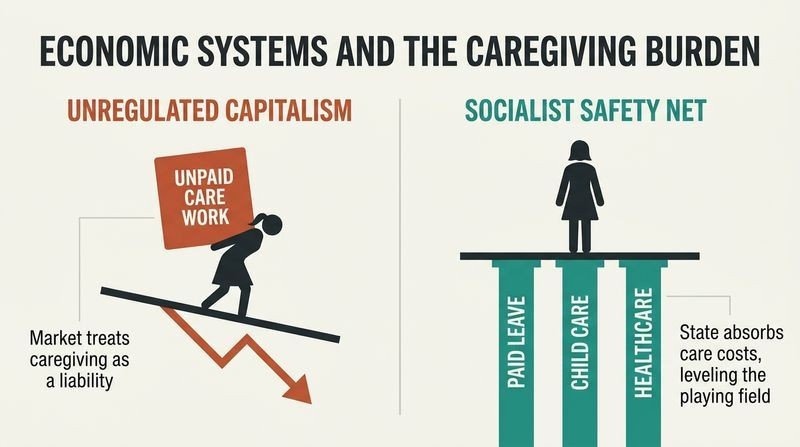
The thesis is simple and provocative. Ghodsee argues that competitive labor markets systematically punish the humans who bear and raise children. Because reproductive biology makes women primary caregivers, markets treat them as unreliable, cheaper, and disposable workers. The fix is not a return to authoritarian state socialism but the selective borrowing of socialist policies: paid parental leave, subsidized child care, public sector jobs, and universal health care.
The evidence is comparative. Women fare measurably better where states redistribute wealth than where markets run unencumbered. In the US in 2013, women over sixty-five suffered poverty at far higher rates than men. Women are hired last, fired first, and paid less. Their unpaid care work quietly subsidizes low taxes and high profits for those at the top.
What's striking is how Ghodsee reframes a moral argument as an economic one: women's domestic labor is an uncompensated subsidy to capital. This echoes feminist economists like Nancy Folbre and Marilyn Waring, who showed that GDP ignores the care economy entirely. The claim that markets discriminate against childbearing bodies is empirically strong, though critics note that Nordic welfare states achieve these gains within capitalism, complicating a neat socialism-versus-capitalism binary. Ghodsee anticipates this by distinguishing state socialism from democratic socialism. The deeper provocation is that dependency, not biology, is the trap, a point that reframes the entire debate around economic autonomy.
When women lack their own money, love becomes a transaction
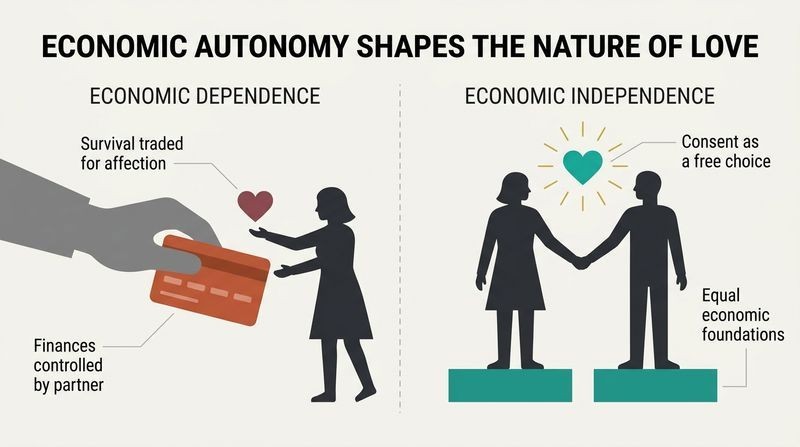
The book opens with Lisa. A stay-at-home mother whose husband controls the credit cards, Lisa must beg for spending money and, in a moment that stuns the author, resolves to have sex with him that night to repay a small loan. Her unpaid labor running the home is invisible to the market. She builds no pension, no resume, no independent access to health care. Everything flows through her husband.
Economic dependence corrupts intimacy. Ghodsee invokes George Bernard Shaw's observation that capitalism continually bribes women into sexual relations for money, inside marriage or out. When a woman cannot meet her basic needs on her own, staying in an unfulfilling or abusive relationship becomes a rational survival strategy rather than a free choice. Independence is the precondition for genuine consent.
The Lisa anecdote lands because it makes an abstraction visceral: the slow erosion of agency inside a comfortable suburban marriage. Behavioral economists would call this a bargaining-power problem; the partner with the exit option holds the leverage. Amartya Sen's capability approach makes a parallel case that freedom requires material means, not just formal rights. A fair critique: Ghodsee draws sweeping conclusions from vivid individual stories, and not every dependent marriage is coercive. Yet the structural point holds. Divorce and domestic violence research consistently shows that financial dependence is among the strongest predictors of why people stay in harmful relationships.
Women's cheapness, not equality, was their first foothold in the labor market
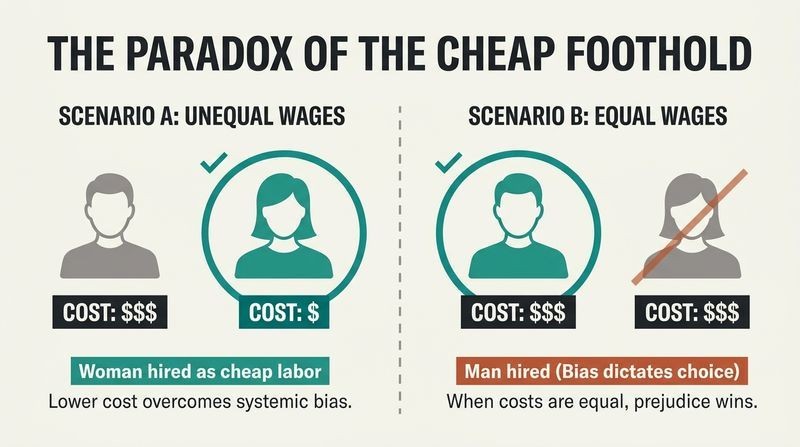
Discrimination is baked into the wage. From the dawn of industrialization, employers viewed women as weaker and less reliable. The only incentive to hire them was that they cost less. Demand equal pay and the employer simply hires a man. So women's original competitive edge was doing identical work for less, an edge that entrenched the wage gap rather than closing it.
The classic proof is the orchestra screen. When symphonies made musicians audition behind a curtain, even removing their shoes so footsteps would not betray their sex, the share of women in top orchestras rose from 6 percent in 1970 to 21 percent by 1993. Similarly, novelists like the Bront\u00ebs and J. K. Rowling used initials or male pen names to be taken seriously. Racism compounds the penalty: Black and Hispanic women face wider gaps than white women.
The blind-audition study by Goldin and Rouse is a canonical piece of economics, though recent statisticians have questioned the strength of its effect size, a reminder that even beloved findings deserve scrutiny. Ghodsee's larger move is smart: she treats the gender pay gap not as a glitch to be legislated away but as a structural feature of how labor gets priced. Her insistence on intersectionality, that gender cannot be analyzed apart from race and class, aligns her with Kimberl\u00e9 Crenshaw and distances her from a corporate feminism that would simply add women to the C-suite while nannies and cleaners absorb the care work below.
Expand public sector jobs to shrink the gender pay gap
Governments can pay women fairly when markets won't. Ghodsee's practical prescription is to grow public employment, where wage gaps are smaller and conditions more flexible. The data is telling: in Norway, Denmark, Sweden, and Finland, government jobs make up 25 to 30 percent of all employment, and women hold roughly 70 percent of those posts. The US figure sits around 15 percent, and it fell after the Great Recession, hitting African American women hardest.
Beyond wages, the state itself becomes an equalizer. She floats job guarantees, citing a proposed Marshall Plan for America modeled on the Depression-era Works Progress Administration, and Universal Basic Income experiments in Finland. Her ironic twist: automation may soon devalue male labor too, making everyone dependent on whoever owns the robots.
The public-sector argument is underappreciated and empirically grounded. In the US, government work has historically been the ladder for groups shut out of private hiring, a point echoed in research on the Black middle class, which is disproportionately built on public employment. The counterargument from free-market economists is that a bloated public payroll crowds out private dynamism. Ghodsee's rebuttal, that private job growth has not reversed wage stagnation or inequality, is fair but incomplete. She leans on the automation thesis, which remains contested; predictions of mass technological unemployment have a long history of arriving late or not at all.
Paid leave and child care only work when the state, not the boss, pays
Voluntary corporate leave fails predictably. Ghodsee tells of her friend Jake, who hired a talented woman only to watch her quit six months after giving birth, crushed by an inflexible job and patchwork child care. His bitter conclusion: never hire a woman again. This is statistical discrimination, judging an individual by group averages, and it becomes self-fulfilling. As of 2013, only 12 percent of US workers had paid parental leave.
The socialist answer originated with Lily Braun. In 1897 she proposed maternity insurance funded by progressive taxation, so no single employer bears the cost. When all firms must offer identical, government-backed leave, none fears becoming a magnet for prospective mothers. East Germany went further, building campus nurseries so students raised babies without derailing degrees.
The insight that only universal, state-backed mandates solve the free-rider problem is textbook collective-action logic. If one company offers generous leave, it attracts costs its competitors avoid, so rational firms race to the bottom. This is precisely why Ghodsee favors Braun's insurance-pool model over corporate goodwill. Iceland's take-it-or-lose-it paternity leave, where 90 percent of fathers use their ninety days, shows how policy design reshapes behavior by making leave the default for men too. The nuance worth flagging: state child care quality varies, and Ghodsee honestly notes overcrowded, disease-ridden socialist cr\u00e8ches, so universality alone is not sufficient without investment.
Quotas, not decades of patience, put women in power fast
Culture changes glacially; law changes quickly. Ghodsee notes that over forty years of activism barely dented the male grip on leadership. In 2015, women held 19 percent of the US Congress. Compare Scandinavia's 40 to 48 percent, or Iceland's near parity. The difference is one word: quotas. Since 1991, over ninety countries adopted parliamentary quotas, and among the forty-six nations with 30 percent or more women legislators, forty use some quota system.
Corporate boards tell the same story. After Norway required 40 percent female board representation in 2003 under threat of dissolution, women's board share soared. Strict-quota countries reached 44 percent in Iceland and 39 percent in Norway, while voluntary-quota Germany lagged at 26 percent. The softer the mandate, the weaker the result.
Quotas force a chicken-and-egg problem open: people distrust women leaders because they rarely see them, and they rarely see them because of that distrust. Role-model research, including KPMG surveys Ghodsee cites, supports the visibility mechanism. Skeptics worry quotas promote the underqualified, but Pew data she references shows Americans rate women equal or superior on honesty and mentorship, so the barrier is bias, not competence. Ghodsee adds a sharp caveat missing from most quota advocacy: elevating elite women means little if their careers rest on the underpaid nannies and aides below them. Real reform must lift the bottom, not just diversify the top.
Sex is priced like a commodity, and women's independence lowers the price
Sexual economics theory, borrowed and turned. Psychologists Baumeister and Vohs argued sex is a resource women sell and men buy with money, commitment, or status; prices rise when supply is scarce. Ghodsee accepts the model but flips its meaning: it describes capitalism, not human nature. Their own data shows that in more gender-equal societies, sex is freer, more casual, and less transactional, because women no longer need to hoard it for survival.
Conservatives weaponize the same logic. Groups like the Austin Institute blame birth control and loose women for lowering sex's price and thereby demotivating young men. Ghodsee exposes the implication: keeping sex expensive requires keeping women economically desperate, without contraception, abortion, or jobs.
The intellectual jiu-jitsu here is the book's cleverest stroke. By granting the conservative and evolutionary-psychology premise that sex functions as a market, Ghodsee shows the premise indicts capitalism rather than defending it. Marx made the parallel argument in 1848 that markets reduce all bonds to cash payment. The vulnerability is that sexual economics theory rests on the contested claim that women's libido is inherently weaker, which many psychologists dispute as culturally constructed rather than biological. Ghodsee sidesteps this by focusing on the model's environmental predictions, which is analytically shrewd, letting her opponents' framework do her argumentative work for her.
East German women reported far better sex than their Western sisters
Divided Germany was a natural experiment. Same people, same language, two economic systems. East Germany promoted women's economic independence and easy, consequence-free divorce; women initiated most splits, hailed as proof of emancipation. Surveys found striking gaps in satisfaction. In one study, 82 percent of East German women felt happy after sex versus 52 percent in the West; another found roughly 80 percent of Eastern women always reached orgasm against 63 percent in the West.
The mechanism is leverage. When women did not depend on men for money, men could not buy access and had to actually be interesting and attentive partners. Studies in Poland and Czechoslovakia echoed this, with sexologists arguing good sex required social equality. Longitudinal research even finds couples have more and better sex when men share housework fairly.
The provocative title claim rests on self-reported subjective well-being, which Ghodsee handles honestly by comparing it to how doctors measure pain: imperfect individually but meaningful in aggregate. Confounds abound, and she names them: the East had fewer commercial distractions, a retreat into private life under surveillance, and a state encouraging sex as a pressure valve. So economic independence is one factor among several, not a sole cause. Still, the modern housework studies she cites, showing egalitarian domestic labor predicts sexual frequency and satisfaction, give the thesis contemporary teeth. The finding that fairness fuels desire challenges older claims that traditional gender roles heighten erotic tension.
Learn from state socialism's failures without discarding its genuine gains
Refuse both whitewash and blackwash. Ghodsee insists on nuance against a hyperpolarized climate. State socialism curtailed political freedom, forced women to work, relied on abortion as birth control, silenced discussion of harassment and rape, and under Ceau\u0219escu and Stalin coerced childbearing. These were real horrors, not anticommunist propaganda.
Yet the record is not all darkness. Maternal and infant mortality fell, life expectancy rose, illiteracy vanished. Albania went from majority-illiterate women in 1945 to universal literacy under forty within a decade. By the 1980s half its university students were women. Polls complicate the totalitarian narrative: in a 2013 Romanian survey, 44 percent said life was better before 1989, with women more nostalgic than men. Her point is to salvage usable tools, not resurrect a failed system.
This is the book's methodological backbone and its riskiest posture, inviting accusations of apologism that Ghodsee names upfront. The comparison to how Americans selectively remember their own history, downplaying slavery, Jim Crow, and mass incarceration, is a fair rhetorical equalizer. Historians of memory would note that nostalgia polls often measure disappointment with the chaotic present, not genuine preference for dictatorship, a nuance Ghodsee concedes. The strongest version of her case is epistemic: refusing to examine socialism's partial successes lets ideology, rather than evidence, dictate which policies are thinkable. That intellectual openness, treating history as a toolkit rather than a morality play, is the argument's real value.
Everything feels permanent until it collapses in forty-eight hours
History is not static, and neither is the present. Ghodsee, who dropped out of college in 1989 fearing nuclear war only to watch the Cold War end weeks later, uses a world-history timeline map to teach students that empires rise and fall, usually unexpectedly. She recounts people who died by suicide days before the Berlin Wall fell, trapped by the belief nothing would change. Rome felt eternal to someone born in 456 CE, twenty years before it ended.
The lesson is agency. Ordinary people, not just the named figures in textbooks, make history through collective action. If millions quit Facebook or withdrew their bank deposits on one day, the mightiest institutions could crumble. The fatalist mantra that nothing can change is itself the change-blocker.
Ghodsee mobilizes Alexei Yurchak's insight about late Soviet life, that the system seemed immutable right up to its evaporation, into a broader antidote to political despair. This connects to complexity theory and the idea of phase transitions, where systems appear stable until a threshold triggers sudden reorganization. The risk is that the same unpredictability cuts both ways: regression arrives as suddenly as progress, which she honestly acknowledges. As a rhetorical close, it functions less as prediction than as permission, freeing readers from the learned helplessness that Mark Fisher called capitalist realism, the sense that no alternative is even imaginable.
Young women's votes are the most feared force in politics
The right knows women's ballots reshape government. Ghodsee points to a 1999 study by Lott and Kenny linking women's suffrage to growth in government spending, because women, facing lower wages and more barriers, favor redistribution and social safety nets. Men's rights activists and pundits like Ann Coulter cite this to fantasize about repealing the Nineteenth Amendment; a hashtag to that effect trended in 2016.
The demographic math favors change. By 2020 millennials became the largest voting cohort, and young women half of it. They lean strongly toward Democrats and redistribution. Ghodsee's call to action: vote, but also educate yourself across the ideological aisle, join movements, and organize. Casting a ballot is necessary but not sufficient.
The reframing of a conservative statistical paper as evidence of women's latent electoral power is characteristic Ghodsee, using an opponent's data against them. Political scientists have indeed documented a persistent gender gap, with women more supportive of social spending across democracies. The vulnerability is treating a demographic bloc as ideologically monolithic; married women, religious women, and women of different classes vote quite differently, as 2016 itself demonstrated. Her broader civic prescription, to break out of digital echo chambers and read across the spectrum, is refreshingly nonpartisan advice in a book with a clear political stance, and it models the intellectual openness she demands regarding history.
Reclaim your emotional life from the logic of buying and selling
Affective sovereignty is the personal endgame. Ghodsee coins this term for full control over one's emotional labor, the giving and receiving of affection without pricing it. She observes college-educated young people seeking sugar daddies to pay for groceries and taking antidepressants that dull libido, turning them into workaholic automatons. Cultural theorist Mark Fisher argued the West's mental health crisis is a negative externality of a precarious economic system, not merely brain chemistry.
Depression can be a rational response. Her radical claim: anxiety and depression are reasonable reactions to a system built on dehumanization, and rising loneliness is profitable because it drives consumption to fill the void. A Munich bookstore awning read love kills capitalism. Refusing to commodify affection is the first act of resistance.
The concept of affective sovereignty extends Arlie Hochschild's foundational work on emotional labor, the commercialized management of feeling she documented among flight attendants, into a political demand for reclaiming that labor from the market. Fisher's politicization of mental health is contested; clinicians warn against dismissing genuine neurobiology, and antidepressants save lives. Ghodsee's framing risks romanticizing suffering as protest. Yet the epidemiological correlation between economic precarity, isolation, and rising depression is robust, documented across public-health literature. The deeper claim, that loneliness is monetizable and therefore structurally encouraged, resonates with critiques of attention-economy platforms that profit from the very disconnection they deepen.
Analysis
Ghodsee's book is a hybrid: part comparative political economy, part memoir, part polemic, structured around the domains of work, motherhood, leadership, sex, and citizenship. Its central maneuver is rhetorical aikido. Rather than arguing socialism is good and capitalism bad, she concedes her opponents' frameworks (sexual economics theory, Lott and Kenny's suffrage study, evolutionary claims about libido) and demonstrates that these frameworks, taken seriously, indict market society and vindicate redistribution. This is more persuasive than preaching, because it forces skeptics to either abandon their own premises or accept her conclusions.
The book's genuine originality lies in linking the intimate to the structural. Most economic writing ignores the bedroom; most sex writing ignores the balance sheet. Ghodsee insists they are the same story, that whether a woman can leave a bad marriage, negotiate for pleasure, or refuse a transaction all trace back to whether she can feed herself independently. This is a materialist feminism in the tradition of Alexandra Kollontai and Friedrich Engels, updated with modern survey data and delivered with accessible wit.
The weaknesses are real and Ghodsee names most of them. Subjective well-being data is soft. Nostalgia polls conflate disappointment with endorsement. Nordic success occurs within capitalism, muddying the socialism binary. Her vivid anecdotes carry more argumentative weight than a single case can bear. And the automation thesis underpinning her job-guarantee vision remains speculative.
What endures is the reframing. Dependency, not biology, is the trap. Care work is an uncompensated subsidy to capital. Independence is the precondition of authentic consent, in labor and in love. Even a reader who rejects the socialist label leaves equipped to see paid leave, public child care, and universal health care not as handouts but as instruments of freedom, expanding rather than shrinking the range of choices available to half the population.
Review Summary
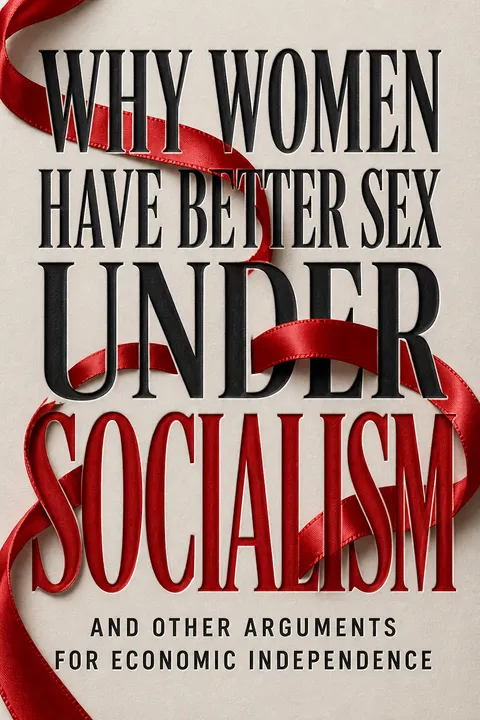
Why Women Have Better Sex Under Socialism received mixed reviews. Many praised its accessible writing and thought-provoking arguments about women's economic independence. Readers appreciated the historical examples and data supporting the benefits of socialist policies for women. However, some criticized the author's interpretation of facts, finding it overly simplistic or biased. Critics argued that the book romanticized life under socialism and failed to fully address its downsides. Despite disagreements, most found the book engaging and a valuable contribution to discussions on feminism and economic systems.
People Also Read



Glossary
Sexual economics theory
Sex as a female-controlled commodityA model by psychologists Roy Baumeister and Kathleen Vohs proposing that heterosexual courtship works like a market where women sell sexual access and men buy it with money, commitment, or status. Prices rise when supply is scarce. Ghodsee accepts the model but argues it describes capitalist societies specifically, not universal human nature, since women's economic independence lowers the transactional price of sex.
Affective sovereignty
Control over your emotional laborGhodsee's coined term for reclaiming full control over one's affections and emotional labor from the commodifying logic of capitalism. It means giving and receiving love and attention without quantifying or selling it, treated as an act of resistance against a system that monetizes loneliness and turns intimate bonds into economic exchanges.
State socialism
Communist-ruled economies, curtailed freedomsGhodsee's term for the twentieth-century regimes of the Soviet Union and Eastern Europe, dominated by ruling Communist Parties, where the state owned the economy and guaranteed employment but curtailed political freedoms. Distinguished from democratic socialism, which pursues socialist principles through free elections while preserving political rights.
Statistical discrimination
Judging individuals by group averagesAn economic concept where employers, unable to observe an individual's productivity, make hiring decisions based on averages for that person's demographic group. If women on average are more likely to leave for family reasons, any individual woman is presumed likely to leave, creating a self-fulfilling cycle: lower pay leads to higher quit rates, which justifies lower pay.
Refamilization
Pushing women back homeThe deliberate post-1989 policy across Central and Eastern Europe of defunding public child care and extending low-paid parental leaves to push women out of the labor market and back into the home. It reduced official unemployment and shifted care costs onto unpaid female labor during the transition to capitalism.
Zhenotdel
Soviet women's emancipation sectionThe Women's Section of the early Soviet Communist Party, founded in 1919 and led by figures like Alexandra Kollontai and Inessa Armand. It worked to implement women's full emancipation through public laundries, cafeterias, children's homes, and cr\u00e8ches. Stalin disbanded it, declaring the woman question solved.
FAQ
What's "Why Women Have Better Sex Under Socialism" about?
- Exploration of Socialism's Impact: The book explores how socialism, particularly in Eastern Europe, provided women with better economic independence, which in turn led to more fulfilling personal and sexual lives.
- Comparison with Capitalism: It contrasts the experiences of women under socialism with those in capitalist societies, highlighting how unregulated capitalism can be detrimental to women's rights and well-being.
- Historical and Theoretical Analysis: The author, Kristen R. Ghodsee, uses historical examples and socialist feminist theories to argue for the benefits of socialist policies for women.
- Focus on Economic Independence: A central theme is the argument that economic independence under socialism leads to better labor conditions, work/family balance, and even better sex for women.
Why should I read "Why Women Have Better Sex Under Socialism"?
- Unique Perspective: The book offers a unique perspective on the intersection of gender, economics, and politics, challenging conventional views on capitalism and socialism.
- Empirical Evidence: Kristen R. Ghodsee provides empirical evidence and historical analysis to support her arguments, making it a well-researched and informative read.
- Relevance to Current Debates: The book is relevant to current debates on gender equality, economic systems, and the role of government in ensuring social welfare.
- Engaging Writing Style: Ghodsee's engaging writing style makes complex theories accessible to a general audience, encouraging readers to think critically about societal structures.
What are the key takeaways of "Why Women Have Better Sex Under Socialism"?
- Economic Independence Benefits: Economic independence under socialism leads to better work conditions, family balance, and personal relationships for women.
- Critique of Capitalism: The book critiques unregulated capitalism for perpetuating gender inequality and economic dependence on men.
- Historical Lessons: It emphasizes learning from the successes and failures of 20th-century state socialism to inform current and future policies.
- Intersection of Feminism and Socialism: The book highlights the importance of integrating feminist perspectives into socialist policies to achieve true gender equality.
How does Kristen R. Ghodsee support her arguments in "Why Women Have Better Sex Under Socialism"?
- Historical Examples: Ghodsee uses historical examples from Eastern Europe to illustrate how socialist policies benefited women.
- Empirical Research: The book draws on over twenty years of research, including interviews, archival work, and ethnographic fieldwork.
- Comparative Analysis: It compares the experiences of women under socialism with those in capitalist societies to highlight differences in economic and social outcomes.
- Theoretical Frameworks: Ghodsee incorporates socialist feminist theories to provide a nuanced understanding of gender and economic systems.
What are the best quotes from "Why Women Have Better Sex Under Socialism" and what do they mean?
- "Unregulated capitalism is bad for women...": This quote encapsulates the book's central argument that capitalism, without checks and balances, disproportionately harms women.
- "Socialism leads to economic independence...": It highlights the benefits of socialist policies in providing women with the freedom to make personal and professional choices.
- "The political is personal...": This quote underscores the interconnectedness of personal relationships and broader economic and political systems.
- "Freedom is always and exclusively freedom for the one who thinks differently.": A nod to Rosa Luxemburg, emphasizing the importance of diverse perspectives in political discourse.
How does "Why Women Have Better Sex Under Socialism" address the concept of economic independence?
- Central Theme: Economic independence is a central theme, with the book arguing that it is crucial for women's empowerment and better personal relationships.
- Socialist Policies: The book discusses how socialist policies, such as guaranteed employment and social safety nets, support women's economic independence.
- Contrast with Capitalism: It contrasts this with capitalism, where women often face economic dependence on men due to wage gaps and lack of social support.
- Impact on Relationships: Economic independence allows women to engage in relationships based on mutual affection rather than economic necessity.
What historical examples does Kristen R. Ghodsee use in "Why Women Have Better Sex Under Socialism"?
- Eastern Europe: Ghodsee uses examples from Eastern European countries like East Germany, Bulgaria, and the Soviet Union to illustrate her points.
- Women's Labor Force Participation: She highlights how these countries promoted women's labor force participation and provided social services to support working mothers.
- Sexual Satisfaction Studies: The book references studies from East Germany showing higher levels of sexual satisfaction among women compared to their Western counterparts.
- Post-1989 Changes: Ghodsee discusses the impact of the transition to capitalism in Eastern Europe on women's rights and economic independence.
How does "Why Women Have Better Sex Under Socialism" critique capitalism?
- Gender Inequality: The book critiques capitalism for perpetuating gender inequality through wage gaps and economic dependence on men.
- Commodification of Relationships: It argues that capitalism commodifies personal relationships, reducing them to economic transactions.
- Lack of Social Support: Ghodsee highlights the lack of social safety nets in capitalist societies, which disproportionately affects women.
- Historical Context: The book provides historical context to show how capitalism has failed to address the needs of women compared to socialist policies.
What role does feminism play in "Why Women Have Better Sex Under Socialism"?
- Intersection with Socialism: Feminism is intertwined with socialism in the book, advocating for policies that promote gender equality and women's rights.
- Critique of Patriarchy: The book critiques patriarchal structures within both capitalist and socialist systems, emphasizing the need for feminist perspectives.
- Empowerment through Policies: Ghodsee argues that feminist policies, such as paid maternity leave and affordable childcare, are essential for women's empowerment.
- Historical Feminist Theories: The book draws on historical feminist theories to support its arguments for integrating feminism into socialist policies.
How does "Why Women Have Better Sex Under Socialism" address the concept of sexual satisfaction?
- Economic Independence Link: The book links sexual satisfaction to economic independence, arguing that women in socialist societies experience more fulfilling relationships.
- Studies and Surveys: Ghodsee references studies from Eastern Europe showing higher levels of sexual satisfaction among women compared to capitalist societies.
- Critique of Sexual Economics Theory: The book critiques the idea that sex is a commodity, arguing for relationships based on mutual affection and equality.
- Impact of Social Policies: It highlights how social policies, such as access to healthcare and education, contribute to better sexual satisfaction.
What lessons does "Why Women Have Better Sex Under Socialism" offer for current and future policies?
- Learning from History: The book emphasizes the importance of learning from the successes and failures of 20th-century state socialism.
- Integrating Feminism: It advocates for integrating feminist perspectives into socialist policies to achieve true gender equality.
- Policy Recommendations: Ghodsee suggests policies such as universal healthcare, paid parental leave, and affordable childcare to support women's rights.
- Challenging Capitalism: The book encourages readers to challenge the status quo of capitalism and consider alternative economic systems that prioritize social welfare.
How does Kristen R. Ghodsee use empirical evidence in "Why Women Have Better Sex Under Socialism"?
- Research-Based Arguments: Ghodsee's arguments are grounded in over twenty years of research, including interviews, archival work, and ethnographic fieldwork.
- Historical Examples: The book uses historical examples from Eastern Europe to illustrate the benefits of socialist policies for women.
- Comparative Studies: It references comparative studies on sexual satisfaction and economic independence to support its claims.
- Data-Driven Analysis: Ghodsee provides a data-driven analysis of the impact of economic systems on women's rights and well-being.
Download PDF
Download EPUB
.epub digital book format is ideal for reading ebooks on phones, tablets, and e-readers.








































