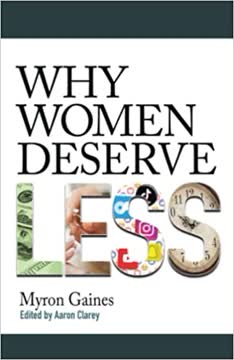

Key Takeaways
Most men are hemorrhaging time, money, and energy on women who don't care
“The pursuit of women, not even getting divorced, costs the average man $6.9 million in lost investments today.”
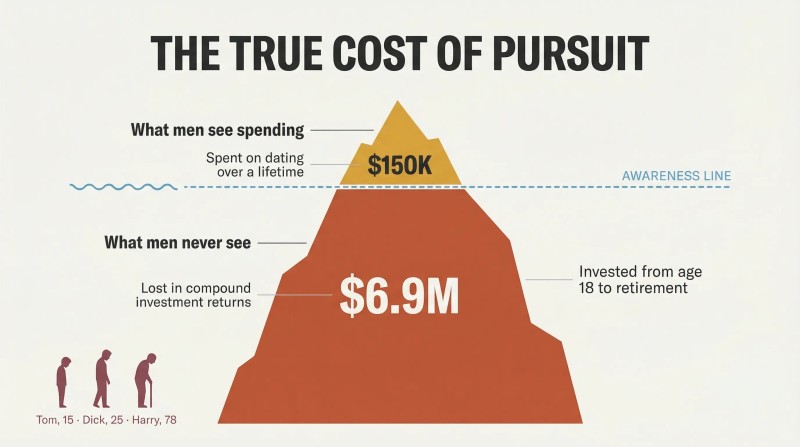
Three cautionary tales open the book. Tom, 15, asks his crush out — she broadcasts his rejection across social media. Dick, 25, gets stood up by a woman who ghosts him to dine with someone else. Harry, 78, spent sixty years in poverty and emotional torture from two divorces and a sexless third marriage. These aren't outliers — they're the default trajectory for men who pour resources into women who won't reciprocate.
The financial toll is staggering. The average American man spends roughly $150,000 in cash on dating and courtship over his lifetime. Had that money been invested in the stock market starting at 18, it would compound to approximately $6.9 million by retirement — before accounting for marriage or divorce costs.
Women's genuine romantic interest in men averages about 8% of the reverse
“You're trying to convince women to do something they don't viscerally and naturally want to do.”
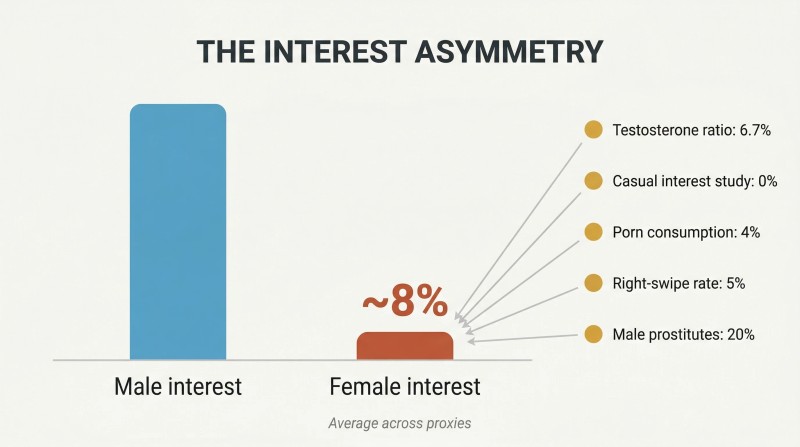
Multiple proxies suggest a dramatic asymmetry. Using testosterone ratios (6.7%), gay vs. lesbian sex frequency (15%), female porn consumption (1/25th of men's), the share of male prostitutes (20%), and a study showing zero female interest in casual propositions, the author averages women's sexual interest at roughly 7.6% of men's.
Online dating reinforces the gap. The OKCupid study found women rated 80% of men below average in attractiveness. Women swipe right on just 3 – 14% of profiles, trending toward 5%. The genetic record shows only about 25% of men ever reproduced, while most women did. This asymmetry — most women simply aren't that interested in most men — is the book's foundational premise for why the traditional approach fails.
The dating marketplace contract shattered — but your instincts didn't update
“Men are taught to 'do the right thing,' while women are taught 'do the right thing for you.'
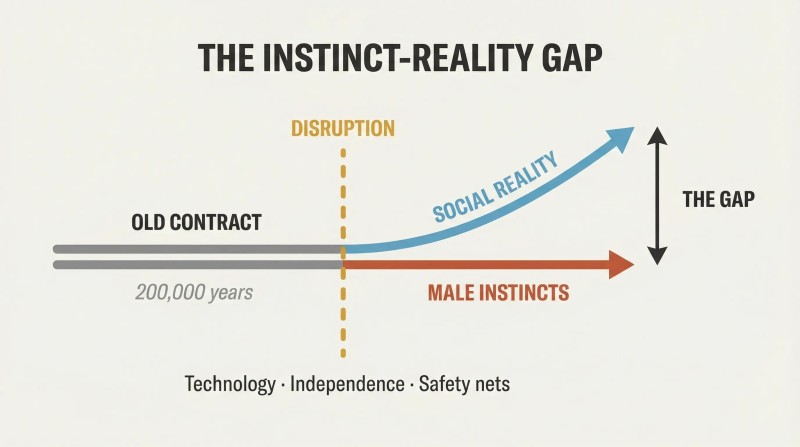
For 200,000 years, the "Old Contract" governed relationships: men provided resources and protection; women provided sex and children. It was transactional, but love, family, and civilization grew from it. The "New Contract" emerged when technology, capitalism, and the welfare state made women economically independent. White-collar jobs replaced physical labor, automated appliances freed household time, and government programs created a safety net.
In theory, voluntary relationships should have been better. Instead, every metric collapsed: marriage hit historic lows (5.1 per 1,000 people), divorce holds at 45% (70 – 80% initiated by women), birth rates dropped from 3.6 to 1.64 per woman, and male virginity nearly tripled to 27%. Men still operate on Old Contract instincts — buying flowers, pursuing relentlessly — but those moves now get labeled creepy under New Contract norms.
Social media turned female selectivity into unchecked runaway hypergamy
“Women will insist on dating a man whose income, height, age, and status put him in the top 1% of men, while they are average and think nothing of it.”
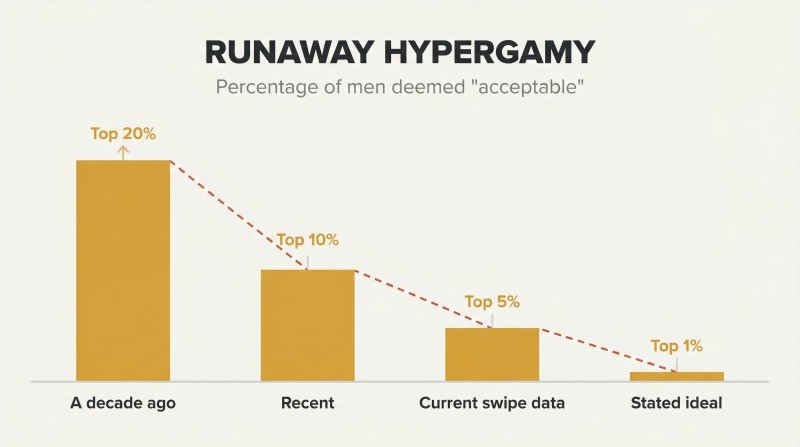
Women were always choosier — that's biology. But the internet removed the reality check. Previously, limited options forced women to reconcile preferences with what was available. Now, dating apps create the illusion of infinite supply. The author's podcast uses a "Female Delusion Calculator" based on census data: when women describe their ideal man (6'+, $100K+ income, fit), he falls in the top 1% — before factoring in looks or personality.
The goalposts keep moving. What was the "top 20%" a decade ago shrank to 10%, and recent swipe data shows women accept just 5% of profiles. The author calls this "runaway hypergamy" — ever-escalating standards with no ceiling, because nothing in modern culture forces women to recalibrate their expectations downward.
Treat dating apps as attention machines, not actual dating tools
“Women are spending between 10-30 hours on dating apps just to go on ONE DATE.”
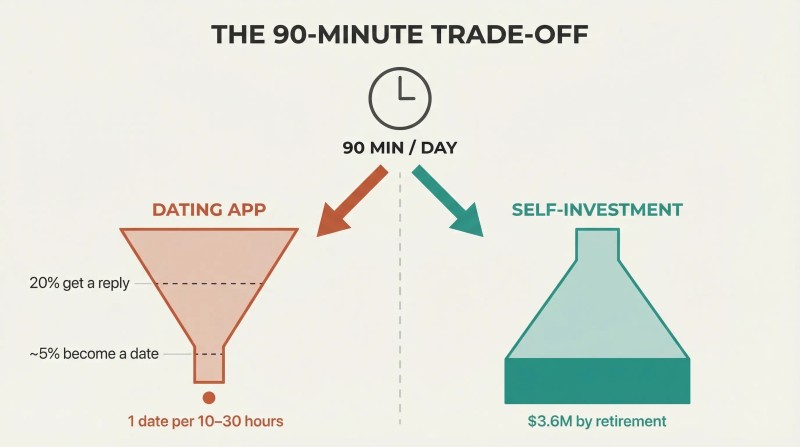
The math exposes the real function. Both sexes spend roughly 90 minutes daily on dating apps. Men use them to get dates. But only about 20% of women's matches produce a conversation, and just 5% lead to a real date. Tinder's own data shows 8.6% of conversations result in meetups — a 91.4% digital flake rate. If women burn 10 – 30 hours of swiping per single date, they aren't there for dating. They're harvesting attention.
The opportunity cost for men is devastating. If a man worked those 90 daily minutes at median wage and invested the earnings in an average-returning fund starting at 18, he'd accumulate roughly $3.6 million by retirement. The author's directive: stop being unpaid content for women's ego feeds and redirect that time into yourself.
Run every romantic investment through five unemotional questions
“Nine out of 10 times, your efforts in pursuing women are usually just a waste of time and you're usually better off investing those resources into yourself.”
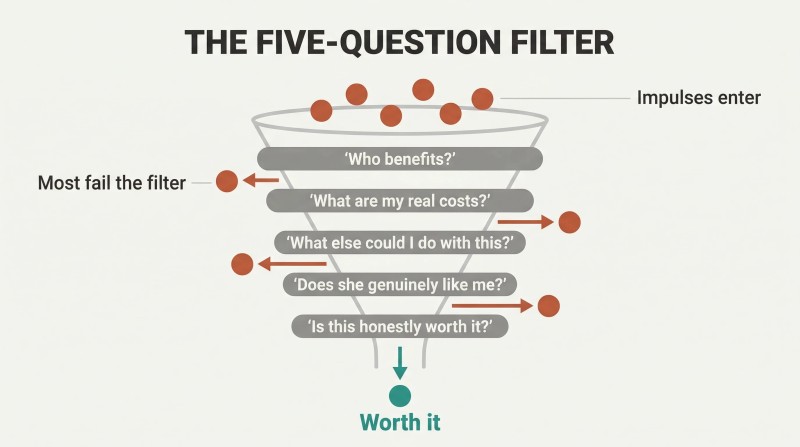
Before spending any resource on a woman, answer these:
1. Who actually benefits from this expenditure?
2. What are my real costs — in time, money, and energy?
3. What could I do with those resources instead?
4. Does she genuinely like me, or am I pulling teeth?
5. Considering all four answers, is this honestly worth it?
The rent example crystallizes the framework. Many young men sign expensive leases mainly to bring women home. At $2,000 per month, that's $240,000 over ten years — enough to fund a retirement. The author suggests renting a hotel on the rare occasion you need one. This isn't about being stingy; it's about catching unconscious expenditure driven by sexual impulse before it bleeds you dry.
Never sign a marriage contract in today's legal environment
“Only 14% of marriages are happy, with half ending in divorce and the remainder being miserable.”
The statistical case is brutal. 45% of marriages end in divorce, 70 – 80% initiated by women (90% if she's college-educated). Of surviving marriages, only 28.5% are happy. Divorce brings catastrophic consequences — alimony is awarded to women in 97% of cases, and custody goes to mothers at five times the rate of fathers.
The author argues modern marriage has been hollowed out. Women increasingly treat husbands and children as status boxes to check rather than humans to love — evidenced by how quickly they divorce "the love of their life" and how frequently they outsource childcare to daycare and public schools. Combined with the legal asymmetry of family courts, the author concludes no rational cost-benefit analysis can justify signing a marriage contract today.
Self-investment is paradoxically the most effective dating strategy
“Women do not want the 24-year-old drunk guy at a party who secretly lives at home as he tries to pay off his student loans from his 'Business Administration Degree.'
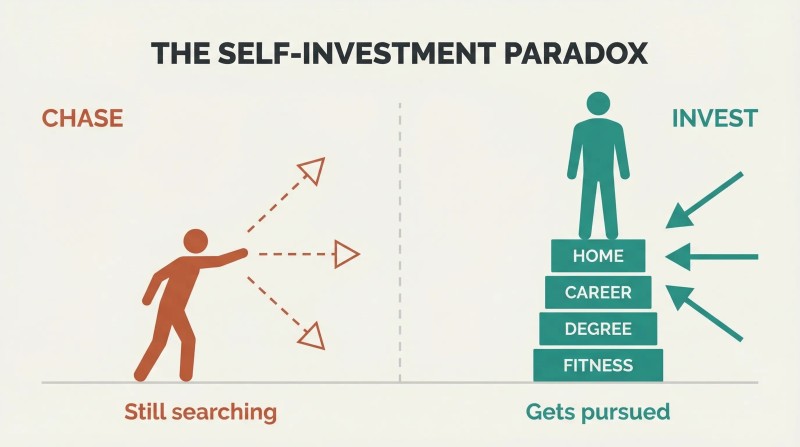
The book's "ironic silver bullet." Imagine a man who never spent a nanosecond chasing women. Instead, he joined the military, earned an engineering degree debt-free via the GI Bill, got his body in shape, bought a modest home, and climbed mountains on weekends. By 30, he's a senior engineer earning $110K with $200K in home equity. He never pursued a single woman — yet he's exactly the type women pursue.
Contrast him with his peers: guys still living at home with vague degrees and crushing debt, or men burning 10+ hours weekly swiping on apps. Every resource redirected from chasing women into building yourself compounds — financially, physically, professionally. The man women actually want is the one who never made women his priority.
Even Tom Brady got divorced — winning everything still isn't enough
“Take the time to sit down and count the number of truly happy couples you know… You'll be able to count them on one hand.”
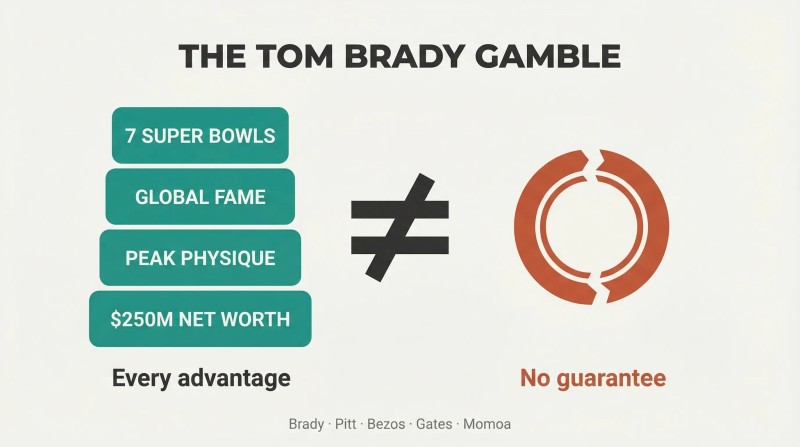
The "Tom Brady Gamble" is the book's most sobering concept. Brady: 7 Super Bowls, $250M net worth, peak physique, playing into his mid-40s. There is arguably no more accomplished man alive. Gisele Bündchen still divorced him. Brad Pitt, Jeff Bezos, Bill Gates, Jason Momoa — the list of top-tier men whose relationships collapsed keeps growing.
This doesn't mean self-improvement is futile — it means guaranteed romantic success doesn't exist. The author invokes Briffault's Law: the female determines all conditions of the relationship, including whether she's happy. Among thousands of couples you've encountered, the truly content ones are countable on one hand. Become your best self, but never stake your emotional wellbeing on a woman's acceptance.
Make women earn your commitment — default to 'just your turn'
“Until that girl proves she is the starry-eye girl who adores you and will make your life infinitely better, there is no committed relationship.”
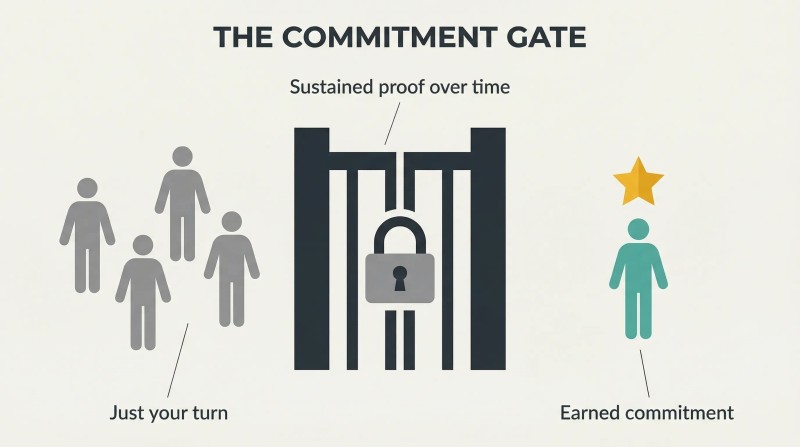
The book's closing strategy is deceptively simple: align expectations with reality. Women's average interest is fractional. Most relationships end quickly. Most women will eventually flake, ghost, or leave. These aren't pessimistic assumptions — they're the statistical baseline. Once you accept this, you stop pinning happiness on outcomes you cannot control.
The practical application: live what the author calls "excellence, with a chance of tail." Become the best man you can, then stop chasing. The responsibility shifts entirely to women. Don't invest emotionally until a woman demonstrates genuine adoration through sustained action — not words. Until then, operate with the red pill axiom that "she's not yours, it's just your turn," and reserve deep commitment for the rare woman who proves herself exceptional over time.
Analysis
"Why Women Deserve Less" functions as a Red Pill primer — an attempt to distill scattered internet manosphere philosophy into one accessible, prescriptive manual. Its core intellectual contribution is framing modern dating through contract theory: relationships have always been transactional, the terms changed, and men haven't adapted. This framework, while reductive, offers genuine explanatory power for the confusion many young men experience navigating post-traditional courtship norms.
The book's strongest material is its economic analysis. The five-question cost-benefit framework is genuinely useful decision-making architecture regardless of one's gender politics. The Tom Brady Gamble concept shows surprising philosophical nuance — acknowledging that self-improvement is necessary but not sufficient, and that romantic outcomes remain outside any individual's control. The synthesis of Buddhist detachment with practical dating advice is more sophisticated than the book's provocative title suggests.
However, the book commits the ecological fallacy repeatedly, treating population-level statistics as individual-level predictions. The "7.6% interest" figure averages incomparable metrics — testosterone ratios, porn consumption, prostitution demographics — that cannot be meaningfully combined into a single number. The OKCupid study measured physical attractiveness on one dimension, ignoring that women systematically weight non-physical attributes more heavily, which is precisely the mechanism the book elsewhere acknowledges when it advocates career and personality development.
More fundamentally, the book frames men's investment in women as purely economic loss, while simultaneously acknowledging these drives are biologically hardwired and psychologically essential. The author never fully resolves this tension, oscillating between "women aren't worth your resources" and "become the man women chase." This is the book's central unresolved paradox: it tells men to stop caring about women as a strategy to attract women.
The sociological claims about institutional incentives — that governments, universities, corporations, and media profit from female independence and consumerism — echo public choice theory and contain legitimate structural observations, even if presented with conspiratorial overtones. At its best, the book challenges men to audit unconscious spending and redirect resources toward personal development. At its worst, it risks hardening legitimate frustration into permanent bitterness — the very emotional prison it claims to dismantle. Briffault's Law: the female determines all conditions of the relationship, is invoked to explain why even objectively accomplished men get divorced and why truly happy couples are statistically rare.
Review Summary
"Why Women Deserve Less" has received polarizing reviews. Many 1-star ratings criticize it as misogynistic and poorly written. Critics argue it promotes a toxic worldview and oversimplifies complex issues. Some 5-star reviews praise it as insightful, claiming it offers valuable advice for men in modern dating. Common themes in positive reviews include focusing on self-improvement and understanding current dating dynamics. The book's provocative title and content have sparked heated debate, with most negative reviews coming from women and positive reviews primarily from men.
Glossary
The Old Contract
Historical gender exchange modelThe implicit agreement governing male-female relationships for most of human history: men provided resources and physical protection, while women provided sex, domestic labor, and children. The author argues this transactional arrangement, though unromantic in description, produced love, family, civilization, and nearly every human advancement.
The New Contract
Modern voluntary gender interactionsThe post-industrial arrangement where women are economically independent through employment and the welfare state, and interactions between the sexes are purely voluntary. Neither party owes the other resources, sex, or commitment. The author argues this contract promised utopia but delivered declining marriage, rising sexlessness, and mutual hostility.
Runaway Hypergamy
Ever-escalating female partner standardsThe phenomenon where women's already-selective mating preferences accelerate without limit due to the internet creating an illusion of infinite male supply. Standards that historically settled around the top 20% of men have compressed to the top 5% or less, with no cultural mechanism to impose a reality check. The author warns these goalposts will continue moving.
The Simp Economy
Monetized male attention onlineThe digital ecosystem where women convert male sexual interest into revenue without providing real relationships or sex. Includes OnlyFans, Twitch donations, sugar sites, paid DMs, and the 'girlfriend experience.' The author frames this as a third economic avenue for women—beyond employment and welfare—that exploits men's sex drive at scale.
The Junk Mail Effect
Male attention as unwanted noiseThe phenomenon where the sheer volume of male attention women receive online—often thousands of messages monthly—makes individual men's approaches as unwelcome and ignorable as junk mail. The author argues this has made women preemptively annoyed, antagonistic, or hostile before any man even speaks to them.
The Tom Brady Gamble
Risk of loss despite peak achievementThe paradox that even becoming the most accomplished man possible (like Tom Brady—7 Super Bowls, $250M net worth, peak physique) does not guarantee relationship success, as Gisele Bündchen still divorced him. The concept warns men that pouring extraordinary effort into becoming a top-tier man carries no romantic guarantee.
Briffault's Law
Female determines relationship conditionsA principle stating that the female, not the male, determines all conditions of the relationship. The author applies it beyond sex to argue that women unilaterally determine whether a relationship is happy. Used to explain why even objectively accomplished men get divorced and why truly happy couples are statistically rare.
Top 5% Man
Threshold where women chase youThe level of male achievement—in physique, income, status, and lifestyle—at which dating dynamics invert and women do the pursuing instead of men. Below this threshold, men must negotiate, chase, and 'pull teeth.' The author frames the core male choice as whether the extra work to reach this tier costs less than a lifetime of chasing women as an average man.
Female Delusion Calculator
Tool exposing unrealistic dating standardsA tool used on the Fresh & Fit podcast that cross-references women's stated preferences (height, income, body type) against actual census data to reveal how statistically rare their ideal man is. Women consistently describe top-1% men as their minimum standard without realizing the mathematical improbability of finding one.
Principle of Least Interest
Less interested party holds powerA law of power dynamics stating that whoever cares less about whether a relationship continues holds all the leverage. The author applies this to modern dating: since women generally need men less than men need women, women hold disproportionate power, and men's desperation for sex puts them in a permanently disadvantaged negotiating position.
FAQ
What's "Why Women Deserve Less" about?
- Author's Perspective: "Why Women Deserve Less" by Myron Gaines explores the dynamics of modern dating and relationships, focusing on the perceived imbalance between men's and women's interests.
- Core Argument: The book argues that women have become less interested in men due to societal changes, and men should adjust their expectations and investments in relationships accordingly.
- Purpose: It aims to guide men in navigating the modern dating landscape by understanding these dynamics and avoiding unreciprocated pursuits that could lead to personal ruin.
- Target Audience: The book is primarily aimed at men who are struggling with modern dating and are seeking a new approach to relationships.
Why should I read "Why Women Deserve Less"?
- Understanding Modern Dynamics: The book provides insights into the changing dynamics between men and women, which can be valuable for anyone navigating the dating world today.
- Practical Advice: It offers practical advice on how men can protect their resources and avoid common pitfalls in relationships.
- Self-Improvement Focus: The book encourages men to focus on self-improvement and personal growth rather than solely pursuing romantic relationships.
- Controversial Perspective: For those interested in controversial and alternative viewpoints on gender relations, this book presents a unique perspective.
What are the key takeaways of "Why Women Deserve Less"?
- Women’s Reduced Interest: The book posits that women are less interested in men due to societal changes, such as increased independence and technological advancements.
- Resource Management: Men should be cautious about investing time, money, and energy into relationships that may not reciprocate their efforts.
- Self-Improvement: Focus on personal development and becoming a top-tier man to naturally attract women, rather than chasing them.
- Realistic Expectations: Align expectations with reality by understanding that most women may not be interested in most men.
What are the best quotes from "Why Women Deserve Less" and what do they mean?
- "Women hate Beta males so much they'll assume $150K+ in student loans to go to college for 4-8 years to qualify for a 40-50 hour per week, soul-crushing job just to avoid marrying one." This quote suggests that women prioritize independence and career over traditional relationships with average men.
- "Desire cannot be negotiated." This emphasizes that genuine attraction cannot be forced or bargained for, and men should recognize when a woman is not truly interested.
- "Chase a check, never chase a bitch." This encourages men to focus on financial and personal success rather than pursuing women who may not reciprocate their interest.
- "Women deserve less." This controversial statement is meant to provoke thought about the level of investment men should make in relationships, advocating for a more balanced approach.
How does "Why Women Deserve Less" define the "Old Contract" and "New Contract"?
- Old Contract: Traditionally, men provided resources and protection, while women offered sex and children. This was a transactional relationship based on mutual dependency.
- New Contract: Women claim independence and no longer need men for resources, leading to a shift in relationship dynamics where men must adapt to women's reduced interest.
- Biological Realities: Despite societal changes, the book argues that biological instincts still influence behavior, making the old contract relevant in some ways.
- Transition Period: Society is in a transition where some people adhere to the old contract, while others embrace the new, creating confusion in modern relationships.
What is the "Tom, Dick, and Harry" analogy in "Why Women Deserve Less"?
- Tom's Story: Represents young men who face public humiliation and rejection in their romantic pursuits, highlighting the risks of unreciprocated interest.
- Dick's Experience: Illustrates the disappointment and wasted effort when men invest heavily in relationships that don't materialize, emphasizing the need for caution.
- Harry's Life: Depicts the long-term consequences of failed relationships, including financial ruin and emotional distress, serving as a warning to modern men.
- Overall Message: These stories exemplify the potential pitfalls men face in modern dating and the importance of adapting to new relationship dynamics.
How does "Why Women Deserve Less" suggest men should adapt to modern dating?
- Focus on Self-Improvement: Men should prioritize personal growth, financial stability, and physical fitness to become more attractive to women.
- Resource Management: Be cautious about investing time, money, and energy into relationships that may not reciprocate their efforts.
- Realistic Expectations: Understand that most women may not be interested in most men, and adjust expectations accordingly.
- Avoiding Pitfalls: Learn from the mistakes of others, like Tom, Dick, and Harry, to avoid similar outcomes in their own lives.
What role does technology play in "Why Women Deserve Less"?
- Increased Choice: Technology, particularly social media and dating apps, has given women access to a wider pool of potential partners, increasing their selectiveness.
- Attention Economy: Women receive constant attention online, which can lead to inflated self-worth and unrealistic expectations in relationships.
- Dating Dynamics: The book argues that technology has made traditional dating strategies less effective, requiring men to adapt to new norms.
- Impact on Relationships: The ease of access to potential partners has led to a decline in stable, long-term relationships, according to the book.
What is the "Principle of Least Interest" in "Why Women Deserve Less"?
- Definition: The principle states that the person with the least interest in a relationship holds the most power, as they are less dependent on the outcome.
- Application to Dating: The book suggests that women often have less interest in men, giving them more power in modern dating dynamics.
- Men's Disadvantage: Men's stronger biological drive for sex puts them at a disadvantage, as they are more likely to invest heavily in relationships.
- Strategic Advice: Men should recognize this dynamic and adjust their approach to relationships, focusing on self-improvement and resource management.
How does "Why Women Deserve Less" address the concept of "Hypergamy"?
- Definition: Hypergamy refers to the tendency of women to seek partners of higher social, economic, or physical status.
- Impact on Dating: The book argues that hypergamy drives women to pursue top-tier men, leaving average men with fewer opportunities.
- Exacerbated by Technology: Social media and dating apps amplify hypergamous behavior by providing women with access to high-status men.
- Men's Response: Men should focus on becoming top-tier individuals themselves, rather than trying to negotiate or convince women to settle.
What is the "Simp Economy" mentioned in "Why Women Deserve Less"?
- Definition: The "Simp Economy" refers to the online ecosystem where men provide attention and financial support to women without receiving reciprocation.
- Platforms Involved: This includes platforms like OnlyFans, Twitch, and other social media where women monetize their presence through male attention.
- Men's Role: The book criticizes men who participate in this economy, arguing that they waste resources on unreciprocated pursuits.
- Advice for Men: Men should avoid participating in the Simp Economy and instead invest their time and money in personal development.
What is the "Tom Brady Gamble" in "Why Women Deserve Less"?
- Definition: The "Tom Brady Gamble" refers to the risk that even top-tier men, like Tom Brady, face in relationships, where success and status do not guarantee happiness or stability.
- Examples: The book cites high-profile divorces of successful men as evidence that even the best men can face relationship failures.
- Implications for Men: Men should be aware that becoming a top-tier individual does not eliminate the risks of modern relationships.
- Strategic Approach: Focus on personal fulfillment and self-improvement, rather than relying on relationships for happiness and success.
Download PDF
Download EPUB
.epub digital book format is ideal for reading ebooks on phones, tablets, and e-readers.








































