

Key Takeaways
You are not your body or mind; you are compressed energy
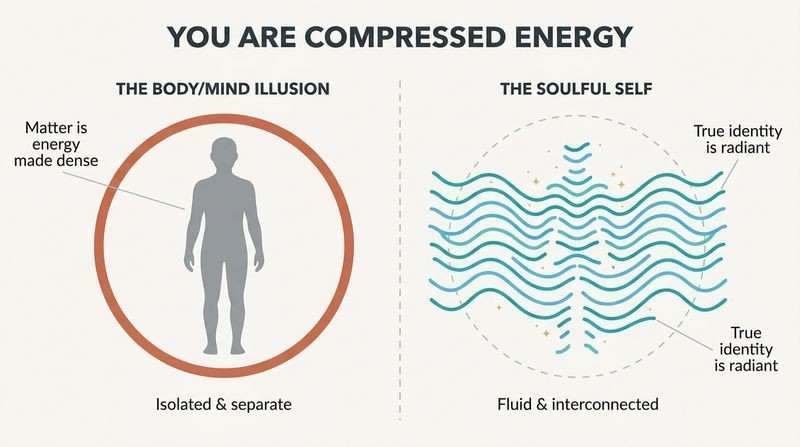
The book's foundational claim is that everything, including flesh, bone, thought, and this book, is energy vibrating at different frequencies. Matter is simply energy made dense enough to touch. Dr. Sue Morter, a chiropractor raised by an energy-medicine pioneer, describes a meditation experience where she felt herself dissolve into a radiant field of light, one with the universe. That moment convinced her that our true identity is intelligent, eternal energy she calls the Soulful Self.
The practical stakes are high: the degree to which you know yourself as energy determines whether you live in pain or bliss. Suffering, she argues, stems from one core error, believing we are broken, separate, and inadequate, when we are actually whole.
The claim that matter is condensed energy is uncontroversial physics (E=mc squared), but Morter stretches it toward a metaphysical identity claim that physics does not support. The leap from atoms being energy to selves being conscious cosmic energy is philosophical, not empirical. Still, the reframe has therapeutic power. Cognitive behavioral therapy similarly teaches that the belief "I am broken" drives dysfunction, and defusing that belief reduces suffering. Buddhist anatta (non-self) and Advaita Vedanta make parallel moves. Readers can extract the psychological medicine (identity is malleable, self-worth is intrinsic) without necessarily accepting the quantum-mystical mechanism as literal science.
Stop fixing yourself; you were never broken to begin with
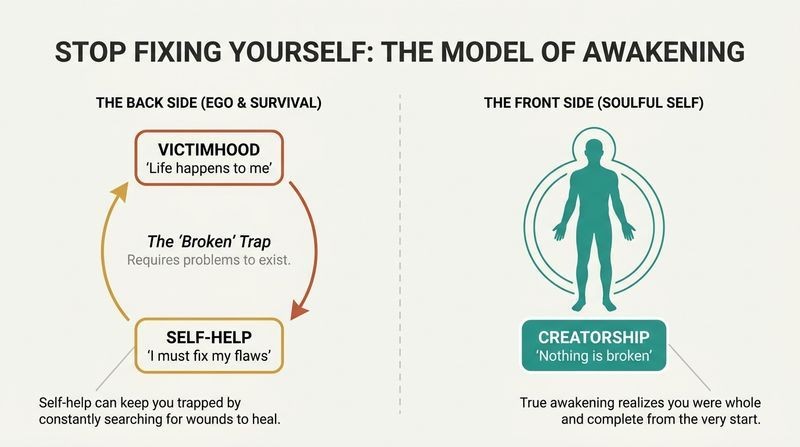
Morter maps consciousness onto a Model of Awakening with two sides. The Back Side houses the Protective Personality, the fearful, survival-focused ego that scans for threats and seeks approval. It has two stages:
1. Victimhood: life happens to me, I have no control.
2. Self-Help: something is wrong but I will fix it.
The Front Side is Creatorship, living as the Soulful Self, where you see that nothing was ever wrong. Even self-help, she argues, traps you, because constantly hunting for problems to fix makes you dependent on problems to know who you are. When her father's will excluded her weeks after his death, she used her tools to reinterpret the wound as a gift rather than spiral into "what's wrong with me?"
The critique of self-help from inside a self-help book is bracing and genuinely useful. Psychologist Carl Rogers made a related point: the paradox that acceptance, not striving, enables change. There is also research on "problem-focused" versus "solution-focused" therapy suggesting that endless problem excavation can entrench identity around dysfunction. The weakness is the sweeping claim that nothing is ever wrong, which risks spiritual bypassing, using positivity to sidestep real injustice, abuse, or trauma that demands acknowledgment and sometimes external action. Morter's own abuse history complicates this; reframing can coexist with accountability, but the book leans hard toward internal reframe over outer redress.
Ask where you feel it in your body, never why it happened
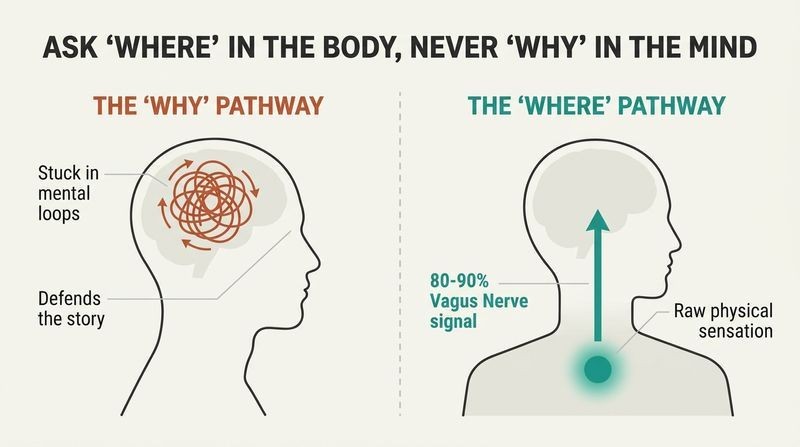
When something upsetting happens, the mind writes stories: why me, who's to blame, how do I fix this. Morter calls this the story route, the slow bumper-car path that takes months or years. Her shortcut, Take It to the Body, redirects attention from the mental story to the physical sensation, the knot in the stomach, the tightness in the throat. You locate the charge, squeeze that area, and breathe through it.
The logic: emotions and physical symptoms are energy shifts. A story stays stuck because the mind, once it writes a narrative, becomes attached and defends it as right or wrong. Working at the raw energy level bypasses that attachment. She cites that the vagus nerve carries 80 to 90 percent of its signals from gut to brain, not brain to gut.
This resonates strongly with modern trauma science. Bessel van der Kolk's The Body Keeps the Score and Peter Levine's Somatic Experiencing both argue that trauma lodges in the body and that top-down talk alone often fails, while bottom-up somatic processing can release it. The vagus nerve statistic is roughly accurate and central to polyvagal theory. Where Morter goes further than the evidence is in promising near-instant resolution and framing sensation-tracking as sufficient for healing serious disease. The safest reading: somatic awareness is a legitimate, underused complement to cognitive processing, especially for stuck emotional loops, but not a replacement for medical or psychological treatment.
Anchor your attention in your body's central channel to feel whole
The first of seven Energy Codes is the Anchoring Code. Most of us live "in our heads," using the mind disproportionately and feeling perpetually unsafe and incomplete. The fix is embodiment: pulling attention down into the body's core.
Morter offers a Subject-Object-Subject drill (fixate on an external object, then pull awareness back behind your own eyes) and four anchor points drawn from yoga: contracting the pelvic floor (mula bandha), the heart center, the throat, and the space behind the eyes. Connecting these with breath up and down a central channel from crown to base builds what she calls circuitry, the nervous-system capacity to perceive subtle energy. She likens the body to a city whose unlit streets need wiring before they can be seen.
The techniques are recognizably yogic (bandhas, pratyahara, ujjayi breath) repackaged in neurological language. "Building circuitry" is a metaphor doing heavy lifting; there is real science that focused attention and interoception strengthen insular cortex activity and body awareness, so the claim that practice changes perception is defensible. The pelvic-floor and diaphragmatic breathing genuinely activate the parasympathetic nervous system, downshifting the stress response. What's valuable here for a skeptic is that grounding attention in the body is a well-validated anxiety intervention (see grounding techniques in trauma therapy) regardless of whether one buys the subtle-energy framework wrapped around it.
Reinterpret your worst experiences as scripts you wrote for growth
The Bus Stop Conversation is Morter's signature reframe. Imagine souls at a cosmic bus stop before incarnating, choosing the experiences they want, like a "Level Ten" lesson in forgiveness, and recruiting other souls to deliver the hard events that make such growth possible. The point is not literal belief but a shift from victimhood to authorship.
She applies it to Ellie, a student molested by her father, disbelieved by her family, who suffered decades of migraines and digestive illness. Reframing her life as something she engaged for her own expansion (not something she asked for, crucially) dissolved the need for forced forgiveness and coincided with dramatic healing, including fifty pounds lost. Morter, herself an abuse survivor, says big souls take on big projects.
This is the book's most ethically fraught idea and deserves careful handling. Framed as chosen-victimhood, it risks blaming survivors for their trauma, a real danger Morter tries to defuse by insisting abuse was not requested, only the growth opportunity. As a coping frame it echoes Viktor Frankl's logotherapy: the last human freedom is choosing one's stance toward unavoidable suffering, and finding meaning aids survival. Post-traumatic growth is a documented phenomenon. The nuance smart readers should hold: meaning-making after trauma is healing; implying cosmic pre-authorship of abuse can retraumatize and can let perpetrators and systems off the hook. Use the empowerment, resist the metaphysical determinism.
Your subconscious runs an emergency it never got told ended
The Clearing Code targets the subconscious. Morter uses a "trapdoor" metaphor: an overwhelming event floods the conscious mind and slams a trapdoor shut to the subconscious, leaving the last message (emergency) stuck. Since the subconscious runs heartbeat, digestion, and hormones, the body stays locked in survival mode for years, exhausting the adrenals and thyroid, even after the crisis consciously resolves.
Her father developed B.E.S.T. (BioEnergetic Synchronization Technique); she created a self-help version. Techniques include the Morter March (a cross-crawl lunge with breath-holding that forces the nervous system to reprioritize) and muscle testing to surface hidden beliefs. Rachel, bedridden three years with vertigo after a delivery-room fall, played softball three months after the trapdoor reopened.
The trapdoor maps loosely onto real neuroscience: the hypothalamus governs autonomic and endocrine function, and chronic stress does dysregulate the HPA axis, adrenals, and thyroid. That much is sound. Muscle testing (applied kinesiology), however, has repeatedly failed controlled trials; studies show results track the tester's expectations, an ideomotor effect, not access to subconscious truth. Breath-holding does trigger vagal and chemoreceptor responses that can shift arousal states, so the Morter March may have genuine physiological effect via a different mechanism than claimed. The clinical anecdotes are striking but uncontrolled, vulnerable to placebo, regression to the mean, and spontaneous remission.
Generate love internally instead of hunting for it externally
The Heart Code reframes love as a vibration you produce, not a supply you extract from others. The Protective Personality loves conditionally ("I'll love you if you behave") and constantly bargains, manipulates, and withholds. The Soulful Self generates love from within and gives without attachment to outcome.
Morter distinguishes unattachment (no worry about the result while still caring) from detachment (aloof withdrawal that breeds loneliness and disease). Her practice: vividly recall someone you love, amplify the feeling, then place a hand on your heart and say "this is for me," receiving the love you generated. She calls love the "universal solvent" that dissolves stuck energy. The illustrating story: after her mother died, her grief cracked her open enough to find 69, then 124 four-leaf clovers, guided by heart, not eyes.
The self-generated-love thesis aligns with self-determination theory and self-compassion research. Kristin Neff's studies show self-compassion predicts resilience and lower anxiety more reliably than self-esteem, precisely because it does not depend on external validation. The unattachment-versus-detachment distinction is philosophically sharp and matches Buddhist upekkha (equanimity), which is warm engagement without clinging, not cold indifference. The clover anecdote invites a confirmation-bias reading: an emotionally primed, pattern-seeking brain finds clovers it would normally overlook, which is itself a fascinating demonstration of how attention shapes perceived reality, arguably the book's deeper and more defensible point.
Breathe directly into stuck areas to move energy and heal
The Breath Code treats breath as spirit and life force made physical. Focusing the mind on a body area while breathing "through" it (not just "into" it) supposedly activates that region's chakra and brings it online. Morter offers targeted breaths for each of seven chakras plus advanced patterns like "A Thousand Tiny Straws" (drawing breath up through the body in sections) and the Fern Frond Breath (uncurling the spine vertebra by vertebra).
For healing pain, she instructs squeezing the affected area and breathing from beyond it, through it, into the heart, and out. Her origin case: Darren, a failure-to-thrive four-year-old whose "reversed" chest-first breathing she corrected, whose lips pinked within minutes.
Breathwork is where the book stands on firmest ground. Slow diaphragmatic breathing demonstrably shifts the autonomic nervous system toward parasympathetic dominance, lowering cortisol, heart rate, and blood pressure, findings replicated across studies on pranayama, coherent breathing, and clinical interventions for anxiety and PTSD. The distinction between shallow chest breathing (sympathetic activation) and deep belly breathing (parasympathetic calming) is physiologically accurate. Where claims outrun evidence is chakra-specific outcomes and breath curing structural disease. A grounded takeaway: conscious breathing is one of the few voluntary levers on the involuntary nervous system, which alone makes daily practice worthwhile.
An acidic body prioritizes survival over healing your back pain
The Chemistry Code argues body chemistry is an equal partner with energy in a feedback loop. Because the body maintains alkalinity as a survival priority, an acidic system diverts all healing energy to neutralizing acid, so lesser issues (back pain, headaches, depression) never resolve. Morter claims 95 percent of diseases occur in an acidic state.
Her prescription: 75 to 80 percent fresh fruits and vegetables, minimal animal protein (over 30 grams a day exceeds what you can alkalize), no caffeine, sugar, or processed food. Crucially, thoughts also acidify: chronic worry produces more acid than diet can offset. She invokes epigenetics (Bruce Lipton's work on cell-surface receptors) to argue environment, not just DNA, dictates gene expression and health.
This section blends solid and shaky science. Epigenetics is real and important; environment and stress genuinely influence gene expression, and chronic cortisol harms health. A whole-foods, plant-heavy diet is well-supported for reducing chronic disease. However, the "alkaline diet" premise is largely rejected by mainstream physiology: blood pH is tightly regulated around 7.4 regardless of diet, and you cannot meaningfully acidify or alkalize your blood through food. What alkaline diets get right, they get right by accident, more vegetables, less processed meat and sugar. The benefits are real; the acid-base explanation is not the mechanism. The stress-chemistry link, by contrast, is robust.
Follow your gut impulse; nobody regrets it, everybody regrets overriding it
The Spirit Code, the seventh, aims for full integration where mind and spirit fuse so completely that intuition becomes your default operating system. Morter says in thirty years and tens of thousands of people, she never heard anyone regret following a gut feeling, but heard hundreds regret overriding one.
She introduces the Void of Creation: life moves not in a line but a spiral through three phases, create, sustain, and deconstruct. We cling in the deconstruct phase, dreading endings. The Void is the pregnant pause between cycles where intuition goes silent, not because you're lost, but because you've reached uncharted territory brimming with possibility. Meditation (matched to your visual, kinesthetic, or auditory learning style) trains the mind to quiet down and perceive these rising impulses.
The gut-feeling claim is memorable but suffers survivorship and selection bias: people remember regretted overrides vividly while forgetting the intuitions that would have misled them, and intuition demonstrably fails in domains lacking reliable feedback (Daniel Kahneman and Gary Klein's joint work maps exactly when intuition is trustworthy versus dangerous). Still, the create-sustain-deconstruct spiral is a wise model, echoing life-cycle theories from ecology to organizational studies, and the Void reframes uncertainty as fertile rather than threatening, a genuinely useful stance. Tailoring meditation to learning style is practical, lowering the barrier for people who "can't meditate."
Build the new self in micro-moments all day, never in one sitting
Transformation, Morter insists, happens through repetition and embodiment, not intellectual understanding. Her mantra is "Never not!" Practice while brushing teeth, driving, standing in line, washing dishes. She built her own circuitry by twisting slightly extra when reaching for a seatbelt, then breathing up the central channel.
The highest-leverage windows are the moments just after waking and just before sleep, when the trapdoor between conscious and subconscious is widest. A morning body scan sets intentions; a bedtime practice of generating gratitude and love anchors a high vibration. She offers ten- and thirty-minute routines but stresses that cellular memory compounds: you never start from zero, each session picks up where the last left off, like muscle memory.
This is the book's most transferable and evidence-friendly counsel, and it converges with mainstream habit science. James Clear's habit-stacking (anchor a new behavior to an existing one) is essentially Morter's seatbelt trick. The pre-sleep and post-waking windows correspond to hypnagogic and hypnopompic states with elevated theta activity, genuinely more suggestible periods exploited by everything from sleep learning to bedtime gratitude journaling (which has measurable effects on wellbeing and sleep quality). The "compounding" claim mirrors how skill consolidation and myelination actually work. Stripped of metaphysics, the meta-lesson is sound: distributed micro-practice beats occasional heroic effort for rewiring behavior.
Analysis
The Energy Codes is a hybrid: part spiritual memoir, part self-help manual, part popular-science apologetics. Structurally it moves from cosmology (part one) to a seven-step chakra-based program (part two) to lifestyle integration (part three), each step keyed to an ascending energy center from root to crown. Its animating thesis, that we are energy beings mistakenly identified with body and mind, and that suffering is the symptom of that misidentification, is ancient (Vedanta, yoga, Buddhism) but repackaged in the vocabulary of quantum physics, epigenetics, and neuroscience.
The book's real strength is somatic and behavioral, not metaphysical. Its most defensible tools, diaphragmatic breathwork, interoceptive attention, self-generated compassion, pre-sleep suggestibility windows, and distributed micro-practice, align with legitimate findings in polyvagal theory, trauma somatics (van der Kolk, Levine), self-compassion research (Neff), and habit science (Clear). A reader can extract enormous practical value by treating the chakra-and-circuitry scaffolding as a mnemonic organizing system rather than literal anatomy.
The weaknesses are equally clear. Muscle testing lacks controlled support; the alkaline-diet mechanism contradicts basic acid-base physiology (though the diet it prescribes is incidentally healthy); the clinical miracle anecdotes are uncontrolled and vulnerable to placebo, regression to the mean, and confirmation bias. Most ethically delicate is the Bus Stop Conversation, whose empowerment can shade into blaming survivors for trauma and can substitute internal reframe for necessary external accountability, a form of spiritual bypassing.
The intelligent way to read Morter is as a gifted clinician-teacher whose techniques often work through mechanisms she misattributes. The placebo response, expectancy, attention, and autonomic self-regulation are powerful and real. Her framework mobilizes them effectively while dressing them in quantum-mystical language that will alienate skeptics and overclaim to believers. Take the practices, hold the cosmology lightly, and keep your doctor.
Review Summary
The Energy Codes received mixed reviews, with an average rating of 4.03 out of 5. Positive reviewers praised the book's meditation practices, energy healing techniques, and potential for personal transformation. Critics found it overly complex, repetitive, and lacking originality. Some readers appreciated the scientific approach to spiritual concepts, while others felt the author took credit for ancient practices. Many found the exercises challenging to follow from the book alone, suggesting videos or workshops might be more effective. Overall, readers recommended an open mind when approaching the content.
People Also Read



FAQ
What's The Energy Codes about?
- Holistic Healing Approach: The Energy Codes by Dr. Sue Morter presents a 7-step system that integrates science and spirituality to awaken the Soulful Self, heal the body, and enhance overall well-being.
- Energy as Foundation: The book emphasizes that everything is energy, including our thoughts and emotions, and that understanding this can lead to profound personal transformation.
- Practical Techniques: It provides practical techniques and exercises to help readers tap into their energy systems, clear blockages, and live more fully as their true selves.
Why should I read The Energy Codes?
- Transformational Insights: Readers will gain deep insights into their energetic nature and learn how to harness this knowledge for personal growth and healing.
- Empowerment Tools: The book offers tools that empower individuals to take charge of their health and happiness, moving away from reliance on external validation or medical interventions.
- Real-Life Applications: Dr. Morter shares real-life stories and examples of how the Energy Codes have helped others, making the concepts relatable and applicable.
What are the key takeaways of The Energy Codes?
- Energy Awareness: Understanding that we are energy beings and that our life experiences reflect our energy patterns is crucial for personal transformation.
- Integration of Mind and Body: The book teaches the importance of anchoring the Soulful Self in the physical body, allowing for a more grounded and fulfilling life.
- Healing Through Energy: By clearing energetic blockages and integrating the Soulful Self, readers can experience healing on physical, emotional, and spiritual levels.
What are the seven Energy Codes in The Energy Codes?
- The Anchoring Code: Focuses on grounding the energy of the Soulful Self in the physical body, helping individuals feel more present and connected.
- The Feeling Code: Teaches readers to recognize and work with their emotions as energy, allowing for deeper healing and integration.
- The Clearing Code: Addresses subconscious interferences that block energy flow, providing techniques to clear these blockages and promote healing.
How does the Anchoring Code work in The Energy Codes?
- Grounding Energy: Helps individuals connect their energy to the physical body, allowing them to feel more stable and secure in their lives.
- Central Channel Focus: Emphasizes focusing on the central channel of energy within the body, crucial for integrating the Soulful Self.
- Practical Exercises: Includes exercises, such as mūla bandha, to help readers anchor their energy and enhance their overall well-being.
What is the significance of the Feeling Code in The Energy Codes?
- Emotional Awareness: Encourages individuals to recognize their emotions as energy, allowing for a deeper understanding of their experiences.
- Energy Integration: By focusing on bodily sensations rather than emotional stories, readers can integrate and heal the energy associated with their feelings.
- Transformative Practices: Provides practices that help individuals shift from a reactive mindset to one of empowerment and creativity.
How does the Clearing Code facilitate healing in The Energy Codes?
- Accessing the Subconscious: Opens the trapdoor to the subconscious, allowing individuals to address unresolved emotional issues that block energy flow.
- Energy Flow Restoration: By clearing these blockages, the code restores the natural flow of energy in the body, promoting healing and well-being.
- Practical Techniques: Includes techniques for identifying and releasing stuck energy, enabling readers to experience profound shifts in their health and life.
What is the Morter March in The Energy Codes?
- Movement and Integration: A physical exercise that activates and unifies various brain centers and body systems, facilitating the integration of mind, body, and spirit.
- Step-by-Step Instructions: Involves specific movements, such as lunging and arm positioning, combined with focused breathing to clear subconscious patterns.
- Benefits for Healing: Helps release trapped energy from past traumas, allowing for physical, mental, and emotional healing.
What is the Chemistry Code in The Energy Codes?
- Body Chemistry and pH Balance: Focuses on maintaining an alkaline body chemistry for optimal health, explaining how acidic environments can lead to health issues.
- Nutritional Guidelines: Provides an Alkaline Ash Nutrition Program emphasizing fresh fruits and vegetables while minimizing acid-ash foods.
- Thoughts Affect Chemistry: Highlights how thoughts and emotions influence body chemistry, with positive thoughts creating an alkaline environment.
How does The Energy Codes address trauma and healing?
- Subconscious Trauma Storage: Explains that unresolved traumas are stored in the subconscious, affecting physical and emotional health.
- Energy Release Techniques: Techniques like B.E.S.T. Release and the Morter March help release trapped energy associated with past traumas.
- Empowerment Through Awareness: By becoming aware of subconscious patterns, readers can take steps to heal and transform their lives.
What are the best quotes from The Energy Codes and what do they mean?
- “Everything is energy . . . including this lectern.”: Highlights the principle that all matter, including our bodies and thoughts, is composed of energy, emphasizing interconnectedness.
- “Our problem as humans isn’t that we are inadequate, wrong, or broken; our problem is that we believe we are.”: Underscores the importance of shifting self-perception to recognize inherent wholeness and potential.
- “You are the breath of life itself.”: Emphasizes the connection between breath and our essence as energetic beings, highlighting the importance of conscious breathing.
How can I apply the practices from The Energy Codes in my daily life?
- Daily Practices: Encourages incorporating Energy Codes practices into daily routines, such as Central Channel Breathing and anchor point exercises.
- Mindfulness and Awareness: Maintaining awareness of energy and feelings throughout the day creates a more grounded and empowered experience.
- Continuous Learning: Engaging with the Energy Codes is an ongoing journey of self-discovery and healing, allowing for continuous growth and transformation.
Download PDF
Download EPUB
.epub digital book format is ideal for reading ebooks on phones, tablets, and e-readers.








































