

Key Takeaways
The law of attraction isn't magic; it's your brain filtering reality
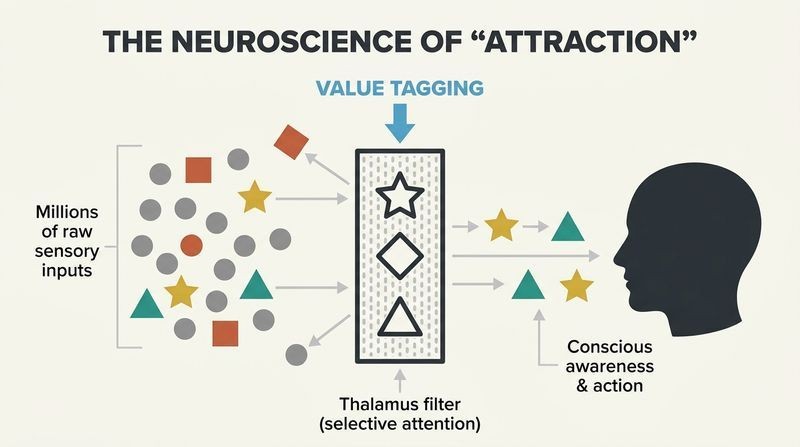
Manifesting is neuroscience, not mysticism. Tara Swart, a neuroscientist and former psychiatrist, argues that popular ideas like The Secret work not through vibrating thoughts but through two measurable brain processes. Selective attention means the thalamus discards millions of sensory inputs per second, keeping only what it deems relevant. Value tagging means the brain assigns importance to each input, steering what you notice and act on.
Focus reprograms the filter. When you consciously define what you want (a partner's qualities, a career goal), you prime the brain to flag matching opportunities you previously ignored. In the famous door experiment, half of pedestrians giving directions failed to notice the stranger they were talking to had been physically swapped. Your brain edits reality constantly. Manifesting simply means directing that editing on purpose, then acting.
What's clever here is reframing a spiritual claim as an attentional one, which is defensible. The reticular activating system and confirmation bias are well documented: buy a red car and suddenly red cars are everywhere. But there's a slippery slope worth flagging. Noticing more opportunities is not the same as the universe delivering them, and Swart's own hedging (a wish plus sufficient action) quietly concedes this. Barbara Ehrenreich's Bright-Sided warns that positive-thinking culture can blame victims for outcomes beyond their control. The honest version: attention shapes perception and behavior, which improves odds. That is powerful enough without cosmic packaging.
Set goals only where head, heart, and gut agree
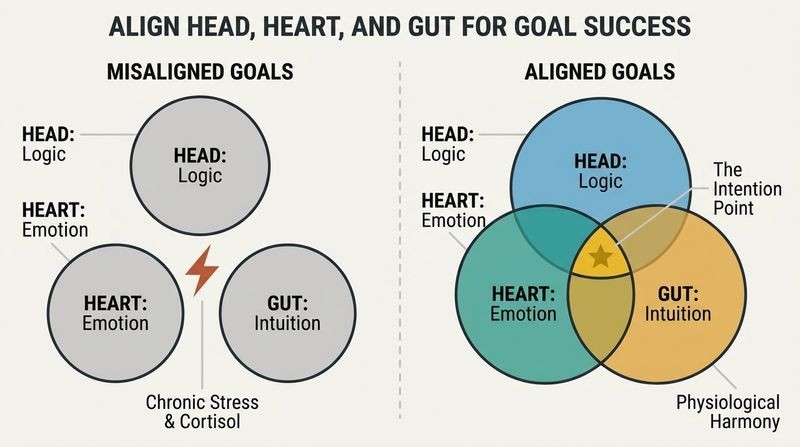
Align three systems before committing. Swart borrows the law-of-attraction idea of an intention point, the meeting of heart and mind, and grounds it in the brain-body connection. Because nerves and hormones flow in both directions, hunger and fatigue distort mood and decisions, while stress and depression alter sleep, appetite, and weight. A goal that satisfies logic but violates your emotional or intuitive read produces chronic internal conflict.
Misalignment has a physiological cost. Chasing money at the expense of purpose floods the body with cortisol, the stress hormone that suppresses the white blood cells guarding your immune system. Swart's client Pippa, trapped in an unhappy marriage, used an action board collage to surface what she truly wanted. Seeing her fear-driven catastrophizing on paper let her separate logical worries from genuine desire, and she left.
The insight that decisions feel right only when cognition, emotion, and interoception converge echoes Antonio Damasio's somatic marker hypothesis: patients with damaged emotional processing make disastrous choices despite intact IQ. So Swart stands on solid ground insisting emotion is not the enemy of good judgment but a required input. The weaker link is the leap from cortisol harming immunity to any specific life decision being validated by gut feeling. Gut feelings also encode bias and trauma. The practical value is the diagnostic question itself: when a goal produces persistent bodily unease, that signal deserves investigation rather than override.
Your brain rewires into adulthood, so no trait is fixed
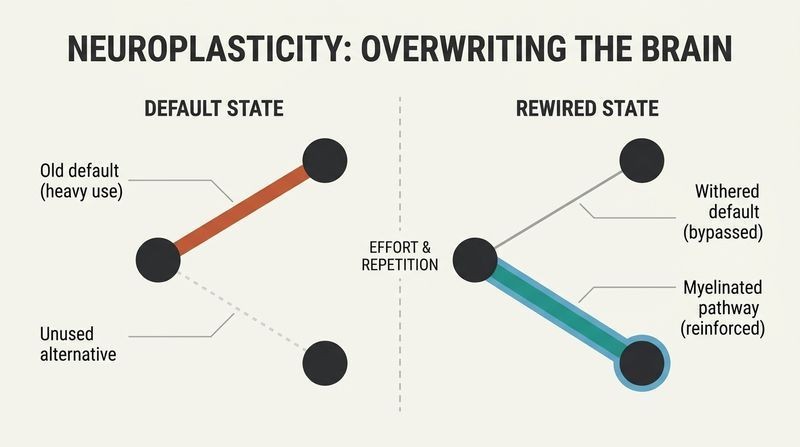
Neuroplasticity kills the excuse it's just who I am. For decades scientists believed the adult brain was hardwired. Brain scanning overturned this. Swart describes three mechanisms:
1. Learning: building new synapses between neurons, your B-plus skill.
2. Perfecting: myelination, coating existing pathways to speed them up, your A-grade skill.
3. Retraining (neurogenesis): growing new neurons, hardest and rarest in adults.
Evidence is dramatic. London taxi drivers who memorize every street grow a denser hippocampus, the memory region. Stroke patients regain paralyzed limbs through constraint therapy. Musicians show denser brain tissue than non-musicians. Neurons that fire together wire together, so repetition and emotional intensity carve pathways. Crucially, you cannot easily erase old patterns, but you can overwrite them with new ones through effort.
Swart's three-tier model is a useful simplification, though neurogenesis in adult humans remains genuinely contested, a nuance her own account acknowledges. The taxi-driver study (Maguire, UCL) is real and striking, but survivorship matters: only those who passed The Knowledge showed the effect. The deeper contribution is motivational reframing. Carol Dweck's growth mindset research shows that simply believing abilities are malleable improves performance. The danger is overselling: neuroplasticity does not mean anyone can become anything with enough willpower. Genetics, age, and starting point constrain the ceiling. Swart's honest framing (a B-plus skill versus an alien new one) respects those limits better than typical self-help.
Choose abundance over lack, because losses hit twice as hard
Two mindsets, two lives. Abundance assumes there is enough for everyone; it fuels generosity, resilience, and reframing failures as not-yets. Lack runs on fear, black-and-white thinking, and clinging to the familiar. The brain defaults to lack because it is wired for survival: it treats change as threat, powers down higher thinking, and grabs instant gratification.
The math is rigged against risk. Drawing on Kahneman and Tversky's loss aversion, Swart notes losses affect us roughly twice as powerfully as equivalent gains, so we overwork to avoid loss rather than pursue reward. Her friend Claire was abundant in love and friendship yet stuck for years in a miserable job, because a childhood of financial instability made her cling to safety. Mindset is context-specific; identify exactly where your lack thinking lives.
Grounding abundance thinking in prospect theory is a smart move that lifts a fuzzy self-help staple onto empirical footing. Loss aversion is one of behavioral economics' most replicated findings and neatly explains why blame cultures paralyze organizations. The observation that mindset is domain-specific rather than global is underappreciated and rings true: plenty of bold entrepreneurs are timid in relationships. One caution: abundance framing can shade into toxic positivity, where legitimate risk assessment gets dismissed as scarcity thinking. Sometimes the frying-pan-to-fire instinct is correct. The skill is distinguishing fear-driven avoidance from genuine prudence, which Swart's context-mapping exercise actually supports.
Vividly imagining an act trains your brain like doing it
Mental rehearsal produces physical results. Because the brain barely distinguishes a strongly imagined event from a real one, visualization is not daydreaming but training. Swart cites a Cleveland Clinic study where volunteers doing only imaginary finger exercises increased strength 35 percent, and imagined elbow work yielded 13.5 percent gains, versus 53 percent for real training. Merely picturing muscle contractions activated the same motor pathways.
Rehearsal defuses threat. Elite athletes like Lindsey Vonn run a course a hundred times mentally before the gate opens. When you visualize an interview or speech in full sensory detail (shoes, faces, sounds), the brain treats it as familiar, dropping its default threat response and the lack thinking that sabotages performance. Engage all senses, always end on a positive outcome, and pair it with physical cues.
The muscle-strength studies (Ranganathan, Yue) are real and genuinely surprising, though effect sizes shrink under scrutiny and the gains stem largely from improved neural drive rather than muscle growth itself. Sports psychology strongly supports motor imagery; the mechanism (shared neural substrate between imagined and executed action, confirmed by mirror-neuron and fMRI work) is solid. The important caveat, established by Gabriele Oettingen's research, is that fantasizing about outcomes alone can backfire, sapping motivation by tricking the brain into feeling the goal is already achieved. Effective visualization rehearses the process and obstacles, not just the trophy. Swart's insistence on pairing imagery with action aligns with this.
Master emotions first; they secretly bias every decision you make
Emotional regulation is the highest-leverage skill. Swart ranks it above all six thinking pathways because every decision is biased by emotion, whether acknowledged or not. Emotions arise in the amygdala, get matched to stored memories, and are interpreted by the prefrontal cortex. She maps eight basic emotions: five survival emotions (fear, anger, disgust, shame, sadness) that release cortisol and drive avoidance, and two attachment spectrums (love/trust, joy/excitement) mediated by oxytocin, serotonin, and dopamine, with surprise as a pivot between them.
You are the chef, not the ingredient. Swart debunks the amygdala hijack myth, the idea you become powerless under strong emotion. Clients who raged uncontrollably learned to notice, then interrupt, then halt the pattern using a STOP visualization. Naming an emotion (sadness, anger) as it arises creates detachment and control.
Swart's chef metaphor and her challenge to amygdala hijack align with Lisa Feldman Barrett's constructed-emotion theory, which argues emotions are built by the brain rather than triggered involuntarily, making them more malleable than Goleman's 1990s framing implied. The affect-labeling claim is well supported: Matthew Lieberman's fMRI work shows that naming an emotion dampens amygdala activity, literally putting feelings into words to reduce their grip. Where caution helps: telling someone mid-rage that they are fully in control can invalidate genuine neurological flooding. The truth is graded, harder but not impossible, which Swart mostly captures. Ranking emotional mastery as the master skill is a defensible, research-aligned bet.
Read your body's inner signals; interoception is a trainable sense
The forgotten sense. Interoception is the ability to perceive your body's internal state: hunger, heart rate, tension, the faint sense of illness days before symptoms. It runs on real neural pathways from heart, gut, lungs, and skin to specific brain regions. People taught to dismiss discomfort (a stiff-upper-lip upbringing) lose fluency in it, ignoring signals until crisis.
Ignoring the body is dangerous. Swart's client Sophie, a workaholic lawyer, had diabetic neuropathy so advanced that a heart-rate monitor read blank; her nerves had withered, a massive heart-attack risk she had normalized. A blunt reality check triggered her overhaul: walking, green juice, weight loss. Vacation sickness (falling ill the moment you stop) signals a body whose warnings you overrode. Train interoception via daily body scans and food-mood-bowel diaries.
Interoception is one of the hottest areas in contemporary neuroscience, and Swart is ahead of the curve in popularizing it. A.D. Craig's and Hugo Critchley's research links interoceptive accuracy to emotional awareness and decision quality, and Sarah Garfinkel has shown it can be trained. There is even evidence that poor interoception correlates with anxiety and alexithymia. The Sophie anecdote is a vivid illustration, though clinically the causation runs both ways: severe diabetes causes the neuropathy that erases signals, not merely inattention. Still, the actionable core stands. Regular body scans measurably improve interoceptive sensitivity, and that sensitivity underpins both physical health monitoring and emotional self-regulation.
Guard your gut: 90% of your serotonin is made there
The gut-brain axis is physical, not mystical. Swart resists calling the gut a second brain but stresses its enteric nervous system, millions of neurons in the gut wall, communicates constantly with the limbic brain. Around 90 percent of the body's serotonin, the mood-regulating neurotransmitter, is produced in the gut. So digestive health directly shapes thinking and intuition.
Care for it and thinking clears. A Dutch study found a month of probiotics reduced cognitive reactivity to low mood, meaning fewer spirals into negative thinking. Chronic stress makes the brain divert blood from digestion, weakening gut walls and lowering the body's stress threshold, so an unwell gut prolongs stress long after its cause passes. Practical moves: cut red meat, processed and sugary foods, test for gluten or lactose intolerance, eat fermented foods, take quality probiotics.
The gut-brain axis is legitimate frontier science, and Swart wisely flags how preliminary it is. The 90-percent-serotonin figure is accurate but often misused: gut serotonin largely cannot cross the blood-brain barrier, so it regulates digestion and platelet function more than mood directly; the brain synthesizes its own. The vagus nerve and microbiome-derived metabolites are the more plausible mood conduits. The probiotic-mood literature (Steenbergen et al.) is promising but small and not consistently replicated. The sensible takeaway survives the caveats: diet, fiber, and fermented foods measurably affect the microbiome, inflammation, and by extension cognition. Just temper expectations. A probiotic is not an antidepressant.
A strong why outlasts every distraction and setback
Purpose is motivation's engine. Swart points to Okinawa, Japan, famed for longevity, where residents live by ikigai, the reason to get up in the morning. A clear why makes the reward of pursuing a goal outweigh distractions, from a pinging phone to addiction. Chasing money or lifestyle without underlying passion is unsustainable and eventually surfaces as burnout.
Resilience is often forged in adversity. Many of the most driven people Swart has met overcame early trauma, learning to thrive despite hardship. She invokes Mandela and Holocaust survivor Viktor Frankl to keep problems in perspective. Two reframing tools: ask how much this will matter in five years, and ask what advice you would give a sibling in your situation. Depersonalizing a problem makes it less threatening and improves decisions.
The purpose-longevity link has real support beyond anecdote. Analyses of the Japanese ikigai cohorts and the US Health and Retirement Study associate sense of purpose with lower mortality and reduced cardiovascular risk. Frankl's logotherapy, born in the concentration camps, anticipated this by decades: he who has a why can bear almost any how. One nuance worth adding: the trauma-builds-resilience narrative risks survivorship bias, since trauma also frequently produces lasting damage, not grit; post-traumatic growth is one outcome among several. The depersonalization technique Swart offers is well validated. Ethan Kross's research on self-distancing shows that addressing yourself in the third person measurably improves emotional regulation and wiser reasoning.
You are the average of your five closest people, so prune ruthlessly
Emotions and habits are contagious. Humans need a tribe, but the quality of those bonds shapes mood, behavior, even finances. Swart cites research on social contagion: if a close friend becomes obese, your own risk rises 57 percent the following year, and a friend's divorce significantly raises yours. Stress spreads too; studies show partners of stressed individuals absorb similar neural stress changes.
Audit your circle deliberately. Swart's people-tree exercise: draw five branches for your five closest people, write five describing words on each, then mark which traits you share. Since we become like those we spend most time with, decide who to see more, who to keep steady, and who to let fade. Adults, unlike children, can curate their tribe, growing or pruning connections just as the brain prunes unused neural pathways.
The contagion statistics come from Christakis and Fowler's Framingham social-network studies, which are influential but genuinely contested. Critics like Cosma Shalizi argue that homophily (similar people clustering) and shared environments can masquerade as contagion, so the 57-percent obesity figure may overstate causal spread. Still, the directional claim holds across emotional-contagion research: moods, stress hormones, and behaviors do transmit through close ties, partly via mirror systems and shared context. The actionable wisdom is sound and echoes Jim Rohn's popular five-people maxim. The ethical wrinkle Swart underplays: ruthlessly pruning people treats relationships instrumentally. Some draining relationships (an ailing parent, a struggling friend) are moral commitments, not energy investments to optimize.
Build an action board, then act on it, don't just wish
Not a passive vision board. Swart insists on the word action because a collage of images works only when it drives behavior. Images bypass conscious thought and hit the brain's visual centers directly, engaging tactile, visual, emotional, and motivational pathways far more powerfully than a written list. Use mostly images and metaphors (a balloon for freedom), one exact income figure if money matters, and place it where you see it daily, especially by your bed.
Timing exploits brain states. Viewing the board just before sleep uses the hypnagogic state, when the mind is highly suggestible, so its imagery patterns your dreams (the Tetris effect). Swart's own 2016 board carried an engagement ring and the phrase joy comes out of the blue; weeks later she met her future husband on a flight. The board primes attention to seize matching opportunities you then pursue.
The action board sits at the book's controversial edge, and Swart's insistence on coupling it with action is what rescues it from magical thinking. The neuroscience she invokes is plausible: images are processed faster than text, and the hypnagogic state is genuinely hypersuggestible, exploited by hypnotherapy. The mechanism is best understood as goal priming plus the Zeigarnik effect, keeping unfinished intentions salient. The honest risk, again, is Oettingen's finding that vividly picturing success can reduce effort. Her own biography (meeting her husband after adding a ring to the board) is compelling storytelling but classic survivorship anecdote. The defensible core: externalized, visual goals that you act on beat vague resolutions.
Lasting change follows four stages: awareness, board, focus, practice
The Source is your whole integrated brain. Swart's central thesis is that true power comes not from the rational cortex alone but from integrating cortex, limbic system, gut, and body into whole-brain thinking. Her four-step program operationalizes it:
1. Raised Awareness: switch off autopilot, surface subconscious imprints and self-limiting beliefs through journaling.
2. Action Board: design and commit to your vision.
3. Focused Attention: use mindfulness and visualization to direct energy.
4. Deliberate Practice: repeat new behaviors until pathways stick.
Change is taxing and non-linear. Progress plateaus then suddenly clicks once neural pathways hit critical mass, so patience matters. US Marines given eight weeks of mindfulness stayed calmer and recovered faster from simulated combat stress. Just 12 minutes of daily meditation measurably reshapes the cortex; frequency beats duration.
The four-step arc maps neatly onto established behavior-change models (Prochaska's stages of change, and the awareness-then-repetition logic of habit formation) while adding a spiritual-practice layer. The Marine mindfulness study (Johnson et al.) is real and rigorous, part of Amishi Jha's respected resilience-training work, lending genuine credibility. The frequency-over-duration point on meditation is well supported. Where the framework is strongest is its refusal to treat insight as sufficient: deliberate practice, the unglamorous repetition, is where most self-help fails and where Swart is most honest about difficulty and plateaus. The synthesis of Eastern practice and Western neuroscience is the book's real signature, ambitious and mostly earned, occasionally straining the evidence to unify them.
Analysis
The Source belongs to a distinctive and commercially potent genre: the neuroscientist's rehabilitation of New Age self-help. Tara Swart, with dual authority as psychiatrist and neuroscientist, sets out to give The Secret an evidence-based spine. The book's structure mirrors its thesis, moving from law-of-attraction principles through brain anatomy and neuroplasticity to a six-pathway model of whole-brain agility, culminating in a practical four-step program. The organizing metaphor, The Source, is the fully integrated brain: cortex, limbic system, gut, and body working in concert rather than logic tyrannizing over emotion and intuition.
The book's genuine strength is its translation work. Concepts that would otherwise float free (manifesting, abundance, intention) are anchored to real mechanisms: selective attention, value tagging, loss aversion, cortisol's immune effects, the gut-brain axis, interoception. Much of the cited science is sound and current, and interoception in particular is a frontier Swart popularizes ahead of the mainstream.
The book's vulnerability is the reverse motion, where established science is stretched to validate practices whose efficacy is anecdotal. The muscle-visualization studies are oversold, gut serotonin does not straightforwardly reach the brain, and social-contagion statistics are causally contested. Most tellingly, Swart's own success stories (meeting her husband via an action board) are textbook survivorship bias, and the outcome-visualization she champions runs against Oettingen's evidence that fantasizing can sap effort. Her repeated coupling of visualization with action partially inoculates against this.
What elevates the book above its genre is Swart's clinical honesty about difficulty: change is metabolically expensive, non-linear, and plateaus before it clicks. She debunks neuromyths (10 percent of the brain, rigid left-right lateralization, amygdala hijack as helplessness). The result is a bridge text, imperfect but useful, that lets skeptics access self-help practices and lets believers ground their faith in mechanism. Read it for the reframes and the four-step discipline, not the cosmic promises.
Review Summary
The Source receives mixed reviews, with ratings ranging from 1 to 5 stars. Many readers appreciate the scientific approach to manifestation and visualization, finding the neuroscience explanations interesting. Some praise the practical exercises and personal anecdotes. However, critics argue the book lacks originality, repeating concepts from other self-help books. Some find it too autobiographical or lacking in depth. Overall, readers who are new to the topic tend to find it more valuable, while those familiar with similar concepts may be less impressed.
People Also Read







Glossary
The Source
Your whole integrated brainSwart's term for the full power of the entire brain working as an integrated whole: the rational cortex, the emotional and intuitive limbic system, the gut, and the wider body all aligned rather than in conflict. Tapping The Source means using whole-brain thinking to take ownership of decisions, relationships, and one's future.
Value tagging
Brain assigns importance to inputThe unconscious process by which the brain assigns a level of importance to every piece of information it encounters, based on logical relevance to survival and emotional significance. This tagging happens before any response and steers what you notice, remember, and act on, which is why past experience can bias you toward or against opportunities.
Selective attention
Filtering out most sensory inputThe cognitive process, managed largely by the thalamus, in which the brain attends to a small number of sensory inputs and filters out the millions it deems irrelevant each second. Demonstrated by change-blindness experiments where people fail to notice a conversation partner being swapped. Consciously directing it lets you notice opportunities the brain previously discarded.
Action board
Goal collage that drives behaviorSwart's reworking of the vision board: a collage of mostly images and metaphors representing your aspirations for the next 12 to 18 months. Unlike a passive wish board, it is meant to prime the brain's attention and drive real action. Viewed daily, especially before sleep, it engages visual, emotional, and motivational neural pathways.
Interoception
Sensing your internal bodily stateThe lesser-known sense that lets you perceive and interpret internal body signals such as hunger, thirst, heart rate, tension, and early signs of illness. It runs on neural pathways from organs to specific brain regions. Trainable through body scans and diaries, high interoceptive awareness correlates with better emotional regulation, self-awareness, and physical resilience.
Brain agility
Nimbly switching between thinking modesSwart's model of optimal brain functioning: the ability to focus intensely, think about a problem in multiple ways, switch seamlessly between them, and fuse them into integrated solutions. It rests on six neural pathways (emotions, physicality, intuition, motivation, logic, creativity) kept adequately developed and balanced rather than over-relying on one or two.
Intention point
Alignment of head, heart, gutBorrowed from law-of-attraction literature as the meeting of heart and mind, and reframed by Swart as the state where intuition, deepest emotions, and rational thinking line up in harmony. Setting a goal from this aligned place, rather than from conflict between the three, makes it far more achievable and avoids the physiological cost of internal discord.
Survival vs. attachment emotions
Cortisol fear versus bonding rewardsSwart's grouping of the eight basic emotions. The five survival emotions (fear, anger, disgust, shame, sadness) release cortisol and drive avoidance behaviors. The two attachment spectrums (love/trust and joy/excitement) are mediated by oxytocin, serotonin, and dopamine and activate reward systems. Surprise sits between them as a potentiator that can flip your state either direction.
FAQ
What's The Source about?
- Mind and Brain Connection: The Source by Tara Swart explores the link between neuroscience and personal development, focusing on how thoughts and emotions shape reality.
- Four-Step Program: It introduces a four-step program—awareness, action, attention, and practice—to unlock the brain's potential and rewire neural pathways for better life outcomes.
- Science and Spirituality Integration: Swart combines scientific research with spiritual concepts, like the law of attraction, to offer a comprehensive toolkit for personal transformation.
Why should I read The Source?
- Empowerment through Knowledge: The book provides insights into how the brain works, empowering readers to control their thoughts and emotions for personal growth.
- Practical Techniques: It offers exercises like visualization and action boards, backed by scientific research, to help manifest goals effectively.
- Holistic Approach: Swart's integration of scientific and spiritual perspectives appeals to those interested in self-improvement, emphasizing emotional intelligence alongside logical thinking.
What are the key takeaways of The Source?
- Neuroplasticity is Key: The book highlights the brain's ability to change and adapt, allowing for the development of new habits and behaviors through effort and practice.
- Mind-Body Connection: Understanding the brain-body connection is crucial for overall well-being, as physical and mental states influence each other.
- Harnessing Emotions: Mastering emotions is vital for personal success, with strategies provided for emotional regulation to enhance decision-making and relationships.
What is the four-step process outlined in The Source?
- Raised Awareness: Identify subconscious behaviors and thought patterns that may be holding you back, allowing for change.
- Action Board: Create a visual representation of goals to serve as motivation and focus on achievements.
- Focused Attention: Practice mindfulness to enhance the ability to respond thoughtfully rather than reactively.
- Deliberate Practice: Consistently apply insights to create lasting change, setting specific actions to overcome barriers.
How does The Source define emotional intelligence?
- Understanding Emotions: Emotional intelligence involves recognizing, understanding, and managing your own and others' emotions, crucial for communication and relationships.
- Regulating Emotional Responses: The book emphasizes regulating emotions to avoid being overwhelmed, allowing for resilience and clarity in challenges.
- Impact on Decision-Making: Emotional intelligence influences decision-making, enabling informed and balanced choices by being aware of emotional triggers.
What is the law of attraction as described in The Source?
- Manifesting Desires: The law of attraction involves focusing on positive thoughts to attract positive outcomes, grounded in neuroscience rather than wishful thinking.
- Six Principles: Swart outlines principles like abundance, manifestation, and universal connection, supported by scientific evidence and practical applications.
- Intention Setting: Setting clear intentions aligns heart, mind, and gut, creating a powerful starting point for manifesting desires.
How does visualization work in The Source?
- Brain's Response to Imagery: Visualization engages the brain similarly to actual experiences, activating neural pathways as if experiencing the event.
- Creating a Mental Blueprint: Visualizing goals creates a mental blueprint guiding actions, reinforcing positive thinking and opportunity recognition.
- Sensory Integration: Effective visualization involves engaging all senses, enhancing the brain's connection to desired outcomes, making them feel attainable.
What is neuroplasticity, and why is it important in The Source?
- Brain's Ability to Change: Neuroplasticity allows the brain to reorganize by forming new connections, enabling changes in thought patterns and behaviors.
- Overcoming Limitations: Understanding neuroplasticity empowers overcoming limiting beliefs and habits, reshaping the brain for healthier lifestyles.
- Practical Applications: Techniques like mindfulness and journaling reinforce new pathways, promoting lasting change through consistent practice.
How can I create an action board as described in The Source?
- Collect Meaningful Images: Gather images that resonate with your goals, evoking positive emotions and representing aspirations.
- Organize and Arrange: Lay out images on a board, grouping by themes like career and health, placing important ones prominently.
- Display Your Action Board: Place the board in a visible location for daily exposure, reinforcing goals and motivation to take action.
How does The Source address emotional intelligence?
- Mastering Emotions: Emotional intelligence is crucial for success, with strategies for recognizing, understanding, and managing emotions effectively.
- Impact on Decision-Making: Regulating emotions improves decision-making, allowing for balanced responses to challenges.
- Building Relationships: Enhancing emotional intelligence fosters empathy and understanding, leading to healthier and fulfilling connections.
How does The Source address the concept of resilience?
- Bouncing Back from Adversity: Resilience is the ability to recover from setbacks, cultivated through emotional intelligence and mindfulness.
- Finding Purpose: A strong sense of purpose motivates resilience, driving perseverance through difficulties.
- Building Resilience through Practice: Strategies like reframing failures and practicing self-compassion strengthen coping abilities.
What are the best quotes from The Source and what do they mean?
- “Whether you think you can or you think you can’t—you’re right.” Highlights mindset's power in shaping reality, emphasizing belief's influence on outcomes.
- “I am the master of my fate; I am the captain of my soul.” Reflects personal responsibility and empowerment, reinforcing the ability to shape life through thoughts and actions.
- “Neurons that fire together, wire together.” Encapsulates neuroplasticity, reminding of the importance of consistent practice in creating lasting change.
Download PDF
Download EPUB
.epub digital book format is ideal for reading ebooks on phones, tablets, and e-readers.








































