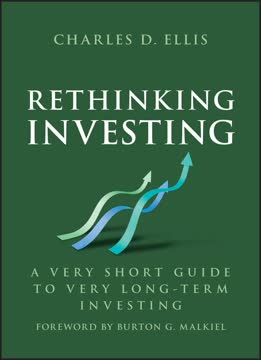
Key Takeaways
1. Harness the Exponential Power of Compounding and Time.
The power of compounding is unmatched by any factor in the production of wealth through investment.
Unmatched wealth creation. Compounding is the extraordinary ability to make money with money, growing your investments exponentially over time. This "Power Curve" effect means that the later stages of your investment journey yield the largest gains, as each doubling of your money is twice as large as the previous one. Starting early is paramount to fully leverage this phenomenon.
Time is your ally. The Rule of 72 illustrates this power: divide 72 by your annual rate of return to estimate how many years it takes to double your money. For example, at 8% annual growth, your money doubles every 9 years. This means $1,000 becomes $2,000, then $4,000, then $8,000, and so on, with each subsequent doubling contributing more to the total wealth.
Early start, greater gains. The fable of the emperor and the wise man, where a single grain of wheat doubled on each square of a chessboard, vividly demonstrates how seemingly small beginnings lead to unimaginable wealth. The largest gains occur in the final doublings, emphasizing why initiating the compounding process as soon as possible and sustaining it for as long as possible is the single most important factor for long-term investment success.
2. Make Saving Your Foremost Financial Priority.
The most important saving and investing decision most of us ever make is made when we decide where to work—and whether the prospective employer offers a 401(k) retirement plan and, if so, how that plan works.
Conscious financial choice. Saving is a deliberate choice requiring self-discipline, not self-denial. It's about strategically allocating current resources to secure future financial well-being and increase your "first choices" in life. Viewing saving as an investment in your future self transforms it into a positive, empowering habit.
Leverage employer benefits. A critical step is choosing an employer with a robust 401(k) plan, especially one offering a matching contribution. This employer match is essentially "found money" that compounds tax-free, significantly boosting your retirement savings. Key questions to ask about a 401(k) include:
- Does the company offer a 401(k)?
- What is the employer's matching contribution?
- How quickly do employer contributions vest?
- Are low-cost index funds available as investment options?
Practical saving strategies. Beyond employer plans, adopt personal saving habits. Automate deductions from your paycheck, avoid high-interest credit card debt, and make frugal lifestyle choices. Simple changes, like making coffee at home instead of buying a daily latte, can free up significant funds that, when invested, compound into substantial wealth over decades.
3. Understand the Market's Evolution: Active Management is a Losing Game.
The whole world around active investing has changed in many major ways, and all those changes compound to make it more and more difficult for any of those high-talent, hard-working active managers to outperform the market that they have collectively made so hard to keep up with—let alone beat.
Market's profound transformation. Over the past half-century, the stock market has undergone radical structural changes, making it increasingly difficult for active managers to consistently beat the market. The shift from 90% individual amateur trading to over 90% professional institutional trading has dramatically increased market efficiency and price discovery.
Professionals cancel each other out. Today's market is dominated by highly trained, intensely competitive professionals with instantaneous access to information, advanced technology, and extensive research. This intense competition means that any potential informational advantage is quickly neutralized, making it nearly impossible for any single active manager to consistently outperform the collective wisdom of the market, especially after accounting for costs.
Data confirms underperformance. Studies by Standard & Poor's (SPIVA) and Morningstar consistently show that the vast majority of actively managed funds fail to beat their benchmarks over the long term. For instance, over 20 years, 89% of U.S. mutual funds underperformed the S&P 500. This isn't due to a lack of skill, but rather the inherent difficulty of consistently outsmarting a market made efficient by the very professionals trying to beat it.
4. Embrace Low-Cost Index Funds and ETFs as Your Core Investment.
Index funds—and later exchange-traded funds (ETFs)—take a different approach. Index funds and ETFs do not struggle to do “better” than the market. They simply match the market, and they charge much lower fees and minimize operating costs.
The simple, superior solution. Given the difficulty of beating the market, index funds and ETFs offer a proven, effective alternative. Instead of trying to outperform, these funds aim to replicate the performance of a specific market index, such as the S&P 500 or the total U.S. stock market. This strategy inherently matches market returns, avoiding the underperformance common among active managers.
Cost-efficiency and diversification. Index funds boast significantly lower management fees (as low as 0.05% compared to 1% or more for active funds) and lower operating costs due to minimal portfolio turnover. This cost advantage, compounded over decades, translates into substantially higher net returns for investors. They also offer broad diversification, reducing risk compared to holding a few individual stocks.
Benign neglect is rewarding. One of the greatest advantages of index funds is their "uninteresting" nature. This lack of daily excitement discourages impulsive trading and market timing, which behavioral economics shows are detrimental to returns. Investors who simply buy a broad index fund and hold it for the long term consistently achieve top-quartile results, proving that "benign neglect" is a splendidly rewarding strategy.
5. Aggressively Minimize All Investment Costs, Fees, and Taxes.
The real cost of active management is not just the higher fees—hard to justify as they may be each year—but in their long-term stealth impact by shifting you down to a lower Power Curve—and reducing your rate of compounding over time as the adverse impact gets bigger and bigger.
Costs erode returns. If consistently beating the market is nearly impossible, then the most impactful way to improve your net returns is to minimize what you pay out. Most investors overlook the cumulative effect of fees, operating costs, and taxes, which can significantly diminish long-term wealth through the power of compounding.
The "only 1%" fallacy. Active management fees, often presented as "only 1%," can consume a disproportionately large share of your actual returns. If the market returns 7%, a 1% fee represents nearly 15% of your earnings. When compared to index funds with fees as low as 0.04%, the incremental cost of active management can effectively be over 100% of any incremental returns it might generate.
Hidden costs add up. Beyond management fees, investors incur other expenses:
- Operating costs: Brokerage commissions and dealer spreads from frequent trading.
- Taxes: Higher portfolio turnover in actively managed funds triggers more capital gains taxes annually.
- Advisor fees: Additional charges from Registered Investment Advisors (RIAs) can add another 1% of assets.
Collectively, these costs can reduce annual returns by 2-3%, which, over decades, can evaporate a third or more of an investor's potential final assets.
6. Confront Your Behavioral Biases to Avoid Costly Mistakes.
We have met our enemy—it is us!
Human irrationality in investing. Classical economics assumes rational decision-making, but behavioral economics, pioneered by Daniel Kahneman, proves that humans are often their own worst enemies in investing. Our inherent psychological biases lead to repetitive, irrational actions that significantly harm investment returns.
Common behavioral pitfalls:
- Loss aversion: We feel the pain of a loss twice as intensely as the pleasure of an equivalent gain, leading to excessive risk aversion or panic selling.
- Illusion of control: We believe we can influence outcomes we cannot, like market timing, leading to frequent, detrimental trading.
- Jumping to conclusions: Acting on incomplete information or first impressions, often based on anecdotal evidence or "hot tips."
- Overconfidence: Most people believe they are "above average" investors, leading to excessive risk-taking and underestimation of market efficiency.
Persistence over perfection. Missing even a few of the market's best days can dramatically reduce long-term returns, highlighting the danger of market timing. The average investor consistently underperforms the market by 2-5% annually due to these self-imposed errors. The solution is "benign neglect" – sticking to a simple, long-term plan, ideally with low-cost index funds, to avoid the temptations that behavioral biases exploit.
7. Re-evaluate Your "Total Financial Portfolio" to Include Hidden Assets.
Most of us have other stable assets—“bond equivalents”—that are important parts of our Total Financial Portfolio; those assets need to be included when determining our true Portfolio Allocation.
Beyond traditional assets. When assessing your financial portfolio, don't limit yourself to just stocks, bonds, and cash. Many individuals possess significant "bond equivalents" – stable assets that provide long-term value and should influence your overall asset allocation. Ignoring these can lead to an overly conservative, low-return investment strategy.
Key "bond equivalents" to consider:
- Home equity: The market value of your home, minus any mortgage, acts as a stable, appreciating asset with tax benefits and forced savings.
- Social Security: The present value of your future Social Security benefits is like an inflation-adjusted annuity, offering a highly secure income stream.
- Potential inheritance: If you anticipate a substantial inheritance, factor this into your long-term financial outlook.
- Future earnings and savings: Especially for younger individuals, the present value of your future income and your capacity to save represents a significant, stable asset.
Optimize equity allocation. By including these stable, bond-like assets in your "Total Financial Portfolio," you'll likely find that your overall financial picture is far more conservative than your securities portfolio alone suggests. This realization frees you to allocate a larger portion of your liquid investment portfolio to equities, which offer higher long-term returns and greater compounding potential, without compromising overall stability.
8. Utilize Bonds Strategically for Specific, Short-Term Needs.
Bonds can be the right way to invest if you know you will need the money in the near or intermediate future (say two to six years) for a specific important purpose, such as college tuition or a starter home—when you don't want to be exposed to the risk of the stock market having a steep decline just when you will need the money.
Bonds for specific purposes. While equities generally outperform bonds over the long term, bonds serve a crucial role for specific, short-to-intermediate term financial goals. If you anticipate needing a sum of money within 2-6 years for a defined purpose, such as a down payment on a house or college tuition, bonds offer price stability and predictability, mitigating the risk of a stock market downturn just when funds are required.
Spending cushion for stability. Another strategic use for bonds is to create a "spending cushion" of 2-3 years' worth of expenses. This buffer allows you to cover living costs without being forced to sell stocks during a market decline. This approach provides psychological comfort and financial flexibility, ensuring you don't liquidate assets at an unfavorable time.
Beware of opportunity cost. While bonds offer stability and predictable nominal payouts, they come with a significant opportunity cost: lower long-term returns compared to equities. Overemphasizing short-term price fluctuations by over-allocating to bonds can severely dampen your Power Curve and reduce your eventual wealth. Therefore, bond allocation should be deliberate and limited to specific, risk-averse needs, rather than a default strategy.
9. Adopt a Smart Spending Rule for Consistent Retirement Income.
An effective Spending Rule converts the price-volatile returns of the market into far smoother, more predictable stream of payouts and enables your long-term investment strategy to focus on achieving higher long-term returns.
Smooth out market volatility. A well-designed Spending Rule is a powerful tool for managing withdrawals from your investment portfolio, particularly in retirement. Instead of reacting to daily market fluctuations, it provides a consistent, predictable income stream, allowing your investment strategy to remain focused on long-term growth rather than short-term stability.
The Yale endowment model. Inspired by Nobel Laureate James Tobin's work for Yale's endowment, a personal Spending Rule typically involves averaging your portfolio's year-end values over several prior years (e.g., five or more). You then apply a prudent withdrawal rate (e.g., 4-5%) to this smoothed average to determine your annual spending amount. This dampens the impact of market swings; for example, a 30% market drop might only reduce your payout by 5%.
Freedom for higher returns. By implementing a Spending Rule, you reduce the need to over-invest in low-return bonds for income stability. This frees your portfolio to allocate more to equities, which offer higher long-term returns and faster compounding. Whether you aim to preserve capital or gradually spend down assets (e.g., a 7% withdrawal rate for a pure equity portfolio), a Spending Rule provides financial freedom and a more rapidly rising income stream over time.
10. Maximize Retirement Security by Deferring Social Security and Working Longer.
The actual increase in annual benefits is 8% each year. Over 8½ years, that compounds to—drum roll—76%!
Unlock significant benefits. Two of the most impactful, yet often mishandled, financial decisions are when to claim Social Security benefits and when to stop working. Most people claim Social Security at age 62, missing out on a massive increase in lifetime income. By deferring benefits from age 62 to 70½, your annual payout increases by a remarkable 8% per year, compounding to a total increase of 76%.
Inflation-adjusted income. These significantly larger Social Security benefits are not only guaranteed by the federal government but are also adjusted annually for inflation, providing a powerful, lifelong income stream that maintains its purchasing power. This makes deferring Social Security one of the most financially advantageous moves for most individuals.
Double-barreled advantage. Combining deferred Social Security with working longer creates a powerful synergy. Continuing to work past age 62 allows you to:
- Keep contributing to and growing your 401(k) tax-free.
- Avoid drawing down your retirement savings, allowing them to compound further.
- Potentially more than double your 401(k) assets by age 70½.
This dual strategy dramatically increases your annual retirement income, offering enhanced financial security and flexibility in your later decades.
11. Build a Simple, Disciplined, Long-Term Personal Investment Plan.
The benefits of benign neglect can be formidable.
Your personalized roadmap. A robust Personal Investment Plan integrates your Portfolio Allocation, Savings Plan, and Spending Rule into a cohesive strategy. This plan should be tailored to your unique financial objectives, future earning potential, and a comprehensive inventory of your "Total Financial Portfolio," including all bond-like assets.
Focus on the long game. Long-term investors prioritize the power of compounding and the prospects for future earnings and dividends over short-term price fluctuations. Resist the urge to react to daily market noise; a diversified portfolio of equity index funds, held for decades, will consistently outperform. The goal is to internalize market history and understand that short-term volatility is normal, not a signal for action.
Embrace "benign neglect." The principle of "less is more" applies profoundly to investing. By making fewer, well-considered decisions, you reduce the likelihood of costly mistakes. Avoid common pitfalls such as market timing, frequent changes to portfolio structure, or switching managers based on short-term performance. A disciplined, consistent approach to your long-term plan, especially through index funds, will yield superior results.
Review Summary
Reviews of Rethinking Investing are generally positive but modest, averaging 3.78/5. Many readers find it a concise rehash of Ellis's earlier work, best suited for beginner investors. Key themes praised include the power of compounding, low-cost index fund investing, saving early, and delaying Social Security. Critics note the book lacks depth on topics like asset allocation, taxes, and Roth accounts, and contains a factual error regarding Social Security's maximum age. Several reviewers recommend it as an ideal gift for young adults beginning their financial journey.
People Also Read

 Immersive

 Immersive