

Key Takeaways
Wealth grows in tenfold rungs, not one smooth line
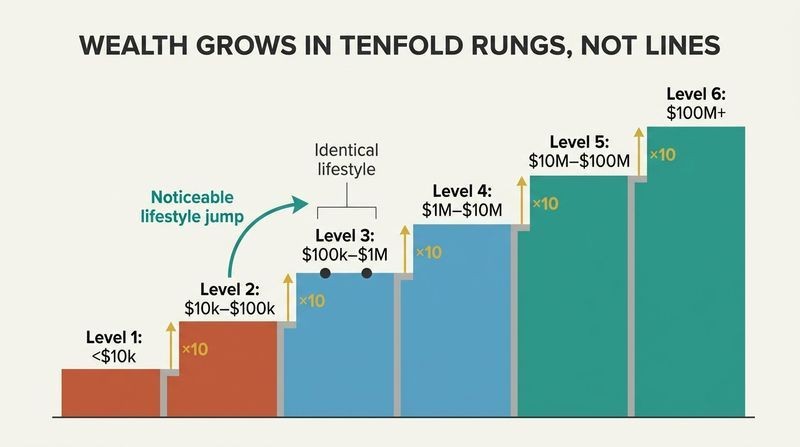
The Wealth Ladder has six levels, each separated by a factor of ten because that is roughly the jump needed to change your lifestyle in a noticeable way. Level 1 is under $10k (paycheck-to-paycheck), Level 2 is $10k to $100k, Level 3 is $100k to $1M (middle class), Level 4 is $1M to $10M, Level 5 is $10M to $100M, and Level 6 is $100M+.
The insight: a person with $500,000 lives almost identically to one with $400,000, yet someone with $1,000 lives nothing like someone with $100,000. Enjoyment of money moves in steps, not inches. This is why budgeting advice helps a Level 1 household but is useless at Level 6, and why starting a business matters at the top but is reckless at the bottom. Contradictory financial gurus are often both right, just talking to different rungs.
The framework's real power is diagnostic. Most money advice fails because it ignores context, prescribing the same medicine to an obese patient and a trained athlete. Maggiulli's logarithmic view echoes the Weber-Fechner law in psychophysics: humans perceive stimuli (loudness, brightness, and apparently wealth) in proportional, not absolute, terms. A caution worth noting: the tidy tenfold bands are a heuristic, not physics. Real lifestyle thresholds cluster around lumpy purchases (a house, private school, a jet) that do not always land neatly on powers of ten. Still, as a mental organizing tool for matching strategy to situation, few personal finance frameworks are this clarifying.
Spend from your wealth, not your paycheck, using the 0.01% rule
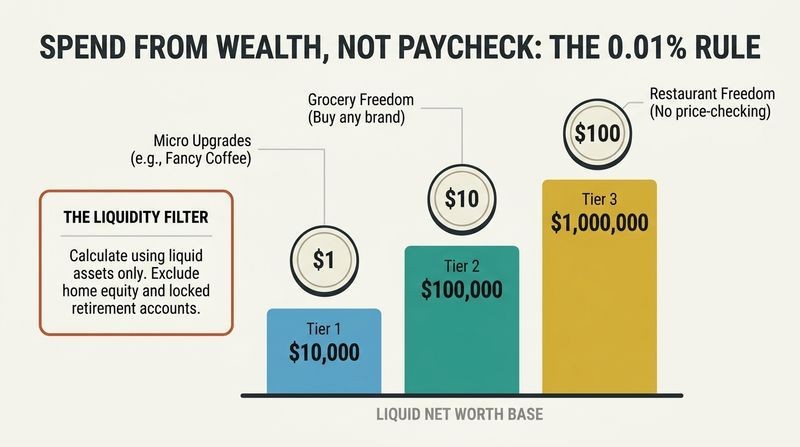
Income is fickle, wealth is durable. Maggiulli's 0.01% Rule says the amount you can spend above your necessities each day without eroding your net worth is roughly one ten-thousandth of it. At $100,000 net worth, that is $10 a day of guilt-free upgrades; at $10,000, it is a single dollar. This maps neatly onto lifestyle: grocery freedom, restaurant freedom, travel freedom, and so on up the ladder.
The danger is spending to match income. High earners suffer surprisingly permanent income shocks (research shows negative shocks to top earners tend to stick, while gains are transitory), which is why some athletes earning millions still go broke. He also urges spending from liquid net worth, not paper wealth. Someone worth $1.1M with only $250k in a brokerage account should live like a Level 3 household, because home equity and locked retirement accounts cannot buy dinner.
The 0.01% Rule is a clever repackaging of the sustainable withdrawal logic behind the 4% retirement rule, scaled to daily decisions (0.01% daily compounds to about 3.7% annually). Its genius is behavioral: it converts an abstract net worth into a concrete, permission-granting number, defusing the guilt that makes frugal people miserable and the recklessness that bankrupts spenders. One tension: the rule assumes wealth is invested and growing, so for a jobless person sitting on cash it collapses (a $20k cushion yields only $2 a day). Maggiulli acknowledges this, which is why he insists spending guidance only works alongside a live income stream.
Your income today is the bedrock of tomorrow's wealth
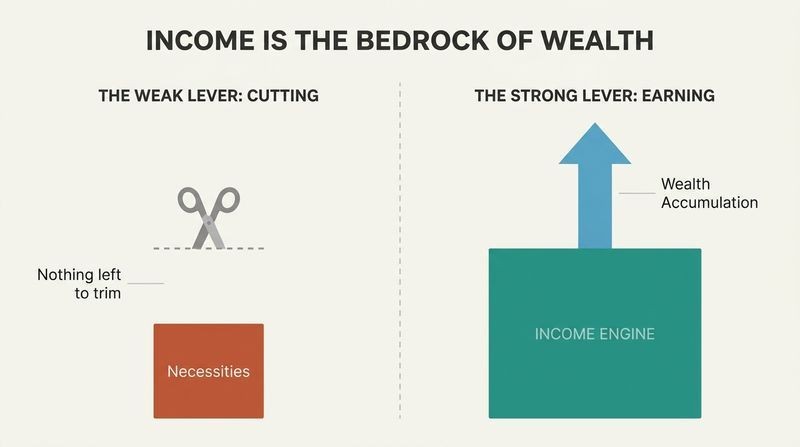
Income and wealth move together, forming what Maggiulli calls the strongest relationship in personal finance. It is rare to find high wealth with low income or vice versa. In 2022 US data, the least wealthy high earners held about four times more wealth than the wealthiest low earners.
Because of this, cutting spending is a weak lever compared to raising income, especially at the bottom, where the poorest fifth of Americans already spend over 100% of after-tax income on necessities. There is nothing left to trim. The escape route is building marketable skills and applying the 1% Rule: pursue an earning opportunity only if it can add at least 1% to your net worth. That threshold rises as you climb, so odd jobs worth $100 make sense at Level 1 but are a waste of attention at Level 4.
Maggiulli's income-first stance is a useful corrective to the latte-shaming school of personal finance, which fixates on trivial cuts while ignoring the denominator. Behavioral economists would add that income growth also compounds psychologically: higher earners gain optionality, which reduces stress and enables better long-term decisions. The 1% Rule cleverly formalizes opportunity cost, the economist's most underused concept, into a personal filter. The nuance he underplays is that income and wealth causation runs both ways. Existing wealth buys education, networks, and risk tolerance that generate more income. For those starting with neither, the bootstrap is real but steeper than the tidy rule suggests.
Trade your time for leverage: labor, capital, content, or code
To divorce income from hours worked, you need leverage, borrowed from Naval Ravikant: output per unit of input. There are four kinds:
1. Labor (employing people, capturing the gap between wages paid and revenue generated)
2. Capital (investing money, yours or others', for a fee or return)
3. Content (build once, sell infinitely, permissionless but fiercely competitive)
4. Code (near-infinite scalability, needs technical skill and maintenance)
Labor and capital are Level 3 to 6 strategies; content tops out around Level 4; code reaches Level 5. The pattern up the ladder is a shift from working for money to having money work for you. A lawn-mowing business illustrates labor leverage: hire a helper at $20 an hour who lets you mow six extra lawns, and daily profit rises even after paying them. The trap is that people, markets, and audiences are all hard to manage.
Ravikant's leverage taxonomy has become startup-world gospel, and Maggiulli's contribution is anchoring each form to a wealth level, clarifying when each becomes viable. The framework aligns with economist Paul Romer's insight that ideas (content and code) are non-rival goods: they can be used by many people at once, which is precisely why they scale without proportional cost. The honest caveat, which Maggiulli makes, is that content and code have collapsed to near-zero barriers to entry, so the scarce resource is now attention and differentiation, not production. The winners increasingly stack leverage: content markets a product built with code and run by labor.
Own assets that pay you, not assets that cost you
The clearest fault line on the ladder is income-producing assets. Households in Levels 1 to 3 keep 20% or less of their wealth in assets that generate income; Levels 4 to 6 hold 50% or more. Lower rungs own cash, vehicles, and a primary residence (things that cost money or merely reduce expenses). Higher rungs own stocks, rental real estate, retirement accounts, and private businesses.
The accumulation path runs: cash and vehicles, then home and retirement, then stocks and business ownership. Business interests are the single largest holding for Level 6 households, which is how Elon Musk's net worth once grew by roughly $6,000 per second during Tesla's 2020 to 2021 run. But ownership guarantees nothing: buying stocks will not make you Warren Buffett any more than starting a business makes you Bill Gates. Correlation is strong, causation is not.
This is the operational core of Maggiulli's first book, Just Keep Buying, compressed into a single distinction. The lottery-winner analogy is a sharp guard against survivorship bias, the logical error of studying only winners and inferring their habits were the cause. Behavioral finance research reinforces the point: most retail investors underperform the funds they own because of poor timing, so ownership without discipline can destroy value. What the data cannot resolve is direction of causation. Do income-producing assets create wealth, or does wealth simply enable people to buy them? Almost certainly both, in a reinforcing loop that rewards getting started early with even small amounts.
Level 4 is a trap: a great salary cannot break you out
The million-dollar plateau is the hardest to escape. With $1M invested and a strong $100k annual savings rate at 5% returns, reaching $10M takes 28 years. Even saving $300k a year, it takes 17 years. The math is brutal: at $5M, saving $100k only moves you 2%. Sixty-four percent of Level 4 households remain there two decades later; only 8% reach Level 5.
The reason is that the strategy that got you in (high income plus solid investing) cannot get you out. Escape requires equity in a business that sells for millions or throws off large income. The Harrison Group found 63% of households with $500k+ in discretionary income built it through business ownership. Cautions matter: successful founders average age 45, industry experience more than doubles success odds, and a family financial safety net makes the risk survivable.
The Nauru parable that opens this idea (a phosphate-rich island that squandered its sovereign fund on a flop London musical) dramatizes how sudden wealth without investing discipline evaporates. Maggiulli's candor about entrepreneurship as a class-privileged dart game (rich kids get many throws, poor kids work the carnival) is refreshingly honest for a wealth-building book, and backed by Israeli data linking founder likelihood to parental income. The counterintuitive gem is that middle-aged founders dominate, puncturing the Silicon Valley wunderkind myth. One challenge: framing Level 4 as a trap assumes everyone wants Level 5. For most, $1M to $10M funds a genuinely free life, and the smartest move may be to stop climbing.
Sell the first business, then play again with bigger chips
Serial entrepreneurship compounds skill and capital. Mark Cuban sold MicroSolutions for $6M before Broadcast.com; Musk netted $20M from Zip2 before PayPal and Tesla. MIT research found each prior company an entrepreneur sold predicts 52% higher revenue at their current company. Nearly 80% of billion-dollar unicorns founded from 2003 to 2013 had at least one founder who had started a company before.
At Level 5, the choice is to scale the existing business or start a new one. Scaling wins because bigger firms sell at a premium: one wealth management firm with $10M revenue is worth more than ten firms with $1M each, thanks to economies of scale and more predictable earnings (a 10x versus 8x valuation multiple in Maggiulli's example). But only about 1 in 1,500 startups ever reaches $1B, so when offered a life-changing sum, seriously consider selling.
The first-exit-then-bigger-swings pattern is well documented, and Maggiulli wisely uses it to lower the psychological bar for aspiring founders: aim for a modest, reliable win before a moonshot. The valuation-multiple point connects to a real phenomenon private-equity roll-ups exploit, called multiple arbitrage, buying small firms cheaply and selling the combined entity at a higher multiple. The Mozart anecdote (if you have to ask how, you may not be ready) is charming but double-edged. It could discourage prudent due diligence. The stronger reading is about conviction, not competence: hesitation about scaling often signals that the founder's real appetite has already been satisfied, which is valuable self-knowledge.
Past Level 4, wealth stops solving problems and starts creating them
More money buys diminishing returns and new hazards. Once basics are secured, additional wealth introduces loss of trust (the wealthy constantly wonder whether people want them or their money), increased stress (studies show an inverted-U between wealth and mental health, with well-being declining past a peak), and distorted family dynamics.
Research by Suniya Luthar found children of affluent parents showed higher rates of anxiety, depression, and substance use than inner-city kids, driven by achievement pressure plus emotional isolation. Huguette Clark, heir to a $300M copper fortune, died at 104 in a hospital by choice, estranged from everyone, with no family at her funeral. Buffett's prescription for heirs is to leave them enough to do anything but not enough to do nothing. The remedy across all these risks is deliberate communication, boundaries, and keeping pre-wealth friendships alive.
Maggiulli joins a lineage from the Stoics to modern hedonic-adaptation research in arguing that wealth's marginal utility craters. The Luthar findings are especially important because they invert the intuition that money shields children. The mechanism, isolation plus pressure, is instructive: it is not affluence itself but the parenting patterns affluence enables. Notably, Luthar found first-generation immigrant kids face high achievement pressure without the same damage, because they lack the isolation. This suggests the culprit is absent, distracted parents, not high expectations. The section's honesty about first-world problems is disarming, and its practical value is preventive: knowing these traps exist is the first step to not falling into them.
The typical millionaire is 62, not 32, so recalibrate your timeline
Time is the quiet engine of wealth. The median age rises with every rung: 42 at Level 1, 54 at Level 3, 62 at Level 4, 66 at Level 6. Fewer than one in four US millionaire households are under 50. The financial media's twenty-something millionaire is a statistical freak, not a benchmark.
Panel data following the same households from 1984 to 2021 shows most people stay put: over ten years, 63% remain in the same level, 21% climb one, and 11% fall one. Over twenty years, upward mobility roughly doubles (32% climb one level), reaffirming time's role. Mobility is highest at the top and bottom, lowest in the sticky middle (72% of Level 3 and Level 4 households stay). Downward moves cluster near the top, where concentrated business wealth swings hardest. Even households that never change levels typically build real wealth along the way.
This chapter is the book's most valuable service, because unrealistic expectations cause premature quitting. Maggiulli opens with Curt Richter's grim 1950s rat experiment (rats that were rescued once before drowning then swam 60 hours versus 15, because they had hope) to make a point about expectation shaping persistence. The panel-data approach is methodologically superior to cross-sectional snapshots, tracking real households through recessions and booms. The sobering nuance for younger readers: the slight upward bias in mobility reflects an unusually prosperous US era with strong asset returns. Global poverty declines suggest the pattern generalizes, but sequence-of-returns risk means the next 40 years may not mirror the last.
Money buys happiness only if you are not already deeply unhappy
The Kahneman versus Killingsworth debate resolved. Kahneman and Deaton's famous 2010 finding that happiness plateaus above $75,000 was partly a measurement artifact: their scale was capturing the absence of unhappiness, not the presence of joy. Killingsworth's later work showed well-being keeps rising with income. Their joint 2023 paper reconciled it: money keeps boosting happiness for most people, but for the unhappiest 15% it plateaus around $75,000.
Maggiulli's summary: if you are poor, more money helps; if you are already happy, more money helps; if you are neither poor nor happy, money does nothing. The relationship is logarithmic, so each happiness gain requires a bigger dollar jump, which is why the goalpost always moves. Rockefeller, asked how much money is enough, reportedly said just a little bit more. The escape from this treadmill is shifting focus to non-financial wealth.
This is a masterclass in how scientific consensus gets built, corrected, and refined rather than overturned. The subtle distinction between reducing unhappiness and increasing happiness has clinical weight: it implies money cannot treat depression, which aligns with research showing mental illness responds to income only weakly. The logarithmic framing connects to the hedonic treadmill and to relative-income effects (people compare upward, so absolute gains feel smaller in wealthy reference groups). Maggiulli's Bud story (the facilities coordinator radiating joy on modest pay) is anecdotal by his own admission, but it usefully illustrates that contentment is partly a chosen orientation. The actionable core: buy time and offload chores, and spend on others.
Money is salt: it enhances a good life but cannot be the meal
Financial wealth multiplies your other wealth, but any number times zero is still zero. Borrowing from chef Samin Nosrat, Maggiulli calls money the great enhancer: like salt, it amplifies flavors already present rather than adding its own. He tracks five types of wealth (from Sahil Bloom): financial, social, mental, physical, and time.
The supporting data is startling. Across 148 studies of 310,000 people, the strongest predictor of surviving a heart attack was friendships, rivaled only by quitting smoking. Good physical health was valued at $400,000 a year of equivalent salary, four times any other factor. A top-2.5% VO2 max cuts all-cause mortality risk by about 80%, the strongest association Peter Attia has seen for any modifiable behavior. Firefighters who could do 40+ pushups had 96% fewer cardiovascular events than those doing under 10. Social rank, more than absolute money, predicts health.
The salt metaphor is the book's most elegant reframe, rescuing the money-and-happiness conversation from both cynicism (money is evil) and naivety (money is everything). The friendship-and-heart-attack finding deserves wide circulation; it reflects a growing epidemiological consensus that loneliness rivals smoking as a mortality risk, per Julianne Holt-Lunstad's meta-analyses. The Whitehall studies' twist, that social rank rather than absolute income drives health outcomes, is genuinely subversive: it implies a respected teacher may outlive a stressed-out junior banker earning triple. The five-wealths taxonomy risks feeling like a listicle, but Maggiulli grounds it in hard mortality data, which elevates it from self-help platitude to evidence-based priority-setting.
Analysis
The Wealth Ladder succeeds as a synthesis book: it fuses Federal Reserve Survey of Consumer Finances data, the University of Michigan's five-decade Panel Study of Income Dynamics, and the personal finance canon (Ravikant's leverage, Bloom's five wealths, Housel's psychology) into one coherent, level-indexed system. Its central move is intellectually honest and rare in the genre: instead of a universal prescription, Maggiulli offers a conditional one. Strategy should be a function of position. Budgeting for Level 1, education for Level 2, investing for Level 3, entrepreneurship for Levels 4 to 5, and wealth preservation for Level 6. This context-dependence resolves the apparent contradictions between financial gurus and gives the book unusual staying power.
The framework's greatest strength is also its subtlest limitation. The clean tenfold bands and the 0.01% and 1% rules are heuristics dressed in the authority of data. They are memorable and directionally sound, but real lifestyle thresholds are lumpy and geography-dependent; $1M means something different in Mississippi than Manhattan, a point Maggiulli concedes when he notes the numbers are an approximate art. The book is also, refreshingly, honest about luck and class: the carnival-dart-game metaphor and the parental-income-predicts-entrepreneurship data undercut bootstrap mythology that lesser books peddle.
Where the book transcends its genre is Part III. Having spent two-thirds teaching accumulation, Maggiulli argues that beyond Level 4 money largely stops solving problems, marshaling Luthar's affluent-youth research, the Whitehall social-rank findings, and the reconciled Kahneman-Killingsworth happiness data. The salt metaphor crystallizes the thesis: wealth is a multiplier of an already-built life, worthless in isolation. The memoir chapter grounds the abstraction in a working-class-to-Level-4 arc driven by inflection points that only looked inevitable in hindsight. The result is both a competent wealth-building manual and a quiet argument for knowing when to stop climbing.
Review Summary
The Wealth Ladder offers a practical framework for building wealth across six levels, from under $10,000 to over $100 million. Readers appreciate Maggiulli's data-driven approach, relatable anecdotes, and emphasis on adapting strategies as wealth grows. The book provides insights on spending, investing, and starting businesses. While some find it oversimplified or lacking novelty, many praise its accessible tone and realistic perspective on money's role in happiness. Critics note its US-centric focus and potential irrelevance for higher wealth levels.
People Also Read








Glossary
The Wealth Ladder
Six net-worth levels, tenfold apartMaggiulli's central framework dividing net worth into six levels separated by factors of ten: Level 1 (under $10k), Level 2 ($10k to $100k), Level 3 ($100k to $1M), Level 4 ($1M to $10M), Level 5 ($10M to $100M), and Level 6 ($100M+). Each level implies a different optimal strategy for spending, earning, and investing, because lifestyle changes happen in discrete jumps rather than smoothly.
The 0.01% Rule
Daily guilt-free spending equals net worth times 0.0001A spending guideline stating the amount you can spend above your necessities each day, without eroding your wealth, equals roughly one ten-thousandth (0.01%) of your net worth. At $100,000 that is about $10 per day. It assumes wealth is invested and growing, since 0.01% daily compounds to about 3.7% annually above inflation.
The 1% Rule
Pursue earning opportunities worth 1%+ of net worthAn earning guideline: take on a new income opportunity only if it can raise your net worth by at least 1%. The dollar threshold rises as you climb the ladder, so a $100 side gig is worthwhile at Level 1 but a distraction at Level 4, where opportunities should add $10k to $100k.
Four kinds of leverage
Labor, capital, content, codeBorrowed from Naval Ravikant, the four ways to increase output per unit of input and separate time from income: labor (employing people), capital (investing money), content (build once, sell many times), and code (software that scales near-infinitely). Content and code are permissionless; labor and capital require others' cooperation.
Income-producing assets
Assets that generate future incomeAssets expected to generate income over time, including stocks, bonds, rental real estate, farmland, royalties, and private businesses, as opposed to non-income-producing assets like cash, vehicles, and a primary residence. Maggiulli identifies the share of wealth held in these assets as the single sharpest divider between Levels 1 to 3 (20% or less) and Levels 4 to 6 (50% or more).
The Great Enhancer
Money amplifies existing life qualityMaggiulli's metaphor, drawn from chef Samin Nosrat's description of salt, for money's role: rather than adding new value on its own, wealth amplifies the value already present in your relationships, health, work, and time. Money multiplied by an otherwise empty life yields nothing, just as salt alone is inedible.
Five types of wealth
Financial, social, mental, physical, timeA taxonomy from Sahil Bloom that Maggiulli adopts to argue that financial wealth is only one dimension of a rich life. Social wealth (relationship quality), mental wealth (psychological well-being), physical wealth (health), and time wealth (control over your hours) are backed by mortality and happiness research showing they often matter more than money past a basic threshold.
Legacy = Action * Wealth
Impact equals deeds times resourcesMaggiulli's formula for Level 6, illustrated by Alfred Nobel (whose fortune created the Nobel Prizes) and Jadav Payeng (who single-handedly planted a 1,300-acre forest with almost no money). It argues that legacy is fundamentally about what you do; wealth merely amplifies the impact of that action, and meaningful action is possible at any wealth level.
FAQ
1. What is "The Wealth Ladder: Proven Strategies for Every Step of Your Financial Life" by Nick Maggiulli about?
- A new framework for wealth: The book introduces the "Wealth Ladder," a step-by-step framework for understanding and building wealth, tailored to your current financial situation.
- Levels of wealth: It breaks down wealth into six distinct levels, each with its own challenges, strategies, and mindset shifts.
- Personal and data-driven: Maggiulli combines personal stories, research, and large-scale financial data to illustrate how people move up (and sometimes down) the Wealth Ladder.
- Beyond money: The book also explores how wealth intersects with happiness, relationships, and life satisfaction, emphasizing that money is a tool, not the end goal.
2. Why should I read "The Wealth Ladder" by Nick Maggiulli?
- Tailored financial advice: The book provides actionable strategies specific to your current wealth level, making the advice more relevant and practical than generic financial tips.
- Unifies conflicting advice: It explains why financial experts often give contradictory advice—because they’re speaking to people at different points on the Wealth Ladder.
- Focus on mindset and strategy: Maggiulli emphasizes that effort alone isn’t enough; having the right strategy for your situation is crucial for financial progress.
- Addresses non-financial aspects: The book goes beyond money, discussing how wealth impacts happiness, relationships, and personal fulfillment.
3. What are the six levels of the Wealth Ladder in Nick Maggiulli’s framework?
- Level 1 (<$10k): Paycheck-to-paycheck living, often with high debt and little financial security.
- Level 2 ($10k–$100k): "Grocery freedom"—enough wealth to not worry about basic expenses, with a focus on building skills and education.
- Level 3 ($100k–$1M): "Restaurant freedom"—can enjoy more discretionary spending, with investing and side hustles becoming key.
- Level 4 ($1M–$10M): "Travel freedom"—significant investments, but breaking out requires business ownership or equity.
- Level 5 ($10M–$100M): "House freedom"—can afford dream homes and major purchases, but risk and complexity increase.
- Level 6 ($100M+): "Impact freedom"—wealth enables large-scale philanthropy, business acquisitions, and legacy-building.
4. How does the "Wealth Ladder" framework by Nick Maggiulli change traditional financial advice?
- Contextualizes advice: It shows that strategies like budgeting, investing, or starting a business are effective at different wealth levels, not universally.
- Explains conflicting guidance: The framework clarifies why some experts focus on frugality while others emphasize entrepreneurship or investing.
- Encourages strategic shifts: As you move up the ladder, the book recommends changing your approach—what worked at one level may not work at the next.
- Focuses on leverage and opportunity cost: The Wealth Ladder highlights the importance of using leverage (labor, capital, content, code) and regularly reassessing opportunity costs as your wealth grows.
5. What are the key strategies for moving up each level of the Wealth Ladder in Maggiulli’s book?
- Level 1: Focus on increasing income, reducing debt, and building marketable skills without taking on risky debt.
- Level 2: Invest in education and skill-building that leads to higher-paying work; be mindful of opportunity costs and dead-end jobs.
- Level 3: Prioritize investing in income-producing assets and consider side hustles to diversify income streams.
- Level 4: Shift focus to managing and diversifying investments; consider business ownership or equity for significant wealth jumps.
- Levels 5 & 6: Scale or sell businesses, manage risk through diversification, and focus on legacy, impact, and protecting wealth from non-financial threats.
6. What are the "0.01% Rule" and "1% Rule" in "The Wealth Ladder" by Nick Maggiulli?
- 0.01% Rule (Spending): You can safely spend 0.01% of your net worth per day above your income without reducing your wealth, guiding discretionary spending at each wealth level.
- 1% Rule (Earning): Only pursue income opportunities that increase your net worth by at least 1%—this helps you focus on higher-value opportunities as your wealth grows.
- Practical application: These rules help you decide when a spending or earning decision is significant enough to warrant your attention, preventing wasted effort on trivial gains.
- Adjusts with your level: As you climb the Wealth Ladder, the dollar amounts these percentages represent increase, changing your financial decision-making.
7. How does Nick Maggiulli recommend investing at different levels of the Wealth Ladder?
- Levels 1–3: Focus on building assets like cash, vehicles, and a primary residence; start investing in retirement accounts as soon as possible.
- Levels 4–6: Shift toward income-producing assets—stocks, real estate, and especially business ownership become dominant in higher levels.
- Diversification is key: As wealth grows, diversify investments to manage risk, especially to avoid overconcentration in a single asset or business.
- Ownership ≠ guaranteed success: While business ownership is common among the ultra-wealthy, simply owning a business doesn’t guarantee wealth—execution and diversification matter.
8. What forms of leverage does "The Wealth Ladder" by Nick Maggiulli identify, and how do they help build wealth?
- Labor: Employing others to multiply your output; essential for scaling businesses from Level 3 upward.
- Capital: Using your own or others’ money to invest and generate returns; crucial from Level 3 and above.
- Content: Creating scalable media or intellectual property; effective from Level 2 to Level 4, often as a marketing engine for larger ventures.
- Code: Building software or digital products that can be replicated at scale; can propel you from Level 3 to Level 5, especially with equity in tech ventures.
- Strategic use: The right form of leverage at the right time can dramatically accelerate your climb up the Wealth Ladder.
9. How does "The Wealth Ladder" by Nick Maggiulli address the relationship between wealth and happiness?
- Money buys happiness—up to a point: More money increases happiness, especially when escaping poverty, but the effect diminishes as wealth grows.
- Happiness is logarithmic: Each additional dollar brings less happiness than the previous; the biggest gains come from moving out of Level 1 or 2.
- Non-monetary factors matter more: Beyond a certain point, relationships, health, purpose, and time have a greater impact on happiness than additional wealth.
- Beware of the "never-ending then": The pursuit of "just a little more" can lead to perpetual dissatisfaction if not balanced with non-financial fulfillment.
10. What are the main risks and pitfalls at higher levels of the Wealth Ladder, according to Nick Maggiulli?
- Overconcentration: Having too much wealth in a single business or asset can lead to catastrophic losses.
- Lifestyle inflation: Increased spending on luxury items and experiences can erode wealth and create new liabilities.
- Complexity and stress: Managing large sums brings legal, tax, and relational complexities, including lawsuits and family dynamics.
- Loss of trust and altered relationships: Wealth can change how others perceive and interact with you, sometimes leading to isolation or family conflict.
11. How long does it typically take to climb the Wealth Ladder, based on Maggiulli’s research?
- Wealth takes time: The median age for each wealth level increases as you go up; most millionaires (Level 4) are in their 60s.
- Upward mobility is gradual: Over a decade, most households stay in the same wealth level; moving up one level is common, but jumping multiple levels is rare.
- Twenty-year perspective: Over two decades, upward mobility increases, but the biggest gains still require time, discipline, and sometimes luck.
- Patience is essential: The book emphasizes realistic expectations—quick wealth is rare, and compounding works best over long periods.
12. What are the best quotes from "The Wealth Ladder" by Nick Maggiulli, and what do they mean?
- "Atypical results require atypical actions." — To achieve extraordinary financial progress, you often need to take bold or unconventional steps, especially when starting from behind.
- "What got you here won’t get you there." — The strategies that help you reach one wealth level may not work for the next; adaptability is crucial.
- "Legacy = Action * Wealth." — Your impact is determined by both what you do and the resources you have; wealth amplifies your actions, but action is still required.
- "Money is a multiplier of every other kind of wealth you have." — Financial wealth enhances social, mental, physical, and time wealth, but cannot replace them.
- "Once you see it, you can’t unsee it." — The Wealth Ladder framework fundamentally changes how you view financial decisions and progress, making it hard to return to old ways of thinking.
About the Author
Other books by Nick Maggiulli

Download PDF
Download EPUB
.epub digital book format is ideal for reading ebooks on phones, tablets, and e-readers.








































