

Key Takeaways
Attainable goals are why most businesses stagnate and die
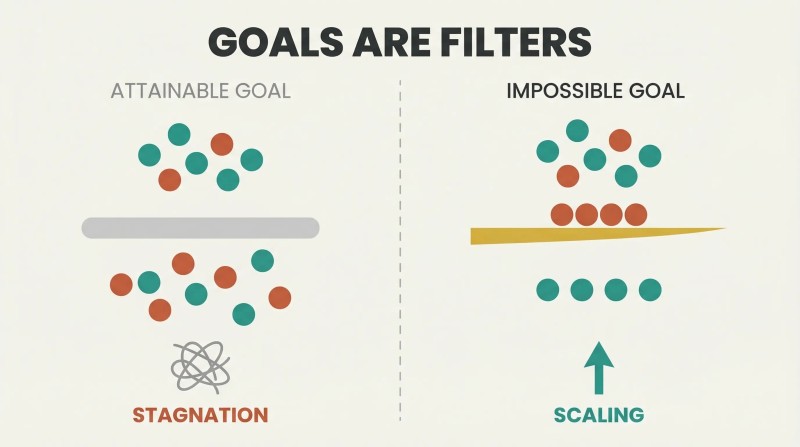
Hardy's central, counterintuitive claim: attainable goals don't just underwhelm — they actively prevent scaling. Why? Because goals aren't merely endpoints; they're perceptual filters. Everything you see, decide, and build is shaped by the goal you've set. An attainable goal is too dull a filter to separate signal from noise. It lets you keep "optimizing a thing that should not exist," as Elon Musk puts it.
Hardy introduces The Scaling Framework — Frame, Floor, Focus — to fix this. Your Frame (goal) determines what you see. Your Floor defines what you eliminate. Your Focus defines the path you pursue. Kennedy didn't just declare a bold vision about space; he set a genuinely impossible goal. That impossibility forced NASA to find a singular, innovative path. Most leaders set attainable goals and expect moon-level results. They get complexity instead.
Set an impossible goal — it's a strategic filter, not a fantasy
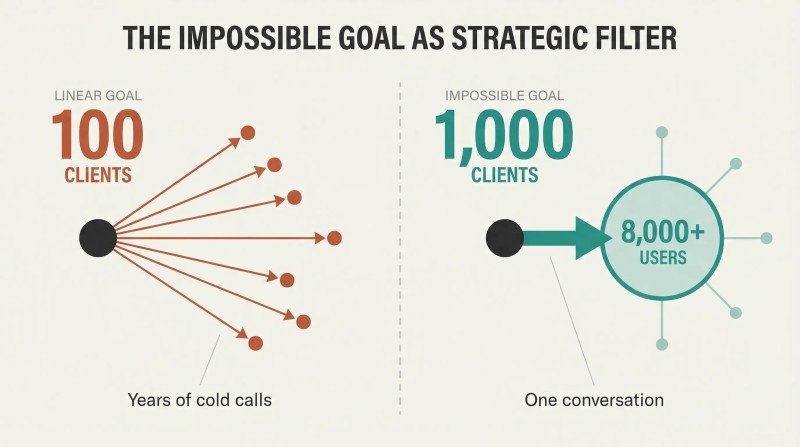
An impossible goal redefines your identity. Alicia Ault had LevelUp Score, a credit repair software with 10 clients. Her initial goal of 100 clients in 90 days was linear — just more cold calls. When she 10x'd to 1,000 clients, the goal became genuinely impossible. That impossibility forced a completely different approach: instead of calling individual companies, she partnered with a credit software company already serving 8,000+ users. One conversation accomplished what years of cold calls never could.
Duke management researcher Dr. Sim Sitkin defines these stretch goals as objectives with an unknown probability of attainment that seem impossible given current capabilities. They demand "radically new approaches" and "extreme redefinitions" of what an organization can become. The goal doesn't just motivate — it reveals paths invisible from a lower frame.
Compress your 10-year goal to 3 years and the path transforms
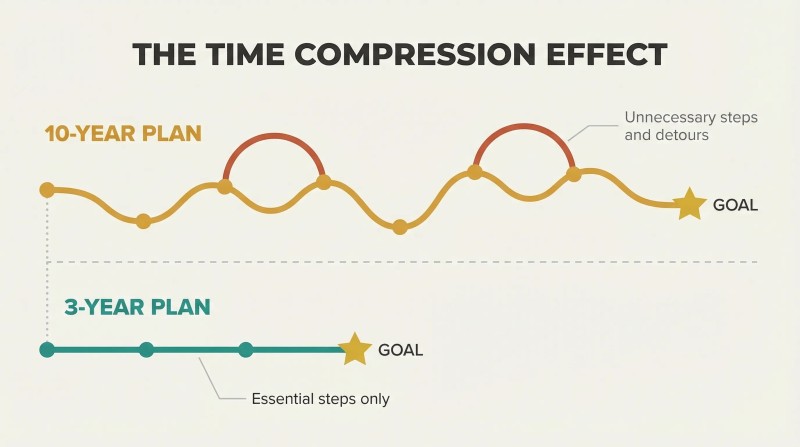
Time is a filtering tool, not a fixed reality. Richard Bryan planned to sell his UK real estate portfolio and pivot to coaching by age 65 — eleven years away. When challenged to do it in one year, the path simplified dramatically: sell the portfolio immediately, stop flying to Bristol quarterly, reinvest passively. His wife was relieved, not stressed. Within months, nearly half his portfolio was sold.
Hardy calls this using time as a tool — what he terms holistic time, where the future shapes the present instead of the past dictating it. A 10-year goal doesn't force better decisions today. McKinsey's study of 3,000 companies found that "supergrowers" with 60%+ annual growth at $100M revenue were 8x more likely to reach $1 billion. Slow growth isn't safe — it compounds bad decisions.
Your floor, not your ceiling, decides if you'll scale
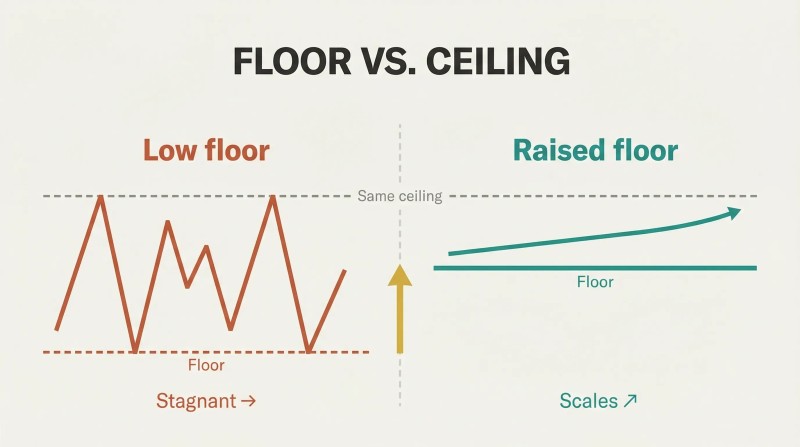
Zion Williamson entered the NBA as perhaps the most anticipated prospect in a generation — 6'6", 285 pounds, with a point guard's agility. Five years later, he's a financial liability, playing roughly 50% of possible games. His contract includes a weight clause penalizing him above 295 pounds. The problem isn't potential — it's accountability. He returns from offseasons overweight and unreliable.
The Floor defines what you don't do — the standards, discipline, and minimum performance that make results consistent. Tom Wood's franchise company FCI set a $2M revenue floor per franchisee (up from $700K). It took six months of firing and replacing team members before the floor became real. But once it did, FCI grew 31% while the flooring industry declined 7%. The amateur practices until they can do it right; the pro practices until they can't do it wrong.
Radical honesty is the price of admission to scaling
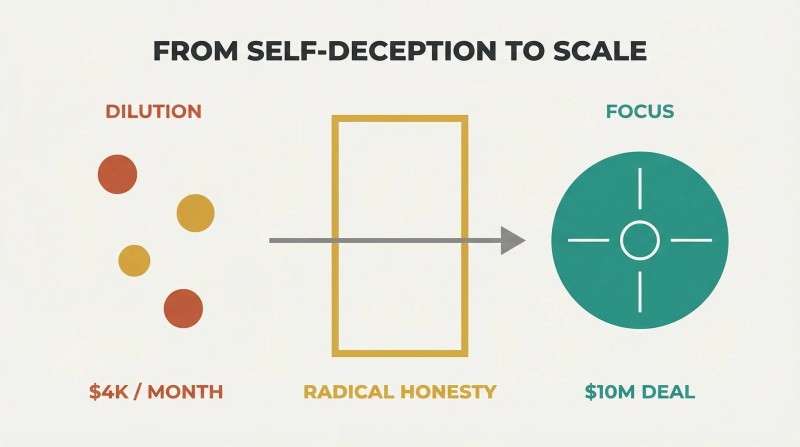
Near-billionaire Garnet Morris says people don't scale because they constantly lie to themselves — about performance, consequences, and trajectory. Mark Young of Jekyll & Hyde Advertising exemplifies this. His agency was the world's best at getting products into mass retail through TV, but out of fear that "everything was going digital," they'd diluted into lesser services like social media and Amazon campaigns.
After setting an impossible goal of $100M in three years, Mark told a client paying $4K/month for Amazon ads: "We did the wrong thing for you. We told you what you wanted to hear instead of what you needed." The client wired $300,000 for the right service. Within two weeks, Jekyll & Hyde had eliminated all below-the-floor offerings, landed a nearly $10M deal, and Mark began selling his other companies to eliminate distraction.
Simplify until your company does exactly one thing brilliantly
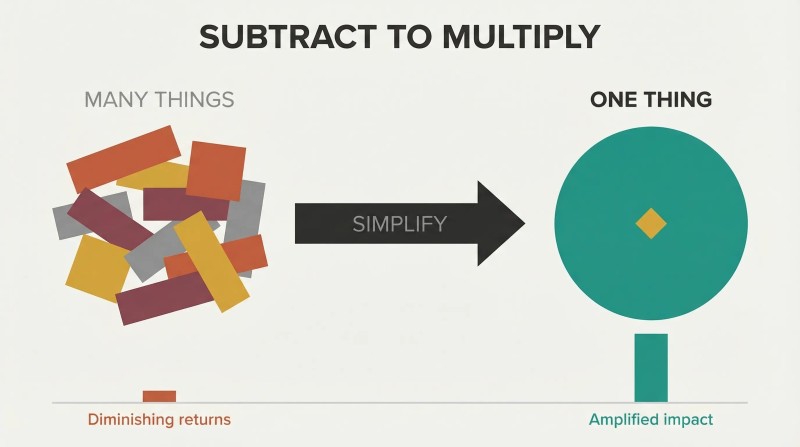
When Steve Jobs returned to Apple in 1997, the company was losing $1 billion annually with 350 products. He cut to roughly 10. Within a year, Apple posted a $309 million profit. Lewis Howes had 17 income streams; when he simplified to just his podcast, downloads surged from 30 million to 500 million. CellCore Biosciences had 7+ confusing supplements until CEO Ryan Riley consolidated them into The Protocol — one system, one purchase. Revenue went from $500K to a $200M sale in five years.
Hardy draws on Latin roots: simple means "one fold"; complex means "braided together." Programmer Rich Hickey calls the growing complexity of any system "the elephant" — existing code, products, or processes that become the primary obstacle to change. You can move something simple. You can barely budge something complex.
Fold losing hands fast — pros filter in seconds, not months
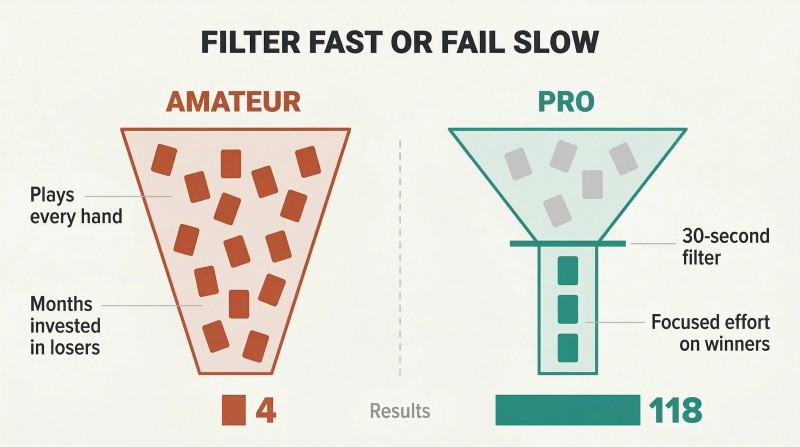
Professional poker players play far fewer hands than amateurs, as Annie Duke explains. Amateurs pile money into losing positions — escalation of commitment driven by sunk-cost bias. Professionals fold fast and only play when the odds favor them.
Co-author Blake Erickson applied this as a missionary in Peru. After baptizing only 4 people in his first year (average was 10 over two years), he created three filtering questions used within the first 30 seconds of every street conversation: Do you work on Sunday? Are you married? Will you attend church this week? If someone didn't pass, he moved on — no guilt, no lingering. He finished with 118 baptisms, nearly 12x the average. The lesson extends to clients, employees, and projects: stop investing months in situations that will never convert.
Find the single crux holding everything back and solve only that
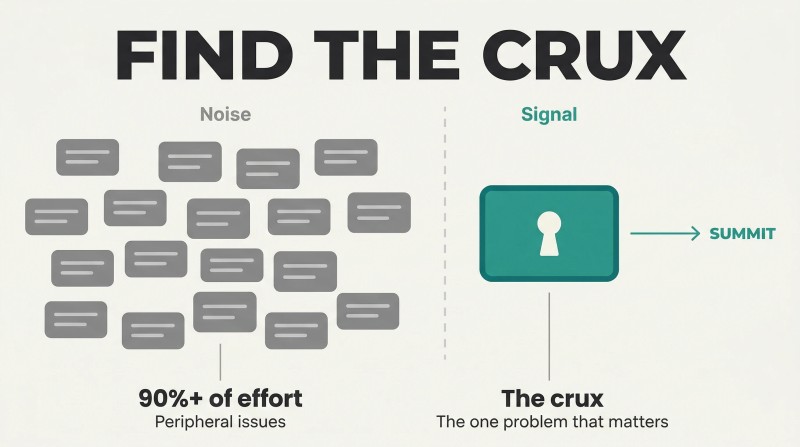
Strategy expert Richard Rumelt borrowed "the crux" from rock climbing — the single hardest problem on the route. Solve it and you summit; fail and nothing else matters. Hardy applies this to NASA's moon mission: with 7+ years, NASA ran excessive Mercury and Gemini test flights, built prototype rockets unfit for the actual Apollo goal, and sent astronauts through jungle survival training and PR tours.
The actual crux was landing the lunar module and ascending from the moon's surface. A tighter deadline would have forced NASA to skip intermediary programs and solve that core problem directly. Hardy argues most businesses similarly spend 90%+ of resources on peripheral issues — what Musk calls "false requirements" — assumed necessities that, under aggressive timelines, reveal themselves as noise.
One Super Who creates more value than a dozen average hires
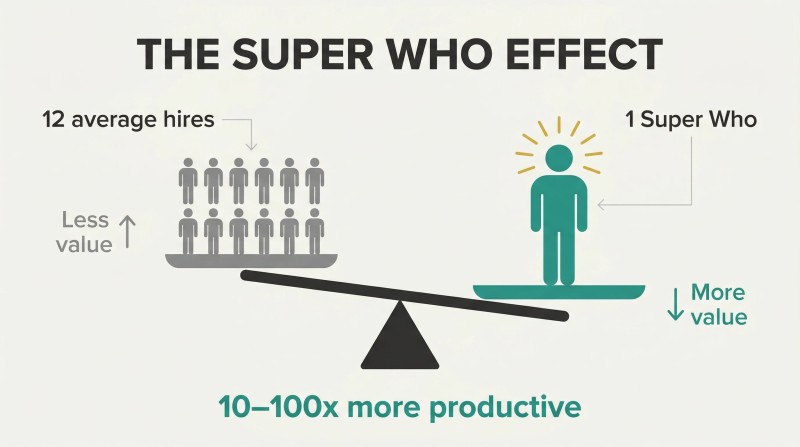
1960s research revealed top software engineers weren't 2 – 3x better than average — they were 10 to 100x more productive. Netflix CEO Reed Hastings applied this directly: instead of hiring 12 adequate engineers, he'd hire one rock star at the top of their personal market. The result was "exponentially increased speed of innovation and output." Hardy calls these elite performers Super Whos — individuals who create disproportionate results.
When the Golden State Warriors acquired Jimmy Butler, beat writer Marcus Thompson noted the instant transformation: "He doesn't even have to play well and you can feel it." Steph Curry took more shots in back-to-back games than ever in his career. Super Whos don't just perform — they elevate expectations, create slack in the system, and raise the floor for everyone around them.
Build something that scales beyond you, not around you
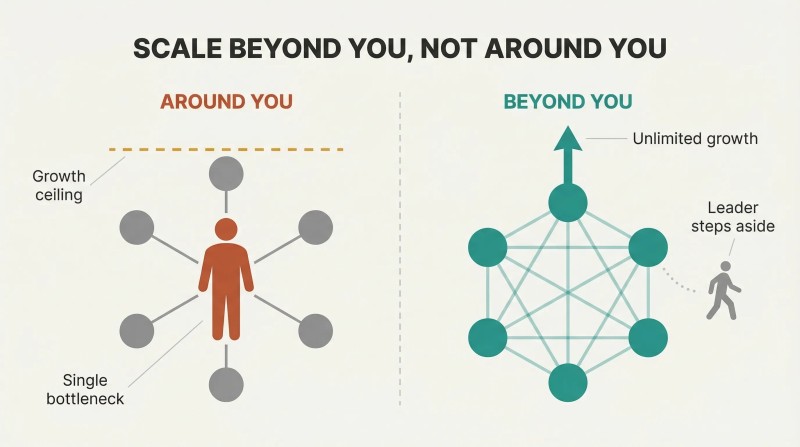
George Washington deliberately stepped down after two presidential terms — not because he had to, but because America couldn't scale if it depended on one person. Hardy argues most entrepreneurs are what Jim Collins calls "the leader with 1,000 helpers" — brilliant individuals whose business can't grow past their involvement.
CellCore's CEO Ryan Riley modeled the opposite. Before the company's $200M sale, he stepped down and positioned founder Dr. Todd Watts as CEO and face of the brand. That single move added $50M to the company's valuation. Similarly, Blake Murray built Divvy — a free financial software company funded by credit card transaction percentages — scaling from $0 to $150M revenue in three years before selling for $2.5 billion. The company had one product and one measurement: monthly revenue. No distractions, no ego, no bottleneck.
Analysis
Hardy positions this work at the intersection of organizational psychology and business strategy, claiming both fields are 'muddled and mistaught.' The genuine contribution lies in reframing goals not as endpoints but as perceptual filters — drawing on prospection research (Seligman, Baumeister) and selective attention neuroscience to argue that the quality of your goal literally shapes what you can perceive. This is more sophisticated than typical 'dream bigger' advice and gives the framework real intellectual teeth.
The Scaling Framework's three-part structure (Frame, Floor, Focus) has the virtue of brutal simplicity. But the book's primary weakness is mistaking correlation for causation. Case studies are selected post hoc — we hear about Alicia Ault's 1,000x scale and Divvy's $2.5B exit, but survivorship bias is never addressed. How many entrepreneurs set impossible goals and failed impossibly? The book acknowledges the need for 'slack' (financial margin) when pursuing stretch goals, citing Sitkin's research, but never fully reckons with the privilege baked into that requirement.
Hardy's treatment of time deserves credit for intellectual rigor. His 'holistic time 'model — synthesizing Slife's critique of Newtonian psychology with Baumeister's prospection research — offers a genuinely useful mental model. The practical implication (compress deadlines as a filtering tool, not a stress inducer) is both actionable and psychologically grounded. However, the McKinsey 'Grow Fast or Die Slow' data, while compelling, comes exclusively from software companies — generalizing it to law firms and photography studios stretches the evidence.
The promotional layer is heavy — Scaling.com advertisements are woven throughout. But beneath the marketing lies a framework worth pressure-testing against your own business. The most powerful insight may be the simplest: if your goal doesn't force you to stop doing most of what you're currently doing, it isn't big enough to be useful.
Review Summary
The Science of Scaling receives mostly positive reviews, with readers praising its practical insights on business growth. Many appreciate Hardy's framework for setting ambitious goals, compressing timelines, and simplifying systems. Reviewers find the book inspiring and applicable to various leadership roles. Some critics argue it lacks originality or concrete strategies, while others note its promotional tone. Overall, readers value the book's focus on mindset shifts and real-world examples, though opinions vary on its depth and practicality for different business contexts.
People Also Read








Glossary
The Scaling Framework
Three-part model for rapid growthHardy's central framework for business scaling, comprising three elements: Frame (the impossible goal that determines what you see), Floor (what you filter out and refuse to do), and Focus (the singular path and partners you develop to realize the goal). The framework argues that only a goal so large it seems impossible creates sufficient filtering pressure to simplify a business enough to scale.
Impossible Goal
Seemingly unachievable target used as filterHardy's replacement for the academic term 'stretch goal.' Defined as a goal with an unknown probability of attainment that seems impossible given current capabilities, knowledge, and practices. Unlike merely ambitious goals, impossible goals force 'radically new approaches' and 'extreme redefinitions' of what an organization can achieve, serving primarily as a strategic filter rather than a motivational target.
Holistic Time
Future-driven model of psychological timeHardy's alternative to the common linear model of time (past → present → future). In holistic time, all three dimensions co-occur in the present, with the future carrying the most weight in shaping decisions and actions. Based on research by psychologist Brent Slife and neuroscience on prospection, the model treats both past and future as psychological tools for improving present decisions, rather than as sequential external realities.
Super Whos
Top performers producing disproportionate resultsHardy's term for elite individuals who produce 10x to 100x or more results compared to average performers. Based on research showing top software engineers are 10–100x more productive and that the top 1–5% of salespeople generate over 95% of revenue. Super Whos not only produce outsized results but also elevate expectations, create 'slack' (margin for error) in the system, and raise the performance floor of everyone around them.
The Crux
Core constraint blocking the goalBorrowed from strategy expert Richard Rumelt (who drew it from rock climbing), the crux is the single most difficult bottleneck or constraint standing between you and your goal. Hardy argues that most businesses spend the majority of their time and resources on peripheral issues while the crux goes unsolved. Identifying and optimizing around the crux—rather than the many 'false requirements'—is where rapid scaling actually occurs.
False Requirements
Assumed necessary steps that aren'tA concept Hardy draws from Elon Musk's Five-Step Algorithm. False requirements are steps, processes, or conditions that people assume are necessary for achieving a goal but which, under the pressure of an impossible deadline, reveal themselves as unnecessary noise. Musk's first algorithmic step is to 'question requirements,' noting that 'most requirements are dumb.' Compressing timelines forces these false requirements to surface.
Pathways Thinking
Finding multiple routes to goalsA psychological concept describing a person's ability to identify or create multiple viable pathways to a goal. Central to Hardy's framework because the quality of one's goal determines the quality of available pathways. With an attainable goal, pathways are obvious and incremental. With an impossible goal, pathways thinking is forced into creative territory—discovering partnerships, business models, or strategies invisible from a lower frame.
Raise the Floor
Eliminate everything below new standardsHardy's term for the process of increasing accountability, transparency, and minimum standards across a business or life. The floor represents what you refuse to accept—clients below a certain threshold, team members who won't be accountable, products that dilute focus. Raising the floor means making uncomfortable cuts to people, offerings, and habits that were previously acceptable. Hardy argues this is the hardest but most critical step in scaling.
FAQ
1. What is "The Science of Scaling" by Dr. Benjamin Hardy about?
- Paradigm Shift in Scaling: The book introduces a new, evidence-based framework for scaling businesses rapidly and effectively, challenging traditional incremental growth models.
- Three-Part Framework: It centers on the "Scaling Framework," which consists of Frame (goal-setting), Floor (eliminating distractions and raising standards), and Focus (engineering a scalable, simple system).
- Psychology Meets Strategy: Hardy combines insights from organizational psychology and business strategy to show how leaders can achieve seemingly impossible growth.
- Case Studies and Application: The book is filled with real-world examples and case studies of businesses and individuals who have applied the framework to achieve exponential results.
2. Why should I read "The Science of Scaling" by Dr. Benjamin Hardy?
- For Leaders Ready to Scale: The book is designed for entrepreneurs, founders, and leaders who want to grow their businesses 10x or more within a few years.
- Actionable, Not Theoretical: It provides a clear, actionable blueprint rather than abstract theory, making it practical for immediate implementation.
- Addresses Common Pitfalls: Hardy explains why most businesses fail to scale—due to complexity, lack of focus, and self-deception—and offers solutions.
- Mindset and Tools: Readers gain both the mindset and the tools needed to set impossible goals, filter out distractions, and build organizations that can scale beyond themselves.
3. What are the key takeaways from "The Science of Scaling" by Dr. Benjamin Hardy?
- Set Impossible Goals: Scaling starts with setting a goal so big and a timeline so short that it seems impossible, forcing innovation and focus.
- Raise Your Floor: Success depends on eliminating everything below a new, higher standard—this means quitting the wrong stuff faster and being brutally honest about what’s holding you back.
- Simplify to Scale: Complex systems can’t scale; only simple, focused systems can. This requires making tough decisions and letting go of legacy products, clients, or processes.
- Accelerate with Focus and Team: Building a scalable model and bringing in “Super Whos” (top talent and partners) is essential for exponential growth.
4. What is the "Scaling Framework" in "The Science of Scaling" and how does it work?
- Frame: This is your perspective, shaped by your goals. Setting a seemingly impossible goal changes what you see as possible and filters out distractions.
- Floor: The floor is what you refuse to tolerate or do. Raising your floor means eliminating all activities, clients, or products that don’t align with your impossible goal.
- Focus: With a high frame and floor, you can focus on the most scalable, high-leverage paths and partners, engineering a simple system that can grow rapidly.
- Iterative Process: The framework is cyclical—raising your frame leads to a higher floor, which sharpens your focus, leading to further scaling.
5. How does "The Science of Scaling" by Dr. Benjamin Hardy define and use "impossible goals"?
- Definition: An impossible goal is one that seems unattainable given your current resources, knowledge, and capabilities.
- Purpose: Such goals force you to abandon incremental thinking and find radically new approaches, partners, and pathways.
- Filtering Tool: Impossible goals act as a psychological and strategic filter, helping you separate signal from noise and focus only on what truly matters.
- Case Studies: The book provides examples (e.g., Alicia Ault’s LevelUp Score) where setting an impossible goal led to breakthroughs that would have been impossible with linear goals.
6. Why is setting a short, "impossible" timeline important in "The Science of Scaling"?
- Time as a Tool: Hardy argues that time is a psychological tool, not a fixed reality. Short deadlines force you to act urgently and creatively.
- Eliminates False Requirements: Aggressive timelines help you strip away unnecessary steps and focus on the crux of the problem.
- Accelerates Learning and Progress: Short timelines create fast feedback loops, enabling rapid iteration and growth.
- Prevents Stagnation: Long-term goals often justify bad decisions and slow progress; short, impossible deadlines prevent complacency and force decisive action.
7. What does "raising your floor" mean in "The Science of Scaling" and why is it crucial?
- Higher Standards: Raising your floor means increasing your minimum acceptable standard for clients, products, team members, and processes.
- Eliminating Distractions: It involves quitting the wrong stuff faster—letting go of legacy offerings, underperformers, or anything that doesn’t align with your impossible goal.
- Culture and Accountability: A high floor creates a culture of accountability and excellence, where only the best remain.
- Enables Scaling: Without raising your floor, you remain mired in complexity and mediocrity, making true scaling impossible.
8. How does "The Science of Scaling" by Dr. Benjamin Hardy advise simplifying your system to scale?
- Focus on One Thing: The book advocates for radical simplification—doing one thing exceptionally well rather than many things poorly.
- Remove Complexity: Complexity is the enemy of agility and growth; simplifying your offerings, processes, and team structure is essential.
- Strategic Choice: Good strategy is as much about what you don’t do as what you do; choose a singular path and eliminate conflicting goals.
- Real-World Examples: Case studies (e.g., Steve Jobs at Apple, CellCore’s product simplification) illustrate how simplification leads to explosive growth.
9. What role does honesty and self-awareness play in "The Science of Scaling" by Dr. Benjamin Hardy?
- Brutal Self-Honesty: Scaling requires leaders to be brutally honest about what’s working, what’s not, and where they’re lying to themselves.
- Accountability: Admitting weaknesses, mistakes, and sunk costs is necessary to raise your floor and make tough decisions.
- Cultural Impact: Organizations with high transparency and accountability scale faster and more sustainably.
- Personal Growth: The process of scaling is as much about personal character and maturity as it is about business tactics.
10. How does "The Science of Scaling" by Dr. Benjamin Hardy recommend building a team and partnerships for scaling?
- Super Whos: The book emphasizes hiring and partnering with “Super Whos”—top talent who can deliver 10x or 100x results compared to average performers.
- Elevate Expectations: Bringing in high performers raises the floor and expectations for everyone, creating a culture of excellence.
- Letting Go: Leaders must be willing to let go of average team members and even their own centrality in the business to allow for true scaling.
- Strategic Partnerships: Sometimes, a single key partner or hire can unlock exponential growth, as shown in multiple case studies.
11. What are some of the best quotes from "The Science of Scaling" by Dr. Benjamin Hardy and what do they mean?
- “A goal properly set is halfway reached.” (John Doerr): The right goal immediately filters out distractions and clarifies the path forward.
- “You never change things by fighting the existing reality. To change something, build a new model that makes the existing model obsolete.” (Buckminster Fuller): True scaling requires a paradigm shift, not incremental improvement.
- “The difference between successful people and really successful people is that really successful people say no to almost everything.” (Warren Buffett): Focus and the discipline to say no are essential for scaling.
- “If you can’t say, ‘We do this,’ then you’re undefined, diluted, and cannot scale.” (Dr. Benjamin Hardy): Clarity of purpose and offering is non-negotiable for exponential growth.
12. How can I apply the lessons from "The Science of Scaling" by Dr. Benjamin Hardy to my own business?
- Set an Impossible Goal: Define a goal so big and a timeline so short that it forces you to rethink your entire approach.
- Audit and Raise Your Floor: Identify everything in your business that doesn’t align with your new goal and eliminate it, even if it’s painful.
- Simplify Relentlessly: Streamline your offerings, processes, and team to focus only on what can scale.
- Build a World-Class Team: Seek out and empower top talent and partners who can help you achieve your impossible goal, and be willing to let go of those who can’t.
- Continuous Application: Use the Scaling Framework as an ongoing process—constantly raising your frame, floor, and focus as your business grows.
Download PDF
Download EPUB
.epub digital book format is ideal for reading ebooks on phones, tablets, and e-readers.








































