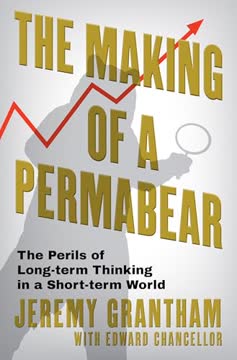
Key Takeaways
1. Embrace Contrarian Value Investing
My motto in investing has always been cry over spilt milk, for analyzing errors is how you learn almost everything.
Early lessons. Jeremy Grantham's Quaker and Yorkshire upbringing instilled in him a deep sense of frugality and a contrarian mindset, which he calls "double jeopardy." His early investment blunders, like losing his entire savings on speculative "gunslinging" stocks such as Acrow A and American Raceways, painfully taught him the fundamental rules of investing. These experiences, including witnessing a friend lose his pension, profoundly turned him away from speculation and towards patient, long-term value investing.
Value's bedrock. This shift led him to embrace the core tenets of value investing: buying cheap assets and ignoring short-term noise. He realized that "cheap is better than expensive" was a natural understanding for a Yorkshireman. His early work at Keystone and Batterymarch focused on identifying undervalued small-cap stocks and sectors, often overlooked by the broader market, providing a significant informational edge.
Trusting the data. Grantham's personal and professional journey underscored the importance of rigorous data analysis and trusting one's own conclusions, even when the market vehemently disagrees. His experience with Security-Connecticut Life, which plummeted 90% despite consistently rising earnings, taught him that the market can be "very, very inefficient, particularly on little companies not worth its trouble." This conviction became the foundation of his firm's success.
2. Markets are Inherently Inefficient
If the market is a zero-sum game and you have a lot of money, you should index, period.
The zero-sum reality. Grantham's most significant early insight was that investing is a zero-sum game, akin to poker. For every winner, there's a loser, and the collective costs of playing (fees, commissions) mean that active managers, as a group, must underperform the market. This led him to advocate for index funds, a "loony" idea at the time, as a low-cost, efficient alternative for most investors.
Exploiting imperfections. Despite the theoretical appeal of indexing, Grantham believed the market was "handsomely inefficient," especially in the 1970s. His firm, Batterymarch, sought to exploit these imperfections by specializing in "neglected stocks, disliked stocks, unfashionable stocks, stocks that were not widely followed by others." This contrarian approach, combined with deep fundamental analysis, allowed them to gain an information edge.
Quantifying value. Grantham and his team, particularly Chris Darnell, pioneered the use of computers for investment analysis, building the first machine-readable database of international stocks. Their quantitative models, initially based on dividend discount models and later incorporating momentum and "neglect," systematically identified mispriced assets. This early adoption of quant techniques gave GMO a significant competitive advantage in an amateurish industry.
3. Mean Reversion is the Market's Gravitational Pull
Everything concerning markets and economies (and everything else, for that matter) regresses from extremes toward normal, faster than people think.
The universal law. Grantham's career has been dominated by the principle of mean reversion, the idea that prices and profits, pushed away from fair value by inefficiencies, are eventually dragged back by the logic of value. He observed this phenomenon across individual stocks, sectors, and entire asset classes, noting that "reversion is mean" because good times don't last forever, but neither do bad ones.
Profit cycles. His research, initially done by hand, showed that corporate profitability systematically reverts to the mean.
- Excess returns attract competition, driving profits down.
- Depressed returns drive capital away, allowing profits to recover.
This understanding was crucial for identifying undervalued companies and predicting market shifts.
Asset class dynamics. Mean reversion also applied powerfully to asset allocation. Grantham's models identified bubbles when asset classes moved two standard deviations from their long-term trend, predicting their inevitable return to the mean. This principle guided GMO's major strategic bets, such as avoiding Japanese equities in the late 1980s and U.S. growth stocks in the late 1980s, often with remarkable accuracy.
4. Bubbles are Inevitable and Dangerous
All bubbles burst.
Predictable patterns. Grantham identified 27 major historical bubbles across commodities, bonds, and stocks, all of which eventually broke. He noted that bubbles are characterized by:
- Excellent fundamental economic conditions (or perceived as such).
- Generous and cheap liquidity, encouraging leverage.
- Strong "animal spirits" and low-risk premiums.
- Extrapolation of current conditions indefinitely.
These factors create a self-reinforcing cycle of optimism and rising prices.
The "new era" delusion. A critical feature of bubbles is the belief that "this time it's different," often fueled by new technologies or economic paradigms. Grantham vehemently argued against this, pointing out that the internet bubble of 2000, the U.S. housing bubble of 2006, and the Japanese bubble of 1989 all shared the same underlying dynamics as previous manias, despite claims of a "new high plateau."
The cost of denial. Fighting a bubble is "dangerous to your career health," as Keynes noted. Grantham's firm suffered significant client outflows during the tech bubble for being "dangerously persuasive and totally wrong" in the short term. However, his long-term forecasts for asset classes proved remarkably accurate, demonstrating that while timing is difficult, avoiding overpriced assets is crucial for capital preservation.
5. The Financial Industry is Flawed by Design
Everyone’s ultimate job description becomes “keep your job.”
Career risk reigns. Grantham argues that the financial industry, increasingly dominated by professionals managing other people's money, prioritizes "career risk" over "real risk." Managers are incentivized to conform to the herd, avoid underperforming benchmarks, and remain bullish, even when they privately know the market is overvalued. This leads to "herding, momentum and extrapolation," which are major causes of mispricing.
The "Great Bull Market Conspiracy." Grantham believed the late 1990s saw a "great bull market conspiracy" where various vested interests aligned to keep the market rising:
- Corporations: Overstated earnings and lavish stock options.
- Politicians: Desired a strong market for re-election.
- Federal Reserve: Alan Greenspan's "moral hazard" policy of bailing out crises without addressing underlying bubbles.
- Investment Industry: Benefited from high activity and optimism.
This collective bias created a powerful "brainwashing capability" that made rational bearish advice commercially suicidal.
Lack of accountability. The Global Financial Crisis exposed a "Global Competence Crisis" and a pervasive unwillingness among financial leaders and authorities to admit mistakes. Despite widespread failures and immense losses, few faced accountability or jail time in the U.S., unlike Iceland. This lack of consequence, combined with policies like "Too Big to Fail," only exacerbated moral hazard and encouraged future risk-taking.
6. Capitalism's Blind Spots Threaten Our Future
The tyranny of the discount rate means your grandchildren have no value.
Ignoring long-term costs. Grantham contends that capitalism, while excellent at balancing supply and demand, is "totally ill-equipped" to deal with long-term existential threats. The "tyranny of the discount rate" means that future costs, even catastrophic ones, are heavily discounted to near zero in present value, leading corporations to disregard long-term harm for short-term profit.
Flawed economic measurement. GDP, as currently measured, is a "mishmash of costs and outputs of 'goods' and 'bads' indiscriminately jumbled up." It fails to account for the depletion of finite resources or environmental degradation.
- Putting more people in prison increases GDP.
- Fighting wars increases GDP.
- Depleting copper mines or polluting water is not accounted as a loss.
This perverse accounting system incentivizes "growth at any price," masking the true decline in collective well-being.
Resource scarcity. Humanity is rapidly depleting finite resources like fossil fuels, ores, and essential fertilizers (e.g., phosphate, 75% of high-grade reserves in Morocco). The "hydrocarbon revolution" provided a temporary reprieve, but compound growth in a finite world is "mathematically impossible." This new era of scarcity will lead to permanently higher commodity prices and increasing stress on agriculture, which faces threats from:
- Soil erosion (losing 1% globally per year).
- Increased extreme weather events (floods, droughts).
- Bug and pathogen immunities.
- Urban expansion on fertile land.
- Water depletion.
7. The Race of Our Lives: Population & Green Energy
Unexpectedly, and for the first time in human history, our species has apparently decided to have steadily fewer children, so that on its current flight path, global population will drop, reducing the pressure on several of our overshoot problems.
Two unexpected gifts. Despite the grim outlook, Grantham identifies two "extraordinarily lucky" and unprecedented advantages that might save civilization from collapse:
- Declining fertility: Global population growth is slowing, with fertility rates falling below replacement levels in many countries (e.g., Iran from 7 to 1.69, India from 6 to 2). This reduces pressure on resources and the environment.
- Cheap green energy: Technological advancements in solar, wind, and other alternatives, along with potential breakthroughs in energy storage and fusion, offer effectively infinite and clean energy sources.
The dark side of fertility decline. While a smaller population is environmentally beneficial, there's a troubling aspect: a "50% loss of sperm count over the last half century" in the developed world, likely due to endocrine-disrupting chemicals. This, combined with rising miscarriage rates and declining libido, poses a direct threat to human viability and could hinder the innovation needed for the energy transition.
A closely run race. Grantham believes humanity is in "The Race of Our Lives," where our capacity for innovation and adaptation is pitted against our tendency for self-destruction. The transition to a sustainable world requires unprecedented long-term planning, governmental leadership, and a shift from unfettered capitalism to a system that prioritizes the common good. He remains cautiously optimistic, believing that "when times get much tougher, most will rise to the occasion."
8. Confronting Unpleasant Truths is Essential
Our society’s capacity for self-delusion is massive, beyond anything I would have guessed.
The optimism bias. Grantham's ultimate lesson is humanity's profound reluctance to face unpleasant facts and its fixation on the present. Investors, politicians, and the public alike prefer "good news" and easily extrapolate current conditions indefinitely, even when data screams otherwise. This "self-delusion" is exploited by vested interests in finance, politics, and business.
Ignoring critical data. Examples of this denial abound:
- Americans' belief in their superior economic system despite stagnant real wages and rising inequality compared to other developed nations.
- The widespread unawareness of Massachusetts' high COVID-19 death rate, despite readily available data.
- The dismissal of scientific warnings on climate change and resource depletion.
This "broad and heavy prejudice against unpleasant data" prevents necessary action on existential threats.
Short-termism's peril. The short-term horizon of most people is "key to almost everything that’s wrong in the modern world," from stock market bubbles to environmental crises. Corporations prioritize maximizing short-term stock prices over long-term public good, leading to unsustainable practices and the production of dangerous chemicals. Grantham argues that contrarianism, focusing on the long term and questioning consensus, is a vital function in this short-sighted world, even if it comes with significant personal and career risks.
People Also Read
 Immersive
 Immersive
 Immersive
 Immersive