

Key Takeaways
Silicon Valley abandoned the nation that built it for photo-sharing apps
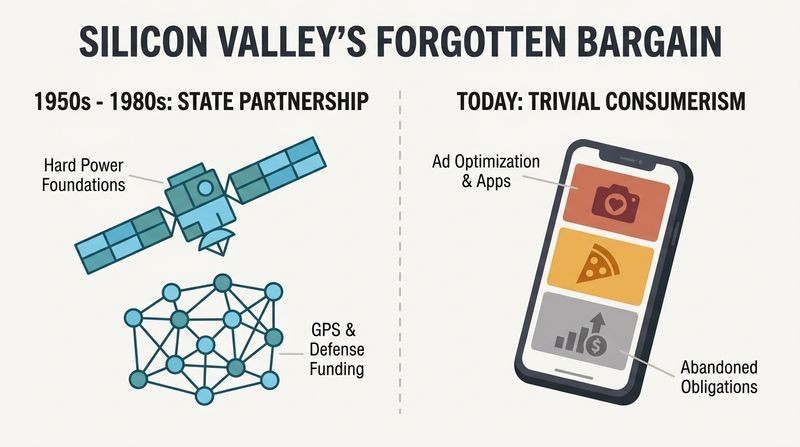
The founding bargain has been forgotten. Karp argues that Silicon Valley's origins were military and governmental, not the garage-startup myth it tells about itself. Fairchild built spy-satellite cameras for the CIA in the late 1950s. For a time, all U.S. Navy ballistic missiles were made in Santa Clara County. The internet, GPS, and early AI came from Defense Department funding.
Yet today's engineers build trivia. The most talented coders in history raise fortunes to optimize ad placement and food delivery while refusing military work. In 2022 YouTube earned $959 million from ads targeting 31.4 million children under twelve. Karp's thesis: the software industry has an affirmative obligation to rebuild its partnership with the state, especially as AI reshapes warfare.
What's striking is how the book weaponizes the Valley's own origin myth against it. Mariana Mazzucato's The Entrepreneurial State made a parallel case: nearly every component of the iPhone, from touchscreens to Siri, traces to public funding. Karp extends this into a moral claim, not just a historical correction. The vulnerability is selective framing. Consumer platforms also produced genuine welfare gains and, arguably, the compute infrastructure that makes military AI possible. The line between frivolous and foundational is blurrier than the polemic allows. Still, the observation that geopolitical adversaries face no such squeamishness lands with uncomfortable force.
We've reached an Oppenheimer moment with AI, and pausing is the wrong instinct

Large language models are the new atomic gadget. Karp draws a direct line from 1945 to now. Just as physicists faced a crossroads building the bomb, engineers now build systems whose power they cannot fully explain. GPT-4 solved a physical-reasoning puzzle (stacking eggs, a laptop, a bottle, and a nail) that stumped earlier models. Researchers called these 'sparks of artificial general intelligence.'
Halting development is a mistake. Over 33,000 people signed a 2023 letter demanding a six-month pause. Karp counters that adversaries will not wait, and that an ethical society needs weapons far more powerful than its enemies, not merely equal. The atomic age produced nearly a century without great-power war. He argues AI-based deterrence should replace it, not be abandoned out of fear.
The Oppenheimer analogy is seductive but imperfect. Nuclear weapons were governed by a stable logic of mutually assured destruction between few actors; autonomous AI proliferates cheaply and diffuses to many, complicating deterrence. Karp's dismissal of pause advocates as elites distrusting the public sidesteps the genuine alignment problem that researchers like Stuart Russell raise. Yet his core point deserves weight: unilateral restraint by liberal democracies simply cedes the field. Game theory supports him. The prisoner's dilemma of AI development means moral abstention by one player rewards the least scrupulous. The harder question, which the book underplays, is whether guardrails can be built fast enough.
Power to hurt is bargaining power, so build the sharpest tools first
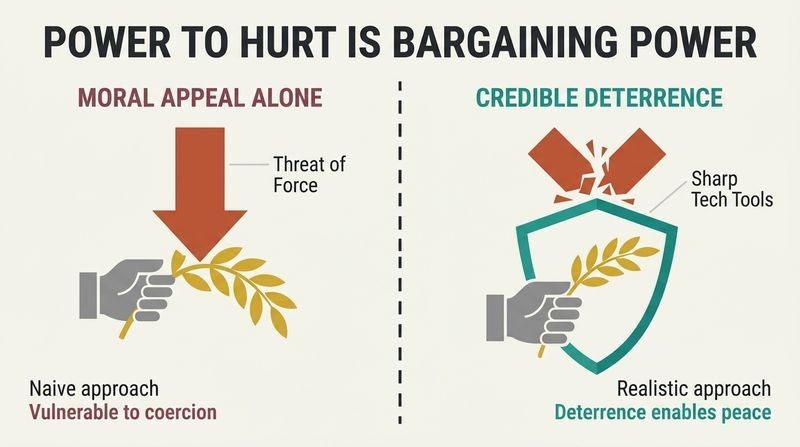
Moral appeal without hard power is naive. Karp invokes economist Thomas Schelling: violence, to be coercive, must be anticipated, and the capacity to inflict harm is itself diplomacy. The West grew complacent believing history had ended with liberal democracy's victory, a Fukuyama-era conceit. Meanwhile three of the world's top six facial-recognition firms are Chinese, and China researches drone swarms for large-scale combat.
Deterrence requires credible force. The U.S. requested just $1.8 billion for AI in 2024, a fifth of one percent of the $886 billion defense budget, while pouring $2 trillion into the F-35, a manned jet meant to fly until 2088. Karp calls for a new Manhattan Project to keep AI weaponry under democratic control. The preconditions for durable peace, he argues, come from a credible threat of war.
Schelling's realism is a bracing corrective to a foreign-policy culture that often mistakes moral clarity for strategic leverage. Karp's critique of legacy hardware echoes defense reformers who note that a single anti-ship missile costing a fraction of a carrier can threaten it. The blind spot is that hard power divorced from legitimacy erodes the very alliances that amplify it, as Joseph Nye's soft power framework warns. Karp nods to this but subordinates it. History offers cautionary tales: overwhelming military superiority did not prevent strategic defeat in Vietnam or Afghanistan. Capability is necessary but, as those wars showed, never sufficient.
A culture that believes in nothing cannot defend anything
The hollowing out is the deepest problem. Karp's central cultural diagnosis: elites have been trained that conviction itself is dangerous, that having no firm beliefs (except in oneself) is the safest path to reward. He contrasts this with Aryeh Neier, the Jewish ACLU director who defended Nazis' free-speech rights in 1970s Skokie, losing 30,000 members but holding two genuine beliefs at once.
Modern leaders are empty vessels. When university presidents testified before Congress in 2023, one answered whether calling for genocide of Jews was harassment with 'it is a context-dependent decision.' Karp reads this clinical evasiveness as the archetype of a managerial class coached by law firms to risk nothing. Google's 'don't be evil' captures a generation that can identify evil but cannot articulate what it is for.
This channels Michael Sandel's critique that a proceduralist liberalism obsessed with rights leaves a moral vacuum that demagogues fill. It also rhymes with Yeats: the best lack all conviction while the worst are full of passionate intensity. The analysis is sharpest when it distinguishes hard belief (costly, risked) from cheap signaling. The weakness is generational nostalgia. The eras Karp romanticizes also produced McCarthyism and conformity, which the book itself acknowledges elsewhere. Conviction is not intrinsically virtuous; Neier's greatness lay in holding conviction and self-restraint simultaneously. The prescription risks celebrating boldness for its own sake rather than the harder discipline Neier modeled.
Killing Western Civ courses left America a balloon cut loose
The canon wars severed the anchor. Karp traces today's rootlessness to the 1960s and 70s dismantling of required Western Civilization courses. Stanford retired its iconic survey in 1969, going out 'with a whimper.' An 1890s historian had warned that American history floats like a balloon in mid-heaven unless anchored to European history.
Deconstruction won but built nothing. Edward Said's 1978 Orientalism, one of the most influential postwar works, exposed that writing history is an exercise of power, elevating the speaker's identity over what is said. Karp credits the insight but argues its overextension bred a relativism where all cultures became equally sacred and thus immune from judgment. The dismantling of a privileged, exclusionary story was justified. The failure was resurrecting nothing coherent in its place.
The book performs a delicate move: praising Said's core thesis while condemning its epigones. This is more generous than typical culture-war polemic. Nate Silver's concept of decoupling, evaluating a claim's truth independent of who states it, is invoked usefully. Yet the argument can slide toward wanting the prestige of a shared canon without reckoning with why it fractured: it genuinely excluded most of humanity. Kwame Anthony Appiah's counterpoint, that Western civilization was always a constructed narrative rather than a coherent inheritance, is acknowledged but brushed aside. The strongest version of Karp's case is procedural: societies need shared stories, read critically, not none at all.
Run your organization like a beehive, pushing decisions to the edges
Swarms decide without central control. In 1951 Munich, biologist Martin Lindauer watched honeybees choose a new nest. Scout bees at the periphery, who hold the freshest information, 'dance' to advocate for sites, and the swarm votes without a queen directing anything. Starlings turn in flocks the same way: birds at the edge, with the best view of predators, initiate moves passed inward in a fraction of a second.
The ideal startup mimics this. Karp argues Palantir distributes autonomy to the margins rather than building rigid hierarchies where energy is wasted jockeying for position. Traditional firms hold fifty-person meetings preceded by pre-meetings; one executive admitted stabbing her leg with a pencil to endure them. Peter Drucker saw it early: the best model is an orchestra, specialists playing directly to one conductor with no intermediary layers.
The biological analogy is charming and increasingly evidenced. Thomas Seeley's research on swarm intelligence shows decentralized quorum-sensing often outperforms individual expertise, a finding mirrored in prediction markets and open-source software. But organizational scholars would caution against over-literal borrowing. Bees share nearly identical genetic interests; human employees have divergent incentives, politics, and information asymmetries that no dance resolves. Karp concedes Palantir has a 'shadow hierarchy,' which is the honest admission that flatness is partly theater. The durable insight is narrower and sound: minimize energy spent maintaining status structures, and let those closest to the problem act without seeking permission.
Two-thirds of ordinary people will shock a stranger on command
Conformity is the enemy of creation. Karp draws on the classic postwar psychology experiments. Solomon Asch (1951) showed that people will call an obviously longer line equal to a shorter one when a unanimous group does so first. Stanley Milgram (1961) went further: about two-thirds of ordinary New Haven residents administered what they believed were lethal electric shocks because a man in a lab coat told them to continue.
Build a culture of constructive disobedience. These studies buried the hope that the Nazi era was an aberration; conformity, one researcher concluded, is international. For Karp, the lesson is that a certain 'social deafness,' an inability to bend to group pressure, is essential to building anything disruptive. Monet painting through cataracts and Beethoven composing while deaf suggest constraints can redirect and augment creativity rather than merely hinder it.
Milgram and Asch remain among the most replicated and debated findings in social science, though modern scholars note Milgram's methods and reported obedience rates were somewhat massaged. The application to corporate innovation is fresh. Most management literature treats dissent as a diversity-of-thought checkbox; Karp treats resistance to authority as a core competency. There is tension worth naming: the same insensitivity to social cues that enables iconoclasm can also produce reckless or abusive leadership, and the book's celebration of difficult personalities risks excusing genuine dysfunction. The strongest reading is that organizations should protect principled dissenters, not that every contrarian is a genius.
When soldiers beg for better software, build it without theatrical debate
The IED crisis exposed procurement rot. By 2012, over 3,000 U.S. service members had died from roadside bombs costing under $300 each. Soldiers had the intelligence data but no software to stitch it together. Lockheed Martin's contractors sat in Virginia suburbs, too distant from users to iterate. A deputy to General Mattis wrote that Marines were alive because of Palantir's system, yet the Army resisted.
A forgotten statute broke the logjam. During the 1991 Gulf War, U.S. procurement rules were so rigid the Air Force had Japan buy $20 walkie-talkies from Motorola because it couldn't. That absurdity produced the 1994 Federal Acquisition Streamlining Act, requiring the government to consider commercial products first. Palantir sued the Army in 2016 under that law and won, later taking over a $3 billion intelligence program.
This is the book's most concrete case, and its power lies in specifics: the $435 hammer, 700 pages of cookie-baking specifications, the walkie-talkie workaround. It vividly illustrates how process ossifies into an end in itself, a phenomenon public-administration scholars call goal displacement. The self-interested angle deserves flagging, since Palantir is both narrator and beneficiary. Still, the deeper argument transcends the company: a society should be able to debate a war's wisdom while equipping the soldiers it sent unflinchingly. The observation that fewer members of Congress have served, and that elites outsource wars they never fight, adds moral seriousness beyond mere efficiency.
Judge cultures on results, not the identity of who speaks
Pragmatism beats grand theory. Karp champions the engineering mindset: software either runs or it doesn't, forcing a confrontation with reality that ideology cannot spin away. He invokes Isaiah Berlin's fox (who knows many things) versus hedgehog (who knows one big thing). Philip Tetlock's study of 284 experts found foxes, who see politics as cloudlike rather than clockwork, predicted the future far better than confident hedgehogs.
Trace problems to their human root. Palantir uses Toyota's Five Whys: ask why a problem occurred, then ask why four more times. A missed software deadline traced back through lost engineers, shifted budgets, and a compensation model to a feud between two executives. The discipline is to follow the causal thread without assigning blame, focusing on structural and interpersonal roots rather than scapegoating an individual.
Tetlock's forecasting research is robust and has since seeded the Good Judgment Project, which showed trainable superforecasters routinely beat intelligence analysts with classified data. The fox-hedgehog frame pairs naturally with Karp's anti-ideological stance. The Five Whys, borrowed from Taiichi Ohno's Toyota Production System, is genuinely useful but has known limits: it can produce a single linear causal chain when real failures are multi-causal, and its no-blame ideal collides with accountability. What elevates Karp's version is extending root-cause analysis from mechanical faults to human systems, acknowledging that most organizational failures live in the tangle of relationships and incentives, not any one person's oversight.
Stop asking public servants to work as priests for volunteer wages
We underpay the consequential and overpay the trivial. The Federal Reserve chair earns roughly $190,000, less than a first-year investment banker, while steering the global economy. Members of Congress earn $174,000. The unintended result: only the already-wealthy can afford public office, and roughly 11 percent of the world's billionaires have run for or held office.
Singapore paid ministers over a million. Lee Kuan Yew pegged public salaries to private-sector comparables, reaching $1.26 million for ministers by 2007, arguing that very few people become priests. Karp extends this to a defense of results over piety, citing Admiral Rickover, father of the nuclear navy, who accepted $67,628 in gifts over sixteen years yet delivered a decisive Cold War advantage. Society, Karp warns, too often prefers a scapegoat to a flawed genius who delivers.
The compensation critique is economically sound and understudied. Andrew Hall's research confirms that lower legislative pay drives polarization by deterring qualified moderate candidates. The Singapore model, however, travels poorly: it operated within a semi-authoritarian meritocracy, and paying politicians like bankers could equally attract mercenaries or entrench a plutocracy, the opposite of the intended effect. The Rickover defense is the book's most provocative and its riskiest, edging toward excusing corruption if the results are good enough. René Girard's scapegoat mechanism, invoked here, is illuminating, but the line between rehabilitating unfairly maligned achievers and rationalizing genuine self-dealing is precisely where reasonable readers will part ways with the author.
Reclaim the right to say one thing is better than another
Aesthetic judgment underwrites building great things. Karp mourns the loss of confident discernment, symbolized by Kenneth Clark's 1969 series Civilisation, which drew two million viewers and unapologetically ranked cultures and artists. Such pronouncements are unsayable now, dismissed as elite status-seeking. But refusing all judgment, Karp argues, leaves us directionless. Building software requires taste, in code and in the personalities chosen to write it.
Founders outperform because they impose a point of view. Constraining choice can be the only route to creation, like Odysseus lashing himself to the mast to resist the Sirens. Evidence backs the aesthetic: one study found founder-led companies returned 10.7 percent annually, beating the market by 4.4 percent; another found they held 31 percent more significant patents. Silicon Valley's radical move was granting equity to all employees, creating an ownership society.
The founder-premium data is real but contested. Survivorship bias haunts it: we remember Jobs and Zuckerberg, not the thousands of founder-led firms that flamed out precisely because no board checked a singular, wrong vision. Bain's Chris Zook and others document the premium, yet causation is murky, since founders may cluster in high-growth sectors. The aesthetic argument is philosophically braver. It connects to Roger Scruton's defense of beauty as a real value against relativism. The Odysseus image is apt: freedom of motion can masquerade as power, while self-binding enables creation. The equity-ownership point is the sleeper insight here, linking cultural conviction to a concrete economic mechanism.
Rebuild shared identity, or the market and sport will fill the void
Humans need imagined community beyond capitalism. Karp closes with Benedict Anderson's idea that nations are imagined communities bound by language and shared story, letting strangers who will never meet build together. Robin Dunbar found humans can maintain only about 150 direct relationships; everything larger requires narrative glue. A commitment to individual rights and free markets is too thin to sustain the human psyche.
Silicon Valley became the substitute nation. As civic identity withered, technology firms became city-states offering what the national project no longer did: freedom to build, ownership, shared purpose. Karp's remedy is not muscular nationalism but re-embracing collective identity divorced from blood and soil. The left, he argues, made its gravest error abandoning national identity, leaving a void that consumer culture, celebrity, and sports rushed to fill.
Anderson and Dunbar are well-chosen scaffolding, and the diagnosis that meaning migrates to sport and consumption when civic life empties out is empirically resonant, echoing Robert Putnam's Bowling Alone on collapsing social capital. The prescription is where thoughtful readers will hesitate. Karp insists on a civic nationalism open to all comers, but history shows how readily such projects harden into the exclusionary blood-and-soil versions he disavows. The Walser episode, a German writer wearied of Holocaust remembrance, is a genuinely uncomfortable illustration that the book presents with more sympathy than caution. The tension between needing shared identity and fearing its dark forms is the book's unresolved core, honestly left open.
Analysis
The Technological Republic is a hybrid rare in business writing: part corporate manifesto, part conservative cultural jeremiad, part intellectual variety show. Karp, a Frankfurt-trained social theorist running a $60 billion defense-software firm, and co-author Zamiska braid anthropology, art history, and military procurement into a single argument. That breadth is both the book's charm and its difficulty to summarize, because the connective tissue between honeybees, Beethoven's deafness, and Federal Reserve salaries is a sensibility rather than a system.
The spine is a syllogism. The West's dominance rested on a marriage of state ambition and technical genius (Part I). That marriage collapsed when postwar culture dismantled belief itself, leaving elites who know what they oppose but not what they are for (Part II). Silicon Valley's engineering culture accidentally preserved the virtues, results over theater, dissent over conformity, that the wider culture lost (Part III). Therefore, those virtues must be redirected toward national purpose (Part IV).
The argument is strongest as cultural diagnosis and weakest where self-interest intrudes. Karp runs the company that benefits most from the state-tech reunion he prescribes, and the Afghanistan and Army-lawsuit chapters double as Palantir marketing. Read skeptically, the book rationalizes a business model. Read charitably, a practitioner has earned the right to theorize from the arena.
Intellectually, Karp performs a distinctive maneuver: he adopts left-coded thinkers (Said, Anderson, Graeber) to reach right-coded conclusions about nationhood, deterrence, and merit. This makes the book genuinely heterodox rather than partisan. Its blind spot is a persistent nostalgia that underweights why the old order fell, plus an untroubled faith that civic nationalism can be summoned without its uglier cousins.
The lasting provocation is the reframe of technologists as citizens with obligations, not mercenaries chasing consumer whims. In an AI arms race, that question, what should be built and for whom, may prove the decisive one.
Review Summary
The Technological Republic receives mixed reviews. Many praise its critique of Silicon Valley's shift from meaningful innovation to consumer-driven technologies and its call for renewed collaboration between tech and government. Readers appreciate the book's insights on engineering culture and national purpose. However, some find it overly broad, lacking depth, and potentially biased due to the authors' connection to Palantir. Critics argue it could have been condensed into an essay and question its proposals for revitalizing the military-industrial complex.
People Also Read









Glossary
Technological Republic
State-tech partnership serving national purposeKarp's ideal in which the software industry rebuilds close collaboration with government to develop technology and AI addressing collective security and welfare, while the state absorbs Silicon Valley's outcome-focused, anti-bureaucratic culture. It requires re-embracing a shared national identity and purpose that Karp believes the West abandoned, without which technological gains serve only a narrow elite.
Hollowing out of the American mind
Elite abandonment of genuine beliefKarp's phrase for a cultural condition in which leaders across government, academia, and industry are trained that conviction is dangerous and that believing in nothing (except oneself) is safest. The result is a managerial class that can identify what it opposes but cannot articulate any affirmative vision, values, or collective purpose.
The Eck Swarm
Bee study of decentralized decisionsMartin Lindauer's 1951 observation in Munich of a honeybee swarm choosing a new nest site through scout bees at the periphery 'dancing' to advocate for locations, reaching collective decisions without any central authority. Karp uses it as the model for how startups and organizations should distribute autonomy to the edges rather than building rigid hierarchies.
Sparks of artificial general intelligence
Human-like reasoning emerging in AIA phrase from a 2023 research study describing forms of reasoning in advanced large language models like GPT-4 that appear to approximate human thought, such as solving a novel physical-stacking puzzle. It signals that AI has begun encroaching on creative and reasoning domains once thought immune to computation.
Five Whys
Repeated questioning to find root causeA root-cause analysis method from Toyota's Taiichi Ohno: when a problem occurs, ask why it happened, then ask why four more times to reach the fundamental cause. Palantir extends it to human systems, tracing failures through incentives and relationships to structural roots, while deliberately avoiding blaming individuals.
Founder premium
Superior returns of founder-led firmsThe documented tendency of companies still led by their founders to outperform. One study found a portfolio of founder-run firms earned 10.7 percent annually, beating the market by 4.4 percent; another found such firms held 31 percent more heavily-cited patents. Karp attributes this to founders' willingness to impose a singular aesthetic point of view.
Luxury belief
Elite view harming less privilegedAuthor Rob Henderson's term, adopted by Karp, for a belief that a privileged elite can afford to adopt as a status marker but that harms less privileged people. Karp's example is opposing technology or funding in law enforcement, a stance costless to those insulated from violent crime but damaging to those living under it.
Improvisational startup
Company built like improv theaterKarp's model, drawn from Keith Johnstone's book Impro, holding that building a company resembles improvisational theater: it demands psychological flexibility, sensitivity to the audience, and treating status as an instrumental tool to be deployed rather than a fixed rank, freeing talent from rigid corporate hierarchy.
FAQ
What's The Technological Republic about?
- Exploration of Technology's Role: The book examines the influence of technology on modern society, focusing on governance and public policy. It highlights the balance between technological progress and ethical considerations.
- Engineering Culture Focus: Emphasizes the importance of an engineering mindset, which values pragmatism and results over theoretical ideals. This approach is crucial for tackling complex societal issues.
- Historical Context: Includes historical references, such as the recruitment of Nazi scientists post-World War II, to illustrate the interplay between technology and power dynamics.
Why should I read The Technological Republic?
- Insightful Perspectives: Offers a unique view on the intersection of technology, politics, and ethics, challenging readers to think critically about technological implications.
- Practical Applications: Provides insights into applying an engineering approach to fields like public policy and corporate governance, valuable for professionals in technology and management.
- Cultural Reflection: Encourages reflection on the cultural and moral implications of technology, urging readers to consider their role in shaping a future aligned with shared values.
What are the key takeaways of The Technological Republic?
- Importance of Pragmatism: Stresses that pragmatic problem-solving is crucial for progress, echoing John Dewey's call to engage with concrete realities.
- Engineering Mindset: Advocates for understanding system complexities to achieve better outcomes, promoting experimentation and adaptability.
- Collective Identity: Calls for a renewed sense of national and collective identity, emphasizing shared values and goals for a cohesive society.
What are the best quotes from The Technological Republic and what do they mean?
- Objective Observation: "The act of observation...sits at the heart of any engineering culture." Highlights the importance of unbiased observation in effective problem-solving.
- Realism and Adaptability: "It is a willingness to respond to the world as it is..." Advocates for a practical approach to innovation, acknowledging existing challenges.
- Nuanced Thinking: "A commitment to this sort of pragmatism...militates against too sweeping and easy generalizations." Encourages detailed and thoughtful analysis over oversimplification.
What is the engineering mindset discussed in The Technological Republic?
- Focus on Results: Prioritizes tangible outcomes and practical solutions over abstract theories, rooted in understanding system realities.
- Emphasis on Detail: Encourages engagement with system complexities, fostering innovation and improvement through a hands-on approach.
- Discouragement of Dogmatism: Promotes flexibility and adaptability, allowing for experimentation and learning from failures.
How does The Technological Republic address the concept of "wisdom of the crowd"?
- Historical Experiment: References Francis Galton's experiment, illustrating the potential of collective judgment in decision-making.
- Critique of Market Logic: Critiques deferring to market wisdom without questioning underlying values, advocating for critical engagement.
- Call for Dialogue: Encourages open discussions about societal values and business priorities, promoting thoughtful economic development.
What role does technology play in addressing societal challenges according to The Technological Republic?
- Tool for Progress: Posits technology as a powerful tool for solving societal issues, emphasizing ethical considerations in its application.
- Potential for Misuse: Warns of risks in deploying technology, particularly in law enforcement, highlighting the need for responsible governance.
- Need for Collaboration: Suggests effective solutions require collaboration between technologists, policymakers, and the public for the common good.
How does The Technological Republic define "luxury beliefs"?
- Concept Explanation: Refers to ideas and values held by affluent individuals without facing their consequences, often disconnected from less privileged realities.
- Impact on Society: Argues such beliefs can lead to policies neglecting vulnerable populations, creating a social divide.
- Call for Accountability: Encourages a grounded approach to beliefs, recognizing real-world impacts for a more equitable society.
What is the significance of the "Five Whys" method in The Technological Republic?
- Root Cause Analysis: A problem-solving technique involving asking "why" multiple times to uncover root causes, essential for understanding complex systems.
- Application in Organizations: Illustrates its use in corporate settings to identify systemic issues, fostering accountability and improvement.
- Encouragement of Open Dialogue: Promotes a non-punitive environment, encouraging employees to report problems, vital for innovation and resilience.
How does The Technological Republic suggest rebuilding a technological republic?
- Emphasis on Shared Goals: Advocates for a collective vision aligning technological advancements with societal values and aspirations.
- Cultural Reinvigoration: Calls for a revival of national identity and cultural narratives to unite diverse populations amidst rapid technological change.
- Engagement with Ethical Considerations: Stresses integrating ethics into technological development, ensuring innovations serve the public good.
What historical references does The Technological Republic use to illustrate its points?
- Nazi Scientists Post-WWII: Discusses the recruitment of Nazi scientists to highlight the interplay between technology and power dynamics.
- Francis Galton's Experiment: Uses Galton's livestock fair experiment to demonstrate the potential accuracy of collective judgment.
- John Dewey's Philosophy: References Dewey's call for pragmatism and engagement with concrete realities in problem-solving.
How does The Technological Republic critique market logic?
- Questioning Market Wisdom: Critiques the tendency to defer to market wisdom without questioning underlying values and priorities.
- Call for Critical Engagement: Advocates for a more thoughtful approach to economic development, questioning societal investments.
- Dialogue on Business Priorities: Encourages discussions about the types of businesses that should thrive, reflecting societal values.
Download PDF
Download EPUB
.epub digital book format is ideal for reading ebooks on phones, tablets, and e-readers.








































