

Key Takeaways
Systems cause their own behavior; stop blaming outside villains
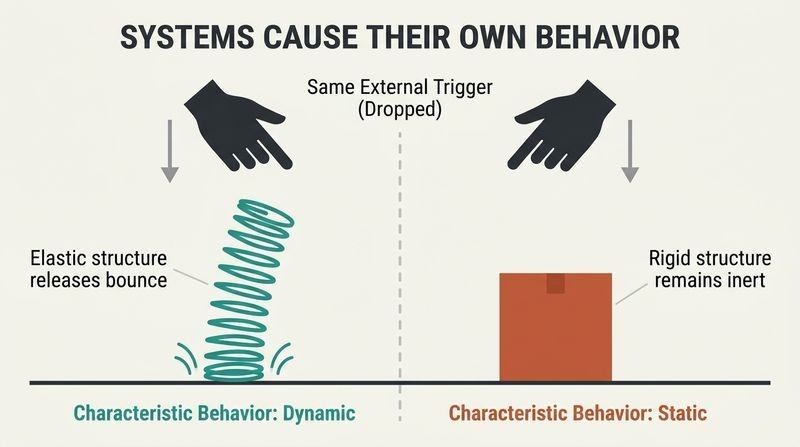
The Slinky reveals the secret. Meadows opens her classes by dropping a Slinky from her hand. Students say her hand made it bounce. So she drops the empty box the Slinky came in, and nothing happens. The bouncing was latent in the spring's structure all along; her hand merely released it. That is the core lesson: a system's characteristic behavior lives inside its own structure, not in the events that trigger it.
This idea is heretical when applied to us. Politicians do not cause recessions; booms and busts are baked into a market economy's structure. A flu virus does not attack you; your body sets up conditions for it to flourish. Blaming external forces feels natural but blinds us to the real leverage: redesigning the structure that keeps generating the problem.
What's striking is how this reframes responsibility without moralizing. Attribution theory in psychology documents a mirror-image bias: people blame their own failures on circumstances but others' failures on character. Meadows flips both, locating causation in structure rather than actors. The view echoes W. Edwards Deming's claim that 95% of performance variation comes from the system, not the individual worker. The caution: structural determinism can slide into fatalism or excuse-making. Meadows threads this carefully by arguing structures are human-made and therefore changeable, which keeps agency alive while dissolving the reflex to scapegoat.
A system is elements, interconnections, and above all a purpose
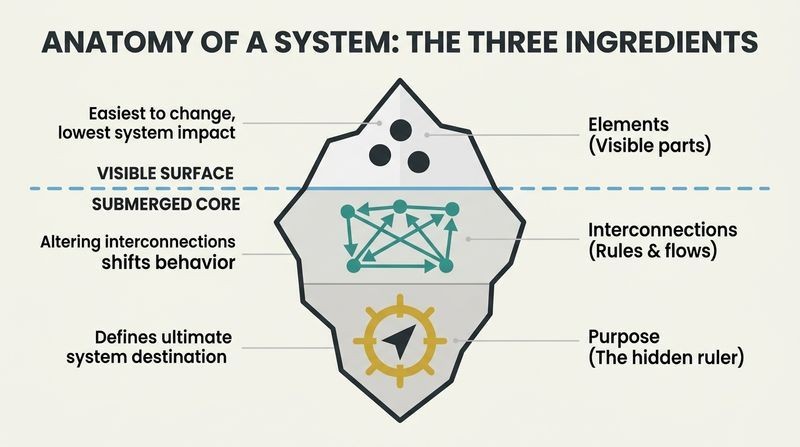
Three ingredients define any system. Elements are the visible parts (players, cells, students). Interconnections are the relationships and rules that bind them, often flows of information. Purpose or function is what the system actually does, deduced from behavior rather than stated goals. A football team, a tree, a national economy all qualify. Sand scattered on a road does not, because it has no interconnections or function.
Purpose is the hidden ruler. Swap every player and a football team is still a football team. Change the rules from football to basketball and everything shifts. Change the purpose from winning to losing and the system transforms utterly, even with identical parts. To read a system's true purpose, watch what it does: if a government proclaims environmental protection but funds none, protection is not its purpose.
The insistence on inferring purpose from behavior rather than rhetoric is quietly radical and directly applicable to organizations. It anticipates the systems-thinking maxim POSIWID (the purpose of a system is what it does), attributed to cyberneticist Stafford Beer. This cuts through mission statements and stated intentions to expose revealed priorities. The framework also warns against reductionism: dissecting elements endlessly loses the forest. One tension worth naming is that complex systems often serve multiple, conflicting purposes simultaneously, so reading a single purpose from behavior can oversimplify. Still, the discipline of watching before theorizing remains a powerful diagnostic habit.
You can fill a bathtub by closing the drain, not just opening the faucet
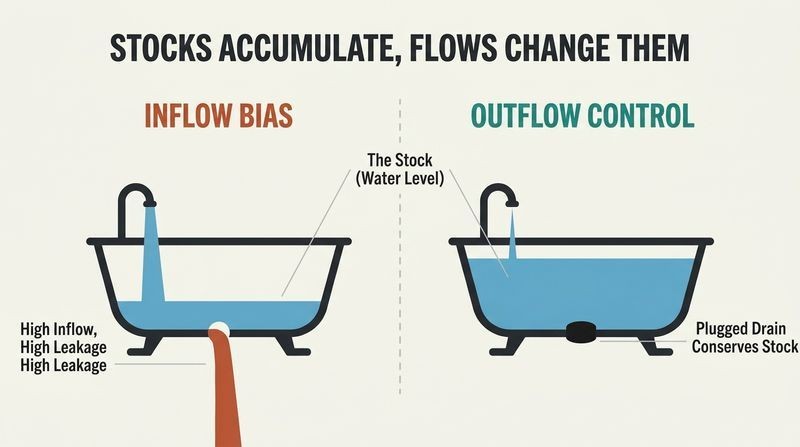
Stocks accumulate, flows change them. A stock is any accumulation you can measure at a moment: water in a tub, money in a bank, trees in a forest, trust between people. Flows fill or drain it. Meadows uses the bathtub because everyone intuits it: the water level rises when inflow beats outflow, falls when outflow wins, holds steady when they match.
Our minds fixate on inflows. Everyone knows you extend an oil economy by discovering new fields; fewer see that burning less oil achieves the identical effect on the stock. A company grows its workforce by hiring faster or by reducing quitting and firing. Crucially, stocks change slowly even when flows change abruptly, so they act as buffers, delays, and momentum. That sluggishness gives systems both their stability and their tendency to overshoot.
The stock-flow distinction is deceptively humble but explains chronic policy failure. Research by MIT's John Sterman shows even highly educated people fail basic stock-flow reasoning: told that CO2 emissions must fall to stabilize atmospheric concentration, most wrongly assume stabilizing emissions stabilizes the stock. This bathtub blindness underlies confusion about debt, climate, and inventory alike. The asymmetric attention to inflows over outflows also maps onto behavioral economics: reducing waste or attrition is psychologically less salient than adding new sources, even when cheaper. Recognizing that stocks buffer and delay is the antidote to expecting instant results from flow changes.
Every persistent behavior is a feedback loop running quietly underneath
Feedback loops are self-governing circuits. When a stock's level changes the flows that alter that same stock, you have a feedback loop. Two kinds exist. Balancing loops are goal-seeking and stabilizing: a thermostat, a cooling coffee cup, your body regulating blood sugar. They oppose change and pull a stock toward a target. Reinforcing loops amplify: money compounding interest, rabbits breeding more rabbits, eroded soil eroding faster. They drive exponential growth or collapse.
Doubling sneaks up on us. A handy shortcut: divide 70 by the growth rate to get the doubling time. At 7% interest, money doubles in a decade. Meadows nudges readers to ask, whenever they hear A causes B, whether B also feeds back to cause A. Once you see loops everywhere, you stop hunting for someone to blame and start asking what structure produces this pattern.
The balancing-versus-reinforcing dichotomy is the grammar of dynamics across disciplines, from Norbert Wiener's cybernetics to ecology's predator-prey cycles. What Meadows adds for lay readers is the diagnostic instinct: persistent stability signals a hidden balancing loop, persistent acceleration signals a reinforcing one. The 70 divided by growth rate rule deserves emphasis because human intuition is catastrophically linear; people routinely underestimate compounding, a bias Einstein allegedly called the eighth wonder. One nuance: real systems interleave many loops of shifting strength, so labeling a single dominant loop is a snapshot, not a permanent truth. The habit of asking 'does B also cause A' alone rewires causal reasoning.
Delays make well-meaning managers overshoot, oscillate, and overcorrect
A car dealer learns the hard way. Meadows models a dealership keeping ten days of inventory. Add three realistic delays (five days to perceive a sales trend, three days to adjust orders, five days for factory delivery) and a simple 10% jump in demand triggers wild oscillations. The owner underorders, then panic-orders, then overshoots, then cuts back too far. She is not stupid; she is operating with delayed information in a delayed system.
Reacting faster backfires. When she shortens her perception time, oscillations barely improve. When she reacts faster still, they get dramatically worse. The counterintuitive fix is to slow down: stretching her response from three days to six damps the swings. This same structure of delays and overreaction drives business cycles across entire economies, not the presidents blamed for them.
This is perhaps the book's most practically humbling lesson. The dealership is a miniature of the Beer Game, MIT's famous supply-chain simulation where players reliably generate the bullwhip effect: small demand changes amplify into violent swings upstream. It illustrates why aggressive intervention in delayed systems (interest-rate tinkering, just-in-time panic ordering) so often destabilizes. The deeper point connects to control theory: gain and delay together determine stability, and impatience is a form of excessive gain. The lesson resists our action bias. Sometimes the wisest move in a laggy system is to wait, average, and respond gently, a stance that feels like negligence but is actually competence.
Prize resilience over efficiency, because brittle systems crash silently
Resilience is the invisible plateau. Meadows describes three reasons systems thrive: resilience (the ability to bounce back from shocks), self-organization (the capacity to grow new structure and evolve), and hierarchy (nested subsystems that reduce information overload). Resilience comes from many overlapping feedback loops with redundancy, one kicking in when another fails. The human body, fending off invaders and repairing itself, is the exemplar.
We trade it away without noticing. Just-in-time inventories cut costs but leave production vulnerable to any hiccup in fuel, traffic, or labor. Single-species tree plantations yield wood efficiently but collapse under new pests. Because resilience is only visible when you exceed its limits, people sacrifice it for productivity or stability, operating on a shrinking plateau until one ordinary day the system does something it has done a hundred times before and crashes.
The efficiency-resilience tradeoff has become brutally salient since 2008 and 2020, when lean supply chains and financial systems shattered under shocks. Meadows anticipated this decades early. Ecologist C.S. Holling, whom she cites, formalized resilience as the size of the basin a system can be perturbed within before flipping to a new regime. The insight generalizes: monocultures of crops, ideas, or business models optimize for known conditions and fail catastrophically under novel ones. The self-organization point adds a hopeful counterweight, echoing complexity science findings that simple rules (fractal geometry, DNA's four letters) generate boundless diversity. The warning against stripping rarely-used emergency mechanisms is worth heeding personally and institutionally.
Your mental model is not the world, so surprises are guaranteed
Events hide structure. Meadows warns that we consume the world as a stream of dramatic events (a crash, an election, an oil discovery) which have almost no predictive power. Beneath events lie patterns of behavior over time, and beneath those lies structure: the stocks, flows, and loops that generate everything. Nightly stock-market explanations stay stuck at event level and teach us nothing about how to change outcomes.
Boundaries and rationality trip us up. There are no true boundaries in nature; we draw them for sanity, then get surprised when pollution crosses the line we imagined. The world is nonlinear, so doubling a cause rarely doubles the effect. And bounded rationality means each actor decides sensibly on the limited, delayed information visible from their seat. A fisherman with a mortgage overfishes; swapping in a new fisherman changes nothing. The structure, not the person, drives the result.
The event-behavior-structure hierarchy is a genuinely portable thinking tool, mirroring the iceberg model widely taught in systems education. Herbert Simon's bounded rationality, invoked here, won a Nobel and dismantled the fiction of the omniscient optimizer; Meadows extends it with the vivid claim that dropping a virtuous person into a corrupt position rarely reforms the position. The Dutch electric-meter story elsewhere in her work shows the flip side: change what information a person sees and behavior shifts effortlessly. The boundary point connects to Garrett Hardin's critique of the word 'side-effects' as self-deception. The humbling takeaway is intellectual: cultivate holding multiple models loosely rather than defending one.
Escape the tragedy of the commons by restoring missing feedback
Shared resources invite ruin. Meadows catalogs recurring structural traps she calls archetypes. The tragedy of the commons, drawn from Garrett Hardin, arises when everyone reaps the full private benefit of using a shared, erodable resource but shares the cost of its abuse with all. Each herdsman rationally adds one more cow; collectively they destroy the pasture. The structural flaw is weak or absent feedback from the resource's condition to the users' decisions.
Three exits exist.
1. Educate and exhort users about consequences (least reliable, since it depends on honor).
2. Privatize so each owner feels their own abuse directly.
3. Regulate through mutual coercion, mutually agreed upon: traffic lights, parking meters, fishing quotas, garbage fees.
Each solution works by reconnecting the severed feedback loop between the resource and those depleting it.
Hardin's 1968 essay framed the commons as nearly inescapable, but Meadows's structural reading points toward the work of Elinor Ostrom, who won the 2009 Nobel for documenting hundreds of real communities (Swiss alpine pastures, Japanese fisheries, Nepali irrigation) that governed shared resources sustainably for centuries without privatization or top-down coercion. Ostrom identified design principles like clear boundaries, graduated sanctions, and local monitoring, essentially homegrown feedback loops. This enriches Meadows's third option, showing regulation need not be imposed from above. The broader lesson is diagnostic: whenever you see chronic overuse, hunt for the feedback link that got severed rather than blaming individual greed.
Beware fixes that shift the burden and breed addiction
Quick relief can hollow out a system. In the shifting-the-burden trap, a symptom-relieving intervention masks a problem without solving its root, and the system's own capacity to cope atrophies. Then more of the fix is needed, deepening dependence. This is the structure of addiction in every guise: not just heroin and caffeine, but farmers hooked on fertilizer, industries reliant on subsidies, economies addicted to cheap oil, medicine that shifts responsibility for health from lifestyle to pills.
Two related traps compound the danger. Drift to low performance (the boiled-frog syndrome) happens when standards quietly erode because you judge today against a discouraging memory of the past, so goals sink year by year. The antidote is holding standards absolute or anchoring them to your best performance. Seeking the wrong goal is equally insidious: measure education by dollars spent or test scores, and you get spending and test scores, not learning.
The addiction archetype reframes dependency as a system dynamic rather than a moral failing, resonating with Bruce Alexander's Rat Park experiments suggesting environment, not the substance alone, drives addiction. The prescription (intervene to rebuild the system's own capacity, then withdraw) mirrors the best development aid and therapy philosophies: teach fishing, do not ship fish forever. The wrong-goal trap is a devastating critique of metric fixation, echoing Goodhart's Law, that a measure targeted ceases to be a good measure. Meadows's assault on GNP as a welfare proxy prefigures today's wellbeing and doughnut-economics movements. The through-line: what you measure and relieve shapes what you become.
Fiddling with numbers is the weakest way to change a system
Leverage points are counterintuitive. Meadows offers a famous ranked list of places to intervene in a system, from least to most powerful. At the bottom sit numbers: taxes, subsidies, standards, minimum wages. She estimates 99% of our attention goes here, yet these rarely change behavior; they are rearranging deck chairs. Moving up: buffer sizes, physical structures, delays, the strength of balancing and reinforcing loops, information flows (adding a missing feedback link is cheap and potent), the rules, and the power to self-organize.
The deepest levers are mental. Near the top sit goals, then paradigms (the shared unstated assumptions from which everything else flows, like 'growth is good' or 'nature is a resource'), and finally the power to transcend paradigms entirely, holding all worldviews lightly. Paradigms resist change fiercely in societies but can shift in one individual in a millisecond.
This list is the book's most cited contribution and a staple of change-management and sustainability curricula. Its inversion of intuition is the payoff: activists and policymakers exhaust themselves battling over parameters (tax rates, thresholds) while the high-leverage rules and paradigms go unexamined. The claim that paradigm shifts can happen instantly in a mind but glacially in a culture connects to Thomas Kuhn's structure of scientific revolutions, which Meadows cites, and to Max Planck's grim quip that science advances one funeral at a time. A fair critique: the ranking is admittedly 'slithery,' with exceptions, and high leverage points are precisely the hardest to move, so the list describes potency, not feasibility.
You cannot control complex systems, but you can dance with them
Prediction and control are illusions. After a career of modeling, Meadows concludes that self-organizing, nonlinear, feedback-rich systems are inherently unpredictable and uncontrollable. The industrial dream of mastering the world through analysis dissolves. What replaces it is participatory: like whitewater kayaking or playing music, you stay awake, watch the system's rhythm, and respond to feedback rather than imposing your will.
Practical dancing lessons follow.
1. Get the beat of the system by watching its history before intervening.
2. Expose your mental models to daylight and invite challenge.
3. Honor and distribute information, since most malfunctions trace to biased or missing data.
4. Pay attention to what matters, not just what is quantifiable.
5. Expand the boundaries of caring and the time horizons you consider.
Systems thinking, she insists, points beyond analysis to what only the human spirit can do.
The pivot from control to partnership marks the book's philosophical climax and distinguishes it from techno-managerial systems literature. It converges with Taoist wu wei, with adaptive management in ecology, and with agile methodology's embrace of iteration over rigid planning. The Toxic Release Inventory example she cites (mandated disclosure alone cut emissions 40% within two years, with no fines) is a stunning proof that information flow beats regulation. The insistence on valuing the unquantifiable is a needed corrective to metric worship, though it risks vagueness; her answer is to name qualities aloud even when unmeasured. The stance demands humility that institutions built on the promise of control find hard to swallow.
Analysis
Thinking in Systems is a posthumously published primer, distilled from Donella Meadows's decades in the MIT system dynamics tradition founded by Jay Forrester and popularized through her landmark 1972 report The Limits to Growth. The book's structure moves from mechanics (stocks, flows, feedback) through a bestiary of simple models, into why systems both work beautifully and confound us, and finally to intervention and philosophy. Its difficulty for a summarizer is that the value lies as much in visual intuition (the Slinky, the bathtub, the oscillating car dealership) as in propositions; the diagrams do argumentative work that prose must reconstruct.
What makes the book endure is its dual register. On one level it is a rigorous engineering discipline; on another it is a wisdom text that keeps translating jargon into folk proverbs (a stitch in time, don't put all your eggs in one basket). Meadows's genius is refusing the false choice between reductionist science and holistic intuition, insisting they are complementary lenses. This positions her against both the technocrat who believes better models yield control and the mystic who rejects analysis entirely.
The book's contemporary relevance has only grown. Its warnings about efficiency-driven brittleness were vindicated by financial and pandemic supply-chain collapses. Its critique of GNP anticipates wellbeing economics. Its leverage-points hierarchy became foundational to sustainability and organizational change practice. The intellectual lineage is rich: Forrester, Simon's bounded rationality, Hardin's commons, Holling's resilience, Kuhn's paradigms, later amplified by Ostrom, Sterman, and complexity science.
The honest limitations are Meadows's own admissions: the leverage list is slithery, boundaries are arbitrary, and the highest leverage points resist movement most. There is also a normative environmentalism woven throughout, growth skepticism especially, that readers should recognize as a value commitment, not a neutral deduction. Yet the core discipline (watch behavior over time, find the structure, locate the missing feedback, resist the urge to control) is among the most transferable thinking tools in nonfiction.
Review Summary
Thinking in Systems is widely praised as an accessible introduction to systems thinking, offering valuable insights for understanding complex systems in various fields. Readers appreciate Meadows' clear explanations, practical examples, and thought-provoking ideas. Many find the book transformative, changing their perspective on problem-solving and decision-making. Some criticize its simplicity or outdated examples, but most agree it's an essential read for anyone interested in systems analysis. The book's concepts are seen as applicable to personal, professional, and global challenges.
People Also Read








Glossary
Stock
An accumulation measured at a momentAny store or quantity that builds up over time and can be counted or measured at a given instant: water in a bathtub, money in a bank, trees in a forest, population, or even intangibles like trust and hope. Stocks are the memory of past flows and change slowly, acting as buffers and sources of momentum that delay a system's response to change.
Flow
Rate that fills or drains stocksThe movement of material or information into or out of a stock over time: births and deaths, deposits and withdrawals, hiring and quitting. Flows can be adjusted relatively quickly, but because stocks change only gradually as flows accumulate, a stock can be raised by increasing an inflow or, equally, by decreasing an outflow.
Balancing feedback loop
Stabilizing, goal-seeking self-correctionA feedback structure that opposes whatever change is imposed on a stock, pulling it toward a goal or holding it within a range. A thermostat, a cooling cup of coffee, and the body's blood-sugar regulation are examples. Balancing loops are sources of stability and of resistance to change; they can fail if their information is delayed, weak, or resource-constrained.
Reinforcing feedback loop
Self-amplifying vicious or virtuous circleA feedback structure that enhances whatever direction of change is imposed, producing exponential growth or runaway collapse. Compounding bank interest, breeding populations, and accelerating soil erosion are examples. Reinforcing loops appear wherever a stock can reproduce or grow as a fraction of itself; unchecked, they eventually destroy the system or are halted by a balancing loop.
Shifting dominance
Loops changing relative strength over timeThe process by which competing feedback loops change in relative power, so that first one loop and then another governs a system's behavior. It explains why a system can grow exponentially, then level off, then decline as reinforcing and balancing loops trade dominance, a common source of surprising nonlinear behavior.
Bounded rationality
Sensible decisions on limited informationHerbert Simon's concept, adopted by Meadows, that people make reasonable decisions based on the incomplete, delayed information available from their particular position in a system. Because actors cannot see the whole, their locally rational choices can add up to collectively bad outcomes. Replacing the individual rarely helps; redesigning the information and incentives they face does.
Resilience
Capacity to recover from shocksA system's ability to survive, recover, and restore itself after disturbance, arising from many overlapping feedback loops with redundancy operating at different scales. Resilience is often invisible until its limits are exceeded, and it is frequently sacrificed for short-term productivity or stability, leaving systems brittle and prone to sudden collapse.
Leverage points
Where small change yields big shiftPlaces to intervene in a system, ranked by Meadows from least to most powerful: numbers and parameters, buffers, physical structure, delays, balancing loops, reinforcing loops, information flows, rules, self-organization, goals, paradigms, and transcending paradigms. Counterintuitively, people focus on weak points like parameters while the potent levers, rules and paradigms, go ignored.
Archetypes (system traps)
Recurring problem-generating structuresCommon system structures that reliably produce troublesome behavior, including policy resistance, the tragedy of the commons, drift to low performance, escalation, success to the successful, shifting the burden to the intervenor, rule beating, and seeking the wrong goal. Meadows calls them traps and opportunities because each can be escaped by recognizing and restructuring it.
Paradigm
Shared unstated assumptions about realityA society's deepest, usually unspoken beliefs about how the world works, such as 'growth is good' or 'nature is a resource to be used.' Paradigms are the source from which goals, rules, and structures flow, making them among the highest leverage points. They resist change fiercely in cultures yet can shift in an individual mind almost instantly.
FAQ
What's Thinking in Systems: A Primer about?
- Understanding complex systems: The book introduces systems thinking, focusing on how interconnected elements create behaviors over time. It emphasizes that systems are more than just the sum of their parts.
- Feedback loops and structure: It highlights the role of feedback loops and system structure in determining behavior, illustrating how these can lead to stability or instability.
- Real-world applications: The concepts are applicable across various fields, including economics, ecology, and social sciences, making it relevant for understanding complex interactions in the world.
Why should I read Thinking in Systems: A Primer?
- Practical insights: The book offers practical insights into managing and redesigning systems, beneficial for business, policy-making, or environmental management.
- Framework for problem-solving: It provides a framework for identifying root causes of problems and recognizing opportunities for change, essential in today’s complex world.
- Learn from an expert: Written by Donella Meadows, a renowned systems thinker, the book makes complex concepts accessible to a wide audience.
What are the key takeaways of Thinking in Systems: A Primer?
- Systems cause their own behavior: Systems largely produce their own behavior through their structure, leading to surprising outcomes.
- Importance of leverage points: Identifying leverage points—places where a small change can lead to significant impacts—is crucial for effective intervention.
- Interconnectedness of systems: Understanding the connections within systems is vital for addressing complex issues effectively.
What are the best quotes from Thinking in Systems: A Primer and what do they mean?
- “The system, to a large extent, causes its own behavior!” This quote encapsulates the idea that the structure of a system largely determines how it behaves.
- “A stitch in time saves nine.” This proverb highlights the importance of addressing problems early before they escalate.
- “There are no separate systems.” This emphasizes the interconnectedness of all systems, suggesting that understanding one requires considering its relationships with others.
What is a system according to Thinking in Systems: A Primer?
- Definition of a system: A system is a set of interconnected elements that produce their own pattern of behavior over time.
- Elements and interconnections: Systems consist of elements, interconnections, and a function or purpose, with behavior emerging from these interactions.
- Examples of systems: Ecosystems, economies, and organizations are examples, illustrating that systems can be found in various contexts and scales.
What are feedback loops and why are they important in Thinking in Systems: A Primer?
- Types of feedback loops: Feedback loops can be balancing (stabilizing) or reinforcing (amplifying), influencing system behavior.
- Impact on system behavior: They determine how a system responds to changes, affecting its stability and resilience.
- Real-world implications: Feedback loops can lead to both positive and negative outcomes in real-world systems, such as in economics and ecology.
What are leverage points in systems according to Thinking in Systems: A Primer?
- Definition of leverage points: Specific places within a system where a small change can lead to significant shifts in behavior.
- Types of leverage points: They range from changing parameters to altering the system's goals or structure, with varying effectiveness.
- Practical application: Understanding leverage points allows for focusing efforts on impactful changes, enhancing positive outcomes in complex systems.
How does Thinking in Systems: A Primer address the concept of resilience?
- Definition of resilience: Resilience is a system's ability to bounce back from disturbances and maintain core functions.
- Importance of feedback loops: Resilience arises from a rich structure of feedback loops that restore a system after perturbations.
- Examples of resilient systems: Ecosystems and human communities that adapt to crises illustrate the practical importance of resilience.
What is self-organization in systems as discussed in Thinking in Systems: A Primer?
- Definition of self-organization: A system's ability to create new structures and complexity from within, often without external direction.
- Examples of self-organization: Complex ecosystems and social structures develop through simple rules leading to intricate patterns.
- Implications for management: Recognizing self-organization can inform management practices, fostering creativity and adaptability.
How does hierarchy function in systems according to Thinking in Systems: A Primer?
- Definition of hierarchy: A structure where subsystems are organized into larger systems, allowing for stability and efficiency.
- Benefits of hierarchical organization: Hierarchies manage complexity by allowing subsystems to operate semi-independently while contributing to overall goals.
- Challenges of hierarchy: Potential downsides include suboptimization and overcontrol, requiring balance between autonomy and coordination.
What is the concept of bounded rationality in Thinking in Systems: A Primer?
- Limited decision-making capacity: Bounded rationality refers to decisions made based on limited information and cognitive constraints.
- Influence on system behavior: It can lead to decisions that do not align with the overall welfare of the system.
- Need for better information: Improving information available to decision-makers can enhance their ability to act in ways that benefit the system.
What are system traps and how can they be addressed according to Thinking in Systems: A Primer?
- Common problematic patterns: System traps are recurring patterns leading to undesirable outcomes, such as policy resistance.
- Recognizing and escaping traps: Addressing traps involves recognizing them early and understanding their structures.
- Transforming traps into opportunities: By reframing challenges and engaging stakeholders, it is possible to create effective and sustainable solutions.
About the Author
Other books by Donella H. Meadows

Download PDF
Download EPUB
.epub digital book format is ideal for reading ebooks on phones, tablets, and e-readers.








































