


Key Takeaways
Every discussion is secretly three conversations happening at once
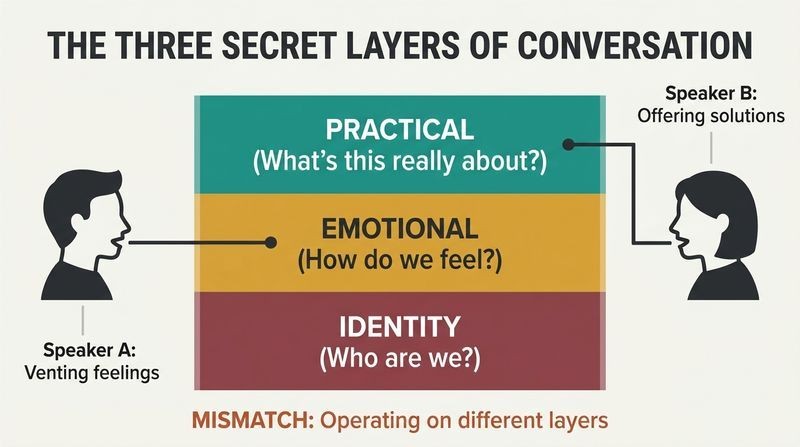
Duhigg's central thesis is that most meaningful conversations are actually three distinct types layered together, each governed by a different question and a different part of the brain:
1. What's This Really About? (practical, decision-making, using the brain's frontal control network)
2. How Do We Feel? (emotional, drawing on the amygdala and other feeling structures)
3. Who Are We? (social identity, using the default mode network)
Miscommunication happens when two people are in different conversations at the same moment. When your spouse vents that their boss is impossible and you offer a tidy fix, you are answering What's This Really About? while they are living inside How Do We Feel? You are speaking different cognitive languages. Connection requires detecting which conversation is live and joining it.
What's striking is how this maps onto older communication research without collapsing into it. Deborah Tannen's work on 'report talk versus rapport talk' anticipated the vent-versus-fix mismatch decades ago, but Duhigg's tripartite model adds the social-identity layer that gender-focused frameworks often miss. The neuroscience framing (distinct brain networks) is more suggestive than settled; localization of function is genuinely contested. The practical power does not depend on the brain claims, though. The actionable core is simpler than the theory: before responding, ask yourself which of the three questions your partner is actually asking. That diagnostic habit alone prevents most everyday conversational collisions.
You cannot understand someone until your brains physically sync
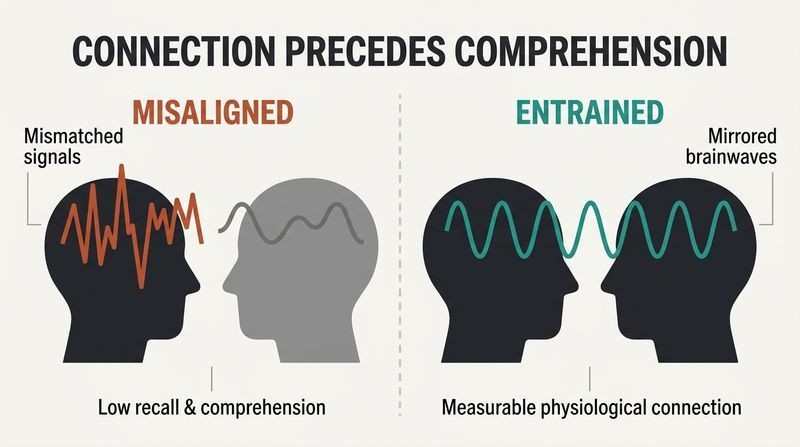
Neural entrainment is the phenomenon where connected people's bodies align: pupils dilate together, pulses match, breathing synchronizes, even skin's electrical activity converges. Researchers studying guitarists found their brain activity looked unrelated when playing separate scores, then merged the instant they played a duet, and diverged again during solos. A Princeton study of listeners hearing a woman recount her prom night found that the more closely a listener's brain mirrored the speaker's, the better they understood and recalled the story.
This is why connection precedes comprehension. We absorb information from others not through raw transmission but through alignment. When someone says a conversation just 'clicked,' they are describing measurable physiological convergence, not a vague feeling.
The entrainment research is among the book's most seductive and most fragile material. Hyperscanning studies (measuring two brains simultaneously) are young, correlational, and prone to overinterpretation; synchrony may be a byproduct of shared attention rather than its cause, and Duhigg's own cited researcher hedges on causal direction. Still, the broader point resonates with predictive-processing theories of cognition: brains constantly model other minds, and conversation is a mutual error-correction loop. The reframe worth keeping is motivational. If understanding requires alignment rather than mere clarity, then persuasion-by-argument is often doomed, and the humbler work of syncing up comes first.
Match the mindset, not the mannerisms, to truly connect
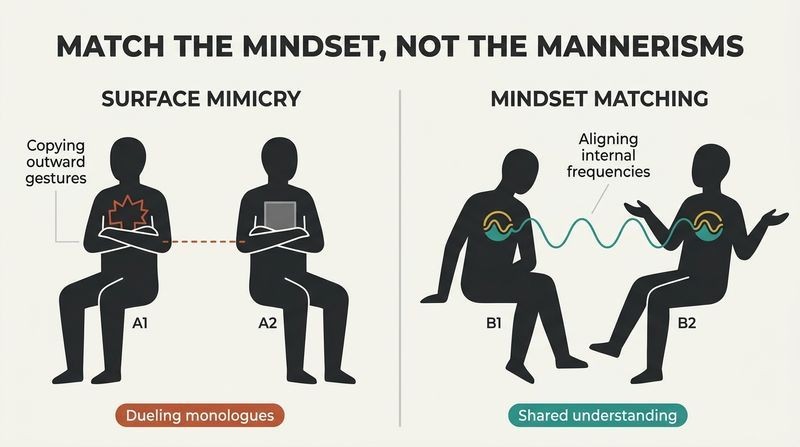
The matching principle states that effective communication requires recognizing which kind of conversation is happening, then aligning with it: get emotional when others are emotional, practical when they are practical, social when they are focused on identity. Duhigg illustrates it through CIA officer Jim Lawler, who failed to recruit a foreign source named Yasmin until, at a final dinner, he stopped pitching and simply shared his own fears of being a failure. She matched his vulnerability, felt understood, and agreed to help.
Crucially, matching is not mimicry. Parroting gestures or repeating words back creates dueling monologues, not connection. Real matching means genuinely grasping what someone feels, wants, and is, then offering something authentic of your own in return.
The mimicry caveat rescues this idea from the pop-psychology 'mirror their body language' advice that fills sales seminars. Research on the 'chameleon effect' shows unconscious mimicry does build rapport, but conscious, mechanical copying often reads as manipulative or unsettling, precisely Duhigg's point. There is a tension worth naming: the spy example frames authentic vulnerability as a recruitment tool, which raises the question of whether genuine matching can survive instrumental intent. Lawler insists it works only when the care is real. That is likely true and also convenient. The honest takeaway is that manipulation and connection use overlapping mechanics but diverge in whether you actually mean it.
Before any hard talk, negotiate what you're even discussing
Every conversation opens with a quiet negotiation over two things: what topics everyone actually wants to cover, and the unspoken rules for how you will decide together. Duhigg draws on the 1979 Harvard Negotiation Project insight from Getting to Yes: skilled negotiators do not fight over slices of pie, they expand it, seeking win-win solutions through open-ended questions.
The prostate surgeon Behfar Ehdaie learned this the hard way. He kept drowning patients in survival statistics urging 'active surveillance,' yet 40% chose unnecessary surgery anyway. Once he stopped assuming he knew what patients wanted and began asking what the diagnosis meant to them, patients revealed they cared about family and control, not data. Surgeries dropped 30%.
Ehdaie's case is a quiet indictment of expertise. Physicians are trained to transmit information, but information delivered into the wrong conversation bounces off. This echoes the medical literature on shared decision-making and 'ask-tell-ask' protocols, and it parallels behavioral economics: the 3% risk figure triggered loss aversion, so patients fixated on the vivid minority who suffered rather than the reassuring majority. The deeper lesson extends beyond medicine. Any time an expert feels baffled that people 'just won't listen to the evidence,' the likelier culprit is a mismatch of conversation type, not a deficit of facts. Asking what something means to someone is the cheapest diagnostic available.
Deep questions feel risky but almost always deepen bonds
Psychologist Nicholas Epley discovered that the path to connection is not perspective-taking (imagining someone's shoes) but perspective-getting: actually asking, then listening. The Arons' famous '36 Questions' study turned strangers into friends (one pair later married) through escalating, reciprocal self-disclosure. The engine is vulnerability, which triggers emotional contagion, our automatic tendency to catch others' feelings.
The practical trick: you do not need a lab questionnaire. Recast factual questions into feeling ones. Instead of 'Where do you work?' ask 'What's the best part of your job?' Then ask follow-ups. When Epley made hedge fund managers ask each other about crying, they dreaded it, then rated it among their best conversations in months. People consistently underestimate how much they will enjoy going deep.
The 'affective forecasting error' Epley documents (we predict awkwardness that never materializes) is one of the most useful findings in social psychology, because the barrier to richer relationships is largely imaginary. It connects to Gillian Sandstrom's research showing people underestimate how much strangers enjoy talking to them. One nuance Duhigg flags via other researchers: vulnerability has a pacing and a power dimension. Disclosing too much too fast, or to someone who does not care, backfires, and women and marginalized groups can face penalties for emotional expression that others do not. The reframe that endures: treat a new acquaintance a little more like a close friend, and watch the conversation open.
Prove you heard emotions by matching mood and energy
Specific emotions are nearly impossible to read accurately. Is that furrowed brow anxiety or concentration? So the brain relies on a faster gauge: mood (positive or negative) and energy (high or low). NASA psychiatrist Terence McGuire cracked astronaut selection using this. Reviewing decades of interview tapes, he noticed the best future astronauts matched his emotional pitch, chuckling when he chuckled, grieving when he shared grief, while weaker candidates laughed politely but out of sync.
Laughter reveals the mechanism. Robert Provine found under 20% of laughs follow actual jokes; we laugh to signal we want to connect. What matters is matching intensity. A half-hearted chuckle against someone's belly laugh signals misalignment. The Big Bang Theory writers exploited this, having socially awkward characters repeat 'Hi' at identical pitch to show connection.
The mood-and-energy shortcut (valence and arousal, in the technical vocabulary) is a genuinely liberating simplification. It relieves the anxious listener of the impossible task of naming another's exact feeling and replaces it with a two-dimensional read almost anyone can perform. There is supporting depth here from affective science: Russell's circumplex model has organized emotion along these two axes for forty years. A subtle caveat Duhigg himself raises through his sources: matching is not always the goal. If someone is furious, matching fury escalates; the move then is to acknowledge their energy rather than mirror it. Skilled therapists call this 'pacing and leading,' syncing first, then gently shifting the tempo.
In conflict, seek control together instead of over each other
Marriage researchers (the 'Love Shrinks') filmed over a thousand couples' arguments and found happy and unhappy couples fought about the same things with equal frequency, and neither resolved conflicts better. The real difference was control. Unhappy couples tried to control each other (your tone, your words, your gestures). Happy couples controlled three other things:
1. Themselves (breathing, slowing down, taking breaks)
2. Their environment (postponing a 2 a.m. fight to morning)
3. The boundaries of the conflict (keeping it small, not letting it spill into 'you never do the laundry')
Every fight contains two conflicts: the surface issue and the emotional issue beneath it. Unresolved arguments recur endlessly because people never name the hurt, fear, or feeling of disrespect actually driving them.
The control distinction reframes conflict as a collaboration problem rather than a persuasion contest, which is quietly radical. Trying to force someone to see your side almost always inflames the fight; harnessing the shared craving for control toward de-escalation defuses it. This dovetails with Gottman's decades of data on 'the Four Horsemen' and with the observation that many marital conflicts are perpetual and unsolvable, so management, not resolution, is the realistic aim. The framework generalizes cleanly to workplaces and online spats. 'Kitchen-sinking' (dumping every past grievance into one argument) is the universal signature of a fight about to go nuclear, and naming it in the moment can shrink it back down.
During arguments, looping proves you listened and lowers defenses
Showing you heard someone is not enough during conflict, because everyone suspects you are just loading your rebuttal. The fix is looping for understanding:
1. Ask questions until you grasp their point
2. Repeat it back in your own words
3. Ask if you got it right
4. Repeat until they confirm
Duhigg shows it working at a Washington gun debate that gathered fervent gun-control and gun-rights advocates. Trained to loop, a gun-rights man who had never discussed his mother's suicide with his group wept as a liberal stranger accurately reflected his pain back to him. Looping does not mean agreeing. It distills the other's view, proves you are working to see it, and grants them a measure of control over the conversation, which builds the psychological safety needed for honesty.
Looping is essentially active listening with a verification step, and the verification is what makes it potent. Research on 'conversational receptiveness' shows that signaling genuine engagement early forestalls escalation later, and hostage negotiators have used variants for decades. The gun-dialogue experiment also delivers a sobering caveat the book does not hide: the in-person magic evaporated online, where untrained newcomers were calling each other Nazis within an hour. This exposes looping's dependency on setting and buy-in. It is a skill, not a spell. Its real-world reliability drops sharply without structure, moderation, and participants who actually want understanding rather than victory. Technique amplifies intention; it cannot manufacture it.
Remind people they contain multitudes to defuse stereotype threat
Social identities (the groups we belong to) quietly shape every conversation. Claude Steele coined stereotype threat: merely knowing a negative stereotype exists about your group can sabotage performance. Women equally skilled at math scored 20 points lower than men on hard tests, not from low ability but from the mental drain of double-checking under suspicion. The antidote is multiplicity. When women were prompted to sketch their many identities (athlete, sibling, musician, friend) before a math test, the gender gap vanished.
Pediatrician Jay Rosenbloom applied this with vaccine-resistant parents. Instead of playing 'the expert who knows better,' he found a shared identity, reminding himself he too was a parent who understood fear. A soccer league mixing Christian and Muslim players in post-ISIS Iraq worked the same way, making 'teammate' more salient than 'enemy.'
The multiplicity intervention is elegant because it does not deny identity, it enriches it. This aligns with self-complexity research suggesting people with more distinct self-aspects are buffered against any single threat. The Iraqi soccer study is a modern vindication of Gordon Allport's 1954 contact hypothesis, with the crucial refinement that contact only works under specific conditions: equal status, shared goals, and institutional support. Merely throwing groups together can worsen prejudice. It is worth noting stereotype threat has faced replication scrutiny in recent years; some effects are smaller or more context-dependent than early studies implied. The conversational lesson survives regardless: invoking someone's full range of selves opens doors that fixating on one label slams shut.
Guard against identity threat by ditching generalizations for stories
Identity threat is what makes conversations about race, gender, or belonging so combustible. It fires whenever someone is forced into a group they reject ('you rich people are all snobs') or denied one they claim ('you wouldn't understand, you have no kids'). A study found participants experienced over 11 identity threats in a single week; blood pressure rises, stress floods, people fight or flee.
The neutralizer is specificity. Generalizations strip away individuality and provoke defensiveness. Speaking from your own experience does the opposite. When Black and white friends were briefly primed to expect discomfort and plan for it before discussing race, their conversations went deeper and left both feeling closer. The move: acknowledge experiences rather than solve them, and describe your own reality instead of assigning traits to a group.
Identity threat elegantly explains why well-meaning statements detonate: the offense is rarely the content, it is the involuntary categorization. This links to self-categorization theory and to the psychology of 'othering.' The most actionable finding is the pre-conversation priming, which costs minutes and reliably improves outcomes, echoing implementation-intention research showing that anticipating obstacles beforehand blunts their impact. One tension deserves daylight: the burden of these conversations falls unequally. Asking a marginalized person to narrate their trauma so others can learn extracts a real cost, which is why the guideline to let people decline matters. Specificity protects connection, but it must not become a demand for perpetual self-exposure from those already carrying the heaviest load.
Hard conversations need explicit rules, especially where candor rules
Netflix's radical-candor culture (where 'silent disagreement is unacceptable' and employees critique each other brutally) imploded when a top executive used a racial slur in a meeting to illustrate how hurtful words can be. The same bluntness that fueled innovation made discussions of identity go nuclear, so people stopped talking entirely.
Inclusion chief Vernā Myers fixed it with guidelines (they could not be called 'rules' at Netflix): no blaming, shaming, or attacking; questions welcome if asked in good faith; speak from your own experience; expect discomfort and treat it as learning, not danger. Leaders modeled their own mistakes first. One executive, asked to define Netflix's hiring 'bar,' realized aloud he had just described his own resume. Structure, not spontaneity, made the hardest conversations possible.
The Netflix arc is a case study in how a communication norm optimized for one domain (product decisions) fails catastrophically in another (identity). Radical candor assumes a level playing field where all feedback lands equally, but identity threat guarantees it does not. The broader finding Duhigg cites is bracing: most diversity trainings show effects lasting a day or two, and some backfire by making stereotypes more salient. What distinguished Netflix's approach was duration, clear guidelines, and leaders volunteering their own fallibility, which lowers the stakes for everyone. The counterintuitive punchline for a Silicon Valley obsessed with removing rules: the most sensitive conversations require more scaffolding, not less. Freedom without structure is not safety.
The strongest predictor of a good life is warm connection
The Harvard Study of Adult Development tracked participants for over 80 years, starting in 1938. Two men anchor the story. Godfrey Camille arrived a lonely hypochondriac from a bleak childhood, predicted by everyone to fail; he built a life of deep relationships and died beloved, among the study's happiest subjects. John Marsden, the golden boy from a wealthy family, prioritized career over people, withdrew during conflict, and died alienated and unloved.
The finding, replicated across decades and hundreds of other studies: the single greatest predictor of a healthy, happy old age was satisfaction in relationships at age 50. Social isolation proved more dangerous than diabetes. Connection is built and sustained through countless deep, ordinary conversations, which is why learning to have them is not a soft skill but a survival skill.
The Harvard study is the empirical keystone that elevates the whole book from communication tips to something closer to a theory of flourishing. Its power is also its vulnerability: the original cohort was affluent white men, generalization is fraught, and 'relationship satisfaction predicts health' cannot fully disentangle whether good health enables relationships or vice versa. Yet the convergent evidence (Holt-Lunstad's meta-analyses equating loneliness with smoking as a mortality risk) makes the core claim hard to dismiss. The quiet radicalism is reframing conversation itself as the mechanism of connection. If relationships determine longevity, and conversations build relationships, then the humble skill of talking well becomes, quite literally, life-extending.
Analysis
Supercommunicators sits in a crowded genre (the how-to-talk-better book) yet earns its place by supplying a unifying architecture where rivals offer scattered tips. Duhigg, a Pulitzer-winning journalist rather than a scientist, plays to his strength: he braids peer-reviewed research through irresistible narratives (a bungling CIA recruiter, a jury acquitting a disabled ex-con, sitcom writers rescuing a failing pilot, an 80-year Harvard study) so the frameworks arrive already dramatized. The book's spine is the tripartite model (What's This Really About?, How Do We Feel?, Who Are We?) plus the matching principle and the learning conversation. This is genuinely useful scaffolding because it converts a vague aspiration (connect better) into a diagnostic (which conversation is live, and am I in it?).
The intellectual risk is the neuroscience veneer. Claims about neural entrainment, default mode networks, and brain-region localization are presented with more confidence than the young, largely correlational hyperscanning literature warrants, and Duhigg's own footnoted sources repeatedly hedge on causality. Wisely, none of the practical advice actually depends on the brain scans; strip them out and the behavioral findings (perspective-getting beats perspective-taking, looping builds safety, mood-energy matching signals listening, multiplicity defuses stereotype threat) stand on firmer social-psychology ground.
What distinguishes the book from Tannen, Stone/Patton, or Voss is its integration of identity and conflict into a single system, and its honesty about failure: the gun dialogue that thrived in person collapsed online, and diversity trainings often fizzle. Duhigg resists the guru's temptation to oversell.
The deepest contribution is philosophical rather than tactical. By ending on the Harvard longevity data, Duhigg reframes conversational skill not as workplace polish but as the load-bearing infrastructure of a life worth living. The book's implicit argument is that connection is learnable, that supercommunicators are made not born, and that the barriers (awkwardness, fear of depth) are mostly illusions we could dispel this week. That optimism, grounded in data, is its most valuable and most testable claim.
Review Summary
Supercommunicators receives mixed reviews, with praise for its insights on effective communication and criticism for its political leanings. Readers appreciate the practical advice and real-world examples but find some content repetitive or lacking novelty. Many commend Duhigg's writing style and the book's potential to improve relationships. Critics argue it oversimplifies complex issues and may not apply universally. Despite disagreements, most reviewers acknowledge the importance of the subject matter and find value in the book's exploration of communication techniques.
People Also Read









Glossary
The Matching Principle
Align to the conversation typeThe core rule that effective communication requires recognizing which of the three kinds of conversation is occurring, then aligning with it: becoming emotional when others are emotional, practical when they are practical, socially attuned when they focus on identity. Matching means genuinely understanding and reciprocating, not mechanically mimicking gestures or words, which produces only dueling monologues.
The Three Kinds of Conversation
Practical, emotional, social layersDuhigg's framework that most discussions are really three overlapping conversations, each with its own logic: What's This Really About? (practical decisions and negotiation), How Do We Feel? (emotions and vulnerability), and Who Are We? (social identity and belonging). Connection fails when two people are in different ones simultaneously.
Neural Entrainment
Brains and bodies synchronizingThe physiological alignment that occurs when people connect through conversation: pupils dilate in tandem, heart rates and breathing match, and brain activity converges. Research suggests the closer a listener's brain mirrors a speaker's, the better they understand and remember what was said.
Perspective-getting
Asking rather than imaginingNicholas Epley's alternative to perspective-taking. Rather than trying to imagine what another person thinks or feels (often inaccurate), you simply ask them directly and listen. Asking questions about someone's values, beliefs, and experiences yields far more accurate understanding than guessing from their shoes.
Fast Friends Procedure
36 escalating intimacy questionsA research protocol by Elaine and Arthur Aron using 36 increasingly personal questions asked reciprocally between strangers, generating sustained, escalating, mutual self-disclosure. It reliably created closeness where shared interests and small talk failed, because its questions elicit vulnerability, which triggers emotional contagion.
Emotional Contagion
Automatically catching others' feelingsThe largely automatic human tendency to synchronize one's emotions with those expressed nearby, catching joy, anger, fear, or sadness whether or not one intends to. It begins in infancy and is most reliably triggered by vulnerability, making it the neurochemical engine of emotional connection.
Mood and Energy
Valence and arousal readA fast two-dimensional gauge the brain uses to read others' emotional states when specific emotions are too hard to identify. Mood is whether someone seems positive or negative; energy is whether they are high or low. Matching or acknowledging both signals that you have heard how someone feels.
Looping for Understanding
Reflect back, confirm accuracyA listening technique for conflict: ask questions, repeat the speaker's point in your own words, then ask whether you got it right, repeating until they confirm. It proves you are genuinely trying to understand (not just preparing a rebuttal), which creates the psychological safety needed for honest exchange.
Stereotype Threat
Fear of confirming a stereotypeClaude Steele's concept that merely knowing a negative stereotype exists about one's group can impair performance, independent of any actual prejudice present. The anxiety of possibly confirming the stereotype drains mental resources. Reminding people of their multiple identities can neutralize it.
Identity Threat
Forced into rejected groupThe psychological distress triggered when someone is involuntarily assigned to a group they dislike or denied membership in one they value. It provokes defensiveness, raised blood pressure, and stress, and it is a primary reason conversations about race, gender, and belonging become combustible.
Learning Conversation
Dialogue aimed at mutual understandingDuhigg's term for the ideal meaningful discussion, where the goal is to learn how others see the world and help them understand your perspective in return, rather than to win. It rests on four rules: identify the conversation type, ask deep questions, surface emotions, and address social identities.
FAQ
What's Supercommunicators about?
- Focus on Communication Skills: Supercommunicators by Charles Duhigg explores the art of effective communication, emphasizing deeper connections through understanding social identities and emotional cues.
- Three Types of Conversations: Duhigg identifies three primary conversation types: practical, emotional, and social identity discussions, which help navigate interactions more effectively.
- Strategies for Connection: The book provides practical strategies, such as asking open-ended questions and practicing active listening, to foster deeper connections.
Why should I read Supercommunicators?
- Enhance Relationships: The book offers insights to improve interpersonal skills, leading to stronger personal and professional relationships.
- Navigate Difficult Conversations: It provides strategies for handling tough discussions, relevant in today's polarized environment.
- Learn from Experts: Insights from psychologists and communication experts enrich the reader's understanding of effective communication.
What are the key takeaways of Supercommunicators?
- Understanding Conversation Types: Recognizing practical, emotional, and social conversations helps align communication styles for effective dialogue.
- Importance of Social Identities: Social identities shape communication; understanding them aids in navigating conversations.
- Active Listening and Questions: Asking open-ended questions and practicing active listening lead to deeper understanding and connection.
What are the best quotes from Supercommunicators and what do they mean?
- “Every meaningful conversation is made up of countless small choices.”: Highlights the importance of engagement choices in effective communication.
- “The single biggest problem with communication is the illusion it has taken place.”: Emphasizes the need for active listening and ensuring understanding.
- “It is not our differences that divide us, it is our ability to recognize, accept and celebrate those differences.”: Encourages embracing diversity for stronger connections.
What is the Matching Principle in Supercommunicators?
- Definition of Matching Principle: It involves recognizing the conversation type and adjusting communication style accordingly for effective dialogue.
- Importance of Alignment: Miscommunication often occurs when conversation types are mismatched; alignment fosters productive dialogue.
- Practical Application: Duhigg provides examples of applying the principle in work and personal contexts for meaningful conversations.
How can I improve my emotional conversations as suggested in Supercommunicators?
- Ask Deep Questions: Delve into beliefs and values to invite vulnerability and foster emotional connection.
- Practice Active Listening: Pay attention to nonverbal cues and emotional expressions to show engagement.
- Use Looping for Understanding: Summarize and confirm what the other person has said to demonstrate listening and clarify misunderstandings.
What is the Fast Friends Procedure mentioned in Supercommunicators?
- Overview of Fast Friends Procedure: A series of thirty-six questions designed to foster intimacy and connection between strangers.
- Mechanism of Connection: Encourages sharing vulnerabilities and reciprocal self-disclosure, creating emotional contagion.
- Application in Real Life: Principles can be applied by asking deep questions and encouraging open dialogue in various contexts.
How does Supercommunicators suggest handling conflicts in conversations?
- Acknowledge Emotions: Recognizing and discussing emotions can de-escalate tensions and foster understanding.
- Use Looping for Understanding: Summarizing thoughts and feelings helps clarify and demonstrate listening.
- Focus on Common Goals: Identifying shared interests shifts conversations from adversarial to collaborative problem-solving.
What role does vulnerability play in Supercommunicators?
- Foundation of Connection: Vulnerability is key to meaningful conversations, encouraging reciprocity and deeper connections.
- Emotional Contagion: Sharing vulnerabilities can trigger emotional contagion, enhancing bonds between partners.
- Creating Safe Spaces: Active listening and empathy create environments where individuals feel safe to express feelings.
How does Supercommunicators address online communication?
- Criticism in Public Forums: Negative feedback online often backfires; Duhigg advises against public criticism to maintain positivity.
- Importance of Tone and Context: Mindfulness of tone and context leads to better communication outcomes.
- Strategies for Improvement: Practical tips include using gratitude and hedging comments for constructive digital dialogue.
What is the significance of the Motivational Interviewing method in Supercommunicators?
- Guiding Conversations: Encourages self-reflection and personal insight by exploring beliefs and motivations.
- Building Rapport: Establishing a connection leads to more productive and meaningful conversations.
- Facilitating Change: Effective in encouraging behavior change by understanding perspectives and guiding informed decisions.
How can I apply the concepts from Supercommunicators in my daily life?
- Practice Active Listening: Listen attentively, paying attention to verbal and nonverbal cues to understand emotions.
- Ask Meaningful Questions: Incorporate deep questions to encourage vulnerability and emotional connection.
- Be Mindful of Conversation Types: Recognize conversation types and adjust approach to prevent misunderstandings and foster better communication.
About the Author



Download PDF
Download EPUB
.epub digital book format is ideal for reading ebooks on phones, tablets, and e-readers.








































