


Key Takeaways
Stop fighting for what you want; simply choose it and let it come
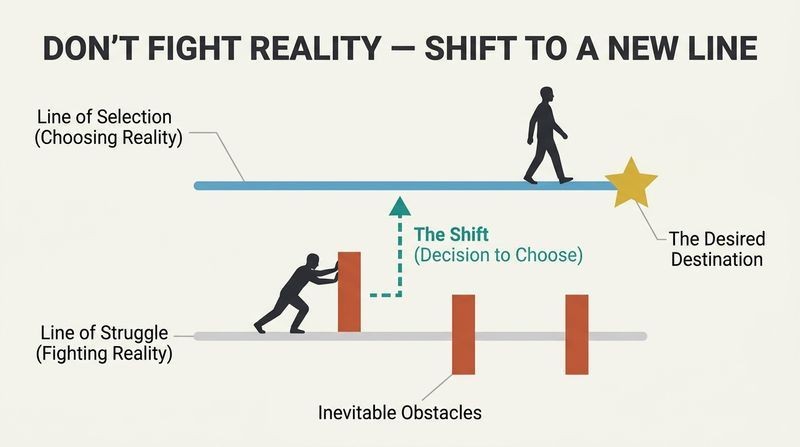
The book's core promise: life feels like a battle because you treat the world as an opponent to conquer. Zeland argues the opposite. You don't rise up into the air by flying; you shift to a reality where you're already flying. He frames this through a fictional Guardian's riddle: everyone is free to choose any destiny, yet almost no one exercises that freedom because they never learned what 'choosing' means.
The practical shift is from struggle to selection. Instead of pressuring reality (banging on a locked door), you adjust your inner relationship to it so the door opens on its own. The recurring image: you don't chase happiness in the future, you occupy the life line where it already exists.
What's striking is how this echoes acceptance-based therapies like ACT, where struggling against experience amplifies suffering, while defusion and acceptance reduce it. The claim that effort is counterproductive will irritate hustle-culture readers, and rightly so as a full life philosophy. But there's a defensible kernel: over-effort often signals low self-belief, and anxiety measurably degrades performance (the Yerkes-Dodson curve). Zeland's mistake-prone move is inflating a psychological insight into metaphysics. Read as a manual for reducing self-sabotage rather than a physics of parallel worlds, the advice becomes testable and often useful.
Importance is the hidden tax that turns your desires against you
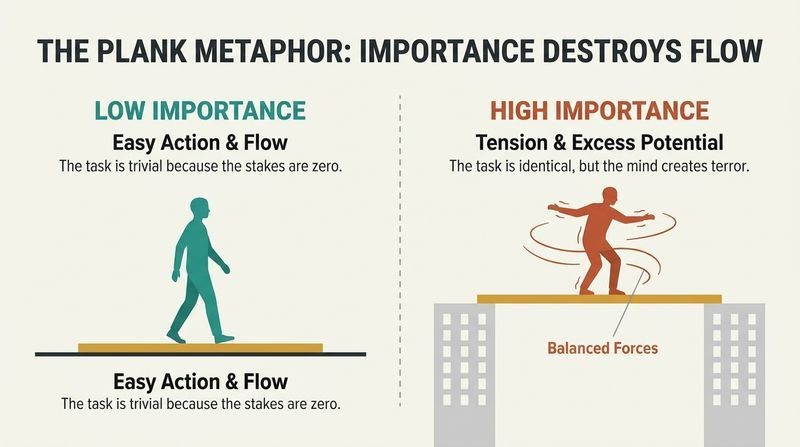
Zeland's single most useful concept: excess potential. When you assign inflated meaning to anything (a job, a person, an outcome), you create tension in the energy field, and 'balanced forces' arise to eliminate it, often delivering the opposite of what you wanted.
Two flavors:
1. Inner importance: overrating your own virtues or flaws (arrogance and inferiority both count).
2. Outer importance: overrating an external goal or event.
His plank metaphor nails it: walking a board on the ground is trivial, but the same board between two rooftops becomes terrifying, not because the task changed but because importance did. The antidote is not suppressing emotion but consciously lowering the stakes, keeping a safety net, and acting instead of stewing.
This maps cleanly onto the paradox of desire in sport and dating: the person who needs the outcome most tends to choke or repel. Research on choking under pressure and on 'trying too hard' in creative tasks supports the mechanism, even without invoking cosmic forces. The Taoist concept of wu wei (effortless action) is the older sibling here. The weakness: 'balanced forces' is unfalsifiable, so failures get retrofitted as proof. Still, the operational advice, lower the stakes, keep a plan B, is sound risk psychology that reliably reduces performance anxiety.
Energy structures feed on your outrage, fear, and guilt like invisible parasites
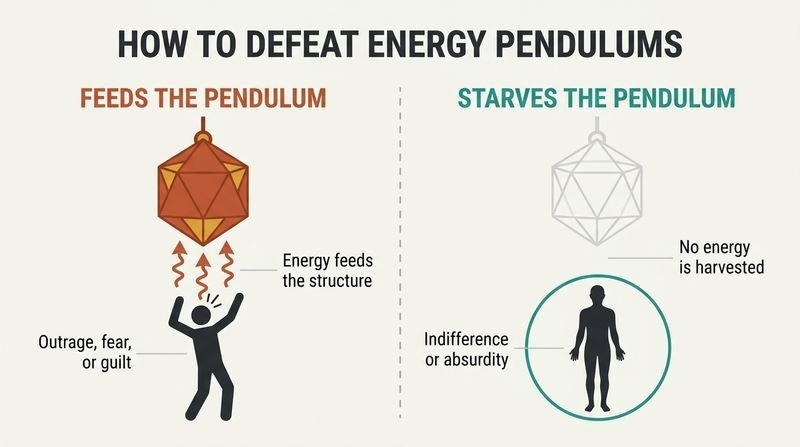
A pendulum is Zeland's term for a self-organizing energy structure that arises whenever a group thinks and acts alike: a religion, a political party, a corporation, a fashion, even a football crowd. It grows by harvesting adherents' emotional energy and survives by keeping them agitated.
Crucially, pendulums feed on opposition as much as support. Hating the government, fearing an epidemic, or arguing against war all radiate energy at the pendulum's frequency. The defense is not to fight (which feeds it) but to go empty: ignore the provocation, or respond in an absurd, unexpected way that breaks the script. Bad news dominates media precisely because anxiety and anger are the richest fuel.
Strip away the mysticism and this is a shrewd media-literacy and attention model. Outrage-driven engagement is now a documented business strategy of algorithmic platforms, and studies show negative content spreads faster and deeper. Zeland anticipated the attention economy by describing institutions that profit from emotional capture regardless of your side. The concept overlaps with Dawkins's memes and Jung's crowd psychology. The practical tool, deny the system your reaction, resembles Stoic apatheia and gray-rock techniques for disengaging manipulators. Where it overreaches is treating pendulums as quasi-conscious entities rather than emergent incentive systems.
You keep meeting exactly what you can't stand because you obsess over it
Zeland's explanation for Murphy's Law: the intense desire to avoid something guarantees encountering it. Whether you love or hate an object, if your thoughts are latched onto it, you radiate energy at that frequency and shift toward a reality saturated with it.
His apple metaphor: a person who hates apples but constantly rages about them is, energetically, stuffing their mouth with apples. Hate the noisy neighbor and the parties multiply. Fear losing your job and you telegraph weakness. The mind clearly knows what it doesn't want but only vaguely knows what it wants, which is why negatives materialize more reliably. The fix: withdraw attention from what you reject and redirect it to what you actually want.
This is the sharpest reframe of the law of attraction: it works better in reverse. Cognitive science backs the attention half strongly. The ironic-process theory (Wegner's 'don't think of a white bear') shows suppression increases intrusive thoughts, and threat-vigilance biases perception toward feared stimuli. Confirmation bias then harvests evidence. Behaviorally, chronic aversive focus also shapes actions that provoke the outcome (the anxious employee becomes less competent). Zeland's causal story is inflated, but the corrective is genuinely therapeutic: define and rehearse the wanted state rather than cataloguing the unwanted one.
Chase your own goal, not the prestigious mirage pendulums sell you
Most misery, Zeland argues, comes from pursuing foreign goals: aims imposed by fashion, prestige, other people, or the myth that you must fight and suffer for success. A foreign goal feels like obligation, attracts endless obstacles, and, even when achieved, leaves you empty.
Your true goal makes life feel like a celebration in the process, not just at the finish. Its telltale sign is inner comfort when you imagine already having it; a foreign goal produces a subtle heaviness (inner discomfort) even when it looks attractive. The test he insists on: when considering a goal, ignore how prestigious, realistic, or achievable it is, and how you'd get there. Notice only whether your heart lifts or sinks.
This is a spiritualized version of self-determination theory: intrinsic goals (growth, connection, authenticity) predict wellbeing, while extrinsic goals (money, image, status) correlate with anxiety even when attained. Zeland's 'money is an attribute, not a goal' line parallels findings that wealth pursued as an end disappoints, while wealth arriving as a byproduct of meaningful work satisfies. His somatic decision test, listen to the body's yes/no, resembles Gendlin's Focusing and interoceptive research on gut feelings guiding sound choices. The blind spot: some worthy goals genuinely require grinding through discomfort, and 'follow your bliss' can rationalize avoidance.
Force nothing; let others' motives carry you where you want to go
Zeland splits will into two kinds. Inner intention pushes directly on the world (do the work, insist, struggle). Outer intention is the stranger, stronger force that lets the world reconfigure itself around you. It arises not from willpower but from the harmony of heart and mind.
In relationships this becomes frailing: drop the intention to receive and replace it with the intention to give, and you get the very thing you gave up. Want respect? Give it. Want interest? Show interest first. Everyone is primarily defending their own sense of self-worth, so the fastest route to your goal is to advance theirs. Stop imposing yourself and instead enable other people's inner intention.
The relationship principle is essentially Dale Carnegie rendered in energy language: people crave feeling significant, so make them feel it. It also prefigures negotiation research on interest-based bargaining and Adam Grant's finding that strategic givers often outperform takers. The 'self-worth as universal motive' claim is a reasonable simplification of esteem needs and self-verification theory. Where Zeland adds value is reframing manipulation anxiety: you're not tricking people, you're aligning your aim with what they already want. The risk is instrumentalizing every interaction, which can curdle into calculated pseudo-warmth that others eventually detect.
Drift with the current of least resistance instead of paddling against it
The alternatives flow is Zeland's name for the path of least energy expenditure, the stream in which problems tend to solve themselves. The restless mind, gripped by importance, invents complicated solutions and fights the current, generating the very obstacles it then struggles to overcome.
Practical moves: shift your center of gravity from control to observation. Don't rush to argue, object, or manage. When someone offers advice, consider it. When events deviate from your plan, don't panic-correct. Watch for guiding signs, subtle shifts (a spontaneous comment, a feeling of unease) that signal a bend in the flow. And trust your gut's clear 'no,' which is more reliable than the mind's confident reasoning.
This is Taoism with a to-do list. Modern parallels include Csikszentmihalyi's flow state, where over-control breaks performance, and the psychology of intuition (Klein's naturalistic decision-making) showing that experts' gut reads often beat deliberate analysis under uncertainty. The 'simplest solution' heuristic echoes Occam's razor and satisficing over maximizing. The honest caveat Zeland himself gestures at: passivity can be dangerous, so the flow must be steered, not surrendered to. The tricky part in practice is distinguishing genuine intuitive signal from fear-driven avoidance dressed up as 'the flow telling me to quit.'
The world mirrors your attitude toward it, but reflects with a delay
Zeland's capstone framework: reality is a dual mirror. One side is physical, the other is the alternatives space (an infinite field storing every possible version of events). The mirror reflects your inner relationship to the world back at you as circumstance.
Seven mirror principles govern it. The key operational ones:
1. The world reflects your relationship to it.
2. Reflection forms only in unity of heart and mind.
3. The mirror reacts with a long delay, so patience is mandatory.
4. It copies the content of your thoughts, ignoring whether you want or dread it.
5. Stop staring at the reflection; change the image (your thoughts).
Most people chase their reflection, trying to fix results directly. Instead, hold the image of what you want, endure the lag without flinching, and the world slowly turns toward you.
The mirror is a vivid mental model for a real phenomenon: self-fulfilling prophecy and behavioral confirmation, where expectations shape actions that shape outcomes. The 'delay' principle is quietly the most practical, because it inoculates against the impatience that kills most habit and identity change; results lag effort, so people quit during the flat part of the curve. This resembles the compounding gap in James Clear's 'plateau of latent potential.' The metaphysics of an infinite alternatives space is unfalsifiable and does heavy lifting Zeland can't cash out. Treated as a psychology of expectation plus persistence, though, the mirror is a genuinely useful reframe.
Declare every setback a stroke of luck and it tends to become one
Coordination of intention is Zeland's rule for staying on the fortunate branch of your life line. Every event forks into a favorable and unfavorable outcome, and your reaction at that fork chooses the branch. Negativity, our default, selects the bad branch; then 'misfortune never comes alone' as one irritation triggers the next.
So when something appears to go wrong, consciously reframe it as positive before reacting like an oyster to a stimulus. His extreme version is reality inversion: greet failures with absurd, exaggerated delight ('luckily, something terrible happened!'). This isn't naive optimism; it's a deliberate refusal to feed the downward spiral and a way to keep your energy attuned to lucky lines. King Solomon's ring, engraved 'this too shall pass,' served the same function.
This is cognitive reappraisal, one of the best-validated tools in emotion regulation, dressed in mystical clothing. Reframing an event's meaning measurably alters physiological stress and downstream behavior. There's also a real mechanism behind 'misfortune comes in threes': one negative event narrows attention, floods working memory, and degrades subsequent decisions, so the cascade is partly self-manufactured. The benefit-finding literature (post-traumatic growth) shows meaning-making improves coping. The danger, which Zeland underweights, is toxic positivity: reframing must not become denial of genuinely harmful situations that require action rather than a cheerful spin.
Your energy is spent guarding useless burdens; drop them to reclaim it
Transurfing needs fuel, and Zeland distinguishes physiological energy (from food and rest) from free energy (the energy of intention that makes you feel capable of decisive action). Most people aren't low on energy; they've spent it all maintaining excess potentials.
The drains: unfulfilled obligations, self-imposed conditions, guilt, the compulsion to prove your worth, exaggerated problems, and a body clogged with toxins narrowing the energy channels. The fixes:
1. Free up resources by dropping needless obligations or acting on them.
2. Do energy exercises focusing attention on the rising and descending currents along the spine.
3. Cleanse the body and eat more natural food.
Stop justifying yourself and stop defending your significance, and manipulators lose their hook.
The insight that vitality is less about intake than about stopping leaks is genuinely modern. It parallels research on ego depletion's contested cousin, cognitive load: unresolved intentions occupy working memory (the Zeigarnik effect, where incomplete tasks nag at us). David Allen's Getting Things Done exploits the same mechanism, capturing open loops frees mental bandwidth. The advice to quit self-justification tracks with boundary-setting psychology, where over-explaining signals guilt that manipulators exploit. The spinal-current exercises and toxin-clearing claims lack scientific grounding and blur into pseudo-physiology, but the core prescription, close open loops and stop proving yourself, is defensible and immediately actionable.
Break the pendulum's rule 'do as I do' and claim your own uniqueness
Pendulums keep people in line with one command: imitate the model of success we display. Fans copy stars, teens copy trends, employees become interchangeable cogs. But stars became stars precisely by refusing to imitate and expressing their own unique essence, what Zeland calls fraile, the irreplaceable signature of a soul.
The move is to stop chasing others' scripts (which only produces a parody) and give yourself permission to be yourself. The counter-rule of Transurfing: be yourself and allow others to be themselves. This dissolves the polarization that makes people 'get on your nerves,' and, paradoxically, forces pendulums to eventually adopt you as a favorite, since they cannot tolerate genuine individuality without absorbing it.
The observation that trendsetters break rules while imitators chase a fading light is well supported by innovation and status research: differentiation, not conformity, produces breakout success, and copying a winning formula usually arrives too late. Zeland's 'individuality as competitive advantage' anticipates personal-branding thinking and the long-tail economics of niche authenticity. The polarization idea, that comparing yourself to others (I'm disciplined, they're slobs) magnetically attracts the opposite, is a poetic overreach, but it encodes a real social truth: contempt provokes friction, acceptance defuses it. The universal weakness across the book remains that every prescription is framed as cosmic law rather than tendency.
Analysis
Reality Transurfing is a sprawling Russian esoteric system (roughly 280,000 words) that blends quantum-flavored metaphysics, folk psychology, and self-help pragmatism into a single worldview. Its difficulty for a summarizer is twofold: the metaphysical scaffolding (alternatives space, life lines, dual mirror) is unfalsifiable and repetitive, while buried inside it sits a coherent and often shrewd psychology of attention, expectation, and self-sabotage. The honest move is to extract the operational core and treat the cosmology as a memorable delivery vehicle rather than literal physics.
Read charitably, Zeland converges with several respectable traditions. His 'reduce importance' is Taoist wu wei and Stoic detachment. His mirror principles are self-fulfilling prophecy plus a crucial insight about temporal delay that explains why people abandon change during the plateau. His attack on 'foreign goals' restates self-determination theory. His 'you get what you resist' inverts the law of attraction into something closer to ironic-process theory. His pendulums prefigure the outrage-driven attention economy with uncanny accuracy. His frailing is Carnegie-style significance psychology. Taken together, the book is a unified theory of getting out of your own way: lower the stakes, withdraw energy from what you dread, define what you want, act without desperation, and persist through the lag.
The liabilities are real. Everything is asserted as immutable law, so failure is always the reader's insufficient practice, never the theory's fault, a closed epistemic loop shared with astrology. The coordination principle risks tipping into toxic positivity, and the flow doctrine can license avoidance. The energy physiology is invented. Yet the book endures because its psychological instructions frequently work regardless of why. Its deepest contribution may be reframing agency itself: not as forcing the world, but as governing one's relationship to it. For readers exhausted by struggle-based achievement culture, that reframe is worth the mystical packaging it arrives in.
Review Summary
Reality Transurfing has garnered overwhelmingly positive reviews, with readers describing it as life-changing and mind-expanding. Many praise its unique blend of quantum physics and practical self-development techniques. While some find the concepts challenging to grasp initially, most agree that perseverance yields profound insights. Critics note occasional repetition and translation issues but generally consider these minor compared to the book's overall value. Readers particularly appreciate the practical applications and the author's fresh perspective on reality manipulation.
People Also Read









Glossary
Alternatives space
Field of all possible realitiesAn infinite, metaphysical information field that Zeland claims stores the scripts and scenery of everything that ever was, is, or could be. Physical reality is one materialized 'sector' of it. Thought energy of sufficient quality 'illuminates' a matching sector, transforming a potential reality into an actual one. It functions as a template or coordinate grid for the movement of matter.
Pendulum
Parasitic collective-energy structureA self-organizing energy-information entity that emerges when a group of people think and act alike (a religion, party, company, fashion, crowd). It grows by harvesting adherents' emotional energy, feeding equally on support and opposition, and survives by keeping people agitated and imitative. Defeat it by ignoring provocation or reacting in unexpected ways that break its script.
Excess potential
Tension from inflated importanceA localized disturbance in the energy field created when you assign disproportionate meaning to something. Desire, fear, guilt, and idealization are examples. It provokes 'balanced forces' that act to eliminate the tension, frequently by producing the opposite of what you intended. The antidote is consciously reducing importance.
Importance
Over-assigned meaning causing problemsThe excess significance a person attaches to themselves (inner importance) or to an external object or outcome (outer importance). Zeland treats it as the single largest source of life problems because it generates excess potential and hands pendulums a hook. Reducing importance is the master move throughout the system.
Inner vs outer intention
Forcing versus allowing outcomesInner intention is direct willpower applied to the world (work, insist, struggle). Outer intention is a subtler, more powerful force that lets the world reconfigure around you; it arises from unity of heart and mind rather than effort. Inner intention achieves a goal; outer intention simply chooses it and lets it realize itself.
Unity of heart and mind
Feeling and reasoning alignedThe state in which the subconscious (heart/soul) and conscious mind (reason) agree without conflict. Zeland says only in this state is outer intention activated, letting thought materialize. It occurs easily in negative emotions (fear, hatred), which is why worst expectations come true, and rarely in positive desires, where doubt usually splits heart from mind.
Slide
Mental image shaping realityA picture carried in the mind that distorts or shapes perception. A negative slide (e.g. 'I am unattractive') gets reflected into reality; a target slide is a deliberate mental image of the goal already achieved, lived from the inside. Systematically running a target slide materializes the corresponding sector of the alternatives space.
Frailing
Give what you want to receiveZeland's relationship technique. Because everyone is primarily defending their own self-worth, you achieve your aim fastest by advancing the other person's. Abandon the intention to receive, replace it with the intention to give (respect, attention, significance), and you receive the very thing you gave up. Inner intention becomes outer intention.
Coordination of intention
Declare setbacks as successesA rule for staying on favorable life lines. Every event forks into positive and negative outcomes, and your reaction chooses the branch. By deliberately perceiving apparent setbacks as beneficial before reacting negatively, you avoid downward spirals and keep your energy attuned to fortunate outcomes.
Dual mirror
World reflects your inner attitudeZeland's capstone model: reality is a two-sided mirror, physical on one side and the alternatives space on the other. It reflects your relationship to the world back as circumstance, but with a long delay. To change reality, change the image (your thoughts) rather than chasing the reflection (results).
Fraile
Soul's unique signatureThe unique, irreplaceable essence of an individual soul, its characteristic 'frequency.' Attuning your mind to your own fraile rather than copying others' standards produces charm, authenticity, and genuine success. Chasing someone else's model produces only a parody.
FAQ
What's Reality Transurfing: Steps I-V about?
- Managing Reality: Reality Transurfing introduces a technique for managing reality, allowing individuals to shape their lives according to their desires. It emphasizes that life can change under one's own direction.
- Alternatives Space: The book presents the concept of the "alternatives space," which contains all possible life scenarios and events. This space allows individuals to choose their desired outcomes rather than being subject to fate.
- Practical Application: Readers are encouraged to test the methods themselves, suggesting that belief is not necessary for the techniques to work. The book aims to empower readers to take control of their destinies.
Why should I read Reality Transurfing: Steps I-V?
- Transformative Techniques: The book offers practical techniques that can lead to significant life changes, making it appealing for those seeking personal development.
- Unique Perspective: It provides a different worldview that challenges traditional self-help methods, focusing on the power of intention and thought energy.
- Real-Life Examples: Readers can find practical confirmations of the ideas presented, as many have experienced positive changes after applying Transurfing principles.
What are the key takeaways of Reality Transurfing: Steps I-V?
- Power of Choice: Individuals have the freedom to choose their destinies from the infinite alternatives available in the alternatives space.
- Pendulums and Energy: "Pendulums," or collective thought structures, can drain personal energy and lead to negative life experiences. Understanding this helps avoid manipulation.
- Balance and Importance: Excess potential from placing too much importance on events can lead to negative consequences. Reducing this importance is crucial for maintaining balance.
What is the concept of "pendulums" in Reality Transurfing?
- Energy Structures: Pendulums are energy structures formed by collective thought energy, influencing individuals and groups. They thrive on the energy of their adherents.
- Destructive Nature: Pendulums are inherently destructive, consuming the energy of their followers without regard for individual well-being, leading to a loss of personal freedom.
- Avoiding Manipulation: Recognizing pendulums allows individuals to detach from their influence, maintaining personal freedom and happiness.
How does the "wave of fortune" work in Reality Transurfing?
- Favorable Life Lines: The wave of fortune represents life lines favorable to an individual, allowing for a cascade of positive events.
- Energy Alignment: Aligning energy with positive thoughts and feelings helps attract good luck, requiring letting go of negative influences.
- Temporary Nature: The wave is temporary and can pass by if not acknowledged. Staying open to opportunities is crucial to keep the wave flowing.
What is the "alternatives space" in Reality Transurfing?
- Information Field: The alternatives space is an information field containing all possible scenarios and events that can occur in life.
- Choice and Manifestation: Individuals can access this space to choose their desired outcomes, effectively manifesting their intentions into reality.
- Infinite Possibilities: The space is infinite, offering countless alternatives for every situation, empowering individuals to shape their destinies.
What is the concept of outer intention in Reality Transurfing?
- Definition of Outer Intention: Outer intention aligns one's desires with the universe's flow, allowing goals to manifest naturally, independent of personal will.
- Contrast with Inner Intention: Unlike inner intention, which involves direct effort, outer intention allows for effortless realization of desires.
- Practical Application: Reducing importance attached to goals and cultivating acceptance and openness can harness outer intention, leading to unexpected opportunities.
How does the heart communicate with the mind in Reality Transurfing?
- Heart as a Guide: The heart provides intuitive knowledge, guiding decision-making through sensations of comfort or discomfort.
- Mind's Role: The mind struggles to interpret the heart's signals due to its focus on rationality, leading to missed opportunities.
- Achieving Unity: Practicing mindfulness and self-awareness improves heart-mind communication, facilitating the realization of desires.
What is the target slide technique in Reality Transurfing?
- Visualizing Goals: The target slide technique involves creating a vivid mental image of your desired outcome as if it has already been achieved.
- Methodical Practice: Consistent practice, ideally for at least half an hour each day, reinforces the image in your mind.
- Outer Intention Activation: Focusing on the target slide activates outer intention, helping to manifest goals in the physical world.
How can I reduce the influence of negative thoughts in Reality Transurfing?
- Awareness of Thoughts: Recognize negative thoughts and their impact on your reality to address them consciously.
- Redirecting Focus: Shift focus from what you do not want to what you desire, creating a positive mental environment.
- Practicing Gratitude: Regularly expressing gratitude counteracts negative thinking, reinforcing a positive mindset.
What is the significance of frailing in Reality Transurfing?
- Definition of Frailing: Frailing involves attuning to another person's unique characteristics and needs, fostering better communication and relationships.
- Enhancing Relationships: Successful relationships are built on frailing, allowing for mutual understanding and support.
- Practical Application: Actively listening and engaging with others, focusing on their interests, leads to meaningful connections.
How does Reality Transurfing address fear and anxiety?
- Understanding Fear: Fear is excess potential from attributing excessive meaning to a situation. Recognizing this reduces its power.
- Practical Techniques: Focus on action rather than worry to dissipate anxiety and redirect energy.
- Creating a Safety Net: Establishing a safety net provides reassurance, reducing fear intensity and fostering confidence.
About the Author
Other books by Vadim Zeland





Download PDF
Download EPUB
.epub digital book format is ideal for reading ebooks on phones, tablets, and e-readers.








































