

Key Takeaways
Make your offer so different that price comparison becomes impossible
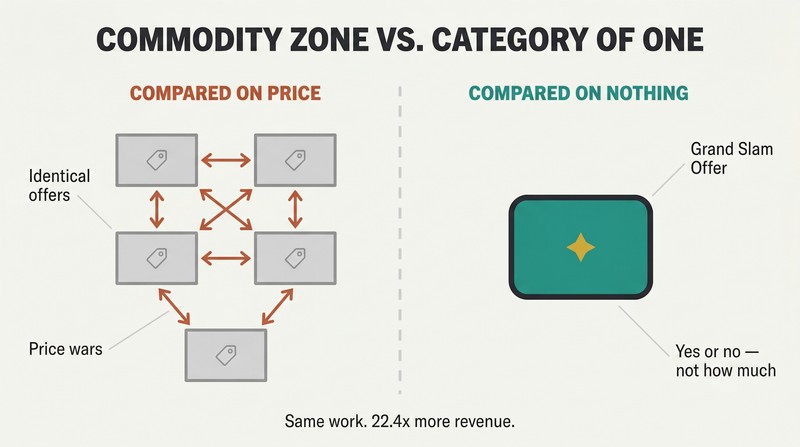
A Grand Slam Offer is an offer so differentiated it can't be compared to any competitor — combining an attractive promotion, unmatchable value proposition, premium pricing, and an unbeatable guarantee. It lets you sell in a "category of one" where the prospect's only decision is yes or no, not a price comparison between you and someone cheaper.
Hormozi went from $1,036 in his bank account on Christmas Eve 2016 to $100,117 his first month, eventually crossing $120 million in cumulative sales within 24 months. The secret wasn't a better product — it was a better offer. In one agency example, a Grand Slam Offer generated 22.4x more upfront cash than a commoditized alternative with identical ad spend, because more people responded, more people bought, and they paid dramatically higher prices. Same work delivered. Wildly different economics.
A starving crowd beats a brilliant offer and elite sales skills
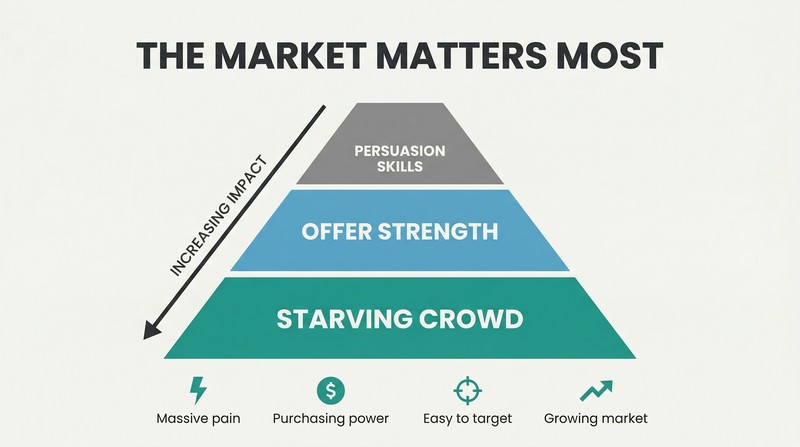
Market selection trumps everything else. A marketing professor once asked students what single advantage they'd want for a hot dog stand. The answer: a starving crowd. Toilet paper in early COVID sold for $100 a roll with zero sales pitch, proving raw demand overpowers everything. Hormozi ranks the hierarchy: Starving Crowd > Offer Strength > Persuasion Skills.
His friend Lloyd had great software for newspapers — zero-risk revenue sharing, natural salesman — but the market shrank 25% annually. Nothing worked. When COVID hit, Lloyd pivoted to automated mask manufacturing with zero industry experience and made millions within five months. Same entrepreneur, different market. Look for four indicators:
1. Massive pain
2. Purchasing power
3. Easy to target
4. Growing market
Niche down to charge 100x more for the same core product
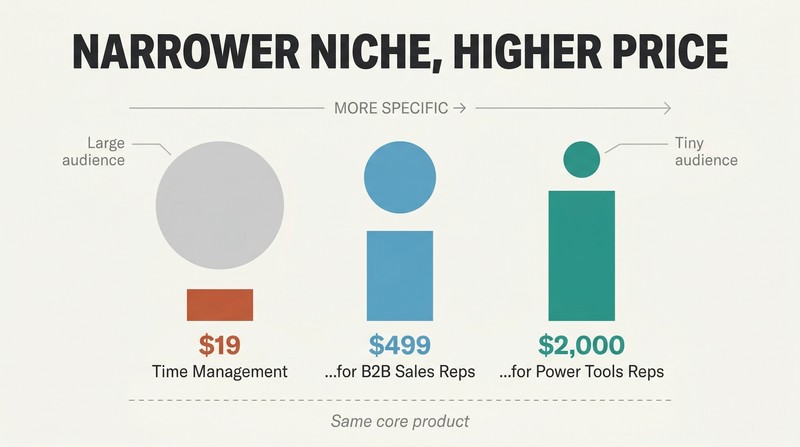
Specificity is a pricing multiplier. A generic time management course sells for $19. Rename it "Time Management for B2B Outbound Sales Reps" and charge $499. Narrow further to power tools sales reps, and they'll pay $1,000 – $2,000 — because it feels custom-built for them. The content barely changes, but the perceived relevance skyrockets.
Hormozi practiced this ruthlessly with Gym Launch, targeting only microgym owners with roughly 100 members, a signed lease, at least one employee, and a focus on weight loss. He turned down personal trainers, online coaches, and anyone outside that avatar. This razor-sharp focus justified charging $16,000 for a 16-week program — 32 times the lowest competitor — because every word of his marketing spoke directly to that one person's exact pain.
Price so high it stings — that sting drives client success
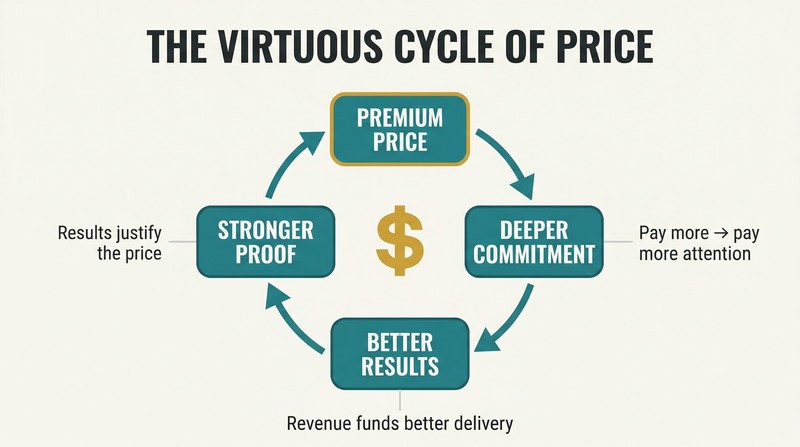
Price itself shapes perceived value. When researchers gave wine tasters the same wine at three different price points, tasters consistently rated the "expensive" one as best. Higher prices also create higher emotional investment, which drives better adherence and results — a phenomenon Hormozi calls the Virtuous Cycle of Price.
Hormozi charged gym owners $42,000 per year when the average gym owner earns $35,280 — meaning many committed half their annual income. His conviction came from data: participating gyms averaged $239,000 in added top-line revenue over 11 months, tripling their profit. Premium prices attract better clients, fund better delivery, produce better results, and generate stronger testimonials. Cutting prices does the exact opposite — attracting the worst clients while destroying your ability to deliver anything exceptional. As Hormozi puts it: profit is oxygen.
Shrink time delay and effort — that's where real pricing power hides
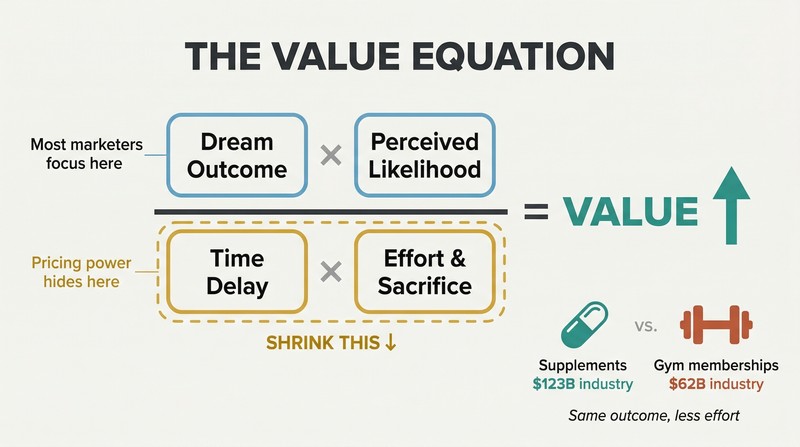
Hormozi's Value Equation quantifies four drivers of perceived value: (Dream Outcome × Perceived Likelihood of Achievement) ÷ (Time Delay × Effort & Sacrifice). Increase the numerator. Decrease the denominator. If the denominator reaches zero, value becomes theoretically infinite — the prospect pays and the result materializes instantly with zero work.
Most marketers inflate promises. The real advantage lies in shrinking the bottom of the equation. This explains why supplements ($123B industry) are twice the size of health clubs ($62B): both promise the same outcome, but swallowing a pill requires almost zero effort. Liposuction costs $25,000 for an afternoon versus bootcamp at $100/month for 12 – 24 months. London's biggest rider satisfaction gain came not from faster trains but from dotted maps showing when the next train arrived — a psychological solution costing a fraction of the logical one.
Every unsolved objection is a lost sale — fix them all, creatively
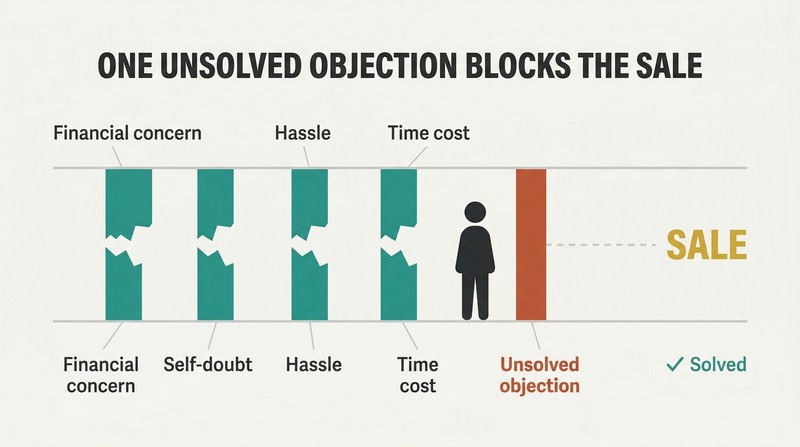
Enumerate every obstacle your prospect faces before, during, and after using your product. For each step the customer takes, identify problems through four lenses: financial concerns, self-doubt, hassle, and time cost. A weight loss offer might surface 32 – 64 distinct problems — each one a chance to create value, not a reason to feel overwhelmed.
Hormozi once lost sales by refusing to help fitness clients eat at restaurants — until desperation forced him to create a quick eating-out guide. That one solution eliminated a recurring objection and closed future sales effortlessly. Use the Product Delivery Cheat Codes to brainstorm: vary attention level (one-on-one, small group, one-to-many), effort level (DIY, done-with-you, done-for-you), and medium. The 10x to 1/10th Test — imagining what you'd deliver at ten times your price or one-tenth — stretches creativity in both directions.
Sell fewer units than you can to keep demand ravenous
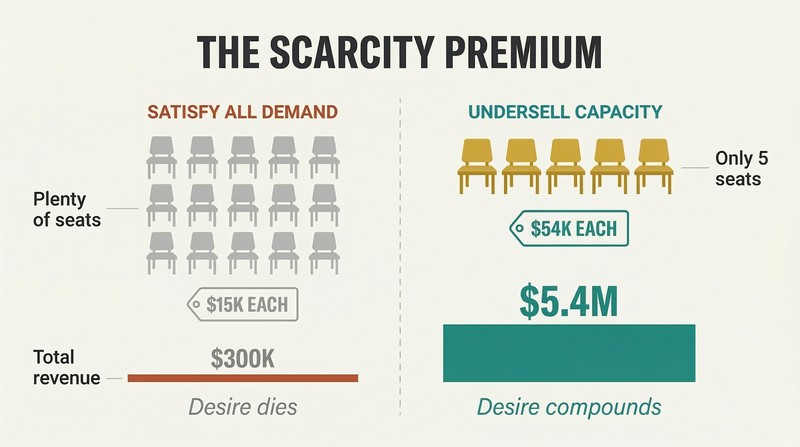
At Schwarzenegger's charity fundraiser, a jewelry mogul advised cutting the guest list and raising ticket prices from $15,000 to $25,000 for only 100 people. That night raised $5.4 million — $54,000 per head — the charity's most successful ever. Items that wouldn't move for $10,000 elsewhere sold for $100,000 because each was one-of-a-kind.
Hormozi calls this the Delicate Dance of Desire. When you satisfy all demand, desire dies. Deliberately underselling capacity makes remaining prospects more desperate next time — at higher prices. In week-long campaigns, the last four hours generate 50 – 60% of total sales, proving deadlines drive decisions. Three practical scarcity methods: cap total clients, cap weekly intake, or run limited cohorts. Always sell out, then publicize that you sold out. The compounding FOMO effect strengthens each subsequent round.
Stack bonuses to widen value perception — never discount your core
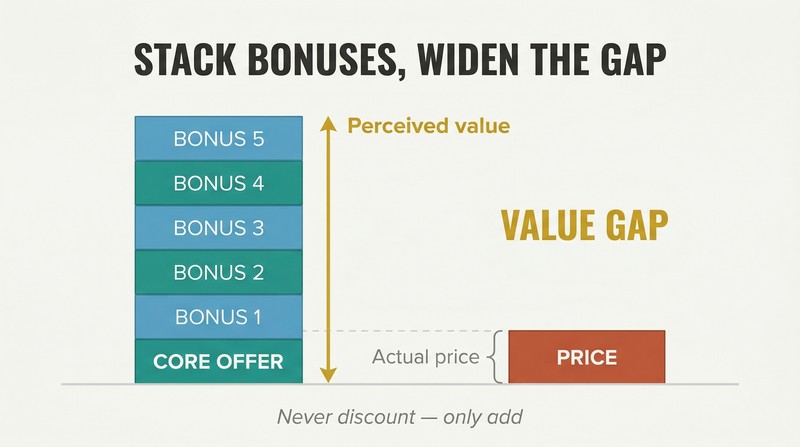
Every infomercial follows the same logic: establish one price, then pile on bonuses until the value gap feels absurd. Each additional bonus expands perceived value without requiring a price cut — which would train customers that your prices are negotiable.
Present bonuses strategically. In one-on-one sales, ask for the sale first. If they say yes, reveal bonuses as a surprise to reinforce their decision. If they hesitate, layer bonuses matching their specific objection. Name each bonus with benefit-driven language and assign dollar values. Recruit adjacent businesses to contribute free products — then negotiate affiliate commissions, turning "freebies" into revenue streams. Hormozi's weight loss bundle stacked seven named systems into $4,351 of perceived value, initially sold for $599 and later at $2,400 – $5,200 as the team refined value delivery.
Guarantee the outcome, not a refund — bolder and rarely triggered
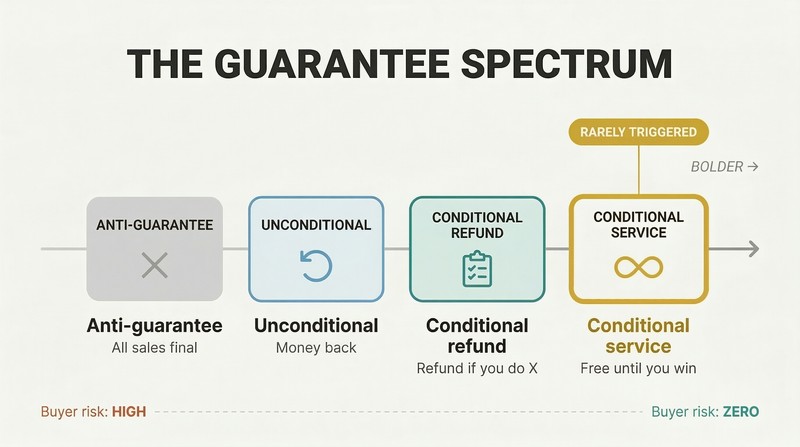
Four guarantee types exist: unconditional (money back, no questions), conditional (refund if client does X and doesn't get Y), anti-guarantee ("all sales final" positioned as proof of exclusivity), and implied (performance-based pay). Hormozi's favorite is the conditional service guarantee: keep working for free until the client achieves the promised result. It eliminates buyer risk without exposing the business to refund losses.
The math favors boldness. If a guarantee increases sales by 30% but doubles refund rates from 5% to 10%, net sales still rise 23%. Jason Fladlien offered to buy failing students' e-commerce stores for $25,000 on a $2,997 course — generating $3 million in extra sales against only ten payouts. Stack multiple guarantees for compounding effect: an unconditional 30-day refund layered with a conditional triple-money-back at 90 days.
When offers fatigue, change the wrapper — not the engine
Hormozi's M-A-G-I-C Formula uses five components: Magnetic reason why (free, seasonal hook), Avatar (target customer), Goal (dream outcome), Interval (timeframe), and Container word (challenge, blueprint, bootcamp). Use three to five per name. "Free Six-Week Lean-By-Halloween Challenge" hits four of five. The shorter and punchier, the better.
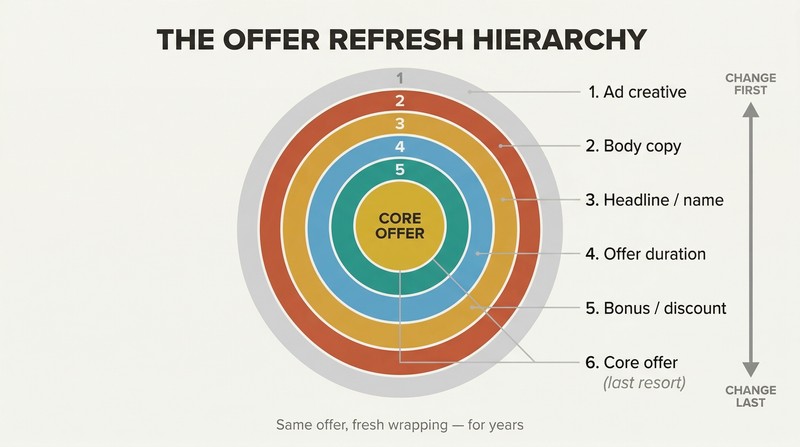
When marketing stalls — especially in local markets where reaching an entire population costs as little as $10,000 — follow this hierarchy before touching anything structural:
1. Change ad creative (images, video)
2. Change body copy
3. Change the headline or name wrapper
4. Change offer duration
5. Change the bonus or discount enhancer
Only as a last resort should you change the core offer itself. The same Grand Slam Offer can run for years with fresh wrapping paper.
Analysis
Hormozi's $100M Offers sits at a revealing intersection: it's a direct-response marketing manual in the Dan Kennedy lineage, a behavioral economics primer dressed in gym-bro vernacular, and a surprisingly rigorous framework for product-market fit — all compressed into a single playbook.
The book's genuine intellectual contribution is the Value Equation. By structuring value as a ratio rather than a sum — with time delay and effort as denominators that can drive perceived value toward infinity — Hormozi implicitly formalizes what Clayton Christensen's jobs-to-be-done theory and Rory Sutherland's behavioral advertising philosophy have argued from different angles: that the worth of a solution is inseparable from the friction of adopting it. The meditation-versus-Xanax comparison crystallizes this better than most academic papers on the topic. It reveals that objective superiority and perceived value are entirely orthogonal dimensions — a distinction most entrepreneurs only learn after pricing themselves into irrelevance.
The five-step offer creation process may be the book's most underrated section. Unlike lean startup methodology, which requires iterating with live products, Hormozi's framework operates as a pre-launch thinking tool that can dramatically reduce failed experiments. The insistence on mapping every conceivable objection before selling — rather than discovering them painfully in conversation — reflects operational maturity few business books achieve at this price point.
The book's limitations deserve acknowledgment. Its framework applies most naturally to high-margin service, consulting, and education businesses. Venture-backed startups pursuing market share over margins, physical product companies with real COGS constraints, and businesses with network effects operate under fundamentally different economics. Hormozi also largely sidesteps fulfillment — the very thing that makes a guarantee viable or a premium price sustainable over years, not months.
Still, for the vast majority of small business owners trapped in commodity pricing, this book provides something genuinely rare: a specific, repeatable process for escaping the race to the bottom without needing to reinvent the product itself.
Review Summary
Readers praise "$100M Offers" for its actionable advice and transformative impact on their businesses. Many report significant increases in revenue and profitability after implementing Hormozi's strategies. The book is lauded for its clear, concise writing and practical examples. Some critics find the content basic or overly focused on service businesses, but the overwhelming majority consider it a game-changing read for entrepreneurs looking to boost their pricing power and profitability.
People Also Read

Glossary
Grand Slam Offer
Incomparable, premium-priced bundled offerAn offer combining an attractive promotion, unmatchable value proposition, premium price, and unbeatable guarantee so it cannot be compared to any competitor. It creates a 'category of one' where the prospect's decision is yes or no—not a price comparison. Named in homage to Jeff Bezos's baseball analogy about outsized business returns.
Value Equation
Four-variable formula for perceived valueHormozi's formula for quantifying perceived value: (Dream Outcome × Perceived Likelihood of Achievement) ÷ (Time Delay × Effort & Sacrifice). The two numerator drivers should be maximized; the two denominator drivers should be minimized. If the denominator reaches zero, perceived value becomes theoretically infinite. Used to identify which offer elements to create, enhance, or eliminate.
Virtuous Cycle of Price
Premium pricing self-reinforcing growth loopHormozi's framework describing how premium pricing creates a positive feedback loop: higher prices attract better clients, increase emotional investment, improve client results, fund better service delivery, and generate stronger testimonials—which attract more premium clients. The reverse (low pricing) creates a destructive cycle of poor clients, thin margins, and declining service quality.
Niche Slap
Warning against premature niche-switchingHormozi's coined term for the correction entrepreneurs need when considering switching niches prematurely. The core principle: most markets are viable, and the problem is usually the offer, not the market. Entrepreneurs should commit to one niche long enough to iterate through many offers before concluding the market is unworkable.
Sales to Fulfillment Continuum
Balancing sellability versus deliverabilityA framework for balancing what's easy to sell versus what's easy to deliver. Doing more for clients makes selling easier but fulfillment harder; doing less makes fulfillment easier but selling harder. The sweet spot is high perceived value with manageable delivery costs. Hormozi recommends starting by over-delivering to generate cash flow, then optimizing operations.
M-A-G-I-C Formula
Five-component offer naming frameworkHormozi's naming system for offers and promotions, using five components: Magnetic reason why (the promotional hook like 'free' or 'seasonal'), Avatar (target customer), Goal (dream outcome), Interval (timeframe), and Container word (challenge, blueprint, bootcamp, etc.). Three to five components are typically used per name. Designed to generate fresh 'wrappers' for the same core Grand Slam Offer to combat marketing fatigue.
10x to 1/10th Test
Creative stretch for solution brainstormingA thinking technique within the offer creation process: ask 'What would I deliver if clients paid 10x my current price?' and 'How would I still create value at 1/10th the price?' Stretching imagination in both directions generates solution ideas that default thinking misses, particularly high-value, low-cost delivery methods that create large value-to-cost discrepancies.
Trim & Stack
Prune then bundle offer componentsThe fifth step of Hormozi's offer creation process. After brainstorming all possible delivery solutions, remove high-cost/low-value items first, then low-cost/low-value items. Bundle remaining low-cost/high-value and high-cost/high-value items into a single comprehensive deliverable. Prioritize 'one to many' solutions that require high one-time creation cost but near-zero marginal cost per additional customer.
Hormozi Law
Delayed asks enable larger asksHormozi's named principle stating that the longer you delay asking for the sale—keeping demand unsatisfied—the larger the ask you can eventually make. Analogized as: 'The longer the runway, the bigger the plane that can take off.' Applied practically through scarcity and urgency tactics that keep supply below demand over successive promotional cycles.
FAQ
What's "$100M Offers" by Alex Hormozi about?
- Core Focus: The book is about creating offers so compelling that potential customers feel foolish saying no. It emphasizes the importance of crafting irresistible offers to drive business growth.
- Main Objective: Hormozi aims to teach entrepreneurs how to turn advertising dollars into significant profits by using a combination of pricing, value, guarantees, and naming strategies.
- Target Audience: The book is primarily aimed at business owners and entrepreneurs who want to maximize their potential and achieve financial freedom.
- Structure: It is divided into sections that cover the journey from understanding market dynamics to creating and enhancing offers, with practical advice and real-world examples.
Why should I read "$100M Offers"?
- Practical Strategies: The book provides actionable strategies for creating offers that stand out in the marketplace, which can be directly applied to your business.
- Proven Frameworks: Hormozi shares frameworks that have been tested and proven to work, offering a reliable path to increasing sales and profits.
- Inspiration and Motivation: Through personal anecdotes and success stories, the book inspires readers to push beyond conventional limits and achieve extraordinary results.
- Comprehensive Guide: It covers everything from pricing strategies to enhancing offers with bonuses and guarantees, making it a comprehensive resource for entrepreneurs.
What are the key takeaways of "$100M Offers"?
- Grand Slam Offers: The concept of creating offers that are so unique and valuable that they cannot be compared to competitors, allowing for premium pricing.
- Value Equation: Understanding the components of value—dream outcome, perceived likelihood of achievement, time delay, and effort & sacrifice—and how to manipulate them.
- Pricing Strategy: The importance of charging premium prices to enhance perceived value and attract the best clients.
- Market Selection: The significance of choosing the right market, focusing on those with massive pain, purchasing power, and ease of targeting.
How does Alex Hormozi define a "Grand Slam Offer"?
- Unique and Incomparable: A Grand Slam Offer is one that cannot be compared to any other product or service available, making it a category of one.
- High Value Proposition: It combines an attractive promotion, unmatchable value, premium pricing, and an unbeatable guarantee.
- Market Impact: Such offers increase response rates, conversion rates, and allow for premium pricing, leading to significant business growth.
- Profitability: The offer is structured to ensure that acquiring new customers is profitable, removing cash constraints on business growth.
What is the "Value Equation" in "$100M Offers"?
- Four Drivers of Value: The Value Equation consists of dream outcome, perceived likelihood of achievement, time delay, and effort & sacrifice.
- Increase and Decrease: The goal is to increase the dream outcome and perceived likelihood of achievement while decreasing time delay and effort & sacrifice.
- Perception is Key: It's not just about actual improvements but how these improvements are perceived by the customer.
- Infinite Value: If the bottom part of the equation (time delay and effort & sacrifice) can be reduced to zero, the value becomes infinite.
How does Alex Hormozi suggest using scarcity in offers?
- Limited Supply: Create a fear of missing out by limiting the number of products or services available.
- Psychological Impact: Scarcity increases perceived value and urgency, prompting quicker purchasing decisions.
- Ethical Scarcity: Use honest scarcity by setting realistic limits on what you can deliver, enhancing credibility.
- Compounding Strategy: Consistently selling out can increase demand over time, as customers anticipate scarcity.
What role do bonuses play in enhancing offers according to "$100M Offers"?
- Value Perception: Bonuses increase the perceived value of an offer without changing the core product or service.
- Strategic Presentation: Present bonuses as additional benefits that address specific customer concerns or obstacles.
- Naming and Pricing: Assign a value to each bonus and name them creatively to enhance their appeal.
- Stacking Bonuses: Layer bonuses to create a compelling offer that seems too good to pass up.
How does Alex Hormozi recommend using guarantees in offers?
- Risk Reversal: Guarantees remove the perceived risk for the customer, making it easier for them to say yes.
- Types of Guarantees: Includes unconditional, conditional, anti-guarantees, and implied guarantees, each with different levels of commitment.
- Creative Guarantees: Use specific and creative guarantees to address customer fears and enhance trust.
- Stacking Guarantees: Combine different types of guarantees to strengthen the offer and increase conversions.
What are some of the best quotes from "$100M Offers" and what do they mean?
- "Make people an offer so good they would feel stupid saying no." This quote encapsulates the book's core message of creating irresistible offers.
- "Price is what you pay. Value is what you get." Emphasizes the importance of focusing on the value provided rather than just the price.
- "The pain is the pitch." Highlights the importance of understanding and addressing customer pain points in your offer.
- "The longer you delay the ask, the bigger the ask you can make." Suggests that building anticipation can lead to larger sales.
How does "$100M Offers" address pricing strategies?
- Premium Pricing: Encourages charging high prices to enhance perceived value and attract committed clients.
- Avoiding Commoditization: Differentiating your offer to avoid competing on price alone.
- Virtuous Cycle of Price: Higher prices lead to better clients, more resources, and improved services, creating a positive feedback loop.
- Value-Based Pricing: Focus on increasing the value to price discrepancy rather than lowering prices.
What is the significance of market selection in "$100M Offers"?
- Starving Crowd: The importance of choosing a market with high demand and unmet needs.
- Four Indicators: Look for markets with massive pain, purchasing power, ease of targeting, and growth potential.
- Commitment to Niche: Once a market is chosen, commit to it and refine your offer to meet its specific needs.
- Riches in Niches: Niching down allows for higher pricing and more targeted marketing, leading to greater profitability.
How does Alex Hormozi suggest naming offers in "$100M Offers"?
- MAGIC Formula: Use a combination of Magnetic reason, Avatar, Goal, Interval, and Container to create compelling offer names.
- Avoid Fatigue: Regularly refresh offer names to keep them appealing and relevant to the target audience.
- Attention-Grabbing: A well-named offer attracts the right prospects and sets the stage for a successful pitch.
- Testing and Iteration: Continuously test different names to find the most effective ones for your market.
About the Author
Download PDF
Download EPUB
.epub digital book format is ideal for reading ebooks on phones, tablets, and e-readers.








































