

Key Takeaways
Mastery is a three-phase process your brain was literally built for
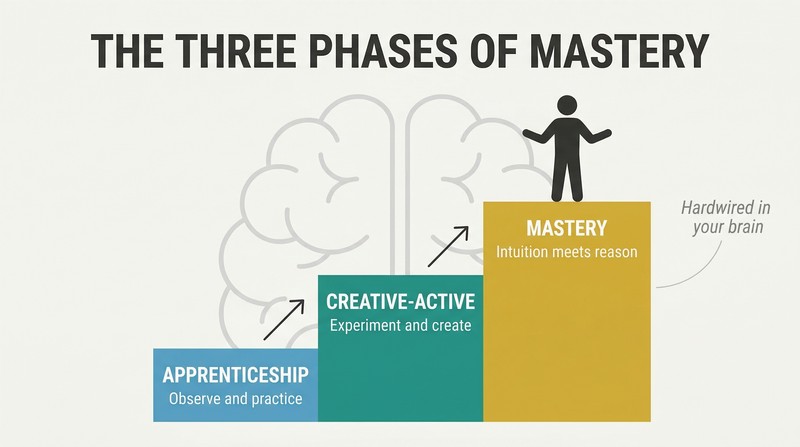
Mastery isn't genetic magic. Greene argues it follows three predictable phases anyone can move through: (1) the Apprenticeship, where you learn fundamentals through deep observation and practice; (2) the Creative-Active, where internalized knowledge fuels original experimentation; (3) Mastery itself, where intuition fuses with rational thinking and you grasp the whole of your field.
Consider Darwin vs. his cousin Galton. Galton had a measurably higher IQ and was considered a super-genius, yet Darwin is rightly celebrated as the greater scientist. The difference wasn't intellect — it was Darwin's intense emotional connection to his subject, which sustained him through decades of painstaking work. The wall we've built around mastery, calling it 'genius,' is imaginary.
Dig for your childhood obsessions — they're the truest map to your calling
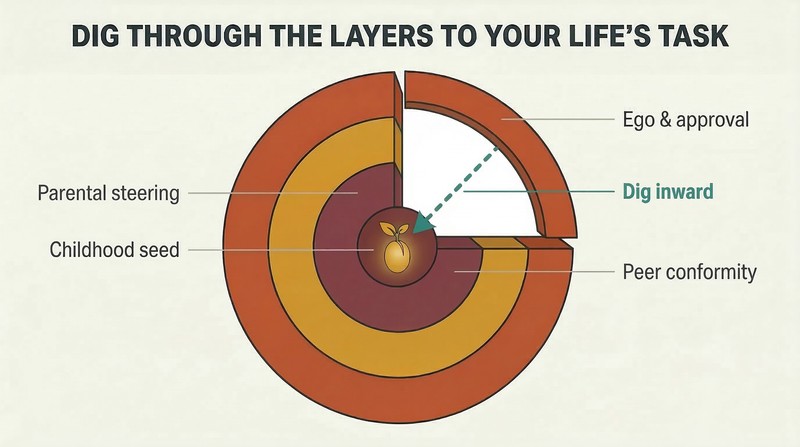
Greene calls it your Life's Task — what you're meant to accomplish, rooted in primal inclinations visible in childhood. Einstein was transfixed by a compass at five, sensing invisible forces he'd spend his life investigating. Marie Curie stood mesmerized before her father's lab instruments at four. John Coltrane heard Charlie Parker play and instantly knew the saxophone would give voice to his spiritual longings. These pre-verbal attractions are uncontaminated by parental pressure or social expectation.
The danger is losing contact with these signals. Parents steer you toward 'practical' careers; peers pressure conformity; your own ego craves approval. Greene's remedy: search your past for visceral reactions, activities that never bored you, feelings of power attached to specific actions. Then build a career that connects to that core, even if the path zigzags.
Optimize apprenticeships for learning, not paychecks or prestige
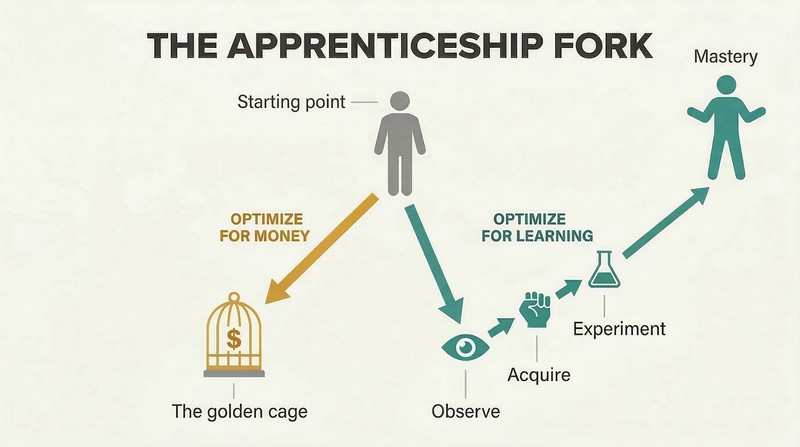
Your first job isn't about earning. It's about rewiring yourself from naïve outsider to disciplined practitioner. Greene outlines three overlapping modes: Deep Observation (learn the unwritten rules and power dynamics by watching, not acting), Skills Acquisition (achieve tacit knowledge through intense repetition), and Experimentation (test your ideas and absorb feedback).
Concrete examples drive this home. Einstein chose the low-paying Swiss Patent Office because it left mental space for his thought experiments — and produced relativity. Benjamin Franklin chose the harder, longer printing apprenticeship over his father's candle business because it gave him access to books and writing. Martha Graham refused lucrative commercial dance jobs that drained her creative energy. The fat paycheck is a trap: it makes you conservative, focused on self-preservation rather than growth.
Embrace tedium — deep practice physically rewires your neural pathways
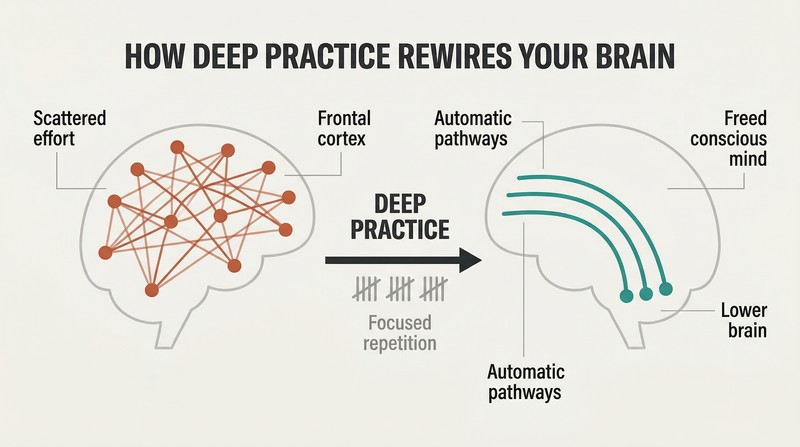
Your brain literally changes shape when you practice deeply. New skills recruit large numbers of neurons in the frontal cortex; through repetition, those pathways get delegated to lower brain areas and become automatic, freeing your conscious mind for higher-order thinking. Researchers consistently find roughly 10,000 hours of quality practice needed for exceptional skill — about seven to ten years, matching traditional apprenticeship length.
But hours alone aren't enough. Two hours of intense, undistracted focus outperform eight hours of scattered attention. The medieval Gothic cathedrals — masterpieces built without blueprints — embodied the accumulated tacit knowledge of craftsmen who learned by watching, imitating, and repeating until their skills became second nature. Multitasking is the enemy: it prevents neural pathways from ever solidifying. The boredom you feel early in practice is the mind's challenge — conquer it, and a cycle of accelerated returns awaits.
Desire and persistence outperform raw intelligence every time
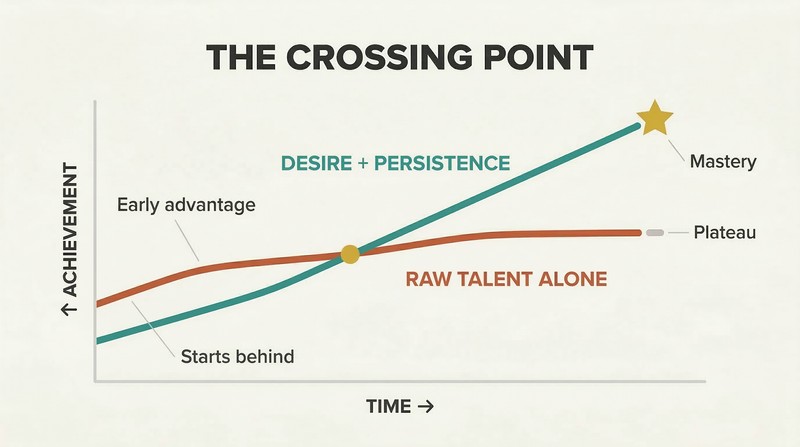
The emotional fuel matters most. Greene emphasizes that what separates Masters from competent practitioners is not cognitive horsepower but the intensity of their connection to their work. Mozart wasn't just talented — he loved practice so much his parents had to drag him from the piano at night. Coltrane practiced until his reeds turned red with blood. This obsessive desire lets you withstand the inevitable self-doubts, tedious hours, and barbs from the envious.
Natural talent can even be a curse. Child prodigies who coast on early gifts often never develop the discipline and focus that more 'ordinary' people forge through struggle. Temple Grandin, born with severe autism and seemingly destined for institutionalization, built her career precisely by leaning into her few strengths — visual thinking, deep focus, empathy for animals — and letting these expand outward like a lotus flower.
Use mentors to compress decades of learning, then outgrow them
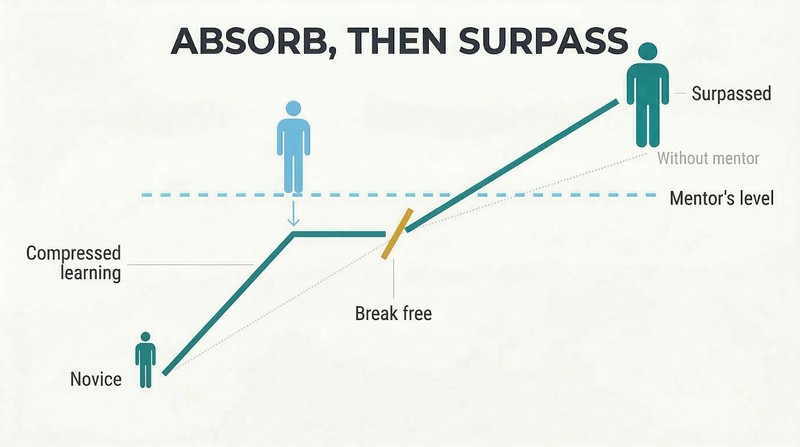
Mentors are philosopher's stones. They transform dead information into living, practical knowledge through direct interaction. What takes ten years alone can happen in five with guidance — not because mentors offer shortcuts, but because their tailored feedback and accumulated wisdom streamline the process. The emotional bond deepens absorption: when you admire someone, mirror neurons engage more powerfully.
Michael Faraday's story illustrates this. A bookbinder's apprentice, Faraday maneuvered into Humphry Davy's lab at the Royal Institution. Through eight years of intense mentorship, he absorbed Davy's experimental thinking and discovered the principles behind electromagnetism. But Davy eventually grew possessive, trying to block Faraday's recognition. Greene's lesson: internalize your mentor's best ideas, adapt them to your spirit, then break free — even if it requires the metaphorical knife. The goal is always to surpass them.
Stop projecting onto people — study what they do, not what they say
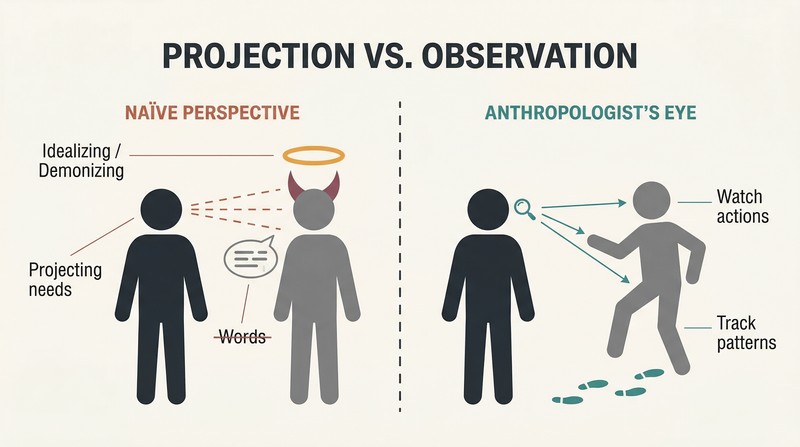
We all carry the Naïve Perspective — a leftover from childhood dependency in which we project our emotional needs onto others instead of seeing them clearly. Benjamin Franklin learned this painfully: he revealed his anonymous authorship to his brother (not anticipating jealousy), trusted a governor who was all talk (blinded by his own ambitions), and alienated coworkers over a beer fund (ignoring social consequences).
Franklin's fix became his superpower. He forced himself to step back from every interaction, cut off his own insecurities, and think inside the other person's mind. He studied people like an anthropologist — their actions, not their words. He read Isaac Norris's insecurities and converted a political enemy into a lifelong ally by borrowing a rare book. Greene also catalogs seven universal traps to watch for: Envy, Conformism, Rigidity, Self-obsessiveness, Laziness, Flightiness, and Passive Aggression.
Tolerate uncertainty longer than anyone else to unlock originality
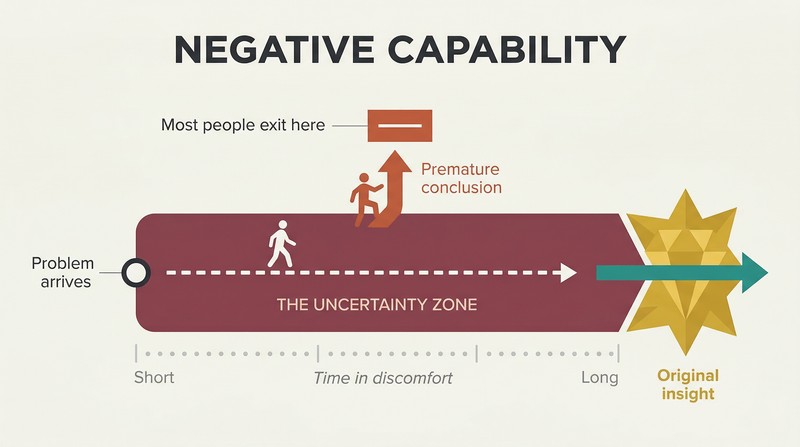
Negative Capability is the superpower of creative Masters. Poet John Keats coined the term to describe the ability to remain in uncertainties, mysteries, and doubts without grasping for premature conclusions. Your ego craves the comfort of being right. Truly creative people suspend that craving, holding a problem open long enough for deeper answers to emerge.
Einstein embodied this for a full decade. His thought experiment about traveling alongside a beam of light produced a paradox he couldn't resolve. Instead of settling for existing theories or giving up, he sat with the discomfort for ten years — until one day, walking with a friend and announcing he was quitting the problem, the solution to special relativity came to him in a flash. Mozart never asserted rigid musical opinions, which allowed him to absorb Bach's counterpoint late in his career. Confirmation bias — finding evidence for what you already believe — is the opposite of Negative Capability.
Fuse the child's openness with the expert's discipline to create
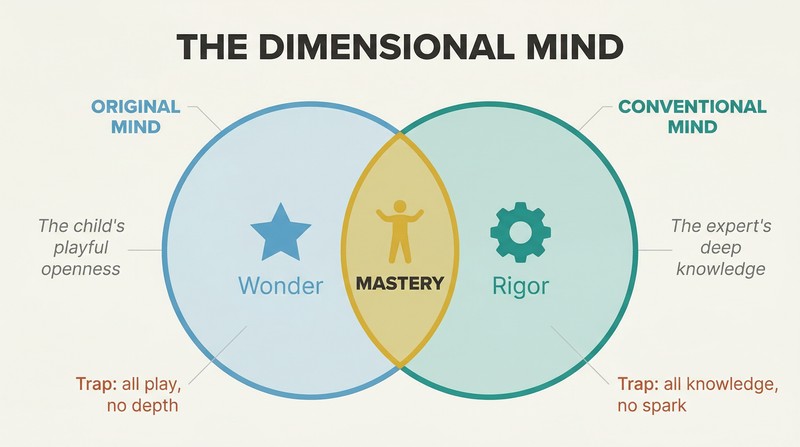
Greene identifies three mind-states. The Original Mind is childhood's radical openness — preverbal, image-based, full of wonder. The Conventional Mind is adulthood's rigid, habitual thinking, where we see through a screen of opinions and stop questioning. The Dimensional Mind is the rare fusion: deep expert knowledge combined with the child's playful, exploratory spirit.
Mozart's trajectory is the archetype. For eight stifled years in Salzburg, his father and the court suppressed his creative urges, forcing conventional compositions. When he finally broke free to Vienna at twenty-five, all that pent-up knowledge and emotion exploded. He reworked the piano concerto and symphony from within — expanding orchestras, introducing dramatic tension and emotional depth — permanently altering European music. The trap: some people stay spontaneous but lack discipline; others accumulate expertise but lose all creative spark. Mastery requires both.
After 20,000+ hours, intuition becomes your fastest and deepest thinking
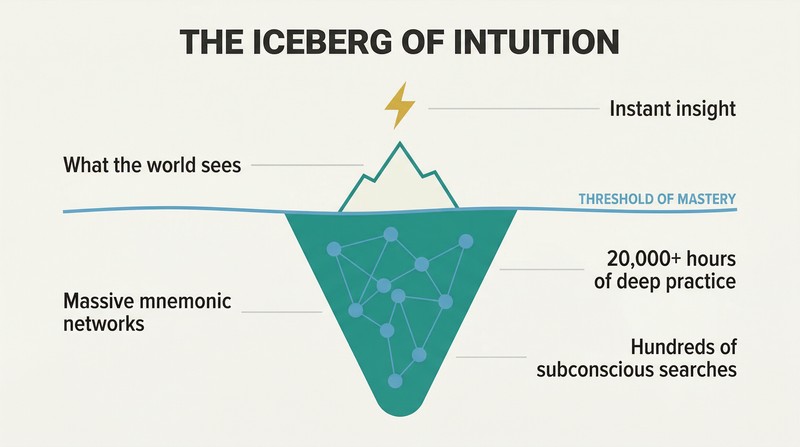
This isn't mysticism — it's neuroscience. After approximately 20,000 hours of deep immersion, the brain undergoes a qualitative transformation. Massive mnemonic networks allow hundreds of simultaneous subconscious searches, surfacing connections as sudden insights. Chess master Bobby Fischer stopped seeing individual moves and perceived 'fields of force' sweeping the board. General Erwin Rommel could intuit enemy strike points in the North African desert with seemingly oracular precision — but he'd studied every aspect of warfare with obsessive depth.
The crucial distinction: this intuition doesn't replace rationality. Masters verify intuitive flashes through rigorous reasoning. Einstein's image-based insight about the relativity of time required years of mathematical proof. The two modes fuse into one instrument. Greene warns that our technology-saturated age tempts us toward passive consumption and erodes the deep focus this transformation requires — making the choice to pursue mastery more countercultural, and more powerful, than ever.
Analysis
Greene's Mastery is essentially a secular theology of excellence. Where his earlier works (48 Laws of Power, The Art of Seduction) mapped the terrain of social manipulation, Mastery argues for something rarer and more demanding: the development of authentic individual power through sustained disciplined immersion. The book's deepest contribution is its demystification of genius. By weaving neuroscience — mirror neurons, neural plasticity, frontal cortex recruitment — with biographical evidence spanning Leonardo da Vinci to Temple Grandin, Greene constructs a persuasive case that mastery is process, not providence.
The framework's greatest strength is its sequential architecture. Unlike motivational books offering disconnected tips, Greene maps a developmental arc from discovering inclination to achieving intuitive command that mirrors actual human cognitive development. His concept of the Dimensional Mind elegantly resolves the false binary between rigor and creativity that plagues both corporate culture and art education.
Several tensions deserve scrutiny. Greene romanticizes the solitary path while simultaneously demonstrating how profoundly relational mastery is — every Master in the book depended on mentors, collaborators, or cultural ecosystems. His evolutionary argument (our brains were 'designed' for mastery) flirts with the naturalistic fallacy; evolution has no teleology. The 10,000- and 20,000-hour thresholds, drawn from K. Anders Ericsson's research, have been contested by meta-analyses showing high variance across domains.
The book's most underappreciated insight may be its treatment of social intelligence as prerequisite to — not distraction from — mastery. The Semmelweis versus Harvey comparison demonstrates that brilliant ideas die without social competence, a lesson scientific and technical communities still resist. Where the book falters is survivorship bias: Greene's Masters all eventually succeeded, and we never meet the equally passionate strivers who didn't. Still, as a phenomenology of deep expertise — a catalog of what the journey looks like from the inside — Mastery remains the most architecturally rigorous popular treatment of the subject since Ericsson's original research, and considerably more readable.
Review Summary
Mastery by Robert Greene receives mostly positive reviews, praised for its engaging biographies of historical masters and practical advice on achieving excellence. Readers appreciate Greene's insights on developing skills through dedicated practice and mentorship. However, some criticize the book's repetitive nature and lack of scientific evidence. Critics also question Greene's generalizations and oversimplification of complex topics. Despite these critiques, many readers find the book inspirational and valuable for personal growth, recommending it as an essential read for those seeking to excel in their chosen fields.
People Also Read



Glossary
Life's Task
Your destined life's workThe unique purpose you are meant to fulfill, rooted in primal inclinations first visible in childhood. Greene argues this task is connected to your genetic uniqueness and expresses itself through deep, often preverbal attractions to specific activities or subjects. Discovering and following your Life's Task is the first move toward mastery.
Ideal Apprenticeship
Self-directed practical education phaseThe critical period after formal education in which you learn real-world skills, discipline your mind, and transform yourself into an independent thinker. It consists of three overlapping modes—Deep Observation (learning rules and culture), Skills Acquisition (developing tacit knowledge through practice), and Experimentation (testing your own ideas). The goal is not credentials but the transformation of mind and character.
Negative Capability
Tolerating uncertainty without grasping conclusionsA term coined by poet John Keats and adopted by Greene to describe the ability to remain in uncertainties, mysteries, and doubts without prematurely reaching for conclusions. Greene positions this as the single most important quality for creative thinking, enabling broader exploration and resistance to confirmation bias. It requires temporarily suspending the ego's need to appear certain.
The Dimensional Mind
Fusion of openness and disciplineThe creative mind-state that combines the Original Mind's childlike openness, wonder, and preverbal thinking with the deep knowledge and discipline gained through apprenticeship. It is active and transformative rather than passive and consuming. Greene contrasts it with the Conventional Mind (rigid adult thinking) and the Original Mind (childhood spontaneity without structure).
Original Mind
Childhood's open preverbal creativityThe natural state of childhood consciousness characterized by radical openness, wonder, sensory intensity, and preverbal thinking. Children see the world directly rather than through received ideas. Greene argues this quality is the seed of all creative power but is typically drummed out by formal education and social pressure.
Conventional Mind
Adulthood's rigid habitual thinkingThe default adult mind-state in which we see the world through a screen of words, opinions, and prior experiences. It relies on mental shortcuts and categories, resists unfamiliar ideas, and defends existing beliefs. Greene positions it as the enemy of creativity and the natural result of social pressures to conform.
The Current
Alternating speculation with observationGreene's term for the mental process of cycling between theoretical speculation and empirical observation or experimentation to penetrate deeper into reality. Like a drill penetrating wood through rotational motion, the Current allows thinkers to make visible what is invisible. Darwin's development of evolutionary theory exemplifies this process—decades of alternating between observation in nature and theoretical speculation.
Resistance Practice
Practicing weaknesses with extra intensityA training approach in which you deliberately go opposite to your natural tendencies: prioritize your weakest skills, concentrate with double intensity, create arbitrary deadlines, and invent exercises targeting specific deficiencies. Named and described through examples like Bill Bradley's basketball training and John Keats's self-imposed 4,000-line poem.
Naïve Perspective
Projecting emotional needs onto othersThe habitual tendency, rooted in childhood dependency, to view other people through the lens of our own emotional needs rather than seeing them as they are. We idealize, demonize, or project onto others based on our insecurities and desires. Greene argues that discarding this perspective is the foundation of social intelligence and a prerequisite for mastery.
Seven Deadly Realities
Universal negative human behavioral traitsSeven recurring patterns of destructive human behavior that Greene identifies as universal across cultures and time: Envy, Conformism, Rigidity, Self-obsessiveness, Laziness, Flightiness, and Passive Aggression. People disguise these traits, making them hard to detect. Greene advises studying them to avoid triggering them and to protect yourself from their effects.
Tacit Knowledge
Skill felt but hard to verbalizeA form of deep, embodied understanding that is difficult to articulate in words but easy to demonstrate through action. It develops through extensive hands-on practice and repetition rather than through reading or verbal instruction. The Gothic cathedrals of Europe, built without blueprints, represent the accumulated tacit knowledge of medieval craftsmen.
Evolutionary Hijack
Repurposing accidental discoveries creativelyGreene's term for the creative process in which existing technologies, ideas, or skills are accidentally discovered and then repurposed for entirely new applications—mirroring biological evolution, where feathers evolved for warmth but were later hijacked for flight. Paul Graham's Viaweb exemplifies this: created to avoid Windows programming, it accidentally pioneered web-based commerce.
The Dynamic
Living interactive force within systemsThe holistic, fluid quality of any phenomenon that emerges from the interaction of all its parts—what ancient Chinese philosophy called the Tao or Way. It cannot be grasped by analyzing components separately. Masters develop an intuitive feel for the Dynamic through decades of immersion, allowing them to perceive patterns and make decisions that seem almost prescient to outsiders.
FAQ
What's Mastery by Robert Greene about?
- Exploration of Human Potential: Mastery explores the concept of mastery as the pinnacle of human potential, offering a structured process to achieve it in any field.
- Three Phases of Mastery: The book outlines three phases—Apprenticeship, Creative-Active, and Mastery—each essential for skill and mindset development.
- Historical and Contemporary Examples: Greene uses examples from figures like Leonardo da Vinci to illustrate mastery principles, providing inspiration and practical insights.
Why should I read Mastery by Robert Greene?
- Practical Guidance: The book provides actionable strategies for personal and professional growth, applicable to enhancing skills and achieving goals.
- Understanding Mastery: It demystifies mastery, showing it as attainable through dedication, not just natural talent.
- Inspiration from Masters: Stories of various masters offer motivation and insight into overcoming challenges on the path to mastery.
What are the key takeaways of Mastery by Robert Greene?
- Self-Discovery is Essential: Discovering your Life’s Task, or unique calling, is the first step toward mastery.
- Apprenticeship is Crucial: This phase involves acquiring skills through observation and practice, laying a solid foundation.
- Mentorship Matters: A mentor can accelerate learning, providing guidance and experience that are invaluable.
What are the best quotes from Mastery by Robert Greene and what do they mean?
- Inner Force: “You possess an inner force that seeks to guide you toward your Life’s Task.” This highlights the importance of self-discovery and following passions.
- Transformation Over Rewards: “The goal of apprenticeship is not money, a good position, a title, or a diploma, but rather the transformation of your mind and character.” It emphasizes personal growth over external rewards.
- Urgency of Learning: “Life is short, and your time for learning and creativity is limited.” This serves as a reminder to pursue mastery with urgency and seek mentors.
What are the three phases of mastery in Mastery by Robert Greene?
- Apprenticeship Phase: The initial phase focuses on learning basics through observation, skills acquisition, and experimentation.
- Creative-Active Phase: Here, you apply skills creatively and independently, developing a unique style.
- Mastery Phase: Achieve a high level of skill and understanding, allowing for innovation and seeing the bigger picture.
How can I discover my Life’s Task according to Mastery by Robert Greene?
- Return to Your Origins: Reflect on childhood interests to reconnect with primal inclinations.
- Observe Patterns: Identify recurring themes or activities that bring joy and fulfillment.
- Experiment and Explore: Try new things to discover true passions and your Life’s Task.
What strategies does Mastery by Robert Greene suggest for completing the Ideal Apprenticeship?
- Value Learning Over Money: Prioritize opportunities that offer learning, even with lower pay.
- Keep Expanding Horizons: Continuously seek new experiences to prevent stagnation.
- Trust the Process: Embrace challenges and failures as valuable lessons for growth.
What is the importance of mentorship in Mastery by Robert Greene?
- Accelerated Learning: Mentors provide guidance and feedback, speeding up the learning process.
- Emotional Connection: The mentor-protégé relationship enhances learning through emotional engagement.
- Absorbing Knowledge: Close work with a mentor helps internalize their knowledge and approach.
How does Mastery by Robert Greene define genius?
- Genius as Uniqueness: Genius is about embracing and expressing uniqueness, not just natural talent.
- Process Over Innate Ability: Mastery is a process requiring dedication and hard work, not just a gift.
- Cultural Barriers: Historically, societal barriers limited access to mastery, but these are diminishing today.
What role does failure play in the journey to mastery according to Mastery by Robert Greene?
- Learning from Mistakes: Failure is essential for learning, providing valuable lessons for growth.
- Building Resilience: Embracing failure builds resilience and determination, crucial for mastery.
- Trial and Error: Experimentation and trial and error refine skills and discover effective methods.
How does Mastery by Robert Greene address the concept of suffering in the learning process?
- Necessary for Growth: Suffering and challenges are necessary for personal growth and mastery.
- Transforming Pain into Insight: Pain and struggles can be transformed into valuable insights.
- Long-Term Perspective: Maintaining a long-term perspective on suffering contributes to future success.
What is the significance of "Negative Capability" in Mastery by Robert Greene?
- Embracing Uncertainty: Negative Capability involves remaining in uncertainty without rushing to conclusions.
- Creative Exploration: Embracing uncertainty leads to more creative and original thinking.
- Flexibility in Thought: Promotes flexibility, avoiding rigid thinking and fostering innovation.
About the Author
Other books by Robert Greene





Download PDF
Download EPUB
.epub digital book format is ideal for reading ebooks on phones, tablets, and e-readers.








































