


Key Takeaways
Say what you actually want instead of playing manipulative head games
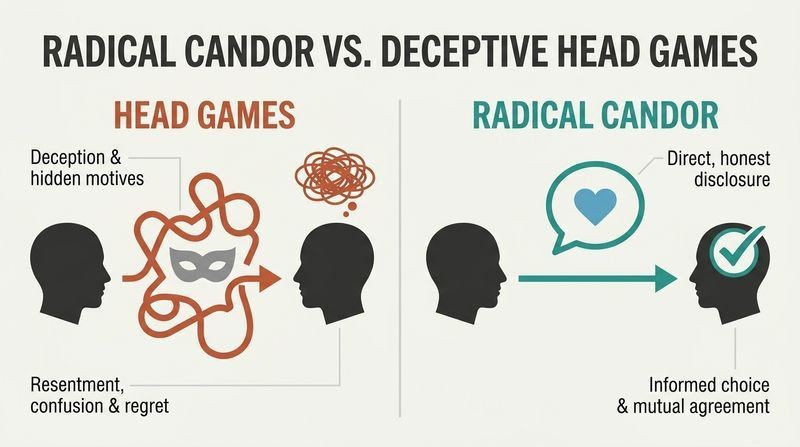
The core prescription is radical candor. Currie's entire philosophy rests on "Mode One Behavior": confidently telling a woman your true romantic or sexual desires within the first few minutes of meeting her, rather than disguising them. He contrasts this with men who fake interest in a relationship to get casual sex, and women who fake interest in casual sex when they want commitment. Both are "head games."
His ethical line is consent through disclosure. He refuses to coach lying, drugging, or "tricking," which he considers what pickup artists do. His pitch: if you only want short-term sex, announce it, and let her make an informed choice. He argues this produces less regret and bitterness on both sides, since nobody was deceived about intentions.
The honesty-first frame has unexpected allies. Behavioral ethicists and negotiation researchers note that stated-preference transparency reduces downstream conflict, and the "radical candor" idea echoes disclosure norms in ethical non-monogamy communities. What's shakier is the assumption that stating intent equals genuine respect: disclosure can coexist with pressure, and "I told you upfront" can become a shield against accountability. Still, the underlying claim that most dating friction stems from mismatched, hidden agendas is defensible and aligns with research showing deception is rampant in early courtship signaling.
Stop splitting women into pure "good girls" and dirty "sluts"
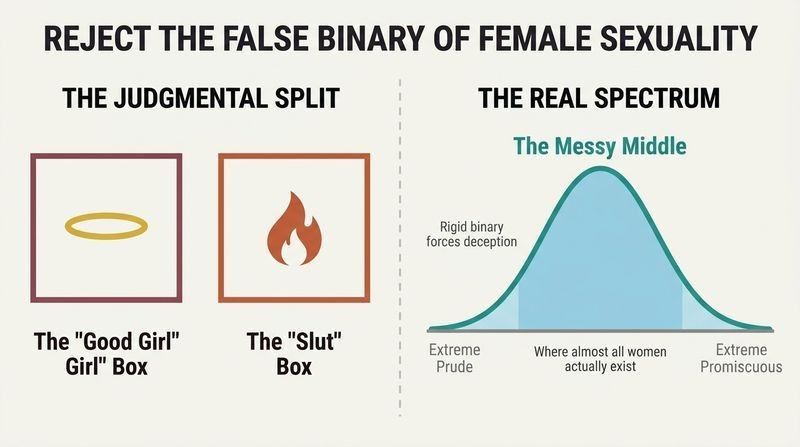
The Madonna/Whore Complex sabotages men. Borrowing Freud's term, Currie describes men who mentally file women into two boxes: chaste, marriage-worthy "good girls" and kinky, disposable "whores." He argues almost no women actually live at those extremes; most sit in the messy middle. Men afflicted by this split chase "trophy" prudes for status while reserving their real sexuality for women they secretly disrespect, leaving everyone unsatisfied.
Judgment breeds the very deception men complain about. Because men punish women who enjoy sex by labeling them, women hide their appetites behind a prudish front. Currie's fix: be discreet (no kiss-and-tell) and non-judgmental. He insists a woman sleeping with you quickly is a compliment, not evidence she is a "slut."
The diagnosis is sharper than the vocabulary. Clinical psychology still recognizes Madonna-whore dynamics, and modern research on slut-shaming supports the mechanism Currie describes: social punishment pushes desire underground, producing the "confusing" behavior men then blame on women. His prescription (drop the double standard) is genuinely progressive. The tension is that the book simultaneously trades in the same reductive scale it critiques, ranking women by kinkiness. Reducing anyone to a number reinstates exactly the objectification the Madonna-whore critique is supposed to dissolve.
A woman's real obstacle isn't disinterest, it's social programming
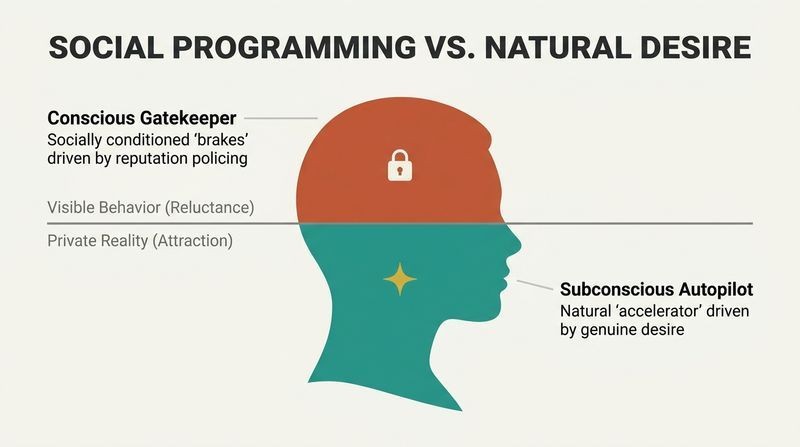
Programming, not preference, drives resistance. Currie's central mechanism: much of what feels like a woman rejecting sex is actually her internalized "social programming," the conditioning that a respectable woman must guard her reputation. He splits the mind into a conscious "gatekeeper" (judging right, wrong, appropriate) and a subconscious "autopilot" (chasing pleasure and avoiding pain). Desire lives in the autopilot; the brakes live in the gatekeeper.
He compares it to dieting. You may genuinely crave the cake while your programmed brain lists reasons to resist. So a woman can be attracted and aroused yet perform reluctance. His claim: she wasn't born disliking frank sexual talk; a Judeo-Christian, reputation-policing culture taught her to react against it, even when it privately turns her on.
The conscious-subconscious split is a folk version of dual-process theory (Kahneman's System 1 and System 2), and the "desire versus internalized shame" conflict maps onto real findings in sexual psychology about discordance between women's physiological arousal and reported arousal. Where caution is warranted: Currie treats "no" as almost always programming to be overcome, which dangerously blurs the line between cultural inhibition and genuine refusal. Attributing resistance to conditioning risks rationalizing persistence past a real boundary, a leap the book's own consent ethic should forbid.
Learn to tell resistance apart from an actual no
The tell is in the detail. Currie offers a genuinely useful diagnostic borrowed from sales. A true rejection is brief and flat: she calmly says she is not interested and disengages. Resistance is talkative. She lingers, argues, lists specific nitpicks about you, and explains at length why you two "can't" hook up. Paradoxically, the more detailed her objections, the more interest she is revealing.
Body language confirms it. In his grocery-store story, a woman named Felicia lectured him for minutes about not sleeping with strangers, yet never walked away and stayed rooted to her spot. He read the staying, not the words. His rule: be persistent only with resistance, never after a firm rejection, which is stalking.
The sales analogy (interest, resistance, indifference) is legitimate and widely taught; objection-handling really does distinguish a hesitant buyer from a hard no. The behavioral observation that engagement signals interest has support in interpersonal research. The peril is obvious and the book only partly guards against it: treating verbal objections as buying signals to overcome can license coercion. The honest version of this insight is diagnostic, not manipulative: read the signals to decide whether to leave gracefully, not to bulldoze. Currie draws that line, but readers primed to "win" may not.
Treat confidence like a muscle you overload, not a trait you own
Confidence is used, not possessed. Currie rejects the idea that you either "have" self-confidence or don't. Like a muscle, it grows only under resistance. His prescription: deliberately approach the women who intimidate you most, the 8s, 9s, and 10s, not the safe options. He argues rejection doesn't shrink confidence; inaction does. Walk into a room of ten intimidating women, talk to all ten, and your confidence grows even if none say yes.
Indifference to opinion is the real aphrodisiac. He claims flattery pleases a woman's ego but rarely arouses her. What arouses is a man who genuinely does not care what she, her friends, or her mother think of him. Being too eager or deferential reads as insecurity.
The "confidence as trainable skill" framing aligns with exposure therapy and self-efficacy research: repeated approach under manageable stress does build tolerance, and avoidance reliably worsens social anxiety. The claim that non-neediness attracts also has some support in attachment and scarcity psychology. The overreach is the blanket "flattery never arouses" and the celebration of studied indifference, which can shade into contempt. Genuine security and cultivated aloofness look similar from outside but feel different up close; the durable version is not-needing approval, not performing that you don't care.
Comfort can kill attraction; a little tension keeps it alive
Being too comfortable lands you in the friend zone. Currie warns that making a woman feel completely at ease can register as "platonic, like family." Several women told him they had no desire to sleep with a man precisely because he felt safe and comfortable, reminding them of a brother. The friend zone, he quips, has an easy entrance and a nearly invisible exit.
Good tension versus bad tension. He distinguishes intriguing discomfort (direct eye contact, calm intensity, a man who holds his frame, illustrated by the wordless meat-shop stare in the film 9 1/2 Weeks) from creepy discomfort (nervous, indirect, physically threatening). The goal is erotic tension, not fear. He also cites a dominatrix's clients: powerful people bored by constant deference craved someone who wouldn't fawn.
There is real signal here. Research on attraction finds that a degree of uncertainty and arousal can heighten interest (the misattribution-of-arousal studies on the shaky-bridge effect), and predictability can dampen desire, a theme Esther Perel built a career on: desire needs some distance and mystery. The friend-zone-via-comfort observation resonates with that. The caution is that "make her slightly uncomfortable" is easy to misread as "unsettle her," and Currie's own creepy-versus-intriguing line is subtle. Intrigue built on confidence differs sharply from tension built on intimidation.
Arousal peaks when her desire and her conscience collide
Erotic tension is manufactured conflict. Currie's arousal model ranks three states. A woman is least aroused when both her conscience and her appetite say a topic is boring or wrong. She is moderately aroused when both approve. She is most aroused when the two clash: her programmed mind says "a good girl shouldn't want this" while her subconscious screams yes. That internal tug-of-war, the "should I stay respectable or unleash my inner freak" conflict, is where wetness lives.
Practical rule: risk the turn-off to earn the turn-on. He argues you cannot arouse anyone by playing safe. Provocative talk that flirts with the line of "almost rude" generates the tension. His default tactic is to confidently assume she is as kinky as he is until she signals otherwise.
This is the book's most psychologically interesting claim and it has legs. Forbidden-fruit and taboo dynamics are well documented; transgression itself can amplify arousal, and Perel's work argues eroticism thrives on the tension between the permitted and the prohibited. Currie essentially operationalizes that. The blind spot is consent calibration: "assume she's as kinky as you and push toward the line" only works if you're genuinely reading her feedback, and the strategy rewards escalation. The ethical version treats her signals as a live veto, not a hurdle that heightened tension is meant to clear.
Your voice can arouse before she ever sees your face
Aural sex is seduction through sound. Currie's signature concept: "aural" is to the ear what "verbal" is to the mouth. He claims the erotic power of voice, word choice, and conversational skill can arouse a woman using her own imagination as the engine. His metaphor: your voice is the pilot light, your words are the gas, her mind is the furnace. No fantasy you describe arouses her more than one she builds herself.
Train the instrument. He recommends recording yourself, noticing whether you sound choppy or tense, and practicing a low, slow, relaxed tone. He credits phone sex as his highest-conversion seduction tool, arguing it strips away height, looks, and clothing, leaving only voice and language, and often predicts in-person chemistry.
The underlying science is sound: vocal qualities strongly shape attraction, and studies link lower, slower, resonant voices to perceived confidence and desirability. The "her imagination does the work" principle mirrors why audio erotica and romance fiction outsell much visual porn among women, a market fact Currie cites. His claim that voice predicts chemistry better than appearance is plausible for sustained rapport but overstated as a universal. The genuinely portable lesson, beyond seduction, is that vocal delivery is a trainable persuasion skill relevant to teaching, sales, and leadership, not just the bedroom.
Match your intentions to women whose intentions match yours
Sort before you pursue. Currie divides women by intent into Reciprocators (want you and say so), Rejecters (don't and say so), Pretenders (want you but feign disinterest), and Timewasters (don't want you but string you along for attention, favors, or an ear). He also ranks erotic openness on a 1-to-5 scale, from the very uninhibited "1" to the strictly marriage-only "5." His advice: if you want casual sex, pursue 1s, 2s, and 3s, and leave genuine 4s and 5s alone.
The pretender problem. The trickiest is a "2" (kinky, casual-friendly) masquerading as a prudish "4" or "5" to protect her reputation. His rule of thumb: if you must guess wrong, assume a prude is secretly open rather than the reverse, because pedestals are hard to climb down from.
Stripped of the crude scoring, this is a targeting and compatibility principle: spend energy where intentions align, disengage where they don't. That's efficient and, applied honestly, respectful of everyone's time. The uncomfortable core is the taxonomy itself, which reduces people to receptivity ratings and assumes hidden availability is the norm. Modern relationship science would reframe "pretenders" less as deceivers and more as people responding rationally to real social risk. The salvageable insight is universal beyond dating: mismatched goals, not personality flaws, sink most interactions, so clarify intent early and route accordingly.
Analysis
This is a niche seduction self-help book with a surprisingly coherent psychological spine, structured in two halves: a mindset section built on named frameworks (Mode One Behavior, the Madonna/Whore Complex, social programming, the 1-to-5 scale) and a story section of six autobiographical seductions used as case studies. Its difficulty for a summarizer is twofold. First, the surface is deliberately crude and explicit, which obscures ideas that are actually defensible. Second, the book braids a genuinely humane thesis (stop deceiving each other about what you want) with gender-essentialist generalizations and a persistence-past-resistance strategy that sits uneasily against its own consent ethic.
The strongest intellectual contribution is the arousal model: desire as a conflict between a conscious "gatekeeper" shaped by cultural conditioning and a pleasure-seeking subconscious. This is essentially dual-process psychology fused with the forbidden-fruit dynamic that Esther Perel and taboo researchers describe, and it explains the "confusing" female behavior men complain about without pathologizing women. Currie's claim that shaming drives desire underground is well supported by contemporary work on slut-shaming and sexual stigma.
The book's ethical stance is more thoughtful than its reputation suggests. Currie explicitly rejects lying, coercion, and intoxication, positioning himself against pickup artistry. His honesty-first pitch, tell the truth about wanting only casual sex and let her choose, is genuinely disclosure-based. Yet the same book teaches reading verbal objections as "resistance" to overcome, which can rationalize pressure. The tension is never fully resolved.
What survives translation to a general audience: confidence is a trainable muscle built through exposure; non-neediness beats flattery; voice and language are underrated persuasion tools; and mismatched intentions, not character flaws, wreck most human interactions. The dating-specific scaffolding is dated and reductive, but the behavioral principles underneath echo findings in social psychology, negotiation, and communication far beyond seduction.
Review Summary
"Oooooh . . . Say It Again" receives overwhelmingly positive reviews, praised for its straightforward approach to verbal seduction and dating advice. Readers appreciate Currie's honest, no-nonsense style and his insights into male-female dynamics. The book is divided into two parts: educational content and erotic stories based on the author's experiences. Many reviewers find the audiobook version particularly engaging due to Currie's smooth, seductive voice. Both men and women recommend the book for its practical advice on confidence, communication, and embracing one's sexuality.
People Also Read









Glossary
Mode One Behavior
Stating sexual intent upfrontCurrie's central technique: confidently and honestly expressing your romantic or sexual desires to a woman within the first few minutes of conversation, without hedging, disguising, or misleading. It contrasts with Mode Two (delayed, vague hinting), Mode Three (avoidance or false impressions), and Mode Four (deliberately antagonizing). The point is transparency of intent so the other person can make an informed choice.
Aural Sex
Arousal through voice and wordsCurrie's coined concept that "aural" is to the ear what "verbal" is to the mouth. It refers to arousing someone using tone of voice, word choice, and conversational skill so their own imagination generates the erotic response, as in phone sex. His metaphor: voice is the pilot light, words the gas, and the listener's mind the furnace.
Madonna/Whore Complex
Splitting women into pure or dirtyA Freudian concept Currie applies to modern dating: the tendency of some men to categorize all women as either chaste, marriage-worthy "good girls" or promiscuous, disposable "whores." He argues this false binary leaves men sexually unsatisfied and pressures women into hiding their real desires behind a prudish facade.
Social Programming
Internalized cultural rules on behaviorThe conditioning, absorbed from family, religion, and society, that governs what a person deems appropriate. Currie casts it as the conscious mind's "gatekeeper" that suppresses raw desire, and identifies it as the primary reason women perform reluctance toward sexual advances even when privately aroused.
The 1-to-5 Scale
Ranking women's erotic opennessCurrie's subjective spectrum of female sexual inhibition. A "1" is very uninhibited and promiscuous, a "5" only has sex within marriage, and 2s, 3s, and 4s occupy the middle. He advises pursuing 1s through 3s for casual sex and leaving genuine 4s and 5s alone unless seeking commitment.
Reciprocators, Rejecters, Pretenders, Timewasters
Four types by intentCurrie's classification of women by their true intentions: Reciprocators want you and show it; Rejecters don't and show it; Pretenders want you but feign disinterest to protect their reputation; Timewasters aren't attracted but string you along for attention, favors, or emotional support.
Wholesome Pretenders / Erotic Hypocrites
Kinky women posing as prudesTerms from Currie's earlier book for women who are erotically open (a 1 or 2) but present themselves as conservative (a 3, 4, or 5). Erotic Hypocrites differ by being more materialistic and status-driven. Both hide their real sexuality, which Currie attributes to men's judgmental double standards.
FAQ
What's "Oooooh . . . Say It Again: Mastering the Fine Art of Verbal Seduction and Aural Sex" about?
- Focus on Verbal Seduction: The book explores the art of verbal seduction and how to use words to create sexual chemistry and arousal.
- Mode One Behavior: It introduces the concept of "Mode One Behavior," which involves being upfront and straightforward about one's sexual desires and intentions.
- Overcoming Social Programming: The book discusses how societal norms and social programming can inhibit sexual expression and how to break through these barriers.
- Real-Life Examples: It includes real-life stories and examples of the author's experiences with verbal seduction.
Why should I read "Oooooh . . . Say It Again"?
- Improve Communication Skills: The book offers insights into improving communication skills, particularly in the context of romantic and sexual relationships.
- Understand Social Dynamics: It provides a deeper understanding of social dynamics and how they affect interactions between men and women.
- Learn from Real Experiences: The author shares personal experiences and stories that illustrate the principles of verbal seduction.
- Challenge Conventional Norms: It encourages readers to challenge conventional norms and be more honest and direct in their interactions.
What are the key takeaways of "Oooooh . . . Say It Again"?
- Mode One Behavior: Being direct and honest about sexual desires can lead to more genuine and fulfilling interactions.
- Social Programming: Recognizing and overcoming societal conditioning is crucial for authentic communication.
- Confidence is Key: Developing strong self-confidence can make interactions more successful and reduce fear of rejection.
- Aural Sex: The power of words and voice can be as arousing as physical touch, and mastering this can enhance sexual chemistry.
What is Mode One Behavior according to Alan Roger Currie?
- Direct Communication: Mode One Behavior involves being upfront and straightforward about one's romantic or sexual desires.
- Avoiding Manipulation: It emphasizes honesty and discourages manipulative tactics in interactions with women.
- Overcoming Fear: The approach helps men overcome the fear of rejection by promoting confidence and self-assurance.
- Creating Clarity: It aims to create clear and honest communication, reducing misunderstandings and head games.
How does Alan Roger Currie define Aural Sex?
- Focus on Words: Aural sex involves using words and voice to create sexual arousal and chemistry.
- Power of Imagination: It leverages the imagination and mental imagery to enhance sexual experiences.
- Non-Physical Stimulation: Aural sex can be as stimulating as physical touch, relying on verbal interaction.
- Enhancing Intimacy: It can deepen intimacy and connection by engaging the mind and emotions.
What are the symptoms of the Madonna/Whore Complex discussed in the book?
- Dual Perception of Women: Men with this complex view women as either pure and chaste or promiscuous and lustful.
- Impact on Relationships: It can negatively affect a man's ability to form healthy relationships with women.
- Social Conditioning: The complex is often a result of societal norms and upbringing.
- Overcoming the Complex: The book suggests recognizing and challenging these perceptions to improve interactions with women.
How does "Oooooh . . . Say It Again" address social programming as an obstacle to seduction?
- Recognizing Conditioning: The book highlights how societal norms condition individuals to suppress their sexual desires.
- Breaking Through Barriers: It offers strategies to overcome these barriers and express desires more freely.
- Impact on Women: Social programming often leads women to present themselves as more prudish than they are.
- Encouraging Authenticity: The book encourages readers to be authentic and challenge societal expectations.
What role does self-confidence play in verbal seduction according to the book?
- Foundation of Success: Self-confidence is crucial for successful interactions and overcoming fear of rejection.
- Developing Confidence: The book suggests pushing oneself out of comfort zones to build confidence.
- Impact on Women: A strong sense of confidence can make women feel intrigued and attracted.
- Avoiding Over-Respectfulness: It warns against being overly respectful, which can lead to being friend-zoned.
What are some real-life examples of verbal seduction in the book?
- Grocery Store Encounter: The author shares a story of meeting a woman in a grocery store and using Mode One Behavior to seduce her.
- Office Interaction: Another example involves seducing a woman in an office setting by being direct and confident.
- Celebrity Encounter: The book includes a story of interacting with a celebrity and maintaining confidence despite rejection.
- Phone Sex Experiences: It highlights the use of phone sex to create sexual chemistry before meeting in person.
What are the best quotes from "Oooooh . . . Say It Again" and what do they mean?
- "Oooooh … Say it Again": This phrase is used to emphasize the power of words in creating arousal and is a recurring theme in the book.
- "Mode One Behavior": This concept is central to the book, advocating for direct and honest communication.
- "Social Programming": The book frequently discusses how societal norms inhibit authentic expression and how to overcome them.
- "Confidence is Key": The importance of self-confidence is a recurring message throughout the book.
How does the book suggest overcoming the fear of rejection?
- Embrace Honesty: By being upfront and honest, individuals can reduce the fear of rejection and gain clarity in interactions.
- Build Confidence: Developing self-confidence is crucial for overcoming fear and approaching women with assurance.
- Focus on Action: The book emphasizes taking action and expressing desires rather than worrying about potential reactions.
- Learn from Rejection: Viewing rejection as a learning experience rather than a failure can help build resilience.
What is the significance of the book's title, "Oooooh . . . Say It Again"?
- Emphasis on Words: The title highlights the power of words and verbal expression in creating sexual arousal.
- Signature Phrase: "Oooooh … Say it Again" is a phrase the author frequently uses during verbal seduction.
- Aural Sex Focus: It reflects the book's focus on aural sex and the impact of voice and words on intimacy.
- Memorable Impact: The title is designed to be memorable and encapsulate the book's central theme of verbal seduction.
About the Author
Other books by Alan Roger Currie

Download PDF
Download EPUB
.epub digital book format is ideal for reading ebooks on phones, tablets, and e-readers.








































