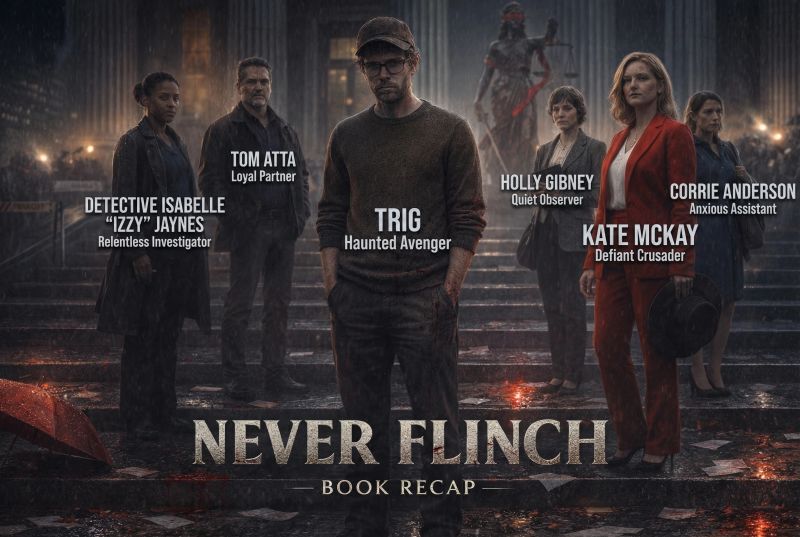

Plot Summary
Prologue
In March, a man known only as Trig2 attends an out-of-town Narcotics Anonymous meeting in Buckeye City, Ohio, rattled and fighting the urge to drink. Someone he cared about has died in prison, stabbed in the shower. By April, a podcaster named Buckeye Brandon reveals that the dead man — Alan Duffrey,19 convicted of child pornography — was framed by a jealous coworker.
Trig2 reads the story and something calcifies inside him. The people who convicted Duffrey19 — twelve jurors, a judge, a prosecutor — must understand what their verdict cost. They must feel guilt. And if they won't feel it on their own, innocents will die in their names until they do. He begins to plan. His father's voice echoes: No flinching.
Bill Wilson's Fourteen Innocents
Detective Izzy Jaynes4 is summoned by her lieutenant12 to examine a letter signed with the name of AA's founder. The writer announces he will kill thirteen innocents and one guilty person to atone for the needless death of an innocent man.
Izzy4 connects the timing to Alan Duffrey's19 prison murder and the recent revelation that his pedophilia conviction was a frame job by a coworker named Cary Tolliver.15 She consults Holly Gibney,1 a private investigator she's befriended through a previous case.
Holly1 notes the alias suggests an AA attendee, and the letter's careful punctuation and phrasing indicate an educated white-collar writer. Both agree the threat could be real. Izzy4 begins interviewing Duffrey's dying framer15 and former colleagues, searching for whoever cared enough about Duffrey19 to promise slaughter.
A Poodle Without Its Mistress
On a warm afternoon, Trig2 ambushes a woman walking her Standard Poodle, asking her to look at his trail map. While her eyes are down, he puts a snub-nosed .22 to her temple and fires. She sags in his encircling arm. He drags her into the bushes and slips a paper bearing the name Letitia Overton — a Duffrey19 juror — into her dead hand.
His car initially won't start because he left the shifter in Drive, and the delay nearly destroys him. But he escapes unseen. Annette McElroy, thirty-eight, becomes the first surrogate to die for someone else's guilt. The poodle stands on the trail with its leash trailing, whimpering. Trig2 drives home and discovers he slept through the night without a single bad dream.
Bleach Meant for Kate
Kate McKay,3 America's most polarizing feminist activist, is touring the country for her book A Woman's Testament. She sends her young assistant Corrie Anderson5 out in the rain wearing Kate's3 trademark Borsalino hat. A woman in a red wig yanks Corrie5 into an alley and hurls liquid from a Thermos labeled ACID into her eyes, quoting scripture about women not usurping male authority.
The burn is real — bleach, not acid — but Corrie's5 vision returns. Kate,3 recognizing the publicity value even through her fury, photographs Corrie's5 blistered face and presents her onstage that night. Corrie5 arranges off-duty police escorts going forward, and the attacker's discarded wig yields DNA. This is not the last time they'll hear from their stalker.
Twelve Plus Two Equals Fourteen
Holly1 has been tracking the investigation informally through Izzy4 and her AA contact, a bartender named John Ackerly.10 When Izzy4 confirms that names left in murdered strangers' hands match Duffrey19 jurors, Holly1 has a flash of insight in a bathroom stall.
The letter promised thirteen innocents and one guilty. Twelve jurors plus a judge plus a prosecutor equals fourteen. The killer isn't targeting jurors directly — he's murdering random people as surrogates, one for each person he blames for Duffrey's19 conviction.
The jurors are meant to feel blood on their hands. Holly1 calls Izzy,4 who confirms it fits: Letitia Overton was Juror 8. Meanwhile, Trig2 has killed two homeless men behind a laundromat, leaving two more juror names. The method has become a pattern.
Fingerprints on the Wrong Surface
Izzy4 ambushes the assistant to ADA Doug Allen16 with hard questions about the evidence that convicted Duffrey.19 A colleague at Duffrey's19 bank had revealed that Tolliver15 once gifted Duffrey19 a set of Plastic Man comics in Mylar bags — then asked for the bags back, preserving Duffrey's19 fingerprints.
Allen16 submitted photographs showing prints that appeared to be on the kiddie porn magazines, but they were actually on the bags, carefully lit so the Mylar was invisible. The assistant confirms it.
Allen16 never lied outright; he simply let the jury draw the wrong conclusion. This deception, combined with Tolliver's15 claim that Allen16 shredded a February confession letter, means the ADA effectively engineered an innocent man's conviction and eventual prison murder.
Holly Joins Kate's War
Kate's3 stalker grows bolder — an anthrax-dusted greeting card in Omaha, a threatening photograph in Spokane. Corrie Anderson5 calls Holly,1 having researched her reputation. Kate3 wants a female bodyguard unaffiliated with police, to avoid the optics of men protecting a feminist icon.
Holly,1 whose caseload is thin and curiosity boundless, agrees. She joins the tour in Iowa City, carrying her late mentor Bill Hodges's .38 revolver, pepper spray, and an anti-rape siren. She immediately begins switching hotels, varying exit routes, and attaching a GPS tracker to Kate's3 truck.
But Kate3 resists every precaution with the imperious confidence of a woman who considers herself invulnerable. Holly1 begins to realize that protecting someone from the world is simpler than protecting them from themselves.
The Reverend's Last Appointment
Reverend Mike Rafferty17 — Big Book Mike, a garrulous AA fixture — may remember that Trig2 once mentioned losing someone who died in prison. That loose thread becomes a death sentence. Trig2 visits the Rev under the pretense of seeking counsel, then shoots him with a .38 and smothers him with a pillow embroidered with an AA slogan. He stages a robbery, pocketing the wallet and watch.
Then he faces the appointment book, which reads TRIG 7 PM. He can't take the whole book without raising suspicion, so he carefully alters the T into a B and adds GS at the end, turning TRIG into BRIGGS. The forgery is near-perfect. John Ackerly,10 Holly's1 bartender contact, discovers the body the next day when he goes to ask the Rev about Trig.2
The Chair That Saved Kate
Outside the Davenport RiverCenter, a three-hundred-pound drunk named Victor DeLong charges through a crowd of autograph seekers with a baseball bat, screaming that Kate3 ruined his marriage. Kate3 freezes. Corrie5 raises one hand uselessly. Holly1 doesn't think — she kicks the usher's folding chair into DeLong's path. He trips and faceplants on concrete.
Holly1 pepper-sprays him before he can rise, then hustles her charges into the waiting car. Later, at the hotel bar, Holly's1 hands shake so violently she can barely hold her wine glass. Kate3 kisses her cheek and vows to do everything Holly1 says from now on. Holly1 appreciates the sentiment. She also knows it will last roughly until the next time Kate3 wants to do something reckless.
The B That Was a T
Jerome Robinson,6 Holly's1 young associate, had been studying the photograph of Reverend Rafferty's17 appointment calendar, sensing something wrong but unable to name it. During Kate's3 Davenport show, Holly1 peeks at the same screenshot — casually, her mind mostly elsewhere — and it clicks.
The capital B in BRIGGS started life as a T. The last two letters are more compressed, squeezed in after the fact. The killer's name isn't Briggs at all; it's Trig. Holly1 tells Izzy,4 and a forensic graphologist confirms the alteration under magnification.
She also notices the letters T-R-I-G hiding inside the defense lawyer Grinsted's surname, suggesting the anagram might be deliberate. That second deduction proves false when Grinsted's alibis check out — but the first one sticks. The police now have the killer's nickname.
Real Christ, Real Danger
Holly1 asks Jerome6 to research fundamentalist churches with violent histories. He unearths Real Christ Holy in Baraboo Junction, Wisconsin — bankrolled by the late inventor Harold Stewart, whose patents still fund the congregation.
Holly1 finds a Pensacola newspaper article about a fake acid attack at a women's clinic by church members — including Christopher Stewart,9 Harold's son. Jerome6 obtains a clear audience-camera photo of Stewart9 from Kate's3 Iowa City lecture: third row, hand raised, face upturned.
Holly1 draws bangs on the glossy print with a Sharpie, and Corrie5 tentatively identifies the result as her Reno attacker. The stalker is a man who sometimes presents as a woman. Holly1 calls Deacon Andrew Fallowes,13 who almost certainly directed Stewart's9 mission, and warns him the trail leads back to his church.
Kindling at Center Ice
Donald Gibson,2 the Mingo Auditorium's Program Director, has been hiding in plain sight. He is Juror 9 from the Duffrey19 trial — the man who bullied three holdouts into convicting an innocent man. His nickname, Trig, comes from a ceramic horse his father named after Roy Rogers's palomino.
The Holman Hockey Rink in Dingley Park, where his violent father once took him to games, is condemned and full of creosoted boards that would burn like torches.
Gibson2 enters using a code his electrician father taught him and envisions a grand finale: he will lure famous women — Kate,3 Sista Bessie,8 their associates — to this ruin the same weekend they converge on his city. He programs the Mingo's digital signs to display, at 7:17 PM Friday, juror names paired with his intended victims.
Chrissy Hides with the Dead
With his photo circulated to every hotel and police officer, Christopher Stewart9 needs to vanish. Deacon Fallowes13 reluctantly provides a list of abandoned buildings, including the Holman Rink.
Chrissy — Christopher's9 female persona, wearing a wig and lavender pants suit — enters using the same Plumber's Code Gibson2 used, and discovers a decomposing girl's body on the old rink floor with a slip of paper reading CORINNA ASHFORD in her hand. When Gibson2 later arrives to deposit bound hostages, Chrissy watches from behind the snackbar, silent and still.
Two killers from utterly different backgrounds and motives have converged on the same ruin through the same forgotten electrician's trick. Chrissy decides God has placed her here for more than one purpose.
Two Women Drugged at Noon
Gibson2 lures Corrie Anderson5 to the Mingo at noon, claiming she needs to sign insurance papers. When she arrives at the service entrance, he injects her neck with pentobarbital and loads her into the venue's Transit van. He drives to the Holman Rink and tapes her to a steel post in the old penalty box.
Two hours later, he calls Barbara Robinson,7 claiming Betty8 is crying in her dressing room and asking for Barbara.7 When she arrives, she receives the same treatment — drugged, bound, driven to the rink, taped beside Corrie.5 From behind the snackbar, Chrissy Stewart9 watches silently. Gibson2 photographs both women, then prepares to bait his biggest catch: Kate McKay3 herself, using Corrie's5 phone as the lure.
Kate's Note on the Bedroom Door
Gibson2 calls Kate3 on Corrie's5 phone, sending a photo of Corrie5 bound and gagged. He threatens death if she tells anyone. Kate3 scrawls a note to Holly1 — mistakenly blaming Christopher Stewart9 — sticks it to the door, and escapes the hotel through the utility exit.
She sprints to the Holman Rink with only pepper spray. When Gibson2 opens the doors, he punches her in the face, shattering her nose. Chrissy Stewart9 bursts from hiding, gun drawn, screaming that Kate3 belongs to her. Gibson2 seizes Chrissy's9 wrist and breaks her neck.
Kate3 manages to spray Gibson's2 face before he beats her unconscious and drags her inside. Holly1 discovers the note. John Ackerly10 calls — he's recognized Gibson's2 staff photo on the Mingo break room wall. Holly1 realizes Gibson2 is Trig and tracks Kate's AirTag to Dingley Park.
The Anthem and the Riot
Gibson2 has also threatened Betty Brady,8 showing her a photo of Barbara7 bound in the penalty box. Betty8 tucks her sax player Red Jones's14 loaded .38 into her purse, walks to the pitcher's mound with Jerome6 and Red,14 and sings the National Anthem with everything she has.
The crowd falls silent, then erupts. But in the second inning, fireman George Pill18 deliberately crashes into Izzy,4 shattering her shoulder. Her first baseman tackles Pill.18 Both benches empty. Fans pour onto the field. A police car is overturned.
In the chaos, every autograph seeker vanishes from Betty's8 dressing room door. She whispers a prayer to mighty Jesus, grabs the gun, and runs for the rink. Holly,1 meanwhile, reaches the Holman doors and presses against the wall, listening to Gibson2 argue with his dead father in three different voices.
Holly Doesn't Flinch
Betty8 collapses short of the rink. Jerome6 finds her, takes Red's14 .38, and sprints ahead to Holly,1 who stands frozen outside the locked doors. Jerome6 whispers urgently: knock, say it's me, sound like Betty8 — because only a woman's voice will make Gibson2 open up. Holly1 deepens her voice as much as she can.
The keypad light turns green. Gibson2 opens the door and sees not Sista Bessie8 but a small gray-haired white woman with a revolver. Holly1 fires twice into his chest. Jerome6 fires a third round. Inside, flames are already racing along the creosoted ties where Gibson2 lit his crumpled hockey posters.
Jerome6 stomps the fire while Holly1 frees Barbara.7 Betty8 arrives with her pocket knife, and Jerome6 cuts through Corrie's5 tape. Kate,3 bound to the bleachers, is freed last. They drag the bodies out and flee in Gibson's2 van as the Holman burns behind them.
Epilogue
Weeks later, Holly1 and Izzy4 sit at their old picnic table in Dingley Park, eating fish tacos in the sunshine. The Holman Rink is blackened rubble. Kate McKay's3 blood-smeared photograph has made her the most famous woman in America; more states are now protecting abortion rights.
Izzy's4 shoulder is pinned with hardware. George Pill18 has been fired; the police and fire chiefs resigned. The Real Christ Holy Church13 was raided — a massive weapons cache in the basement — and shut down, though Deacon Fallowes13 walks free behind a platoon of lawyers.
Corrie5 has gone home to New Hampshire. Barbara7 is in California with Betty,8 writing poems. Holly1 has resigned as Kate's3 bodyguard. The Mingo will reopen in August with a Sista Bessie8 concert. Holly1 has tickets. She has friends in the band.
Analysis
Never Flinch achieves its deepest effect through a structural revelation: the serial killer is himself one of the jurors who convicted Alan Duffrey19 — Juror 9, the very man who bullied three holdouts into a guilty verdict. Gibson's2 crusade against the jurors is ultimately a crusade against himself, a fact he programs into the Mingo's signboard in his final act: DONALD TRIG GIBSON JUROR 9 GUILTIEST OF ALL. His killing spree precisely mirrors the alcoholic's progression: the first murder is deliberate, the second easier, and by the fifth he recognizes with sickening clarity that he can no more stop killing than he could stop drinking. The AA framework isn't decorative — it's diagnostic. Gibson's2 'amends' are a grotesque parody of Step Nine, and his Bill Wilson alias reveals the desperate honesty-within-deception that characterizes addicts who confess at meetings but lie everywhere else.
Holly Gibney,1 constitutionally incapable of the very quality the title demands, repeatedly rises when lives depend on her. Her courage is involuntary — a reflex that bypasses her chronic self-doubt. She flinches at compliments and social encounters but never when the stakes are lethal, making her the title's quiet inversion.
King weaves the Kate McKay3 thread as commentary on how culture simultaneously weaponizes and commodifies women's bodies. Kate's3 fight for bodily autonomy is mirrored by the violations she endures: bleach in her assistant's5 face, anthrax in a greeting card, broken teeth. Her stalker, Christopher Stewart,9 embodies the paradox of religious patriarchy — someone forbidden to express their own feminine self channeling that suppression into destroying the woman who advocates most loudly for the body's sovereignty.
The convergence of both killers in the Holman Rink transforms a municipal ruin into a moral crucible: two products of abusive fathers, both hiding behind assumed identities, meeting in a building that represents America's characteristic response to things that are broken — condemn the structure and walk away. Holly1 doesn't walk away. She knocks.
Review Summary
Never Flinch receives mixed reviews, with some praising King's storytelling and character development, particularly Holly Gibney's evolution. Many enjoy the intertwining plotlines and suspenseful climax. However, critics note pacing issues, excessive political commentary, and underdeveloped subplots. Some fans feel the book lacks the supernatural elements typical of King's work. Overall, readers appreciate the exploration of themes like justice and empowerment but are divided on the execution, with ratings ranging from 1 to 5 stars.
People Also Read




Characters
Holly Gibney
PI turned reluctant bodyguardA small, gray-haired private investigator who runs the Finders Keepers agency in Buckeye City. Holly is fundamentally shy yet ferociously brave when cornered, self-deprecating yet capable of extraordinary deductive leaps. She battles a lifetime of internalized maternal criticism that manifests as chronic self-doubt—yet when her mind locks onto a problem, she becomes unstoppable. Her relationships with Jerome6 and Barbara Robinson7 are the closest she has to family. She has survived encounters with genuinely monstrous people in prior cases and carries scars both visible and otherwise. She takes on bodyguard work for Kate McKay3 despite having no experience, simultaneously helping the police investigation by connecting dots no one else sees. She will never feel adequate, which is precisely what makes her dangerous to those who underestimate her.
Donald 'Trig' Gibson
Program Director and serial killerThe Program Director of the Mingo Auditorium, Gibson presents a professional, pleasant exterior that conceals a fractured psyche. His childhood was shaped by a violent electrician father who oscillated between rough affection and abuse—and who, Gibson believes, killed his mother. The nickname Trig derives from a ceramic horse his father named after Roy Rogers's palomino, a childhood relic he still keeps on his desk. A recovering alcoholic who attends AA meetings under his nickname, Gibson carries a burden of guilt he cannot discharge through the usual steps. His relationship with alcohol followed a pattern he recognizes, with growing horror, is repeating itself in a far more destructive form. He argues with his dead father in moments of stress, cycling between obedience and rage.
Kate McKay
Feminist activist and authorA bestselling author and the most polarizing feminist activist in America, Kate tours relentlessly, confronting hostile audiences with humor, scripture, and sheer force of personality. She possesses genuine charisma—a crackling energy that fills auditoriums—but also a monumental ego that sometimes blinds her to the people around her. She can reduce her assistant5 to tears over a missed hotel booking, then turn around and inspire thousands. Kate's defining flaw is her conviction that she is too important to be truly vulnerable; she freezes when physically threatened yet believes she can talk her way through any crisis. Her trademark gesture—fingers beckoning, come on, come on—is both an invitation to supporters and a dare to enemies.
Isabelle 'Izzy' Jaynes
Lead detective on the caseA sharp, competitive Buckeye City detective who becomes the point person on the Bill Wilson threat letter. A two-time divorcée, Izzy channels her drive into police work where she's risen rapidly through the ranks. She has no patience for bureaucracy but understands the political game well enough to play it. Her friendship with Holly1—forged through a previous shared trauma—functions as an intellectual partnership: Izzy provides institutional access, Holly1 provides deductive brilliance. Izzy openly acknowledges Holly's1 superiority in certain areas, displaying an unusual ego security for law enforcement. Drafted against her will to pitch in a charity softball game, she discovers that competition still lights something fierce in her—an old college athlete's fire that never quite went out.
Corrie Anderson
Kate's capable young assistantKate McKay's3 young assistant, a recent graduate plucked from a seminar, who manages logistics, schedules, and crisis communications with precocious skill. Corrie absorbs Kate's3 verbal explosions with the understanding that proximity to greatness has costs. She endured the Reno bleach attack and the Omaha anthrax scare and kept going, developing her own quiet steel beneath the compliance Kate3 requires. Her growing competence makes her indispensable and simultaneously invisible—the kind of person on whom empires depend but rarely credit.
Jerome Robinson
Holly's loyal associateHolly's1 associate at Finders Keepers, Barbara's7 brother, and a published author whose debut novel reached the bestseller list. Jerome combines intellectual curiosity with physical athleticism and an easy charm that opens doors Holly's1 shyness keeps shut. He serves as her researcher, sounding board, and occasional field agent, but his deepest loyalty is to his sister7. He calls Holly1 Hollyberry against her wishes and genuinely considers her family. His willingness to abandon his own struggling novel to chase leads for Holly1 reveals where his real passions lie.
Barbara Robinson
Prize-winning poet turned singerA young poet who won the Penley Prize for her debut collection, Faces Change. Barbara possesses an unusual adaptability—equally comfortable as a roadie hauling amplifiers, a backup singer hitting harmonies, or a scholar hunched over a notebook. Her friendship with Sista Bessie8 transforms her from an observer of art into a participant in it, though she remains uncertain whether music or poetry is her true calling. She has survived encounters with the genuinely inexplicable and carries the knowledge quietly.
Betty Brady
Soul legend Sista BessieA legendary soul singer coming out of retirement for a comeback tour, Betty is big-bodied, big-hearted, and big-voiced, with a street-smart warmth that disarms everyone she meets. Behind the showmanship lives a woman battling heart trouble and years of hard living who still performs with ferocious commitment. Her attachment to Barbara Robinson7 reawakens maternal instincts she's carried since giving up a child at seventeen. When performing, she goes by Sista Bessie; offstage she's plain Betty, and prefers it that way.
Christopher Stewart
Religious zealot stalking KateA young man from the Real Christ Holy Church13 who embodies a literal duality: he is sometimes Christopher, sometimes his dead twin sister Chrissy, who died of a heart defect at age seven. His mother nurtured this divided identity in secret; his father condemned it. Religious fervor and unprocessed grief have been weaponized by church elders into a crusade against Kate McKay3, the woman they consider an advocate for baby-killing. Stewart's female persona carries out the most intimate acts of violence—the bleach, the anthrax—while the male persona watches from behind.
John Ackerly
Bartender and Holly's AA sourceA bartender at a bar called Happy who has been clean and sober for nearly seven years. A recovering cocaine addict who works around alcohol without temptation, John serves as Holly's1 eyes and ears in the recovery community. His willingness to ask discreet questions at AA meetings—walking a fine line between loyalty to Holly1 and the anonymity tradition—makes him an invaluable intelligence asset in a world the police cannot easily penetrate.
Tom Atta
Izzy's pragmatic detective partnerIzzy's4 partner, a pragmatic investigator who serves as her sounding board and occasionally her conscience. He recognizes Holly's1 deductive gifts and urges Izzy4 to consult her when the department's own efforts stall.
Lewis Warwick
Izzy's lieutenant at BCPDIzzy's4 lieutenant, he balances bureaucratic pressures with genuine investigative instinct. He first shared the Bill Wilson letter with Izzy4 and captains the police softball team, drafting Izzy4 as pitcher.
Andrew Fallowes
Deacon directing Stewart's missionFirst Deacon of Real Christ Holy Church, a smooth-voiced manipulator who directs and funds Christopher Stewart's9 crusade against Kate McKay3 while maintaining careful plausible deniability for himself and the congregation.
Red Jones
Betty's elderly sax playerSista Bessie's8 longtime saxophone player, who travels by bus because he hates flying. He carries a .38 revolver out of old habit, and his spare, haunting playing complements Betty's8 voice perfectly.
Cary Tolliver
Duffrey's dying framerThe bank employee who planted child pornography on Alan Duffrey's19 computer out of jealousy over a promotion. Dying of pancreatic cancer, his deathbed confession to a podcaster triggers the entire chain of events.
Douglas Allen
Ambitious ADA who railroaded DuffreyThe Assistant District Attorney who prosecuted Duffrey19 using deceptive fingerprint evidence and may have destroyed Tolliver's15 confession letter to protect his conviction record and career ambitions.
Reverend Mike Rafferty
Garrulous AA counselorKnown as Big Book Mike, a recovering opioid addict who replaced his lost church with compulsive AA attendance. He takes the anonymity tradition seriously—a quality that makes him both trusted and fatally vulnerable.
George Pill
Fireman who provokes IzzyA fireman whose aggressive trash-talking toward Izzy4 escalates from verbal sparring to physical violence at the charity softball game, with consequences that ripple far beyond the playing field.
Alan Duffrey
The wrongfully convicted dead manA bank loan officer framed for child pornography, convicted, imprisoned, and murdered before the truth emerged. Though dead before the story begins, his ghost drives every murder and every investigation.
Plot Devices
The Bill Wilson Letter
Announces the killer's missionThe letter sent to police, signed with the name of AA's founder, announces a plan to kill thirteen innocents and one guilty person as atonement. It introduces the killer's warped inversion of the Blackstone Rule—that innocents should be punished for the needless death of an innocent—establishing his moral logic while simultaneously tipping investigators to his AA membership. The alias functions as both manifesto and dare. The letter's careful punctuation, use of business formatting, and deliberate misspelling of the lieutenant's12 first name later serve as identification clues. Holly1 notices the educated phrasing early on, correctly deducing a white-collar writer, which will eventually point toward a venue administrator rather than a street criminal.
The Surrogate Juror Names
Links random murders to guiltSlips of paper bearing Duffrey19 trial participants' names, placed in the hands of murdered strangers. Each name represents a transfer of guilt: the victim dies as a proxy while the juror whose name they carry is meant to feel responsible. The names serve multiple functions—they connect seemingly random killings into a pattern, enable Holly's1 breakthrough deduction about fourteen targets, and become public spectacle when Gibson2 programs them onto the Mingo's electronic signs alongside the names of his intended famous victims. The pairing of juror names with celebrity names transforms a private ritual of guilt-assignment into a public declaration, timed to display at 7:17 PM on the night of his planned finale.
The Plumber's Code
Opens the condemned rinkA four-digit code printed inside the Holman Rink's keypad cover, a relic from when service workers needed building access. Both Gibson2 and Christopher Stewart9 learn this trick from their respective fathers—Gibson's2 was an electrician, Stewart's9 an inventor who started as one. The code becomes the narrative coincidence that brings two unrelated killers into the same physical space: Gibson2 uses it to store bodies and plan his finale, while Stewart9 uses it to hide from police. That two murderers from entirely different backgrounds enter the same locked building through the same forgotten tradesman's trick speaks to the novel's deep concern with damaged children inheriting their fathers' tools—and using them for vastly different, equally destructive purposes.
Kate's AirTag
Tracks Kate to the rinkEarly in the tour, Holly1 attached an Apple AirTag to Kate's3 keyring because Kate3 habitually lost track of her keys. This small, practical gesture—barely mentioned at the time—becomes the mechanism by which Holly1 locates Kate3 after she disappears to the Holman Rink alone. With Kate's3 truck still in the hotel garage and no tracker on the Uber she took, the AirTag is Holly's1 only lifeline. The Find My app shows Kate's3 keys located in Dingley Park, 1.8 miles away, giving Holly1 a destination when everything else has failed. It is a quintessentially Holly1 device: she prepared for a minor inconvenience and inadvertently created the instrument that enables a rescue.
The Holman Hockey Rink
Convergence point for all threatsA condemned, abandoned hockey arena in Dingley Park where Gibson's2 father took him as a child—the emotional epicenter of his trauma, where his father gripped his arm hard enough to bruise during games, and where he was told his mother was gone. The rink becomes the setting for Gibson's2 planned Viking funeral, its creosoted boards serving as both killing floor and pyre. Its Plumber's Code allows both Gibson2 and Stewart9 independent access, creating a convergence of unrelated threats in one structure. Its proximity to the softball field means the riot masks the violence inside, while simultaneously clearing the crowd that had trapped Betty Brady8—enabling the rescue that Gibson2 never anticipated.
FAQ
Synopsis & Basic Details
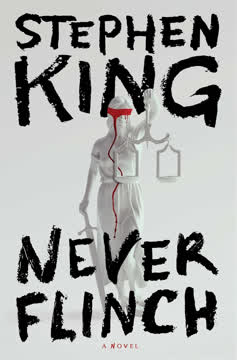
What is Never Flinch about?
- Atonement for injustice: The story centers on a series of murders in Buckeye City, where a killer calling himself "Bill Wilson" targets seemingly random innocents, leaving behind notes linking them to the jury of a past wrongful conviction case. This is framed as atonement for the death of Alan Duffrey, who died in prison after being framed.
- Parallel threats emerge: Simultaneously, a renowned feminist author, Kate McKay, embarks on a national book tour, facing escalating threats and violence from a religious zealot who stalks her across the country.
- Worlds collide in chaos: The narratives converge as the killer kidnaps key individuals to lure his targets to a condemned building, while a city-wide charity event descends into a riot, culminating in a violent confrontation and the unmasking of the perpetrators.
Why should I read Never Flinch?
- Intricate psychological thriller: The novel delves deep into the fractured minds of its antagonists, exploring complex motivations rooted in trauma, ideology, and a warped sense of justice, offering a chilling look at how guilt and fanaticism can manifest.
- Sharp social commentary: King uses the intertwined plots to critique contemporary American society, touching on themes of political polarization, media spectacle, institutional failures, and the often-unseen costs borne by those who stand for their beliefs.
- Compelling character studies: Beyond the plot, the story offers nuanced portraits of its protagonists, particularly Holly Gibney and Kate McKay, exploring their vulnerabilities, resilience, and the unexpected ways they find strength and connection in the face of overwhelming danger.
What is the background of Never Flinch?
- Echoes of real-world tensions: The narrative is set against a backdrop of intense social and political division, particularly concerning abortion rights and religious extremism, mirroring contemporary cultural conflicts in the United States.
- Influence of the justice system: The plot is directly triggered by a miscarriage of justice within the legal system – the wrongful conviction and subsequent death of Alan Duffrey – highlighting flaws in prosecution, defense, and jury deliberation.
- Recovery community context: The world of Alcoholics Anonymous and Narcotics Anonymous plays a significant role, providing the killer with an alias ("Bill Wilson") and a framework (atonement, amends) that he twists for his violent mission, while also serving as a source of potential leads for investigators.
What are the most memorable quotes in Never Flinch?
- "You have to push through to the bitter end. No flinching, no turning away.": This quote, Trig's father's mantra, encapsulates the core theme of perseverance, but also highlights the dangerous rigidity and inability to adapt that drives Trig's destructive mission.
- "The innocent should be punished for the needless death of an innocent.": From the "Bill Wilson" letter, this chilling reinterpretation of the Blackstone Rule reveals the killer's twisted logic, where vengeance is enacted upon proxies to inflict suffering on the perceived guilty.
- "It's not easy being the bad bitch. The devil-dog.": Kate McKay's self-aware reflection captures the immense personal cost of being a controversial public figure, acknowledging the hate she attracts while simultaneously embracing her defiant persona.
What writing style, narrative choices, and literary techniques does Stephen King use?
- Alternating perspectives and plotlines: King employs a multi-strand narrative, shifting between the investigation into the surrogate murders and the experiences of Kate McKay and her team, building suspense as the two seemingly separate threats move towards a collision.
- Internal monologue and voice: The novel frequently delves into characters' internal thoughts, particularly Trig's fractured psyche and his conversations with his dead father, providing deep psychological insight and highlighting the unreliable nature of his reality.
- Symbolism and recurring motifs: King uses recurring symbols like fire (destruction, cleansing), specific locations like the Holman Rink (childhood trauma, final reckoning), and objects like the ceramic horse (lost innocence, paternal influence) to add layers of meaning and connect disparate plot elements.
Hidden Details & Subtle Connections
What are some minor details that add significant meaning?
- The Plumber's Code (9721): This seemingly throwaway detail, a trick Trig learned from his father for opening keypads, becomes the crucial key allowing both Trig and later Chrissy Stewart access to the condemned Holman Rink, making it the inevitable site of the climax.
- The Ceramic Horse Paperweight: Trig's paperweight, a gift from his mother named "Trigger" by his father, is a potent symbol of his fractured childhood and the origin of his nickname, subtly linking his present violence to past trauma and paternal influence.
- The Mylar Comic Book Bags: The detail that Alan Duffrey's fingerprints were on the bags the magazines were stored in, not the magazines themselves, is the subtle piece of evidence that ADA Allen exploited and defense attorney Grinsted missed, highlighting the deliberate manipulation of truth that led to Duffrey's conviction.
What are some subtle foreshadowing and callbacks?
- Trig's early confession: In the first chapter, Trig tells Reverend Mike he's upset because someone he knew died "in lockup," a seemingly vague statement that, in retrospect, is his first oblique reference to Alan Duffrey's death and the catalyst for his mission.
- The Holman Rink's condemnation: The sign reading "HOLMAN RINK CONDEMNED BY ORDER OF CITY COUNCIL" foreshadows its eventual destruction by fire, marking it as a place already designated for ruin, mirroring the fate of the characters drawn there.
- Kate McKay's "Come on, come on, come on" gesture: This repeated physical tic, initially just a sign of Kate's energy and charisma, is later adopted by Holly and Jerome in moments of urgency, subtly linking their courage and determination to Kate's public persona.
What are some unexpected character connections?
- Donald Gibson (Trig) and the Duffrey Jury: The reveal that the Mingo Program Director, Donald Gibson, is actually "Trig" and was Juror 9 in the Duffrey trial is a major twist, connecting the seemingly separate worlds of city administration/entertainment and the criminal justice system.
- Barbara Robinson and Sista Bessie's bond: The genuine and deep friendship that quickly forms between the young poet Barbara and the legendary singer Sista Bessie is an unexpected source of warmth and connection, providing a stark contrast to the toxic relationships driving the antagonists.
- Holly Gibney and the "Elephant Shit" reference: The seemingly random detail about cleaning up elephant shit, mentioned by an AA acquaintance of John Ackerly, becomes a crucial, albeit obscure, clue that only Holly's unique intuition and connection to the Mingo (via the elephant that performed there) can potentially decipher.
Who are the most significant supporting characters?
- Corrie Anderson: More than just an assistant, Corrie is Kate's shield and emotional anchor, enduring direct attacks and kidnapping, her resilience highlighting the personal cost of standing beside a controversial figure.
- John Ackerly: The recovering addict bartender serves as a vital link to the recovery community, providing crucial, albeit fragmented, information about "Trig" to Holly and Izzy, demonstrating the unexpected places where help can be found.
- Jerome Robinson: Barbara's brother evolves from a supportive sibling and aspiring writer to a key figure in the climax, using his quick thinking and loyalty to help rescue the captives, embodying the theme of stepping up when needed.
Psychological, Emotional, & Relational Analysis
What are some unspoken motivations of the characters?
- Trig's need for paternal approval: Beyond the stated goal of making the guilty "rue the day," Trig's internal monologues reveal a deep-seated need to finally impress his abusive, deceased father, driving him to increasingly grandiose and reckless acts of violence.
- Kate McKay's pursuit of martyrdom: While advocating for her cause, Kate's actions and rhetoric suggest a subconscious desire for martyrdom, seeing her own potential suffering or death as a powerful catalyst for her movement, which both fuels her courage and blinds her to genuine threats.
- Holly Gibney's drive for atonement: Despite her stated reasons for taking the bodyguard job (money, growth opportunity), Holly's deep-seated guilt over past failures (like not preventing the Harrises' crimes) subtly motivates her relentless dedication to protecting Kate and Corrie, viewing it as a form of personal amends.
What psychological complexities do the characters exhibit?
- Trig's dissociative identity: Trig's conversations with his dead father's voice, his adoption of multiple aliases ("Bill Wilson," "Trig," "Donald Gibson"), and his shifting rationalizations for murder reveal a profound psychological break, blurring the lines between his public persona, his violent alter ego, and the internalized trauma of his past.
- Chrissy/Chris's fractured self: The dual nature of Christopher Stewart, who sometimes identifies and presents as his deceased sister Chrissy, is a complex manifestation of trauma, grief, and religious indoctrination, highlighting the psychological toll of suppressing identity and the dangers of ideological manipulation.
- Kate McKay's performance of strength: Kate projects an image of unwavering confidence and defiance, but moments of vulnerability (her reaction to the bloodied luggage, her fear during the kidnapping) reveal the immense psychological effort required to maintain her public persona in the face of constant threats.
What are the major emotional turning points?
- Corrie's bleach attack: This event transforms Corrie from a starstruck assistant into a trauma survivor, forcing her to confront the real-world danger of Kate's work and prompting her to insist on increased security measures, marking a shift in her character arc.
- The discovery of the bloodied luggage: This act of vandalism, while not physically harming Kate, is a profound emotional shock, shattering her sense of invulnerability and forcing her to acknowledge the personal nature and escalating threat of the stalking campaign.
- Sista Bessie's decision to go to the rink: Despite her fear and physical limitations, Sista Bessie's choice to risk her life to save Barbara, driven by love and faith, represents a powerful emotional turning point, demonstrating selfless courage in the face of terror.
How do relationship dynamics evolve?
- Kate and Corrie's bond: Their relationship deepens from professional assistant/employer to a bond forged in shared trauma, with Corrie gaining agency and Kate showing moments of genuine care and reliance, though the power imbalance remains.
- Holly and Kate's complex connection: Initially a professional arrangement, their relationship becomes a tense mix of admiration, frustration, and reluctant mutual reliance, with Holly struggling with Kate's arrogance and Kate eventually acknowledging Holly's quiet competence and courage.
- Barbara and Sista Bessie's mentorship/friendship: What begins as a fan's admiration blossoms into a genuine friendship and artistic collaboration, providing Barbara with confidence and opportunity, and offering Sista Bessie a renewed sense of purpose and connection.
Interpretation & Debate
Which parts of the story remain ambiguous or open-ended?
- The full extent of Fallowes's complicity: While strongly implied that Deacon Andrew Fallowes manipulated Christopher/Chrissy Stewart, the novel doesn't definitively prove his direct involvement in planning or ordering the attacks on Kate McKay, leaving the degree of his culpability open to interpretation.
- The fate of Bonita Gibson: The disappearance of Donald Gibson's mother is mentioned as a potential factor in his psychological breakdown and his father's perceived guilt, but her body is never found, and the truth of what happened to her remains an unresolved mystery.
- The long-term psychological impact on survivors: While the novel touches on the immediate aftermath and some coping mechanisms (Barbara's poetry/singing, Holly's withdrawal from bodyguarding), the lasting psychological effects of the trauma on characters like Corrie, Barbara, and Kate are left for the reader to contemplate beyond the final pages.
What are some debatable, controversial scenes or moments in Never Flinch?
- The Guns and Hoses riot: The depiction of the charity softball game descending into a violent, drunken brawl between police and firefighters is a controversial portrayal of public servants, sparking debate about institutional culture, accountability, and the prioritization of spectacle over safety.
- Kate McKay's public persona and rhetoric: Kate's confrontational style, her use of provocative language, and her willingness to put herself and others at risk for her cause are presented complexly, inviting debate about the effectiveness and ethics of her activism.
- Holly Gibney's use of lethal force: Holly's decision to shoot Donald Gibson, while presented as necessary for survival, raises ethical questions about vigilante justice and the psychological toll of taking a life, even in self-defense or defense of others.
Never Flinch Ending Explained: How It Ends & What It Means
- The Climax at the Holman Rink: The story culminates with Donald Gibson (Trig) holding Corrie, Barbara, and Kate captive in the condemned Holman Rink, planning a fiery "Viking funeral" for them as proxies for those he blames for Alan Duffrey's death. Christopher/Chrissy Stewart arrives, also intending to kill Kate, but is killed by Gibson in the ensuing chaos. Holly, guided by a tracking device and intuition, arrives with Jerome just as Gibson is about to ignite the fire.
- Rescue and Resolution: Holly shoots Gibson, and Jerome helps rescue the bound women as the rink burns. Gibson dies, and Stewart's body is also recovered. The riot at Dingley Park rages simultaneously, distracting authorities but ultimately leading to institutional fallout (chiefs resign, officers disciplined). The survivors are physically and emotionally scarred but alive.
- Meaning and Aftermath: The ending signifies the destructive culmination of unchecked guilt and fanaticism, but also highlights the power of courage, loyalty, and unexpected connections (Holly/Jerome, Barbara/Sista Bessie) in overcoming evil. Gibson's death ends his spree, but the underlying issues of injustice, trauma, and societal division remain. Kate's survival makes her an even more potent symbol, while Holly grapples with the moral weight of her actions. The final scene of Holly and Izzy sharing lunch suggests a return to normalcy is possible, but the scars and lessons learned from the events of "Never Flinch" endure.
Holly Gibney Series

About the Author


Download PDF
Download EPUB
.epub digital book format is ideal for reading ebooks on phones, tablets, and e-readers.








































