

Key Takeaways
If you're not reading 70+ books a year, you're not ready to write
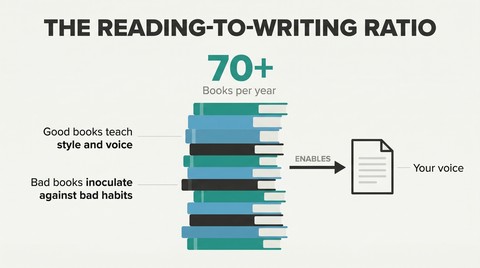
Reading is the Great Commandment. King reads 70-80 books a year — on the treadmill, in waiting rooms, in the car via audiobooks — and considers reading the creative center of a writer's life. Bad books vaccinate you against bad habits: a pulp sci-fi novel that overused the word "zestful" inoculated King against it forever. Good books teach style, narration, and truth-telling. As a teenager, King wrote like whoever he was reading — Bradbury's nostalgia, Cain's hardboiled prose, Lovecraft's baroque excess — and that stylistic blending is how you develop your own voice.
Kill your television. King argues that TV is the enemy of reading time and should be eliminated. A four-to-six-hour daily program of reading and writing won't feel strenuous if you have genuine aptitude — it'll feel like play. Without constant reading, you lack the instincts to know what's trite, what's fresh, and what lies dead on the page.
Treat stories as buried fossils to excavate, not plots to construct
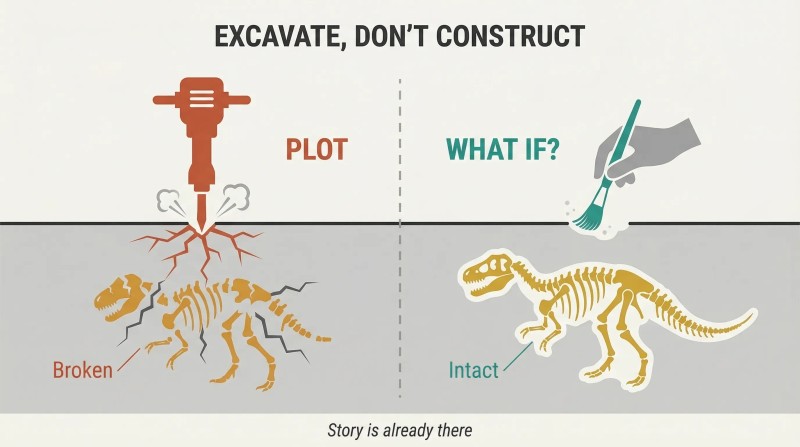
Stories are found objects. King's central craft metaphor: stories are fossils embedded in the ground, and the writer's job is to excavate them intact using increasingly delicate tools. Plot is a jackhammer — it breaks as much as it liberates. Instead, King begins with a situation and follows it. Misery started with a single image from a dream: a psychotic fan holding a writer captive. He wrote sixteen pages that first night without knowing the ending. The characters surprised him — Annie Wilkes became pitiable, Paul Sheldon resourceful. None of it came from an outline.
Start with a What-if question. What if vampires invaded a small New England village? ('Salem's Lot). What if a cleaning woman was suspected of a murder she didn't commit? (Dolores Claiborne). What if a mother and son were trapped by a rabid dog? (Cujo). A strong enough situation renders the whole question of plot moot.
Stock your writer's toolbox — vocabulary and grammar come first
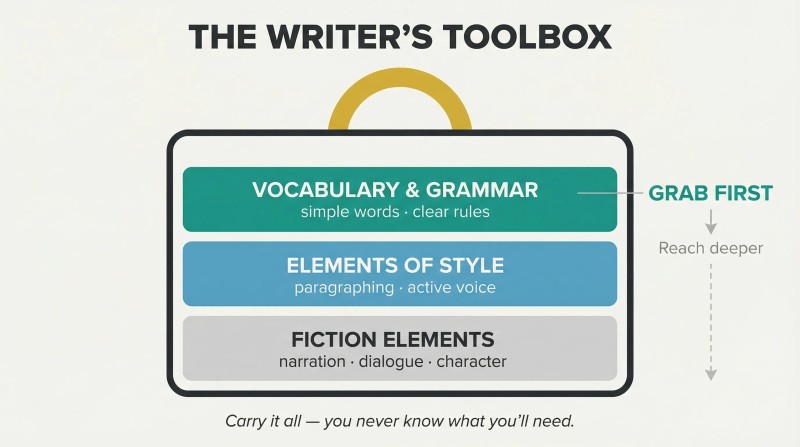
King's toolbox has layers. Modeled on his grandfather's handmade carpentry box, the writer's toolbox places the most common skills on top: vocabulary and grammar. Below that: elements of style — paragraphing, active vs. passive construction. Below that: the fiction elements like narration, dialogue, and character. Carry the whole toolbox every time you write, because you never know what you'll need.
Don't dress up your vocabulary. Use the first word that comes to mind if it's appropriate and colorful. Reaching for fancy words is like dressing a household pet in evening clothes. Steinbeck wrote a 50-word sentence in The Grapes of Wrath using 39 one-syllable words. Hemingway wrote "He came to the river. The river was there." Both are masterful. The rule: never say "emolument" when you mean "tip."
Fear breeds passive voice, adverbs, and bloated prose
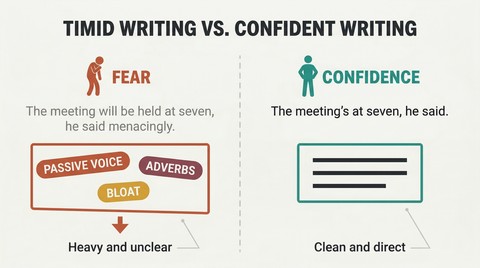
Timid writers produce weak sentences. Passive voice ("The meeting will be held at seven") feels safe but reads as bureaucratic. The timid writer thinks it sounds authoritative; it sounds like an instruction manual. Rewrite it: "The meeting's at seven." Adverbs in dialogue attribution — "he said menacingly" — signal that the writer doesn't trust the context to carry the meaning. King calls these Swifties, after the Tom Swift novels: "'Do your worst!' Tom cried bravely."
"Said" is almost always sufficient. Larry McMurtry, whom King admires, uses "he said/she said" even in emotional crises. If the preceding dialogue and action are doing their job, the reader already knows how the words were spoken. The adverb is a crutch — like Dumbo's magic feather. The magic was already in the writing.
Write your first draft behind a closed door, for you alone
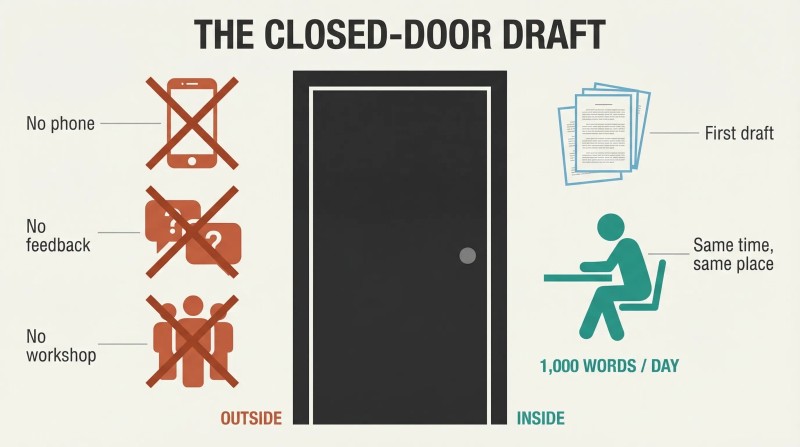
The All-Story Draft needs isolation. King's first phase of writing — borrowed from newspaper editor John Gould — means no outside input whatsoever. Don't show your spouse, don't bring pages to a workshop, don't ask for feedback. Let the story's internal pressure carry you to the end. King compares writing to creative sleep: same time, same place, until your mind learns to unlock on schedule.
Set a daily minimum and shut the door. King suggests a thousand words per day for beginners, with the door literally closed. No phone, no TV, no distractions. He personally targets 2,000 words daily, finishing a first draft in roughly three months. The muse doesn't visit the uncommitted. Show up consistently at your desk and he'll grudgingly appear, "chomping his cigar and making his magic."
Put your desk in the corner — it's a workbench, not a throne
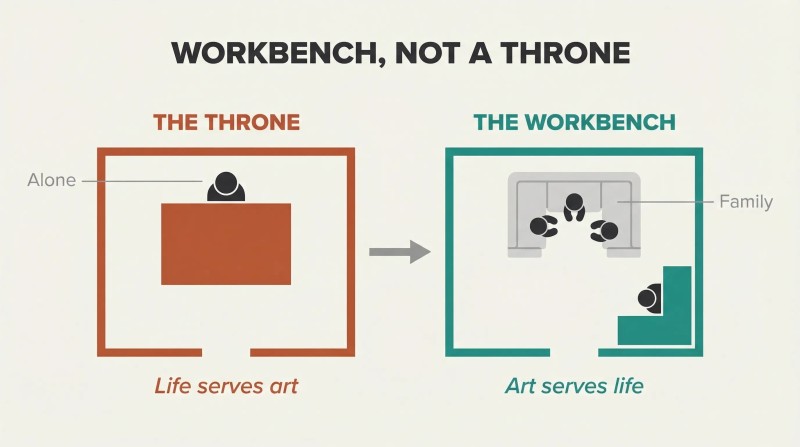
King's giant desk nearly killed him. For six years he wrote behind a massive oak desk centered in a skylighted study. He was also drunk or high the entire time — drinking a case of tallboys nightly, snorting cocaine until his nose bled. After getting sober through an intervention staged by his wife Tabitha, he replaced that monument with a living-room suite. His new desk went in the corner, half the size. His kids would come up to watch basketball and eat pizza where the old desk had been.
The corner desk is both literal and symbolic. Do the work, but don't let it devour your marriage, your health, or your family. King's most productive decades came after he stopped treating his writing space as a command center and started treating it as one part of a full life.
Every manuscript is collapsible — cut at least 10% per draft
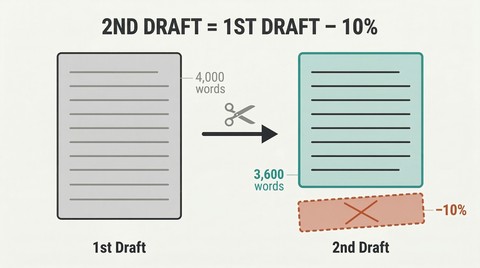
An anonymous editor's rejection note transformed King's revision. Scribbled at the bottom: "2nd Draft = 1st Draft- 10%." King taped this formula — the Rewrite Formula — above his typewriter. Before it, his second drafts ran longer than his firsts. Afterward, a 4,000-word story aimed for 3,600 in revision. The formula taught him that every story can be compressed without losing its essence.
What gets cut? Whatever bores your reader. When King's wife told him a two-page section about his protagonist's community-service work was dull, he slashed it to two paragraphs. Three million readers later, not one noticed it was gone. After finishing a draft, King lets it rest at least six weeks — long enough that rereading it feels like encountering someone else's work. Then the cutting begins.
One person who believes in you can save your entire career
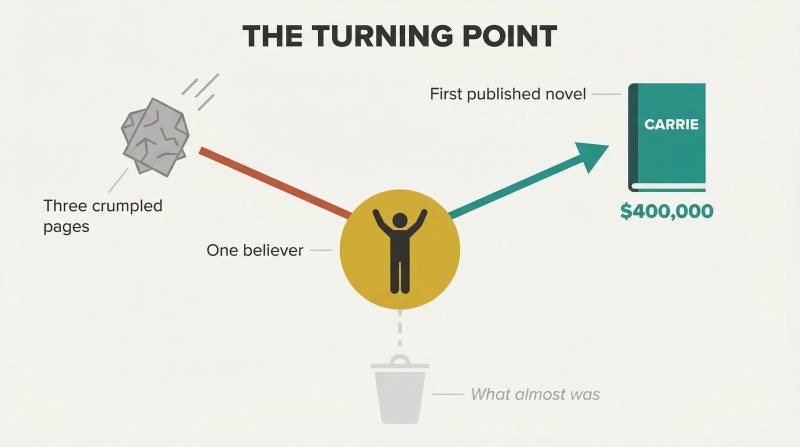
Tabitha King rescued Carrie from the trash. King had written three pages about a telekinetic outcast girl, hated them, and crumpled them into the wastebasket. Tabby fished them out, shook off the cigarette ashes, and said: "You've got something here. I really think you do." That rescued manuscript became King's first published novel. The paperback rights sold for $400,000 — announced over the phone while King stood in the kitchen of their $90-a-month apartment.
Belief and honesty work together. Throughout years of poverty — two kids, laundry wages, no telephone — Tabby never once suggested King's writing time was wasted. But she was also his fiercest critic, his Ideal Reader, the person whose laughter or silence told him whether a scene worked. Every writer needs both: unconditional faith that the work matters and unsparing honesty about where it fails.
Sobriety preserves creativity; addiction only pretends to help
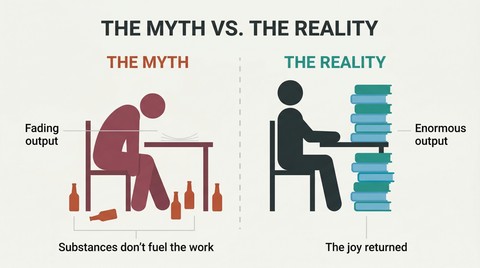
King barely remembers writing Cujo. By the mid-1980s he was drinking a case of sixteen-ounce tallboys every night plus cocaine and whatever else he could find. He wrote The Tommyknockers with cotton swabs up his nose to stem coke-induced nosebleeds. That novel's alien spacecraft — which trades intelligence for your soul — was, King admits, the best metaphor for addiction his exhausted mind could produce.
The myth of the tortured artist is self-serving nonsense. Hemingway and Fitzgerald didn't drink because they were creative — they drank because they were alcoholics. King's wife staged an intervention, dumping a garbage bag of beer cans, cocaine vials, and mouthwash bottles onto the living room rug. He got sober, terrified he'd lose his ability to write. He didn't. The joy returned, and his output remained enormous.
Writing is a way back to life — start even when it hurts
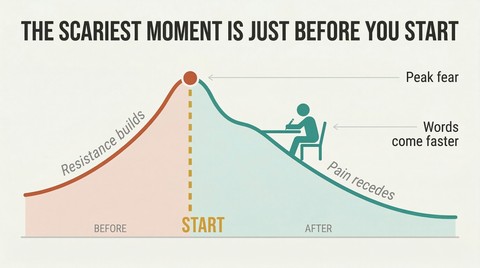
Five weeks after a van shattered his body, King sat down to write. Nine fractures in his right leg, chipped spine in eight places, collapsed lung. The first session lasted an hour and forty minutes in a makeshift desk his wife assembled in the back hallway. He was dripping sweat, nearly unable to remain upright in his wheelchair. The first 500 words felt like crossing a stream on wet stones — one terrifying step at a time.
But the words came faster. Then faster still. The pain receded without disappearing. King had written Carrie in a laundry closet and 'Salem's Lot in a trailer — the back hallway felt like coming full circle. He finished On Writing there, balanced between agony and creation, proving his own thesis: the blank page is only terrifying for the moment before you begin.
Analysis
On Writing is structurally radical for a craft book. By braiding childhood memoir, addiction narrative, and near-death experience through practical instruction on grammar and storytelling, King creates something unprecedented: a theory of fiction that feels not taught but confessed. The advice gains authority not from King's sales figures but from the visible scar tissue of the life that produced them.
The book's most provocative claim — that stories are pre-existing fossils to be excavated, not plots to be constructed — positions King against the dominant tradition of story structure, from Aristotle's Poetics through Robert McKee's Story. King argues for creative surrender: begin with a situation and follow wherever it leads. What he doesn't fully acknowledge is that this intuitive method likely depends on having internalized millions of words of reading and writing — the very muscle memory a beginner hasn't built. The toolbox metaphor quietly resolves this tension: stock the tools before trusting your instincts.
The addiction narrative serves a structural purpose easily missed. Just as stories must be discovered rather than controlled, recovery requires admitting that willpower alone won't save you. The intervention scene — Tabitha dumping a garbage bag of beer cans, cocaine vials, and mouthwash bottles onto the rug — mirrors King's revision philosophy: sometimes someone else must show you what you can't see yourself. The Ideal Reader and the interventionist perform the same function.
What makes On Writing endure is its refusal to be precious about craft while insisting it matters enormously. King treats writing as blue-collar labor — toolboxes, daily word counts, a desk in the corner — while defending it as telepathy and magic. That contradiction isn't a flaw. It's the engine of the entire book, and the reason writers return to it involuntarily, because some things won't stay buried.
Review Summary
On Writing: A Memoir of the Craft is widely praised as an insightful and inspiring book for aspiring writers. King combines personal anecdotes with practical writing advice, emphasizing the importance of reading extensively, writing regularly, and honing one's craft. Readers appreciate King's honesty, humor, and straightforward approach to discussing the writing process. The book covers topics such as grammar, storytelling techniques, and the author's own experiences with rejection and success. Many consider it an essential read for both fans of King's work and those interested in improving their writing skills.
People Also Read

Glossary
Writer's Toolbox
Layered metaphor for writing skillsKing's central metaphor for a writer's accumulated skills, modeled on his grandfather's handmade carpentry toolbox. Organized in layers: vocabulary and grammar on top (most commonly used), elements of style on the next level, and fiction techniques (narration, dialogue, character development) below. The writer should build and maintain this toolbox so they're prepared for any challenge, just as a carpenter carries tools to every job site.
Ideal Reader (I.R.)
The one person you write forThe single specific person a writer imagines while composing and revising. For King, this is his wife Tabitha. The I.R. helps gauge pacing, clarity, humor, and emotional impact—serving as an internal audience during the private first draft and as the primary external critic during revision. King watches Tabby read his manuscripts, looking for laughs, tears, or the moment she puts the pages down.
All-Story Draft
The private, uninterrupted first draftKing's term for the first draft, written with the 'door closed'—no outside input, focused entirely on getting the story down as fast as possible while remaining comfortable. Should be completed in roughly three months to maintain momentum and freshness. The writer should resist showing this draft to anyone, letting the story's internal pressure and the hope of success carry them to the end.
Swifties
Adverb-laden dialogue attributionsDialogue attributions burdened with unnecessary adverbs, named after the Tom Swift adventure novels by Victor Appleton II, which featured lines like "'Do your worst!' Tom cried bravely." King considers them a hallmark of timid, insecure writing. Examples: 'she shouted menacingly,' 'he pleaded abjectly.' The remedy is to use 'said' almost exclusively and let context convey tone.
The Rewrite Formula
Second draft minus ten percentA revision guideline King adopted from an anonymous editor's rejection note: 2nd Draft = 1st Draft - 10%. Before learning this formula, King's revisions made stories longer. Afterward, he systematically compressed every manuscript—a 4,000-word story targets 3,600 in revision, a 350,000-word novel targets 315,000. King calls the effect of judicious cutting 'literary Viagra' and considers every manuscript collapsible.
Door Closed / Door Open
Two phases of the writing processKing's two-phase process, originally articulated by newspaper editor John Gould. 'Door closed' is the first draft phase: written privately, without outside input, focused purely on story. 'Door open' is the revision phase: the writer incorporates feedback from the Ideal Reader and others, considers audience, enhances theme and symbolism, and cuts aggressively. The closed door keeps the world out; the open door lets it back in.
Constant Reader
King's term for his audienceKing's affectionate term for his dedicated readership, used throughout his career and in On Writing. Represents the general reader whose experience the writer must always prioritize. Without Constant Reader, the writer is 'just a voice quacking in the void.' The concept reinforces King's belief that writing is fundamentally an act of communication—telepathy between writer and reader across time and space.
FAQ
What's "On Writing: A Memoir of the Craft" about?
- Blend of memoir and guide: "On Writing" by Stephen King combines personal memoir with a writing guide, offering insights into King's life and career.
- Practical writing advice: The book provides practical tips on grammar, style, and the writing process, drawn from King's extensive experience.
- Inspiration for writers: It serves as a motivational tool for aspiring writers, emphasizing the importance of perseverance and passion in the craft.
Why should I read "On Writing: A Memoir of the Craft" by Stephen King?
- Learn from a master: Stephen King is a prolific and successful author, and his insights are invaluable for both new and experienced writers.
- Engaging storytelling: The book is written in King's engaging style, making it both informative and entertaining.
- Practical and motivational: It combines practical writing tips with motivational anecdotes, encouraging readers to pursue their writing dreams.
What are the key takeaways of "On Writing: A Memoir of the Craft"?
- Read and write regularly: King emphasizes the importance of reading widely and writing daily to improve one's craft.
- Simplicity and clarity: He advises using simple, clear language and avoiding unnecessary adverbs and passive voice.
- Honesty in storytelling: King stresses the importance of honesty in writing, urging writers to tell the truth in their stories.
What is Stephen King's writing process as described in "On Writing"?
- Daily writing routine: King writes every day, including holidays, to keep his characters and stories alive in his mind.
- First draft with the door closed: He writes the first draft for himself, without external opinions, allowing creative freedom.
- Revisions with the door open: After the first draft, King revises with feedback, refining the work for the audience.
How does Stephen King view the role of plot in writing?
- Plot is secondary: King believes that plot is not essential and can often feel artificial and labored.
- Focus on situation and characters: He prefers to start with a situation and let the characters drive the story.
- Stories as found objects: King views stories as pre-existing relics that the writer uncovers and transcribes.
What advice does Stephen King give about writing dialogue?
- Honesty is crucial: King emphasizes that dialogue should be honest and true to the characters.
- Avoid clichés: He advises against using clichéd phrases and encourages fresh, realistic dialogue.
- Dialogue reveals character: Good dialogue can convey a character's intelligence, honesty, and personality.
What does Stephen King say about the importance of reading for writers?
- Read a lot: King insists that reading is essential for writers to learn different styles and improve their craft.
- Exposure to various genres: Reading widely exposes writers to different genres and techniques.
- Reading as a learning tool: It helps writers understand what works and what doesn't in storytelling.
How does Stephen King suggest handling back story in writing?
- Keep it minimal: King advises keeping back story to a minimum to maintain the story's pace.
- Integrate it naturally: Back story should be integrated naturally into the narrative without overwhelming the reader.
- Focus on the present: He suggests focusing on the present story and only including back story that is essential.
What are some of the best quotes from "On Writing: A Memoir of the Craft" and what do they mean?
- "The adverb is not your friend." King advises against overusing adverbs, as they can weaken writing.
- "Books are a uniquely portable magic." This highlights the power of books to transport readers to different worlds.
- "The scariest moment is always just before you start." This emphasizes the fear and hesitation writers often feel before beginning a new project.
How does Stephen King view grammar and style in writing?
- Grammar as a tool: King sees grammar as a fundamental tool for clear communication.
- Style as personal expression: He encourages writers to develop their own style, reflecting their unique voice.
- Simplicity over complexity: King advocates for straightforward language to convey meaning effectively.
What advice does Stephen King give to aspiring writers in "On Writing"?
- Read widely and often: King stresses the importance of reading a variety of genres and authors.
- Write every day: He advises setting a specific word count goal to maintain discipline.
- Embrace rejection and keep going: King shares his own experiences with rejection and encourages perseverance.
What role does Stephen King's personal life play in "On Writing"?
- Memoir elements: The book includes memoir elements, sharing King's personal experiences and how they influenced his writing.
- Overcoming challenges: King candidly discusses his battles with addiction and how he overcame them.
- Family support: He highlights the importance of his family's support in his writing career.
About the Author
Other books by Stephen King


Download PDF
Download EPUB
.epub digital book format is ideal for reading ebooks on phones, tablets, and e-readers.








































