

Plot Summary
Ancestor from the Wall
In 2012, Etsy Beaucarne3 — a single, forty-two-year-old Communications professor at the University of Wyoming — receives digitized pages of a journal discovered inside the wall of a Montana parsonage being renovated.
The journal belongs to Arthur Beaucarne,2 her great-great-great-grandfather, a Lutheran pastor who vanished from Miles City in 1912. Desperate for a book contract to save her foundering tenure case, Etsy3 begins transcribing the spidery, acid-eaten script.
She prints the pages on card stock, spreads them across her apartment floor, and walks her ancestor's final weeks like a path. Her only companion is her cat Taz,12 a scrappy tomcat who brings home increasingly alarming prey — birds, moles, and one very alive prairie dog that charges her down the hallway.
Sunday's Uninvited Penitent
In March 1912, an Indian man arrives at Beaucarne's2 Sunday service wearing a floor-length black clerical robe and dark spectacles. He sits alone in the last pew, tracking the pastor's every movement. Beaucarne,2 seventy-three and limping from three missing toes, is mesmerized and unnerved. The second Sunday, after the congregation files out, this man stays.
He introduces himself as Good Stab,1 a Pikuni Blackfeet, and renames the pastor Three-Persons for the Trinity. He claims an eye condition that requires darkness. Beaucarne2 snuffs the candles, and in the dim chapel, Good Stab1 announces he has come to confess. He promises to return every Sunday until the telling is complete and his great crime revealed.
God Caged in Iron
Good Stab's1 confession begins in 1870. He and his companion Tall Dog5 are recruited by two tribal policemen, Peasy8 and Hunts-to-the-Side,1 to hide a burned wagon train near Pikuni territory — white men disguised as Indians had attacked it to frame the Blackfeet. Under the canvas of the surviving wagon, they find an iron cage containing a naked white creature with fangs, black eyes, and claws.
Good Stab1 shoots it with an arrow through the chest. It pulls the arrow out. Hunts-to-the-Side fires a musket ball into its gut. It recovers. Peasy8 recognizes a possibility: the Pikuni prophecy says a Great White God will climb Chief Mountain and open an escape for their people. They decide to drag the creature into the mountains to test this hope.
The Beaver's Price
While the others haul the caged creature toward Chief Mountain through a blizzard, Good Stab1 is sent to find a wooden yoke. Instead of going straight to the fallen tree his spirit guide — a white rabbit — shows him, he wades into a beaver pond and kills a beaver for its pelt, needing one more to trade for a repeating rifle.
The Pikuni are forbidden to kill beavers; their medicine is sacred. His spirit guide watches from a log with sad eyes, like his father's when Good Stab1 drank cow's milk at the fort. He throws a stone to chase it away. The rabbit vanishes forever. This single act of greed — choosing a gun over the sacred — is the first step into darkness, the broken hinge his entire future swings on.
Blood Swallowed in Snow
A detachment of twenty soldiers, sent to intercept the fugitive Owl Child, stumbles onto the Pikuni party in the mountains. Hunts-to-the-Side dies immediately, his musket unfired. Tall Dog5 takes a fatal shot through the liver.
Peasy,8 shirtless in the snow, sings his death song while soldiers riddle him, and with his last motion drags his hand across the latch of the iron cage. The Cat Man4 erupts. Thirteen soldiers die in seconds — throats torn, heads removed, a slaughter so fast the snow barely registers it.
The last soldier fires a cannon that cuts the creature in half. Another shoots Good Stab1 twice. As he dies, the Cat Man's4 blood rolls downhill across crusted snow, warm against Good Stab's1 lips, filling his mouth and throat. He swallows. He dies. He doesn't stay dead.
The Rules of Red Thirst
Good Stab1 wakes days later running on all fours, his skin charred black from being burned in the soldiers' pyre. His senses are transformed — he can taste the world through his nose, see in darkness, hear roots growing. He tracks the cannon soldier by scent and kills him, drinking his blood in an ecstasy he compares to buttermilk and rum.
Afterward, he tries to die — slitting his own throat, stabbing a knife through his chest. His body heals both wounds. He discovers the rules of his curse: he can only drink blood, never eat solid food. If he feeds on animals, he takes on their features — antler nubs from elk, spots from fawns. To stay human, he must drink from humans. Tobacco constricts his blood like poison. And he can no longer dream.
Weasel Plume's Herd
Venturing east from the mountains, Good Stab1 stumbles into a field of slaughtered buffalo stretching farther than he can cross in a night — skinned for robes, tongues cut out, meat left rotting. A hide hunter's long-range Sharps rifle punches through his shoulder from eight hundred paces.
He burrows inside a dead bull to heal, drinking its warm blood. Calves bawl around him for their dead mothers, sucking his fingers. He rescues one — a white calf he names Weasel Plume,9 gifting it his own childhood name, the most precious thing he has left.
He begins building a secret herd on Face Mountain, barricading the approaches with brush and dead animals, and launches a one-man war against the hide-hunting camps — skinning the skinners, cutting their tongues out, painting their dead faces yellow and black.
Napi's Reluctant Student
Good Stab's1 war has been running four years when he accidentally smokes his father Wolf Calf's6 pipe. The tobacco seizes his blood vessels shut, blackening his veins, collapsing his lungs. Wolf Calf6 runs all night carrying his dying son into the Backbone mountains, delivering him to an old trapper in a hidden dugout.
This is no trapper but Napi,7 the Blackfeet creator-trickster, alive and eating from jars of golden preserves. Over two winters, Napi7 nurses Good Stab1 back by feeding him from his own inexhaustible wrist, and teaches him English by gradually switching Pikuni words for American ones in the endless stories he tells. When Good Stab1 wakes speaking a new language, Napi7 warns him: keep feeding on white men, and he'll become one. His jaw is already growing stubble.
The Skinned Men of Miles City
Back in 1912, Beaucarne's2 Montana town is unraveling. Skinned bodies appear on the prairie — men stripped of their hides, faces painted yellow and black, dusted with strychnine so no scavengers disturb them.
A Pinkerton detective named Dove11 arrives from San Francisco, investigating a wealthy family called Flowers — a father and three sons who vanished after the father was seen meeting a man in dark spectacles and a black robe. Dove11 shares photographs with Beaucarne2 and reveals the first body was the father, Benjamin Flowers.
The Titanic sinks, triggering a local suicide. Then Dove11 himself is found mangled on the railroad tracks, and postmaster Livinius Clarkson15 vanishes. Beaucarne2 clutches a tin cup Good Stab1 left behind, smeared with yellow and black paint, and tries to lure the sheriff13 to Sunday service.
Black Yolk, Sharp Teeth
Climbing a ladder to investigate a hidden ventilation window in the church ceiling, Beaucarne2 discovers a dust-free rafter where someone has been sitting, watching him in the dark.
A German parishioner named Frieda Zimmerman brings eggs and drops them one by one outside the church — each cracks yellow for the dogs, except the last, snatched by a strange terrier and spat back out. Its yolk is oily black. Frieda mutters a single word: nachzehrer — the old German term for a creature that rises from the grave to feed on the living.
When Good Stab1 returns that Sunday, he snatches a mole from the church cat's mouth and drinks it dry in front of Beaucarne,2 his mouth red, a drop of blood sliding down his chin while he holds the pastor's terrified gaze.
The Cat Man Comes Home
In Good Stab's1 confession, decades have passed. The creature they thought was dead has survived — healing over years in the mountains, feeding on elk until antlers crown his head and his legs stretch to inhuman length. The Cat Man4 finds Good Stab's1 secret buffalo herd on Face Mountain and slaughters every animal, saving Weasel Plume9 for last — skinning the white bull alive.
When Good Stab1 attacks in grief and fury, the Cat Man4 overpowers him, breaks his bones, and imprisons him inside the original iron cage, sunk into a glacier. For three winters Good Stab1 is trapped in blue ice, fed only the occasional victim the Cat Man4 pushes down through a melted hole. He escapes by biting off his own hand and chipping through ice with exposed bone.
Blackie's Sacrilege
Good Stab1 returns to the Small Robes disguised as a bearded white man called Blackie, only to find the Cat Man4 installed as their leader under the name Walks Twice, living in a lodge painted entirely black. Walks Twice has been feeding on the band's people and forces a children's Sun Dance — the most sacred Pikuni ceremony, performed by children who drum and cry, a deliberate desecration.
Good Stab1 is made to dance with bone pegs through his chest. When the band fractures in terror, the Cat Man4 pursues a deaf girl named Kills-in-the-Water10 whose blood possesses a rare quality no vampire can resist. Good Stab1 knows the only way to stop the Cat Man4 is to use that irresistible blood against him — a plan requiring the girl to die.
The Girl Who Killed a God
On Wild Goose Island, Good Stab1 sets his trap: iron traps from drowned trappers' caches, Kills-in-the-Water10 as the lure. When the Cat Man4 wades across and bites into her neck, Good Stab1 simultaneously bites her shoulder — but instead of swallowing, he pushes his own blood back into her wound.
One drop of Cat Man4 blood had knocked Good Stab1 unconscious for days; a full mouthful of his blood through the girl devastates the ancient vampire. Good Stab1 force-feeds him tobacco through a broken pipe, then spends four years feeding him only fish, until the Cat Man forgets himself entirely and becomes a sturgeon, released into the lake with no memory of five centuries. Kills-in-the-Water10 dies in Good Stab's1 arms. This is the confession's true weight.
Crucified in His Own Church
Good Stab1 bites Beaucarne2 unconscious at a campfire north of the Yellowstone and carries him back to the church. The pastor wakes tied to the wooden cross above his own pulpit, his bare feet adorned with false toes clipped from corpses.
Below him, lit candle by candle, the pews hold the dead: Sheriff Doyle13 with his badge pinned through his eye, Livinius Clarkson15 wrapped in a tattered American flag, the lodging house regulars posed in their customary seats. Then comes the cruelest blow — the Flowers family.
Good Stab1 reveals that Benjamin Flowers was Beaucarne's2 own son, conceived with a red-haired woman at the fort after the massacre. The youngest, Arthur, shares the pastor's name. Good Stab1 has drained Beaucarne's2 entire bloodline and staged them as his congregation.
The Whisper That Killed 173
Hanging from the cross, Beaucarne2 breaks. He admits that in January 1870, he was a young civilian traveling with Major Baker's cavalry, freezing, starving, obsessed with pudding left behind at the fort.
On the morning the soldiers found Heavy Runner's camp on the Marias River, Beaucarne2 attached himself to the scout Joe Cobell and whispered into his ear — telling him the Indians were savages, that God forgave the killing of foxes who stole hens, that shooting them would be mercy. Cobell raised his rifle and shot Chief Heavy Runner through his peace paper.
The entire bluff opened fire. A hundred and seventy-three Blackfeet died that morning — mostly women, children, and elders sick with smallpox. When Good Stab1 asks why, Beaucarne2 bellows his damning answer: because they were just Indians.
Granddad, the Giant Prairie Dog
A century later, Etsy's3 father dies in a Denver facility. In his Bible she finds an unstamped letter from the Blackfeet Nation addressed to her — hand-delivered to his deathbed.
Then Good Stab1 comes to her apartment wearing a bison-head mask and work boots, returns her missing cat Taz,12 and presents what he has kept imprisoned for a hundred years: Arthur Beaucarne,2 transformed by a century of forced prairie-dog blood into a seven-foot rodent with human eyes.
The creature tries to claw its way onto her couch, falls between the couch and coffee table, thrashing in terror. When Etsy3 holds out her father's Bible, it turns away. When she lights one of her dead father's cigarettes and offers it, the creature inhales with the desperate gratitude of a man reaching for death.
Ashes Eat the Ink
Etsy3 loads the sedated creature and Taz12 into her Subaru and drives through a blizzard toward Montana. She stops in Bozeman, where she donates the journal to the university library — then, alone in the conservation lab for ten promised minutes, she opens the climate-controlled case and sifts her father's alkaline cremains onto the acid-eaten pages.
The calcium phosphate neutralizes the old ink's acid, punching each painstaking letter from its page, erasing the written record of Good Stab's1 confession forever. She deletes the digital copies from the library server. By the time she reaches the parking lot, a hundred years of spidery handwriting is dissolving into salt, and the story exists only in the minds of those who carried it.
The Bluff, the Fire, the Nod
At the Marias Massacre site on January 23rd — the 143rd anniversary — Etsy3 kills the creature that was Arthur Beaucarne.2 She uses a nail gun, a cable saw, lighter fluid, and spray foam, sobbing with every trigger pull, every drag of the cable through his neck.
The headless body stumbles toward the bluff's edge and falls, burning, into the river bottom below. Down there, among Blackfeet memorial riders who have come as they come every year, Good Stab1 sits a painted horse. He watches the burning shape tumble down through the snow.
He nods once. Then he turns his horse around — a hard hat swinging from his saddle beside his dark spectacles — and rides west toward the Backbone with his people. The storm folds him into itself, and the oldest debt in Montana closes like a wound that finally remembered how.
Analysis
The Buffalo Hunter Hunter reimagines the vampire as a product of colonialism rather than aristocratic European decadence. Good Stab's1 transformation occurs simultaneously with the Marias Massacre — the same system that kills his people births his curse. The Cat Man4 arrives by ship from Europe, and his blood creates a new predator from the body of the colonized, reframing vampirism not as seduction but as infection that reproduces itself across generations.
The novel's most devastating insight is its body-changing mechanic: Good Stab1 becomes what he eats. This literalizes the assimilation paradox Indigenous peoples face — consume settler culture to survive, but risk losing yourself entirely. The only way Good Stab1 can remain Pikuni is by drinking Pikuni blood, which means killing his own people. There is no clean survival, only degrees of self-destruction.
The triple-layered narrative — Etsy3 reading Beaucarne2 transcribing Good Stab1 — mirrors how historical trauma transmits across generations. Each layer adds distance but also distortion: Beaucarne's2 footnotes betray his skepticism and guilt, Etsy's3 annotations show academic detachment crumbling into personal reckoning. The confession is both genuine and weaponized — Good Stab1 needs absolution but also vengeance, and the novel refuses to separate these impulses, suggesting that in the aftermath of genocide, justice and healing may be irreconcilable needs contained within the same act.
The Marias Massacre functions as the gravitational center everything orbits. Beaucarne's2 guilt originates there, Good Stab's1 transformation begins simultaneously, and Etsy3 must physically return there to break the cycle 143 years later. The closing image — Good Stab1 riding away with memorial riders, a construction hard hat swinging from his saddle — refuses the expected horror ending. The monster of this story was never the vampire. It was the whisper that made the first shot seem reasonable, and the century of silence that followed.
Review Summary
The Buffalo Hunter Hunter is a highly-praised historical horror novel blending Native American history with vampire lore. Readers appreciate Jones' unique take on vampires, the immersive writing style, and the powerful exploration of colonization's impact. Many found the book emotionally affecting and thought-provoking, praising its complex characters and atmospheric setting. Some readers struggled with the dense prose and slow pacing, while others considered it a masterpiece. The novel's graphic violence and animal harm were noted as potential triggers. Overall, most reviewers highly recommend the book for its originality and impact.
Characters
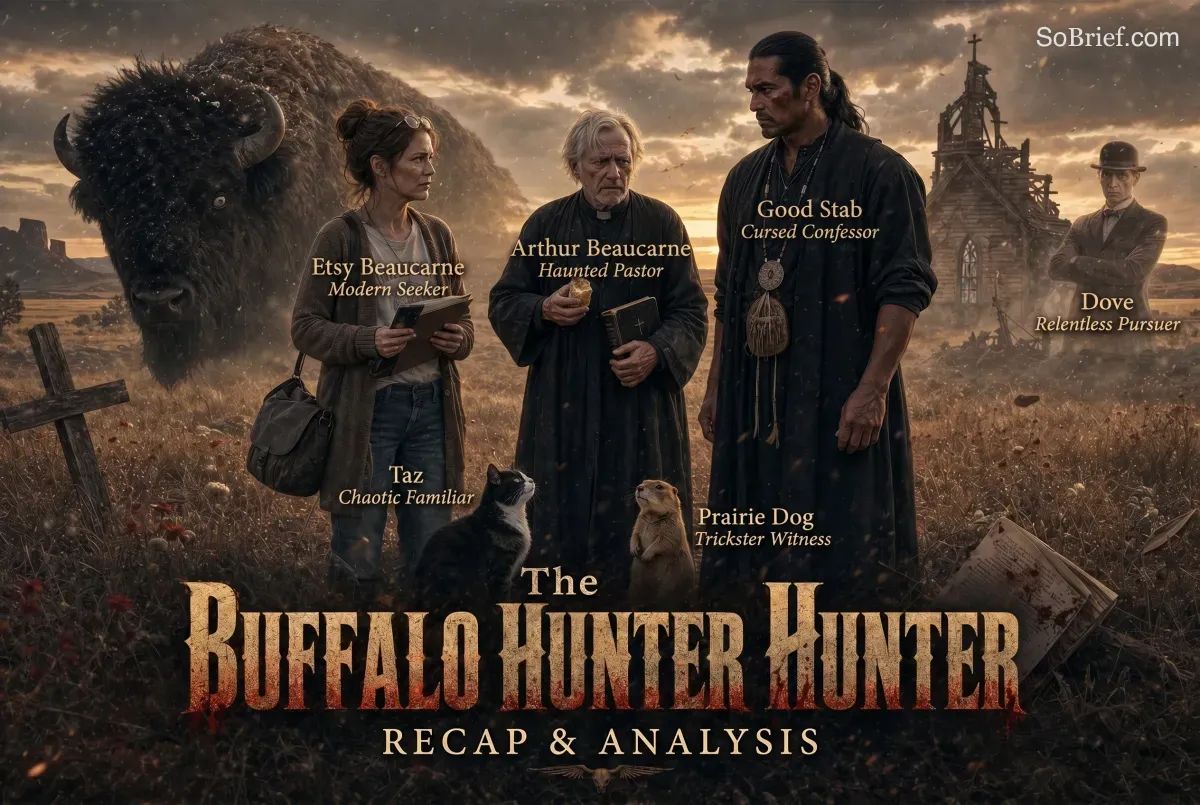
Good Stab
Blackfeet vampire confessorBorn Weasel Plume9 in 1833, a Pikuni Blackfeet warrior who accumulates names like scars—his childhood name, his warrior name Good Stab, the reputation names Takes No Scalps and The Fullblood. Transformed against his will into a blood-drinking creature in 1870, he wages a decades-long solitary war against buffalo hunters while trying to preserve a secret herd in the Backbone mountains. His psychology is the novel's engine: a man who loves his people so fiercely that every act of survival becomes a betrayal of them. He drinks blood but cries it in red tears. He cannot eat, dream, smoke, ride horses, or walk among the Pikuni without endangering them. His confession to Beaucarne2 is both a genuine plea for absolution and something far more calculated—a blade sharpened over a century of grief.
Arthur Beaucarne
Guilty pastor, Three-PersonsAn elderly Lutheran pastor in Miles City, Montana, 1912, educated at Yale and hiding a catastrophic secret beneath decades of piety and drink. His journal entries reveal a man of enormous literary vanity—cataloguing the cakes and sausages his parishioners bring, negotiating social hierarchies with lodging house regulars—but that vanity is armor over guilt so deep he has buried it beneath a new identity. He fled to the frontier after the Indian Wars, found religion, and convinced himself ordination could wash away what prayer could not. His trembling fingers, weakening eyes, and obsessive journaling are symptoms of a man who knows his past is walking toward him in a black robe, but cannot stop documenting the approach.
Etsy Beaucarne
Last descendant, modern narratorThe last living Beaucarne—a forty-two-year-old Communications professor fighting for tenure at the University of Wyoming, whose only companion is her cat Taz12. Pragmatic, self-deprecating, and lonely, Etsy processes horror through profanity and academic distance until both fail her. She discovers her great-great-great-grandfather's journal and transcribes it expecting a book contract; instead she inherits a moral debt she never incurred. Her voice is distinctly modern—she swears, cites McLuhan, battles her tenure committee—but her arc traces the same question that haunted her tresayle: what does a person owe for sins committed by the blood in their veins? Where Beaucarne2 evaded, Etsy drives straight into the storm, literally.
The Cat Man
Ancient vampire antagonistAn approximately 450-year-old European vampire found caged in a wagon on the Montana frontier in 1870, transported to America by Pinkerton agents and hung with crucifixes that proved useless. His blood transforms Good Stab1 when it flows into the dying warrior's mouth. Intelligent, multilingual, and profoundly cruel, the Cat Man embodies colonial predation in supernatural form—arriving by ship from across the ocean, consuming indigenous people while claiming to lead them. When he returns decades later having fed on elk, he grows antlers and stretches to inhuman height. He infiltrates the Small Robes band as a false chief called Walks Twice, feeding on the people whose trust he cultivates and desecrating their most sacred ceremonies for sport.
Tall Dog
Good Stab's loyal companionGood Stab's1 closest friend and hunting companion, a widower whose gentle humor centers on elaborate fantasies about finding a wife behind every tree and creek. Skilled at reading tracks, he accompanies Good Stab1 on the fateful mission that discovers the caged creature. His warmth and loyalty make him the human heart of Good Stab's1 past—the friend whose absence hollows out every year that follows.
Wolf Calf
Good Stab's elder fatherGood Stab's1 father, a Small Robe elder who witnessed the first white explorers arrive in Pikuni territory during his boyhood. He carries his people's history in his pipe and his stories. When his transformed son is poisoned by tobacco, Wolf Calf runs all night through the mountains carrying him—the ultimate act of a father who understands he is delivering his child not to safety but to something stranger than death.
Napi
Blackfeet trickster-creator godThe Blackfeet trickster-creator figure, disguised as a scruffy old trapper in a mountain dugout. Playful, irreverent, and ancient, Napi heals Good Stab1 over two winters, feeds him from his own inexhaustible blood, teaches him English through cascading stories, and guards the buffalo herd. His doorflap becomes solid rock when he leaves, and his cook-fires warm the hot springs under the Backbone.
Peasy
Elder warrior in stovepipe hatAn elderly All Crazy Dog warrior who always wears a tall stovepipe hat he claims is good medicine because enemies shoot at it and miss him. He leads the mission to hide the wagon train and decides to transport the caged creature to Chief Mountain. His final act defines him—standing shirtless in the snow, absorbing bullets while singing his death song, his last motion completing one decisive task.
Weasel Plume
Sacred white buffalo bullA white buffalo calf Good Stab1 rescues from a hide-hunting camp and names with his own childhood name—the most intimate gift a Pikuni warrior can give. Raised on Face Mountain in a secret herd, Weasel Plume grows into a bull who nuzzles Good Stab's1 shoulder and anchors the small band of survivors that represents everything the hide hunters tried to destroy.
Kills-in-the-Water
Deaf Pikuni girl with rare bloodA deaf Pikuni girl who communicates through sign language, forced to serve as medicine woman for a sacrilegious ceremony. She possesses a rare quality in her blood that makes her irresistible to vampires—a once-in-a-century phenomenon. She ties a cloth over Good Stab's1 eyes to shield him from sunlight, the first kindness anyone has shown him in years, a gesture that reminds him of his own daughter.
Dove
Pinkerton detective from CaliforniaA sharp, taciturn Pinkerton detective from San Francisco, investigating the disappearance of a wealthy family called Flowers. He arrives in Miles City with photographs and standing orders to also locate six Pinkerton agents who vanished in Montana in 1870 with a mysterious cargo. His interrogation of Beaucarne2 unfolds with the patient precision of a man accustomed to the guilty revealing themselves.
Taz
Etsy's scrappy tomcatEtsy's3 only companion, named for the Tasmanian Devil cartoon. He brings home birds, moles, and one live prairie dog. His abduction and calm return by Good Stab1 proves supernatural involvement in Etsy's3 life.
Sheriff Doyle
Miles City lawmanThe gruff sheriff of Custer County whose investigation of the skinned bodies leads Beaucarne2 to attempt using him against Good Stab1—a manipulation that backfires when Doyle ventures alone onto the prairie.
Happy
Raven boy turned medicine manA Pikuni boy Good Stab1 saves from a wildfire on Two Medicine, whose spirit helper becomes a raven. He grows into a medicine man who recognizes Good Stab1 as The Fullblood and serves as an intermediary between the vampire and the Blackfeet bands.
Livinius Clarkson
Nostalgic postmaster turned victimMiles City's postmaster and former cavalryman who publicly claims the skinned bodies match incidents from the frontier's wilder days. His knowledge and his voice make him a target.
Plot Devices
The Iron Cage
Prison that fails to containConstructed from octagonal rifle barrels and hung with hundreds of small crucifixes, the iron cage first imprisons the Cat Man4 during his transport across America by Pinkerton agents. After the mountain battle, a soldier burns the Pikuni warriors' bodies in it, making it a communal grave. Decades later, the Cat Man4 sinks it into a glacier to imprison Good Stab1 for three winters. The cage represents containment that always fails—crucifixes don't work, bars can be bent, the creature escapes. It mirrors the reservation system: the attempt to cage a people who will not stay caged. Its transformation from prison to grave to prison again traces the cycle of violence that structures the entire novel, each use more desperate and more futile than the last.
The Journal and Buckskin Pouch
Confession vessel across centuriesArthur Beaucarne's2 handwritten journal, wrapped in what he believes is gifted deerskin, serves as the primary narrative vessel—containing both his entries and his transcriptions of Good Stab's1 oral confession. Hidden in a parsonage wall for a century, it passes from construction worker to university library to Etsy Beaucarne3. As a physical object, it degrades: the homemade ink eats through brittle paper, pages crumble at a breath. The buckskin pouch, forensically revealed to be human skin, transforms the journal from artifact to evidence of a crime spanning generations. The device embodies the paradox of testimony—preserving horror to confront it, while preservation keeps the horror alive. Etsy3 must decide whether to save or destroy it.
Tobacco
Vampire kryptonite via blood vesselsTobacco is lethal to nachzehrers because nicotine constricts blood vessels, and these creatures burn oxygenated blood like fuel. When Good Stab1 smokes his father Wolf Calf's6 pipe, the tobacco collapses his circulatory system, sending him into a two-year coma. This vulnerability becomes a weapon: Good Stab1 force-feeds the Cat Man4 tobacco to weaken him during their final confrontation. In the modern frame, Etsy3 uses her dead father's cigarettes to sedate the transformed Arthur Beaucarne2. The device is narratively elegant—the social ritual of sharing tobacco, which connects humans, is poison to the creature expelled from human community. Each era deploys it differently: Wolf Calf's6 sacred pipe, Beaucarne's2 Chesterfields, Etsy's3 inherited pack.
Buffalo Skinning and Face Paint
Signature linking slaughter to vengeanceThe yellow-and-black face paint and the practice of skinning victims connects Good Stab's1 war against buffalo hunters to the bodies appearing around Miles City in 1912. Hide hunters skinned buffalo and left the meat to rot; Good Stab1 skins the hunters and paints their faces in the same bifurcated pattern the Blackfeet use to honor a gifted buffalo. The White Clay People who witness his early attacks adopt this practice, creating a tradition that predates and outlasts Good Stab1 himself. The paint transforms murder into ceremony, vengeance into ritual—a grim reversal forcing colonizers to become the very animals they slaughtered. When these same markings appear on the Flowers family, they carry 40 years of accumulated meaning.
The Body-Changing Mechanic
You become what you consumeGood Stab's1 vampirism follows a unique rule: he gradually takes on physical characteristics of whatever species he drinks from. Elk blood sprouts antler nubs on his head. Fawn blood produces white spots on his arms. White men's blood grows him a beard and lightens his hair. Prairie dog blood, consumed for a century, transforms Arthur Beaucarne2 into a giant rodent. The only way to remain human is to drink human blood—creating an inescapable moral trap. This mechanic literalizes the assimilation paradox Indigenous peoples face: consume settler culture to survive, but risk losing yourself entirely. It also provides the method for defeating the Cat Man4, as sustained fish blood turns him into a sturgeon that forgets it was ever anything else.
FAQ
Synopsis & Basic Details
What is The Buffalo Hunter Hunter about?
- Dual Narrative Unearths History: The novel follows two intertwined timelines: the journal entries of Arthur Beaucarne, a Lutheran pastor in 1912 Montana, who documents mysterious, gruesome deaths mirroring buffalo hunting practices, and the modern-day perspective of Etsy Beaucarne, his descendant and a struggling academic, who is transcribing the journal hoping to save her career.
- Supernatural Confession Unfolds: Arthur's narrative details his encounters with a mysterious Blackfeet man, Good Stab, who begins attending his church and confesses a fantastical, horrifying life story involving a curse, transformation into a blood-drinking creature, and a long war against those who destroyed his people and the buffalo.
- Legacy of Violence Explored: As Etsy delves deeper into the journal, and Good Stab's story reveals connections to historical massacres and a cycle of vengeance, the past bleeds into the present, impacting Etsy's own life and forcing a confrontation with the dark legacy of her family and the violent history of the American West.
Why should I read The Buffalo Hunter Hunter?
- Unique Blending of Genres: The book masterfully combines historical fiction, supernatural horror, and literary analysis, offering a complex narrative that explores themes of cultural trauma, inherited guilt, and the enduring power of history through a chilling vampire-like mythos rooted in the American West.
- Deeply Layered Symbolism: Stephen Graham Jones weaves rich symbolism throughout the text, from animal transformations and weather patterns to everyday objects and locations, inviting readers to engage in deep interpretation and uncover hidden meanings beneath the surface plot.
- Compelling Character Studies: The novel provides intense psychological portraits of its characters, particularly Arthur Beaucarne's descent into fear and guilt and Good Stab's struggle with his monstrous identity, offering a raw and unflinching look at the human (and inhuman) condition under extreme duress.
What is the background of The Buffalo Hunter Hunter?
- Historical Context of Massacres: The narrative is deeply rooted in the history of the American West, particularly referencing the Marias Massacre of 1870, where U.S. soldiers attacked a Blackfeet camp, and the near extinction of the buffalo herds, providing a backdrop of real-world violence and cultural destruction that fuels the supernatural elements.
- Cultural Collision in Montana: The setting of Miles City, Montana, in 1912, represents a frontier town where different cultures (white settlers, European immigrants, Native Americans) clash, highlighting tensions over land, resources, and historical grievances that resonate throughout the story.
- Exploration of Indigenous Mythology: The novel draws upon and reinterprets elements of Blackfeet beliefs and storytelling, particularly the concept of the "Person-Eater" (atupyoye) and figures like Napi (the Old Man), weaving them into a modern horror narrative that speaks to the trauma of colonization.
What are the most memorable quotes in The Buffalo Hunter Hunter?
- "I listen with a good heart.": This phrase, used repeatedly by Arthur Beaucarne to invite Good Stab's confession, becomes increasingly ironic and fraught with tension as the pastor's "good heart" is tested and ultimately broken by the horrors he hears and witnesses, highlighting the performative nature of his pastoral duty versus his internal turmoil.
- "It's a single, long night.": Good Stab's response to Arthur's hopeful declaration that "This is a new day, is it not?" encapsulates the novel's pervasive theme of historical trauma and cyclical violence, suggesting that for the Blackfeet, the darkness of past injustices has never truly ended, but continues to define their reality.
- "You wanted to make us cry. And so you did. You wanted our land, so you took it. You wanted us out of the way, so you killed us in our lodges.": Arthur's final, forced confession of the motivations behind the Marias Massacre lays bare the brutal truth of colonization from the perspective of the victim, serving as the devastating climax of Good Stab's narrative and the core of the novel's exploration of historical guilt.
What writing style, narrative choices, and literary techniques does Stephen Graham Jones use?
- Epistolary and Dual Narrative Structure: The novel employs a compelling structure alternating between Arthur Beaucarne's formal, increasingly frantic journal entries (The Beaucarne Manuscript) and Etsy Beaucarne's modern, informal, stream-of-consciousness framing narrative, creating a dialogue across time and highlighting the subjective nature of history and memory.
- Unreliable Narration and Shifting Voice: Both Arthur and Good Stab serve as unreliable narrators, their accounts colored by trauma, delusion, or supernatural influence. Jones masterfully shifts voice and tone, particularly in Good Stab's sections, which adopt a distinct, almost mythic cadence and vocabulary ("blackhorn," "greased-shooters," "sticky-mouth"), reflecting his cultural perspective and transformation.
- Sensory Detail and Body Horror: Jones is known for his visceral, sensory descriptions, and this novel is no exception. He uses graphic body horror, focusing on skinning, dismemberment, and unnatural transformations, to create a pervasive sense of unease and underscore the physical and psychological toll of violence and the monstrous.
Hidden Details & Subtle Connections
What are some minor details that add significant meaning?
- The Raven's Persistent Presence: The recurring appearance of ravens, particularly the one associated with the boy Happy and later seen by Arthur in the church, symbolizes guidance, prophecy, and the enduring connection between the spiritual world and the Blackfeet people, suggesting that even in his monstrous state, Good Stab is still tied to his cultural roots and perhaps guided by forces beyond his control.
- The Significance of Hands and Feet: Throughout the text, there's a subtle focus on hands (Arthur's trembling, Good Stab's claws/missing hand, the Pinkerton's severed hand, the gravediggers' offer, Kills-in-the-Water's sign language) and feet (Arthur's limping, Good Stab's ability to run on snow, the lack of footprints, the frozen toes), symbolizing agency, connection, vulnerability, and the physical imprint left by actions and experiences.
- The Motif of Brokenness and Repair: Objects like Arthur's broken ladder, Good Stab's broken bones that heal unnaturally, the shattered glass door, the broken pipe stem, and the fragmented journal pages themselves, subtly underscore the theme of pervasive brokenness—of bodies, lives, cultures, and history—while the unnatural healing or attempted repair highlights the distorted nature of survival and the inability to truly fix past damage.
What are some subtle foreshadowing and callbacks?
- Etsy's Cat's "Gifts": Etsy's description of her cat, Taz, bringing her dead animals (birds, mice, moles, a prairie dog) foreshadows the gruesome discoveries of bodies in the prairie and, more chillingly, the eventual transformation of her ancestor into a prairie dog, subtly linking the domestic uncanny to the larger supernatural horror unfolding.
- The Titanic's Ill Fate: The mention of the Titanic's impending maiden voyage and its sinking serves as a subtle historical foreshadowing of catastrophic loss and hubris, mirroring the inevitable downfall faced by characters who believe they can control or escape the forces of history and nature, much like the ship's passengers believed in its unsinkability.
- The Pinkerton's Missing Agents: Dove's mention of the "Missing Six" Pinkerton agents from 1870, transporting a valuable "transport," subtly foreshadows the nature of the "cargo" (the Cat Man) and the fate of those who attempt to control or contain supernatural forces, hinting at a larger, ongoing conflict that predates Good Stab's story.
What are some unexpected character connections?
- Arthur Beaucarne and the Flowers Family: The revelation that the San Francisco family being hunted by Good Stab—Benjamin Flowers and his sons, including one named Arthur—are Arthur Beaucarne's direct descendants, fathered after the Marias Massacre, creates a shocking and deeply personal connection between the historical violence and the present-day horror, making Arthur directly responsible for the fate of his own bloodline.
- Good Stab and Napi: Good Stab's account of wintering with the "old trapper" who teaches him English and heals him, only to reveal himself as Napi, the Blackfeet creator figure, is an unexpected mythological connection that elevates Good Stab's story beyond mere monstrous transformation, suggesting his curse and survival are tied to the very fabric of the world and its ancient powers.
- Etsy and Good Stab's Shared Traits: Beyond their connection through Arthur, Etsy and Good Stab share subtle traits: both are outsiders (Etsy academically/socially, Good Stab culturally/supernaturally), both are drawn to documenting/understanding the past (Etsy transcribing, Good Stab confessing), and both experience physical transformations or afflictions (Etsy's perceived prairie dog form, Good Stab's animalistic changes), creating a mirrored parallel across time.
Who are the most significant supporting characters?
- Napi: As the Blackfeet creator figure who interacts directly with Good Stab, Napi is crucial not just mythologically but narratively. He provides context for Good Stab's transformation, teaches him language, and represents the ancient forces of the land, highlighting the cultural and spiritual dimensions of Good Stab's struggle and the novel's themes of cultural memory and survival.
- Livinius Clarkson: The postmaster serves as a key source of local lore and historical memory, connecting the present-day "humps" to past incidents. His character embodies the town's limited, often prejudiced understanding of its own history and the Native American presence, making his eventual death and desecration by Good Stab a symbolic act of vengeance against this willful ignorance.
- Sheriff Doyle: As the representative of law and order in Miles City, Doyle's inability to comprehend or contain the supernatural violence underscores the limitations of conventional authority in dealing with forces rooted in historical trauma and myth. His reliance on Arthur and eventual disappearance highlight the breakdown of societal structures in the face of the monstrous.
Psychological, Emotional, & Relational Analysis
What are some unspoken motivations of the characters?
- Arthur's Need for Absolution: Beyond documenting events for his career or historical record, Arthur's journal entries, particularly those titled "The Absolution of Three-Persons," reveal an unspoken, desperate need for personal absolution for his past sins, especially his complicity in the Marias Massacre, which drives his engagement with Good Stab's "confession" as a potential path to forgiveness.
- Good Stab's Desire to Be Understood: While presenting his story as a confession or a means to an end (like getting Arthur to believe or lead him to Kills-in-the-Water), Good Stab also seems driven by an unspoken need to be truly seen and understood by someone outside his cursed existence, particularly by a representative of the culture that caused his suffering, highlighting his profound loneliness and isolation.
- Etsy's Search for Connection: Etsy's initial motivation is academic survival, but her deep dive into Arthur's journal and her emotional reaction to finding the family connection reveal an unspoken longing for a deeper connection to her family history and identity, especially given her isolated life and strained relationship with her father, making the journal a substitute for familial bonds.
What psychological complexities do the characters exhibit?
- Arthur's Dissociation and Denial: Arthur exhibits psychological complexities rooted in trauma and guilt. His detailed documentation of gruesome events contrasts with his attempts to rationalize or deny their supernatural implications. His reliance on alcohol and his internal debates ("neither here nor there") show dissociation as he struggles to reconcile his past actions and present reality with his identity as a man of God.
- Good Stab's Internalized Trauma and Rage: Good Stab's transformation is not just physical but deeply psychological. He embodies the trauma and rage of his people, his monstrous form a manifestation of historical violence. His struggle to control his hunger, his self-hatred ("Blackie," "Takes No Scalps"), and his moments of vulnerability reveal the complex psychological burden of carrying centuries of pain and seeking vengeance while simultaneously longing for connection and peace.
- Etsy's Inherited Trauma and Fear: Etsy's psychological state becomes increasingly complex as she transcribes the journal. She experiences vicarious trauma, her reality blurring with Arthur's. Her fear manifests physically (shaking, inability to sleep, hallucinations) and psychologically (paranoia, questioning her sanity), suggesting that the historical trauma documented in the journal is not just a historical record but an inherited burden impacting her present-day mental state.
What are the major emotional turning points?
- Arthur's Realization of Complicity: A major emotional turning point for Arthur is the gradual realization, forced by Good Stab's narrative and the Pinkerton's investigation, that his past actions at the Marias Massacre are directly linked to the present horrors and the fate of his own descendants, shifting his emotional state from detached observer to deeply implicated participant.
- Good Stab's Encounter with Napi: Good Stab's winter with Napi, the creator figure, marks an emotional turning point where he gains a deeper understanding of his condition and its connection to the land and his people's history. This encounter, though painful, provides a framework for his existence and fuels his subsequent actions, moving him from aimless monstrousness to purposeful vengeance.
- Etsy's Confrontation with Arthur's Transformation: The most significant emotional turning point for Etsy is her direct confrontation with Arthur Beaucarne's transformed state as a giant prairie dog. This visceral encounter shatters her denial and forces her to accept the literal truth of the supernatural elements and the full, horrifying extent of her family's legacy, leading to a shift from academic detachment to active engagement with the monstrous.
How do relationship dynamics evolve?
- Arthur and Good Stab: From Confessor to Captive: The relationship between Arthur and Good Stab evolves dramatically from a seemingly conventional confessor-penitent dynamic to one of tormentor and captive. Good Stab initially seeks Arthur out for confession, but gradually reveals his true purpose is to force Arthur to confront his past and ultimately become a victim of the cycle of violence he helped initiate.
- Etsy and Arthur: From Ancestor to Monster: Etsy's relationship with Arthur evolves from a distant academic interest in an ancestor to a horrifying personal connection with a monstrous entity. Her initial respect and curiosity turn to fear and eventually a complex mix of horror and pity upon encountering his transformed state, highlighting how uncovering history can fundamentally alter one's perception of family.
- Good Stab and the Blackfeet People: Good Stab's relationship with his people is fraught with pain and banishment. Initially a warrior, his transformation makes him an outcast. While he seeks to protect them (from the Cat Man, from hide-hunters), his actions (killing Yellow Kidney's sister) and appearance make him feared and hunted by his own kind, reflecting the devastating impact of trauma and the monstrous on community bonds.
Interpretation & Debate
Which parts of the story remain ambiguous or open-ended?
- The Literal Nature of the Transformations: While the narrative presents the transformations (Good Stab, the Cat Man, Arthur) as literal, the possibility remains open for interpretation that they are powerful metaphors for the psychological effects of trauma, cultural memory, and the dehumanizing impact of violence, leaving readers to debate the extent of the supernatural versus the psychological reality.
- The Full Extent of Napi's Role: Napi's interactions with Good Stab are presented within Good Stab's potentially unreliable narrative. The ambiguity surrounding Napi's true nature and motivations—is he a benevolent creator, a trickster, or simply a manifestation of the land's ancient power?—leaves his ultimate role in the unfolding events and the nature of the curse open to interpretation.
- The Final Fate of Etsy and Good Stab: The ending leaves the ultimate fate of both Etsy and Good Stab ambiguous. Etsy drives into the storm with Arthur's transformed body, her survival uncertain. Good Stab rides away into the storm, his purpose seemingly fulfilled but his existence as a nachzehrer ongoing. The lack of a definitive resolution suggests the cyclical nature of the themes explored, implying that the struggle against historical trauma and monstrousness is never truly over.
What are some debatable, controversial scenes or moments in The Buffalo Hunter Hunter?
- Arthur's Complicity in the Marias Massacre: The scene where Arthur Beaucarne confesses whispering to Joe Cobell during the Marias Massacre is highly debatable and controversial. It directly implicates a man of God in inciting violence against innocent people, forcing readers to confront the uncomfortable truth of how individuals and institutions can be complicit in atrocities, challenging conventional notions of good and evil.
- Good Stab's Killing of Yellow Kidney's Sister: Good Stab's decision to kill and drink the blood of Yellow Kidney's sister, even if she was already dying or to gain power against the Cat Man, is a controversial moment that challenges reader sympathy. It forces a debate about whether his actions, even in pursuit of vengeance or survival, are justifiable, highlighting the moral complexities of his monstrousness and the devastating choices imposed by trauma.
- The Staging of the Dead in the Church: Good Stab's arrangement of the corpses (Flowers family, Miles City residents, dogs, Marias victims) in Arthur's church is a deeply disturbing and controversial scene. It serves as a brutal, sacrilegious tableau of historical violence and its consequences, forcing Arthur (and the reader) to confront the full horror of the past in a space meant for worship and healing, sparking debate about the effectiveness and morality of such a confrontational act.
The Buffalo Hunter Hunter Ending Explained: How It Ends & What It Means
- Etsy Inherits the Burden: The ending reveals that Etsy has inherited the "curse" or burden of her family's past, not through supernatural infection but through knowledge and confrontation. Her decision to take Arthur's transformed body into the storm signifies her acceptance of this legacy and her active engagement with the monstrous history she uncovered, moving beyond passive transcription to become a participant in the ongoing narrative.
- The Cycle Continues, Transformed: Good Stab's departure suggests his immediate vengeance is complete, but his existence as a nachzehrer continues, implying the cycle of trauma and monstrousness persists. However, Etsy's actions—destroying the journal's physical form, deleting digital copies, and taking Arthur's body—represent an attempt to control or alter the narrative, suggesting a potential shift in how the legacy of violence will be carried forward, perhaps towards a different kind of reckoning or healing.
- Survival and Transformation as Resistance: Etsy's survival in the storm and her final defiant tone, despite her fear and the horrifying reality she faces, suggest that survival itself, even in a transformed or broken state, can be an act of resistance against forces that seek to erase or destroy. Her final words and actions imply a determination to face the future, however monstrous, on her own terms, carrying the weight of the past but perhaps forging a new path.
About the Author
Other books by Stephen Graham Jones
Download PDF
Download EPUB
.epub digital book format is ideal for reading ebooks on phones, tablets, and e-readers.








































