


Key Takeaways
One belief about whether you can change quietly rules your whole life
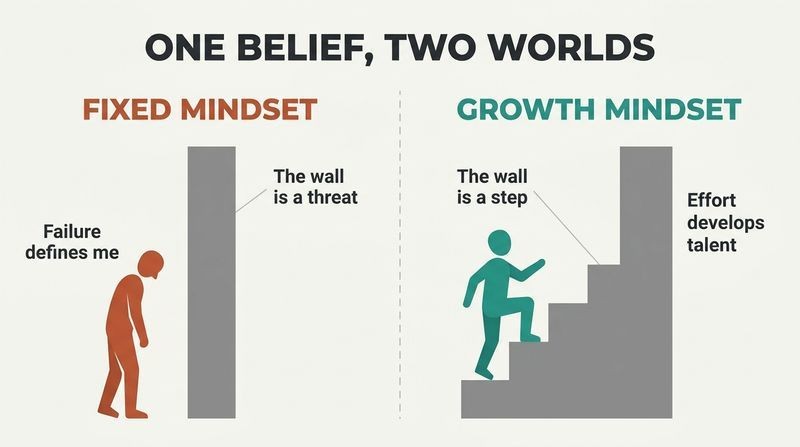
Two mindsets, two worlds. Psychologist Carol Dweck argues that a single belief shapes how you handle challenge, criticism, and setback. The fixed mindset assumes intelligence, talent, and character are carved in stone, so life becomes a series of tests proving you have enough of them. The growth mindset assumes these qualities are starting points that grow through effort and experience.
The tell is in the reaction. Dweck stumbled onto this watching children tackle impossible puzzles. Some groaned. But one boy rubbed his hands and declared he loved a challenge, and another said he hoped it would be informative. They were not coping with failure; they did not think they were failing. They thought they were learning. That reframe, Dweck found, predicts who thrives.
What's striking is how a laboratory observation of ten-year-olds scaled into a theory touching parenting, sport, marriage, and management. The framing echoes Alfred Binet, inventor of the IQ test, who insisted intelligence could be cultivated, not merely measured. A useful caution: later replication research (large-scale studies by Sisk and colleagues) found growth-mindset interventions produce small average effects, strongest for at-risk and low-income students. That does not sink the idea, but it tempers the promise. The mindset is best understood not as magic but as a lens that reliably nudges behavior toward persistence, which compounds over years.
When failure becomes who you are, you lose the map back
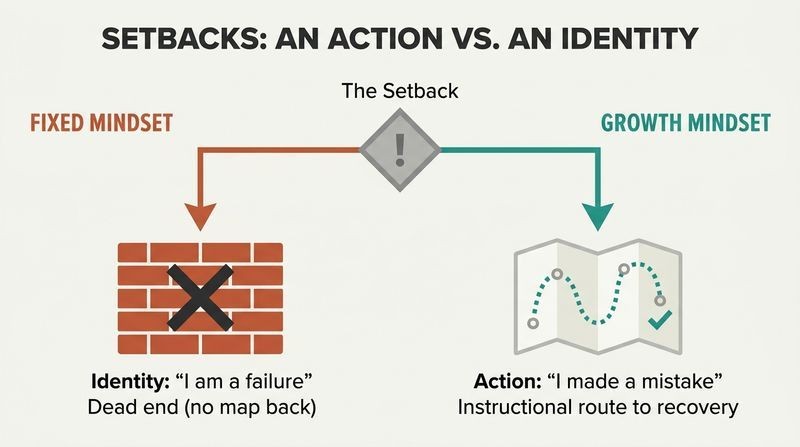
An action versus an identity. In the fixed mindset, failing stops being something you did and becomes something you are. Dweck gave people a mildly bad day scenario: a C-plus on a midterm, a parking ticket, a friend brushing them off. Fixed-mindset responders spiraled into self-verdicts like idiot, loser, worthless, though nothing catastrophic had happened. Growth-mindset responders felt bad too, then planned: study differently, pay the ticket, check on the friend.
The fixed mindset offers no recovery recipe. French chef Bernard Loiseau, facing rumors of losing a Michelin star, took his own life. Football player Jim Marshall once ran a fumble the wrong way on national TV, then used the humiliation to play his best half ever. Same event, opposite meanings, because one man's setback labeled him and the other's merely instructed him.
This maps neatly onto Aaron Beck's cognitive therapy and Martin Seligman's work on explanatory style: people who explain bad events as permanent, pervasive, and personal are far more prone to depression. Dweck's contribution is locating the root belief underneath those explanations. There is a subtle danger worth naming, though. Reframing every failure as a learning opportunity can shade into toxic positivity, denying legitimate grief or the reality that some doors truly close. The healthiest version, which Dweck models, allows the pain to be real while refusing to let it deliver a life sentence on your worth.
Effort is heroic, not humiliating, once you stop worshipping the natural
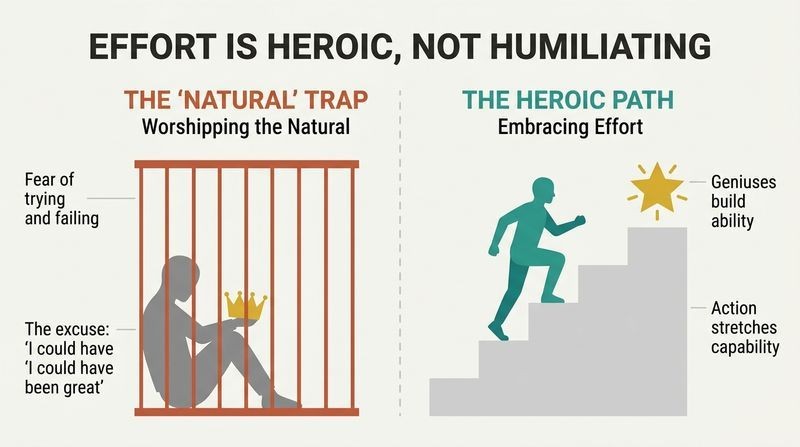
The tortoise problem. Fixed-mindset thinkers believe that if you are truly gifted, things come easily, so needing to work exposes you as lacking. Dweck confesses she once assumed colleagues working late must be less smart than her. This belief is quietly lethal: it makes people avoid the very stretching that builds ability.
Effort terrified even prodigies. Violinist Nadja Salerno-Sonnenberg, a childhood star, stopped bringing her violin to lessons rather than risk trying hard and still failing, which would strip away her excuse. Her teacher threatened to expel her, and once she finally went all out, she won. Dweck's point: without effort you can always say I could have been great, but that comfort is a cage. Geniuses like Edison and Mozart logged years of grinding, collaborative work before their breakthroughs.
The cultural angle deserves emphasis. Dweck, drawing on Malcolm Gladwell, notes societies romanticize effortless genius, and researchers at Duke documented women chasing effortless perfection into anxiety and depression. This connects to Anders Ericsson's deliberate practice research and Angela Duckworth's grit, both suggesting sustained effort, not raw talent, best predicts elite achievement. The nuance often lost: effort is necessary but not sufficient. Dweck herself concedes resources, luck, and access matter enormously; a laid-off worker's diligence and a trust-funder's diligence do not pay off equally. Praising effort without acknowledging structural advantage risks a cruel meritocracy myth.
Praise the process, not the person, or you build fragile children
Telling kids they are smart backfires. Across seven studies of hundreds of children, Dweck found praising intelligence after success produced the clearest harmful result she had seen. Praised-for-smarts kids then avoided challenging tasks, wilted when problems got hard, enjoyed the work less, and their performance dropped. Kids praised for effort chose harder problems, stayed engaged, and improved. Alarmingly, nearly 40 percent of the intelligence-praised children later lied about their scores, since in a fixed mindset flaws are shameful.
What to say instead. Praise strategies, focus, persistence, and choices: the long homework you concentrated through, the essay you thought hard about. Reassuring an anxious child that she is brilliant only raises the stakes. Better to signal that you value the learning, not the verdict.
This finding reshaped a generation of parenting and teaching advice, and rightly so, though it has been widely oversimplified into never say smart. The mechanism matters: ability praise teaches children that performance is a readout of a fixed trait, so they protect the trait by avoiding risk. Replication has been mixed for broad mindset interventions but the praise studies themselves have held up reasonably well. A practical extension from behavioral science: the same logic applies to adults in performance reviews. Manager feedback that labels people as high-potential naturals can, paradoxically, make them defensive and risk-averse rather than motivated.
A growth mindset pulls the teeth out of a negative stereotype
Stereotypes hijack the fixed mind. Research by Claude Steele and Joshua Aronson showed that merely reminding people of their race or sex before a test, sometimes just checking a box, can sink scores. Dweck's addition: this stereotype threat mainly wounds people in a fixed mindset, because they hear you and your group are permanently inferior and half-believe it. Those in a growth mindset treat the stereotype as someone else's opinion, not a diagnosis.
It changes what you take from hostility. Black students given harsh but useful feedback from a white establishment figure split by mindset. Fixed-mindset students rejected him as biased and learned nothing. Growth-mindset students called him arrogant too, then mined his critique for improvement. In calculus classes, women with growth mindsets kept their sense of belonging even amid sexism.
This is one of the book's most socially consequential claims and also one of its most delicate. It could be misread as blaming victims for internalizing prejudice, a reading Dweck explicitly rejects, insisting the bias is a real societal wrong. The steelman: mindset is a psychological buffer, not a cure for discrimination. It gives targets a way to keep functioning while the structural work continues. Bridging to Steele's own book, Whistling Vraz, and to belonging interventions by Greg Walton, the emerging consensus is that reframing adversity as common and temporary, rather than as evidence of inferiority, measurably protects marginalized students' performance.
The natural is a myth; champions are made through relentless practice
Talent without mindset self-destructs. Billy Beane was the scout's dream, the next star, yet he could not tolerate failure and flamed out as a player. He succeeded only as an executive who learned to buy mindset over raw talent. Meanwhile the supposed naturals were grinders: Michael Jordan was cut from his high school varsity and practiced obsessively; Muhammad Ali failed every physical measurement and won with his mind; Babe Ruth practiced hitting relentlessly and rebuilt his body when he seemed washed up.
Character is trainable. Dweck reframes what athletes call heart as a growth-mindset product: the capacity to raise your level under pressure. Wilma Rudolph, paralyzed by polio as a child, became the fastest woman on earth. Pat Summitt taught that success, not failure, is the real enemy, because it lulls you into complacency.
The sports domain makes the argument vivid precisely because physical gifts seem visible and fixed. Yet even here Dweck concedes some children arrive with genuine head starts. The honest position, consistent with Ericsson's expertise research, is that innate differences set a floor and a ceiling but rarely determine who reaches the top; sustained purposeful training does. What Dweck adds beyond deliberate practice is the emotional engine: why some gifted athletes, like John McEnroe by his own account, refuse to practice or blame external forces. The fixed mindset does not just skip the work, it manufactures excuses to protect the self-image.
CEO disease: worshipping talent is what sank Enron
The talent mindset breeds fragility. Enron recruited brilliant people and built a culture demanding they always look brilliant, which, Dweck argues via Malcolm Gladwell, forced everyone into a fixed mindset where admitting error was intolerable. They would sooner lie than take the remedial course. Contrast Jim Collins's good-to-great leaders, who were self-effacing, question-asking, and unafraid to confront brutal facts.
Ego versus growth at the top. Fixed-mindset chiefs like Lee Iacocca and Chainsaw Al Dunlap treated the company as a stage for personal greatness, blamed others, crushed critics, and chased short-term stock pops. Growth-minded leaders like Jack Welch, Lou Gerstner, and Anne Mulcahy dismantled elitism, rewarded teamwork over solo genius, listened to frontline workers, and rebuilt from reality. In lab studies, growth-mindset management groups debated openly and outperformed; fixed groups fell into groupthink.
The Enron diagnosis is elegant but partial. Fraud, deregulation, and mark-to-market accounting were also mechanical drivers, not just psychology. Still, the cultural insight is powerful and echoes work by Amy Edmondson on psychological safety: teams that treat mistakes as data rather than as verdicts learn faster and fail less catastrophically. Dweck's leader typology risks hindsight bias, since we know who won, but the underlying prediction, that leaders obsessed with proving superiority suppress the dissent that prevents disaster, is well supported. The practical takeaway for any manager: the moment your team fears your judgment more than reality, mediocrity is baked in.
Believing great love shouldn't require work is what wrecks it
The compatibility fantasy. In a fixed mindset, people expect a good relationship to feel effortless and telepathic, as if the right partner would just know your needs. Dweck describes couples who conclude that because they must talk through differences, they were not meant to be. Marriage researcher John Gottman and therapist Aaron Beck agree the opposite: every strong relationship demands ongoing effort and communication.
Problems get read as permanent flaws. Fixed-mindset partners blame character (you are selfish, boring, irresponsible) rather than solvable situations, breeding contempt. After rejection, they feel branded unlovable and crave revenge; Dweck found normal people fantasizing about making an ex pay. Growth-minded people hurt just as much but aim to understand, forgive, and learn what they want next time. Nicole Contos, jilted at the altar, danced solo at her own reception and later married happily.
This translates Gottman's decades of couples research into a single upstream belief. The mind-reading trap has real empirical backing: relationship satisfaction correlates with expressed communication, not assumed understanding. Where the framing can mislead is in implying that all problems are workable. Some incompatibilities are genuine and staying to work at them is not always wisdom; sometimes it is sunk-cost fallacy. A mature growth mindset in love includes discerning which conflicts are solvable and which signal a fundamental mismatch. Dweck's revenge-versus-forgiveness data also resonates with research showing that rumination, not the injury itself, prolongs the pain of betrayal.
Every word to a child says either I'm judging you or I'm helping you grow
Judge versus teach. Dweck argues that parents, teachers, and coaches broadcast a mindset in ordinary moments. Constructive criticism should help a child fix something, not label them dense or irresponsible. When kids spill nails or flub homework, the growth move treats it as a repairable event, not a character exposure.
Two coaches, two philosophies. Bobby Knight, brilliant but fixed-minded about himself, motivated through humiliation, once putting a tampon in a player's locker; his stars fantasized about shooting him. John Wooden, who won ten NCAA titles, asked only for full preparation and full effort, defined losing as failing to try your best, and gave equal attention to bench players. Great teachers like Marva Collins and Rafe Esquith set sky-high standards inside a nurturing atmosphere, then taught the concrete steps to reach them.
The judge-versus-teach distinction is the book's most immediately usable parenting tool, and it aligns with Haim Ginott's classic work on describing behavior rather than labeling the child. Developmental research on attachment supports the deeper claim: children who feel their worth is contingent on performance develop anxious, avoidant patterns. One tension: setting high standards while remaining nurturing is genuinely hard, and the book's exemplars are outliers with extraordinary energy. For ordinary parents, the realistic aim is not sainthood but catching the fixed-mindset phrases (you're so smart, natural artist) and swapping them for process language, day by day.
Change your internal monologue from a judge into a coach
Mindsets are beliefs, and beliefs can shift. The fixed mindset runs a judging monologue: this means I'm a loser, this means I'm superior. The growth version asks what can I learn and how do I improve. Simply teaching students that the brain grows stronger with use, through Dweck's Brainology program, raised falling math grades where a study-skills-only group showed no gain. One turned-off boy asked, with tears, whether this meant he did not have to be dumb.
Vows fail; concrete plans work. Psychologist Peter Gollwitzer showed that intense resolutions rarely produce action. What works is specifying when, where, and how: tomorrow on my break I will call the school. Dweck applies this to dieting, anger, and career. Willpower is not a fixed quantity you have or lack; it needs strategies, and lapses are lessons, not verdicts.
This closing move rescues the book from being merely descriptive. Grounding change in implementation intentions is smart, since Gollwitzer's if-then planning is among the most robust findings in behavior-change science, with meta-analyses showing meaningful effect sizes across health and achievement domains. Dweck also wisely notes that old beliefs do not vanish; they coexist with new ones, echoing how cognitive-behavioral change actually works. The honest caveat she raises herself: the fixed mindset often served a real purpose, offering a route to self-esteem, so shedding it feels destabilizing. Lasting change therefore requires not a one-time insight but ongoing maintenance, the way recovery programs treat vulnerability as permanent.
Analysis
Mindset succeeds as a rare thing in popular psychology: a single, falsifiable variable stretched across nearly every arena of human striving. Dweck's move is reductive in the best sense, showing that beliefs about the malleability of ability generate cascading downstream differences in goals, effort, resilience, and interpretation. The book's structure, marching from schoolchildren to athletes to CEOs to lovers to parents, is less an argument than an accumulation, and the sheer breadth is both its persuasive power and its vulnerability. When one theory explains chess prodigies, Enron, jilted brides, and violin lessons, a careful reader should ask whether it explains too much.
The most durable contributions are the praise studies and the reframing of effort. Both are mechanistically clear and practically actionable, and both have influenced classrooms worldwide. The weakest link is the leadership and sports material, which leans heavily on post-hoc narrative: we already know Welch won and Iacocca faltered, so attributing outcomes to mindset flirts with confirmation bias. The autobiographies of winners are curated documents, not controlled data.
The scientific reckoning matters. Since publication, large-scale replications (notably Sisk et al. 2018 and the National Study of Learning Mindsets) found average effects of growth-mindset interventions to be modest and concentrated among disadvantaged and lower-achieving students. This does not refute Dweck; it right-sizes her. Mindset is a real, measurable moderator, not a lever that reliably transforms anyone.
What endures is the moral reframe. Dweck relocates human worth away from fixed endowment and toward development, replacing a courtroom of constant self-judgment with a workshop of continual learning. Even where the empirical effects are small, the ethical and motivational stance, that people are unfinished and capable of growth, is a healthier operating assumption than its rigid alternative. That, more than any single study, explains the book's staying power.
Review Summary
Mindset: The New Psychology of Success receives mixed reviews. Many praise its insights on growth vs. fixed mindsets, finding it life-changing and applicable to various aspects of life. Critics argue it's repetitive, oversimplified, and lacks practical advice. Some appreciate its emphasis on effort over innate talent, while others find the concept obvious. The book's impact on parenting and education is frequently mentioned. Despite criticisms of writing style and anecdotal evidence, many readers find value in its core message about the power of mindset in achieving success.
People Also Read








Glossary
Fixed mindset
Belief abilities are unchangeableThe belief that intelligence, talent, and character are static traits you are born with in fixed amounts. It creates an urgency to prove yourself, aversion to challenge and effort, defensiveness toward criticism, and a tendency to experience failure as a permanent verdict on your worth rather than a solvable problem.
Growth mindset
Belief abilities can developThe belief that basic qualities like intelligence and talent can be cultivated through effort, strategy, and experience. It fosters a love of challenge, treats effort as the path to mastery, welcomes criticism as information, and views setbacks as learning opportunities rather than measures of a fixed self. It does not claim anyone can become anything.
CEO disease
Leaders craving constant validationDweck's term for fixed-mindset leaders who use their power to build a world that constantly affirms their brilliance, surrounding themselves with flatterers, exiling critics, and refusing to confront flaws. Exemplified by Lee Iacocca and the leaders of Enron, it leads executives to prioritize personal image over long-term organizational health.
Talent mindset
Corporate worship of innate abilityA management philosophy, associated with McKinsey and Enron's culture, that assumes business success comes from recruiting and glorifying naturally gifted stars. Dweck argues it forces employees into a fixed mindset where looking talented matters more than learning, so people hide deficiencies and cannot self-correct, ultimately breeding fragility and collapse.
Brainology
Growth-mindset school programAn interactive computer-based program Dweck's team developed to teach adolescents that the brain grows stronger with use, like a muscle. Students learn how neural connections form through practice and apply growth-mindset study strategies. In trials it reversed declining math grades where a study-skills-only comparison group showed no improvement.
Somebody-nobody syndrome
Winning defines your worthDweck's phrase for the fixed-mindset trap in which a person believes that winning makes them a valuable somebody and losing makes them a worthless nobody. Illustrated by basketball player Iciss Tillis fearing she would end up a nobody like her father, it ties identity to outcomes rather than to full effort.
FAQ
What's Mindset: The New Psychology of Success about?
- Core Concept of Mindsets: The book introduces two primary mindsets: fixed and growth. A fixed mindset sees abilities as static, while a growth mindset believes they can be developed through effort and learning.
- Impact on Success: These mindsets influence how individuals approach challenges, setbacks, and personal growth. A growth mindset encourages embracing challenges and persisting through difficulties.
- Applications Across Life: The concepts apply to various domains, including education, sports, business, and relationships, illustrating how a growth mindset can lead to greater success and fulfillment.
Why should I read Mindset: The New Psychology of Success?
- Transformative Insights: The book offers insights into how beliefs about abilities shape life experiences and outcomes, leading to personal growth and improved performance.
- Practical Applications: Dweck provides advice on cultivating a growth mindset, making it useful for parents, educators, and leaders to foster resilience and a love for learning.
- Research-Based Evidence: Grounded in extensive psychological research, the book is a credible resource for understanding human behavior and motivation.
What are the key takeaways of Mindset: The New Psychology of Success?
- Mindsets Shape Outcomes: Your mindset influences how you approach challenges and setbacks. A growth mindset encourages resilience and learning from failures.
- Praise Effort, Not Talent: Emphasizing effort and strategies over innate talent helps develop a love for learning and a desire to improve.
- Lifelong Learning: Embracing a growth mindset fosters a lifelong love of learning and personal development, encouraging individuals to seek challenges and view failures as growth opportunities.
What are the best quotes from Mindset: The New Psychology of Success and what do they mean?
- "The view you adopt for yourself profoundly affects the way you lead your life.": This highlights the impact of self-perception on life choices, suggesting a growth mindset leads to proactive and positive decisions.
- "When you’re in a fixed mindset, you’re always trying to prove yourself.": This underscores the pressure and anxiety of a fixed mindset, where individuals constantly seek validation of their intelligence or talent.
- "It’s not about being the best; it’s about being better than you were yesterday.": This encapsulates the growth mindset's focus on personal improvement rather than comparison with others.
How do fixed and growth mindsets differ according to Mindset: The New Psychology of Success?
- Beliefs About Abilities: A fixed mindset sees abilities as innate and unchangeable, while a growth mindset believes they can be developed through dedication and hard work.
- Response to Challenges: Fixed mindset individuals may avoid challenges to protect their self-image, whereas growth mindset individuals embrace challenges as learning opportunities.
- Handling Failure: A fixed mindset views failure as a reflection of intelligence, leading to inadequacy, while a growth mindset sees it as a learning opportunity, fostering resilience.
How can I develop a growth mindset according to Mindset: The New Psychology of Success?
- Embrace Challenges: Actively seek challenges and view them as growth opportunities, encouraging resilience and learning from mistakes.
- Learn from Feedback: Use criticism as a tool for improvement, viewing feedback as valuable information for growth and skill development.
- Cultivate a Love for Learning: Focus on the learning process rather than outcomes, engaging in activities that stimulate curiosity and passion for knowledge.
What is the impact of praise on mindset according to Mindset: The New Psychology of Success?
- Praise for Ability vs. Effort: Praising innate abilities can reinforce a fixed mindset, while praising effort encourages embracing challenges and viewing learning as a process.
- Consequences of Ability Praise: Students praised for intelligence may avoid difficult tasks, fearing they won't live up to being "smart," leading to performance decline and lack of motivation.
- Encouraging Growth: Focusing on effort helps develop a growth mindset, fostering resilience and a love for learning, encouraging risk-taking and learning from mistakes.
How does Mindset: The New Psychology of Success apply to education?
- Teaching Strategies: Dweck advocates for methods promoting a growth mindset, including praising effort, encouraging risk-taking, and viewing mistakes as learning opportunities.
- Student Motivation: Students with a growth mindset are more motivated to learn and persist through difficulties, seeking help and resources to improve.
- Long-Term Success: Instilling a growth mindset prepares students for future challenges, benefiting them in both academic and personal contexts.
How do mindsets affect relationships according to Mindset: The New Psychology of Success?
- Impact on Interactions: A fixed mindset can lead to competition and defensiveness, creating tension and hindering personal growth in relationships.
- Growth Mindset in Relationships: A growth mindset fosters collaboration and support, encouraging partners to develop and work through challenges together.
- Conflict Resolution: Growth-minded individuals are more open to discussing issues and finding solutions, strengthening relationships and promoting mutual growth.
How can leaders apply the concepts from Mindset: The New Psychology of Success in the workplace?
- Fostering a Growth Culture: Leaders can create an environment encouraging learning and development, promoting collaboration, and celebrating effort and improvement.
- Encouraging Risk-Taking: A growth mindset allows employees to take calculated risks without fear of judgment, leading to innovation and creativity.
- Developing Talent: Focus on developing team members' skills rather than just evaluating current performance, helping employees feel valued and motivated to grow.
What role do parents and educators play in shaping mindsets according to Mindset: The New Psychology of Success?
- Influence of Messages: Parents and teachers send powerful messages about success and failure through praise and feedback, reinforcing either a fixed or growth mindset.
- Modeling Mindsets: Adults can model a growth mindset by demonstrating their willingness to learn and grow, setting an example for children and students.
- Creating a Supportive Environment: Fostering an environment valuing effort, learning, and resilience helps children develop a growth mindset, encouraging exploration and risk-taking.
What are some common misconceptions about the growth mindset according to Mindset: The New Psychology of Success?
- It’s Just About Positive Thinking: A growth mindset involves actively engaging in learning and development, embracing challenges, and learning from failures, not just optimism.
- It’s Only for Students: While emphasized in education, the principles apply to all life areas, including personal relationships, sports, and business.
- It’s a One-Time Change: Sustaining a growth mindset requires ongoing effort and self-reflection, especially in the face of setbacks and challenges.
About the Author
Other books by Carol S. Dweck


Download PDF
Download EPUB
.epub digital book format is ideal for reading ebooks on phones, tablets, and e-readers.








































