


Key Takeaways
They can strip everything from you except how you respond
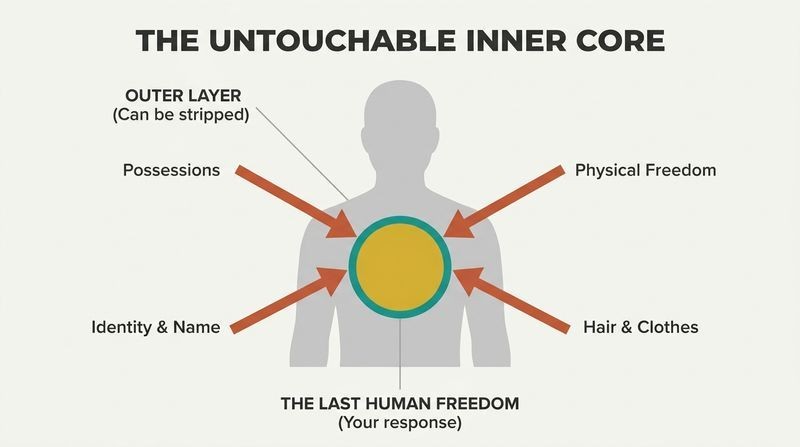
The last freedom no captor can seize. Frankl, prisoner 119,104 at Auschwitz and three other camps, watched the Nazis confiscate his clothes, his hair, his name, and the manuscript representing his life's work. Yet he insisted one thing remained untouchable: the freedom to choose one's inner stance toward suffering. He remembered prisoners who walked the barracks comforting others and giving away their last crust of bread. They were few, but their existence proved that circumstances do not fully determine character.
Attitude as the final human territory. In a world that reduced men to numbers and playthings of fate, the decisive question was whether a person would surrender his inner self or preserve his dignity. Frankl quotes Dostoevsky: the one dread worth having is proving unworthy of one's suffering.
What's striking is how this reframes the entire genre of self-help, which usually promises control over outcomes. Frankl grants almost none of that and locates freedom purely in interpretation. Modern cognitive behavioral therapy rests on a similar premise: events do not disturb us, our judgments about them do, an idea traceable to the Stoic Epictetus, a former slave. A fair challenge: severe trauma, starvation, and sleep deprivation measurably impair executive function, so the capacity to choose is not evenly distributed. Frankl concedes only a minority achieved it. The claim is not that everyone can, but that the possibility itself redeems human dignity.
Humans crave meaning more than pleasure or power
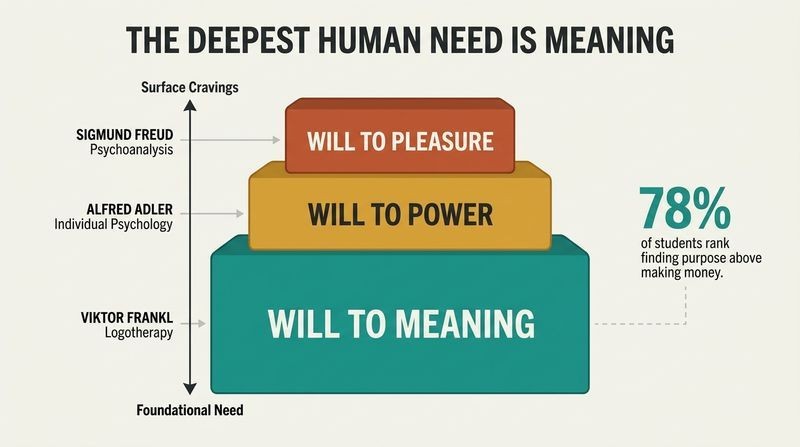
The third Viennese school. Frankl positions his psychology against his predecessors. Freud saw the deepest human drive as the pursuit of pleasure. Adler saw it as the striving for power and superiority. Frankl argues the primary motivational force is the will to meaning, the drive to find purpose specific to one's own life. He calls his method logotherapy, from the Greek logos, meaning.
Meaning is not a rationalization. Skeptics dismiss values as mere defense mechanisms or sublimated instincts. Frankl retorts that no one willingly dies for a defense mechanism, yet people die for ideals. He cites a survey where 78 percent of students ranked finding purpose above making money. When meaning is frustrated, he warns, a distinct suffering follows that is not neurosis but an existential distress signaling one's humanness.
This is the book's spine, and it has aged well. Self-determination theory, developed by psychologists Deci and Ryan decades later, empirically identifies purpose and relatedness as needs distinct from pleasure, echoing Frankl. Positive psychology now distinguishes hedonic well-being (pleasure) from eudaimonic well-being (meaning), and finds the latter more protective against depression. One nuance worth flagging: Frankl frames these three drives as rivals, but they likely operate as a hierarchy or blend rather than a winner-take-all contest. A starving prisoner obsessed with bread is not thereby meaningless, and a life of pure meaning without any joy would be unusually austere.
Stop asking life for answers; answer the question it asks you
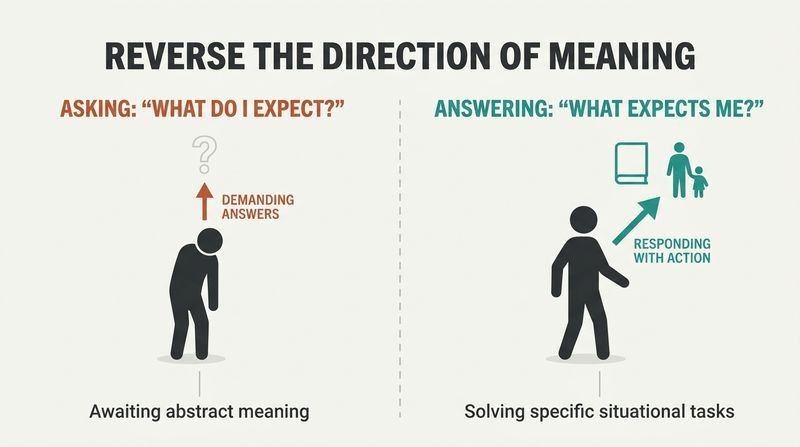
Reverse the direction of the question. The despairing prisoner would say, I have nothing left to expect from life. Frankl's radical inversion: it does not matter what you expect from life, but what life expects from you. Each person is being questioned by existence, hourly and concretely, and can only respond by taking responsibility for a specific task that no one else can perform.
Meaning is situational, not abstract. Frankl compares asking the meaning of life in general to asking a chess champion for the single best move. There is no such move apart from a particular board. Meaning differs from person to person and moment to moment. He prevented two suicides by helping each man see that something irreplaceable awaited him: for one, a child abroad; for the other, an unfinished scientific book.
The move here is subtle and powerful. By shifting from passive expectation to active responsibility, Frankl relocates agency in the person even when their situation is fixed. This anticipates the therapeutic technique of behavioral activation, which treats depression not by resolving feelings first but by resuming meaningful action. It also resonates with the concept of ikigai, the Japanese notion of a reason to get up in the morning tied to concrete daily tasks. A constructive caution: reframing life as a taskmaster demanding responses could burden someone already crushed by circumstance. Frankl's genius was calibrating the task to what the person could still uniquely offer.
Lose your reason to live and your body soon follows
A Why sustains any How. Frankl adopts Nietzsche's line: he who has a why to live for can bear almost any how. Prisoners who kept a future goal, a waiting spouse, an unfinished book, an intended lecture, proved most likely to survive. Those who surrendered hope collapsed physically. The telltale sign was a man who stayed in his bunk lying in his own filth, then pulled out a hidden cigarette to smoke. Within two days he was usually dead.
Hope guards immunity. Frankl's block warden dreamed the war would end for him on March 30. When the date passed with no liberation, he spiked a fever on March 29, fell delirious on the 30th, and died on the 31st. The camp death rate surged around Christmas 1944, when prisoners had staked hope on being home by the holiday.
The mind-body link Frankl describes intuitively now has a research field: psychoneuroimmunology. Chronic hopelessness elevates cortisol and suppresses immune response, plausibly explaining why a shattered expectation could unlock a latent typhus infection. Studies of terminal patients show survival sometimes clusters just after milestones like holidays or family events, hinting people can briefly postpone death for meaning. The causal story is hard to prove and vulnerable to survivorship bias, since Frankl himself notes the best often did not return and luck dominated. Still, the observation that giving up precedes dying, rather than merely accompanying it, remains one of the memoir's most haunting clinical insights.
Meaning arrives through work, love, or how you bear suffering
Three doors to purpose. Frankl maps three avenues to meaning:
1. Creating a work or doing a deed (achievement).
2. Experiencing something or loving someone (encounter).
3. Choosing one's attitude toward unavoidable suffering.
The third is the hardest and most distinctly human. When a situation cannot be changed, we are challenged to change ourselves.
Turning tragedy into achievement. An elderly doctor, crushed by his wife's death, asked Frankl for help. Frankl asked what would have happened had the doctor died first. The wife, he replied, would have suffered terribly. Frankl noted that by outliving her, he had spared her that pain, at the cost of mourning. The suffering suddenly held meaning as a sacrifice. Frankl adds a crucial caveat: if suffering is avoidable, remove its cause. To suffer needlessly is masochism, not heroism.
The reframe offered to the grieving doctor is a textbook example of what therapists now call cognitive reappraisal, changing the meaning of an event to change its emotional charge. Notably Frankl gave no advice and prescribed no drug; he asked one question that let the man rebuild the narrative himself. The love avenue deserves emphasis: Frankl argues love perceives a person's unrealized potential and helps actualize it, a strikingly generative view. The suffering avenue invites misreading, so his caveat matters. He is not romanticizing pain but insisting that when pain is truly inescapable, dignity in bearing it becomes the one available achievement.
Chase happiness and it flees; it only arrives as a byproduct
Success must ensue, never be pursued. Frankl warns his students that the more you aim at success or happiness, the more you miss them. Both come only as unintended side effects of dedication to a cause greater than yourself or surrender to another person. He calls this self-transcendence: humans are wired to point beyond themselves, and self-actualization happens only as a residue of that outward focus.
Forcing an outcome sabotages it. Frankl observed hyper-intention wrecking sexual function: the harder a man tries to prove potency or a woman to force orgasm, the more it eludes them, because pleasure is spoiled the instant it becomes the goal. He mocks the American cultural command to be happy, comparing it to people frozen in fake smiles when told to say cheese for a camera. You need a reason to be happy; supply the reason and happiness follows on its own.
This paradox of hedonic pursuit has robust empirical backing. Psychologist Iris Mauss found that people who most value happiness often report being less happy, partly because monitoring their own mood disrupts it. The mechanism mirrors what Frankl saw clinically: attention turned inward on a spontaneous process jams that process. Flow research by Csikszentmihalyi points the same direction, since flow arrives when attention is absorbed in a task, not in oneself. The cross-cultural jab at American positivity is sharp but slightly overdrawn, since striving toward goals still requires wanting outcomes. Frankl's precise claim is narrower and correct: make the feeling itself the target and you scatter it.
Modern emptiness is an epidemic of having means but no meaning
The existential vacuum. Frankl diagnoses a mass affliction of the twentieth century: a pervasive sense of inner emptiness and boredom. Humans lost the animal instincts that once dictated behavior and then lost the traditions that replaced them. Now many neither know what to do nor what they wish to do, so they conform to others or obey what others want. He found this void in 25 percent of his European students and 60 percent of his American ones.
Boredom outpaces distress. Frankl cites Sunday neurosis, the depression that surfaces when the busy week stops and the inner emptiness becomes audible. He links the vacuum to the triad of depression, aggression, and addiction, noting that 90 percent of the alcoholics in one study and 100 percent of certain drug addicts reported life felt meaningless. Purpose, not pleasure, fills the hole.
Written in the postwar boom, this diagnosis reads as prophetic about affluent societies. Rising rates of what sociologists call deaths of despair, from suicide, overdose, and alcohol, cluster precisely where economic means outstrip felt purpose, echoing Frankl's means-without-meaning formula. Durkheim's older concept of anomie, normlessness following the collapse of shared frameworks, is essentially the same phenomenon at the societal scale. A caveat: Frankl's percentages come from his own clinical populations and self-reports, not representative sampling, so the exact figures should be held loosely. The underlying pattern, that unstructured freedom without a guiding purpose breeds distress, is nonetheless well supported by later work on autonomy and well-being.
Only two kinds of people exist: decent and indecent
The line runs through every group. After watching guards and prisoners alike, Frankl concluded there are only two races of humanity: the decent and the indecent. Both appear in every category. Some SS guards showed unexpected kindness; one camp commander secretly spent his own money buying medicine for prisoners. Meanwhile the senior prisoner functionaries, the Capos, were often crueler than the SS, beating fellow inmates savagely.
Character is a choice, not a role. Knowing whether a man was guard or prisoner told you almost nothing about his soul. A foreman once slipped Frankl a piece of bread saved from his own ration, and the human warmth in the gesture moved him more than the food. Frankl refused collective guilt entirely, insisting it is unjust to blame one person for another's deeds. Evil and decency, he argues, cut through the middle of every human heart.
This refusal to divide the world into tribes of angels and demons is morally sophisticated and hard-won, coming from a man whose wife, parents, and brother were murdered. It anticipates Solzhenitsyn's famous observation that the line between good and evil runs through every human heart, and it braces against the tribalism that fuels atrocity. Social psychology complicates the picture: Milgram's obedience experiments and Zimbardo's prison study suggest situations pull ordinary people toward cruelty far more than fixed character predicts. Frankl would not deny situational pressure; his point is that even under maximal pressure, a residue of choice, and therefore of responsibility, survives. Both truths can hold.
Beat your phobia by wishing for the very thing you fear
Fear is the mother of the event. Frankl noticed that anticipatory anxiety produces exactly what the sufferer dreads. Fear of blushing triggers blushing; fear of sleeplessness prevents sleep. His counterintuitive technique, paradoxical intention, tells the patient to deliberately intend the feared outcome, using humor to gain distance from the symptom.
Wishing it on makes it flee. A doctor terrified of sweating was told, next time, to resolve to show everyone how drenched he could get, to pour out ten quarts. After four years of the phobia, he was free within a week. A stutterer discovered he could not stutter when he tried to. A woman with a sixty-year washing compulsion recovered in two months. The companion technique, dereflection, redirects obsessive self-focus outward, since the cure for morbid self-monitoring is self-transcendence, not more introspection.
Paradoxical intention prefigured mainstream behavioral therapy by decades. It closely resembles exposure therapy, where confronting rather than avoiding a feared stimulus extinguishes the anxiety, and it shares DNA with the acceptance strategies in modern acceptance and commitment therapy, which stops the exhausting war against intrusive thoughts. The active ingredient is twofold: it breaks the vicious feedback loop where fear of the symptom amplifies the symptom, and it recruits humor, which creates psychological distance. Frankl is careful to call it no panacea, effective mainly for phobic and obsessive-compulsive conditions rooted in anticipatory anxiety. What makes it durable is that the reversal removes the fuel, not merely the flame.
Your past is a full granary nothing can ever empty
Tragic optimism. In his postscript, Frankl asks how one can say yes to life despite the tragic triad of pain, guilt, and death. His answer: turn suffering into achievement, extract from guilt the chance to change for the better, and let life's fleeting nature spur responsible action. Optimism cannot be commanded, only earned by finding a reason.
Transience is not loss. People fixate on the stubble field of what has passed and forget the full granaries behind them. Once you actualize a possibility, it is stored permanently in the past, safe from all erasure. The deeds done, loves loved, and sufferings borne with dignity are the surest kind of being. This is why Frankl says the old should be envied, not pitied: the young have mere possibilities, while the aged hold realities already harvested and beyond anyone's reach.
The granary metaphor offers a quietly radical counter to a culture obsessed with youth and future potential. It reframes aging as accumulation rather than decline, an idea gerontologists echo when they find that older adults often report higher well-being despite fewer prospects, a pattern called the paradox of aging. Frankl's insistence that the past is permanently secured also functions as a bulwark against regret and the fear of death, since what was lived cannot be un-lived. His categorical imperative, to live as if living for the second time and about to repeat a past mistake, is a practical device for making each irreversible choice count. Tragic optimism names the mature stance of affirming life with eyes fully open to its worst.
Analysis
Man's Search for Meaning is really two books fused by circumstance: a spare, unsentimental Holocaust memoir and a compressed manual of Frankl's psychiatric school, logotherapy. The memoir earns the theory. Frankl wrote the whole thing in nine days in 1945, initially intending anonymity, and its authority comes precisely from that fusion. The abstract claim that meaning sustains life would be a pleasant hypothesis in a lecture hall; delivered by prisoner 119,104 who lost his wife, parents, and brother to the camps, it becomes existential testimony. Frankl himself notes that either half without the other would be far weaker.
The book's enduring power lies in a single structural move: relocating human freedom from external circumstance to internal response. This is not new philosophically, since the Stoics said it and Nietzsche supplied the epigraph, but Frankl stress-tested it in the most extreme laboratory imaginable and reported back that it held for a stubborn minority. That empirical honesty matters. He never claims most prisoners transcended; he admits the best did not return and that survival hinged largely on luck. The heroism he documents is statistically rare, which paradoxically makes it more credible.
Where the work invites scrutiny is its universalizing tendency. The will to meaning is presented as the primary human drive, dethroning Freud and Adler, but the evidence is largely clinical and anecdotal, and later research suggests meaning, pleasure, and connection coexist rather than compete. His figures on existential vacuum come from unrepresentative samples. Yet these are quibbles against a book whose central therapeutic insight has been vindicated by cognitive behavioral therapy, acceptance-based approaches, and self-determination theory alike. Frankl's final wisdom is deceptively simple and genuinely hard: you cannot choose what happens, you can always choose your stance, and meaning is discovered by answering life rather than interrogating it. That reversal remains the book's gift.
Review Summary
Man's Search for Meaning receives mostly positive reviews, with readers praising its profound insights on finding purpose in life, even amid extreme suffering. Many find the first part, describing Frankl's concentration camp experiences, deeply moving and thought-provoking. The second part, focusing on logotherapy, garners mixed reactions, with some finding it enlightening and others considering it dry or outdated. Critics note the book's clinical tone and lack of emotion, while supporters appreciate its enduring wisdom and transformative potential.
People Also Read







FAQ
What's "Man's Search for Meaning" about?
- Survival and Meaning: "Man's Search for Meaning" by Viktor E. Frankl is about his experiences as a Holocaust survivor and his development of logotherapy, a form of existential analysis.
- Concentration Camp Experiences: The book details Frankl's time in Nazi concentration camps and how he found meaning in suffering.
- Logotherapy Introduction: It introduces logotherapy, which posits that the primary drive in humans is not pleasure or power, but the pursuit of meaning.
- Human Freedom and Choice: Frankl emphasizes the freedom to choose one's attitude in any given set of circumstances, even in the face of extreme suffering.
Why should I read "Man's Search for Meaning"?
- Inspiration and Resilience: The book offers profound insights into human resilience and the ability to find meaning in the most challenging circumstances.
- Psychological Insights: It provides a unique perspective on psychological health, emphasizing the importance of meaning in life.
- Practical Philosophy: Frankl's experiences and theories offer practical advice for finding purpose and dealing with life's adversities.
- Universal Relevance: The themes of suffering, choice, and meaning are universally applicable, making it relevant to anyone seeking deeper understanding of life.
What are the key takeaways of "Man's Search for Meaning"?
- Meaning as Motivation: The primary motivation in life is the search for meaning, not pleasure or power.
- Freedom of Choice: Even in the direst situations, individuals have the freedom to choose their attitude and find meaning.
- Suffering and Meaning: Suffering is an inevitable part of life, but it can be transformed into a source of meaning.
- Logotherapy's Role: Logotherapy helps individuals find meaning in life, which is crucial for psychological health and well-being.
What is logotherapy according to Viktor E. Frankl?
- Meaning-Centered Therapy: Logotherapy is a form of psychotherapy that focuses on the search for meaning in life as the primary motivational force.
- Existential Analysis: It involves analyzing existential questions and helping individuals find purpose in their lives.
- Freedom and Responsibility: Logotherapy emphasizes the freedom to find meaning and the responsibility to choose one's attitude.
- Application in Therapy: It is used to treat existential frustration and noögenic neuroses, which arise from a lack of meaning.
How did Viktor E. Frankl survive the concentration camps?
- Mental Resilience: Frankl survived by maintaining mental resilience and finding meaning in his suffering.
- Focus on the Future: He focused on future goals, such as reuniting with his wife and completing his work on logotherapy.
- Inner Freedom: Frankl exercised his inner freedom by choosing his attitude towards the camp's horrors.
- Love and Beauty: He found solace in thoughts of his loved ones and moments of beauty in nature and art.
What are the best quotes from "Man's Search for Meaning" and what do they mean?
- "He who has a why to live can bear almost any how." This quote emphasizes the power of having a purpose or meaning in life to endure hardships.
- "Everything can be taken from a man but one thing: the last of the human freedoms—to choose one's attitude in any given set of circumstances." It highlights the ultimate freedom of choice in one's response to life's challenges.
- "When we are no longer able to change a situation, we are challenged to change ourselves." This quote speaks to the transformative power of adapting one's mindset in the face of unchangeable circumstances.
- "The salvation of man is through love and in love." It underscores the importance of love as a source of meaning and strength.
How does "Man's Search for Meaning" address suffering?
- Suffering as Meaningful: Frankl argues that suffering can be meaningful if it is unavoidable and faced with the right attitude.
- Transforming Tragedy: He suggests that individuals can transform personal tragedies into triumphs by finding meaning in them.
- Attitudinal Change: The book emphasizes changing one's attitude towards suffering to find purpose and growth.
- Examples of Suffering: Frankl provides examples of how individuals, including himself, found meaning in suffering during the Holocaust.
What is the "existential vacuum" in "Man's Search for Meaning"?
- Feeling of Emptiness: The existential vacuum is a feeling of emptiness and meaninglessness that many people experience.
- Loss of Traditions: It arises from the loss of traditional values and the lack of instinctual guidance in modern society.
- Consequences: This vacuum can lead to depression, aggression, and addiction as individuals struggle to find purpose.
- Logotherapy's Role: Logotherapy addresses the existential vacuum by helping individuals discover personal meaning in life.
How does Viktor E. Frankl define the "will to meaning"?
- Primary Motivation: The will to meaning is the primary motivational force in humans, according to Frankl.
- Contrast with Other Theories: It contrasts with Freud's pleasure principle and Adler's will to power, focusing instead on finding purpose.
- Unique and Specific: Meaning is unique and specific to each individual and must be fulfilled by them alone.
- Living and Dying for Values: Frankl argues that people can live and even die for the sake of their ideals and values.
What is "tragic optimism" in "Man's Search for Meaning"?
- Optimism Despite Tragedy: Tragic optimism is the ability to remain optimistic despite the tragic aspects of life, such as pain, guilt, and death.
- Turning Negatives into Positives: It involves creatively turning life's negative aspects into something positive or constructive.
- Human Potential: Frankl emphasizes the human potential to find meaning and growth in suffering and adversity.
- Incentive for Action: Tragic optimism provides an incentive to take responsible action and make the best of any situation.
How does "Man's Search for Meaning" relate to modern psychological issues?
- Relevance to Depression: The book addresses existential depression and the search for meaning in life, which are common modern issues.
- Coping with Emptiness: It offers insights into coping with feelings of emptiness and meaninglessness in contemporary society.
- Therapeutic Applications: Logotherapy is used to treat various psychological conditions by helping individuals find purpose.
- Universal Themes: The themes of choice, responsibility, and meaning are universally applicable to modern psychological challenges.
What impact has "Man's Search for Meaning" had on readers and professionals?
- Influence on Therapists: The book has influenced therapists to focus on helping patients find meaning and purpose in their lives.
- Inspiration for Readers: It has inspired countless readers to overcome personal challenges and find meaning in adversity.
- Educational Use: The book is widely used in educational settings to teach psychology, philosophy, and Holocaust studies.
- Enduring Legacy: Frankl's work continues to resonate with people seeking deeper understanding and fulfillment in life.
About the Author
Other books by Viktor E. Frankl





Download PDF
Download EPUB
.epub digital book format is ideal for reading ebooks on phones, tablets, and e-readers.








































