


Key Takeaways
Replace all your goals with one: maximize efficiency everywhere
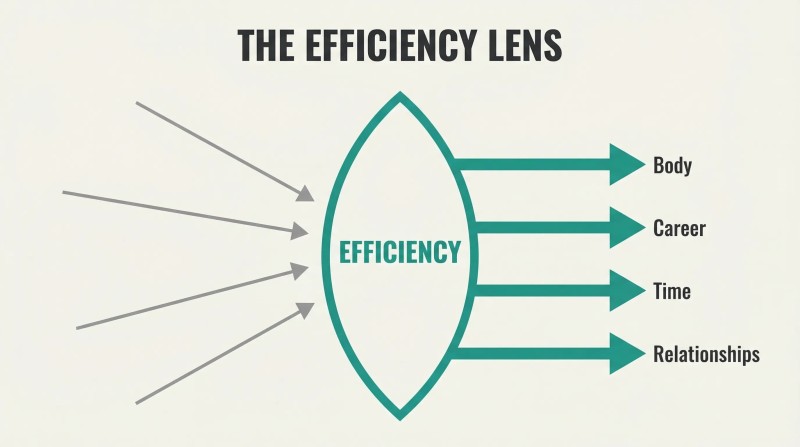
The book's entire thesis in two words: maximize efficiency. The authors argue that every frustration in life — a failed lift, a traffic jam, a stalled career — is really a failure of efficiency. Physical training makes your body adapt more efficiently. Technology makes processes faster. Career growth means using your time to generate more output. Instead of setting scattered goals, treat efficiency as your only metric and improve it yearly across 1-2 areas at a time.
Five laws of time efficiency anchor the framework:
1. If nothing can be done right now, stop thinking about it
2. Build the foundation before obsessing over details
3. You've mastered a task when someone else does it for you
4. Overachievement past the threshold is wasted energy (a 90% and 100% earn the same A)
5. Maintain only "Up or Out" relationships — cut stagnant contacts ruthlessly
Stop cutting costs — spend that time creating income instead
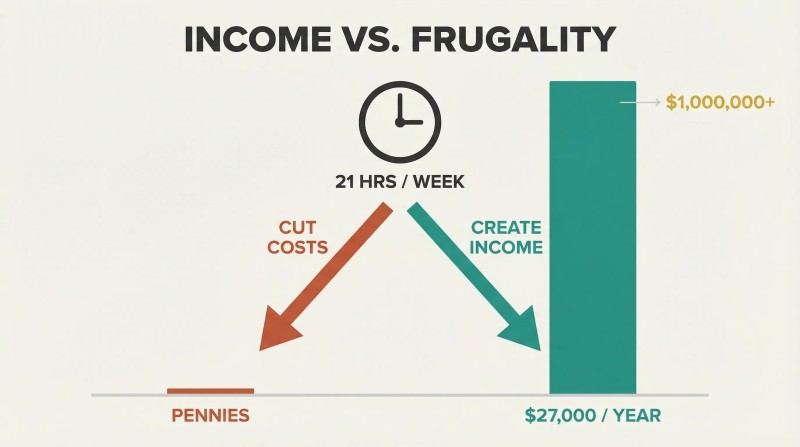
Frugality is a losing strategy. The authors draw a sharp line: frugal people optimize pennies, future multi-millionaires optimize earning power. Consider the math: the average American earns roughly $25/hour and watches about 3 hours of television per day — that's 21 hours a week. Redirecting those hours to income-generating work yields approximately $27,000 in annual savings, compounding to over a million dollars in about 36 years, even with zero investment returns.
The same logic applies to every cost-cutting habit. Time spent clipping coupons, hunting for discounts, or haggling over $10 is time not spent building a second income stream. The book's stance: you won't have time to overspend anyway if you're genuinely busy building something. High earners save by accident — their schedules are too packed to burn cash on frivolous purchases.
Learn to sell before anything else — it's the only universal skill
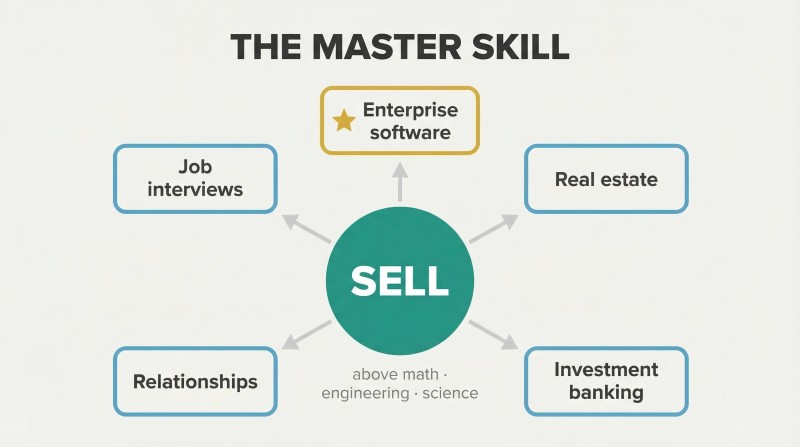
Sales is the master skill. The authors rank it above mathematics, engineering, and hard science in terms of lifetime return on investment. Why? Every business must sell its product. Every interview is a sale. Every date is a pitch. The skill transfers to enterprise software deals, real estate, and even convincing a CEO to sell his company through investment banking. The book lists eight specific benefits of a sales career, including forced optimism, emotional resilience to rejection, and performance-based pay with no income ceiling.
Enterprise software sales gets their strongest recommendation. The reasoning: recurring multi-year contracts create sticky revenue, switching costs lock customers in (think Apple vs. Microsoft habits), and person-to-person high-ticket sales is the last thing artificial intelligence will automate. If you can close a six-figure B2B contract, you'll never be unemployable.
Route your career through your intelligence type, not your interests
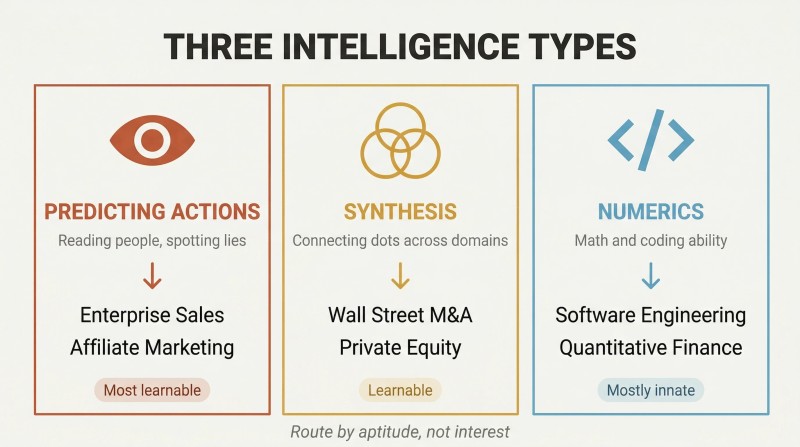
Three intelligence types, three career paths. The book rejects IQ as the sole measure and splits intelligence into three practical categories. First, Predicting Actions — reading people, detecting lies, spotting insecurities. This maps to enterprise sales and affiliate marketing. Second, Synthesis — connecting dots across people, data, and strategy, like a great coach assembling a winning roster from mismatched talent. This maps to Wall Street M&A and private equity. Third, Numerics — pure mathematical and coding ability, the hardest to develop but the easiest to test (SATs, coding interviews). This maps to software engineering and quantitative finance.
The critical test: other people — not friends or family — must tell you you're good at it, or you must rank in the top 10% nationally. Interest in a field is irrelevant; aptitude determines earning power. Of the three, predicting actions and synthesis are the most learnable, while numerics is largely innate.
People buy from fear and insecurity — sell to that, not features
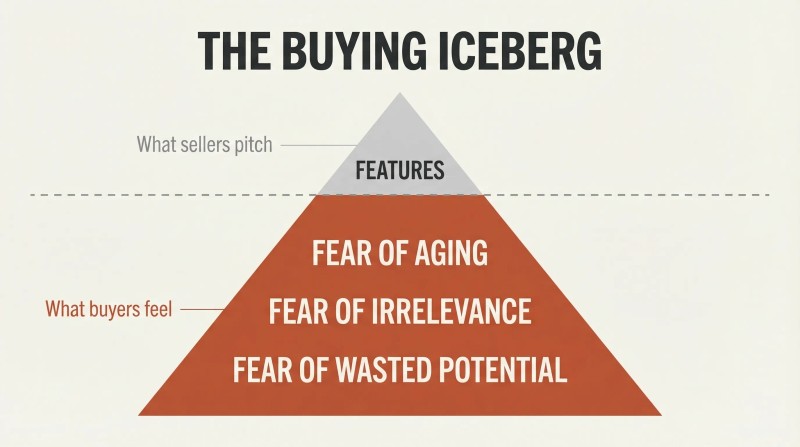
Forget product comparisons. Most competing products are functionally identical — Coke vs. Pepsi, smartphone vs. smartphone. The real question isn't "what's in demand" but "why do people buy?" The answer: insecurity and emotion. Skin care sells because women fear aging. Ferraris sell because men fear sexual irrelevance. Motivational products sell because people fear they're wasting their potential. The book's selling framework — called the SET Framework — structures every pitch as Story (relate emotionally to your audience's pain), Example (show the results of your solution), and Tell (close with a direct call to action).
Fear of loss outperforms desire for gain. Losing $100 stings far more than gaining $100 feels good. The authors recommend defaulting to fear-based selling with words like "avoid," "last chance," "security," and "right now." They also advise writing at an eighth-grade reading level — emotion sells, not vocabulary.
Rank business models by revenue type: recurring beats everything
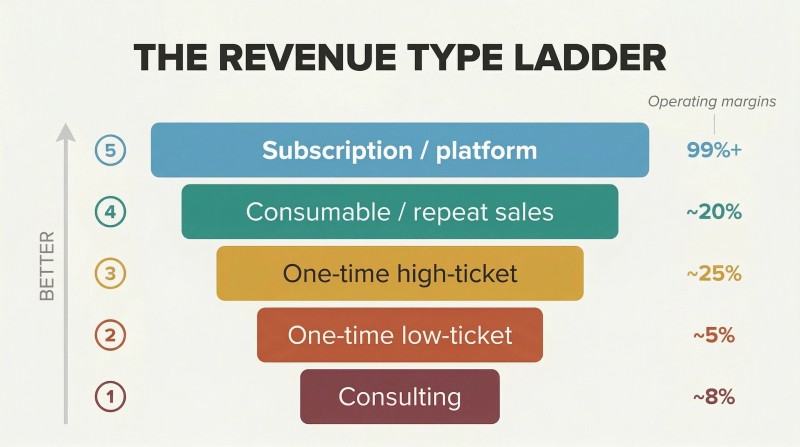
Five tiers of business models determine your ceiling, from worst to best:
1. Consulting — trading time for money (~8% operating margins, like Booz Allen Hamilton)
2. One-time low-ticket sales — books, home goods (single-digit margins, no repeat purchases)
3. One-time high-ticket sales — M&A advisory, luxury real estate (~25% margins but no recurring income)
4. Consumable item sales — protein powder, Coca-Cola (~20% margins, customers replenish monthly)
5. Licensing, platform, or subscription revenue — Netflix, Facebook (margins expand with every new user approaching 99%+)
The authors self-deprecatingly admit their own book is a tier-two product: "There is no reason to buy a second one!" Facebook exemplifies the pinnacle: users are the product, personal data flows freely, and adding one more subscriber costs nearly nothing. Your goal is to climb this ladder — ideally starting at tier four or five from day one.
Never build a product before proving strangers will pay for it
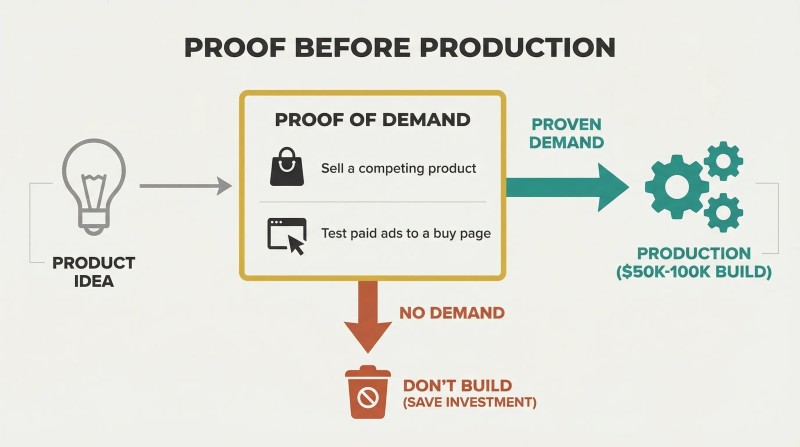
Two ways to validate demand before spending $50-100K on production. First, sell a competing product via affiliate marketing. If you want to launch a line of earrings but can't convert sales for someone else's earrings, your own brand will fare even worse — you'd have zero brand recognition on top of no sales skills. Second, buy a few thousand dollars of paid traffic to a sales page with a purchase button that returns an error page. The visitors who click "buy" before hitting the error become your conversion rate. If the numbers work, shut it down and start production.
The authors also warn against assuming any strategy works forever. Today's winning ad format — whiteboard videos, native content, mobile popups — can become tomorrow's ignored noise. Master one sales channel, then diversify or hire specialists in others.
Motivation is a product to sell, not a vitamin to take
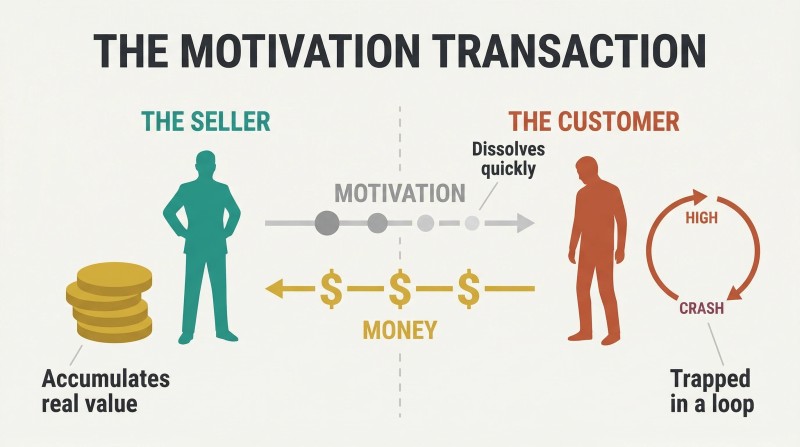
Pump-up speeches are designed to extract money, not produce results. The authors call motivational content an "emotional Ponzi scheme" — it converts deep-seated insecurity into a brief dopamine hit, then funnels that emotional high into a product purchase. The audience feels better temporarily, the speaker profits, and nothing changes. If someone needs an external source to get fired up, they never wanted the outcome badly enough. Preparation replaces motivation: practice a speech a thousand times and nervousness evaporates without a pep talk.
But here's the flip side: because the masses crave emotional pump-ups, motivation is an extraordinarily profitable product category. Get-rich-quick courses, self-improvement seminars, and inspirational content target people with the lowest self-direction — and they buy eagerly. The authors' advice: be the seller, never the customer. Use emotional triggers to convert sales, but run your own life on internal drive and daily execution.
Run a career and side business in parallel — then bleed out the career
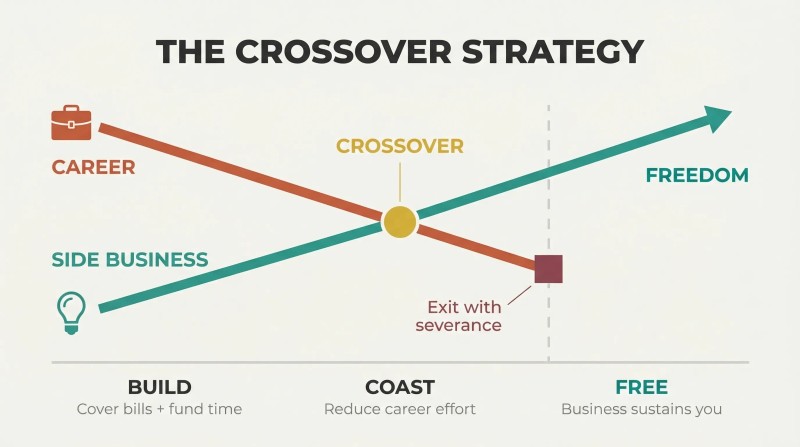
The barbell approach to risk. Rather than quitting your job to go "all in" on a startup, the authors recommend building enough career income to cover 10-20% above your cost of living, then funneling all remaining time into a scalable side business. Real problems — like not making rent — cause worry that kills creativity. Manageable stress, however, fuels output.
Once the side business generates a near-living wage, begin strategically coasting at your career. Focus only on top-revenue accounts. Delegate low-value work to junior employees. Schedule meetings later in the morning to free up time for your business. Increase sick days timed after big wins so nobody notices. The goal: maintain a mediocre-but-acceptable performance for 1-2 years while collecting a full paycheck, health insurance, and 401K match. The cardinal rule: get laid off with severance — never get fired.
Choose employers by profit per employee, not brand prestige
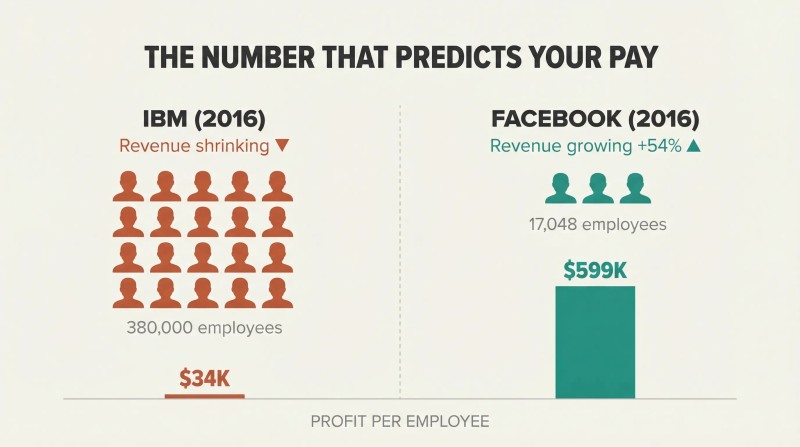
Two numbers reveal whether a company can pay you well: top-line revenue growth and profit per employee. The authors compare Facebook and IBM using public filings. Facebook in 2016: 17,048 employees, $27.6B in revenue, $10.2B in net income — yielding $599K in profit per employee with revenue growing 54% year-over-year. IBM: 380,000 employees, $79.9B in revenue, $12.9B in net income — yielding just $34K in profit per employee with revenue shrinking 2%. The gap is staggering and directly predicts compensation potential.
The same analysis applies to Wall Street. The authors contrast Moelis & Company (660 employees, average compensation of $472K, $210K operating profit per employee) with Piper Jaffray (1,315 employees, losing money). Always pick the firm that generates more profit per head — that's where bonuses come from and promotions happen fastest.
Analysis
Efficiency occupies an unusual position in the business book landscape: it's simultaneously a comprehensive life manual and a blunt financial operations playbook written by anonymous practitioners rather than branded thought leaders. This anonymity is both its weakness (no verifiable track record) and its strength (no reputational incentive to soften advice for mass appeal). The result reads like a private memo from a ruthless older brother who happens to work in finance.
The book's most original intellectual contribution is its intelligence typology — predicting actions, synthesis, and numerics — which functions as a practical, career-oriented alternative to academic frameworks like Howard Gardner's multiple intelligences or the Big Five personality traits. By mapping each type to specific career paths (enterprise sales, M&A banking, software engineering), the authors create a decision tree that collapses years of career exploration into weeks of honest self-assessment. The critical insight that predicting actions and synthesis are learnable while numerics is largely innate challenges the growth-mindset orthodoxy popularized by Carol Dweck.
The business monetization hierarchy — from consulting through recurring subscription revenue — is among the clearest frameworks in bootstrapper literature, rivaling MJ DeMarco's Fastlane distinctions. The self-deprecating admission that their own book represents a terrible business model (one-time, low-ticket, non-recurring) lends credibility.
However, the book suffers from significant survivorship bias. The implicit assumption that anyone willing to work 70+ hours per week for three years will inevitably find a $100K+ career ignores structural barriers of geography, discrimination, and credential gatekeeping. The moral framework — anything legal that works is ethical — is logically consistent but philosophically thin, particularly in the affiliate marketing sections where the line between aggressive and deceptive blurs.
The dating sections reveal the book's demographic limitations most starkly, but the underlying principle — whoever needs the other person least holds power — applies universally to employer-employee dynamics, client relationships, and negotiation, making it perhaps the book's most portable insight across domains.
Review Summary
Efficiency receives overwhelmingly positive reviews, with readers praising its practical advice on achieving success and wealth without sacrificing personal life. Many recommend it for young adults, particularly those under 25. The book is commended for its concise, straightforward approach and valuable insights on career planning, time management, and entrepreneurship. Some readers note its focus on male and American perspectives but find the principles broadly applicable. Critics mention its similarity to existing self-help books and potential redundancy for those with more life experience.
People Also Read








Glossary
SET Framework
Sales messaging structureA three-step selling framework coined in the book: Story (relate to the audience's pain emotionally), Example (demonstrate the benefits and results of the solution), and Tell (direct the audience to take a specific action, such as purchasing). The authors consider it the foundational template for all online and offline sales copy.
Inside First, Outside Second
Build core before aestheticsA principle stating that physical development should start from the inside (gut health, brain function, core strength, and natural gifts) before focusing on external appearance (aesthetics, wardrobe, brand-name clothing). The authors apply it broadly: fix the foundation of any system before optimizing surface-level details.
Barbell Approach
Stable income plus side businessA risk management strategy where you maintain a career generating 10-20% above your cost of living (the stable end) while dedicating all remaining time to building a scalable business (the high-risk/high-reward end). The goal is to avoid the creativity-killing worry of unpaid bills while still pursuing asymmetric upside from entrepreneurship.
Up or Out Relationships
Cut stagnant contacts ruthlesslyA relationship management rule borrowed from consulting culture and applied to all personal and professional contacts. If someone in your life is not actively progressing—improving their career, health, or skills—they should be removed from your inner circle. The authors argue that stagnant friends cause you to stagnate by association.
Abilities vs. Facts
Innate talent versus learnable rulesA distinction between natural aptitudes unique to each person (Abilities) and universally learnable principles anyone can follow (Facts). The authors claim that following the Facts alone guarantees millionaire status, since roughly 97% of people ignore them. Abilities—innate talents in sales, synthesis, numerics, or athletics—determine whether someone can break past the millionaire threshold into multi-millionaire territory.
Churn and Burn
Short-term aggressive customer cyclingA sales and business approach where the seller aggressively pushes products to new customers using non-compliant or hyper-aggressive tactics, exhausting each customer segment before moving to the next. The authors acknowledge it can generate fast income but argue it destroys lifetime customer value, forces constant product switching, and damages long-term reputation.
Cloaking
Showing different pages to auditorsAn affiliate marketing technique where different landing pages are shown to different users based on their profile. Targeted customers (e.g., overweight women searching for diet products) see aggressive, often non-compliant sales pages, while platform auditors from Google or Facebook see harmless, compliant content. The authors describe it as the primary method most affiliates use to generate fast income, though accounts are frequently banned.
Motivation Ponzi Scheme
Emotional pump-up that sells productsThe authors' term for the motivational content industry—seminars, videos, speeches, and courses that convert audience insecurity into a temporary emotional high, which is then channeled into purchasing a product. Like a Ponzi scheme, it requires constant new converts (one success story out of thousands) to sustain the illusion. The authors argue 99% of consumers gain nothing actionable from it.
FAQ
What's Efficiency: Get Rich Without Giving Up Your Life about?
- Focus on Efficiency: The book emphasizes maximizing efficiency in life, including making money, staying healthy, and achieving happiness. Efficiency is portrayed as the key to success.
- Practical Strategies: It offers actionable strategies like eliminating obligations, avoiding distractions, and focusing on scalable business models to achieve financial success.
- Mindset Shift: Encourages readers to take full responsibility for their success, avoiding blame on external factors or people.
Why should I read Efficiency: Get Rich Without Giving Up Your Life?
- Real-World Application: Provides practical advice that can be applied immediately to improve financial situations and life efficiency.
- Unique Perspective: Offers a fresh take on wealth-building, challenging conventional wisdom and traditional financial advice.
- Time Management Focus: Highlights the importance of managing time effectively to achieve wealth without sacrificing personal life.
What are the key takeaways of Efficiency: Get Rich Without Giving Up Your Life?
- Eliminate Obligations: Focus on personal success by removing unnecessary obligations to others.
- Avoid Motivation Ponzi Schemes: Steer clear of motivational content that lacks actionable results; focus on preparation and internal motivation.
- Health vs. Wealth: Temporary health sacrifices may be necessary for financial goals, but understanding personal limits is crucial.
What are the best quotes from Efficiency: Get Rich Without Giving Up Your Life and what do they mean?
- “Baggage Free”: Emphasizes living life on your own terms and removing toxic relationships that hinder growth.
- “Productive Relationships”: Encourages focusing on relationships that contribute to success and avoiding distractions.
- “Value of Time”: Highlights the importance of investing time in productive activities rather than passive entertainment.
How does Efficiency: Get Rich Without Giving Up Your Life define success?
- Personal Responsibility: Success involves taking full responsibility for actions and outcomes without blaming others.
- Financial Independence: True success is achieving financial independence and living life on one's own terms.
- Maximizing Resources: Efficient use of time and resources to achieve personal and financial goals is key.
What are the 10 basic axioms to follow in Efficiency: Get Rich Without Giving Up Your Life?
- Obligations Are Gone: Free yourself from obligations to focus on personal success.
- No Social Media, No Television: Limit distractions unless they contribute to financial goals.
- Focus on Scale: Prioritize scalable business models for recurring income.
- Stress Management: Manage stress effectively without letting it impede progress.
What is the Cloaking method mentioned in Efficiency: Get Rich Without Giving Up Your Life?
- Definition of Cloaking: Disguising the true nature of a product to bypass restrictions, often used in affiliate marketing.
- Risks Involved: Can lead to account bans and loss of merchant relationships, posing significant risks.
- Recommendation Against Cloaking: Advocates for building legitimate businesses for sustainable income and better customer relationships.
How can I effectively leave my career as suggested in Efficiency: Get Rich Without Giving Up Your Life?
- Gradual Transition: Slowly reduce work effort while ensuring your side business is financially stable.
- Financial Planning: Have a solid financial cushion, including savings and severance packages, before leaving.
- Focus on High-Value Clients: Concentrate on high-paying accounts to maintain income during the transition.
What strategies does Efficiency: Get Rich Without Giving Up Your Life suggest for improving social life and dating?
- Develop Social Skills: Regularly practice social skills by going out and meeting new people.
- Quality Connections: Build meaningful connections with individuals who share your interests and values.
- Balance Work and Play: As your business grows, naturally increase social opportunities to meet potential partners.
What is the Two-Pronged Approach mentioned in Efficiency: Get Rich Without Giving Up Your Life?
- Career and Business: Maintain a stable career while building a side business for financial security and growth.
- Skill Development: Leverage career skills to enhance business ventures, creating synergy for success.
- Long-Term Vision: Focus on setting up a sustainable future, eventually transitioning fully into entrepreneurship.
How does Efficiency: Get Rich Without Giving Up Your Life suggest managing stress?
- Stress is Normal: Acknowledge stress as part of the entrepreneurial journey and manage it effectively.
- Avoid Worrying: Worrying about real problems can impede creativity; adopt a balanced approach to stress management.
- Barbell Approach: Maintain stable income while pursuing entrepreneurial goals on the side for balanced stress management.
What are the common pitfalls to avoid according to Efficiency: Get Rich Without Giving Up Your Life?
- Chasing Quick Fixes: Avoid shortcuts like relying solely on affiliate marketing without building a real business.
- Ignoring Personal Development: Continuous learning and skill development are essential for long-term success.
- Neglecting Health: Physical and mental health are crucial; neglecting them can lead to burnout and decreased productivity.
Download PDF
Download EPUB
.epub digital book format is ideal for reading ebooks on phones, tablets, and e-readers.








































