

Key Takeaways
Most knowledge workers can't concentrate — that's your advantage
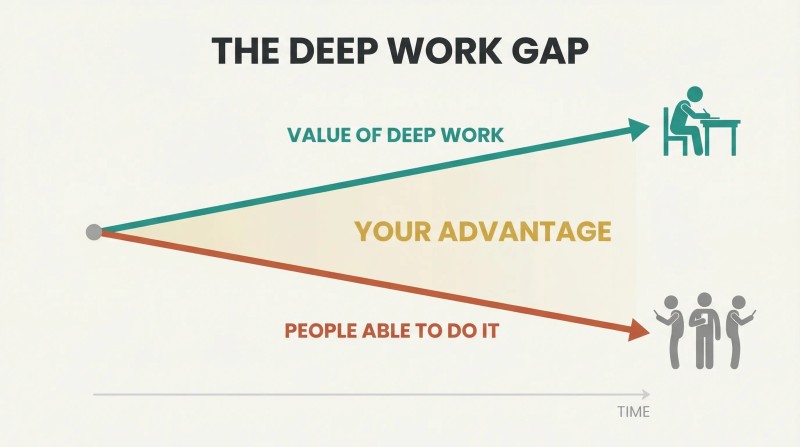
Deep work means distraction-free concentration that pushes your cognitive abilities to their limit — producing new value, building skills, and generating results hard to replicate. Its opposite, shallow work, is the logistical busywork of email, meetings, and form-filling that anyone could handle. Newport argues the modern economy rewards two abilities: quickly mastering hard things and producing at an elite level — both of which require deep work.
Jason Benn proved the thesis. A financial consultant who realized Excel macros could replace his job, Benn locked himself in a room with programming textbooks — no computer, no Internet — and trained himself to focus five disconnected hours daily. Six months later, he went from $40,000 to $100,000 as a developer at a San Francisco startup.
A quick inbox check leaves cognitive residue that tanks performance
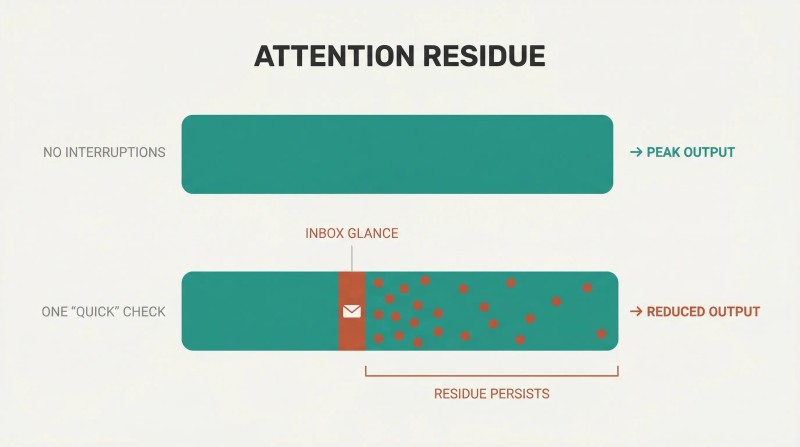
Attention residue is the hidden tax of task-switching. Researcher Sophie Leroy found that when you switch from Task A to Task B, your attention doesn't fully follow — a residue remains stuck on the previous task. This residue gets especially thick if Task A was unfinished. Even a ten-second glance at your inbox introduces a new target for your attention, and the unresolved messages you see leave residue that dampens everything you do next.
Wharton's Adam Grant exploits this principle by batching work into intense, uninterrupted pulses — sometimes spending days with an out-of-office auto-reply while writing a single paper. Newport formalizes it as: High-Quality Work Produced = (Time Spent) × (Intensity of Focus). Grant doesn't work more hours than his peers; he works with less residue.
Visible busyness is the knowledge worker's laziest refuge
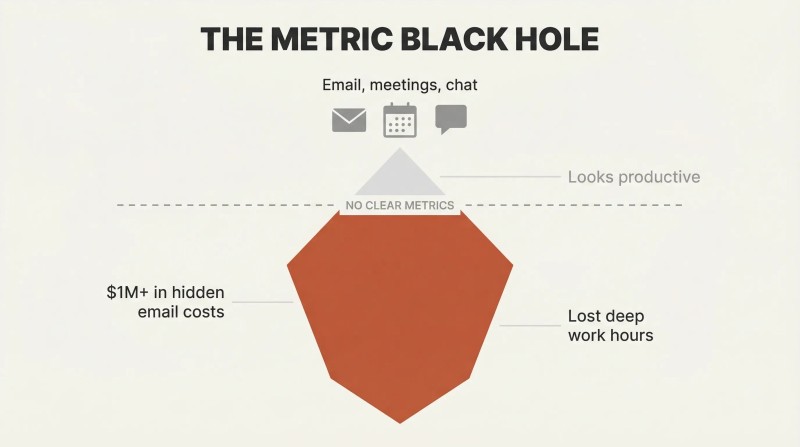
The metric black hole protects shallow behavior. Newport argues that the bottom-line cost of depth-destroying habits — constant email, status meetings, open offices — is nearly impossible to measure. Without clear metrics, two forces take over. The Principle of Least Resistance drives people toward whatever is easiest in the moment: pinging colleagues, forwarding emails tagged "Thoughts?", or letting standing meetings substitute for actual planning. And busyness as proxy for productivity fills the gap where real performance indicators should be.
Tom Cochran, CTO of Atlantic Media, calculated his company spent over a million dollars a year paying people to process email. The "free and frictionless" tool carried soft costs equivalent to buying a corporate Learjet. But without such painstaking analysis, no one noticed — because the metric black hole kept the costs invisible.
Build rituals so deep work doesn't drain your willpower
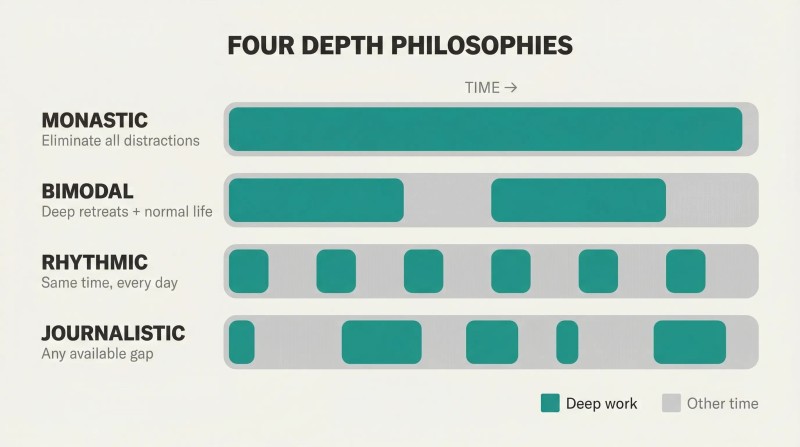
Desire is the norm, not the exception. A study by Hofmann and Baumeister found people fight desires all day — and resist Internet and television only about half the time. Since willpower depletes like a muscle, relying on motivation to "just focus harder" is a losing strategy. Newport's solution: routines and rituals that minimize the willpower needed to enter and sustain concentration.
He offers four depth philosophies:
1. Monastic — eliminate nearly all shallow work (Donald Knuth hasn't used email since 1990)
2. Bimodal — alternate deep retreats with normal life (Carl Jung at his lakeside stone tower)
3. Rhythmic — same time daily, no exceptions (a doctoral candidate wrote starting at 4:45 a.m., producing a thesis chapter every two to three weeks)
4. Journalistic — fit depth into any available gap (Walter Isaacson wrote an 864-page book in spare moments between magazine deadlines)
Schedule Internet blocks — take breaks from focus, not distraction
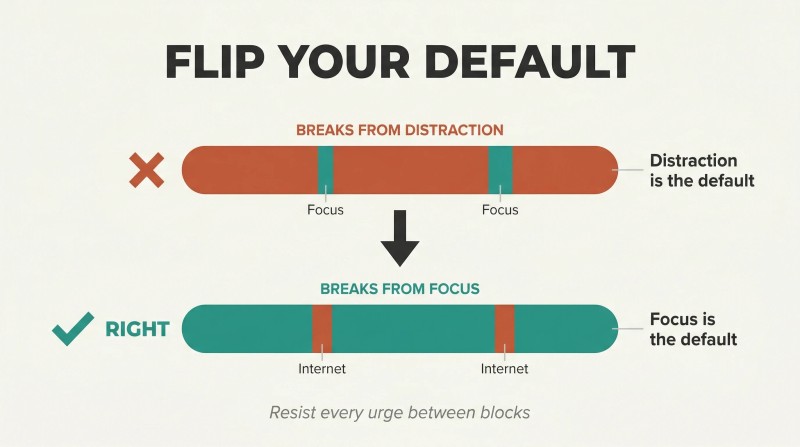
A weekly digital detox won't rewire your brain. If you eat healthy one day a week, you won't lose weight — and an Internet Sabbath won't cure chronic distraction. Stanford researcher Clifford Nass found that habitual multitaskers become unable to filter irrelevancy even when they genuinely try to focus. The damage is structural, not motivational.
Newport's counterintuitive fix: instead of scheduling occasional breaks from distraction, schedule occasional breaks from focus. Keep a notepad by your computer recording the next time you're allowed online. Between those blocks, resist completely — even if you're bored and stuck. Each moment of resistance becomes concentration calisthenics, strengthening the mental muscles that make deep work possible. Apply this at home too, because your brain doesn't distinguish between work browsing and evening scrolling.
Apply a farmer's skepticism — not a fanboy's zeal — to your tools
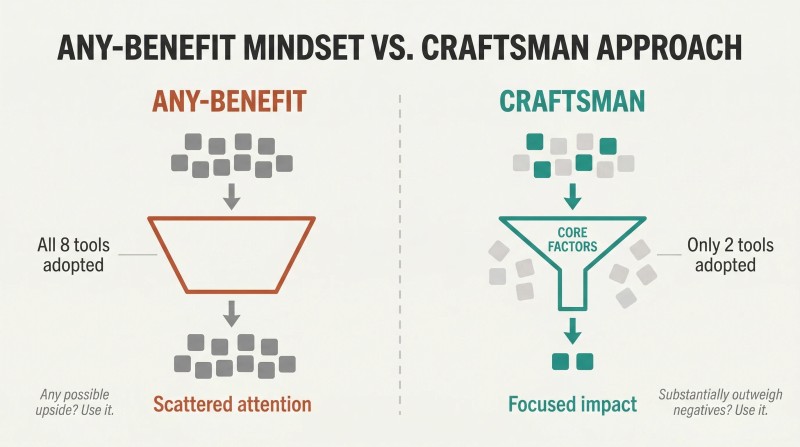
Most people adopt tools with an any-benefit mindset: if a service offers any possible upside, they use it. But farmer Forrest Pritchard sold his hay baler despite its obvious benefits — because when he weighed opportunity costs, soil health, and time redirected to raising chickens, buying hay was the smarter move. The same rigor should apply to digital tools.
Newport proposes the craftsman approach: identify the core factors determining success and happiness in your life, then adopt a tool only if its positive impacts on those factors substantially outweigh its negatives. The Law of the Vital Few reinforces this — roughly 20% of your activities generate 80% of results. Time on low-impact tools like casual social media directly steals from high-impact activities like deep research or meaningful friendships.
Shut down work completely at a fixed time every evening
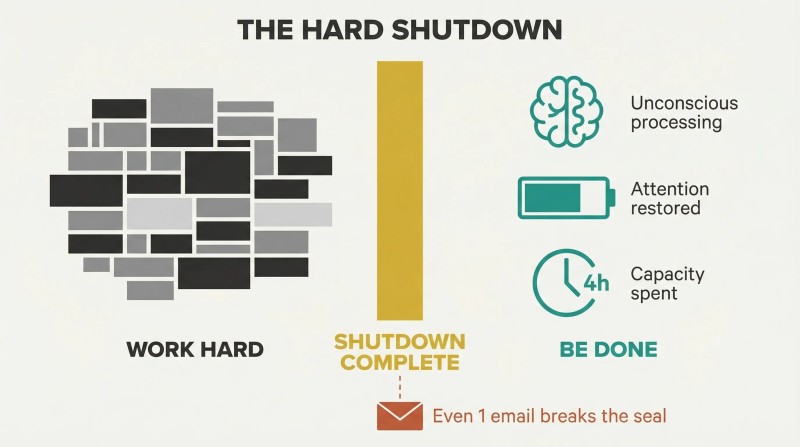
Downtime isn't laziness — it's strategic. Newport identifies three reasons to enforce a hard shutdown:
1. Your unconscious mind excels at processing complex decisions that conscious deliberation handles poorly
2. Directed attention is finite and replenished by rest — even a nature walk boosts concentration by 20%
3. Experts sustain at most four hours of deep work daily; evening efforts yield only low-value shallow output
The Zeigarnik effect — the nagging pull of unfinished tasks — makes shutting down hard. Newport's antidote is a shutdown ritual: review every task, confirm each has a plan or is captured in a trusted system, then say a closing phrase like "Shutdown complete." Even checking one email after dinner can unravel the restoration process for hours.
Give every minute of your workday a job
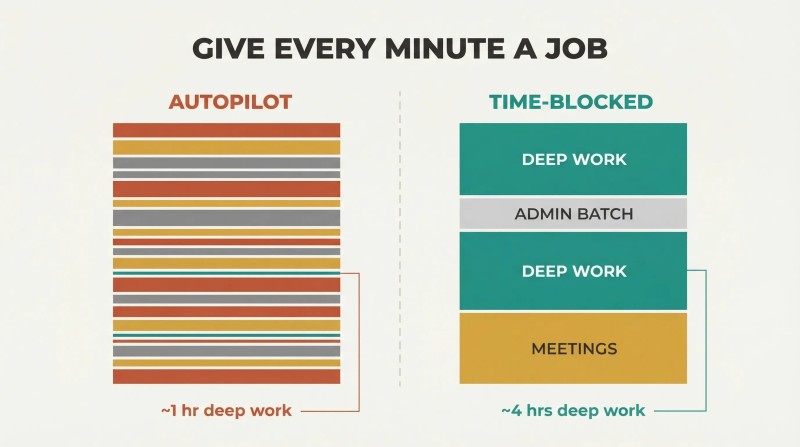
People wildly misjudge their time. British adults who estimated watching fifteen hours of TV per week actually watched twenty-eight. Workers claiming sixty-hour weeks averaged forty-four. Without deliberate structure, shallow work fills every crack.
Newport's method is simple: at the start of each workday, divide your hours into blocks on a lined notebook page and assign each block a task. Batch small chores into generic task blocks. Use overflow conditional blocks for unpredictable tasks — if a project runs long, the next block absorbs it; if it finishes on time, an alternate task is ready. When your plan breaks (and it will), redraw the blocks. The goal isn't rigid compliance but constant intentionality — a habit of asking, "What makes sense to do with the time that remains?"
Craftsmanship generates meaning — even in a cubicle
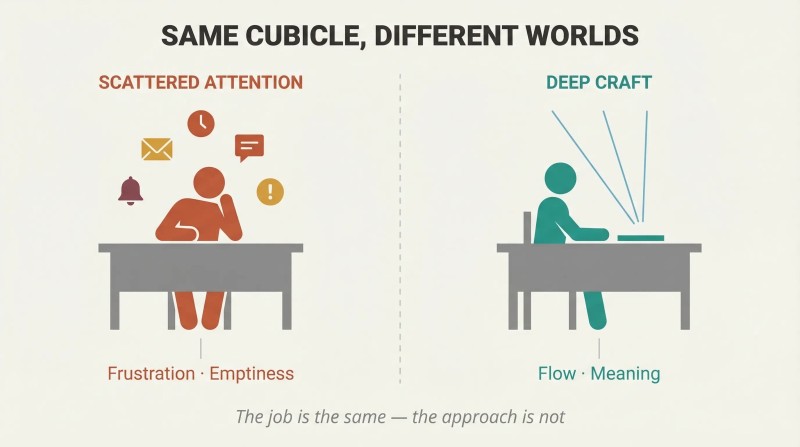
Your brain constructs reality from what you focus on. Science writer Winifred Gallagher discovered after a cancer diagnosis that directing attention toward good things — movies, walks, martinis — made life pleasant despite terrible circumstances. A day spent in your inbox, dominated by petty frustrations and unresolved threads, literally constructs a worse world in your mind.
Psychologist Csikszentmihalyi's flow research found something equally counterintuitive: people report greater happiness during challenging work than during leisure. Jobs with built-in goals and feedback naturally produce satisfaction. Philosophers Dreyfus and Kelly extend this further — skilled practice of any craft, whether smithing swords or writing code, reconnects us with a sense of meaning the modern world has lost. The specifics of your job matter far less than the depth of your approach.
Most shallow work is quietly dispensable — cut it and prove it
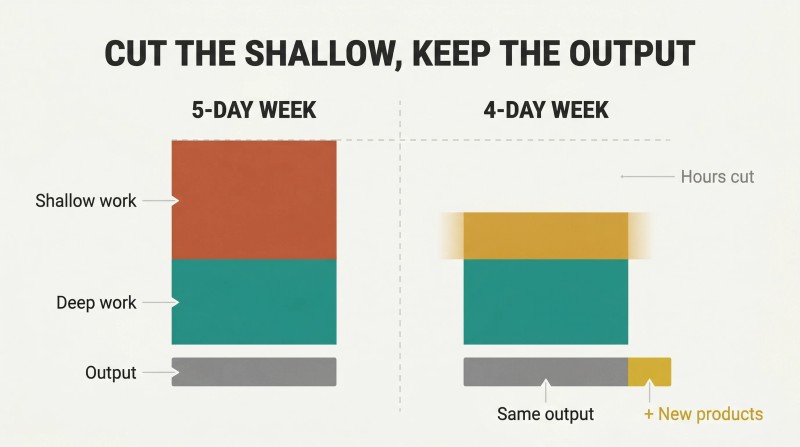
37signals (now Basecamp) tested this directly: they cut the workweek from five to four days — not by cramming hours, but by simply working less. Output barely changed because the eliminated hours were almost entirely shallow work. They then gave employees a full month of uninterrupted deep work, producing two valuable new products their normal schedule never would have generated.
Newport suggests quantifying your own shallowness. Ask of each task: "How many months to train a smart college graduate to do this?" A low number means shallow; fifty-plus months means deep. Then negotiate a shallow work budget with your boss — typically 30 to 50 percent. Use fixed-schedule productivity, capping your workday at a firm endpoint like 5:30 p.m., to force ruthless prioritization of depth over comfortable busywork.
Analysis
Newport's most enduring contribution isn't the observation that focus matters — everyone knows that abstractly. It's his reframing of deep work as an economic arbitrage opportunity rather than a lifestyle preference. By positioning concentration as simultaneously scarce and valuable, he transforms what sounds like productivity advice into career strategy. The metric black hole concept is perhaps the book's most underappreciated insight: depth-destroying behaviors survive not because they're effective, but because their costs are invisible. This explains why entire industries adopt open offices and always-on messaging despite mounting evidence of damage — the same invisibility that protects executive salaries untethered from marginal productivity.
Where Newport is less convincing is in his treatment of collaboration. The hub-and-spoke model — separate serendipitous encounters from deep thinking — is elegant but underspecified for workers who can't choose their office architecture. His dismissal of the Jack Dorsey counterexample is also too tidy; the line between 'CEO who legitimately needs distraction' and 'manager who merely believes they do' is blurrier than he admits.
The book's lasting cultural influence comes from its vocabulary. Terms like 'deep work,' ' shallow work,' and 'attention residue 'gave professionals a shared language for negotiating how they spend their time. Before Newport, requesting uninterrupted hours sounded like a productivity excuse; after Newport, it sounds like a strategic investment. The adapted 4DX framework — tracking deep work hours on a visible scoreboard — is deceptively powerful because it addresses the core behavioral problem: people optimize what they measure.
Published in 2016, Deep Work has aged remarkably well because the trends it diagnosed — notification creep, performative busyness, open-plan worship — have only accelerated. The rise of remote work, Slack, and AI tools since publication has widened the gap between those who can concentrate and those who cannot, making Newport's thesis more urgent than even he predicted.
Review Summary
Readers widely praise Deep Work for its practical strategies to improve focus and productivity. Many find the book's ideas transformative, though some criticize its repetitiveness and focus on privileged examples. The book's emphasis on eliminating distractions and cultivating deep concentration resonates with many readers seeking to enhance their work quality and career prospects. While some find the implementation challenging, most agree the core message is valuable in today's distracted world.
People Also Read

Glossary
Deep Work
Distraction-free, cognitively demanding concentrationProfessional activities performed in a state of distraction-free concentration that push your cognitive capabilities to their limit. These efforts create new value, improve your skill, and are hard to replicate. Newport coined the term to distinguish it from the shallow logistical tasks that dominate most knowledge workers' days.
Shallow Work
Easy, logistical, often distracted tasksNoncognitively demanding, logistical-style tasks often performed while distracted. These efforts tend not to create much new value in the world and are easy to replicate. Examples include email processing, scheduling meetings, and filling out forms. Newport argues this type of work increasingly crowds out deep work in most professionals' schedules.
The Deep Work Hypothesis
Rare skill becoming increasingly valuableNewport's central thesis: the ability to perform deep work is becoming increasingly rare at exactly the same time it is becoming increasingly valuable in our economy. As a consequence, the few who cultivate this skill and make it the core of their working life will thrive professionally and personally.
Attention Residue
Lingering focus from previous taskA concept from researcher Sophie Leroy describing how, when you switch from Task A to Task B, your attention doesn't immediately follow—a residue remains stuck thinking about the original task. The residue is especially thick if Task A was unfinished or low-intensity. Newport uses this to explain why even brief email checks devastate deep work performance.
Metric Black Hole
Unmeasurable cost of shallow behaviorsNewport's term for the difficulty of measuring the bottom-line impact of behaviors that impede or support deep work. Because the cost of constant email, open offices, and social media use is nearly impossible to quantify, these depth-destroying practices are protected from scrutiny and allowed to persist unchallenged in most organizations.
Principle of Least Resistance
Defaulting to easiest workplace behaviorsNewport's principle stating that in a business setting, without clear feedback on the impact of various behaviors to the bottom line, people will tend toward behaviors that are easiest in the moment. This explains why cultures of connectivity and shallow work persist—they make daily logistics simpler even when they reduce long-term productivity.
Busyness as Proxy for Productivity
Visible effort substituting for real valueNewport's concept describing how, in the absence of clear indicators of what it means to be productive and valuable, many knowledge workers revert to an industrial-era metric: doing lots of stuff in a visible manner. Sending emails at all hours, attending constant meetings, and rapid-response messaging all signal busyness without necessarily creating value.
Any-Benefit Approach
Any upside justifies using a toolThe common mindset where you're justified in using a network tool if you can identify any possible benefit to its use, or anything you might miss out on by not using it. Newport argues this approach ignores the significant negatives these tools impose on time and attention, and contrasts it with the more rigorous craftsman approach.
Craftsman Approach to Tool Selection
Adopt tools only if benefits outweigh costsNewport's proposed alternative to the any-benefit approach. It requires identifying the core factors that determine success and happiness in your professional and personal life, then adopting a tool only if its positive impacts on these factors substantially outweigh its negative impacts. Named to emphasize that tools should serve the larger goals of one's craft.
Monastic Philosophy
Eliminate nearly all shallow obligationsOne of Newport's four depth philosophies for scheduling deep work. Practitioners maximize deep efforts by eliminating or radically minimizing shallow obligations. Best suited for people with a well-defined, highly valued professional goal. Examples include computer scientist Donald Knuth, who abandoned email entirely in 1990, and novelist Neal Stephenson.
Bimodal Philosophy
Alternate between deep and shallow periodsA depth philosophy where you divide your time into clearly defined stretches dedicated to deep pursuits, leaving the rest open to shallow work. The minimum deep work unit tends to be at least one full day. Carl Jung exemplified this by retreating to his lakeside tower for deep writing while maintaining a busy clinical practice in Zurich.
Rhythmic Philosophy
Daily deep work at consistent timesA depth philosophy arguing that the easiest way to start deep work consistently is to transform it into a simple daily habit at a set time, removing the need to decide if and when to go deep. Jerry Seinfeld's 'chain method'—crossing off each day you write jokes, then not breaking the chain—is a well-known example of this approach.
Journalistic Philosophy
Fit deep work into any gapA depth philosophy where you shift into deep work mode whenever free time appears in your schedule, rather than following a fixed routine. Named after journalists trained to write on deadline. Not recommended for deep work novices, as it requires the ability to rapidly switch from shallow to deep mode—a skill that takes confidence and practice.
Fixed-Schedule Productivity
Cap workday, force ruthless prioritizationNewport's strategy of fixing a firm goal of not working past a certain time (such as 5:30 p.m.), then working backward to find productivity strategies that satisfy this constraint. The time pressure forces ruthless reduction of shallow work and sharper organizational habits. Harvard professor Radhika Nagpal used this approach to earn tenure while capping her week at fifty hours.
FAQ
What's "Deep Work: Rules for Focused Success in a Distracted World" by Cal Newport about?
- Focus on deep work: The book emphasizes the importance of deep work, defined as professional activities performed in a state of distraction-free concentration that push cognitive capabilities to their limit.
- Value in modern economy: Newport argues that deep work is increasingly valuable in our economy, yet it is becoming rare due to the rise of network tools and shallow work.
- Strategies for deep work: It provides strategies and philosophies to help individuals cultivate a deep work habit and integrate it into their professional lives.
Why should I read "Deep Work" by Cal Newport?
- Improve productivity: The book offers insights into how deep work can significantly enhance productivity and the quality of work produced.
- Navigate a distracted world: Newport provides practical advice on focusing in a world filled with distractions, crucial for excelling in any field.
- Achieve meaningful work: By embracing deep work, readers can find more satisfaction and meaning in their professional lives, producing work of real value.
What are the key takeaways of "Deep Work"?
- Deep work is rare and valuable: Newport highlights the scarcity and importance of deep work in the modern economy, where shallow work is prevalent.
- Different philosophies for deep work: The book outlines various approaches to integrating deep work into one's schedule, such as monastic, bimodal, rhythmic, and journalistic philosophies.
- Rituals and routines: Establishing rituals and routines can help minimize the willpower needed to transition into deep work, making it a more consistent part of one's life.
How does Cal Newport define "Deep Work" and "Shallow Work"?
- Deep Work: Defined as professional activities performed in a state of distraction-free concentration that push cognitive capabilities to their limit, creating new value and improving skills.
- Shallow Work: Consists of non-cognitively demanding, logistical-style tasks often performed while distracted, which do not create much new value and are easy to replicate.
- Importance of distinction: Understanding the distinction is crucial for prioritizing tasks that lead to significant professional advancement.
What is the "Deep Work Hypothesis" in Cal Newport's book?
- Increasing rarity and value: The hypothesis states that the ability to perform deep work is becoming increasingly rare while becoming increasingly valuable in our economy.
- Opportunity for those who cultivate it: Those who cultivate this skill and make it the core of their working life will thrive.
- Foundation for the book: This hypothesis provides the foundation for the strategies and advice presented, aiming to help readers leverage this opportunity.
What are the different philosophies of deep work scheduling mentioned in "Deep Work"?
- Monastic Philosophy: Involves eliminating or radically minimizing shallow obligations to focus almost exclusively on deep work.
- Bimodal Philosophy: Divides time between deep work and open periods, allowing for intense focus during designated stretches.
- Rhythmic and Journalistic Philosophies: The rhythmic approach involves setting a regular schedule for deep work, while the journalistic philosophy fits deep work into available time slots, requiring more flexibility and experience.
How can rituals and routines support deep work according to Cal Newport?
- Minimize willpower use: Rituals and routines help minimize the amount of willpower needed to start and maintain deep work sessions by providing structure and predictability.
- Specify work environment: Effective rituals specify where and for how long deep work will occur, helping to create a conducive environment for concentration.
- Support mental energy: Rituals can include elements that support mental energy, such as starting with a cup of coffee or organizing materials to reduce friction.
What is the "Grand Gesture" strategy in "Deep Work"?
- Radical change for focus: The grand gesture involves making a significant change to your environment or investing effort or money to boost the importance of a deep work task.
- Increase task priority: This strategy increases the perceived importance of the task, reducing procrastination and enhancing motivation.
- Examples of grand gestures: Notable examples include J.K. Rowling checking into a luxury hotel to finish a book and Bill Gates taking Think Weeks to focus on big ideas.
How does collaboration fit into deep work according to Cal Newport?
- Hub-and-spoke model: Newport suggests a hub-and-spoke model where serendipitous encounters occur in hubs, while deep work happens in isolated spokes.
- Whiteboard effect: Collaborative deep work can leverage the whiteboard effect, where working with others pushes individuals to deeper levels of concentration.
- Balance interaction and focus: The key is to balance the need for interaction and inspiration with the necessity of unbroken concentration for deep work.
What is the "shutdown ritual" mentioned in "Deep Work"?
- End-of-day routine: The shutdown ritual is a routine Newport suggests for ending the workday, ensuring that all tasks are reviewed and planned for future completion.
- Release work thoughts: This ritual helps signal to the mind that it is safe to release work-related thoughts, allowing for relaxation and mental recovery.
- Combat the Zeigarnik effect: By planning and capturing tasks, the ritual combats the Zeigarnik effect, which is the tendency for incomplete tasks to dominate attention.
How does Cal Newport suggest handling email to maintain deep work?
- Sender filters: Newport recommends using sender filters to manage incoming emails, asking senders to filter themselves before contacting you.
- Process-centric responses: He suggests crafting process-centric responses that outline the steps needed to resolve the email's project, minimizing back-and-forth communication.
- Selective response: Newport advises being selective in responding to emails, focusing only on those that are clear, interesting, and impactful.
What are some of the best quotes from "Deep Work" and what do they mean?
- "Deep work is necessary to wring every last drop of value out of your current intellectual capacity." This quote emphasizes the importance of deep work in maximizing one's cognitive abilities and producing valuable output.
- "A deep life is a good life." Newport suggests that embracing depth over shallowness leads to a more meaningful and satisfying life.
- "The ability to perform deep work is becoming increasingly rare at exactly the same time it is becoming increasingly valuable in our economy." This highlights the market mismatch and the opportunity for those who cultivate deep work skills.
About the Author
Other books by Cal Newport





Download PDF
Download EPUB
.epub digital book format is ideal for reading ebooks on phones, tablets, and e-readers.








































