

Plot Summary
Prologue
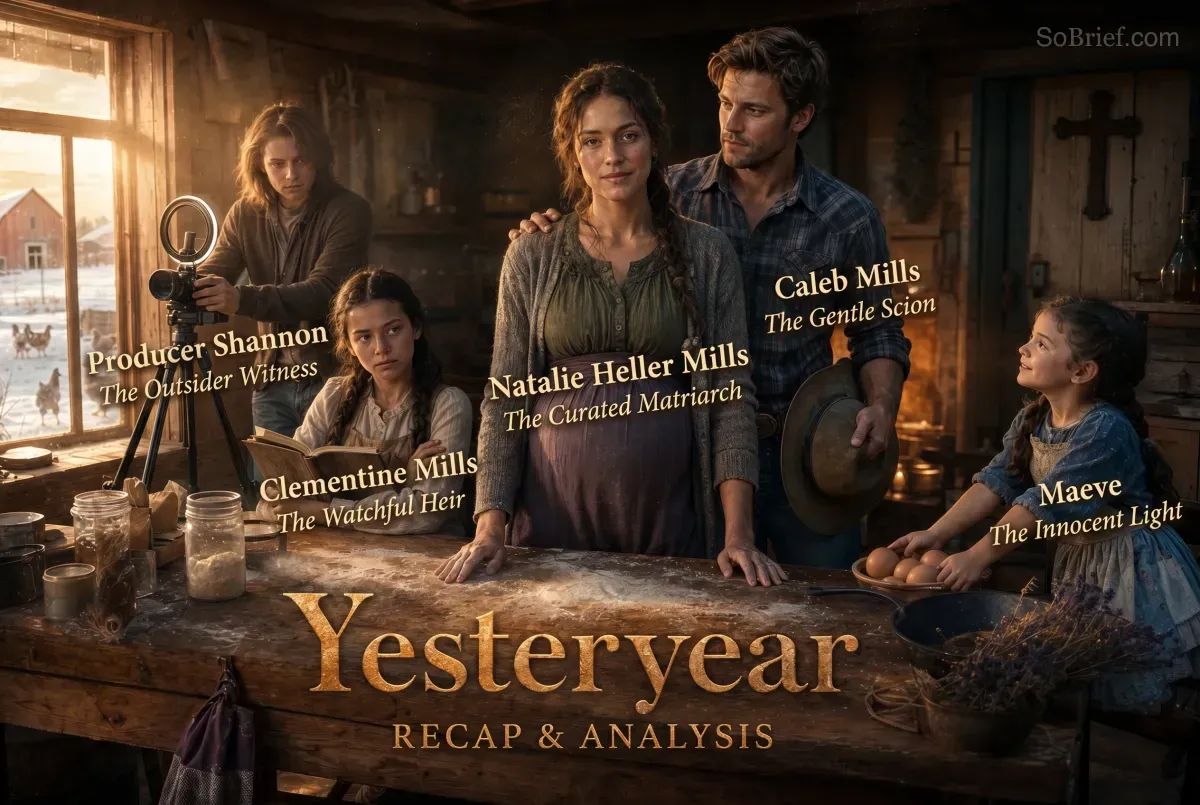
Natalie Heller Mills1 introduces herself as perfect at being alive: five million Instagram followers, pregnant with her sixth child, running a curated farm in Idaho's mountains. She films sourdough tutorials, sells branded cookware, and shapes every frame of her family's public image.
But the frame is cracking. Her producer Shannon5 suffers nightmares of the farm burning, then emails a resignation — its subtext unmistakable to Natalie,1 who knows Shannon5 has been sleeping with her husband.2
Twelve-year-old Clementine3 asks what a tradwife is, evidence of unsupervised phone access. That evening, Caleb2 reveals his senator father6 wants him to run for office. Natalie1 absorbs it all with a frozen smile, already calculating. The dominoes she arranged are starting to fall.
Mama, 1855
Natalie1 opens her eyes to freezing cold and an unfamiliar quilt. Her phone is gone, her bedside table missing. She stumbles through a hallway identical to her own into a firelit kitchen where four children in homespun clothing sit watching her — children who resemble hers but aren't hers. A teenage girl named Mary4 braids a younger girl's hair. The little one, Maeve,9 calls her Mama.
Carved into the doorframe are height measurements ending in MAMA, 1855. Outside, a man who looks like a harder, older version of her husband — she will come to call him Old Caleb2 — orders her inside. When Natalie1 runs, he catches her and slaps her unconscious. She wakes in bed with no phone, no mirror, and no baby in her womb. Her pregnancy has vanished.
Harvard's Loneliest Christian
Seventeen-year-old Natalie1 arrives at Harvard on a full scholarship, carrying a hand-stitched quilt and an unshakable contempt for the secular world. Her roommate Reena11 forces her into a dorm party, brings a boy home that first night, then later tells friends the boy assaulted her.
Natalie1 — the only witness — knows Reena11 is lying. She endures months of alienation before snapping: she calls Reena11 a whore and exposes the lie. Reena11 punches her. The fight earns Natalie1 a single room and a reputation as someone who never softens.
Then at a Christian group meeting in a library basement, she meets Caleb Mills2 — sweet, aimless, the youngest son of a powerful senator.6 He looks at her like she's fascinating. No one has ever found Natalie1 fascinating before.
The Trap in the Woods
Desperate to flee what she believes is a kidnapping, Natalie1 sprints toward the tree line at dusk. She crashes through leaves before a steel animal trap snaps shut around her ankle, metal teeth sunken into flesh. She screams until Old Caleb2 arrives, pries the trap open, and carries her back.
Mary4 produces a leather pouch containing a thick needle and coarse thread, then stitches the wound while Natalie1 howls and passes out twice. During the fevered days of recovery, Natalie1 discovers a small black pebble in the dirt that resembles a broken lapel microphone. She tucks it into her pocket and begins constructing a new theory: she is a contestant on a reality television show. Someone, somewhere, must be watching her.
Imagine You're Being Watched
Natalie1 marries Caleb2 in a four-hundred-person wedding. Both are virgins; the wedding night is a humiliating disaster of limp flesh and mutual inexperience. She gives birth to Clementine3 at twenty and plummets into postpartum darkness — holding her newborn at arm's length, convinced the child looks evil.
She jogs two weeks postpartum, rips her stitches open, and collapses bleeding at the hospital entrance. Her mother8 rocks her through the panic and later shares her own secret for surviving domesticity: she imagines an invisible audience watching and cheering her on.
Natalie1 rejects the sedatives her mother-in-law7 offers, conjures the invisible audience instead, and something shifts. She begins performing motherhood rather than enduring it. The strategy works so well she will never be able to stop.
Five Million for a Cowboy
Caleb2 refuses every job Natalie1 finds for him. He wants to teach kindergarten. His father Doug6 — a senator eyeing the presidency — privately tells Natalie1 he'd hoped marriage would fix his son, but it hasn't. Natalie1 finds a five-hundred-acre cattle ranch in Idaho and pitches Doug:6 give us five million dollars and Caleb2 can play cowboy while she manages the business.
Doug6 agrees on one chilling condition — she must keep having babies with his son. She signs. A second trap lies buried in the paperwork: prenuptial and financial agreements place Caleb's2 name alone on the ranch deed. Natalie1 has purchased the project of a lifetime, but the receipt belongs to someone else. She owns nothing but the performance of owning everything.
Sourdough and Submission
Weeks pass in the pioneer world Natalie1 calls Yesteryear. She oscillates between manic determination and paralytic despair. On good days she bakes terrible bread, scrubs laundry until her fingers crack and bleed, and bonds with Maeve9 over sewing hats for the chickens.
On bad days she lies in bed convinced a production crew will storm the driveway any moment. Mary4 runs the household with the cold efficiency of someone twice her age — bathing Natalie1 in a tin washbasin, dispensing cherry-syrup tonics that quiet the panic.
When Old Caleb2 announces he will share her bed again, Natalie1 braces for horror. Instead, something unprecedented happens: she experiences genuine sexual pleasure for the first time in her life. She reinterprets everything as divine purpose — a test built exclusively for her.
Three Hundred Thousand Overnight
For years Natalie's1 Instagram account stagnates. She takes a social media course where other farming wives tell her she looks fake and unlikable. She practices smiling in the mirror alongside seven-year-old Clementine,3 coaching both their faces into warmth.
Then a popular online talk-show host — one of Caleb's2 anonymous forum buddies — features her account during a livestream, praising her as the true American dream. Overnight she gains three hundred thousand followers. Half adore her. The other half are furious.
Natalie1 learns to cultivate both responses equally, developing a split persona she calls Online Natalie — smiling, wholesome, effortlessly maternal. The gap between the woman on screen and the woman off it widens each day, but the money is real, and the money is hers.
The Producer from Brooklyn
Shannon5 arrives at nineteen, a pink-haired Barnard dropout who calls Natalie's1 homesteading lifestyle a road map out of corporate feminism's maze. Her filmmaking talent transforms the account — the footage turns grainy and golden, almost museum-quality. The follower count climbs toward five million.
But Shannon5 also turns her camera on what Natalie1 hides: the twenty farmworkers, the pesticide barrels behind the barn, the children's misery off-screen. She grows close to Clementine,3 eventually slipping the girl a phone.
She starts having private lunches with Caleb,2 who is thrilled to be genuinely listened to. At Doug's6 presidential campaign rally, Shannon5 recognizes the forum rhetoric in Doug's6 speech — practically quoting Natalie's1 captions. She confronts Natalie,1 who dismisses it as theater. Shannon's5 camera has been recording everything.
Neighbors from Nowhere
In the pioneer world, two bearded young men begin visiting to help repair fences. Natalie1 feels a nauseating buzz of recognition she cannot place — like staring at a word she should know but can't read. She turns away and vomits. Mary,4 meanwhile, starts behaving erratically: sleeping late, snapping at the children, staring out the window at the taller visitor with undisguised longing.
One afternoon she returns from a long walk in the woods visibly shaken, claiming she found a dying animal in a trap. Natalie1 doesn't believe her. When she presses, Mary4 calls her Natalie1 for the first time — not Mama — and the slip terrifies them both. Something beyond this ranch exists, and Mary4 has glimpsed it.
Hands Around Her Throat
Caleb2 confesses he is in love with Shannon5 and wants to move to New York. Natalie1 goes to Shannon's5 room the next morning. Shannon5 doesn't apologize. Instead she delivers a devastating assessment: Natalie1 doesn't have a family, she has a business. Her children will never forgive her. And it was Caleb2 who engineered this whole refuge — Natalie1 just can't see it because she believes she's the architect.
Something snaps. Before Natalie1 understands what's happening, she is straddling Shannon5 on the bed, hands locked around the younger woman's throat, squeezing until her knuckles go white. Shannon5 survives, gasping through tears that the ranch is cursed. Natalie1 straightens her blouse, calmly asks if Shannon5 is pregnant, and walks out smiling.
America Watches Yesteryear Burn
Shannon5 appears on national television in a prairie dress, poised and tearful. She describes the assault, the hidden workers, the children's unhappiness. Then the footage rolls — videos Clementine3 secretly recorded on Shannon's5 old phone.
Natalie1 ranting about Shannon5 in the car. Clementine3 refusing to be filmed. The boys fighting over a nail gun. Five million followers watch the curated world crack open like an egg. Doug's6 lawyers swarm the ranch. Caleb2 slaps Natalie.1
Doug,6 through Caleb,2 tells her a car accident on the mountain roads would be the simplest solution. Natalie1 finds her mother-in-law's7 expired pills and swallows three. From the pharmaceutical haze, she calls Doug6 with one final play: put Caleb2 into politics and redirect the narrative entirely.
The Cabin Called Manosphere
Mary4 confesses there was only ever one steel trap — Natalie1 could have walked free months ago. Armed with supplies and Mary's4 directions, Natalie1 escapes through snowy woods. Hours later she stumbles upon a log cabin in a clearing with the word MANOSPHERE etched above the door.
Inside: a hot plate, ramen noodles, a mini-fridge plugged into an electrical outlet, a framed photo of her own family. A man sits with his back to her, methodically peeling grocery store stickers off vegetables before dropping them into a wooden crate. He turns.
He calls her Mama. Through the buzzing in her skull, Natalie1 recognizes the shape of his face — it's Stetson, her grown son, one of the bearded neighbors who has been secretly supplying them with food for years. She screams, runs, gets lost, and stumbles back to the ranch.
Clementine's Red Subaru
A car rolls up the driveway — impossibly modern against the pioneer landscape. Clementine3 steps out, short-haired, tattooed, wearing a puffer coat. She has a warrant.
The truth spills out in fragments: years ago, after the Shannon scandal,5 Natalie1 and Caleb2 stripped the ranch of all modernity and began raising toddler Mary4 in a fabricated pioneer world, telling her that her older siblings were dead. Clementine3 escaped at sixteen, walking the younger children through the woods to the highway. Left alone with Mary,4 the couple had three more children — Abel,13 Noah,14 Maeve9 — all born into the nineteenth-century fiction.
Over the years, Natalie's1 mind fractured until she genuinely forgot creating this world. Her grown sons set up a nearby cabin to secretly supply food. Natalie1 is not pregnant. She is fifty years old, going through menopause.
The Last Walk from Yesteryear
Natalie1 watches Clementine's3 car roll down the hill, Maeve9 screaming for her mama through the glass. She kisses each child goodbye, telling them she loves them — words she realizes she has never spoken to this family before. When the dust settles, only Natalie1 and Caleb2 remain. She tells him they should have divorced years ago. He agrees.
She says she hates him. He says he hates her too. Then she says they must leave — now, before her mind fractures again. She can feel the momentary clarity already straining under its own weight. For the first time in their entire marriage, they choose the same thing at the same time. They reach for each other's hands and walk away from Yesteryear Ranch together.
Epilogue
Five years later, Natalie1 sits shackled at Yesteryear Ranch — now a television set she no longer recognizes as her own home — serving a thirty-year sentence for child abuse. Her interviewer is Reena Magliotti,11 her college roommate turned news anchor, the only person Natalie1 agreed to speak with.
Reena11 hands her a book: The Book of Mary, her youngest daughter's4 bestselling memoir, dedicated simply to her mother. The prologue is read aloud. Mary4 describes growing up in a fabricated pioneer world, believing her siblings were dead, until the day an angel — Clementine3 — appeared and led her out.
The memoir ends where Mary's4 real life begins: the moment Clementine's3 car merged onto the highway, and Mary,4 terrified and clinging to her sister's3 hand, opened her eyes to discover she was hurtling forward into a future beyond anything she could have imagined. For the first time in her life, she smiled.
Analysis
Yesteryear dissects the violence of curation — how the compulsion to package life for consumption can metastasize until the packaging devours the life itself. Natalie Heller Mills1 begins as an ambitious Christian woman performing domesticity for Instagram and ends as a prisoner of her own performance, cycling through psychotic breaks where she cannot distinguish the world she built from the one she hallucinated.
Burke's central insight is that the tradwife influencer and the doomsday prepper occupy the same spectrum of American mythmaking. Both demand systematic erasure of reality in favor of curated fantasy — one looking backward to an imagined golden age, the other forward to an imagined apocalypse. The ranch called Yesteryear begins as an Instagram aesthetic and ends as a literal nineteenth-century homestead, the distance between metaphor and madness closing so gradually that neither spouse can identify the moment they crossed over.
The novel anatomizes how patriarchal structures are maintained not solely by men but by women who enforce them — mothers who teach daughters to smile through pain, wives who manage their husbands' failures, influencers who sell captivity as liberation. Each generation passes the baton of performance to the next. Mary's4 memoir represents the first woman in this lineage who refuses to carry it forward.
Burke's structural innovation — alternating between Natalie's1 fractured pioneer present and the backstory explaining how she arrived there — transforms domestic satire into epistemological puzzle. The reader shares Natalie's1 bewilderment before slowly recognizing what she cannot face: she built her own prison, and her mind chose delusion over accountability.
Most provocatively, the novel implicates the audience itself. Five million followers funded Yesteryear's perfection, then demanded to watch it burn. The relationship between influencer and follower is symbiotic, and the host organism sustaining both is American loneliness. Everyone watching Natalie1 was searching for something they had lost — connection, meaning, a sense that domesticity could still be beautiful. The tragedy is that she was searching for exactly the same things, and looked in the only direction she was ever taught to face: backward.
Review Summary
Yesteryear generates sharply divided opinions, with most readers praising its biting satire of tradwife influencer culture, compulsive readability, and shocking twists. Many find the deeply unlikable protagonist, Natalie, fascinating despite her flaws, and celebrate the novel's timely social commentary on social media, gender roles, and religious extremism. Critics, however, argue the book is mean-spirited, underdeveloped, and lacks nuance, with some finding the characters cartoonish and the themes superficially explored. A film adaptation starring Anne Hathaway is already in development.
People Also Read









Characters
Natalie Heller Mills
Influencer turned pioneer captiveA woman of ferocious discipline and bottomless need for control. Raised by a devout single mother8 in rural Idaho, she learned early that a Christian woman's role is to manage crises for the men around her while smiling through the wreckage. Harvard-educated in religious history, she channels her intellect entirely into performing domestic perfection rather than pursuing any independent ambition. She views every relationship as a project: her husband2 is clay to mold, her children are content to curate, her followers are consumers to manipulate. Beneath the smile is someone who has never been genuinely liked, who confuses control for love, and whose deepest terror—being seen as she actually is—drives every catastrophic choice she makes.
Caleb Mills
Aimless husband and enablerThe youngest of five sons in a political dynasty, Caleb2 was raised by a neglectful father6 and an alcoholic mother7 into a state of perpetual boyhood. He is gentle, aimless, and constitutionally allergic to ambition—genuinely happiest playing with babies and watching YouTube videos about chemtrails. Where Natalie1 sees a project, Caleb sees a refuge: someone willing to handle the thinking for him. His passivity is deceptive. Shannon5 correctly identifies that Caleb engineered the entire ranch lifestyle to avoid adult responsibility while Natalie1 believes she designed it. He drifts from church boy to conspiracy theorist to cowboy to pioneer patriarch, never choosing any identity—always letting someone else dress him in it.
Clementine
Firstborn daughter and rescuerBorn when Natalie1 is twenty, Clementine inherits her mother's1 intelligence and inscrutability but develops something Natalie1 never possesses: moral clarity. From infancy, she watches her mother1 with unsettling directness—dark eyes that evaluate rather than adore. As a preteen, she quietly resists: calling Natalie1 'Mom' instead of 'Mama,' refusing to smile on camera, asking pointed questions about the family's image. She is the only person in Natalie's1 orbit who sees through the performance without being either destroyed by it or made complicit. Her defining quality is patience—she accumulates evidence and resolve across years, waiting for the precise moment to act decisively on behalf of her siblings.
Mary
Eldest child of YesteryearThe oldest child in Yesteryear's pioneer household, Mary runs the homestead with the steely composure of someone twice her age. Before fifteen, she has learned to stitch wounds, manage the kitchen, administer herbal remedies, and discipline siblings—tasks that should belong to her mother1 but increasingly fall to her as Natalie's1 mental state deteriorates. She is the quintessential parentified child, carrying the weight of a household that was never hers to bear. Her stoicism masks a desperate hunger for tenderness, visible only in her gentleness with Maeve9 and in rare moments of vulnerability on the porch at night. She is beginning to suspect the world beyond the ranch is nothing like her parents described.
Shannon
Producer who documents the liesA nineteen-year-old Barnard dropout with pink hair and a nose ring, Shannon initially sees Natalie's1 lifestyle as radical feminism—a woman who opted out of corporate drudgery entirely. Her filmmaking talent transforms the account, but her growing awareness of the ranch's deceptions shifts her from disciple to documentarian. Her closeness with Caleb2 precipitates the crisis, yet Shannon's sharpest weapon is not seduction but perception: she sees what Natalie1 cannot admit about herself.
Doug Mills
Senator patriarch and power brokerA four-decade senator and presidential candidate, Doug is the Mills family patriarch—effortlessly masculine, transactionally generous, and willing to threaten murder when his dynasty is endangered. He funds Yesteryear Ranch as a gilded corral for his least-useful son2 and leverages Natalie's1 social media reach for political messaging. His warmth is performance; his power is real. Every family decision passes through his office first.
Amelia Mills
Pill-addicted political wifeA porcelain-doll socialite who navigates decades of her husband's6 ambition through a cocktail of Chardonnay, painkillers, and practiced ambivalence. She teaches Natalie1 two things: the importance of cosmetic composure and the existence of pharmaceutical assistance. Her brief moments of genuine emotion—sobbing into Natalie's1 neck, whispering a single word: help—reveal the woman drowning beneath the Barbie-pink surface.
Natalie's mother
Devout single mother and liarA devout woman who raised two daughters on secretarial wages and crocheted baby clothes. She taught Natalie1 that a Christian woman's job is threefold: be a mother, be a wife, keep the household clean. Her advice to imagine an invisible audience becomes Natalie's1 foundational coping strategy and eventual professional identity. She carries a secret about her own marriage that, when finally confessed, challenges every assumption Natalie1 built her worldview upon.
Maeve
Natalie's youngest, sweetest shadowThe youngest child on the ranch, Maeve suffered complications at birth that left her with developmental delays. She is Natalie's1 little shadow—chatty, affectionate, magnetically attached. She names every chicken, makes sock-puppet friends, and perceives the world with a sweetness that survives even the horror around her. Her vulnerability is what finally motivates Natalie1 to seek help beyond the ranch's borders.
Abigail
Natalie's divorcing sisterTwo years Natalie's1 senior, Abigail married young to an abusive man and had five children in rapid succession. When she announces plans to divorce, Natalie1 eviscerates her with practical cruelty. Abigail ultimately rebuilds her life—earning a GED, finding a kind partner, entering therapy—quietly becoming everything Natalie1 refuses to be: a woman willing to admit she was wrong.
Reena Magliotti
College roommate turned interviewerNatalie's1 Harvard roommate: branded, brash, and desperately climbing the social ladder. Their antagonism begins on the first night and defines both women for decades. Reena represents everything Natalie1 despises about secular modernity. That Natalie1 specifically requests Reena to conduct her prison interview suggests a grudging respect neither woman can fully articulate.
Nanny Louise
Educator and household anchorA credentialed educator who serves as the children's homeschool teacher and primary caretaker. She sets boundaries Natalie1 resents—requesting not to appear online and gently questioning the homeschool curriculum's ideological bent.
Abel
Pioneer world's oldest boyThe oldest boy in the Yesteryear household, Abel idolizes his father2 and longs to prove himself a man. At thirteen, he accompanies Old Caleb2 beyond the ranch boundaries and returns grinning, keeper of secrets the younger children cannot yet share.
Noah
Youngest boy, desperate soldierThe younger boy in Yesteryear, Noah parrots his father's2 rhetoric about savages and civil war with childlike conviction. He crumbles when left behind while Abel13 goes to the far woods, his desperation to be included revealing how deeply the family's isolationist mythology has burrowed into him.
Plot Devices
Imagine You're Being Watched
Coping trick turned career seedWhen Natalie1 struggles with postpartum depression, her mother8 shares a secret: she survived the loneliness of housework by imagining an audience watching and cheering her on. Natalie1 adopts the strategy, and it transforms her capacity to endure domestic misery. The invisible audience becomes the foundation of her influencer career—if she is performing for imaginary watchers, why not make them real? The device escalates across the novel, from helpful coping mechanism to professional identity to clinical symptom. In the pioneer world, Natalie1 becomes convinced she is on a reality television show, interpreting every hardship as staged entertainment. The boundary between chosen performance and compulsive dissociation blurs until it vanishes, illustrating how a survival tactic can become the very thing you need to survive from.
The Yesteryear Pioneer World
Fabricated reality as refugeAfter the Shannon scandal5 threatens criminal charges and public ruin, Natalie1 and Caleb2 strip their ranch of all modern technology, sell their car, and begin living as nineteenth-century homesteaders. What begins as a temporary hiding strategy hardens into permanent existence. They raise their youngest child4 in a fabricated 1850s world, telling her that her older siblings are dead. Additional children are born into the fiction. Over years, Natalie's1 mental state deteriorates until she cycles through psychotic episodes where she genuinely cannot remember creating this world, experiencing each confused morning as a fresh abduction. The fabricated reality becomes the novel's central metaphor: American nostalgia taken to its logical, terrifying endpoint, where the performance of the past becomes indistinguishable from madness.
Online Natalie vs. Offline Natalie
The performed self versus the realNatalie1 develops what she calls Online Natalie—a smiling, wholesome, effortlessly maternal persona designed for Instagram consumption. Online Natalie bakes perfect bread, adores her husband2, and greets every morning with gratitude. Offline Natalie is sharp, contemptuous, calculating, and frequently cruel. The chasm between these selves drives the novel's tension: Natalie1 cannot maintain the performance indefinitely, and the moments when Offline Natalie hemorrhages through—snapping at children, ranting in the car, wrapping her hands around Shannon's5 throat—become catastrophic breaches. The device illuminates how social media demands not just curation but active dissociation, creating a bifurcated identity that eventually cannot be reconciled. Shannon's5 interview destroys the boundary permanently.
The Steel Trap
Literal and metaphorical captivityWhen Natalie1 attempts to flee the pioneer world, she steps into a steel animal trap hidden in the woods—its teeth sunken into her ankle, immobilizing her for weeks. Mary4 stitches the wound shut with coarse thread. The trap functions on multiple levels: it physically immobilizes Natalie1 and makes her dependent on the household she wants to escape. It also mirrors every invisible constraint in her life—the prenuptial agreement, the financial arrangements that place her name on nothing, the social expectations that make divorce unthinkable. Its most devastating revelation comes later: Mary4 confesses there was only ever one trap. Natalie's1 belief in a minefield of them kept her imprisoned far more effectively than any actual mechanism ever could.
The Book of Mary
Daughter's liberating counter-narrativeIn the novel's epilogue, Mary's4 bestselling memoir serves as the final reframing of everything the reader has witnessed. Dedicated to her mother1, the book tells the story of a girl raised in a fabricated pioneer world who believed her siblings were dead until Clementine3 appeared like an angel and led her to freedom. The memoir's existence proves that Mary4 escaped both the ranch and the narrative her parents imposed on her. Its dedication transforms the ending from pure tragedy into something more complicated: a daughter raised in delusion who emerged with enough love intact to address the woman who imprisoned her—not with accusation but with the impossible grace of understanding. It represents the first generation in this family to break the cycle of performed perfection.
Download PDF
Download EPUB
.epub digital book format is ideal for reading ebooks on phones, tablets, and e-readers.








































