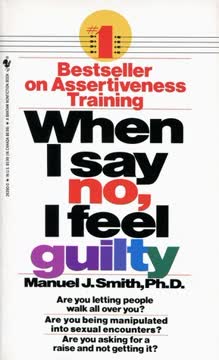
Key Takeaways
Your guilt when saying 'no' was trained into you — untrain it
“We still have feelings of anxiety, ignorance, and guilt that can be and are used efficiently by other people to get us to do what they want irrespective of what we want for ourselves.”
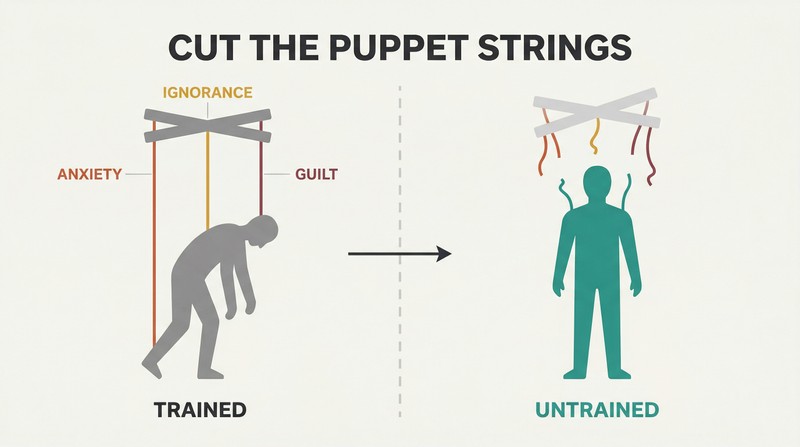
Babies are born assertive. Your first act at birth was to protest your treatment by screaming. The emphatic "No!" was among your first words. But as soon as you could understand language, your parents trained you to feel anxious, ignorant, and guilty — three variations of fear — to control your behavior. "That's a bad boy" replaced "I want you to do this," shifting responsibility from Mom's wishes onto some invisible external authority deciding what's good and bad.
These puppet strings persist. The emotional controls installed in childhood don't magically vanish when you turn eighteen. They remain active, allowing bosses, spouses, salespeople, and parents to manipulate your behavior through the same three levers: making you feel nervous, making you feel stupid, or making you feel guilty. This book's core argument is that these conditioned responses can be systematically unlearned through specific verbal skills practiced in everyday situations.
Claim your right to be the ultimate judge of yourself
“You cannot assume the responsibility of someone else for his happiness, nor can you automatically shunt the responsibility for your own happiness onto someone else.”
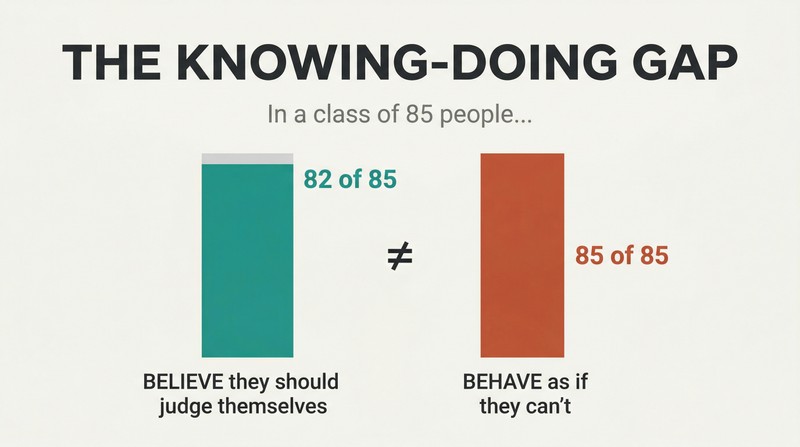
Assertive Right I is the foundation. Smith's Bill of Assertive Rights begins with one prime right from which all others derive: you have the right to judge your own behavior, thoughts, and emotions, and to take responsibility for their consequences. When you exercise this right, your judgments become less like a system of "rights and wrongs" and more like "this works for me, that doesn't."
Most people reject this intellectually but accept it behaviorally. In one class of eighty-five people, Smith asked how many truly believed they shouldn't make independent judgments about themselves — only three raised their hands. But when he asked how many behaved as if they believed it, every hand went up. The gap between knowing your rights and exercising them is what the rest of the book's techniques are designed to close.
Outlast the other person's 'no' — they usually only carry a few
“If he's got three 'Noes,' you only need four. If he's got six 'Noes,' you only need seven.”
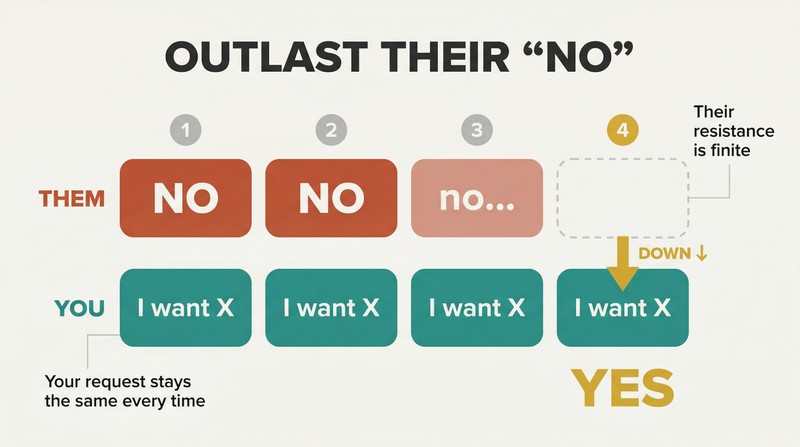
Broken Record teaches persistence. The technique is simple: repeat what you want in a calm voice, over and over, regardless of what the other person says. You don't answer irrelevant questions, don't get angry, and don't explain yourself. You transmit one unmistakable message: "I can do this all day if necessary."
Carlo proved it at the supermarket. When his meat purchases went missing, Carlo told the checkout clerk, the meat manager, and eventually the store manager the same thing: "I want my meat." Each person tried evasion, guilt, and delay. Carlo calmly repeated his request through every attempt. Within minutes, the store replaced his purchases — and invited his wife back for a sale. Most people lose conflicts not because they're wrong but because they give up after the first "no."
Stop offering reasons during conflict — they just arm the other side
“Depending upon who can think up the most reasons, she or the salesclerk, she will probably finish by keeping a pair of shoes she doesn't like.”
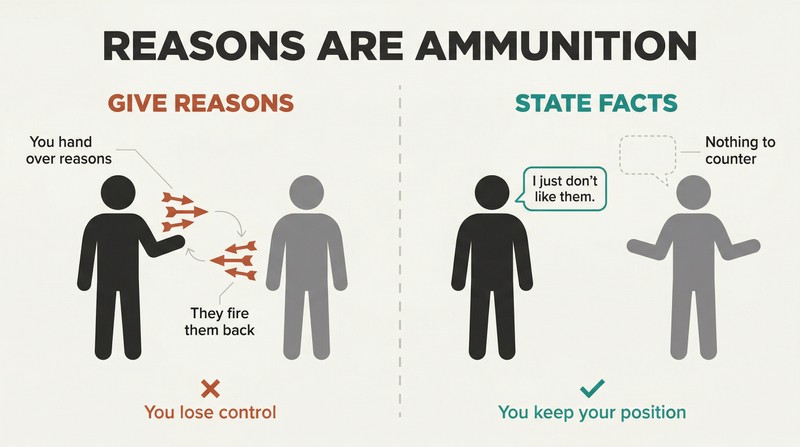
Assertive Right II: you owe no justifications. If you're your own ultimate judge, you don't need to explain your behavior for someone else to approve or reject it. When a salesclerk asks "Why don't you like these shoes?" and you provide reasons, you've just handed them ammunition. For every reason you give, they'll counter with an equally valid one.
Replace reasons with facts. Instead of "They're too loose and the wrong color," try "No reason, I just don't like them." Learners often protest: "But I can't refuse reasons to a friend!" Smith's reply is pointed: if giving reasons is required for the friendship to survive, how valuable is such a fragile friendship? Others always have the option to tell you they don't like what you're doing — and you can negotiate from there.
Agree with your critic's grain of truth, then do what you want
“A fog bank is remarkable… It offers no resistance to our penetration. It does not fight back. It has no hard striking surfaces from which a rock we throw at it can ricochet back at us…”
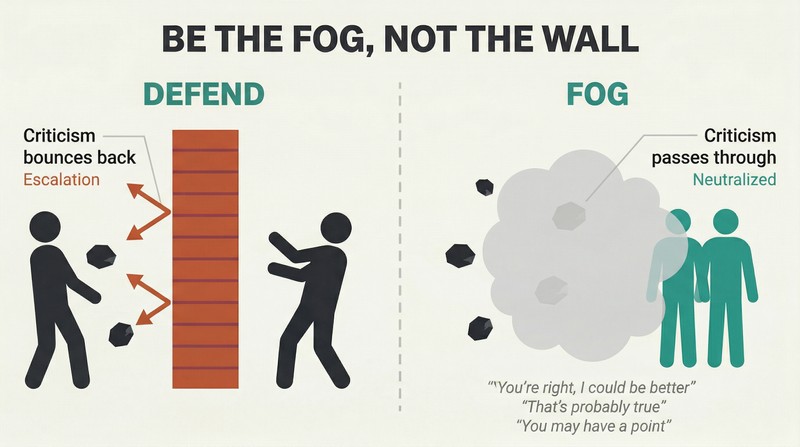
Fogging neutralizes manipulative criticism. Instead of denying criticism or counterattacking, you calmly acknowledge whatever truth exists in it. Three forms work together:
1. Agreeing with truth: "That's right, I am dressed in my usual way"
2. Agreeing with the odds: "You could be right, I may never improve"
3. Agreeing in principle: "What you say makes sense"
The key insight is probabilistic thinking. Nobody is 100% anything. You're somewhat lazy, somewhat messy, somewhat dumb — compared to somebody. When you stop thinking in absolutes and respond in probabilities, criticism loses its sting. Smith observed that after practicing Fogging, students who once panicked at personal criticism began grinning through the exercises. Having fun while someone criticizes you — that's the therapeutic paradox at work.
Treat every 'should' as a red flag for incoming manipulation
“In all likelihood, some message that says, 'You are not your own judge,' will follow.”
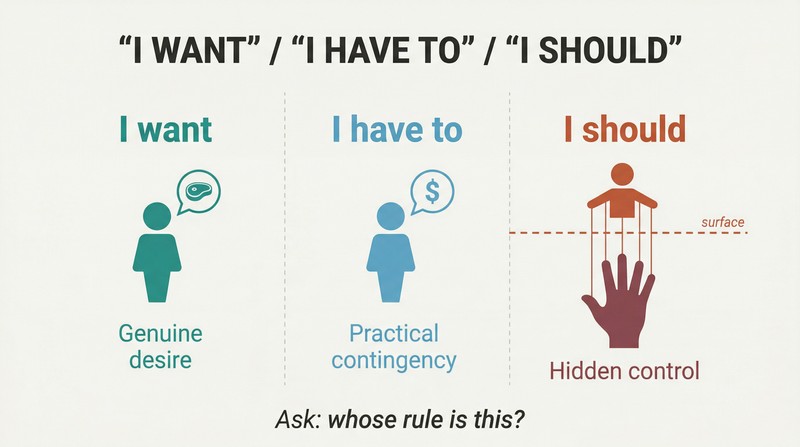
The I-want/I-have-to/I-should framework. Smith offers a quick diagnostic for distinguishing genuine desires from manipulation. "I want" is straightforward — I want steak three times a week. "I have to" is a contingency — I have to earn enough to afford it. "I should" is almost always manipulative structure, either imposed by others or self-imposed from insecurity: I should work because everybody should be productive.
"Should" is how arbitrary rules disguise themselves as universal laws. Your mother says boys should do yard work. Your spouse says you should dress better. Your boss says you should stay late. Each "should" smuggles in an unspoken claim: someone other than you gets to judge your behavior. Once you recognize this pattern, you can ask yourself the clarifying question: "Is this my want, my contingency, or someone else's attempt to control me?"
Openly admit your flaws — it's the strongest anti-manipulation move
“When you make such a self-disclosure, the person you are interacting with must respond to you on the same level of honest personal wants or not deal with you at all.”
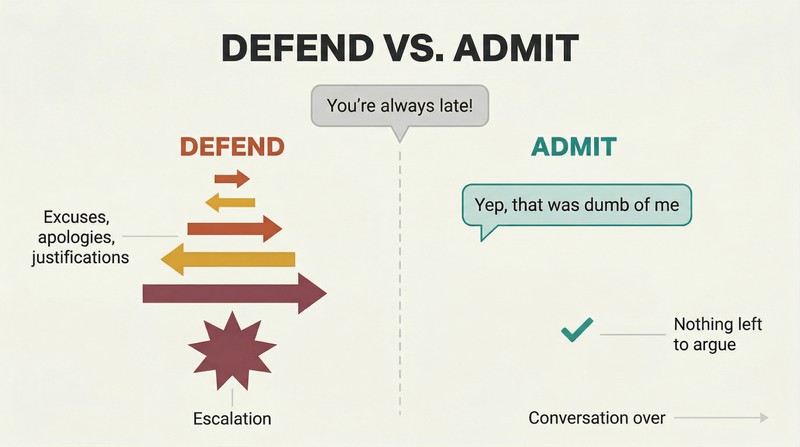
Two techniques work in concert here. Self-Disclosure means voluntarily revealing your worries, dislikes, or uncertainties — even irrational ones. "I just worry when I lend my car out" is unarguable. Nobody can manipulate your honest feelings. Negative Assertion means accepting your actual errors emphatically: "God, that was stupid of me!" instead of defending or apologizing.
Smith instructs students never to say 'sorry' in class. Not because manners don't matter, but to break the automatic guilt-through-error reflex. When you freely acknowledge your mistakes as just mistakes — not moral failings requiring atonement — critics lose their leverage. Sara, late to meet her teen daughter, said: "I'm late. That was a dumb thing to do." What had previously been ten minutes of mutual bitching was over in thirty seconds.
Prompt criticism with 'what bothers you about that?' to defuse it
“If you are not dealing with manipulation, then prompting criticism may eventually result in praise, and as it turned out for me, a lifelong friendship.”
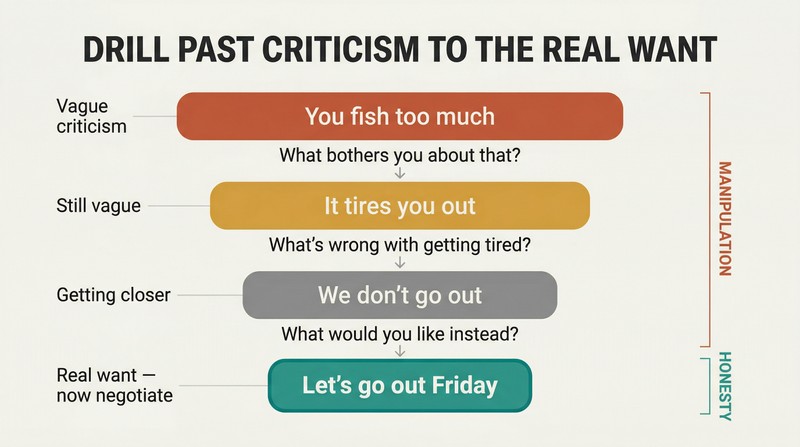
Negative Inquiry actively invites more criticism. Unlike Fogging, which creates distance, Negative Inquiry builds closeness by asking: "What is it about my behavior that's wrong?" or "What else am I doing that bugs you?" This forces the critic to examine their own arbitrary right-and-wrong structure and — ideally — replace it with honest statements of what they actually want.
It works by exhausting manipulation. When a wife criticizes her husband's fishing because "it tires you out," Negative Inquiry asks: "What's wrong with getting tired?" Eventually the manipulative structure collapses, and the real want emerges: "When you're tired, we don't go out in the evening." Now there's something to negotiate. Smith found this skill most powerful in close relationships — prompting a passive or nagging partner to finally say what they want instead of hiding behind rules about what you should do.
Other people's system problems aren't your emergencies to fix
“Other people can and will manipulate you into doing what they want by presenting their own problems to you as if they were your problems.”
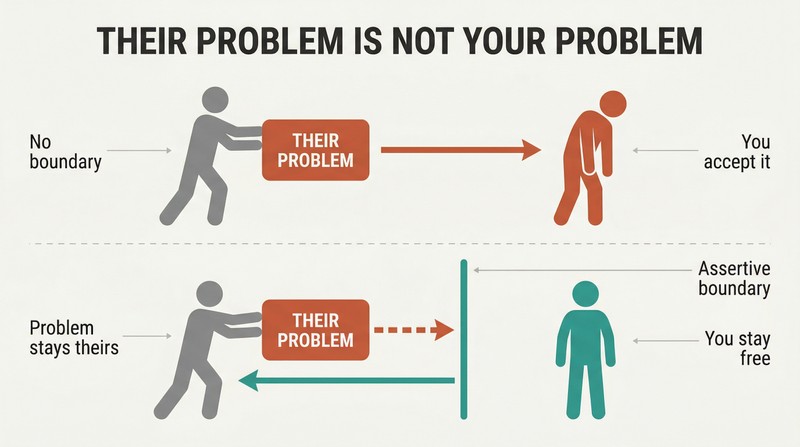
Assertive Right III: you choose your responsibilities. When a store clerk says "Your problem is with the manufacturer, not us," they're transferring their business problem onto you. When a spouse says "If you don't stop irritating me, we'll have to get a divorce," they're implying the marriage system matters more than your individual wants. Both are manipulative reassignments of responsibility.
The assertive response redraws the boundary. Anne, returning defective boots, was told the manufacturer wouldn't authorize a refund. Her reply: "I'm not interested in your problems with the manufacturer. I am only interested in you making a total refund." Mark Heath, dealing with defective couch cushions, heard similar deflection for weeks — factory this, factory that — until he consistently redirected: "I don't have a problem with the factory. I have a problem with you." He got a brand-new couch.
Compromise freely on material goals — never on self-respect
“Compromises don't have to be fair to be useful. All they have to do is work!”
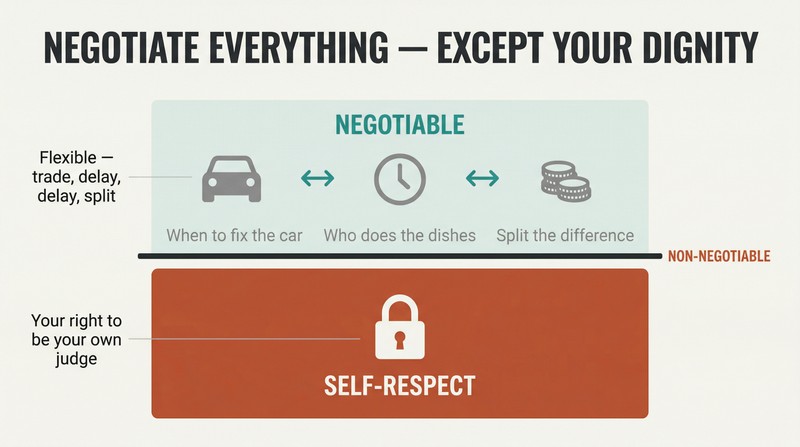
Workable Compromise is the practical endgame. After asserting what you want, if the other person is assertive back, the conflict gets settled on real issues — not on who's the better manipulator. You can offer to wait a set period, do things differently next time, or split the difference. Anything material is negotiable.
The one non-negotiable boundary is dignity. Smith draws a hard line: when the end goal involves your sense of self-worth, there can be no compromise. You can bargain over when your car gets repaired or who does the dishes. You cannot bargain over whether you get to be your own judge. Jack, the student who got $1,800 back from a used-car dealer over three days of calm persistence, put it best after his success: even if the owner had refused, Jack had already achieved his primary goal — to stand face-to-face with someone, say what he wanted, and not be intimidated.
Analysis
Published in 1975, When I Say No, I Feel Guilty essentially codified assertiveness training for a mass audience, and its influence runs deeper than most readers realize. Smith's verbal techniques — Broken Record, Fogging, Negative Inquiry — predate and arguably anticipate the interpersonal effectiveness modules in Marsha Linehan's Dialectical Behavior Therapy (the DEAR MAN framework) by nearly two decades. His Bill of Assertive Rights is a proto-boundaries manifesto before the concept of 'boundaries' entered popular psychology.
Smith's most elegant contribution is his three-emotion model of manipulation: anxiety, ignorance, and guilt. This triangulation explains why manipulation feels so different from outright coercion — it operates through emotions we were trained to feel before we could evaluate them rationally. The practical genius of his system is that it doesn't ask you to stop feeling these emotions (impossible) but to change your verbal behavior in their presence, which then desensitizes the emotional response itself. This behavioral-before-cognitive sequence aligns with modern exposure therapy principles.
The book's limitations are products of its era. The dialogue examples assume relatively symmetrical power dynamics — asserting yourself to a shoe clerk is qualitatively different from asserting yourself to an abusive partner or a structurally racist institution. Smith acknowledges legal and physical constraints briefly but doesn't explore how systemic power imbalances complicate his framework. The gender dynamics, while progressive for 1975, occasionally read as quaint. And the sheer volume of practice dialogues, while clinically useful, makes the book roughly three times longer than it needs to be for a general reader.
Yet the core insight remains radical: that most interpersonal suffering comes not from conflict itself but from our trained inability to say what we want without guilt, to hear criticism without crumbling, and to persist without rage. The techniques are deceptively simple, almost embarrassingly so — but their therapeutic power lies not in their complexity but in their repeated practice.
Review Summary
When I Say No, I Feel Guilty receives mixed reviews. Many praise its assertiveness techniques like "fogging" and "broken record," finding them helpful for building confidence and handling manipulation. However, critics note outdated examples, misogynistic content, and potentially manipulative tactics. The book's straightforward approach and practical advice are appreciated, but some find the dialogues unrealistic or repetitive. Despite its flaws, many readers still find value in the core assertiveness principles, though they recommend reading with a critical eye due to the book's age and dated perspectives.
People Also Read







 Immersive
Glossary
BROKEN RECORD
Calm repetition of your wantA verbal assertive skill in which you calmly repeat what you want over and over, regardless of what the other person says. You do not respond to side traps, irrelevant arguments, or guilt-inducing statements—you simply persist with your point. The technique teaches that persistence, not clever argumentation, is what resolves most conflicts. Named by Dr. Zev Wanderer for its resemblance to a stuck phonograph record.
FOGGING
Agreeing with criticism non-defensivelyA verbal skill for coping with manipulative criticism by calmly acknowledging the probability of truth in what your critic says, without becoming defensive or surrendering your right to judge yourself. Takes three forms: Agreeing with Truth (acknowledging factual accuracy), Agreeing with the Odds (conceding something could be true), and Agreeing in Principle (accepting logical premises without accepting imposed conclusions). Named for the fog bank metaphor—persistent, offering no resistance, impossible to fight.
NEGATIVE ASSERTION
Accepting errors without guilt or apologyA verbal skill for coping with criticism of your genuine mistakes by strongly and sympathetically agreeing with the negative assessment of your behavior. Instead of denying errors, defending them, or apologizing, you treat mistakes as simply mistakes—inefficient, perhaps stupid, but not moral failings requiring atonement. Example: 'God, that was a dumb thing for me to do!' The technique reduces the critic's leverage by removing the guilt they expect you to feel.
NEGATIVE INQUIRY
Actively prompting further criticismA verbal skill in which you nondefensively ask your critic for more specific information about what you're doing wrong: 'What is it about X that bothers you?' Unlike Fogging, which creates psychological distance, Negative Inquiry is designed to improve close relationships by exhausting manipulative criticism and prompting the other person to state their actual wants. It forces critics to examine their own arbitrary right-and-wrong structure rather than hiding behind it.
SELF-DISCLOSURE
Revealing personal negatives voluntarilyA verbal assertive skill involving the voluntary disclosure of both positive and negative aspects of yourself—your worries, uncertainties, dislikes, ignorance, and feelings—to enhance communication and prevent manipulation. Smith considers it the most potent anti-manipulation technique because honest feelings cannot be logically refuted or dismissed. When you say 'I just worry when I lend my car out,' the other person must respond at the same level of honesty or disengage entirely.
FREE INFORMATION
Unsolicited cues about someone's interestsA social conversation skill involving the recognition of information people volunteer about themselves that you didn't specifically ask for. When someone says 'I live in Santa Monica near the beach,' the mention of the beach is free information indicating a possible interest. Following up on free information gives you something to talk about, reduces awkward silences, and assertively prompts the other person to share more about themselves.
WORKABLE COMPROMISE
Practical negotiation preserving self-respectThe practical endpoint of assertive interaction where both parties negotiate material goals through give-and-take. Smith's key distinction: you can always compromise on practical matters (timing, logistics, money) unless the compromise affects your personal feelings of self-worth. When self-respect is at stake, there can be no compromise. Compromises need not be fair—they only need to work for both parties. This is the mechanism by which assertive conflict resolution replaces manipulative cycles.
Bill of Assertive Rights
Ten fundamental rights of self-judgmentSmith's framework of ten assertive human rights, all derived from the prime right to be your own ultimate judge. They include the rights to offer no reasons for your behavior, to change your mind, to make mistakes, to say 'I don't know,' to be independent of others' goodwill, to be illogical in decisions, to say 'I don't understand,' and to say 'I don't care.' Each right directly counters a specific childhood-trained belief that makes people susceptible to manipulation.
FAQ
What's When I Say No, I Feel Guilty about?
- Focus on Assertiveness: The book teaches readers how to assert themselves effectively in various situations, especially when dealing with manipulation or criticism.
- Systematic Assertive Therapy: It introduces systematic assertive therapy, a method to help individuals develop assertive communication skills and cope with interpersonal conflicts.
- Empowerment through Rights: The author presents a "Bill of Assertive Rights," emphasizing individuals' rights to judge their own behavior and emotions without needing to justify themselves to others.
Why should I read When I Say No, I Feel Guilty?
- Overcome Guilt and Anxiety: It's essential for those struggling with guilt when asserting their needs or saying "no" to others.
- Practical Techniques: The book offers practical techniques and dialogues for real-life application to improve assertiveness and communication skills.
- Enhance Relationships: By learning to assert oneself, readers can improve relationships, reduce manipulation, and foster healthier interactions.
What are the key takeaways of When I Say No, I Feel Guilty?
- Assertive Rights: The book outlines ten assertive rights, including the right to judge your own behavior and the right to say "no" without guilt.
- Coping Skills: It teaches specific skills like FOGGING, NEGATIVE ASSERTION, and NEGATIVE INQUIRY to handle criticism and manipulation.
- Self-Respect and Independence: Readers learn the importance of maintaining self-respect and independence from others' expectations and judgments.
What is the "Bill of Assertive Rights" in When I Say No, I Feel Guilty?
- Ten Assertive Rights: The Bill includes rights such as the right to judge your own behavior and the right to change your mind.
- Empowerment: These rights empower individuals to take responsibility for their actions and emotions without needing to justify themselves to others.
- Foundation for Assertiveness: The Bill serves as a foundational framework for developing assertive behavior and coping strategies in interpersonal relationships.
How does Manuel J. Smith define assertiveness in When I Say No, I Feel Guilty?
- Verbal Problem-Solving: Assertiveness is the ability to communicate effectively and solve problems verbally rather than resorting to aggression or avoidance.
- Coping with Conflict: It involves standing up for oneself while respecting others, allowing for healthy conflict resolution.
- Human Rights: Assertiveness is framed as a fundamental human right, essential for personal dignity and self-respect.
What is the FOGGING technique in When I Say No, I Feel Guilty?
- Agreeing with Truth: FOGGING involves agreeing with any truth in a criticism without becoming defensive or argumentative.
- Desensitization to Criticism: This technique helps individuals desensitize themselves to criticism, reducing anxiety and emotional responses.
- Example Dialogue: An example shows a person responding to criticism by saying, “You’re right, I do sound like that,” maintaining composure while acknowledging the criticism.
How can I use the BROKEN RECORD technique from When I Say No, I Feel Guilty?
- Persistence in Communication: BROKEN RECORD involves persistently stating what you want without getting sidetracked by the other person's responses.
- Example Application: The book provides a dialogue where a customer repeatedly asserts their desire for a refund until they achieve their goal.
- Effective in Conflict: This technique is effective in commercial situations where the other party may try to manipulate or evade responsibility.
What is NEGATIVE INQUIRY, and how is it used in When I Say No, I Feel Guilty?
- Prompting Further Criticism: NEGATIVE INQUIRY involves asking for more information about the criticism you receive, which helps clarify the other person's concerns.
- Non-Defensive Response: This technique allows individuals to respond to criticism without becoming defensive, fostering open communication.
- Example Dialogue: The book illustrates this with a dialogue where one person asks, “What is it about my behavior that you find problematic?” to encourage constructive feedback.
How does Manuel J. Smith suggest handling criticism in When I Say No, I Feel Guilty?
- Use of FOGGING and NEGATIVE ASSERTION: The author recommends using techniques like FOGGING to agree with truths in criticism and NEGATIVE ASSERTION to acknowledge mistakes without feeling guilty.
- Maintaining Self-Respect: It emphasizes the importance of maintaining self-respect and not allowing criticism to undermine one’s confidence.
- Example Scenarios: The book provides various scenarios where these techniques can be applied, demonstrating their effectiveness in real-life situations.
What are some common manipulative tactics people use, as discussed in When I Say No, I Feel Guilty?
- Guilt Induction: People often use guilt to manipulate others into compliance, such as saying, “You should care about this.”
- Emotional Appeals: Manipulators may appeal to emotions, suggesting that not complying will hurt their feelings or damage the relationship.
- Logical Arguments: Some may use logical reasoning to convince others that their way is the only correct approach, disregarding the other person's needs or desires.
How does When I Say No, I Feel Guilty address the issue of guilt in assertiveness?
- Understanding Guilt: The book explores the roots of guilt that often accompany assertive behavior, helping readers recognize that feeling guilty is a common response.
- Overcoming Guilt: It provides strategies to manage and overcome guilt, allowing individuals to assert themselves without feeling bad about it.
- Empowerment Through Acceptance: By accepting that guilt is a natural emotion, readers can learn to navigate it and prioritize their own needs and boundaries.
What are the best quotes from When I Say No, I Feel Guilty and what do they mean?
- “When I say no, I feel guilty.”: This quote encapsulates the central theme, highlighting the emotional struggle many face when asserting themselves and the need to overcome guilt to maintain healthy boundaries.
- “You are your own judge.”: This quote reinforces the idea that individuals must take responsibility for their own feelings and decisions, encouraging self-empowerment and personal accountability.
- “Assertiveness is not aggression.”: This quote distinguishes assertiveness from aggression, clarifying that being assertive is about expressing oneself respectfully without infringing on others’ rights.
Download PDF
Download EPUB
.epub digital book format is ideal for reading ebooks on phones, tablets, and e-readers.








































