Key Takeaways
1. Embrace Strategic Subtraction for True Freedom
In a world designed to distract us, freedom can be obtained only through deliberate subtraction accomplished by following seven laws.
Freedom through less. Our lives are often overstuffed with commitments, possessions, and obligations, leading to overwhelm rather than fulfillment. The core principle for a meaningful life isn't about adding more, but about strategically removing what doesn't serve your deepest values. This deliberate subtraction creates space for what truly matters, allowing you to reclaim your time, energy, and attention.
The Slinky Effect. We often accumulate "Slinkys" – silly, invisible habits and things that no longer make sense but persist simply because they've always been there. These unquestioned additions clutter our lives, careers, and relationships, leading to a default existence rather than one consciously chosen. Recognizing and eliminating these unnecessary elements is the first step toward intentional living.
The Half-Full Cup. Imagine your life as a cup. We constantly fill it to the brim with commitments, then try to add "just a little bit more" until it spills over, causing anxiety and forgotten promises. Instead of adding more, we need a "trash-cleaning function" to remove 20% of the junk. This counterintuitive math of meaningful living reveals that less often equals more, freeing you from the constant pressure to do more.
2. Break Free by Seeking Uncertainty and Intentional Exploration
Birds do not sing in caves.
Escape autopilot. True living begins when you break free from comfortable, predictable routines that dull your senses and shrink your world. Exploration isn't just about geographic distance; it's an internal journey of seeking uncertainty and rediscovering your true self. This means actively stepping outside your comfort zone, whether in a foreign city or your own neighborhood.
Braille the world. Instead of over-researching and over-scheduling, immerse yourself fully in experiences. Don't look things up in advance, learn about them as you encounter them, and linger rather than rushing to check off a list. This approach allows for serendipity and wonder, transforming mundane moments into magical discoveries, like finding the best coffee in a bamboo shack in Nicaragua.
Rank safety third. Growth and experience often require deliberately introducing uncertainty, placing them above absolute safety. This doesn't mean recklessness, but recognizing that avoiding all risk is itself the greatest risk to a fulfilling life. The Explorer’s Compass helps you safely expand your comfort zone by:
- Instruments: Developing capabilities like language, physical preparedness, and mental adaptability.
- Risk Spectrum: Incrementally trying safe experiments, moderate challenges, and bold adventures.
- Trajectory: Setting flexible goals and embracing detours.
- Reflection: Learning from each experience to expand your comfort zone.
3. Defeat Burnout with Seasonal Focus and Renewal
Balance is for people afraid to burn for something.
Unbalanced transformation. The myth of balanced, incremental progress often leads to scattered efforts and minimal results. Instead, embrace a radical, seasonal approach: periods of intense, almost unhinged focus on one priority (money, health, or relationships), followed by periods of rest or maintenance. This allows for transformative progress without the guilt of neglecting everything else.
Lightning strikes. True change happens through intensity, not just consistency. A rocket burns 90% of its fuel during liftoff to escape gravity; similarly, new habits demand enormous initial energy. Once established, consistency maintains them. For example, a 12-week season of intense business building can yield more results than three years of sporadic effort, as seen with Taylor, who generated $21,000 in new revenue.
Embrace natural rhythms. Humans are wired for seasonality, with on/off switches built into our DNA. This means scheduled times for wiping your calendar clean, restarting, and reprioritizing. The 8:4 habit model (e.g., 8 months of one focus, 4 months of another) creates contrast, defeats hedonic adaptation, and allows for renewal. An "off-season checklist" ensures other life areas are maintained, not ignored, during intense focus.
4. Cultivate Humility and Say "Yes" to Serendipity
The more you know, and the more you’ve achieved, the more you’ll feel pulled to move throughout the world with the self-directed expectation that you should have the answer.
Admit your ignorance. As we age and achieve success, we often become overconfident, narrowing our perspective and fearing to admit what we don't know. Young people, unburdened by such expectations, are more willing to make "wild guesses" and explore, often stumbling upon brilliance. Embracing humility and acknowledging the vastness of the unknown opens doors to new experiences and growth.
Seek serendipity. An overly productive life can engineer serendipity out of existence. Instead of always saying "no" unless it's a "hell yes," consider saying "yes" more often to opportunities that fall outside your familiar confines. This approach, like my friend Dak Mitchum's unapologetic immersion in his interests, leads to more varied and fulfilling experiences, even if some are a "drag."
Seasons of Yes. Designate time-limited periods (e.g., 30 days) to deliberately say "yes" to opportunities, invitations, and experiences you'd normally decline. This strategic expansion of your comfort zone breaks entrenched patterns and reveals new possibilities. It's not about reckless abandonment, but a conscious effort to disrupt routine and invite unexpected joy and learning, as Alice Lemée discovered in her "Summer of Yes."
5. Choose Your Hard: Worthy Struggle Creates Energy
Your blessing in life is when you find the torture you’re comfortable with.
Purpose over ease. Our culture often promotes escaping work and seeking an effortless life, but this can lead to misery and listlessness. The goal isn't to eliminate hardship, but to choose the right kind of hard – work that matters to you, not just to others. This "worthy struggle" creates energy, purpose, and growth, preventing the emptiness that comes from a life of pure leisure.
Work vs. job. Your "job" is what you do for money; your "work" is what you do for you. While a job provides financial security, your work should be your passion, driving your personal growth. The rewards from a finished project are never as great as the internal growth experienced during the messy middle of creation. The smartest thing to do after finishing one project is to start the next, maintaining momentum and challenge.
Do the work yourself. Some tasks, like mowing your lawn or building something with your children, have hidden value beyond efficiency. The "Work-Worth-Doing Test" encourages you to consider:
- Connection: Does it build meaningful relationships?
- Growth: Does it teach something valuable?
- Pride: Does it bring genuine satisfaction?
- Legacy: Does it create memories to pass down?
These tasks, though seemingly inefficient, forge deeper bonds and provide a sense of accomplishment that outsourced labor cannot.
6. Escape the "When-I-Finally" Trap and Prioritize Dignity
Time passes, regardless.
Fleeting moments. Life is a string of special, expiring moments that pass regardless of your actions. The "when-I-finally" trap is the pervasive habit of postponing meaningful experiences and relationships until some arbitrary future condition is met (e.g., "When I finally have more money, I'll be philanthropic"). This future-focused postponement leads to a life of deferred joy, where the goalposts of happiness constantly shift.
Time charts don't lie. Data from the American Time Use Survey reveals stark realities about how we spend our lives:
- Time with coworkers peaks in mid-career, pulling us from loved ones.
- Time with partners remains flat until old age, then rises dramatically.
- Time with children spikes for a few short years, then falls off a cliff.
- Time with extended family declines sharply after adolescence.
These charts serve as a morbid reminder to invest in these relationships now, as the windows of opportunity are devastatingly short.
Dignity over price. Immanuel Kant distinguished between things with "price" (means to an end, replaceable) and things with "dignity" (ends in themselves, inherently valuable). Wisdom lies in exchanging more things with price for things with dignity. While money and success can amplify good qualities, they don't create them. The paradox of abundance is that too many possessions or choices can paralyze and exhaust us, draining our "extra brain space."
7. Prioritize Social Depth Over Breadth in Your Relationships
Your relationships are the single greatest predictor of your happiness.
The Garden of Friendship. Categorize your social connections to intentionally cultivate them. This metaphor includes:
- Grass: Professional networks and colleagues (utility-based).
- Flowers: Acquaintances and community members (seasonal joy).
- Birds: Content creators or public figures (one-sided, risk-free engagement).
- Tree(s): True friends (sturdy, enduring, steadfast).
While all have a place, depth with a few "trees" is more crucial for well-being than breadth with many "grass" or "flowers."
The True Friend Test. A true friend is defined by three proxies:
- Uselessness: They serve no practical purpose for your professional or social ambitions.
- Effort: They go out of their way for you, even if it doesn't make logical sense.
- Celebration: They are genuinely happy for your successes, not just there for your struggles.
These relationships are fundamentally acts of service, requiring intentional effort and vulnerability, and are essential for profound comfort and being known for who you truly are.
Community microinteractions. Beyond deep friendships, maximizing daily positive microinteractions with acquaintances significantly improves quality of life. A shared smile with a neighbor, a hello from the mailman, or a wave to a shop clerk – these small, frequent exchanges, though individually insignificant, collectively enhance your mood and sense of belonging. Building local community, even through simple gestures like offering bubbles at a park, enriches daily life more than isolated luxury.
8. Grow Separately to Become Stronger Together
What, indeed, is love if not the enmeshing of separate excitements?
Complementarity, not similarity. The most successful relationships aren't built on partners mirroring each other, but on healthy differences that create a stronger whole. While shared values are crucial, complementary personalities (e.g., morning person/night person, planner/spontaneous) reduce friction and allow for individual growth. This means accepting and leveraging each other's unique strengths and interests, rather than seeking a "smorgasbord of sameness" often promoted by dating algorithms.
Lift your own weight. True love requires each partner to pursue their own growth and bring something unique back to the relationship. This means cultivating separate hobbies, taking solo adventures, or developing skills independently. As Alice Lemée discovered, sometimes you need to "take some walks alone" to become whole yourself, returning to the relationship as a more well-rounded person, which is a gift to both partners.
The 4S Celebration Protocol. To integrate individual growth with shared connection, use this framework for process wins:
- Shared: Involves someone you care about.
- Scheduled: Set for a specific date.
- Sacred: Commits both people to showing up.
- Significant: Feels special, not routine.
This protocol transforms challenging projects into meaningful journeys by anchoring key milestones to shared experiences, ensuring joy throughout the process, not just at the outcome.
9. Ruthlessly Edit Your Life: Minimize to Maximize
You are not the author of your life, but you can be the editor.
Constraints enhance. Every item you own demands a piece of you: money, space, time, and attention. Embracing constraints, like packing only carry-ons for a four-month trip, doesn't diminish experience; it enhances it by forcing clarity on what's truly essential. This practice builds resilience and reduces anxiety, as you learn to live with less and become more confident in what you truly need.
Three Spheres of Intentional Minimalism. Freedom is found through strategic reduction across:
- Physical space: Decluttering visible possessions (e.g., the Ten-Minute Minimization Challenge).
- Mental bandwidth: Reducing cognitive load from decisions and information overload (e.g., simplifying purchasing decisions by trusting experts, like ordering "Gustof's favorite beer" in Greenland).
- Identity: Prioritizing the kind of human you want to be over fragmented roles and personas (e.g., focusing on your "thing" like writing, even if it means sacrificing other interests).
Reduce your walking costs. Freedom is optionality – the ability to walk away from situations that no longer serve you, even if you choose to stay. This requires keeping your "walking costs" low across:
- Financial costs: Minimizing debt, recurring payments, and lifestyle inflation.
- Relational costs: Reducing obligations to energy vampires and social expectations.
- Identity costs: Letting go of titles, status, and self-perceptions that no longer align with your true self.
By strategically giving away what holds you back (like giving away 50% of a business for more time and freedom), you gain more than you lose, proving that freedom is control, not just accumulation.
Review Summary
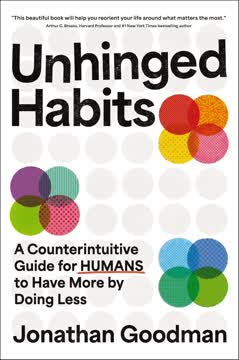
Reviews for Unhinged Habits are largely positive, averaging 4.02 out of 5. Many readers appreciate its conversational tone, practical frameworks, and honest approach to habits, relationships, minimalism, and intentional living. Standout concepts include "choose your hard," the friendship garden model, walking costs, and seasonal intensity cycles. Some critics note the content feels familiar or better suited to wealthier, more flexible lifestyles. Most agree the book is digestible, thought-provoking, and genuinely useful, even if not groundbreaking.
People Also Read

 Immersive

 Immersive