


Key Takeaways
Power isn't a feeling you cultivate; it's influence you exert in conversation
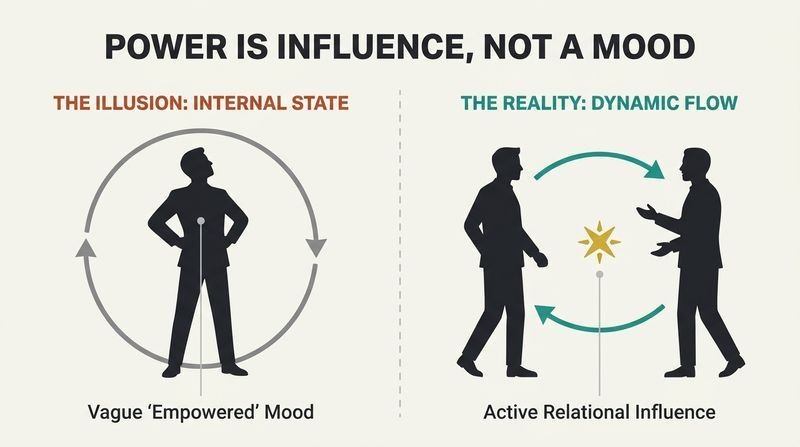
Kasia Urbaniak, a Taoist practitioner who funded her studies working as a dominatrix, dismantles the self-help fantasy that power is a mood you conjure through affirmations, power poses, or the right pantsuit. Power, she insists, is influence, and influence only exists inside a dynamic between people.
She distinguishes influence from control sharply. Control imposes will and wastes energy; every dictator needs ever more suppression to stay on top, and the revolution always comes. Influence instead unlocks another person's intelligence, creativity, and passion, often producing a third solution neither party imagined alone. When students say they want to "feel empowered," she asks what they would actually do if they felt that way: open the unpaid medical bills, name the abuser, break up. The vague longing becomes a concrete, askable desire.
This reframing echoes sociologist Max Weber's classic definition of power as the ability to realize one's will despite resistance, but Urbaniak relocates it from institutions to the interpersonal moment. Her generative-versus-extractive distinction resonates with negotiation research from Fisher and Ury's Getting to Yes, where expanding the pie beats dividing it. What sharpens her version is the insistence that empowerment culture (journaling, yoga, mantras) can become a sophisticated avoidance mechanism, feeling productive while changing nothing external. The critique is bracing, though it risks understating how genuine internal shifts sometimes precede behavioral ones. Still, the demand to convert amorphous longing into a specific action is durable advice.
When frozen and speechless, ask a question to reverse attention's flow
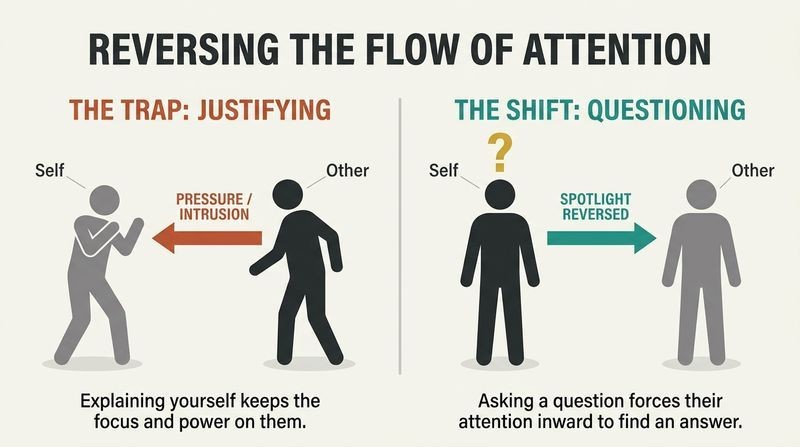
Urbaniak's signature move, Turning the Spotlight, takes ten seconds to learn. When someone puts you on the spot (a movie mogul opening his bathrobe, a stranger asking when you'll have a baby), do not explain or justify. Ask them a question about themselves. It can be a total non sequitur: "Do you swim with sharks?" Then ask another, and another.
Why it works: asking a question reverses the flow of attention, and control over attention is power. When you ask, you turn your attention outward and wait; to answer, the other person must go inward, even for a nanosecond. This flips the dynamic. She discovered the principle reading a dog-training manual in a dungeon: dogs relax when a trainer's whole being signals "I've got this." Humans, she realized, are animal bodies communicating too.
The technique aligns with trauma research on the freeze response, where the sympathetic nervous system locks the body while the mind races. Asking a question is a cognitive-behavioral interrupt that restores agency. It also mirrors journalistic and therapeutic practice: whoever asks the questions steers the exchange. Sales trainers have long taught that questions transfer control. One caveat worth noting is that a barrage of questions can read as evasive or aggressive in genuinely collaborative settings, so calibration matters. But as an emergency circuit-breaker for the ambush moment, the tool is elegant precisely because it requires no wit, only redirection of where attention points.
Dominance and submission are directions of attention, not personality types
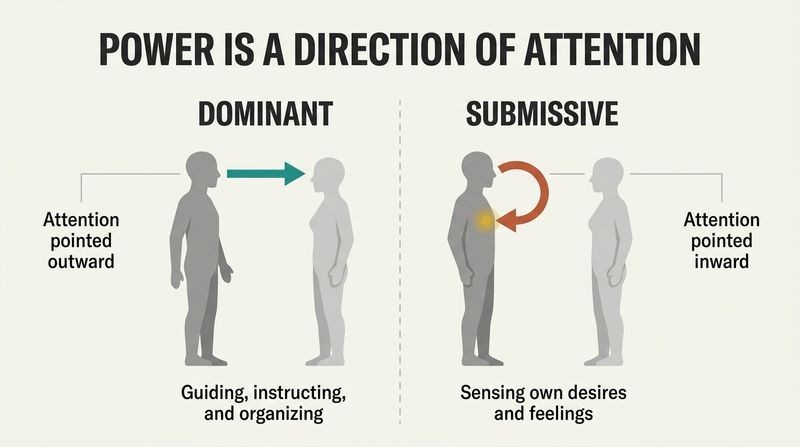
Urbaniak redefines two loaded words as states of attention. Dominance means attention pointed out, onto and into another person's body, combined with instruction: a firefighter, a skilled massage therapist, a good mother all occupy it. Submission means attention turned in, on your own sensations and desires, so you know exactly what you want and can receive without bracing.
Crucially, neither is stronger. A person fully surrendered in the submissive state influences powerfully because her signal is crystal clear; she creates a world where her desire is fulfilled and invites others in. Trouble arises from incongruence: the screaming boss uses dominant words but her attention is turned inward on her own rage and inadequacy, so her body broadcasts "look what you did to me" rather than commanding. A great conversation is a seamless dance, switching between the two states like Taoist Pushing Hands.
By stripping the BDSM vocabulary of cruelty and repackaging dominance and submission as attentional geometry, Urbaniak makes them gender-neutral tools rather than power-over hierarchies. This dovetails with polyvagal theory's insight that felt safety, transmitted nonverbally, lets another nervous system settle. Her claim that a fully surrendered person can dominate an interaction is counterintuitive but coheres with how clarity of desire projects authority. Skeptics might note the framework leans on somewhat mystical energetics that resist measurement. Yet the observable core, that mismatched words and body language read as untrustworthy, is well supported by research on nonverbal leakage and incongruent communication.
Good Girl conditioning traps you in the Smush between too much and not enough
Women are trained from childhood by an outdated manual, essentially "How to Be Marriageable, 1890 edition." Good Girls stay chaste, modest, accommodating, and conflict-avoidant; they maintain the status quo and can never catalyze change. The updated version, the Independent Woman (Good Girl 2.0), can have anything as long as she gets it herself, never burdening anyone, and ends up exhausted and resentful.
The Smush is the razor-thin ledge between "too much" and "not enough": too bossy or too needy, a bitch or a pushover, frigid or a slut. When a request squeezes through this compression, the animal body of the listener recoils, even if his face stays neutral. Urbaniak's noisy-neighbor example shows the brittle, passive-aggressive ask that fails, versus a clean dominant or submissive request that succeeds because it fully occupies one state.
The double-bind Urbaniak names has robust empirical grounding. Research on the "backlash effect" by Rudman and others shows women who self-promote or negotiate assertively are penalized socially in ways men are not, confirming the tightrope is real, not imagined. Her reframe is that the solution isn't finding the perfect middle but committing fully to one clean state. This is shrewd: the middle path here produces incongruence, the worst of both. Where the analysis could go further is acknowledging that the backlash is externally enforced, not merely internal conditioning, so congruence alone won't always dissolve genuine structural penalty. Still, reclaiming the individual moment is empowering.
You don't choose your deepest desires; you only choose whether to honor them
Urbaniak calls true desires "choiceless choices." You have no say in what you want at the deepest level; desire arises within you like turning toward the sun. What you control is whether you uncover it and what you do with it. Suppressed desires don't vanish; they nag, sap energy, and in late stages manifest as mysterious illness.
To excavate real desire (not goals like a raise or ten fewer pounds), she uses two exercises. The Bad Girl Protocol invites you to write what you'd do if you broke every rule with zero consequences: be a slut, a tyrant, a con artist. The Book of Desires logs anything that makes your body expand with elation, from world peace to fuzzy slippers. The rule: no reality allowed, no "deserving," no to-do lists. Every complaint, she notes, hides a desire.
The "complaint hides a desire" heuristic is genuinely useful and echoes Marshall Rosenberg's Nonviolent Communication, where every criticism masks an unmet need. Framing desire as involuntary has philosophical lineage in Schopenhauer and in modern affective neuroscience, where wanting (Berridge's dopaminergic "seeking" system) is distinct from and often precedes conscious choice. The therapeutic claim that suppressed desire causes physical illness overstates the evidence; psychosomatic links exist but are complex and rarely so direct. The stronger, defensible point is that unexamined longing distorts behavior and drains vitality. The Bad Girl exercise cleverly bypasses the internal censor, a technique resembling free-writing and shadow work in Jungian practice.
Rage is unalchemized passion; suppressing it leaves you numb, not calm
Urbaniak compares suppressed anger to a leg that has fallen asleep: numb, then painfully prickly as circulation returns, then finally mobile. Most people, terrified of the painful middle phase, cut off circulation again. That trapped rage doesn't disappear; it produces the listlessness, low libido, and "looking at the world through glass" numbness she sees in every class.
Emotional alchemy moves an emotion from its excluded, hijacking form into fuel. The Things Unsaid exercise ("I never told ___ about ___ ") drains the reservoir of what got stuck. Her method: locate the feeling, approve of it (accept that it exists, not that it's good), then influence where its energy goes. Her mantra is "Welcome." She reframes fighting-against into fighting-for: you're not against police brutality but for the sanctity of every life. The desire beneath the rage carries more energy than the obstacle.
This maps closely onto contemporary emotion research. Suppression, per James Gross's work on emotion regulation, increases physiological arousal and impairs memory, whereas acknowledgment and reappraisal reduce distress, precisely Urbaniak's locate-approve-influence sequence. Her "anxiety is unalchemized enthusiasm" line resembles Alison Wood Brooks's Harvard finding that reframing anxiety as excitement improves performance. The fighting-against to fighting-for pivot parallels approach versus avoidance motivation in psychology, where approach goals sustain energy longer. The invisible-labor thread adds a sociological layer: unacknowledged domestic and emotional work as a rage generator, resonant with Arlie Hochschild's "second shift." A rigorous, unusually actionable chapter.
Feel legitimate about your desire, and even a no stops wounding you
Legitimacy is the superpower of the submissive state: knowing at a cellular level that you have the right to ask, though not necessarily the right to have. Urbaniak illustrates with a nanny who, joking aside, would let no argument on earth persuade her to hand a stranger the child in her care. That unshakable certainty is how she wants women to feel about their dreams.
Without legitimacy, we make "meta-asks": we're really asking whether we're allowed to ask at all ("Can I ask a question?"). This makes the other person's no feel like annihilation, and pushes them toward a false yes they'll later renege on. The Legitimacy exercise cycles three times through physical sensation, emotion, and thought while imagining you already have what you want, keeping out all fear and "deserving." A congruent, legitimate ask lets the other person safely say no, which is the only path to a real yes.
The insight that granting the other person genuine freedom to refuse increases compliance is well established in persuasion science. The "but you are free" technique, studied by Gueguen and Pascual across dozens of experiments, roughly doubles agreement rates simply by affirming the target's autonomy. Urbaniak arrives at the same truth through embodiment rather than scripting. Her point about "meta-asks" is psychologically astute: when self-worth rides on every request, rejection becomes existential, distorting both parties. The three-part body-emotion-mind cycle resembles interoceptive exposure used in anxiety treatment. One tension: legitimacy is presented as internally generated, yet for survivors of chronic invalidation, that felt sense often requires relational repair, not solo visualization.
Bank the 97% you got right instead of obsessing over the 3%
Self-celebration, Urbaniak claims only half-jokingly, is the cure for the patriarchy. Women achieve a 97 percent victory and then fixate on the 3 percent that missed, cementing an identity as someone who never gets it right. Men, by contrast, hang their metaphorical big-fish photos everywhere. Self-attack is the Good Girl's specialty: she's gracious to others and vicious to herself, deflecting compliments and downplaying wins ("I went to school in California" instead of "I graduated from Stanford").
The Victory Log is a nightly five-minute practice: write "I celebrate _ "until the page fills, being specific and feeling each win in the body. This builds a feedback loop and retrains the inner signal. She also warns of the Victory Hangover, or post-expansion contraction: after a big win, the energy body registers only sudden altitude change, triggering a one-to-three-day shame spiral best treated with baths and rest, not analysis.
The 97/3 asymmetry is the negativity bias, one of psychology's most replicated findings: negative events weigh roughly three to five times heavier than positive ones (Baumeister, Rozin). Urbaniak's corrective, deliberately anchoring wins in bodily sensation, aligns with Rick Hanson's "taking in the good," which argues positive experiences must be savored ten to twenty seconds to consolidate into neural structure. The Victory Hangover concept is unusually valuable and underdiscussed; it resembles the "upper limit problem" in Gay Hendricks's work and the deflation many feel after peak achievements. Framing it as a nervous-system altitude adjustment rather than proof of unworthiness could spare people from self-sabotage at exactly the wrong moment.
Every ask assigns someone a role; asking for less offers a smaller one
Urbaniak overturns the belief that asking creates debt and depletes people. Asking instead raises people up and creates roles. Her example: a substitute teacher who hands the class troublemaker the attendance book; the boy straightens his spine and carries it like a holy scroll, transformed from saboteur to trusted assistant.
Refusing to ask, in the name of being low-maintenance, trains the people in your life to stop trying and quietly makes your partner useless in your own eyes. She recounts Alia, dreading dividing possessions in her divorce, who turned it into a costumed "pirate raid" with friends and simply asked her ex to take everything he wanted, then handle the house sale; he agreed instantly, and a Mistress group was born. Asks must be specific (an "Impossible Ask" like "be more romantic" sets people up to fail) and Right-Sized, often Outrageous, big enough to make you light up.
The role-creation frame is a genuinely fresh contribution to the crowded ask-for-what-you-want genre. It inverts the scarcity model of favors (Cialdini's reciprocity as debt) into an abundance model where being asked is a gift, echoing research on the "Ben Franklin effect," where doing someone a favor increases liking for them. The specificity mandate parallels goal-setting theory (Locke and Latham): vague goals produce vague results. Where caution is warranted: not everyone responds to being handed a role, and some asks genuinely do impose costs. The framework works best among people with goodwill and slack; it can misfire with the exploitative or the overextended.
Treat every no as a doorway, then locate, approve, and influence
People rarely say no to mess with you; they say it to protect something that matters. So a no is a neon arrow pointing at what the other person values, and thus a doorway to intimacy that yes can never offer. Urbaniak insists you must be able to hear no and keep going, keeping your attention out rather than snapping it back onto your own hurt (which makes the other person feel dropped).
Her three-step sequence for navigating resistance:
1. Locate: name where the person is ("You seem shocked I'd ask; is that true?")
2. Approve: acknowledge that state exists without condoning it, which paradoxically defuses it
3. Influence: use what you learn to move them from what they're fighting against to what they're fighting for
She illustrates with a mock fight about buying a unicorn farm, cataloging male deflections (invoking a third party, gaslighting, "switching sandboxes") and congruent responses. Two people working through resistance often invent a third solution better than either's original position.
The locate-approve-influence arc closely tracks evidence-based conflict methods. "Approving" mirrors the validation step in Marsha Linehan's Dialectical Behavior Therapy, where acknowledging an emotion as real reduces its intensity, and the "naming to tame" principle from Dan Siegel's affect-labeling research (putting feelings into words dampens amygdala activation). The "fighting-against to fighting-for" reframe parallels interest-based negotiation, which digs beneath positions to underlying interests. The claim that jointly forged resistance yields superior third options is the essence of creative synthesis in negotiation literature. The unicorn-farm device keeps the stakes low enough to see mechanics clearly, a smart pedagogical choice, though real conflicts carry emotional freight that can overwhelm technique.
Context sets calibration: know when to whisper, when to shout
Once a question gets you off the spot, context determines how hard to hit back. Urbaniak uses one prompt, "tell me your sexual fantasies," across three scenarios: a drunk boss at the hotel bar (hard touch, dominant third-party language: "Do you realize what position you put a woman in?"), an intriguing second date (flirtatious delay: "Aren't you forward?"), and a loving partner (light, playful: "How long have you wanted to ask that?").
Calibration comes from attention out; when you truly perceive the other person, you read whether you're hitting too hard or not reaching them at all. She points to a mother dog whose bark is precisely as fierce as needed to settle her pups, then softens to a look. On going too far, she is unbothered: the harm from women staying silent so vastly outweighs the harm of an inelegant ask that overshooting barely tips the scale. Women, she finds, trend conservative and rarely go far enough.
The calibration principle connects to emotional intelligence research on "emotion regulation flexibility," the capacity to match response intensity to situational demand, which predicts better outcomes than any fixed style. The dog analogy usefully illustrates that effective dominance is responsive, not maximal; ethologists note that stable animal hierarchies rely on minimal necessary signaling, not constant aggression. Urbaniak's "go too far" encouragement is deliberately provocative and context-dependent; as a corrective to chronic under-asking it is sound, but as a general license it could backfire in workplaces with real power asymmetries and consequences. Her own caveat, to leave any genuinely dangerous situation immediately rather than stay to play, is the essential guardrail.
Your most outrageous ask may simply be sanity in a skewed world
Urbaniak closes by challenging the very label "outrageous." With what faculty do you judge your own desire as too much? Maternity leave once sounded insane: a woman asking to be paid while not working, then to return at full salary. Now it's a recognized benefit. She invokes Rosa Parks and Malala Yousafzai to argue that world-changing asks always sound outrageous first.
She demonstrates with two Three-Way Asks (asking neutrally, then in a fully dominant state, then a fully submissive one). Ruth escalates from demanding an overdue 4,000 dollar tuition check to asking her ex to buy her family a house, which reframes him from deadbeat to provider; he agrees within three months. Valentina asks an elderly friend not just for a place in his will but to endow her theater company in perpetuity; he does that and more. The right-sized ask is the one that makes your whole body vibrate with possibility.
The historical framing is persuasive: the Overton window of acceptable demands shifts precisely because someone voiced the previously unthinkable, a dynamic documented across social movements. The Three-Way Ask is a clever embodiment device; by overshooting into caricatured dominance and abject submission, the practitioner discharges the energy trapped in forbidden roles and lands, by contrast, in congruence, a technique reminiscent of paradoxical intention and psychodramatic role-play. The two success stories are vivid but selection-biased (we hear the wins, not the asks that detonated relationships). The honest reader should hold both truths: audacious asking can be transformative, and outcomes depend heavily on the goodwill and resources of the person asked.
Analysis
Unbound occupies an unusual niche: a feminist power manual grounded not in policy or corporate lean-in advice but in two esoteric apprenticeships, Taoist internal alchemy and professional domination. That fusion is the book's signature and its risk. Urbaniak's central move is to relocate power from the structural (patriarchy, pay gaps) to the microscopic: the single conversational moment where a woman can or cannot speak. This is strategically shrewd. It hands readers agency they can exercise today rather than a grievance to wait out. Her core mechanism, attention as the currency of power, and its two directions, out (dominance) and in (submission), gives her a genuinely portable, gender-neutral model that avoids the trap of telling women to imitate men.
The book's most rigorous chapters, on rage as trapped energy and on navigating resistance, converge independently on findings from affect-labeling neuroscience, emotion-regulation research, and autonomy-based persuasion science, lending empirical weight to what she frames as body wisdom. The locate-approve-influence sequence is essentially validation plus interest-based negotiation, and it works.
The weaknesses are twofold. First, the energetics vocabulary (life force, qi, animal bodies communicating) resists falsification and will alienate empirically minded readers, even though the observable phenomena beneath it, incongruence, nonverbal leakage, freeze responses, are well documented. Second, the book relies heavily on success anecdotes drawn from her school, an unrepresentative sample of motivated, often affluent women, and rarely examines asks that damaged relationships or invited retaliation. Her "you can't go too far" encouragement, thrilling as a corrective to chronic under-asking, underplays the real backlash that assertive women face, backlash she herself documents.
What endures is the practical scaffolding: turn the spotlight when frozen, mine complaints for desires, treat no as data, right-size the ask until it lights you up. Whether or not one accepts the dungeon-and-monastery metaphysics, these tools reliably restore voice to the moments that decide a life.
Review Summary
Unbound by Kasia Urbaniak receives overwhelmingly positive reviews, praised for its unique perspective on female empowerment and practical tools for overcoming societal conditioning. Readers appreciate Urbaniak's blend of experiences as a dominatrix and Taoist nun, offering insights into power dynamics and communication. The book is lauded for its practical exercises, helping women identify desires, ask for what they want, and navigate difficult conversations. While a few criticize its approach, most find it transformative, recommending it as essential reading for women seeking to reclaim their power and voice.
People Also Read










Glossary
Turning the Spotlight
Ask a question when frozenAn emergency technique for breaking speechlessness: when put on the spot, instead of explaining or justifying, ask the other person a question about themselves, then keep asking. Because answering requires them to turn attention inward while you keep yours outward, it reverses the flow of attention and hands control back to you, regardless of the stakes.
The Smush
Ledge between too-much, not-enoughThe narrow, precarious position women are squeezed into between being seen as "too much" (bossy, needy, a bitch) and "not enough" (a pushover, frivolous). This compression prevents fully occupying either the dominant or submissive state, producing incongruent requests that make the listener's body recoil even when his face stays neutral.
Dominance / Submission (states of attention)
Attention out versus attention inUrbaniak's redefinition of two loaded words. Dominance is attention directed out, onto another person, combined with instruction. Submission is attention turned inward, onto one's own sensations and desires. Neither is stronger; both influence powerfully when fully occupied. A great conversation dances between them. Problems arise from incongruence, when words and attention point in opposite directions.
Congruence
Attention aligned with wordsThe state achieved when the direction of your attention, your body language, and your spoken words all align with your intention. Congruent communication feels trustworthy and lands cleanly in the listener's body; incongruent communication (dominant words with inward attention, or a request braced against rejection) transmits mixed signals that trigger recoil.
Choiceless Choices
Desires you don't selectUrbaniak's term for true, deep desires that arise involuntarily within you, like a plant turning toward the sun. You have no say in what you fundamentally want; your only choice is whether to uncover and honor it. Suppressed choiceless choices don't disappear but nag and drain energy until acknowledged.
Emotional Alchemy
Convert trapped emotion into fuelThe process of moving a suppressed emotion (especially rage) from its excluded, hijacking form into usable energy through three steps: locate the feeling, approve of its existence (not condone it), and influence where its energy goes. Compared to waking a sleeping limb through the painful pins-and-needles phase to restored mobility.
Legitimacy
Cellular right to askThe submissive-state superpower of knowing at a bodily level that you have the right to ask for something, though not necessarily the right to receive it. Legitimacy removes the "meta-ask" (secretly asking whether you're allowed to ask), lets the other person safely say no, and takes the sting out of rejection by reframing no as data.
Meta-Ask
Secretly asking permission to askAn ask contaminated by the hidden question of whether you're even entitled to make it ("Can I ask a question?"). Because the other person senses their no would annihilate your right to exist, they either dodge or give a false yes they later withdraw, creating a confidence-eroding negative feedback loop.
Victory Hangover
Shame spiral after big winAlso called post-expansion contraction: the unpleasant crash (despair, unease, obsessing over minor mistakes) that can follow a major win, lasting one to three days. The energy body registers only a sudden change in altitude, not whether it was good, and needs time to catch up. Best treated with rest and body-based comfort, never analysis.
Impossible Ask
Vague request destined to failAn intangible, non-specific request like "be more romantic" or "show me respect" that sets the other person up to fail because it gives them no information on how to succeed, and gives you no way to know whether your underlying desire was met. The remedy is radical specificity.
Right-Sized Ask
Big enough to light upAn ask large enough that its fulfillment makes your whole body vibrate with "that would be huge," not merely "that's fine." Urbaniak argues women habitually ask for 20 to 80 percent of what they want, negotiating against themselves; the correctly sized ask is often outrageous, and asking for less doesn't spare the giver but dooms them to labor without lighting you up.
Three-Way Ask
Rehearse ask three waysA rehearsal exercise for achieving congruence: state your ask first however it comes out naturally, then in an exaggerated fully dominant state ("you" language), then in a fully surrendered submissive state ("I" language). By overshooting into both extremes and confronting your worst fears, you discharge trapped energy and your real ask emerges clean and congruent.
Locate, Approve, Influence
Three steps through resistanceUrbaniak's sequence for navigating someone's no. Locate: name where they are and confirm it ("You seem upset; is that true?"). Approve: acknowledge that state exists without condoning it, which defuses it. Influence: use the information gathered to move them from what they're fighting against toward what they're fighting for.
Mistress group
Peer practice circle for womenA small group (ideally four to eight in person) of women who meet to practice the book's body-based exercises together, since reading another person's reactions requires a partner. Named for the feminine form of "master," it uses check-ins, partnered exercises, and "frames" (sharing the moment that felt most alive) to build skill and mutual self-celebration.
FAQ
What's Unbound: A Woman’s Guide to Power about?
- Empowerment Focus: The book is a training manual for women to navigate and reclaim power in personal and professional settings.
- Breaking Conditioning: It addresses societal conditioning that keeps women silent, teaching them to express desires and assert influence.
- Practical Tools: Kasia Urbaniak provides methods like "Asking Practice" and "Turning the Spotlight" to help women articulate needs effectively.
Why should I read Unbound: A Woman’s Guide to Power?
- Transformative Insights: Offers profound insights into the invisible binds restricting women's power, helping dismantle these barriers.
- Practical Application: Provides exercises and techniques for immediate application in everyday situations, aiding personal growth.
- Cultural Relevance: Timely in the context of gender equality discussions, offering a fresh perspective on women's societal roles.
What are the key takeaways of Unbound: A Woman’s Guide to Power?
- Influence Over Control: True power is about influencing others positively, not exerting control.
- Legitimacy and Celebration: Emphasizes feeling legitimate in desires and celebrating personal victories to reinforce self-worth.
- Navigating Dynamics: Teaches recognition and navigation of subtle power dynamics for effective communication.
What are the best quotes from Unbound: A Woman’s Guide to Power and what do they mean?
- Power and Love Balance: "Power without love is reckless and abusive, and... love without power is sentimental and anemic." This highlights the need for balance between power and compassion.
- Self-Awareness Importance: "Knowing others is intelligence. Knowing yourself is true wisdom." Emphasizes self-awareness for understanding desires and motivations.
- Transformative Power Dynamics: "When you play skillfully with power dynamics, the world changes." Suggests mastering power dynamics can create significant life changes.
What is the "Asking Practice" in Unbound: A Woman’s Guide to Power?
- Imaginative Exercise: Encourages listing things to ask men in their lives, exploring desires and roles.
- Breaking Barriers: Helps dismantle fear of asking for help, reframing it as collaboration.
- Creating New Roles: Invites others into new roles, fostering deeper connections and collaboration.
How does Unbound: A Woman’s Guide to Power address the concept of legitimacy?
- Entitlement to Ask: Legitimacy is about feeling entitled to ask for what you want, often undermined by societal conditioning.
- Connection to Desires: Feeling legitimate about desires leads to confident expression and effective communication.
- Protecting Dreams: Legitimacy safeguards desires and dreams, reducing susceptibility to external pressures.
What is the "Good Girl Double-Bind" mentioned in Unbound: A Woman’s Guide to Power?
- Cultural Conditioning: Refers to societal expectations for women to be accommodating and selfless, causing internal conflict.
- Impact on Communication: Makes asserting needs difficult, leading to powerlessness and frustration.
- Breaking Free: Provides strategies to overcome this bind, encouraging women to embrace desires confidently.
How does Unbound: A Woman’s Guide to Power suggest women can harness their rage?
- Emotional Alchemy: Introduces transforming suppressed rage into power and clarity.
- Awakening Energy: Acknowledging and expressing anger taps into powerful energy for desires and goals.
- From Numbness to Action: Confronting and channeling rage leads to self-awareness and decisive action.
What role does self-celebration play in Unbound: A Woman’s Guide to Power?
- Reinforcing Self-Worth: Crucial for reinforcing self-worth and legitimacy, recognizing achievements and capabilities.
- Counteracting Self-Attack: Celebrating victories combats self-attack and diminishes societal conditioning impact.
- Positive Feedback Loop: Regular celebration creates a cycle of positivity, encouraging further achievements.
What is the significance of the "Victory Log" in Unbound: A Woman’s Guide to Power?
- Documenting Achievements: A tool for recording successes, acknowledging and celebrating accomplishments.
- Building Confidence: Focusing on victories strengthens self-esteem and belief in achieving desires.
- Encouraging Reflection: Serves as a reflective practice, recognizing growth and patterns in achievements.
What is the "Three-Way Ask" method in Unbound: A Woman’s Guide to Power?
- Role-Playing Technique: Involves asking in three ways: raw, dominant, and submissive, exploring emotional responses.
- Building Congruence: Helps calibrate tone and approach based on context and audience.
- Empowerment Through Practice: Role-playing builds confidence in making asks and navigating interpersonal dynamics.
How does Unbound: A Woman’s Guide to Power address the concept of power dynamics?
- Understanding Power: Explores power dynamics in relationships, emphasizing power as a tool for connection.
- Empowerment Through Relationships: True power comes from strong relationships where both parties feel valued.
- Navigating Conflict: Provides tools for managing conflict, fostering understanding and cooperation.
Download PDF
Download EPUB
.epub digital book format is ideal for reading ebooks on phones, tablets, and e-readers.








































