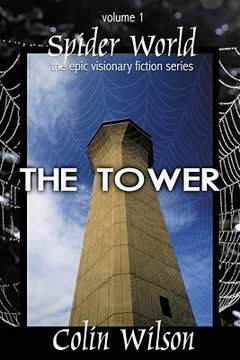
Plot Summary
Desert Shadows and Loss
Niall, reeling from the trauma of his father's death at the hands of the spiders, traverses a harsh, post-apocalyptic desert landscape. His family has been captured, and he is alone, driven by a mixture of numbness and determination. The world is ruled by giant, telepathic spiders who prey on humans, and Niall's act of killing a Death Spider marks him as a target. The desert is both a physical and emotional wasteland, mirroring Niall's internal state. As he follows the faint traces of his family, he is haunted by loss but also by a strange, growing sense of fearlessness—a detachment that allows him to push forward despite overwhelming odds.
Telepathic Awakening
Resting by a cistern, Niall experiences a vision that reveals his latent telepathic abilities. He sees his family through the eyes of the wolf spiders who have captured them, and for the first time, he senses the spiders' thoughts and emotions. This psychic connection is both a blessing and a curse: it gives him insight into his captors but also exposes him to the chilling presence of the Death Lord, the most powerful of the spiders. The experience leaves him shaken but also awakens a new sense of agency. Niall realizes that his ability to read and influence minds may be humanity's only hope against their arachnid overlords.
Captured by Wolf Spiders
As Niall descends from the mountains toward the green plain, he is ambushed by wolf spiders and swiftly captured. Their treatment is clinical and efficient, binding him with silk and carrying him at breakneck speed to their camp. Reunited with his mother and brother, Niall finds them exhausted and traumatized. The spiders' telepathic probing is crude but relentless, and Niall learns to shield his thoughts. The family's reunion is bittersweet, overshadowed by the constant threat of violence and the knowledge that their fate is now inextricably tied to the whims of their captors.
Prisoners on the Green Plain
Forced to march alongside the spiders, Niall and his family experience the strange rhythms of their new existence. The spiders are driven by hunger and instinct, viewing humans as both servants and potential food. Yet, a fragile tolerance develops as the humans prove useful and non-threatening. Niall's telepathic experiments reveal the spiders' limitations: they are powerful but unimaginative, slaves to instinct. The humans' ability to adapt and cooperate becomes their quiet strength, even as they are herded toward an uncertain future.
The Human Servants
The group is joined by a human servant, a physically impressive but mentally subdued man who serves the spiders with animal-like obedience. Niall observes the strange society that has developed under spider rule: humans are bred for strength and docility, their individuality suppressed. The journey continues to the coast, where Niall witnesses the disciplined, almost militaristic behavior of the spider's human servants. The contrast between their physical prowess and mental passivity is unsettling, highlighting the spiders' strategy of breeding out human independence.
Sea Voyage and Storm
The captives are loaded onto Viking-like ships and set sail across a stormy sea. The spiders, out of their element, are terrified, and Niall's empathy leads him to save one from drowning. This act earns him unexpected respect from both the spiders and their human servants. The storm is a crucible, forging new bonds and revealing the complex web of fear, loyalty, and hierarchy that governs life under the spiders. Niall's actions mark him as different—a potential ally or threat, depending on who is watching.
Arrival at Spider City
The ships arrive at a ruined but still imposing harbor, and the captives are paraded through the city. Niall is struck by the scale and decay of the spider metropolis, its towering buildings festooned with webs. The city is a place of rigid order and casual brutality, where humans are divided into castes: servants, slaves, and breeders. Niall's family is separated, and he is assigned to live among the charioteers, the spider's favored human workers. The city's oppressive atmosphere is matched by the psychological control exerted by the spiders, who use telepathy to enforce obedience.
The White Tower's Mystery
At the city's center stands the enigmatic White Tower, a relic from humanity's lost golden age. The spiders fear and despise it, repeatedly attempting to destroy it with the help of beetle allies and their human explosives expert, Bill Doggins. Niall is irresistibly drawn to the tower, sensing that it holds the key to humanity's past—and perhaps its future. His telepathic abilities resonate with the tower's strange energies, hinting at a deeper connection between human potential and the lost technologies of the old world.
The Spider Lord's Gaze
Niall and his family are summoned before the Death Lord, the supreme spider ruler. The encounter is a battle of wills, with the Death Lord probing Niall's mind for secrets. Niall's ability to shield his thoughts and project passivity saves them from immediate execution, but the experience leaves him shaken. The Death Lord is both fascinated and threatened by Niall's psychic abilities, recognizing in him a potential rival. The encounter cements Niall's status as a person of interest—and a danger to the spider regime.
Kazak's Palace and Secrets
Niall is taken to the palace of King Kazak, the human supervisor appointed by the spiders. Kazak is a survivor, pragmatic and cunning, who has made his peace with the spider overlords in exchange for power and comfort. He reveals the grim truth: humans are bred for stupidity and servitude, with only a select few allowed to retain intelligence. Kazak offers Niall a choice—cooperate and help the spiders identify other "dangerous" humans, or risk extermination. Niall is torn between self-preservation and the desire to free his people.
The Breeding System
Niall learns the full extent of the spiders' breeding program. Women are revered and segregated, used as breeders to maintain a population of strong but docile servants. Men are divided into workers and slaves, with the latter bred for stupidity and used as food. The system is enforced by a combination of psychological conditioning and brutal punishment. Niall's encounters with Odina, a powerful female commander, and Merlew, Kazak's daughter, reveal the emotional cost of this system: love, family, and individuality are sacrificed for the sake of order and survival.
Forbidden Knowledge
As Niall explores the city, he experiments with his telepathic powers, discovering that he can influence the thoughts and actions of others. He realizes that the spiders' control over humans is not absolute—there are cracks in the system that can be exploited. However, this knowledge is dangerous: if the spiders discover his abilities, he and his family will be destroyed. Niall's growing mastery of his powers is both a weapon and a burden, forcing him to navigate a treacherous landscape of suspicion and surveillance.
The Tower's Revelation
Drawn by an irresistible compulsion, Niall enters the White Tower using the telescopic rod he found in the desert. Inside, he encounters the Steegmaster, an artificial intelligence left behind by humanity's ancestors. The Steegmaster reveals the true history of the world: how humans once ruled, how a comet forced their exodus, and how the spiders rose to power in their absence. The tower is a repository of all human knowledge, designed to educate and empower any who can access it. Niall undergoes a transformative learning experience, absorbing centuries of history and science in hours.
The Steegmaster's Bargain
The Steegmaster challenges Niall to answer a riddle: why must he find his own path to defeating the spiders, rather than being handed the solution? Niall realizes that freedom must be earned, not given; only by discovering his own strength can humanity reclaim its destiny. The Steegmaster agrees to help, providing Niall with tools and knowledge, but warns that the spiders will soon discover his absence. Niall must act quickly, using his newfound understanding to outwit both his human and arachnid adversaries.
Human History Unveiled
Through immersive visions and direct mental downloads, Niall experiences the entire sweep of human history—from the origins of life to the heights of civilization, and the eventual decline that led to the spiders' dominion. He learns that humanity's greatest strength is its capacity for adaptation, creativity, and self-overcoming. The lessons of the past are both inspiring and sobering: progress is not linear, and every advance carries the seeds of new dangers. Niall emerges from the experience with a renewed sense of purpose and responsibility.
The Power Within
The Steegmaster guides Niall through a final initiation, revealing that the ultimate power lies within the human will. The spiders, for all their telepathic might, are limited by their passivity and lack of imagination. Humans, by contrast, possess the ability to summon inner strength, to change themselves and their world. Niall's awakening to this power is both ecstatic and humbling; he understands that the struggle for freedom is not just against external oppressors, but against the limitations within oneself.
Choosing Sides
Armed with knowledge and power, Niall must decide where his loyalties lie. Kazak offers comfort and safety in exchange for complicity; the spiders offer annihilation or subjugation. Niall chooses a third path: to fight for humanity's liberation, even at the risk of his own life. He recognizes that the struggle is not just for survival, but for the restoration of dignity, creativity, and love. The relationships he has formed—with his family, with Merlew, with the other captives—anchor his resolve and give meaning to his quest.
Escape and New Resolve
As the spiders close in, Niall uses the tools and insights gained from the Steegmaster to escape the tower and vanish into the city's labyrinth. He is now a fugitive, hunted by both spiders and their human collaborators. But he is also a beacon of hope, carrying within him the seeds of a new resistance. The chapter closes with Niall stepping into the unknown, determined to use his powers not just to survive, but to awaken others and reclaim the world for humanity.
Analysis
Colin Wilson's The Tower is a profound meditation on power, freedom, and the resilience of the human spirit in the face of dehumanizing oppression. Set in a world where humanity has been reduced to livestock by telepathic spiders, the novel explores the psychological and social mechanisms of control: breeding, conditioning, and the erasure of individuality. Yet, at its core, the story is one of awakening—both personal and collective. Through Niall's journey, Wilson interrogates the nature of true power, suggesting that the capacity for self-transformation and creative adaptation is humanity's greatest asset. The White Tower, with its repository of lost knowledge, symbolizes the potential for renewal through memory and learning. The novel's moral complexity—its refusal to offer easy heroes or villains—invites readers to reflect on the costs of survival, the dangers of complicity, and the necessity of earning one's freedom. In a modern context, The Tower resonates as an allegory for resistance against totalitarian systems, the importance of critical thought, and the enduring hope that even in the darkest times, the seeds of liberation can take root.
Review Summary
Readers generally enjoy The Tower, praising its imaginative world-building, philosophical depth, and compelling premise of a future Earth dominated by giant spiders. Many appreciated the first section most, finding later parts somewhat repetitive. Wilson's integration of philosophy into adventure fiction drew admiration, though some felt it disrupted pacing. Recurring criticisms include misogynistic undertones and occasional self-indulgence. Several readers noted the book influenced them significantly during childhood, and the series maintains enough momentum to keep readers seeking subsequent volumes.
People Also Read


Characters
Niall
Niall is a young man thrust into crisis by the death of his father and the capture of his family. Initially numb and traumatized, he discovers a latent telepathic ability that sets him apart from both humans and spiders. Niall's journey is one of self-discovery: he evolves from a passive survivor to an active agent of change, grappling with the moral complexities of power, loyalty, and rebellion. His empathy allows him to connect with both allies and enemies, but also exposes him to danger. Niall's development is marked by increasing confidence, strategic thinking, and a willingness to sacrifice personal safety for the greater good.
Siris
Siris, Niall's mother, is a figure of resilience and quiet strength. Her love for her children is unwavering, but she is deeply scarred by loss and captivity. Siris embodies the emotional cost of survival under oppression: she is forced to suppress her grief and adapt to new roles, even as her family is torn apart. Her relationship with Niall is both nurturing and fraught, as she struggles to protect him while accepting his growing independence. Siris's journey is one of endurance, adaptation, and the painful negotiation between hope and despair.
Veig
Veig, Niall's younger brother, is impulsive, passionate, and less cautious than Niall. He resents the constraints of captivity and is quick to question authority, both human and spider. Veig's psychological arc is defined by his struggle to reconcile his desire for freedom with the realities of powerlessness. He is both a source of support and a potential liability for Niall, embodying the tensions between individual defiance and collective survival. Veig's development is shaped by moments of courage, vulnerability, and the gradual acceptance of his brother's leadership.
Kazak
King Kazak is the human supervisor appointed by the spiders to manage their human subjects. He is intelligent, charismatic, and deeply pragmatic, willing to compromise moral principles for the sake of survival. Kazak's relationship with Niall is complex: he is both mentor and manipulator, offering protection while demanding complicity. Psychologically, Kazak is a study in adaptation—he has learned to navigate the spider's system, but at the cost of his own integrity. His development is marked by moments of genuine care for his people, but also by self-serving calculation and a willingness to betray others for personal gain.
Odina
Odina is a powerful female commander among the human servants of the spiders. She is physically strong, disciplined, and emotionally detached, embodying the values imposed by the spider regime. Odina's psyche has been molded by years of psychological conditioning: she is loyal, unimaginative, and views herself as superior to "savages" like Niall. Yet, beneath her rigidity, there are flashes of kindness and protectiveness, suggesting a suppressed humanity. Odina's development is a tragic illustration of how systems of power can deform individual identity and empathy.
Merlew
Merlew, Kazak's daughter, is beautiful, confident, and accustomed to privilege. She is both a love interest for Niall and a symbol of the seductive comforts of collaboration. Merlew is pragmatic, using her charm and status to navigate the dangers of the spider city. Her relationship with Niall is marked by genuine affection but also by manipulation—she is willing to use intimacy as a tool for survival. Psychologically, Merlew is complex: she is both generous and self-serving, capable of empathy but also complicit in the system's injustices.
Bill Doggins
Bill Doggins is a human explosives expert working for the beetles, the spiders' rivals. He is irreverent, resourceful, and fiercely independent, refusing to submit to spider authority. Bill's role is that of the trickster: he provides Niall with crucial information and challenges the fatalism of the other captives. Psychologically, Bill is resilient and adaptable, using humor and cunning to survive in a hostile world. His development is marked by a refusal to accept the status quo and a willingness to risk everything for a chance at disruption.
The Death Lord
The Death Lord is the supreme ruler of the spiders, a being of immense telepathic strength and cold intelligence. He is both fascinated and threatened by Niall, recognizing in him a potential rival. The Death Lord's psyche is alien: he is driven by instinct, hierarchy, and a relentless desire for control. His interactions with Niall are marked by a mixture of curiosity, hostility, and strategic calculation. The Death Lord's development is static—he is the embodiment of the system's inhuman logic, incapable of change or empathy.
The Steegmaster
The Steegmaster is an artificial intelligence housed within the White Tower, designed to preserve and transmit the sum of human knowledge. It serves as Niall's mentor and guide, challenging him to earn his freedom and understand the true nature of power. Psychologically, the Steegmaster is both compassionate and detached, operating according to programmed logic but capable of simulating empathy. Its development is tied to Niall's: as Niall grows in understanding, the Steegmaster becomes less a teacher and more a mirror of his own potential.
Dona
Dona is a young woman assigned as a nursemaid in the spider city, responsible for caring for Niall's sisters. She represents the possibility of love, connection, and a future beyond servitude. Dona's relationship with Niall is tender and genuine, offering a respite from the brutality of their environment. Psychologically, she is resilient and nurturing, able to find joy and meaning in small acts of kindness. Dona's development is a quiet counterpoint to the larger struggles, embodying the enduring human capacity for hope and renewal.
Plot Devices
Telepathy and Mind Control
The central plot device is telepathy, which serves as the primary means of control for the spiders and, paradoxically, as the source of Niall's resistance. The narrative explores the psychological implications of mind-reading: the loss of privacy, the erosion of individuality, and the potential for both domination and liberation. Telepathy is used to enforce obedience, but also to forge connections and subvert authority. The device is layered with foreshadowing, as Niall's growing mastery of his powers hints at the possibility of a broader human awakening.
Dystopian Social Engineering
The spiders' regime is built on the systematic breeding and psychological conditioning of humans. The narrative structure alternates between scenes of brutal enforcement and moments of subversive adaptation, highlighting the tension between conformity and rebellion. The use of caste systems, gender roles, and selective breeding serves as both a plot mechanism and a commentary on the dangers of engineered societies. The device is reinforced by the contrast between the spider city's order and the chaos of the desert, underscoring the costs of security and the value of freedom.
The White Tower and the Steegmaster
The White Tower functions as both a literal and symbolic gateway to humanity's past and future. Its impenetrability and the spiders' fear of it create narrative suspense, while its eventual opening marks a turning point in Niall's journey. The Steegmaster's role as an AI mentor introduces elements of science fiction and philosophical inquiry, allowing for exposition through immersive visions and direct downloads. The tower's revelations provide both plot momentum and thematic depth, linking personal growth to collective memory.
Moral Ambiguity and Choice
The narrative is structured around a series of moral dilemmas: cooperate with the spiders and survive, or resist and risk annihilation. Characters like Kazak and Merlew embody the temptations and costs of collaboration, while Niall's journey is defined by his refusal to accept easy answers. The plot device of the Steegmaster's riddle reinforces the theme that freedom must be earned, not bestowed. The story's structure encourages readers to question the nature of power, responsibility, and the true meaning of liberation.








































