
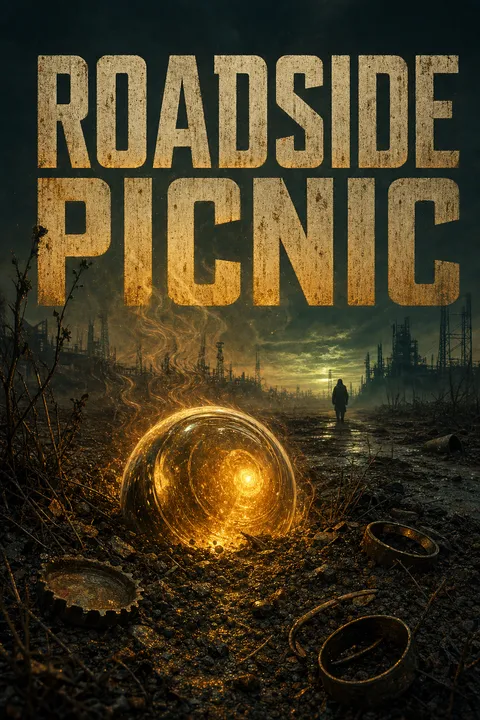


Plot Summary
Prologue
A radio journalist interviews Dr. Valentine Pilman,8 the physicist whose name marks the Pilman Radiant, the point in the sky from which six alien Visitation Zones were struck across Earth as if bullets were fired into a spinning globe. Pilman8 deflects credit and downplays the technological marvels everyone craves, insisting the single greatest discovery is simply that humanity is not alone in the universe.
He notes the internationalization of the Zones, the leakage of alien materials into irresponsible hands, and the thieves called stalkers who risk their lives to loot the sites. The exchange sets the world thirty years after the Visitation, uneasy with its mixture of science, profit, and fear.
The interview frame performs a sly misdirection. By opening on official science, Nobel prestige, and tidy diagrams, the Strugatskys establish the sanctioned view of the Visitation, then spend the novel dismantling it from below. Pilman's insistence that the fact of contact matters more than its spoils foreshadows the book's central irony: humanity gains miracles it cannot understand and cannot resist commodifying. His casual ignorance of stalkers marks the gulf between the clean laboratory narrative and the mud-crawling reality the novel actually inhabits. The radiant image, shots fired at a globe, reframes the aliens as indifferent marksmen, planting the seed of the later roadside picnic thesis.
A Cure for Kirill's Despair
Redrick Schuhart,1 a young lab assistant who moonlights as an illegal Zone scavenger, watches his friend Kirill,3 a Russian scientist, waste away in defeat over the mysterious artifacts called empties. To revive him, Redrick1 lets slip that he knows where a rare full empty sits abandoned in a Zone garage. Kirill3 blazes back to life and arranges an official daylight expedition, adding a cautious third man, Tender.16
But the security chief summons Redrick1 and warns that informers are watching him again. Torn between fear of arrest and pity for his friend,3 Redrick1 nearly backs out, then relents when Kirill3 invents an official pretext for the trip. The bait meant to heal Kirill3 quietly sets in motion a debt neither man can foresee.
The opening fuses friendship with contamination, establishing Redrick's defining contradiction: a self-interested predator capable of tenderness. His impulse to gift Kirill a discovery is generous and lethal at once, since everything the Zone touches carries hidden cost. The scene also maps the novel's social ecology, the institute's sanctioned science stacked atop illicit stalking, with informers, bonuses, and security captains blurring the line between legitimate and criminal knowledge. Kirill's revival on hearing of a full empty exposes the intellectual's hunger to name and possess the incomprehensible, a hunger the Strugatskys will repeatedly punish. The chapter announces its thesis: curiosity and love are the routes by which the Zone claims its victims.
Nuts, Bolts, and a Silver Web
Suited up and floating in the hover platform they call the boot, Redrick1 guides the two greenhorns through the Zone by tossing nuts and bolts to expose its lethal anomalies: a shimmering heat that crawls over the old dump, and a gravity trap he names the mosquito mange that crushes metal into the clay.
He silences a babbling Tender16 with a punch and threads a hairline crack in the asphalt to the garage. They wrestle out the coveted full empty, a copper vessel of drifting blue liquid.
But inside the garage Kirill3 backs into a nearly invisible silver web strung from the canisters. Redrick1 hears the strands tear and freezes, saying nothing. They emerge alive, and Redrick,1 inspecting Kirill's3 clean back, convinces himself the danger has passed.
The stalker's craft is rendered as improvised physics, a discipline built from thrown bolts and superstition rather than theory, dramatizing the gap between using the Zone and knowing it. Redrick's mastery is real but incomplete, and the silver web embodies the anomaly that gives no warning and shows no wound. The moment he chooses not to alarm Kirill, absorbed in his solitary routine, becomes the novel's quiet hinge of guilt. Danger here is not spectacular but statistical and delayed, a violation of causality that terrifies precisely because it looks harmless. The Zone's cruelty is bureaucratic in its patience: it stamps the ticket now and collects later.
The Web Collects Its Debt
Flush with a double bonus, Redrick1 drinks and jokes while Kirill3 dreams aloud of the monograph he will dedicate to his stalker friend. Hours later, at the Borscht bar, Noonan2 brings the news: Kirill3 was found dead in the shower, naked, felled by a heart attack no one can explain. Redrick1 alone knows the truth is the silver web, the Zone itself.
Grief hardens into fury. He presses money on a young Maltese newcomer,17 begging him to flee the city before stalking devours him too, then hurls an itcher into the bar to punish the fence Ernest,10 scattering the panicked crowd. Staggering home, hollowed out, Redrick1 meets Guta,4 who defiantly tells him she is carrying his child and will keep it whatever he decides.
Kirill's inexplicable death is the emotional detonation that recasts everything preceding it. The Zone kills not with monsters but with delayed physiology, mocking the scientist's faith that naming a phenomenon tames it. Redrick's grief refuses articulate mourning and erupts instead as sabotage and reckless generosity, the twin languages of a man who cannot process loss except through action. His warning to the Maltese boy is displaced self-knowledge, an attempt to save someone from the fate he cannot escape. Guta's announcement braids new life into fresh death, and her stubborn insistence on bearing a stalker's child seeds the novel's later reckoning with what the Zone breeds in the next generation.
Carrying the Buzzard Home
Five years later Redrick1 is a full-time stalker, married with a daughter. Pinned in a night cemetery by a patrol car, he crawls to Burbridge,6 the ruthless veteran nicknamed Buzzard,6 whose legs have dissolved in witches jelly.
Redrick1 weighs finishing the treacherous old man6 with brass knuckles, then hauls him out, lured by Burbridge's6 frantic promises of a map and the Golden Ball, a sphere said to grant any wish. Fleeing, they pass one of the risen dead trudging toward town, now an ordinary property of the Zone.
Redrick1 delivers Burbridge6 to the Butcher,15 a surgeon who mines Zone victims for knowledge. Home holds two more marvels: his golden-furred daughter, whom he calls Monkey,5 and his long-dead father, returned as a silent, earth-smelling moulage.18
The leap forward reveals a coarsened Redrick, now the trade's hardened professional rather than its reluctant amateur. The cemetery scene stages a moral test he barely passes, sparing a man who would have abandoned him, and Burbridge's whispered legend of the Golden Ball plants the engine of the finale. The walking dead and the mutated child transform the Zone from a distant hazard into a domestic infection colonizing the family. The novel's horror migrates inward: the wonders are no longer out there but at Redrick's dinner table. Burbridge, greedy even while dismembered, embodies the trade's spiritual cost, a man who bargained away everything human for survival and swag.
The Endlessly Spinning Hoop
In a Métropole hotel suite Redrick1 delivers his haul to two buyers, the angel-eyed Throaty11 and the nervous Bones, laying out empties, batteries, black sprays, and light-flashing pins.
When Bones idly spins a white metal hoop that refuses to stop, Throaty11 recognizes a perpetual motion device and pays a fortune, demanding secrecy and every future specimen. But the buyers crave darker prizes: exposed photographs from deep in the Zone and their porcelain container returned full of witches jelly, the very substance that ate Burbridge's6 legs.
Redrick,1 who has seen what the jelly does to human bodies, is repulsed yet tempted, since delivering it would free him from the Zone forever. He pockets the money, leaves the demand unanswered, and carries the deadly container home.
The market scene exposes the pipeline that turns alien refuse into commodities and weapons, with sinister buyers who treat civilization-ending materials as inventory. The spinning hoop crystallizes humanity's relationship to the Zone: a miracle used without comprehension, a violation of thermodynamics reduced to a saleable curiosity. Throaty's serene, unblinking demand for witches jelly reframes profit as complicity in mass death, and Redrick's temptation dramatizes how economic desperation erodes conscience. The porcelain container becomes a moral hot potato, a portable apocalypse he cannot bring himself to fully embrace or discard. The chapter sharpens the book's critique: the Visitation's true danger is not the aliens but the human appetites it inflames.
Trapped by an Old Friend
Ernest,10 the Borscht bartender and Redrick's1 longtime fence, sells him to Captain Quarterblad,13 who waits with UN troopers to seize the swag. Ordered to gather scattered money from the floor, Redrick1 lunges instead for a trapdoor ring, dives into the wine cellar, and bursts through a hidden gap in the wall, sprinting through familiar backyards and a passing street parade to shake pursuit.
Refusing to surrender the deadly porcelain container, he buries it beneath an abandoned phone booth on the town's edge, unwilling to let it kill anyone.
He telephones Guta4 to steady her for his arrest, then calls Throaty11 and orders him to provide for his wife4 while he serves his sentence. Then Redrick1 walks off through the boarded streets to give himself up.
Betrayal by a trusted fence completes the chapter's portrait of a world where every relationship is monetized and every ally is a potential informer. Redrick's acrobatic escape showcases the animal competence the Zone has honed in him, but the decisive act is moral, not physical: he hides rather than delivers the jelly, sparing anonymous victims at his own expense. This is the closest the coarsened stalker comes to grace, a refusal to become a mass murderer for money. His methodical arrangements for Guta reveal the family man beneath the outlaw. Surrender becomes a strange dignity, a man ordering his affairs before descending into a system that despises him.
The Supplier Who Fights Stalkers
The vantage shifts to Richard Noonan,2 a jovial, plump equipment supplier for the institute who secretly works to strangle the Zone's black market. Freshly proud of dismantling the Métropole ring and other smuggling gangs, Noonan2 is summoned by his glacial handler, Lemchen,14 who demolishes the victory.
Thousands of Zone artifacts have surfaced worldwide, stamped with the fingerprints of Burbridge,6 the Maltese,17 and young stalkers Noonan2 never suspected.
Humiliated and given a week to explain the leak, Noonan2 storms to his front operation, a nightclub, and beats his manager Mosul for answers. The interrogation surfaces a lead he had waved away as harmless: Burbridge's6 lakeside picnics and a clique of youths who cheerfully call their outings Sunday school.
The mid-novel perspective shift widens the lens from a single stalker to the machinery of institutions trying to police the ungovernable. Noonan's comic self-satisfaction, punctured by Lemchen's cold ledger of fingerprints, satirizes bureaucratic delusions of control. The revelation that Burbridge, presumed neutralized, still floods the world with swag exposes the futility of enforcement against human ingenuity and greed. Noonan's casual violence toward Mosul reveals the brutality beneath his affable surface, complicating the reader's sympathy. Structurally, the chapter reframes the entire trade as an unstoppable ecosystem, setting up Valentine's thesis that no order, good or bad, can contain what the Visitation unleashed. The enemy, Lemchen insists, never retreats.
A Picnic on the Cosmic Roadside
Chewing over the mystery, Noonan2 corners the Nobel laureate Valentine Pilman8 at the Borscht, and the physicist offers his deflating theory: the Visitation was like travelers pausing on a roadside, leaving litter that terrifies and enriches the small creatures who creep out afterward.
The aliens, Valentine8 suggests, may never have noticed humanity at all. He catalogs the Zone's uncanny inventory, eternal batteries, gravity traps, corpses that walk, emigrants whose relocation spreads catastrophe, while admitting how little science truly grasps.
Noonan2 recoils at the humiliation of cosmic insignificance yet cannot argue back. The conversation crystallizes his dread: humanity is a colony of animals pressing buttons for bananas, unable to comprehend the machine, and powerless to halt the flood of wonders it cannot control.
This is the novel's philosophical keystone, the image that gives the book its title and its devastating humility. Valentine's roadside picnic dismantles anthropocentric fantasies of contact, replacing first-contact grandeur with the possibility that we were beneath notice, mere fauna sniffing the campfire ash. His taxonomy of Zone phenomena performs genuine science's honesty about ignorance, contrasted with the market's confident exploitation. The banana-button metaphor indicts human progress as mimicry without understanding. Noonan's wounded pride enacts the reader's own resistance to insignificance. Crucially, Valentine leaves open kinder theories, contact yet to come, hidden observers, refusing dogmatism, which makes the bleakness feel earned rather than nihilistic, an argument rather than a verdict.
Dinner With a Dead Man
Noonan2 visits the Schuhart apartment and meets the Zone's cost face to face. Guta,4 worn thin and frightened, confides that Monkey5 is slipping away, ceasing to recognize her parents and pronounced by doctors as no longer human.
In the living room sits Redrick's resurrected father, a silent, earth-smelling moulage18 propped at the table. Newly freed from prison and flush with cash, Redrick1 stages a defiant family feast, pouring drinks for the corpse18 and playing at normalcy while Monkey5 nestles wordlessly against her dead grandfather.18
Noonan,2 who once befriended Guta4 partly to keep watch on Redrick,1 is unmanned by the tenderness and horror before him. For a chilling moment he wonders whether the Visitation is less a picnic than a slow invasion working through the town's children.
The domestic tableau delivers the novel's most intimate devastation, collapsing the abstract Zone into a father's grief. Redrick's insistence on treating the moulage as his living parent is both denial and fierce love, a refusal to let the Zone dictate what counts as family. Monkey's regression from a chattering, affectionate child into an unreachable creature literalizes the mutagenic theme raised earlier, turning statistics into heartbreak. Noonan's fleeting invasion hypothesis, borrowed from pulp fiction and quickly dismissed, shows the human mind reaching for narrative meaning where there may be none. The scene humanizes the hardened stalker completely, ensuring that the final chapter's desperation reads as paternal love, not mere greed.
The Last Road to the Ball
At thirty-one, Redrick1 undertakes his deadliest run, chasing Burbridge's6 Golden Ball with the old man's college-age son, Arthur,7 who begged desperately to come. Privately Redrick1 knows the boy is expendable, a living key to survive the final trap.
They cross a nightmare gauntlet: grass that erupts into searing heat, where Redrick1 instinctively pins the panicking Arthur7 to save them both; a fog-drowned depression between two hills where lightning hammers down over the corpses of earlier stalkers; a reeking slime that clings like tar.
Redrick1 confiscates Arthur's7 pistol and hides it, then drives the boy forward with thrown bolts and threats. Beneath his exhaustion a forbidden hope swells, that the sphere might truly grant one miracle and restore his ruined daughter.5
The final journey is a purgatorial descent, each anomaly stripping away another layer of Redrick's rationalizations. His instinctive rescue of Arthur in the heat contradicts his calculated plan to sacrifice him, exposing the war between his humanity and his desperation. The corpse-littered path visualizes Burbridge's monstrous method, sending others ahead to their deaths, and implicates Redrick in inheriting it. The swelling of hope is the chapter's engine: a man who has spent his life mocking miracles now stakes everything on one. The Zone here becomes a mirror, reflecting how far Redrick will travel and whom he will destroy to buy back the innocence the Zone already stole from his family.
Happiness for Everybody, Free
At the quarry's rim the copper sphere waits amid black splotches, all that remains of the stalkers Burbridge6 sent to their deaths. Redrick1 sends Arthur7 down first, and an invisible force, the meatgrinder, seizes and wrings the boy from the air as he shouts a giddy incantation about happiness for all. His death clears the path.
Alone at last, Redrick1 approaches the ball he has schemed and killed to reach, only to find he has no wish he can put into words. No one taught him how to think or what to want; his mind offers only faces, hatred, and self-pity. Grasping for something pure, he surrenders to the dead boy's cry,7 begging for happiness for everybody, free, and that no one leave unsatisfied.
The climax fuses murder and prayer into one unbearable image. Arthur's death, spent uttering a utopian wish, transforms Burbridge's cynical trap into an accidental benediction, and his words become the only vocabulary Redrick possesses. The final revelation is not the ball's power but the poverty of the human soul standing before it: a lifetime of exploitation has left Redrick unable to articulate a wish beyond another's borrowed idealism. His surrender to Arthur's cry is the novel's ambiguous blessing, damnation and grace at once, an inarticulate man reaching, through blood, toward something larger than himself. The book ends on aspiration wrenched from atrocity, refusing to say whether the wish is granted or even coherent.
Analysis
Roadside Picnic endures because it fuses hardboiled thriller with metaphysical inquiry and refuses easy consolation. Its governing conceit, that a superior intelligence might visit Earth and never notice us, leaving debris the way picnickers leave bottle caps, is one of science fiction's great acts of humility. The Strugatskys weaponize this idea against human vanity: rather than dramatize contact, they dramatize its absence, the way meaning-hungry creatures scavenge alien litter and read cosmic intention into what may be pure accident. Valentine's8 banana-button metaphor indicts technological civilization as mimicry without comprehension, and the novel's structure enacts that ignorance, denying readers any final explanation of empties, jelly, or the Ball. Politically the book is a stinging Soviet-era parable disguised as adventure. The Zone becomes an ungovernable market that no authority, benign or corrupt, can contain, since human appetite reroutes around every barrier. Institutes, smugglers, security services, and religious cranks all feed on the same wound, and Redrick's1 insistence on being his own man, beholden to no system, reads as a cry against every order that would own him. Yet the Strugatskys grant no romantic autonomy: Redrick1 is shaped, coarsened, and finally cornered by forces he cannot name. The deepest current is grief and love. The Zone's cruelty is measured not in monsters but in a scientist's inexplicable death,3 a golden-furred daughter who forgets her parents,5 a father returned as a mute corpse.18 The devastating finale strips the wish-fantasy bare: a man who has schemed and killed to reach a miracle discovers he was never taught what to want. His surrender to a dead boy's utopian cry,7 happiness for everybody, free, snatches fragile transcendence from atrocity, leaving the reader suspended between blessing and damnation, aspiration and its impossible cost.
Review Summary
Roadside Picnic is praised as a masterpiece of Soviet science fiction, offering a unique take on alien contact. Readers appreciate its thought-provoking premise, atmospheric writing, and exploration of human nature. The story follows "stalkers" who enter dangerous zones left by alien visitors, risking their lives for valuable artifacts. Many find the concept of aliens ignoring humanity particularly intriguing. While some readers struggled with the pacing or translation, most commend the novel's philosophical depth, vivid world-building, and lasting influence on science fiction and popular culture.
People Also Read

Characters
Redrick Schuhart
Defiant veteran stalkerKnown to all as Red, Redrick is a Zone scavenger who trades his life for alien loot and answers to no boss. Fiercely self-reliant since childhood, he measures freedom by the money he can wrest from an indifferent world, and he despises institutions, patrols, and the fungus of profiteers who feed on the Zone. Beneath the brawling, hard-drinking exterior runs a startling tenderness: for his friend Kirill3, for his wife Guta4, and above all for his daughter5. Cynicism is his armor and his prison, since he has never been taught how to think, hope, or want beyond survival. His arc traces a man hardened by loss and desperation, driven by love toward a hope he has spent a lifetime mocking.
Richard Noonan
Jovial double-dealing supplierPlump, pink, and endlessly affable, Dick Noonan supplies electronic equipment to the institute while secretly working to crush the Zone's black market for a shadowy security apparatus. He befriends Redrick's1 family with genuine warmth mixed with ulterior motives, buys swag through fronts, and prides himself on control. His comic self-satisfaction masks capacity for cold violence and deep unease. Through his eyes the novel widens into philosophy and satire, as he confronts the futility of policing human greed and the terror of cosmic insignificance. Noonan embodies the ordinary man who looks away from the abyss so he can keep functioning, yet cannot fully silence his dread of what the Visitation means.
Kirill Panov
Idealistic Russian scientistA young physicist at the institute obsessed with unlocking the secret of the empties, Kirill oscillates between crushing melancholy and radiant enthusiasm. He treats Redrick1 as a genuine friend and collaborator rather than a hired stalker, dreaming aloud of a future transformed by Zone knowledge. His faith that naming a phenomenon means mastering it makes him both endearing and vulnerable, embodying the intellectual's hunger to comprehend the incomprehensible.
Guta
Redrick's steadfast wifeBeautiful, strong, and fiercely proud, Guta chooses Redrick1 knowing the cost of loving a stalker. She defies her mother and the neighbors to bear and raise his child5, running a warm household under mounting strain. Beneath her brisk, bossy competence lies deep fear and endurance. She anchors Redrick's1 humanity and carries the domestic weight of the Zone's slow contamination of their family.
Monkey
Redrick's mutated daughterRedrick1 and Guta's4 daughter, nicknamed Monkey, is born covered in soft golden fur with dark eyes lacking whites, a child of the Zone's mutagenic legacy. Early on she is affectionate and endlessly chattering, adored by her father1. She represents the innocent inheritance of the stalker's trade and the intimate, heartbreaking scale on which the Visitation exacts its toll.
Burbridge
Ruthless surviving stalkerNicknamed Buzzard, and once called Winner, Burbridge is the last of the old stalkers, a treacherous, greedy survivor who has outlived every partner, sometimes by abandoning them. A wife-beater and manipulator, he lures the young into the Zone and hoards its legends, especially the Golden Ball. Even maimed he schemes relentlessly, embodying the trade's total corrosion of the soul, cunning enough to bend even Redrick1 to his purpose.
Arthur Burbridge
Burbridge's earnest sonBurbridge's6 handsome, dark-haired son, a college student groomed for a respectable career, Arthur is idealistic, fearful of pain, and desperate to prove himself. He begs to enter the Zone carrying secret hopes and a pistol with a single bullet. His youthful optimism and vulnerability stand in stark, poignant contrast to his father's6 ruthlessness and the trade that consumes stalkers.
Valentine Pilman
Skeptical Nobel physicistA small, immaculate, myopic laureate who gave his name to the Pilman Radiant, Valentine is a xenologist by reluctance and a skeptic by discipline. Over drinks he articulates the roadside picnic theory that reframes the Visitation as indifferent alien littering. Witty and self-deprecating, he embodies honest science that admits its own ignorance, offering the novel its intellectual and thematic center of gravity.
Dina Burbridge
Burbridge's alluring daughterBurbridge's6 stunning, pampered daughter, wished into being from the Zone, she leads a dissolute life. Bitter and clear-eyed about her father6, she scorns Redrick1 for saving the old man rather than seizing his fortune.
Ernest
Bartender and fenceThe proprietor of the Borscht bar who buys stalkers' swag for a fraction of its worth and ships it abroad. Perpetually wiping glasses, coolly mercenary, he feeds men into the Zone and betrays them when it profits him.
Throaty
Serene sinister buyerAlso called Hugh, a blue-eyed, unblinking dealer operating from the Métropole who pays lavishly for rare artifacts and demands the deadliest ones, including witches jelly. His angelic calm masks a chilling readiness to trade in catastrophe.
Gutalin
Drunken religious stalkerA huge black stalker and Redrick's1 friend who preaches that the Zone is the devil's temptation. When flush, he buys swag only to bury it back in the Zone, believing devil's things belong to the devil.
Captain Quarterblad
Dogged patrol officerA yellowed, ailing police captain who once imprisoned Redrick1 and dreams of reforming him. Earnest and moralizing, he sets the ambush that catches Redrick1 with his contraband.
Lemchen
Cold intelligence handlerNoonan's2 angular, general-faced superior in the security apparatus, who demolishes Noonan's2 illusions of victory with a ledger of fingerprints and demands he explain the unstoppable leak of swag.
The Butcher
Zone-harvesting surgeonJames Cutterfield, a fashionable, influential surgeon who treats maimed stalkers to harvest artifacts, knowledge, and fame, becoming the world's expert in the nonhuman diseases the Zone inflicts on the body.
Tender
Timid lab assistantKirill's3 older second assistant, a family man with a sick daughter, recruited as the required third for the legal Zone run. Frightened and talkative, he becomes the greenhorn Redrick1 must silence.
Creon the Maltese
Doomed young newcomerA clean, handsome youth from Malta pushed toward stalking by Ernest10. Redrick1, sickened by Kirill's3 death, tries to buy his escape from the city before the Zone claims him too.
Schuhart Senior
Redrick's risen fatherRedrick's1 father, dead since before the Visitation, returned from the cemetery as a silent, earth-smelling moulage. He sits mute at the family table, embodying the Zone's uncanny intrusion into the Schuhart home.
Plot Devices
The Zone
Alien wasteland of wondersThe blighted district left behind by the extraterrestrial Visitation, sealed off, patrolled, and riddled with lethal anomalies and priceless artifacts. It looks like an ordinary industrial town but obeys warped physics, killing intruders through invisible traps while promising riches to those who survive. The Zone drives the entire economy of the novel, spawning stalkers, institutes, smugglers, and enforcers, and its materials leak outward to corrupt and endanger the wider world. More than a setting, it functions as a moral and epistemological mirror, indifferent to human categories of good and evil, exposing what people will risk, sell, and sacrifice. Its slow contamination of Redrick's1 family collapses cosmic mystery into intimate tragedy.
Nuts and bolts
Improvised anomaly detectorRedrick's1 low-tech survival tool, a pocketful of metal nuts and bolts he tosses ahead to reveal invisible hazards. Where a bolt is yanked sideways or crushed into the clay, a gravity trap lurks; where it flies clean, the path is safe. This ritual of thrown metal embodies the stalker's craft as superstition-tinged empiricism, knowledge won through trial, instinct, and dead predecessors rather than theory. It dramatizes the novel's central irony that humans navigate the Zone effectively without understanding it at all, hammering nails with a microscope. The technique also builds unbearable suspense, turning each step of the expeditions into a wager against unseen death.
The Golden Ball
Legendary wish-granterA copper-colored sphere hidden deep in the Zone, rumored among stalkers to grant any human wish. It circulates first as folklore spun by liars like Burbridge6, then hardens into the object of Redrick's1 final, desperate pilgrimage. The Ball functions as the story's mythic lure and its ultimate test, drawing men to their deaths and demanding, at the last, that a seeker know what he truly wants. Its promise externalizes the novel's deepest question about human desire and self-knowledge, forcing the climax to hinge not on power but on the poverty or purity of the wisher's heart. It transforms a survival tale into a moral reckoning.
The meatgrinder
Invisible guardian trapA lethal, invisible anomaly guarding the approach to the Golden Ball, which seizes and wrings a human body from the air, leaving only a dark splotch on the ground. Burbridge's6 monstrous method for surviving it, sending an expendable person ahead to trigger and clear it, is what makes his map so damning. The device pays off the corpse-littered path and Redrick's1 calculated recruitment of a living key, forcing the protagonist's darkest moral choice. It converts the trade's abstract ruthlessness into a single unbearable act, and its clearing of the path is what finally leaves Redrick1 alone before the wish machine.
Witches jelly
Portable civilizational threatA colloidal substance from the Zone that seeps through metal and plastic and transmutes everything it touches into more of itself, dissolving flesh and destroying whole laboratories. It maims Burbridge6 and becomes the deadliest item sinister buyers demand from Redrick1, sealed in a porcelain container. The jelly embodies the novel's warning that the Visitation's litter is not benign treasure but weaponizable catastrophe in human hands. Redrick's1 refusal to deliver it, choosing instead to bury the container rather than let it kill anonymous victims, marks his closest approach to moral grace and drives his decision to surrender to arrest rather than betray his conscience for profit.
FAQ
Synopsis & Basic Details
What is Roadside Picnic about?
- Post-Visitation alien aftermath: The story is set in a world irrevocably changed by a brief, inexplicable extraterrestrial visit, leaving behind hazardous "Zones" filled with mysterious, dangerous artifacts.
- Stalker's perilous life: It follows Redrick Schuhart, a cynical but complex "stalker" who illegally enters the Zone to retrieve these alien objects for profit on the black market, risking death and mutation.
- Humanity's struggle and exploitation: The narrative explores how various factions – scientists, governments, criminals, and ordinary people – react to and attempt to exploit the Zone's presence, revealing human greed, desperation, and the search for meaning amidst the unknown.
Why should I read Roadside Picnic?
- Unique, thought-provoking premise: The novel presents a fresh take on alien contact, focusing not on interaction but on the aftermath and humanity's often-ignoble response to incomprehensible power and discarded wonders.
- Deep character study: Redrick Schuhart is a compelling protagonist whose internal struggles, cynicism, and hidden tenderness make for a powerful exploration of the human condition under extreme pressure.
- Rich thematic depth: It delves into complex themes like the nature of knowledge, the cost of progress, environmental impact, human morality, and the search for happiness, offering layers of interpretation.
What is the background of Roadside Picnic?
- Soviet-era science fiction: Written by Arkady and Boris Strugatsky, prominent Soviet authors, the novel reflects themes and anxieties potentially influenced by the political and social climate of the time, including bureaucracy, control, and the human spirit's resilience.
- The Visitation event: The central premise is a sudden, brief event where extraterrestrials visited Earth, leaving behind six "Zones" filled with artifacts, treated by the authors as mere litter from a "roadside picnic" on a cosmic scale.
- Harmont, a Zone city: The story is primarily set in Harmont, one of the cities adjacent to a Zone, depicting its transformation into a place of military control, scientific research, black markets, and a dwindling, affected population.
What are the most memorable quotes in Roadside Picnic?
- "Happiness for everybody! Free! As much as you want! Everybody come here! There's enough for everybody! Nobody will leave unsatisfied! Free! Happiness! Free!": These are Arthur Burbridge's final, desperate shouts as he runs towards the Golden Ball, encapsulating the ultimate, perhaps naive, human desire for universal, effortless fulfillment, tragically juxtaposed with his immediate demise in the meatgrinder.
- "A roadside picnic, on some road in the cosmos. And you ask if they will come back.": Dr. Valentine Pilman's famous analogy, suggesting the Visitors were utterly indifferent to humanity, viewing Earth merely as a convenient stop, profoundly diminishing humanity's perceived significance in the universe.
- "I am an animal, you see that. I don't have the words, they didn't teach me the words. I don't know how to think, the bastards didn't let me learn how to think.": Redrick's raw, desperate internal monologue near the end, revealing his profound sense of intellectual and emotional inadequacy when confronted with the ultimate mystery and his inability to articulate his deepest, most complex desires to the Golden Ball.
What writing style, narrative choices, and literary techniques does Arkady Strugatsky use?
- Gritty, colloquial first-person: The narrative primarily uses Redrick Schuhart's voice, characterized by a cynical, street-level, often crude, but deeply human internal monologue, grounding the extraordinary events in a harsh reality.
- Episodic structure with time jumps: The story is divided into four sections spanning several years, showing the long-term impact of the Zone on Redrick and Harmont, highlighting the cyclical nature of his life and the persistent allure and danger of the Zone.
- Subtle world-building and unexplained phenomena: The Strugatskys avoid lengthy exposition, presenting the Zone's bizarre artifacts and deadly traps (like the "witches' jelly," "mosquito mange," "meatgrinder") as unexplained facts of life, mirroring the characters' limited understanding and enhancing the sense of alien mystery.
Hidden Details & Subtle Connections
What are some minor details that add significant meaning?
- Redrick's cigarette butts: Redrick meticulously collects and saves cigarette butts in a matchbox, a seemingly trivial habit that symbolizes his ingrained stalker caution, his need to leave no trace, and a desperate, almost ritualistic attempt to control the uncontrollable environment of the Zone.
- The superintendent's complaints: The recurring presence and complaints of Redrick's building superintendent about minor issues (swings, painting) highlight the jarring contrast between the mundane concerns of ordinary life and the existential dangers and moral compromises Redrick faces daily due to the Zone.
- The rusted gasoline truck vs. new alien trucks: The description of a normal gasoline truck rusting away next to alien trucks that look "just like new" after thirty years subtly emphasizes the fundamental difference between human technology's decay and the Visitors' incomprehensible, enduring creations, reinforcing the alienness of the Zone's contents.
What are some subtle foreshadowing and callbacks?
- Kirill's death and the silver web: Redrick's initial encounter with the "silvery thing" in the garage foreshadows Kirill's tragic, unexplained death shortly after touching it, hinting at the Zone's delayed and unpredictable dangers beyond the obvious traps.
- Buzzard's leg injury: Buzzard Burbridge's crippled legs, explicitly stated to be from falling into "jelly," foreshadow the similar fate that befalls Arthur in the quarry, illustrating the cyclical nature of the Zone's victims and the specific dangers of certain artifacts.
- The "roadside picnic" analogy's origin: Dr. Pilman's famous theory is introduced relatively late, but it serves as a powerful callback that re-contextualizes all the preceding events and the nature of the Zone's contents, shifting the reader's perspective on the Visitors' intentions (or lack thereof).
What are some unexpected character connections?
- Noonan's connection to Buzzard's family: Richard Noonan, the institute supervisor, is shown to have a long-standing, complex relationship with Buzzard Burbridge's family, including his daughter Dina and son Arthur, revealing a deeper entanglement between the official world and the stalker underworld than initially apparent.
- Redrick's past with Captain Quarterblad: The brief, tense interaction between Redrick and Captain Quarterblad reveals a history of arrests and conflict, showing that Redrick's life as a stalker is not just about the Zone but also a continuous battle with law enforcement figures from his past.
- The Butcher's role: The character known as "The Butcher" (Dr. James Cutterfield) serves as a unique link between the Zone's physical effects and the medical world, highlighting how the alien presence has created entirely new fields of study and practice, connecting the scientific and the criminal elements of the story.
Who are the most significant supporting characters?
- Dr. Valentine Pilman: The Nobel laureate physicist who proposes the "roadside picnic" theory, providing a crucial, albeit speculative, framework for understanding the Visitation and the Zone, representing the scientific community's struggle to grasp the alien.
- Richard H. Noonan: An institute supervisor who acts as an intermediary and investigator, his perspective offers an outsider's view of the stalker world and the Zone's impact on society and the black market, highlighting the pervasive corruption and human attempts to profit.
- Buzzard Burbridge: A legendary, now crippled, stalker whose desperation for the Golden Ball drives a significant portion of the plot and reveals the long-term, devastating physical and moral toll the Zone takes on those who exploit it.
Psychological, Emotional, & Relational Analysis
What are some unspoken motivations of the characters?
- Redrick's need for control/meaning: Beyond money, Redrick's relentless return to the Zone seems driven by a need to assert control over a chaotic environment and perhaps find a deeper meaning or purpose in confronting the ultimate unknown, especially after experiencing personal loss and disillusionment.
- Noonan's search for understanding: While ostensibly investigating smuggling, Noonan appears genuinely troubled by the inexplicable phenomena and the human response to the Zone, suggesting an unspoken motivation to understand the larger implications of the Visitation and humanity's place in the universe.
- Buzzard's desire for legacy/redemption: Buzzard's desperate plea for the Golden Ball, specifically mentioning his children's future and his lost legs, hints at a motivation beyond mere survival or wealth – a desire for redemption or to secure a legacy after a life of exploitation and harm.
What psychological complexities do the characters exhibit?
- Redrick's duality: Redrick embodies a profound duality – outwardly cynical, tough, and self-serving, yet inwardly capable of deep tenderness (towards Guta and Monkey), guilt (over Kirill's death), and a desperate, almost spiritual, yearning for something better at the end.
- The normalization of horror: Characters like Redrick, Guta, and even the residents of Harmont exhibit a chilling psychological adaptation to the Zone's horrors (mutant children, unexplained deaths, dangerous artifacts), demonstrating humanity's capacity to normalize the abnormal for survival.
- Disillusionment and existential dread: Characters like Noonan and even scientists like Pilman express a deep sense of disillusionment and existential dread when confronted with the potential indifference of the Visitors and the Zone's defiance of human understanding, highlighting the psychological impact of encountering the truly alien.
What are the major emotional turning points?
- Kirill's death: Kirill Panov's sudden death after their first official Zone trip is a major emotional blow for Redrick, triggering guilt, disillusionment with the scientific/official approach, and a temporary retreat from stalking, marking a loss of innocence and hope.
- Encountering Monkey's mutation: The physical manifestation of Monkey's mutation (the fur, lack of whites in her eyes) is a constant, painful emotional turning point for Redrick and Guta, symbolizing the Zone's inescapable, devastating impact on their family and fueling Redrick's later desperate quest.
- Arthur's death: Arthur Burbridge's horrific death in the meatgrinder, witnessed by Redrick, is the final, brutal emotional catalyst that pushes Redrick to confront the Golden Ball directly, stripping away his remaining cynicism and forcing him to articulate his deepest, most vulnerable desire.
How do relationship dynamics evolve?
- Redrick and Guta's strained bond: Their relationship evolves from passionate connection to a strained partnership burdened by the Zone's dangers, Redrick's absences, his imprisonment, and the tragedy of Monkey's condition, showing love persisting amidst immense hardship and unspoken resentment.
- Redrick's mentorship/exploitation of Arthur: Redrick's dynamic with Arthur shifts from reluctant acceptance of a naive tag-along to a complex mix of responsibility, frustration, and ultimately, using Arthur as a "minesweeper" or "master key" to reach the Golden Ball, highlighting the moral compromises forced by the Zone.
- Noonan's changing view of Redrick: Noonan's perception of Redrick evolves from a simple criminal contact to a figure of complex human struggle and even a source of unexpected insight (like the "roadside picnic" analogy), showing how the Zone forces characters to see beyond superficial labels.
Interpretation & Debate
Which parts of the story remain ambiguous or open-ended?
- The Visitors' nature and purpose: The novel deliberately leaves the Visitors' identity, intentions, and reasons for leaving the Zone completely unknown, offering only speculative theories (like Pilman's picnic) and forcing the reader to confront the limits of human understanding.
- The true function of the artifacts: While some objects are given names and observed properties (empties, black sprays, bracelets), their original purpose and how the Visitors used them remain a mystery, suggesting humanity is merely repurposing alien "trash" without true comprehension.
- The Golden Ball's power and sentience: It is unclear whether the Golden Ball is truly sentient, capable of understanding complex human desires, or if its "wish-granting" is a misunderstood technological effect, leaving the efficacy and nature of Redrick's final plea open to interpretation.
What are some debatable, controversial scenes or moments in Roadside Picnic?
- Redrick's use of Arthur as a "minesweeper": Redrick explicitly acknowledges using Arthur to trigger traps like the meatgrinder, a morally ambiguous decision that sparks debate about whether it was a calculated act of self-preservation, a desperate measure born of the Zone's brutality, or a tragic consequence of Arthur's own insistence on joining.
- The nature of Monkey's mutation: The depiction of Monkey's physical transformation and the doctors' assessment that she is "no longer human" is a controversial element, raising questions about the definition of humanity, the ethics of dealing with Zone-affected individuals, and the story's portrayal of disability or difference.
- The effectiveness of Redrick's final wish: Whether the Golden Ball actually grants Redrick's final, inarticulate wish for "happiness for everybody, free" is highly debatable, leaving the ending open to interpretations ranging from tragic futility to a glimmer of hope based on the sincerity of his plea.
Roadside Picnic Ending Explained: How It Ends & What It Means
- The Final Approach: Redrick reaches the Golden Ball after Arthur is killed by the "meatgrinder" trap, a horrific vortex that shreds organic matter. This final, brutal loss clears the path but also pushes Redrick to his emotional and psychological breaking point.
- The Inarticulate Plea: Standing before the Ball, Redrick struggles to formulate a coherent wish. Stripped of his cynicism and unable to articulate complex desires, he can only repeat the simple, universal plea for "Happiness for everybody, free, and no one will go away unsatisfied," echoing Arthur's dying words.
- Meaning and Ambiguity: The ending is profoundly ambiguous. It's unclear if the Ball grants the wish, if it even understands, or if Redrick's journey ends in tragic futility. It suggests that even when confronted with ultimate power, humanity's deepest desires might be simple, yet perhaps impossible to achieve universally, leaving the reader to ponder the nature of happiness, the cost of the Zone, and the potential indifference of the cosmos.
Download PDF
Download EPUB
.epub digital book format is ideal for reading ebooks on phones, tablets, and e-readers.








































