
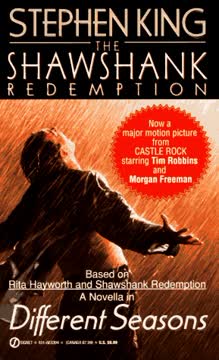

Plot Summary
The Banker Who Wouldn't Break
Red,2 a convicted murderer serving three life sentences at Shawshank State Prison in Maine, has spent decades as the prison's fixer — the man who can get anything for a price. In 1948, a new inmate arrives: Andy Dufresne,1 a thirty-year-old Portland bank vice-president convicted of shooting his wife and her lover, a golf pro named Glenn Quentin, four bullets each.
The evidence was overwhelming — a recently purchased .38, threatening words at a bar, his car at the scene. Andy1 testified with icy calm that he'd gotten drunk, driven to the bungalow, sat in a turnout smoking and drinking, then gone home without entering.
He claimed he'd thrown the gun in the river the day before. The jury didn't believe him. His composure, which might have been his greatest asset in banking, became his worst liability in court.
A Tool for Six Hundred Years
That summer, Andy1 approached Red2 in the exercise yard with the ease of a man conducting business. He wanted a rock-hammer — about a foot long, one end sharp, the other flat. He said he was a rockhound, and to prove it he sifted yard dirt through his fingers, identifying quartz, mica, shale, and limestone with a geologist's fluency.
Red2 judged the tool harmless — it would take six hundred years to tunnel through a wall with it — and arranged delivery for ten dollars. A few months later Andy1 requested something else: a large poster of Rita Hayworth for his cell wall, blushing like a teenager about the ask.
Red2 obliged without questions. The following Sunday Andy1 walked the yard with a fat lip and a scraped cheek, collecting pebbles that vanished up his sleeve.
Bogs Diamond Backs Down
From his first week, a gang led by Bogs Diamond5 targeted Andy1 for sexual assault. Andy1 fought every time, earning worse beatings and stretches in solitary. When four of them cornered him behind the laundry washers, the result was gang rape.
When Bogs5 later tried to force oral sex at razorpoint, Andy1 calmly explained that a serious brain injury causes the victim to bite down with force requiring a crowbar to pry open. Bogs5 beat him savagely but never followed through.
Then one morning in June, Bogs5 was found in his cell with three broken ribs, a hemorrhaged eye, and a dislocated hip. He never named his attackers. Red2 suspected Andy1 had used some of the five hundred dollars he'd smuggled into prison to pay a guard to unlock the cell for hired muscle. Bogs5 left everyone alone after that.
Three Beers on the Roof
In May 1950, Andy1 joined a crew resurfacing the license-plate factory roof. Guard Byron Hadley,4 the meanest screw in Shawshank, spent the morning griping about taxes on a thirty-five-thousand-dollar inheritance from a dead brother.
Andy1 set down his tar brush, walked over, and asked Hadley4 if he trusted his wife. Two guards moved to throw him off the roof. With his feet near the edge, Andy1 explained that the IRS allowed a one-time tax-free gift to a spouse of up to sixty thousand dollars.
He offered to file the paperwork — his only price, three beers for each man on the crew. The next afternoon, ten convicts sat in spring sunshine drinking warm Black Label beer. For twenty minutes they felt like free men. Andy1 sat in the shade, watching them and smiling.
The Prison's Pet Banker
Word spread. Within a year Andy1 was advising guards on investments, setting up trust funds, and preparing tax returns. He replaced old librarian Brooks Hatlen7 — paroled at sixty-eight after decades inside, Brooks7 lasted barely six months in the free world.
Andy1 transformed a small paint-closet into the best prison library in New England, writing weekly letters to the state senate that went ignored for six years before yielding a two-hundred-dollar check. He doubled his efforts and the funding grew. But his real value was darker.
As wardens came and went — each more corrupt than the last — Andy1 processed their rivers of illicit income from kickbacks, prison labor schemes, and pill trafficking. When the pious, Bible-quoting Samuel Norton3 became warden, the library became Andy's1 leash: Norton3 could threaten to dismantle it whenever Andy1 showed independence.
The Cellmate Who Knew
Tommy Williams,6 a twenty-seven-year-old career thief, arrived in late 1962 and began studying for his GED under Andy's1 guidance. When a fellow inmate recounted Andy's1 conviction over the laundry mangle, Tommy6 went white and stopped the machine mid-cycle.
Four years earlier in a Rhode Island prison, his cellmate Elwood Blatch8 — a volatile, mostly bald burglar with deep-set green eyes — had bragged about killing a golf pro and the woman he was with, laughing that some other man went to prison for it. The golf pro's name was Glenn Quentin.
When Tommy6 brought this to Andy,1 the most self-possessed man Red2 had ever known came undone. Andy1 remembered someone matching Blatch's8 description working at the country club marina in 1947. For the first time in fifteen years, he had evidence his innocence was more than a claim.
Norton Buries the Truth
Andy1 took Tommy's6 story to Warden Norton,3 his voice shaking for the first time anyone could remember. Norton3 dismissed it as a young inmate's wishful invention and sent Andy1 to twenty days of solitary for pressing the matter.
When Andy1 finally secured a second meeting months later, Norton's3 answer was surgical: he had already transferred Tommy6 to a comfortable minimum-security facility, clearly buying his silence with furlough privileges. Norton3 told Andy1 that he liked him right where he was, that men like Andy1 needed to learn humility.
When Andy1 threatened to end all financial services — the tax shelters, the laundering, everything — Norton3 countered with annihilation: the library gutted, his single cell revoked, guard protection withdrawn. Another thirty days in solitary followed. The cage had locked tighter than ever.
Zihuatanejo and Peter Stevens
Andy's1 spirit went dark for four years — grey crept into his hair, his faint smile vanished, his eyes drifted to middle distance where men count sentences served. Then the 1967 Red Sox pennant race caught something inside him.
That October, sitting against the yard wall in warm sunshine, Andy1 told Red2 about Zihuatanejo, a small Mexican town on the Pacific where he planned to run a hotel. Before his arrest, a friend had created a false identity — Peter Stevens — with birth certificate, driver's license, and investments now worth over three hundred seventy thousand dollars.
The key to a safety deposit box at a Portland bank sat under a piece of black volcanic glass in a rock wall in Buxton. Andy1 invited Red2 to join him someday. Red2 said he was too institutionalized to survive outside.
Five Hundred Yards of Darkness
On March 12, 1975, the morning head-count in Cellblock 5 came up one short. Andy's1 cell was empty — cot unslept in, his favorite polished rocks gone from the windowsill. That evening, a furious Warden Norton3 ripped the Linda Ronstadt poster from the wall and found a ragged hole bored through four feet of soft Depression-era concrete.
Andy1 had begun chipping in 1949, hiding his tunnel behind a succession of pinup posters, scattering pulverized concrete from his pant legs during yard walks.
He descended a narrow pipe-shaft between the walls, broke into a sewer main with his worn-out rock-hammer, and crawled five hundred yards through raw sewage to a creek beyond the prison. His uniform turned up two miles away. Nothing else did. Three months later Norton3 resigned, broken. That September, Red2 received a blank postcard from McNary, Texas — right on the Mexican border.
The Rock in the Hayfield
Red2 was paroled in 1977 after thirty-eight years. The outside world overwhelmed him — its speed, its noise, the terrifying freedom of bathroom breaks no longer scheduled by a guard. Working as a bag-boy in a Portland grocery store, he fought daily urges to steal something small enough to get sent back where life made sense.
But Andy's1 decades of patient chipping held him like a compass needle. On weekends, Red2 hitchhiked to Buxton, searching hayfields for a stone wall facing north. On April 23rd he found it — the black volcanic glass with no earthly business in a Maine field.
Beneath it lay a waterproof envelope in Andy's1 handwriting, containing twenty fifty-dollar bills and a letter inviting Red2 to Zihuatanejo. Andy1 wrote that hope might be the finest thing a person could carry, and nothing truly good could ever be lost.
Epilogue
Red2 sits in a cheap Portland hotel room, technically a fugitive — parole violation. He has his manuscript, one small bag, and the remainder of Andy's1 money. Outside the unbarred window, the city roars with a hugeness that still frightens him.
He decides that life always comes down to the same fork: start living, or start dying. He plans to buy two shots of Jack Daniels — one for himself, one for Andy1 — then board a Greyhound to El Paso and cross the border at McNary, the same town printed on the blank postcard.
After nearly four decades behind walls, the uncertainty of a free man's journey terrifies him. But for the first time, the terror feels like something worth having. He hopes Andy1 is down there. He hopes the Pacific is as blue as it has been in his dreams.
Analysis
King's novella examines the paradox that the most dangerous prison is internal. Andy's1 conviction is the obvious cage, but nearly every character inhabits a self-made cell. Norton3 is trapped by sanctimonious greed, Hadley4 by bottomless ingratitude, Brooks7 by decades of institutional dependence that make freedom lethal. Red's2 cell survives his sentence — even after parole, his bladder obeys the prison schedule, his reflexes genuflect before authority.
What distinguishes Andy1 is not intelligence or patience, though both are formidable. It is his refusal to accept prison's most seductive offer: the comfort of diminished expectation. The story maps this refusal across three scales of time — geological (ice ages and tectonic pressure, Andy's1 hobby), institutional (wardens rising and falling, parole hearings denied), and intimate (a man chipping concrete behind a swimsuit poster, night after night). King collapses all three into one proposition: pressure and time can destroy, but applied with intention, they can also liberate.
The false identity of Peter Stevens poses a question the novella leaves deliberately open. If selfhood is constructed from documents and legal standing, then Andy Dufresne1 — convicted murderer — genuinely ceases to exist when Peter Stevens walks free. The escape is not merely physical but ontological: Andy1 unmakes one self and assembles another from components cached across the landscape. Red's2 pilgrimage through Buxton's hayfields mirrors this process — a man defined entirely by his institutional role searching for a new identity beneath a piece of volcanic glass.
The novella's most important structural decision is giving the final word to Red2 rather than Andy.1 Andy's1 escape is spectacular, but Red's2 choice to follow is the harder victory. Andy1 fled documented injustice with a plan decades in the making; Red2 must overcome the more insidious enemy of his own thorough accommodation to captivity. The story's ultimate argument is that hope without action is merely decoration on a cell wall, but hope enacted — even clumsily, even years too late — constitutes the only redemption worth the name.
Review Summary
The Shawshank Redemption receives high praise from readers, with many considering it one of King's best works. Reviewers appreciate the character development, themes of hope and friendship, and the compelling prison escape plot. Some find it even better than the acclaimed film adaptation. The novella's gripping narrative and emotional depth resonate strongly with readers. Many recommend it as an excellent introduction to King's non-horror writing. The collection "Different Seasons" also garners positive feedback, with other stories like "Apt Pupil" and "The Body" receiving notable mentions.
People Also Read

Characters
Andy Dufresne
Imprisoned banker, wrongly convictedA Portland bank vice-president convicted of murdering his wife and her lover — a crime he insists he did not commit. Small, neat, with gold-rimmed spectacles and immaculately kept nails, Andy carries himself with a self-possession that unnerves guards and inmates alike. His calm is not apathy but armor: beneath it lies a geologist's patience and a strategist's mind. Where other men deteriorate into institutional submission, Andy maintains an inner sovereignty that Red2 describes as wearing freedom like an invisible coat. His relationships begin as deliberate transactions — earning protection through financial expertise — but deepen over decades into genuine bonds with Red2. What drives Andy is not mere survival but the refusal to let imprisonment define him, channeling intellect into reshaping his environment while privately nursing something far more ambitious.
Red
Prison fixer and narratorShawshank's fixer and the story's narrator, serving three life sentences for the murder of his wife — a crime he freely admits committing. Irish, shrewd, and self-aware, Red has built a small empire of contraband and favors that grants him status within prison walls. His psychological landscape is shaped by institutionalization: after decades inside, he has internalized prison rhythms so deeply that freedom itself becomes terrifying. He recognizes in Andy1 something he has lost — an inner autonomy that confinement cannot erode. Red's bond with Andy1 is the central relationship: part admiration, part envy, part genuine friendship. His narrative voice carries the authority of a man who distinguishes clearly between the stories inmates tell themselves and the truths they bury.
Warden Norton
Bible-quoting corrupt wardenSamuel Norton, Shawshank's warden from the early 1960s, presents himself as a devout Baptist with scripture for every occasion and a wall sampler promising divine judgment. Beneath the piety runs the prison's most profitable corruption scheme: his 'Inside-Out' prison labor program generates kickbacks from terrified construction companies while Andy's1 expertise launders the proceeds. Norton's cruelty is not impulsive but theological — he believes men like Andy1 need humility, and he appoints himself the instrument of that lesson. Power, for Norton, requires that those beneath him acknowledge their complete dependency.
Byron Hadley
Shawshank's most brutal guardThe longest-serving guard at Shawshank, Hadley is a tall, sunburned man who communicates primarily through threats and his billy club. Perpetually ungrateful — he spends an entire morning complaining about inheriting thirty-five thousand dollars — Hadley embodies brute institutional power incapable of recognizing its own absurdity. His willingness to accept Andy's1 tax advice on the rooftop marks the turning point where Andy's1 intelligence begins reshaping his prison life and earning the protection that the institution itself refused to provide.
Bogs Diamond
Leader of prison rapist gangLeader of the 'sisters,' Shawshank's predatory group of sexual predators who target vulnerable inmates. Bogs is a long-timer who carries a pearl-handled razor engraved with his name and takes pleasure in domination through force. He singles out Andy1 from his first days, misreading quiet composure as vulnerability — a dangerous assumption in a place where power operates through currencies he cannot fathom. His cruelty is not strategic but instinctual, the behavior of a predator who has never encountered prey that thinks several moves ahead.
Tommy Williams
Young thief with crucial testimonyA twenty-seven-year-old career thief from Massachusetts who arrives at Shawshank in 1962. Married with a young son, Tommy begins studying for his GED under Andy's1 guidance and develops genuine affection for his tutor. His significance lies not in his own criminal history but in what a former cellmate once boasted about — information that could prove Andy's1 innocence but that powerful men have every reason to suppress. Tommy is impulsive and not especially bright, but his honesty and loyalty make him dangerous to those invested in maintaining the status quo.
Brooks Hatlen
Shawshank's aging librarianShawshank's elderly head librarian since the late 1920s, imprisoned for murder. A college-educated man who has become a person of quiet importance within prison walls, Brooks embodies the devastating psychological cost of decades spent inside an institution — what happens when the familiar cage becomes the only home a man can recognize.
Elwood Blatch
The actual killerA volatile, mostly bald burglar with deep-set green eyes who confessed to Tommy Williams6 about killing a golf pro and the woman with him. Never appearing directly in the narrative, Blatch exists as a ghost who haunts Andy's1 case — proof of innocence that remains frustratingly beyond legal reach.
Normaden
Andy's brief cellmateA large, quiet Passamaquoddy briefly assigned to Andy's1 cell. Soft-spoken and observant, he notices oddities about the cell that others overlook, making his brief residence more significant in retrospect than anyone realizes at the time.
Greg Stammas
Cold-eyed predecessor wardenA brutal warden who succeeds the ineffectual Dunahy and runs Shawshank as a living hell through the 1950s. His close partnership with Byron Hadley4 deepens the prison's corruption and establishes the pattern of exploiting Andy's1 financial skills.
Plot Devices
The Rock-Hammer
Hobby tool turned escape instrumentA miniature pickaxe about a foot long, with a sharp pick on one end and a flat hammerhead on the other. Andy1 requests it from Red2 in 1948, claiming interest in geology. Red2 estimates it would take six hundred years to tunnel through a wall with such a tool and considers it harmless. For years, Andy1 uses it openly to shape and polish stones from the exercise yard, creating small sculptures he gives as gifts. Wrapped in polishing cloths to muffle sound, the hammer also chips away at the soft concrete behind Andy's cell poster — work that consumes two hammers over twenty-seven years. The tool that seemed laughably inadequate for escape becomes, through inhuman patience, exactly adequate. It finally breaks open the sewer pipe that leads to freedom.
The Poster Series
Concealment and symbol of freedomBeginning with a large pinup of Rita Hayworth in 1949, Andy1 maintains a succession of posters on his cell wall for twenty-six years — Marilyn Monroe, Jayne Mansfield, Raquel Welch, and finally Linda Ronstadt. Each hangs in the exact same spot above his bunk. When Red2 asks what they mean, Andy1 says they represent freedom — the feeling you could almost step through the picture and be on the other side. The posters become part of Andy's1 legend, dismissed by guards as a harmless inmate quirk. In reality, each one covers the steadily growing tunnel Andy1 chips through the concrete behind it. When Warden Norton3 tears down the final poster in a rage, the gaping hole behind it reveals just how literally Andy1 meant those words about stepping through.
The Peter Stevens Identity
Financial vehicle for a second lifeBefore Andy's1 trial concluded, his close friend Jim created a complete false identity — Peter Stevens — with a Social Security card, Maine driver's license, and birth certificate. Jim invested Andy's1 pre-trial savings under this name beginning in 1950, and by the mid-1970s the portfolio has grown to over three hundred seventy thousand dollars. The identity documents rest in a safety deposit box at Portland's Casco Bank, with yearly rental maintained by Jim's former law firm even after Jim's death. Peter Stevens is Andy's1 contingency plan — a parallel life sealed in a vault, inaccessible from inside prison but fully functional on the outside. The cruel paradox is that Andy1 cannot touch this fortune without first being free, and cannot use it to buy his freedom.
The Volcanic Glass Rock
Key hidden beneath a stoneA piece of black volcanic glass that once served as a paperweight on Andy's1 office desk. His friend Jim placed it in a stone wall at the north end of a hayfield in Buxton, Maine, with the key to the Peter Stevens safety deposit box hidden underneath. The rock's volcanic origin makes it conspicuously foreign among Maine's granite and shale — findable for anyone who knows to look, invisible to anyone who doesn't. Andy1 tells Red2 about it years before using it, transforming the stone into both a practical instrument and a test of faith. When Red2 eventually searches for it after parole, the hunt through Buxton's hayfields becomes a pilgrimage that reshapes his relationship to freedom and purpose.
The Sewer Pipe
Final passage beneath prison wallsA thirty-three-year-old porcelain sewer main with a two-foot bore, serving the fourteen toilets of Cellblock 5. It runs five hundred yards from beneath the cellblock to a creek on the marshy side of the prison, beyond the outer wall. Andy1 breaks into it after descending the pipe-shaft between the cellblock's inner and outer walls. The pipe is the last in Shawshank not connected to the new waste-treatment plant, scheduled for hookup in August 1975 — creating a hard deadline Andy1 cannot have missed. The crawl through five hundred yards of raw sewage in near-total darkness, with rats and the possibility of a mesh screen at the far end, represents the story's most visceral image of what freedom actually costs.
FAQ
Synopsis & Basic Details
What is The Shawshank Redemption: Different Seasons about?
- Wrongful imprisonment and hope: The novella centers on Andy Dufresne, a banker wrongly convicted of murdering his wife, and his life inside Shawshank Penitentiary.
- Friendship and survival: It explores his unlikely friendship with Red, a fellow inmate, and their shared experiences navigating the brutal realities of prison life.
- A meticulous escape plan: While enduring hardship and corruption, Andy secretly plans and executes a daring escape, symbolizing the triumph of hope and perseverance.
Why should I read The Shawshank Redemption: Different Seasons?
- Triumph of the spirit: The story celebrates the resilience of the human spirit in the face of overwhelming adversity, offering an inspiring message of hope.
- Exploration of friendship: It delves into the profound impact of friendship and human connection in the most desolate of circumstances.
- Critique of the system: The novella provides a compelling critique of the prison system and its dehumanizing effects, prompting reflection on justice and redemption.
What is the background of The Shawshank Redemption: Different Seasons?
- Post-WWII America setting: The story is set in post-World War II America, reflecting the social and economic landscape of the time, including the conservative nature of New England banking.
- Maine's prison system: The narrative provides a glimpse into the workings of the Maine prison system during the mid-20th century, highlighting its harsh conditions and corruption.
- Cultural context of crime: The story touches on the cultural context of crime and punishment, reflecting societal attitudes towards justice, rehabilitation, and the death penalty (or lack thereof in Maine).
What are the most memorable quotes in The Shawshank Redemption: Different Seasons?
- "I find I am excited...": Red's closing lines encapsulate the transformative power of hope and the anticipation of a new beginning, highlighting the story's central theme. "I find I am excited, so excited I can hardly hold the pencil in my trembling hand."
- "Get busy living or...": This quote, though not explicitly stated in the novella, is implied and embodies the core message of choosing hope and action over despair.
- "Some birds are not...": Red's reflection on Andy's spirit captures the essence of his character and the injustice of his imprisonment, emphasizing the value of freedom. "Some birds are not meant to be caged, that's all. Their feathers are too bright, their songs too sweet and wild."
What writing style, narrative choices, and literary techniques does Stephen King use?
- First-person narration: The story is told from Red's perspective, providing an intimate and subjective view of Andy's character and the events within Shawshank.
- Realistic and gritty prose: King employs a realistic and gritty writing style, capturing the harsh realities of prison life with vivid descriptions and authentic dialogue.
- Symbolism and allegory: The novella utilizes symbolism and allegory to explore deeper themes of hope, redemption, and the human spirit, with elements like the rock-hammer and posters representing freedom and perseverance.
Hidden Details & Subtle Connections
What are some minor details that add significant meaning?
- Andy's clean fingernails: This seemingly insignificant detail underscores Andy's meticulous nature and his refusal to succumb to the squalor of prison life, symbolizing his inner strength. "His fingernails were always clipped, and they were always clean. That's a funny thing to remember about a man, I suppose, but it seems to sum Andy up for me."
- The volcanic glass: The specific type of rock Andy leaves for Red connects to Andy's geological interests and symbolizes the unique, out-of-place nature of hope within the bleak prison environment.
- The Brooks Hatlen story: The tragic fate of Brooks Hatlen, the former librarian, foreshadows the challenges of reintegration into society after long-term imprisonment, highlighting the theme of institutionalization.
What are some subtle foreshadowing and callbacks?
- Early mention of Rita Hayworth: Red's initial description of being able to procure almost anything foreshadows his later role in obtaining the posters that conceal Andy's escape. "when Andy Dufresne came to me in 1949 and asked if I could smuggle Rita Hayworth into the prison for him, I said it would be no problem at all. And it wasn't."
- Normaden's comment about cold: The seemingly throwaway line about Andy's cell being cold foreshadows the tunnel and the damp conditions Andy endures during his escape. "He don't let nobody touch his things. That's okay. Nice man, never make fun. But big draught."
- Red's initial skepticism: Red's initial skepticism about Andy's innocence and his chances of survival in prison makes his eventual belief in Andy and his decision to seek him out in Zihuatanejo all the more powerful.
What are some unexpected character connections?
- Andy and Byron Hadley: Their unlikely connection, born from Andy's financial advice, highlights the corruptibility of the prison system and the transactional nature of relationships within it.
- Tommy Williams and Elwood Blatch: The connection between Tommy and the actual murderer, Elwood Blatch, reveals the arbitrary nature of justice and the potential for redemption, even within the prison walls.
- Red and Brooks Hatlen: Both Red and Brooks experience institutionalization, but Red's eventual decision to seek out Andy contrasts with Brooks' tragic inability to adapt to life outside of prison.
Who are the most significant supporting characters?
- Ernie, the trusty: Ernie's role in delivering contraband and messages highlights the informal networks and hidden economies that operate within the prison, facilitating both corruption and acts of kindness.
- Normaden, the cellmate: Normaden's brief presence in Andy's cell and his observation about the cold foreshadow the tunnel and the isolation Andy maintains, emphasizing his unwavering focus on escape.
- Jim, the friend: Jim's actions in setting up Andy's false identity demonstrate the power of loyalty and friendship, providing Andy with the means to achieve freedom and a new life.
Psychological, Emotional, & Relational Analysis
What are some unspoken motivations of the characters?
- Andy's need for control: Beyond simply escaping, Andy's meticulous planning and execution of his escape suggest a deep-seated need to regain control over his life after being unjustly stripped of it.
- Red's desire for redemption: Red's initial cynicism masks a longing for redemption and a belief in the possibility of change, which is ultimately awakened by Andy's unwavering hope.
- Norton's fear of exposure: Warden Norton's extreme actions to suppress Andy's potential exoneration stem from a deep-seated fear that Andy's freedom would expose his own corruption and abuse of power.
What psychological complexities do the characters exhibit?
- Andy's stoicism: Andy's seemingly unwavering composure masks a deep well of suppressed emotions and a constant struggle to maintain hope in the face of despair.
- Red's institutionalization: Red's internal conflict between his desire for freedom and his fear of the outside world reflects the psychological impact of long-term imprisonment and the challenges of reintegration.
- Norton's hypocrisy: Norton's use of religion as a facade for his corrupt actions reveals a complex psychological profile characterized by self-deception and a distorted sense of morality.
What are the major emotional turning points?
- Tommy's story: The revelation of Tommy's story is a major turning point for Andy, reigniting his hope for exoneration and setting in motion the events that lead to his escape.
- Norton's rejection: Norton's refusal to help Andy and his subsequent actions to suppress the truth mark a turning point in Andy's strategy, shifting his focus from seeking justice to planning his escape.
- Red's parole: Red's parole is a bittersweet moment, filled with both hope and fear, as he confronts the challenges of adapting to a world he no longer understands.
How do relationship dynamics evolve?
- Andy and Red's bond: Their relationship evolves from a transactional arrangement to a deep friendship based on mutual respect, shared experiences, and a shared belief in the power of hope.
- Andy and Norton's power dynamic: The power dynamic between Andy and Norton shifts over time, with Andy gradually gaining influence through his financial skills, ultimately leading to Norton's downfall.
- Red and the prison community: Red's role as the "man who can get it" establishes him as a central figure in the prison community, but his relationship with Andy transforms him from a cynical procurer to a hopeful seeker of freedom.
Interpretation & Debate
Which parts of the story remain ambiguous or open-ended?
- Andy's true feelings: The extent of Andy's emotional turmoil and his internal struggles to maintain hope remain somewhat ambiguous, leaving room for interpretation about the true cost of his imprisonment.
- The details of Andy's financial schemes: The specifics of Andy's money laundering activities and the extent of Norton's corruption are left somewhat vague, allowing readers to imagine the full scope of their illicit dealings.
- Red's future in Zihuatanejo: The story ends with Red on his way to Mexico, but his ultimate fate and his reunion with Andy are left to the reader's imagination, emphasizing the power of hope and the uncertainty of the future.
What are some debatable, controversial scenes or moments in The Shawshank Redemption: Different Seasons?
- Andy's financial dealings: The morality of Andy's involvement in money laundering and other illicit activities is debatable, raising questions about whether the ends justify the means.
- Norton's motivations: The extent to which Norton is driven by greed versus a genuine belief in maintaining order and control within the prison system is open to interpretation.
- The portrayal of prison violence: The graphic depiction of prison violence, particularly the sexual assaults, can be controversial, raising questions about the story's sensitivity and its potential to perpetuate harmful stereotypes.
The Shawshank Redemption: Different Seasons Ending Explained: How It Ends & What It Means
- Triumph of hope and perseverance: The ending signifies the ultimate triumph of hope and perseverance over adversity, as Andy achieves his long-sought freedom and Red finds the courage to pursue his own.
- Redemption and second chances: Red's decision to break parole and seek out Andy in Zihuatanejo symbolizes the possibility of redemption and second chances, even for those who have made mistakes in the past.
- The enduring power of friendship: The ending underscores the enduring power of friendship and human connection, as Andy and Red's bond transcends the walls of Shawshank and inspires them to create a new life together.
About the Author


Download PDF
Download EPUB
.epub digital book format is ideal for reading ebooks on phones, tablets, and e-readers.








































