Key Takeaways
1. Embrace Impossible Goals with Urgent Timelines
A goal properly set is halfway reached.
Redefine achievement. Most leaders aim for attainable goals, expecting exponential results, which often leads to complexity and stagnation. An "impossible goal" is one you don't initially know how to reach, demanding radically new approaches and redefining your company's capabilities. This forces innovation over imitation, compelling you to think, operate, and execute differently.
Filter for signal. Impossible goals act as a razor-sharp filter, immediately highlighting that most of your current activities are distractions or "optimizing things that should not exist." Alicia Ault, for instance, shifted from a linear goal of 100 clients to an impossible 1,000 clients in 90 days for her software, LevelUp Score. This forced her to abandon cold calling and seek a strategic partnership with a larger software company, instantly scaling her user base from 10 to over 8,000.
Psychological leverage. These audacious targets, coupled with urgent deadlines, create powerful emotional reasons that pull you through challenges. They shift your attention from old routines to novel, creative solutions, forcing a level of honesty and rigor that attainable goals simply cannot. This mindset is the DNA of scaling, transforming businesses and lives by demanding strategic audacity.
2. Raise Your Floor: Ruthlessly Eliminate the Non-Essential
It doesn’t matter what you’re supposed “potential” is, if you don’t raise your floor, it’s all in vain.
Define your standard. Your "floor" represents the minimum acceptable standard of performance and what you refuse to do. A low floor, like Zion Williamson's inconsistent availability despite immense talent, means you're tolerating distractions and behaviors that contradict your highest potential. To scale, you must strip out everything that no longer fits, even if it once served you.
Confront self-deception. Many entrepreneurs fail to scale because they lie to themselves about their performance, trajectory, and the consequences of their actions. They justify maintaining "a mess of pottage"—lesser commitments, unproductive habits, or misaligned clients—at the expense of their true "birthright" or destiny. Raising your floor means confronting these truths and making uncomfortable, often unpopular, decisions.
Consistency over potential. The difference between an amateur and a professional lies not in their ceiling, but in their floor. A professional practices until they "can't do it wrong," maintaining a consistently high baseline. Raising your floor means elevating this standard across your entire system, increasing accountability and transparency, and saying "no" to anything that dilutes your focus or compromises your commitment to excellence.
3. Simplify Your System: Cut the "Elephant" of Complexity
Simplicity enables change.
Complexity hinders growth. All systems naturally tend towards complexity, creating an "elephant" of existing processes, products, or commitments that become difficult to manage or change. When Steve Jobs returned to Apple, he cut 350 products down to 10, transforming a $1 billion loss into a $309 million profit in a year. You cannot scale a complex system with multiple competing goals; it leads to stagnation and diluted impact.
Unentangle your business. Simplicity, derived from the Latin "simplex" (one fold), means your system can stand and be understood on its own, free from interwoven components. This requires rigorous work and emotional courage to strip down your business further than you think necessary. For example, CellCore, a supplement company, simplified its many offerings into a single, scalable "Protocol," leading to a 10x revenue increase in one year and a $200 million sale.
Focus for leverage. To achieve 10x to 100x growth, you must eliminate most of what you're currently doing. This means letting go of products, services, or client segments that, while perhaps profitable, do not align with your impossible goal. Chad Willardson, a wealth manager, sold off 100 smaller clients to focus on his top 50, immediately attracting a new client with a billion-dollar portfolio. This radical simplification creates clarity and makes your business a magnet for aligned, high-leverage opportunities.
4. Cultivate Radical Honesty and Accountability
All progress starts by telling the truth.
Truth as a superpower. Scaling demands an unwavering commitment to reality, no matter how harsh. As rapper 50 Cent noted, "Reality is my drug. The more I have of it, the more power I get." This capacity to see events exactly as they are, without self-deception or justification, is the foundation for effective strategy and rapid response.
Accountability drives culture. In organizations, culture and the "floor" are synonymous—they represent the agreed-upon level of transparency and accountability. Kim Crawford Goodman, CEO of Smarsh, transformed the company from near breakeven to $100 million in annual profits by making aggressive cuts, renegotiating client terms, and instilling a culture of high performance. She was willing to disappoint to be clear and world-class.
Filter faster, quit quicker. Radical honesty extends to decision-making. Professional poker players, unlike amateurs, are "fast folders," quickly discarding bad hands to avoid escalation of commitment and sunk-cost bias. Blake Erickson, as a missionary, filtered potential converts in 30 seconds, refusing to invest time in those unready for commitment. This ability to quickly identify and quit dead-end paths is crucial for accelerating growth and preventing wasted resources.
5. Engineer a Focused Path and Revolutionary Model
If we want to compete. . . . If we want to steal customers from Chase Bank, Wells Fargo, American Express, I want to be able to go to that customer and offer them that same $1 million line of credit that Chase Bank is offering, and then a powerful suite of software that is just loaded, that they can’t ignore.
Unique solutions for unique problems. A focused path isn't about doing what everyone else does; it's about identifying a critical problem and building a powerful, scalable solution that cuts through the noise. Blake Murray, co-founder of Divvy, realized businesses lacked real-time financial data. His solution: offer robust software for free, funded by credit card companies, a revolutionary model that disrupted the industry.
Conviction fuels execution. Murray and his co-founder, Alex Bean, didn't just have an idea; they had profound conviction. They secured a seven-figure deal with a major bank with only a slide deck, leveraging their belief in their "no-brainer" offer. This conviction, rooted in a deep understanding of the problem and a unique business model, allowed them to scale Divvy from $7 million to over $150 million in revenue in just three years, leading to a $2.5 billion acquisition.
Simplicity in delivery. Even the most brilliant solution won't scale if its delivery is complex or confusing. Divvy maintained a singular focus on its core product, resisting distractions. Their success stemmed from making their offering so clear and compelling that it was "loaded, that they can’t ignore." This laser-like focus on one product, delivered through a simple, revolutionary model, enabled their explosive growth.
6. Leverage Super Whos and Strategic Partnerships
The bigger the dream, the more important to the team.
The power of 100x talent. Scaling aggressively requires "Super Whos"—individuals who are 10 to 100 times more productive than average. Bill Gates noted that Microsoft's top 20 people were essential to its existence, and Netflix CEO Reed Hastings prioritizes hiring one "rock star" over a dozen adequate performers, recognizing their exponential value. These individuals elevate expectations and create "slack" or margin for error within the system.
Elevate your ecosystem. Bringing on Super Whos changes the entire environment, raising the floor for everyone involved. Just as Jimmy Butler's arrival transformed the Golden State Warriors, a truly leveraged partner can dramatically shift team dynamics and performance. However, Super Whos demand a world-class environment; they won't work for average leaders or in cultures that tolerate mediocrity.
Strategic alliances for impossible goals. Achieving truly impossible goals often requires partnerships that provide unique leverage—resources, connections, or capabilities you don't possess. Elon Musk's audacious goal of colonizing Mars led him to acquire Twitter and strategically engage in U.S. politics, ultimately aligning with a presidential candidate who publicly supported his space ambitions. This controversial move, driven by his "Mars" frame, created an unexpected pathway to massive funding and governmental support, demonstrating how leveraged partners can move the world.
7. Build a Business That Scales Beyond Your Personal Involvement
If I say good bye, the nation learns to move on; It outlives me when I’m gone.
Beyond the "king or queen." For a business to truly scale, it cannot be solely dependent on its founder or a single individual. George Washington's decision to step down as president, allowing the nation to "outlive" him, exemplifies this principle. If you are the bottleneck, your business will be limited by your capacity, preventing it from attracting the world-class talent and teamwork needed for aggressive growth.
Impact over ego. True transformational leaders are more committed to the impact, purpose, and growth of their vision than to their personal role within it. This requires a willingness to empower others, delegate authority, and build robust systems that can operate effectively without constant oversight. It means letting go of the need to be the "centerpiece" and instead focusing on creating a self-sustaining, scalable entity.
Attract and empower. To scale beyond yourself, you must attract Super Whos who are just as committed to the mission as you are, and then empower them to lead. This often means being willing to share ownership, credit, and control. The Scaling.com origin story highlights this: the founder brought in co-authors and a CEO, investing in their success and leveraging their unique talents to build a company designed for massive, collective impact.
8. Understand Time as a Strategic Tool, Not a Linear Constraint
If a timeline is long, it’s wrong.
Future dictates present. The common linear model of time, where the past dictates the present and future, is psychologically inaccurate. Instead, time is holistic, with the future being the primary driver of present decisions and actions. Our goals, as representations of our desired future, act as powerful filters, shaping what we see as relevant and irrelevant in the here and now.
Aggressive deadlines accelerate focus. Long, arbitrary timelines (like a 10-year vision) often justify procrastination and allow for the "optimization of things that shouldn't exist." Parkinson's Law states that work expands to fill the available time. By contrast, an "impossible deadline" forces extreme filtering, stripping out false requirements and compelling you to identify and solve the "crux"—the core bottleneck—much faster.
Unlocking readiness. Deadlines, though uncomfortable, are potent levers for increasing "readiness to change." They create a heightened awareness of consequences, forcing individuals and organizations to stop wasting energy on noise and distractions. Richard Bryan, for example, compressed an 11-year goal into a 1-year timeline, forcing him to sell his existing business and fully commit to his true passions, dramatically accelerating his life's trajectory.
9. Strategy is Defined by What You Choose Not to Do
The essence of strategy is choosing what not to do.
Focus through elimination. True strategy is not about setting priorities, which is easy, but about setting "posteriorities"—deciding what tasks not to tackle and sticking to that decision. Most businesses are diluted by trying to optimize several things, which effectively means optimizing for none. Warren Buffett famously stated, "Diversification is protection against ignorance. It makes little sense if you know what you are doing."
Cut the noise. An impossible goal, coupled with an urgent timeline, forces you to make hard choices. It reveals the "hundred other good ideas" that, while potentially good, are distractions from your singular objective. Lewis Howes, a successful entrepreneur, dramatically scaled his podcast from 30 million to 500 million downloads by saying "no" to 17 other income streams and focusing relentlessly on that one channel.
The courage to pivot. Successful companies often get disrupted not because they're doing a bad job, but because they consciously choose not to pivot away from their existing, profitable models, even when they see the future coming. This "cannibalization" of existing business is painful but essential for next-level scaling. Stephanie, a CEO, realized her family's legacy product, though successful, couldn't scale to hundreds of millions. Her impossible goal forced her to consider selling it off to focus entirely on a new, scalable service model.
Review Summary
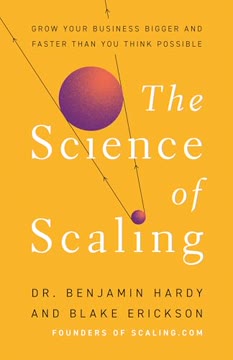
The Science of Scaling receives mixed reviews, averaging 3.91/5. Fans praise its identity-first framework for exponential growth, particularly the "Frame–Floor–Focus" model, and appreciate how it reframes scaling as a learning opportunity. Critics, however, find it abstract, light on practical mechanics, and overly reliant on motivational storytelling. Some note its strong resemblance to Hardy's previous work, 10x Is Easier Than 2x. The book resonates most with entrepreneurs and leadership professionals seeking mindset shifts, while those wanting actionable detail may feel underserved.
People Also Read



 Immersive