Key Takeaways
1. The Progress Paradox: Objectively Better, Subjectively Worse
Americans and Europeans have ever more of everything except happiness.
A striking disconnect. Despite unprecedented advancements in living standards, health, and freedom, Western societies are experiencing a profound paradox: people feel increasingly unhappy and stressed. Objective indicators of societal well-being have consistently trended upward for two generations, yet subjective measures of happiness remain flat, and clinical depression rates have skyrocketed. This suggests a fundamental disconnect between material progress and emotional fulfillment.
Rising discontent. The percentage of Americans describing themselves as "happy" has not changed since the 1950s, even as real income more than doubled. More alarmingly, the proportion of "very happy" individuals has declined, while "unipolar" depression—a sustained state of sadness without specific cause—is now ten times more prevalent than half a century ago. This widespread melancholy, even amidst plenty, points to a deeper societal issue beyond mere material deprivation.
A unique challenge. Our ancestors, grappling with scarcity and hardship, could only dream of the comfort and security we now possess. Yet, this very abundance seems to have created new forms of dissatisfaction. The challenge for modern Western societies is not merely to continue accumulating wealth, but to understand why this accumulation fails to translate into greater joy, and how to cultivate contentment in an era of unprecedented prosperity.
2. Western Life: A Utopia Unappreciated by Its Inhabitants
All told, except for the clamor and speed of society, and for trends in popular music, your great-great-grandparents might say the contemporary United States is the realization of utopia.
Historical marvel. If our great-great-grandparents were to witness modern Western life, they would be astonished by its utopian qualities. Unlimited, affordable food, a near-doubling of lifespan to 77 years, the eradication of historical plagues like polio and smallpox, and the end of backbreaking physical toil for most are just a few examples. These advancements represent the fulfillment of ancient quests for banishing privation and establishing a Golden Age.
Convergence of living standards. The gap between the rich and the average person has dramatically narrowed. Luxuries once exclusive to a minuscule elite—such as homeownership, multiple cars, leisure travel, higher education, and advanced healthcare—are now commonplace for the middle class. This convergence means that the basic structure of daily life for most Westerners is fundamentally similar to that of the wealthy, a historical first.
Unacknowledged blessings. Despite these profound improvements, a majority of Americans tell pollsters the country is declining and their children face a worse future. This "Fallacy of the Golden Age" leads people to romanticize past eras, overlooking their inherent hardships and prejudices, while failing to appreciate the historically favored circumstances of the present. We live in a favored age, yet do not feel favored.
3. The Media and Elites: Profiting from Perpetual Pessimism
Alarmism and anger are good to the pocketbooks of advocates of all ideological stripes; consensus and optimism are bad for business.
The gloom industry. A significant reason for widespread pessimism is the active preference for bad news among various "gloom interest groups." Fundraisers, politicians, and certain intellectual elites benefit financially and socially by exaggerating negative trends and denying positive developments. This dynamic creates a constant barrage of crisis-talk, even when objective indicators show improvement.
Media's negative bias. News organizations, driven by incentives to capture attention, frequently inflate problems into "crises" and focus obsessively on rare, speculative dangers. This "headline-amplified anxiety" distorts public perception, making people believe that:
- Crime is rampant, despite significant declines.
- Environmental conditions are worsening, despite decades of improvement.
- Small, one-in-a-million risks are pervasive threats.
This selective reporting creates a false portrait of society, fostering a sense of peril and tragedy.
Elite disdain for progress. Many intellectuals and academics, influenced by pessimistic philosophies like Freud's or Spengler's "Decline of the West," often embrace narratives of societal decay. They find depressing news validating and optimistic trends suspicious, contributing to a cultural milieu where acknowledging progress is seen as naive or even contemptible. This elite preference for negativity disproportionately shapes public discourse, further fueling general discontent.
4. The Tyranny of Abundance: More Choices, Less Contentment
The distinction between needs and wants is lost.
The paradox of choice. In Western societies, the sheer volume of available goods and services, coupled with an ever-expanding array of choices, paradoxically leads to dissatisfaction. Consumers are overwhelmed by trivial decisions, leading to "choice anxiety" and a constant sense of regret over not having made the "optimal" purchase. This endless pursuit of more, even when basic needs are abundantly met, creates a state of perpetual restlessness.
Materialism's empty promise. The contemporary Western lifestyle encourages "immoderate" consumption, from cosmetic surgeries to $75,000 custom roses, and even portable carpeted dog steps. While these indulgences are often harmless in themselves, they fail to deliver lasting happiness. The "revenge of the plastic" means that credit cards can buy unhappiness by fostering debt and the illusion that possessions will bring joy, a promise they consistently fail to keep.
The "tyranny of the unnecessary." As prosperity grows, the line between needs and wants blurs, with wants often becoming perceived as necessities. This leads to "ten-hammer syndrome"—buying duplicates of items already owned—and a constant need for more storage space, as homes become crammed with unneeded possessions. This relentless acquisition, often fueled by "call-and-raise-the-Joneses" status anxiety and easy debt, creates financial stress and a sense of being controlled by one's belongings, rather than finding contentment.
5. Evolution's Design: Wired for Stress, Not Happiness
We are built to be effective animals, not happy ones.
Survival of the fretful. Evolutionary psychology suggests that our ancestors who were uneasy, distrustful, and prone to assuming the worst were more likely to survive and reproduce. This "stress response," mediated by hormones like cortisol, heightened awareness and improved physical performance, making them "effective animals." Consequently, modern humans may be born with a genetic predisposition for discontentment, as it was a successful survival strategy in the primordial past.
Modern stress triggers. While ancient stresses involved predators and famine, today's anxieties are amplified by constant exposure to global bad news and conjectured threats. This "conservation of anxiety" means that even as objective dangers decline, our minds find new, often minor, things to worry about. The clamor and pace of modern life, coupled with poor sleep, diet, and exercise habits, continuously program our bodies to produce more stress hormones, leading to increased prevalence of anxiety and depression.
The "choice penalty." Rising freedom and choice, while objectively positive, can also contribute to unhappiness. In a world of seemingly limitless options, personal setbacks or rejections become inescapably personal failures, rather than outcomes of societal constraints. This "choice penalty" can be particularly acute for women, who have only recently gained extensive control over their lives and now bear the full psychological weight of their decisions, leading to higher rates of depression.
6. The Quest for Meaning: Beyond Material Wants
A transition from material want to meaning want is in progress on an historically unprecedented scale—involving hundreds of millions of people—and may eventually be recognized as a principal cultural development of our age.
The unslaked craving. As Western societies achieve widespread material prosperity, a new form of hunger emerges: "meaning want." People, having acquired homes, cars, and countless possessions, find themselves with an "unslaked craving for transcendence"—a desire for deeper connections, purpose, and spiritual fulfillment that material goods cannot provide. This shift represents a profound cultural development, as hundreds of millions seek significance beyond consumption.
The emptiness of nihilism. Coinciding with rising prosperity, modern intellectual thought, popular entertainment, and media often promote nihilistic messages, proclaiming life to be meaningless or a "cosmic accident." This pervasive negativism, exemplified by thinkers like Jacques Monod and Steven Weinberg (despite his qualifier about love), subtly programs individuals to believe their lives lack consequence. This intellectual fad directly impedes happiness and fulfillment, as a sense of purpose is crucial for well-being.
A new awakening. Despite declining adherence to formal religion in some Western nations, there is a rising interest in spiritual issues. This suggests that as people realize the hollowness of pure materialism, they seek deeper meaning. This "post-materialism" phase, predicted by scholars like Ronald Inglehart and Robert Fogel, could lead to a "Great Awakening" of spiritual concerns, where purpose is valued more than possessions. Finding meaning, whether through faith or philosophy, is a harder challenge than acquiring wealth, but essential for true contentment.
7. Selfish Virtues: Forgiveness and Gratitude for Personal Well-being
Forgiveness is good not just for the person forgiven, but for the person who forgives.
The power of forgiveness. Positive psychology research reveals that forgiveness, often seen as a purely altruistic act, is profoundly beneficial for the forgiver. Studies show that those who adopt a forgiving attitude experience:
- Fewer stress-related disorders
- Stronger immune systems
- Better cardiovascular health
- Lower rates of divorce
- Fewer episodes of clinical depression
- Better social support and friendships
This suggests that holding onto grievances harms oneself more than the perceived wrongdoer, making forgiveness a self-interested virtue.
The benefits of gratitude. Similarly, cultivating a grateful attitude towards life significantly enhances personal well-being. People who regularly count their blessings, rather than inventorying complaints, tend to have:
- Higher vitality and optimism
- Less stress and anxiety about status or possessions
- Fewer episodes of clinical depression
- Better physical health and more regular exercise
Keeping a "gratitude journal" has been shown to improve these outcomes, demonstrating that actively practicing thankfulness can transform one's outlook and overall life satisfaction.
Wisdom and well-being. Research indicates that older people are more likely to forgive and exhibit gratitude, correlating with their generally higher sense of well-being compared to the young. This suggests that these virtues are forms of wisdom acquired through life experience. By embracing forgiveness and gratitude, individuals can counter the pervasive cultural encouragement of complaint and victimhood, leading to a healthier, happier, and more successful life, regardless of external circumstances.
8. Systemic Flaws: Unaddressed Poverty, Healthcare, and Corporate Greed
America cannot enjoy a clear conscience until it provides health coverage to all, pays a living wage to those at the bottom, and devises a system in which corporate leadership is not based on deceit and greed.
Healthcare scandal. A major structural fault in the United States is the lack of universal health insurance, with about 41 million Americans uninsured and millions more underinsured. While immigration contributes to these numbers, the failure of a prosperous and compassionate society to ensure all its members are protected against the financial ruin of illness or injury is a moral outrage. This violates the principle of equal opportunity, as health crises can cripple those without coverage, hindering their ability to compete.
Persistent poverty. Despite immense national wealth, one in six Americans lives in poverty, and many more experience "money anguish"—a constant fear that a minor setback could lead to destitution. The federal minimum wage of $5.15 an hour means a full-time worker can still be impoverished, a condition that is inexcusable in the world's most affluent nation. Raising the minimum wage to a "living wage" of at least $10 an hour, or significantly expanding the Earned Income Tax Credit, would directly reward hard work and alleviate suffering.
Corporate avarice. The third deep fault is rampant greed at the top of corporations, where executives like Kenneth Lay and L. Dennis Kozlowski have pocketed hundreds of millions through deceit, "rent extraction," and outright fraud, often at the expense of employees and shareholders. This "corporate stealing" violates the free-market principle of Pareto Efficiency, where wealth should not be acquired by harming others. Such lack of character among business leaders taints American prosperity and demands systemic reform to restore integrity and justice.
9. Global Imperative: The West's Moral Duty to End Despair
The nations of the West should take on as their next historic challenge the defeat of global despair.
Developing world progress. Despite widespread hardship, the developing world has seen significant progress: rising incomes, increasing literacy, lengthening lifespans, and expanding democracy. The percentage of people living on $1.08 a day has declined from 37.4% in 1985 to 13.1% in 2000, and global hunger deaths have fallen by two-thirds in 20 years. This guarded optimism suggests that global despair is not an intractable problem, but one that can be overcome with concerted effort.
Western responsibility. The West, particularly the United States, possesses unprecedented wealth, power, and security. Having successfully defeated fascism and communism, its next historic challenge should be to end global despair. This is a moral imperative, as much has been given to these nations, and much is expected. It also offers a profound sense of purpose and fulfillment to Western citizens who often feel a lack of meaning despite their prosperity.
Actionable solutions. Ending global poverty is achievable and surprisingly affordable. The West must:
- Reject the false notion that foreign aid has failed; it has saved tens of millions of lives.
- Increase foreign aid, which currently stands at a mere 0.1% of U.S. GDP.
- Lower trade barriers against developing-world goods, allowing poor nations to earn their way out of poverty.
- Invest in basic needs: clean water, electricity, and Green Revolution agriculture for Africa.
Providing an extra 29 cents a day to the 455 million most destitute people would cost $48 billion annually—a fraction of Western military or agricultural subsidies.
10. The Power of Choice: It's Never Too Late to Change Our World
Endlessly experience teaches that we need not accept what we see out the window; we can make the view one of our choosing.
Utopia within reach. While a perfect utopia may remain elusive, a "semi-utopia" where everyone in the West, and perhaps globally, enjoys material security, long healthy lives, and peace is not out of the question for future generations. The arrow of progress points towards ever-better lives, driven by economic, medical, and technological advancements. This vision, though perhaps still accompanied by complaints, is a testament to humanity's capacity for improvement.
The illusion of insolubility. Many problems once deemed "impossible" or "unsolvable"—such as pollution, crime, indigent old age, and the Cold War—have been significantly reduced or eliminated within our lifetimes. This historical pattern demonstrates that seemingly intractable dilemmas can be overcome, often more rapidly and at lower cost than anticipated. The "unsolvable" problems of today, like global destitution or greenhouse gases, are simply those we have not yet committed to solving.
A call to action. It is within our power to shape the future. By rejecting the pervasive negativism and meaninglessness promoted by some cultural forces, and by embracing a hopeful, purposeful view of the human prospect, we can foster both individual happiness and collective progress. The West has the resources and the moral obligation to address its internal flaws and to help alleviate global despair. Choosing to act on these challenges will not only create a better world but also provide the profound sense of fulfillment that so many prosperous Westerners currently lack.
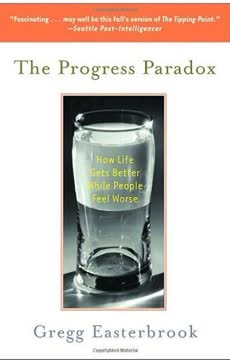
Review Summary
The Progress Paradox receives mixed reviews, averaging 3.63/5. Readers appreciate Easterbrook's core thesis—that life has objectively improved by most measures, yet happiness remains stagnant—but criticize the book's repetitiveness, length, and occasionally unsupported claims. Many note it hasn't aged well since its 2003 publication. Positive reviewers value insights on gratitude, forgiveness, and positive psychology. Critics find the political prescriptions disconnected from the main thesis and take issue with the author's condescending tone and oversimplified economic arguments.
People Also Read






 Immersive