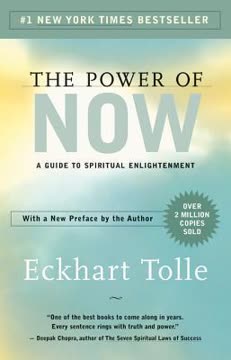

Key Takeaways
Most of your thinking is useless — and it's destroying your life
“Many people live with a tormentor in their head that continuously attacks and punishes them and drains them of vital energy.”
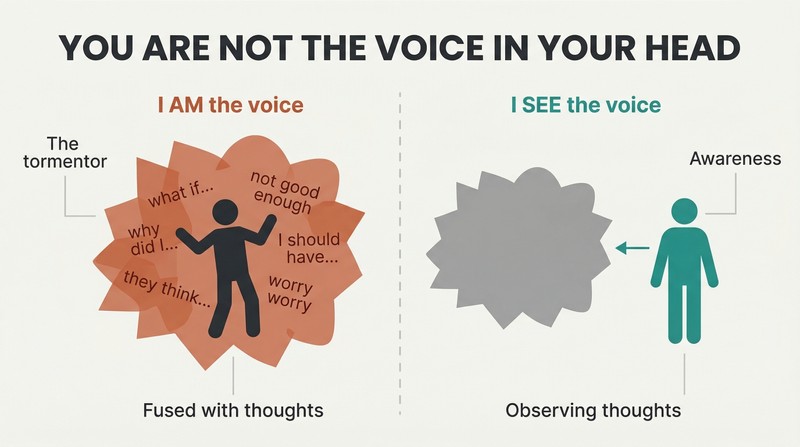
Tolle argues most people are thinking addicts. The voice in your head — commenting, judging, worrying, replaying conversations — runs nearly nonstop. You wouldn't accept hearing literal voices, yet this internal monologue is considered normal simply because everyone does it. The critical insight: you believe you ARE this voice, but you're actually the awareness behind it.
The mind is a superb tool — until it takes over. Tolle compares compulsive thinking to cells multiplying out of control — a disease of consciousness. The mind is brilliant for practical tasks, but left unchecked it creates unnecessary suffering, drains vital energy, and generates a false self (what Tolle calls the ego). The good news: the instant you notice the voice, you've already created distance from it. That noticing is the first crack in the prison wall.
The present moment is literally all that exists
“Nothing ever happened in the past; it happened in the Now.”
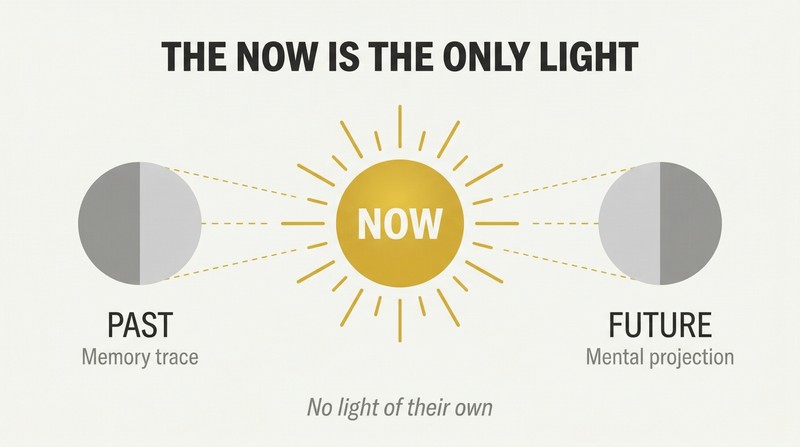
Past and future have no independent reality. The past is a memory trace activated now. The future is a mental projection imagined now. Just as the moon has no light of its own but reflects the sun, past and future borrow all their reality from the present. This is the book's central thesis: the Now is not one moment among many — it is the only moment there ever is.
This isn't just philosophy — it's testable. During life-threatening emergencies, people report extraordinary clarity because danger forces total present-moment awareness. The personality dissolves, time stops, and something vastly more intelligent takes over. Tolle says you don't need to climb mountains for this. Walking stairs or washing hands with complete attention opens the same door.
Watch your thoughts like a cat at a mouse hole
“The beginning of freedom is the realization that you are not the possessing entity — the thinker.”
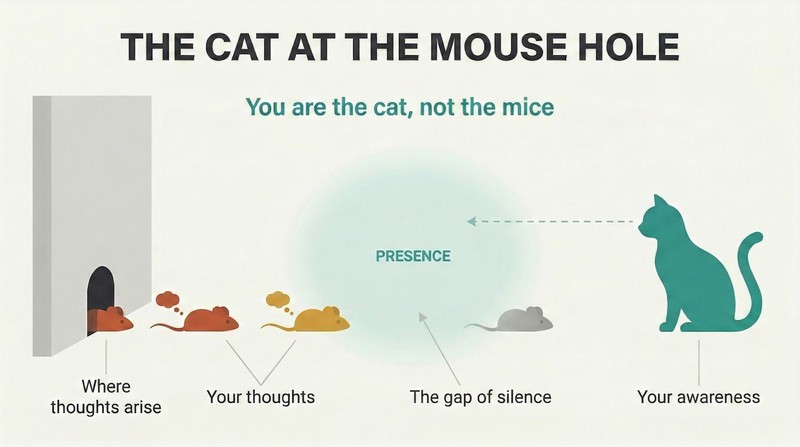
Tolle's foundational practice works like this: observe your own thoughts without judging them. Listen to the internal monologue as an impartial witness. The instant you do, something shifts — there's the voice, and here you are watching it. This realization comes from beyond the mind itself. Tolle calls this watching the thinker.
Try his experiment now. Close your eyes and think: "I wonder what my next thought is going to be." Then wait alertly. You'll notice a gap of silence before the next thought arrives. In that gap — what Zen calls no-mind — you taste what Tolle calls presence: pure consciousness, free of mental noise. Tolle discovered this accidentally: suicidal at 29, the thought "I cannot live with myself" revealed there must be two selves — and one was fictional.
Your old emotional pain is a parasite that feeds on more pain
“The pain-body wants to survive, just like every other entity in existence, and it can only survive if it gets you to unconsciously identify with it.”
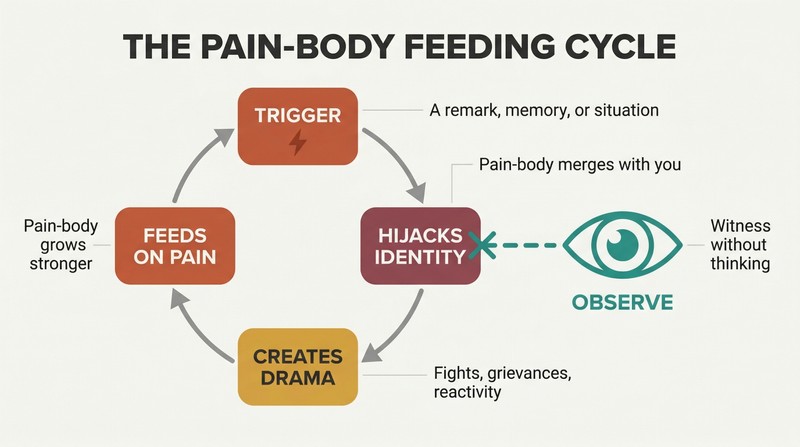
The pain-body is Tolle's most original concept — the accumulated residue of emotional pain from your past that lodges in body and mind. Everyone carries one, built from childhood wounds, cultural trauma, and life's inevitable hurts. It has two modes: dormant and active. When triggered by a partner's remark, a familiar situation, or even a stray thought, it awakens and hungers for more suffering.
Its survival strategy is hijacking your identity. Once you identify with the pain-body, it "becomes" you: you pick fights, replay grievances, create drama. The antidote is deceptively simple — observe it without thinking about it. Feel the raw energy directly in your body. The moment you watch as a witness rather than merge with it, the identification breaks. Consciousness transmutes the pain like fire transforming wood.
Anxiety is too much future; guilt is too much past
“You can always cope with the present moment, but you cannot cope with something that is only a mind projection — you cannot cope with the future.”
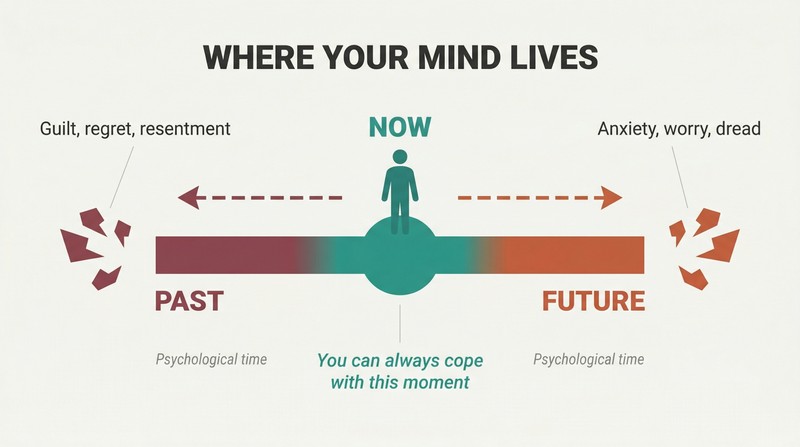
Tolle draws a sharp line between two kinds of time. Clock time is practical and necessary: making appointments, learning from mistakes, planning a trip. Psychological time is compulsive: reliving the past or projecting into the future as a substitute for actually living. One serves you; the other enslaves you.
Every form of fear points forward. You can handle any genuine crisis right now, but you cannot handle a catastrophe that exists only in your imagination. In real emergencies, people rarely freeze — they act. It's the anticipation that paralyzes. Conversely, guilt, resentment, and regret all point backward — replaying events that already happened. Tolle's prescription: use clock time when needed, then snap back to now. If "learning from a mistake" becomes "dwelling on a mistake," you've crossed the line.
Your 'life situation' has problems; your life, right now, does not
“When you are full of problems, there is no room for anything new to enter, no room for a solution.”
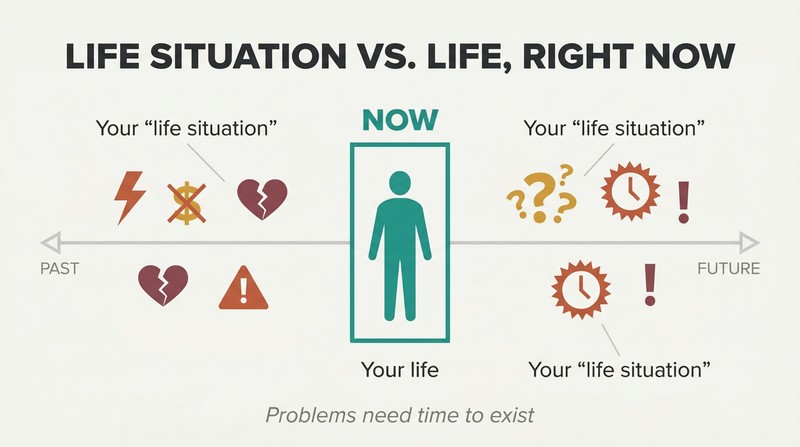
This is one of Tolle's most practical distinctions. Your "life situation" includes your job, finances, health history, and relationship status — it exists in time and can be messy. Your "life" is what's happening right this instant, and it is always manageable. Problems need time to survive; they cannot exist in the actuality of the Now.
Test it for yourself. Ask: do I have a problem at this moment? Not tomorrow, not in ten minutes — right now. Usually the honest answer is no. You're sitting, breathing, reading. The problems are mental constructs projected into a timeline. Tolle doesn't say ignore your circumstances — he says stop confusing them with your existence. Handle situations as they arise, but recognize that this breath, this heartbeat, is already whole.
Surrender to what is, then act — always in that order
“Surrender is the simple but profound wisdom of yielding to rather than opposing the flow of life.”
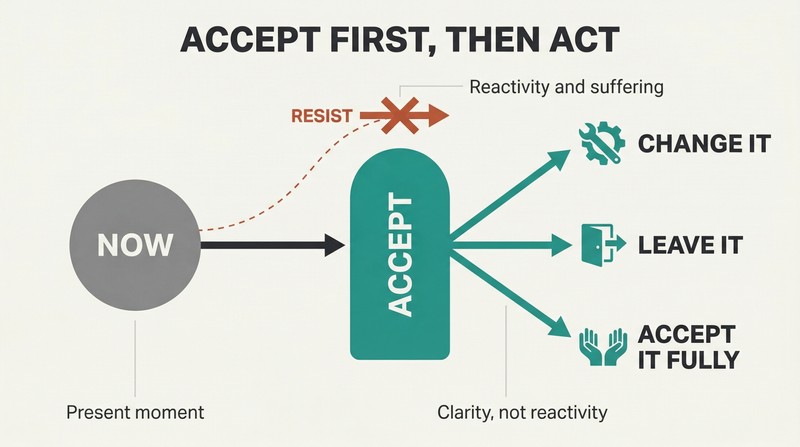
Surrender is not defeat or passivity — it's radical acceptance of this instant without mental resistance. You can still change your circumstances, but you start from acceptance rather than opposition. If you're stuck in mud, you don't "accept being stuck forever." You accept the present second without adding emotional suffering, then take action to get out.
Tolle offers three practical options for any situation:
1. Change it by taking action
2. Remove yourself entirely
3. Accept it completely — drop all inner resistance
Anything else — complaining, resenting, passive-aggressively enduring — Tolle calls madness. Action flowing from acceptance is what he terms surrendered action: vastly more effective than effort contaminated by negativity, because it arises from clarity rather than reactivity.
Happiness depends on external conditions; inner peace does not
“Joy is uncaused and arises from within as the joy of Being.”
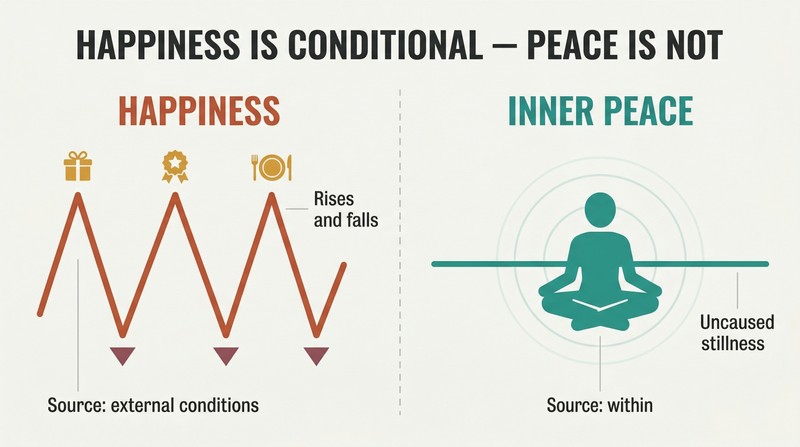
Tolle insists most people chase the wrong target. Happiness is conditional, temporary, and has a built-in opposite. Inner peace is unconditional. You can feel it even when a loved one dies or your own death approaches. Sadness may be there, tears may flow, but underneath — a deep stillness.
Pleasure versus joy reveals the gap. Pleasure comes from something outside — a meal, a purchase, a compliment — and invariably turns to pain when the source disappears. Joy arises uncaused from within, from what Tolle calls Being. The Buddha called even happiness dukkha — unsatisfactoriness — because it's inseparable from its opposite. Only when you stop seeking fulfillment through conditions do things paradoxically tend to improve. True prosperity, Tolle argues, is gratitude for what already is.
Relationships exist to make you conscious, not happy
“Real love doesn't make you suffer… It doesn't suddenly turn into hate, nor does real joy turn into pain.”
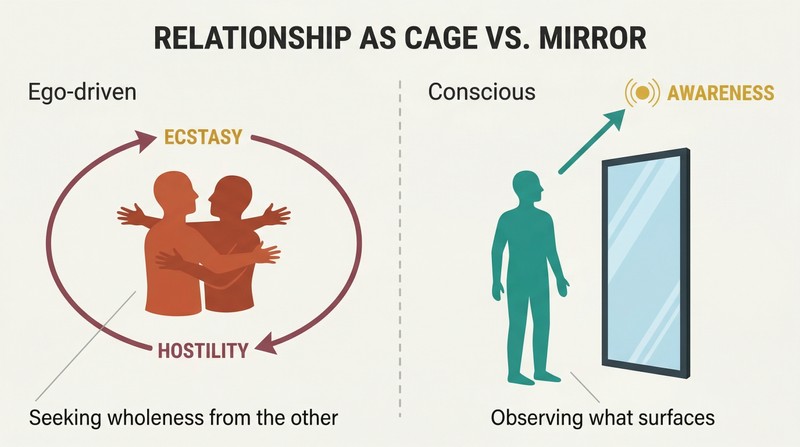
Most romantic relationships oscillate between ecstasy and hostility because they're ego-driven — two incomplete selves trying to feel whole through each other. When the other person fills the void, you're on a high. When they stop filling it, you project your pain outward. The "love" that can flip to hatred overnight was never real love — it was addictive clinging masquerading as connection.
Tolle's reframe is radical. Instead of chasing the ideal partner, use whatever relationship you're in as a mirror. When it triggers anger, jealousy, or the need to control, that's accumulated pain surfacing — the pain-body activated. Don't blame your partner; observe the reaction inside yourself. Tolle calls this using the relationship as sadhana — spiritual practice. The unconsciousness it exposes is the raw material for awakening.
Feel your body from within to escape the prison of thought
“If the master is not present in the house, all kinds of shady characters will take up residence there.”
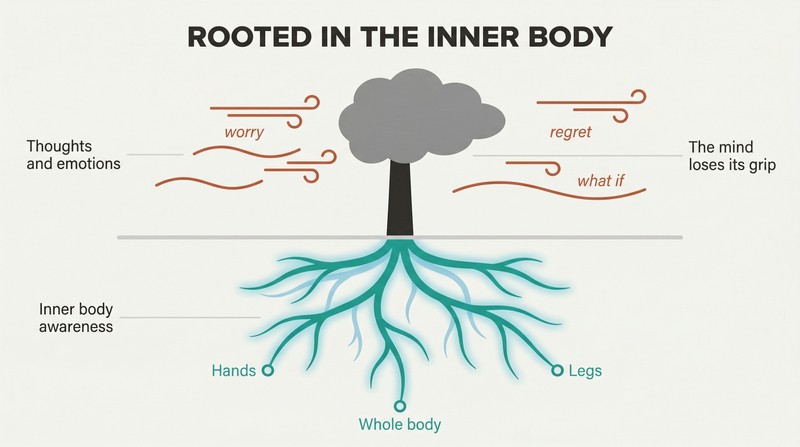
Tolle's most concrete daily practice is directing attention to the energy field inside your body — what he calls the inner body. Start small: can you feel your hands alive without touching anything? Gradually expand to arms, legs, chest, abdomen. Eventually feel the entire body as a single field of vibrant energy. This inner body is your portal to Being and your anchor in the Now.
When attention rests inside the body, the mind loses its grip. Tolle recommends practicing during idle moments: waiting in lines, sitting in traffic, lying in bed before sleep. Over time, this awareness becomes a continuous background presence — like a tree with deep roots that holds steady through any storm. It transforms how you think, how you listen, and how you relate to others.
Analysis
The Power of Now occupies a distinctive position in the self-help canon. Published in 1997, it synthesizes Buddhism, Advaita Vedanta, Christian mysticism, and Taoism into a single framework centered on present-moment awareness. What distinguishes it from earlier spiritual texts is its Western accessibility — Tolle translates nondual philosophy into cognitive-behavioral language that resonates with therapeutic culture.
The core argument is deceptively simple: all suffering arises from identification with thought, and the remedy is noticing the gap between awareness and thinking. This maps closely to what clinical psychology later formalized as cognitive defusion in Acceptance and Commitment Therapy and decentering in Mindfulness-Based Cognitive Therapy. Tolle arrived at these insights experientially, but decades of neuroscience research have validated the mechanisms: rumination predicts depression, future-oriented worry predicts anxiety, and present-moment awareness reliably reduces both.
The pain-body is Tolle's most original contribution — the idea that emotional pain accumulates into a semi-autonomous energy field that actively seeks more suffering. While the metaphysics invite skepticism, the behavioral pattern is clinically well-documented: people with trauma histories frequently recreate painful dynamics in precisely the way Tolle describes. The concept also helpfully reifies abstract emotional patterns into something concrete and observable, giving readers a practical handle on what might otherwise feel overwhelming.
The book's repetitive, circling structure frustrates analytical readers but mirrors the meditative process it advocates. Tolle isn't trying to add information to your mind — he's trying to create gaps in it. The Q&A format brilliantly anticipates ego objections and neutralizes them in real time. Where the text shows its age is in occasional gender essentialism and somewhat uncritical spiritual universalism. But its foundational insight — that you are not the voice in your head, and recognizing this changes everything — remains as practically useful as any finding in modern psychology. Few books generate such polarized responses — dismissed as mystical hand-waving by some, credited with saving lives by others — which itself suggests Tolle struck a genuine nerve.
Review Summary
The Power of Now by Eckhart Tolle receives mixed reviews. Some readers find it life-changing, praising its focus on living in the present moment and spiritual awakening. They appreciate Tolle's insights on mindfulness and letting go of past and future concerns. However, critics argue the book is repetitive, vague, and filled with pseudo-spiritual jargon. Some find Tolle's tone condescending and his concepts difficult to apply in real life. Despite the polarizing opinions, many readers acknowledge the book's core message about presence and self-awareness as valuable.
People Also Read
Glossary
Pain-body
Accumulated emotional pain entityTolle's term for the residue of emotional pain from one's personal and collective past that lodges in the body and mind as a semi-autonomous energy field. It has dormant and active states. When triggered, it hijacks a person's thinking and behavior, creating drama and seeking more pain to feed on. It dissolves when observed with sustained conscious attention.
Psychological time
Compulsive past-future mental dwellingTolle's term for the habit of living through memory and anticipation rather than in the present moment. Distinguished from clock time (practical time use), psychological time creates suffering by denying the Now. It manifests as guilt and regret (past-oriented) or anxiety and worry (future-oriented), and forms the basis of the ego's sense of identity.
Clock time
Practical, necessary time usageTolle's term for the functional use of time — making appointments, learning from past experiences, setting goals, planning ahead. Unlike psychological time, clock time does not deny the present moment or create a false identity. Tolle advises using clock time for practical matters, then immediately returning to present-moment awareness.
Being
Eternal life beyond all formsTolle's central term for the eternal, ever-present One Life beyond the myriad forms subject to birth and death. It is your deepest self, accessible as the felt sense of 'I am' prior to any identity. It cannot be understood mentally, only felt when the mind is still. Roughly equivalent to what religions call God, the Tao, or Brahman, but kept deliberately neutral.
Presence
Consciousness freed from thought formsThe state of being fully, intensely aware in the Now without mental commentary or identification with thinking. Tolle describes it as what happens when Being becomes conscious of itself. It is the witnessing awareness behind thoughts and emotions, and the essential quality cultivated through all the book's practices. Presence dissolves the pain-body and renders the ego transparent.
The Unmanifested
Formless source of all existenceTolle's term for the invisible, timeless Source from which all forms arise and to which they return. It is experienced through portals such as deep inner-body awareness, conscious attention to silence and space, intense present-moment awareness, and surrender. It pervades the physical universe as space and silence but is not a thing — it is the no-thing that enables everything to exist.
Watching the thinker
Observing thoughts without identificationTolle's foundational practice of listening to the voice in your head as an impartial witness, without judging or engaging with the content. By becoming the observer of the mental stream rather than its subject, you activate a higher dimension of consciousness and create gaps of 'no-mind' — moments of stillness in which presence naturally arises.
Inner body
Felt energy field within youThe subtle energy field that pervades and animates the physical body, perceived through directed inward attention. Tolle considers it the doorway to Being and a bridge between the manifested world and the Unmanifested. Practicing inner-body awareness — feeling the body's aliveness from within — anchors attention in the Now and weakens the grip of compulsive thinking.
FAQ
What's "The Power of Now" about?
- Core Message: "The Power of Now" by Eckhart Tolle is a guide to spiritual enlightenment, emphasizing the importance of living in the present moment. It teaches that true peace and happiness can only be found by focusing on the Now, rather than being caught up in past regrets or future anxieties.
- Mindfulness and Presence: The book explores how being present and mindful can help individuals transcend their ego and connect with their true essence, which Tolle refers to as "Being."
- Spiritual Awakening: Tolle synthesizes teachings from various spiritual traditions, including Buddhism and Christianity, to present a universal path to enlightenment that is accessible to everyone.
Why should I read "The Power of Now"?
- Transformative Potential: The book has the potential to change your life by helping you break free from the dominance of your mind and ego, leading to a more peaceful and fulfilling existence.
- Practical Guidance: Tolle provides practical advice and exercises to help readers become more present and aware, making the teachings applicable to everyday life.
- Universal Appeal: The teachings are not tied to any specific religion, making them accessible to a wide audience seeking spiritual growth and inner peace.
What are the key takeaways of "The Power of Now"?
- Present Moment Awareness: The primary takeaway is the importance of living in the present moment, as it is the only time that truly exists and where life unfolds.
- Ego and Mind Identification: Tolle explains that identification with the mind and ego is the root cause of suffering, and liberation comes from disidentifying with them.
- Inner Peace and Enlightenment: By practicing presence and mindfulness, individuals can access a state of inner peace and enlightenment, transcending the dualities of good and bad.
How does Eckhart Tolle define "Being" in "The Power of Now"?
- Essence of Existence: "Being" is described as the eternal, ever-present life beyond the myriad forms of life that are subject to birth and death.
- Inner Reality: It is the innermost invisible and indestructible essence within every form, accessible through presence and mindfulness.
- Beyond Thought: Being cannot be grasped by the mind; it is felt when the mind is still and attention is fully in the Now.
What is the "pain-body" according to Eckhart Tolle?
- Accumulated Pain: The pain-body is an accumulation of past emotional pain that lives in the body and mind, often triggered by certain situations or thoughts.
- Negative Energy Field: It is described as a negative energy field that occupies the body and mind, feeding on pain and perpetuating suffering.
- Transmutation through Presence: Tolle advises that by becoming present and observing the pain-body without judgment, it can be transmuted into consciousness.
How can one practice presence as suggested in "The Power of Now"?
- Inner Body Awareness: Tolle suggests focusing attention on the inner energy field of the body to anchor oneself in the present moment.
- Mindful Breathing: Conscious breathing is a powerful meditation that helps redirect attention from the mind to the body, fostering presence.
- Observing Thoughts: By watching thoughts and emotions without judgment, one can disidentify from them and cultivate a state of presence.
What role does the ego play in "The Power of Now"?
- Source of Suffering: The ego is identified as the mind-made self that creates a false sense of identity, leading to fear, conflict, and suffering.
- Illusion of Separation: It perpetuates the illusion of separation from oneself and the world, causing individuals to live in a state of fear and desire.
- Transcending the Ego: Tolle teaches that by becoming present and disidentifying from the ego, one can access true peace and enlightenment.
What are the best quotes from "The Power of Now" and what do they mean?
- "You are here to enable the divine purpose of the universe to unfold. That is how important you are!" This quote emphasizes the significance of each individual's presence and their role in the greater scheme of life.
- "The present moment is all you ever have." It highlights the central theme of the book, which is the importance of living in the Now as the only reality.
- "Realize deeply that the present moment is all you ever have. Make the Now the primary focus of your life." This quote encourages readers to prioritize the present moment over past and future concerns.
How does "The Power of Now" address relationships?
- Enlightened Relationships: Tolle suggests that relationships can be a spiritual practice when both partners are present and conscious, allowing love to flourish.
- Ego and Pain-Body Dynamics: He explains how the ego and pain-body can create dysfunction in relationships, leading to cycles of love and hate.
- Transformative Potential: By practicing presence, individuals can transform their relationships from sources of pain to opportunities for spiritual growth.
What is the significance of surrender in "The Power of Now"?
- Inner Acceptance: Surrender is about accepting the present moment unconditionally, which dissolves resistance and connects one with Being.
- Not Passivity: It is not about passivity or giving up, but about yielding to the flow of life and taking action from a place of inner peace.
- Path to Peace: Surrender is a key practice for transcending the ego and accessing the peace and joy of the present moment.
How does Eckhart Tolle suggest dealing with negative emotions?
- Awareness and Observation: Tolle advises observing negative emotions without judgment, which allows them to dissolve in the light of consciousness.
- Non-Resistance: By not resisting negative emotions, one can prevent them from turning into suffering and instead use them as a signal to become more present.
- Transmutation: Through presence and acceptance, negative emotions can be transmuted into peace and consciousness.
What impact has "The Power of Now" had on readers and the spiritual community?
- Life-Changing Effects: Many readers report profound life changes and a reduction in suffering after applying the book's teachings.
- Global Reach: The book has reached millions worldwide and is available in multiple languages, influencing diverse spiritual communities.
- Catalyst for Awakening: It is seen as a catalyst for a shift in consciousness, encouraging individuals to awaken to their true nature and live more fulfilling lives.
About the Author
Other books by Eckhart Tolle
Download PDF
Download EPUB
.epub digital book format is ideal for reading ebooks on phones, tablets, and e-readers.








































