

Key Takeaways
Chase grand slams, not doubles; venture lives by the power law
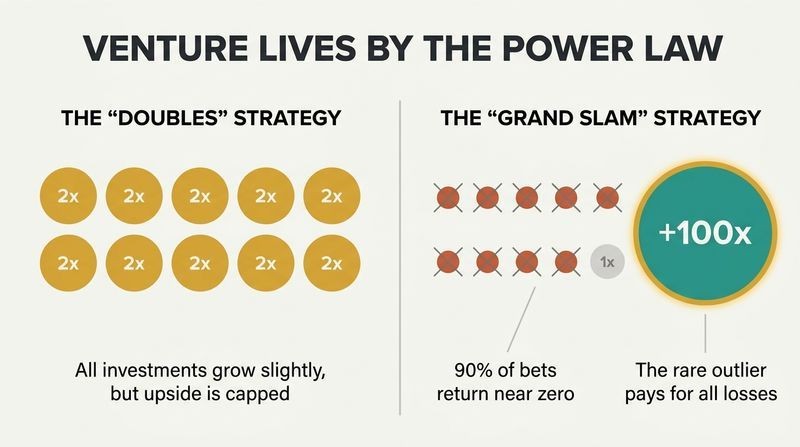
The math of venture is brutal and beautiful. Most phenomena follow a bell curve, where outcomes cluster near an average. Venture returns follow a power law instead: a tiny handful of winners generate almost all the profits. Horsley Bridge data showed that 5% of capital produced 60% of returns across 7,000 startups. Y Combinator found three-quarters of its gains came from 2 of 280 bets.
This flips normal investment logic. A stock picker celebrates a company that doubles. A venture capitalist who aims for doubles guarantees failure, because the power law produces few of them. Most startups go to zero, so the rare winners must return 10x, 100x, even 1,400x (Khosla's Juniper bet) to carry the portfolio. Owning a piece of the outlier is the only thing that matters.
What's striking is how the power law inverts intuitions honed everywhere else in finance. Nassim Taleb's work on fat tails and Clauset's research on power-law distributions in earthquakes, city sizes, and wealth confirm Mallaby's framing: these are not exotic curiosities but a recurring signature of complex systems with feedback loops. The practical danger is survivorship bias, since we only celebrate the Junipers and forget the graveyard. Yet the discipline the power law imposes is real: it forces investors to ask not "how likely is success?" but "how big if it works?" That single reframing separates venture thinking from ordinary risk management.
Fund improbable ideas; reasonable people never attempt world-changing missions
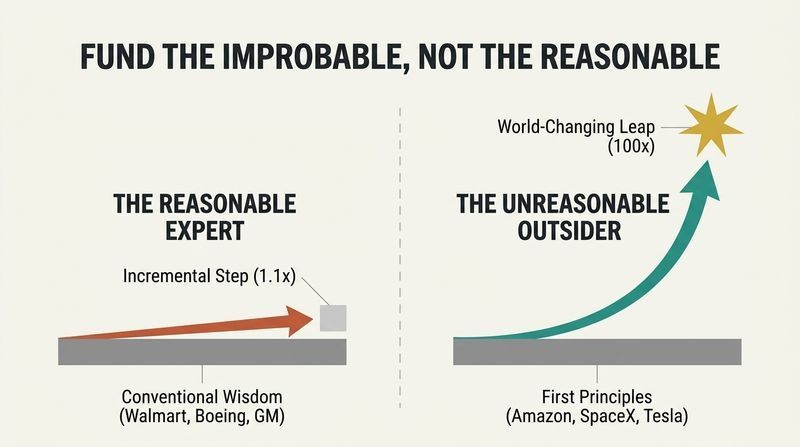
Radical bets beat incremental ones. Vinod Khosla dismisses timid ideas as "one sheet of toilet paper, not two." When geneticist Patrick Brown pitched Impossible Foods, a plant burger that bleeds and sizzles like beef, Khosla's test was not whether it would work but whether he could prove it obviously couldn't. He bet $3 million on a roughly one-in-a-hundred shot, reasoning the payout justified the odds.
Radical rethinks come from outsiders, not experts. Khosla observes that retail innovation came from Amazon, not Walmart; space from SpaceX, not Boeing; cars from Tesla, not GM. Domain experts deliver incremental advances because they are burdened by conventional wisdom. Outsiders, unencumbered by knowing what is "impossible," attack problems from first principles. The future cannot be forecast by extrapolating the past; it must be discovered through iterative, venture-backed experiments.
This romanticizes the outsider, and the record is messier than Khosla's aphorisms suggest. Thomas Kuhn argued that paradigm shifts often come from newcomers to a field, supporting the thesis. But survivorship bias lurks: for every SpaceX there are hundreds of hubristic outsiders who failed precisely because they ignored hard-won domain knowledge. Khosla's own cleantech losses illustrate the cost. The deeper truth may be that outsiders help when an industry has grown complacent and technologically ripe for disruption, not universally. The valuable, testable heuristic is his inversion: rather than proving an idea will work, try and fail to prove it cannot.
Reward talent with equity; liberated founders build the future
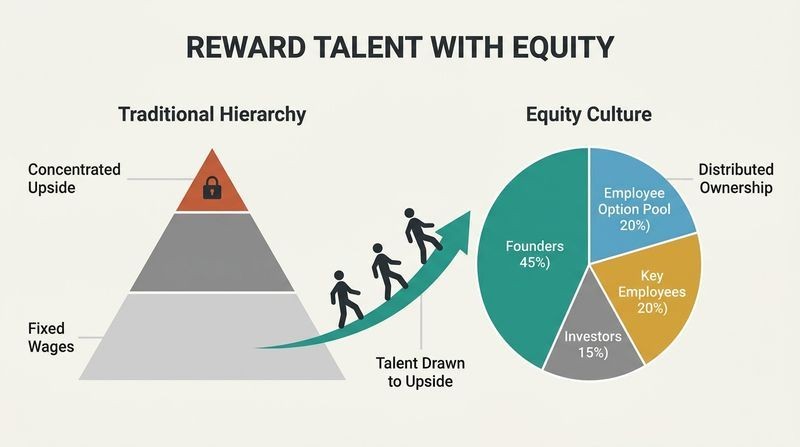
Arthur Rock invented liberation capital. In 1957 eight researchers fled the tyrannical Nobel laureate William Shockley. They only wanted a new employer. Rock, a young broker, told them to start their own company and own it. That act created Fairchild Semiconductor and the template for Silicon Valley. By 2014, 70% of publicly traded Valley tech firms traced their lineage to Fairchild.
Equity aligns everyone and lures the ambitious. Rock's later firm, Davis & Rock, gave founders roughly 45% of their startups and reserved stock for key employees. At Intel he pushed stock options for every employee, not just executives, on the principle that people who accept lower wages for a risky venture deserve the upside. This equity culture, novel in the corporate-hierarchy 1950s, became the Valley's defining engine for pulling talent out of safe jobs.
Mallaby makes a persuasive case that Silicon Valley's edge was financial and cultural, not merely technological, since the transistor, the PC, and the browser were all invented elsewhere. The equity-culture thesis dovetails with principal-agent theory in economics: ownership stakes solve the alignment problem that salaried hierarchies cannot. Ronald Coase asked why firms exist; Mallaby suggests venture networks are a third institution beyond markets and firms. One nuance worth adding: California's ban on non-compete clauses amplified this liberation by letting talent move freely. Equity without labor mobility might have been far less potent, a legal precondition the Rock story understates.
Don't just pick winners; roll up your sleeves and build them
Activism plus staged financing transformed unbackable startups. In the 1970s Don Valentine and Tom Perkins added hands-on shaping to Rock's model. Valentine backed the chaotic, hot-tub-running Atari only after writing its business plan and brokering a Sears distribution deal. He funded in stages, de-risking before committing more.
Perkins pioneered killing the "white-hot risk" cheaply. For Tandem Computers and Genentech, Perkins spent tiny sums first to resolve the single hardest technical question, then scaled up once success looked likely. At Genentech he insisted the founders contract early research to universities rather than build a lab, so failure would be cheap. His law: market risk is inversely proportional to technical risk, because solving a truly hard problem means facing few competitors. Genentech returned over 200x; without Tandem and Genentech, Kleiner's first fund would have managed 4.5x instead of 42x.
The white-hot-risk principle is essentially real-options theory applied to entrepreneurship: spend small to buy information, then exercise the option to scale only when uncertainty resolves favorably. This is intellectually elegant and echoes lean-startup methodology decades before Eric Ries named it. The activist model also raises a genuine debate the book engages honestly: do VCs create value or merely select it? Mallaby's answer, that Valentine and Perkins stamped their will on portfolios, is convincing here but should be held in tension with later evidence that the best founders need the least help. The synthesis: activism matters most for raw, chaotic, or deeply technical startups.
The network beats the genius; Silicon Valley's real advantage is connections
No single investor covered themselves in glory with Apple. Multiple VCs rejected Jobs and Wozniak. Apple got funded only because the Valley's dense web of relationships kept passing the founders along until they reached the right people. Sociologist AnnaLee Saxenian showed the Valley beat Boston not through better invention but through porous boundaries and a wealth of "weak ties" that circulated ideas faster.
Venture capitalists actively manufacture these networks. They schmooze, connect, and vouch. One investor, Bill Younger, systematically took the smartest people to lunch, asked who else he should meet, and built a web of eighty superstars. VCs broker technical alliances between portfolio companies (Kleiner's "keiretsu" model) and settle disputes to preserve trust. This connective tissue turns an agglomeration of clever people into an inventive network, explaining why some regions out-innovate others.
Saxenian's Regional Advantage and Mark Granovetter's "strength of weak ties" (one of the most cited social-science papers ever) give this thesis serious empirical spine. Economists long modeled clusters through labor-market matching, but Mallaby's insight that VCs are the deliberate cultivators of network capital is a genuine contribution. It reframes the venture capitalist not as a stock-picker but as a social infrastructure builder. A challenge: if networks are the moat, why has the model exported successfully to China, Israel, and beyond? The answer the book offers, that VCs rebuild the network wherever they go, suggests the human agent matters as much as the geography.
Bet the jockey: back people whose character survives adversity
Venture is finance without finance. Startups often have no earnings, no assets, no cash flow to model. So Rock and his heirs judged people instead. Rock skipped the financial projections and flipped to the founders' resumes, calling it buying "intellectual book value." He asked open-ended questions and waited in silence, probing for gritty realism versus wishful thinking.
Character is the strategy. Rock backed mathematician Max Palevsky partly because he radiated warmth and adaptability, reasoning that founders with managerial magic can devise a new plan if the first one fails. Survey research confirms one in five VCs don't even attempt cash-flow forecasts. The recurring question Rock asked himself: do they see things as they are, not as they wish them to be? Would they drop dinner to save the business? Judgment about humans, not spreadsheets, drove the biggest wins.
This people-first doctrine anticipates modern findings in entrepreneurship research that founder quality predicts outcomes better than initial idea quality, since pivots are common (Slack, Instagram, and PayPal all pivoted). Yet betting on character is also where cognitive bias creeps in: charisma, pattern-matching, and homophily can masquerade as judgment, which partly explains the industry's diversity deficit and disasters like Theranos, where a compelling founder fooled sophisticated people. The steelman is that in genuinely unpredictable environments, adaptable operators beat rigid plans. The caution is that "I know talent when I see it" is precisely the intuition behavioral science warns is least reliable and most self-serving.
Founder power flipped the industry; capital became a commodity
The balance of power inverted over decades. Early on, capital was scarce and investors dictated terms. By the 2000s, software startups needed little cash, and hits like Google taught founders to push back. Brin and Page forced Kleiner and Sequoia to co-invest and split a deal, something neither firm normally tolerated, then kept control via dual-class shares giving insiders ten votes per share.
Angels and youth accelerated the shift. Andy Bechtolsheim wrote Google a $100,000 check before it was even incorporated, without specifying his stake. Peter Thiel's Founders Fund vowed never to eject a founder. Paul Graham's Y Combinator batch-funded coders with tiny checks and taught them to distrust VCs, declaring "young people are just smarter." Zuckerberg showed up to a Sequoia pitch in pajamas as a deliberate insult. Founders, not financiers, increasingly held the whip hand.
This is a clean illustration of how technology shifts bargaining power. When the marginal cost of launching a software company collapsed (cloud computing, open-source, cheap distribution), the scarcest resource stopped being capital and became talented founders, so the price of capital fell and its terms softened. Hirschman's framework of exit, voice, and loyalty applies: founders gained credible exit options among competing investors, which amplified their voice. The dark side, which the WeWork and Uber sagas expose, is that founder worship plus dual-class shares can strip away the governance checks that protect employees and later investors. Empowerment and accountability turn out to be uneasy companions.
Write the giant check: growth investing let unicorns stay private
Masayoshi Son weaponized scale. In 1996 he stunned the Valley by forcing $100 million on Yahoo, telling the founders "everyone needs $100 million" and threatening to fund their rivals otherwise. His logic: in winner-take-all races, whoever writes the biggest check can choose who wins. He later raised a $98.6 billion Vision Fund.
Yuri Milner perfected the passive version. In 2009 Milner invested in Facebook at a $10 billion valuation when U.S. investors balked at half that. His edge was data: a global spreadsheet showing Facebook was under-monetized versus Russian and Chinese peers. He took no board seat and let Zuckerberg vote his shares, and he bought employee stock to solve liquidity. This growth capital let mature tech firms delay IPOs for years, creating enormous wealth privately and birthing the "unicorn" era.
Milner's move was a textbook information arbitrage: cross-country comparisons revealed mispricing invisible to parochial Valley investors, echoing how global macro hedge funds exploit differences public-market specialists miss. The structural consequence is profound and underappreciated. By letting companies stay private, growth capital shifted value creation away from public markets, meaning ordinary retail investors no longer capture the steepest part of the growth curve, a quiet driver of wealth inequality. It also suspended governance precisely when overconfident founders needed it most. Milner's founder-friendly passivity was rational for a minority investor but, aggregated across the industry, it removed the guardrails that public listings historically imposed.
America's VC playbook, not the Communist Party, built China's tech giants
China's digital economy was midwifed by U.S. finance. Alibaba, Tencent, Baidu, and the major portals all took foreign capital and adopted the American template: equity-only funds, staged financing, stock options, hands-on involvement. Goldman's Shirley Lin financed Alibaba; Son later invested $20 million that became worth $58 billion, the greatest venture bet in history.
Lawyers engineered around Chinese law. Because China banned foreign ownership of internet firms and lacked stock-option law, Valley lawyers incorporated startups in the Cayman Islands and built synthetic-equity side contracts governed by New York law. The top Chinese VCs were themselves quasi-American, educated at Columbia, Yale, and Stanford. Neil Shen ran Sequoia China and became the world's number-one investor. The lesson: China's tech rise vindicated Arthur Rock's financial model more than any state industrial policy.
This is one of the book's most geopolitically loaded claims, and it lands with force. It reframes globalization's supposed win-win: U.S. investors earned returns while China gained strategic industries, including dual-use technologies like drones (DJI) and facial recognition (SenseTime). The variable-interest-entity structure Mallaby describes is a fascinating case of institutional arbitrage, outsourcing legal infrastructure rather than building it, an idea economist Paul Romer explored with charter cities. The uncomfortable implication for policymakers is that the very openness that made American venture capital dominant also accelerated a rival. Recent Chinese crackdowns on Ma, Didi, and edtech test Mallaby's thesis that authoritarian control ultimately throttles disruptive innovation.
Skill is real: elite firms manufacture their own luck systematically
Sequoia turned serendipity into process. Critics argue venture success is path-dependent luck: early hits build reputation, which buys access to the next hits. Mallaby pushes back using Sequoia, which dominated for decades through deliberate systems. It coached young recruits, paired them with mentors, gave them early board seats, and ran behavioral-science postmortems to fight cognitive biases like risk-aversion and confirmation bias.
Infrastructure beats individual genius. Sequoia built an "early bird" web crawler tracking app-store downloads, which flagged WhatsApp before rivals noticed and generated $3.5 billion. Its scouts program recruited active founders to spot the next generation, leading to Stripe. Its stories of "lucky" bonding with founders (a rug-dealer scout for Dropbox, a bike parked outside for Stripe) were actually the fruit of engineered deal flow. Asked his favorite investment, Michael Moritz answered: "Sequoia" itself.
The luck-versus-skill debate mirrors the sports-analytics revolution: outcomes are noisy, but process quality compounds over large samples. Mallaby's rebuttal to the randomness thesis is the book's most rigorous section, marshaling both counterexamples (Tiger and Y Combinator invented genuinely novel models) and the observation that path dependency gets disrupted often (Kleiner's fall). The behavioral-science angle is especially fresh: applying Kahneman and Tversky's prospect theory to venture decisions institutionalizes what most investors leave to gut. The honest concession is that luck clearly matters at the individual deal level; Anthony Montagu snagged Apple stock almost by accident. Skill shows up in the aggregate, across many bets and many years.
Passive growth money, not classic VCs, broke unicorn governance
WeWork and Uber revealed a structural flaw. As unicorns stayed private and founders held super-voting shares, no one could discipline them. Adam Neumann granted himself ten votes per share, self-dealt by leasing his own buildings to WeWork, and burned cash while spouting fake-tech jargon. Uber's Travis Kalanick built a toxic culture, dodged regulators with a "Greyball" deception, and poured billions into an unwinnable China war.
The villains were mostly non-traditional investors. Between 2014 and 2016, over three-quarters of late-stage funding came from mutual funds, hedge funds, and sovereign wealth, not classic VCs. Benchmark's Bill Gurley provided under 1% of Uber's pre-Saudi capital yet fought Kalanick's excesses, eventually ousting him through a lawsuit and an ultimatum. Gurley's fix: take unicorns public. The IPO process forced the reckoning that broken private governance could not.
This is a crucial corrective to the lazy narrative that "venture capitalists deformed capitalism." Mallaby disaggregates the players and shows classic VCs often pushed for restraint while yield-chasing tourists enabled the excess, a distinction most journalism blurs. The underlying mechanism is agency failure supercharged by cheap money: when the Fed held rates near zero, capital hunted returns so aggressively that oversight became a competitive disadvantage in winning hot deals. Gurley's insight that public markets impose discipline private ones cannot is a defense of the maligned IPO. The scandal was less a venture failure than a governance vacuum created by the very growth capital that let companies avoid public scrutiny.
To grow a startup hub, cut taxes and think globally, don't subsidize
Government money mostly fails; incentives mostly work. America's 1960s Small Business Investment Companies were largely wasted, hobbled by rules forcing dividend payments unsuited to growth startups. Europe's 2 billion euro venture push crowded out private investors and returned minus 4% on average. Israel's Yozma program succeeded by subsidizing foreign VCs to set up locally, then withdrawing, growing from one active fund to sixty in a decade.
Four levers actually work.
1. Encourage limited partnerships (pass-through, tax-efficient structures).
2. Encourage employee stock options through favorable tax treatment.
3. Invest in scientific education and fundamental research plus laws (like the Bayh-Dole Act) that let universities commercialize it.
4. Think globally: liberal visas, internationally familiar legal forms, openness to foreign markets and listings.
Tax breaks beat subsidies because investors risk their own money and keep sharper incentives.
Josh Lerner's Boulevard of Broken Dreams underpins this section, and the pattern is remarkably consistent: governments are good at funding basic science and terrible at picking winners, because subsidized funds absorb the state's bureaucracy and cronyism. The deeper economic principle is that venture capital's magic lies partly in its willingness to kill failures fast, an instinct government-backed capital lacks for political reasons. The globalization lever is the most contested today, as U.S.-China tech rivalry pushes toward closure and restriction. Mallaby's nuanced prescription (remain open to Chinese scientific talent while aggressively countering espionage, and restrict inbound Chinese venture capital) tries to preserve openness's benefits while managing its strategic risks.
Analysis
Mallaby's central argument is that venture capital deserves recognition as a third great institution of modern capitalism, sitting between Coase's markets and corporations. By channeling talent, capital, and customers to startups while periodically submitting them to market tests, VC networks have delivered more applied-science progress than corporate R&D, lone garage tinkerers, or government picking winners. The organizing lens is the power law: because a few extreme winners dominate all returns, venture capitalists must think in a fundamentally different register from ordinary financiers, hunting improbable outliers rather than managing probable outcomes.
The book's method is narrative history, tracing an arc from Arthur Rock's liberation of the Traitorous Eight through Valentine and Perkins's activism, the network effects of Apple, the founder-power revolt of Google and Facebook, the growth-capital disruptions of Son and Milner, China's American-built tech boom, and the unicorn governance crises. This storytelling is the book's great strength and a mild weakness: the sheer density of deals can overwhelm, and the reliance on participant recollection invites some heroic reconstruction.
What elevates the work is Mallaby's willingness to adjudicate the luck-versus-skill debate rather than dodge it. He concedes path dependency and serendipity while marshaling genuine evidence for skill: novel model-builders (Tiger, Y Combinator), disrupted incumbents, activist value-creation, and Sequoia's systematic manufacture of luck. His most original contribution may be reframing VCs as network cultivators, extending Saxenian and Granovetter into a theory of why some regions out-innovate.
The book is clear-eyed about failings: a white-male Harvard-Stanford monoculture, the governance vacuum that cheap money and founder worship created, and the geopolitical irony that American finance armed a strategic rival. Its policy conclusion, favoring tax incentives and openness over subsidies, is empirically grounded via Lerner. Overall, a definitive, balanced account that treats venture capital as neither savior nor villain but as a distinctive and consequential engine of the modern economy.
Review Summary
The Power Law is praised as a comprehensive history of venture capital, focusing on Silicon Valley's rise and key players. Reviewers appreciate Mallaby's detailed accounts of influential deals and firms, from early pioneers to modern giants. The book explores VC's evolution, impact on innovation, and global expansion. While some find it dense, most commend its insights into VC culture and decision-making. Critics note potential bias favoring VCs and limited analysis of social impacts. Overall, it's considered an engaging, well-researched read offering valuable perspective on VC's role in shaping technology and business.
People Also Read








FAQ
What's The Power Law: Venture Capital and the Making of the New Future about?
- Venture Capital Focus: The book by Sebastian Mallaby explores the venture capital industry, particularly in Silicon Valley, and its role in shaping technological innovation and economic growth.
- Power Law Concept: It discusses the "power law" distribution in venture capital, where a small number of investments yield the majority of returns, highlighting the need for high-risk, high-reward opportunities.
- Historical Context: The narrative spans decades, from the early days of venture capital in the 1940s to modern tech giants, providing a comprehensive historical perspective.
Why should I read The Power Law?
- Insightful Analysis: The book offers a deep dive into the mechanics of venture capital, essential for anyone interested in finance, entrepreneurship, or technology.
- Real-World Examples: It includes case studies of successful companies like Apple, Cisco, and Genentech, illustrating venture capital principles in action.
- Current Relevance: With the rise of tech startups, the book addresses contemporary issues in the industry, making it a timely read for investors.
What are the key takeaways of The Power Law?
- Importance of Risk: Venture capitalists must embrace high-risk investments to achieve significant returns, as most startups will fail.
- Role of Networks: Social networks in Silicon Valley are crucial, where connections can lead to opportunities and funding.
- Evolving Strategies: The book showcases how venture capital strategies adapt to changing market conditions and technologies.
What are the best quotes from The Power Law and what do they mean?
- “All progress depends upon the unreasonable man.”: This quote by Vinod Khosla highlights the venture capital mindset that values bold, unconventional ideas.
- “The only thing that’s important is something that’s improbable.”: Reflects the belief that transformative ideas often seem impossible but are worth pursuing.
- “You need one or two grand slams to average out the goofs.”: Arthur Rock's quote underscores the high-risk, high-reward nature of venture capital.
How does the power law affect venture capital investments?
- Skewed Returns: A small percentage of investments generate the majority of returns, focusing on finding outliers.
- Investment Strategy: Leads to making many investments, knowing most will fail, but a few will succeed spectacularly.
- High-Risk Tolerance: Encourages calculated risks on innovative ideas with potential for massive payoffs.
How did venture capital evolve according to The Power Law?
- Historical Development: Traces the evolution from pioneers like Arthur Rock to modern firms like Sequoia and Accel.
- Cultural Shifts: Discusses the rise of founder-friendly strategies and the impact of tech boom and bust cycles.
- Global Expansion: Covers the expansion into international markets, particularly China, influencing global tech ecosystems.
What role do networks play in venture capital according to The Power Law?
- Connection Importance: Networks are crucial for identifying and securing investment opportunities.
- Collaboration Benefits: Collaboration among investors enhances decision-making and leads to successful outcomes.
- Trust and Reputation: Trust built through networks facilitates smoother negotiations and partnerships.
How does The Power Law explain the relationship between venture capital and innovation?
- Catalyst for Growth: Venture capital acts as a catalyst by providing necessary funding for startups to scale ideas.
- Fostering Ecosystems: Creates ecosystems that nurture innovation through resources, mentorship, and networks.
- Global Impact: Influences the rise of tech hubs outside the U.S., reflecting the universal need for capital to drive innovation.
What are the challenges faced by venture capitalists according to The Power Law?
- High Failure Rates: Most startups fail, posing significant risk and requiring careful portfolio management.
- Market Competition: Competitive nature leads to rushed decisions to secure deals.
- Balancing Act: Balancing high returns with the need to support and guide companies can lead to conflicts.
How does The Power Law address the issue of diversity in venture capital?
- Underrepresentation: Highlights the lack of diversity, noting women and minorities are underrepresented in investment roles.
- Impact on Innovation: Suggests lack of diversity can stifle innovation, as varied perspectives are crucial.
- Call for Change: Advocates for greater inclusivity to foster a more dynamic and innovative ecosystem.
What lessons can entrepreneurs learn from The Power Law?
- Embrace Control: Entrepreneurs are encouraged to maintain control over their startups for innovative decision-making.
- Focus on Value Creation: Stresses creating real value for customers and investors, not just chasing funding.
- Adaptability is Key: Entrepreneurs should adapt strategies in response to changing market conditions for long-term success.
What is the future of venture capital according to The Power Law?
- Continued Growth: Venture capital will grow as technology evolves and new markets emerge.
- Global Expansion: Increasingly global, with emerging markets gaining prominence, presenting challenges and opportunities.
- Adapting to Change: Future venture capitalists need to adapt to changing dynamics and embrace new strategies for success.
About the Author
Download PDF
Download EPUB
.epub digital book format is ideal for reading ebooks on phones, tablets, and e-readers.








































