

Key Takeaways
Six humble materials, not apps, quietly hold civilization together
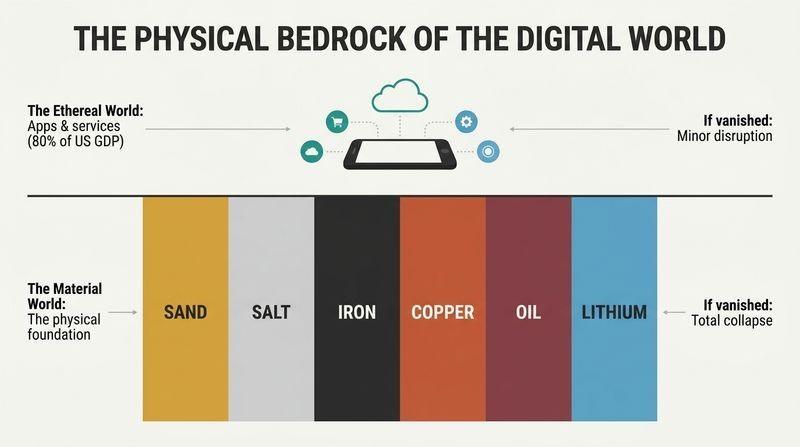
The physical world underpins the ethereal one. Ed Conway argues that despite talk of a dematerialized economy, everything from Instagram to banking depends on six raw materials: sand, salt, iron, copper, oil, and lithium. He calls the realm where these are dug, refined, and made the "Material World," contrasting it with the "ethereal world" of services and ideas that most of us inhabit.
Price is not the same as importance. Four of every five dollars in the U.S. economy traces to services, and mining barely registers in GDP. Yet if Twitter vanished, life would continue; if steel or natural gas vanished, civilization would collapse. Conway's rule of thumb inverts the famous obscenity quote: what matters most is what you notice only when it disappears.
Conway's thesis echoes a growing "supply-chain realism" that gained urgency after COVID and the Ukraine war exposed how fragile just-in-time globalization is. His distinction between price and value revisits an old economic puzzle (the diamond-water paradox) that Adam Smith wrestled with in 1776. The framing is powerful precisely because it is counterintuitive to knowledge workers who rarely see a mine. One caveat worth flagging: choosing exactly six materials is a rhetorical device, and Conway concedes cobalt, boron, and tin nearly qualified. The number is less important than the mindset shift toward material literacy.
We now extract more raw material yearly than all of history before 1950
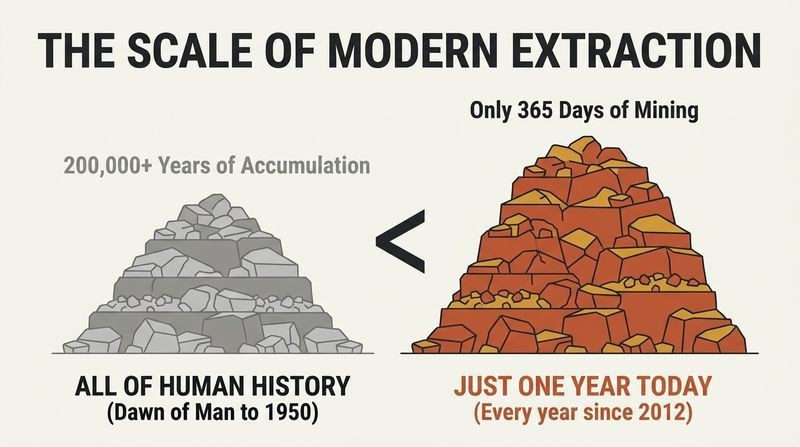
Consumption is accelerating, not shrinking. In 2019 humanity mined, dug, and blasted more materials from the earth than in all history from the dawn of humankind through 1950. This has been true every year since 2012. For every tonne of fossil fuel extracted, we pull out six tonnes of other materials, mostly sand and stone.
The "more from less" story is partly an illusion. Wealthy nations like the U.S. and UK show declining material use per dollar, which optimists cite as proof of dematerialization. But Conway suspects we have simply outsourced the dirty extraction to other countries. Official statistics count only the "material" mined, never the waste rock displaced to get it, so humankind's true footprint is far larger than reported.
This challenges the "decoupling" thesis popularized by writers like Andrew McAfee, whose book More From Less argued rich economies grow while consuming less. Conway's rebuttal, that consumption is offshored rather than eliminated, aligns with "consumption-based accounting" research in climate economics, which reassigns emissions to the country that buys goods, not the one that makes them. His point about uncounted waste rock is especially sharp: a single gold wedding ring can require moving 4 to 20 tonnes of earth, none of which appears in material-flow databases. The green transition, ironically, may intensify extraction rather than reduce it.
A grain of sand becomes both ancient glass and modern microchips
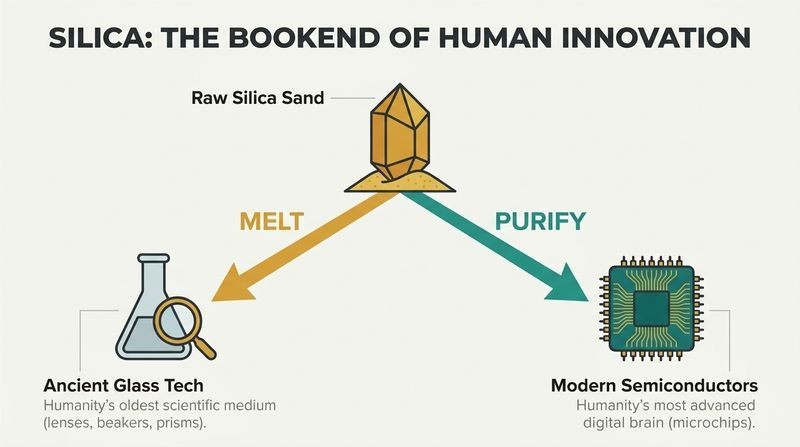
Sand bookends civilization. Silica, sand's main ingredient, is the second most common element in the earth's crust after oxygen. Melt it and you get glass, humanity's oldest manufactured product; purify and crystallize it and you get semiconductors, our most advanced. Glass was a foundational technology: two historians found that all but four of twenty landmark scientific experiments relied on glass lenses, prisms, or containers.
Not all sand is equal. Desert sand is too wind-rounded for concrete, which is why Dubai imports sand from Belgium and Britain. The purest silica, like the 99% silver sand mined at Lochaline in Scotland, is prized for optical glass. Roughly half of all quartz grains have cycled from rock to sand to rock again six times over deep time.
Conway's claim that glass deserves credit alongside the printing press is a compelling piece of counterfactual history. The spectacles-and-literacy link is underappreciated: bi-convex lenses effectively extended the working lives of Europe's literate class just as movable type created mass demand for reading. This dovetails with historian David Landes's arguments about why the Scientific Revolution took root in glassmaking Europe rather than in China or the Islamic world, which largely abandoned the craft. The sand paradox (ubiquitous yet scarce in useful forms) is a recurring theme in materials science: abundance of an element rarely means abundance of the usable form.
No single person on earth can build a smartphone chip alone
The longest journey in manufacturing. A silicon chip begins as fist-sized quartz lumps (not sand, which is too fine to melt properly) in places like Spruce Pine, North Carolina, the only source of quartz pure enough for the crucibles that grow silicon crystals. The material circles the globe multiple times, is heated past 1,000°C three times, and passes through firms most people have never heard of: Ferroglobe, Wacker, Shin-Etsu, TSMC, ASML.
Extreme precision at atomic scale. Modern transistors are smaller than the COVID virus; you could fit four inside a coronavirus. ASML's machines generate extreme ultraviolet light by blasting molten tin droplets 50,000 times per second, bouncing the light off mirrors so smooth that scaled to the size of the U.S., the biggest bump would be under half a millimeter.
This updates Leonard Read's 1958 essay "I, Pencil," which argued no one knows how to make even a pencil, into the semiconductor age. Read's libertarian point was about spontaneous market coordination; Conway's is about fragility and hidden dependency. The Spruce Pine detail is genuinely alarming from a national-security lens: Chris Miller's Chip War documents how a handful of chokepoints (TSMC, ASML, high-purity quartz) create catastrophic single points of failure. The observation that China dominates steel, batteries, and social media yet cannot make cutting-edge chips illustrates that some capabilities resist money and willpower, depending instead on decades of accumulated tacit knowledge.
Whoever controls salt controls power, from Chinese emperors to Gandhi
Salt built states and toppled them. Beyond seasoning, salt is the foundation of the chemical industry. The chloralkali process runs electricity through brine to make chlorine (which purifies drinking water) and caustic soda (for soap and paper). One plant in Runcorn supplies 98% of Britain's chlorine; if it failed, the country would ration drinking water within seven days.
Salt as an instrument of tyranny. China maintained a salt monopoly for over two millennia, at times drawing 90% of state revenue from it. France's hated salt tax, the gabelle, helped ignite the Revolution. Gandhi chose salt for his 240-mile 1930 march precisely because the British salt monopoly taxed something every poor person needed, making it the perfect symbol of colonial injustice.
Conway joins Mark Kurlansky (Salt: A World History) in treating a mundane compound as a lens on political power, but adds the modern chemical dimension that Kurlansky underplays. The insight that governance structures can be shaped by resource control anticipates work by economists like Daron Acemoglu on how extractive institutions form. What is genuinely fresh is connecting ancient salt routes to today's industrial geography: pharmaceutical and chemical plants still cluster atop salt deposits in Cheshire, Teesside, and Michigan. The chloralkali chokepoint is a quiet reminder that critical infrastructure is often invisible until catastrophe, a theme that recurs throughout the book.
Iron is the truest measure of a nation's living standard
Steel inequality mirrors income inequality. The average person in a developed economy has about 15 tonnes of steel embedded in their life (in buildings, cars, hospitals, paperclips). The average Chinese person has 7 tonnes; the average sub-Saharan African has less than one. Iron accounts for roughly 95% of all metal we produce.
Cheapness is steel's secret weapon. Steel is iron with under 2% carbon, its atoms locked in a strong lattice. What made it world-changing was not just strength but Henry Bessemer's converter, which mass-produced it in minutes. In 1810, Americans spent about the same share of income on iron nails as they now spend on computers. Bringing everyone to rich-world steel levels would require quadrupling all the steel humanity has ever made, colliding with the fact that steelmaking emits 7-8% of global CO2.
The "development versus decarbonization" collision Conway identifies is the central moral tension of climate policy. It is unjust to tell developing nations they cannot pour the concrete and forge the steel that the West used to get rich. This echoes debates around "climate reparations" and differentiated responsibility in UN negotiations. Conway's framing of steel-per-capita as a welfare metric is a useful corrective to GDP fetishism, resonating with Amartya Sen's capabilities approach: what matters is whether a country has the physical means (hospitals, bridges, homes) for people to thrive. The Mao Great Leap Forward story is a chilling reminder that fixating on tonnage without understanding metallurgy killed tens of millions.
The green transition means digging and blasting more than ever before
Decarbonizing requires more mining, not less. Building electric cars, wind turbines, and solar panels demands vastly more metal than fossil-fuel systems. A solar installation needs roughly seven times the copper of a conventional power station; offshore wind needs about ten times. An electric car uses three to four times the copper of a petrol car.
Renewables are less energy-dense, so we build more. Because sunlight and wind are diffuse compared to concentrated fossil fuels, replacing a single 100-megawatt gas turbine with wind requires about 20 giant turbines, nearly 30,000 tonnes of iron, 900 tonnes of plastics and fiberglass, and 540 tonnes of copper. Conway cites an estimate that we must mine more copper in the next 22 years than in the entire prior 5,000 years of human history.
This is the book's most important and least intuitive argument, and it is supported by the International Energy Agency's own projections on mineral demand. The paradox that saving the planet requires tearing more of it up creates genuine political tension, visible in the backlash against lithium mines in Serbia and copper limits in Chile and Peru. Conway wisely distinguishes this extraction from the old kind: we are building with these materials, embedding carbon into durable goods, rather than burning them. Critics might note he underweights demand reduction and efficiency, but his core point stands: there is no dematerialized path to net zero.
Half of us are alive only because of fossil-fuel fertilizer
We are literally made of natural gas. The Haber-Bosch process, invented in Germany around 1909-1913, pulls nitrogen from the air and bonds it with hydrogen (from natural gas) to make ammonia fertilizer. Roughly half the nitrogen in your body was fixed this way. Without synthetic fertilizer, we could feed only about half the world's population, even if we turned nearly all land over to farming.
Your tomato is a petroleum product. Modern greenhouse tomatoes are warmed by gas, fed nitrogen made from gas, and dosed with CO2 piped from the gas boiler's flue. Their sugars contain atoms that began as methane. The share of undernourished people fell from about 65% in 1950 to under 10% by 2010, largely thanks to cheap, abundant fertilizer.
Conway dramatizes a fact that biogeochemist Vaclav Smil has long emphasized: Haber-Bosch is arguably the most consequential invention of the twentieth century, yet almost no one outside chemistry knows the name. The framing that "we are made of fossil fuels" is a striking way to complicate simplistic anti-fossil narratives. There is a dark irony worth dwelling on: Fritz Haber, who fed billions, also pioneered chlorine gas warfare. The dependency also creates a decarbonization headache, since green ammonia via electrolysis is wildly energy-hungry. One fertilizer plant powered by green hydrogen would consume the entire output of what was once the world's largest wind farm.
Doubling production of anything cuts its cost by roughly 15%
Wright's law explains falling prices. In the 1930s aeronautical engineer Theodore Wright noticed that every time the cumulative production of an item doubles, its cost drops by about 15%. This "learning curve" explains why lithium-ion battery costs fell 97% between 1991 and 2018, why solar module prices halved 500 times between 1975 and 2019, and why a megabyte of memory fell from $5.2 million in 1960 to well under a cent by 2016.
Making more makes it cheaper, which enables making more. This virtuous circle has operated since the Phoenicians accidentally made glass on a beach. It is why complex products became commonplace and cheap: glass, once a luxury, and steel, once fit only for kings' swords, are now everywhere and nearly free.
Wright's law is a more robust empirical regularity than the better-known Moore's law, because it applies across dozens of technologies, not just semiconductors. Recent work by J. Doyne Farmer at Oxford has shown Wright's law forecasts technological cost declines more reliably than time-based models, which has profound implications for climate policy: it suggests aggressive early deployment of solar and batteries drives costs down faster than waiting for breakthroughs. The one worrying crack Conway flags is that in 2022, lithium-ion battery prices rose for the first time, driven by raw-material shortages, hinting that the learning curve can be overwhelmed by physical scarcity upstream.
The battery age creates electrostates and hands China the lead
Petrostates give way to electrostates. Just as oil enriched Saudi Arabia and Russia, the shift to batteries elevates lithium-rich nations like Chile, Argentina, and Australia. But the decisive power is China, which controls roughly 80% of both battery production and battery-material processing, an advantage no previous industrial revolution handed it.
America starts behind for the first time. In the motor, silicon, and concrete ages, the U.S. led from the start. In batteries it depends on China for refined materials, cathode chemicals, and graphite. Even Tesla's Gigafactory in Nevada has most of its floor space run by Japan's Panasonic. Governments are responding by reviving Cold War-era mineral stockpiles and passing critical-minerals laws to reduce dependence.
Conway captures a genuine geopolitical inflection point. The "electrostate" concept extends thinking from analysts like Daniel Yergin on how energy transitions redraw power maps. What is underappreciated in his account, and worth adding, is that lithium itself is not especially rare; the chokepoint is refining and battery manufacturing know-how, which China built through two decades of state-backed industrial policy. This mirrors how Japan and Korea earlier climbed the battery learning curve by repurposing cassette-tape reel-to-reel machinery. The lesson for Western policymakers is sobering: subsidies alone cannot instantly buy tacit manufacturing expertise, as China's own struggle to make cutting-edge chips demonstrates in reverse.
Tomorrow's mines may be the waste piles we already dug
Urban mining and the circular economy. Companies like Belgium's Umicore (formerly the notorious Union Miniere that plundered the Congo) now refine metals from discarded electronics and dead batteries rather than fresh ore. Recycling rates vary wildly: steel exceeds 70-90%, copper 43-53%, but lithium sits below 1%.
Waste rock could become ore. A company called Jetti claims it can extract copper from the lowest-grade chalcopyrite once discarded as junk. Since about two-thirds of the world's copper sits in such low-grade rock, this matters enormously. Conway imagines a poetic end for Chuquicamata, the Chilean mine so vast it swallowed its own town: squeeze copper from the waste mountains, then pour the spent earth back, making the world's biggest hole whole again.
The circular-economy vision is appealing but Conway is admirably honest about its limits. Even at 95% recovery, a battery recycled every decade loses over 40% of its original material within a century, requiring continuous fresh mining. This punctures utopian "closed loop" rhetoric common in ESG marketing. The deeper insight is that recycling economics depend entirely on whether virgin material is cheaper, which it usually is thanks to Wright's law. The Umicore story also carries moral weight: a firm built on colonial exploitation and lead poisoning now positions itself as green savior, a reminder that the Material World's future is entangled with its ugly past.
The people who benefit from net zero may not be born yet
The breakeven year is around 2080. Using standard climate-economic models, if the world reaches net zero by 2050, the point where atmospheric carbon falls and benefits outweigh costs arrives around 2080. The first generation to enjoy the payoff of today's sacrifice might be the grandchildren of children born now.
Three risks threaten the transition. Conway identifies them clearly:
1. People despair and abandon a project whose rewards they will never see.
2. Political resistance and public apathy block the mines, turbines, and panels needed.
3. The geopolitical foundations fracture, as war or trade conflict shatters the global supply chains that let a chip circle the world before reaching your pocket.
The transition is possible but demands reimagining nearly every industrial process at once.
This closing insight reframes climate action as an unprecedented act of intergenerational altruism, which behavioral economics suggests humans find extraordinarily difficult (see hyperbolic discounting and the tragedy of the horizon that former Bank of England governor Mark Carney described). Conway's honesty about the delayed payoff is politically risky but intellectually vital: pretending the transition is cheap and immediate invites backlash when costs bite, as fuel-price protests across Europe have shown. His three-risk framework is a useful diagnostic. The most underrated is the third: the entire edifice of cheap materials rests on a peaceful, interconnected world that recent history suggests we cannot take for granted.
Analysis
Material World belongs to a rising genre of "thing-biography" journalism (following Kurlansky, Smil, and Yergin) but distinguishes itself through Conway's economist's eye and reportorial legwork, descending into Europe's deepest mine and detonating charges in Nevada. The book's structural cleverness is casting six materials as protagonists, telling human history from the perspective of substances rather than people. This inverts the fashionable "institutions and ideas" school (Acemoglu, Mokyr) that attributes prosperity to political arrangements, insisting instead that destiny is intertwined with what we extract from the earth.
The central intellectual contribution is the distinction between the "ethereal world" of services and the "Material World" of stuff, and the argument that GDP systematically blinds us to the latter because price diverges from importance. This is genuinely useful, though Conway sometimes overstates the neglect: supply-chain economics and industrial policy are hardly ignored fields. His strongest and most original thread is the green-transition paradox: decarbonization is not dematerialization but rematerialization, requiring more copper, lithium, and mining than ever. This deserves to reshape public debate, which remains stuck in a naive "clean versus dirty" binary.
Where the book is most vulnerable is its relative optimism about scaling. Conway leans on Wright's law to suggest costs will keep falling, yet acknowledges the 2022 battery-price reversal that threatens the whole logic. He also underweights demand-side solutions (using less, degrowth, efficiency) in favor of a build-more framing that suits his materialist thesis.
The prose achieves the rare feat of making metallurgy thrilling, and the recurring motif ("you know it when you can't see it") is a memorable inversion of the obscenity quote. Ultimately the book is a plea for material literacy: a citizenry that understands where things come from will make wiser choices about energy, geopolitics, and climate than one that believes value lives only in apps. It is popular science with a serious policy spine.
Review Summary
Material World explores six essential raw materials—sand, salt, iron, copper, oil, and lithium—that shape modern civilization. Conway's engaging narrative combines history, science, and travelogue, revealing the complex supply chains and environmental impacts behind everyday products. Readers praise the book's eye-opening insights, fascinating anecdotes, and accessible writing style. While some find it occasionally repetitive or lacking in depth, most consider it an essential read for understanding the interconnectedness of global resources and the challenges of sustainable development. The book offers both sobering realities and cautious optimism for the future.
People Also Read




FAQ
What's Material World about?
- Exploration of raw materials: Material World by Ed Conway examines six essential raw materials—sand, salt, iron, copper, oil, and lithium—that are foundational to modern civilization. The book explores their extraction, processing, and significance in daily life.
- Interconnectedness of materials: Conway highlights the complex supply chains and global dependencies on these materials, showing how they support everything from technology to infrastructure.
- Historical context: The book provides historical insights into how these materials have influenced human progress, trade, and conflict, with each chapter focusing on a specific material's journey from extraction to its role in society.
Why should I read Material World?
- Understanding civilization's foundations: The book offers a deeper understanding of the physical foundations of our civilization, emphasizing the often-overlooked importance of raw materials.
- Insight into supply chains: It provides valuable insights into global supply chains, revealing hidden processes behind the products we use and the impacts of supply chain disruptions.
- Environmental awareness: Conway discusses the environmental consequences of material extraction and use, prompting readers to consider sustainability and future resource consumption.
What are the key takeaways of Material World?
- Dependence on raw materials: Modern civilization heavily relies on six key materials, each playing a crucial role in various industries.
- Environmental impact: The book highlights the environmental degradation associated with material extraction and processing, urging a sustainable approach to resource management.
- Historical significance: It connects the historical importance of these materials to contemporary issues, illustrating their role in shaping economies and societies.
What are the best quotes from Material World and what do they mean?
- “The world would probably not cease to function, nor civilization grind to a halt, if we suddenly ran out of gold.” This quote contrasts the critical nature of materials like sand and copper with the non-essential nature of gold.
- “Without concrete, copper and fibre optics there would be no data centres, no electricity, no internet.” It emphasizes the foundational role of these materials in enabling modern technology and infrastructure.
- “The secret of humankind’s success is about more than our DNA or our political institutions.” This suggests that human achievements are deeply intertwined with the materials we extract and utilize.
How does Material World address environmental issues?
- Extraction consequences: Conway discusses the environmental degradation caused by material extraction, such as habitat destruction and pollution, emphasizing sustainable practices.
- Resource consumption: The book highlights the increasing demand for materials and the potential consequences of over-exploitation, urging readers to consider sustainability.
- Future solutions: Conway suggests striving for more sustainable practices and innovations, encouraging responsible resource use to protect the environment.
What role does salt play in the modern economy according to Material World?
- Foundation of industries: Salt is critical in the chemical and pharmaceutical industries, essential for producing various products.
- Historical significance: The book traces salt's historical importance in trade and power dynamics, illustrating its value beyond sustenance.
- Current production: Modern salt production is largely invisible, reflecting changes in technology and its ongoing importance in society.
What is the significance of lithium in Material World?
- Future energy transition: Lithium is crucial for the next energy transition, particularly in electric vehicles and renewable energy storage.
- Environmental concerns: The book addresses the environmental impact of lithium extraction, urging consideration of sustainable mining practices.
- Global competition: It highlights the geopolitical implications of lithium production, as countries vie for access to this essential resource.
How does Material World explore the concept of supply chains?
- Complexity of supply chains: Conway illustrates the intricate networks connecting raw materials to final products, emphasizing global dependencies.
- Interconnectedness of industries: Various industries rely on the same raw materials, creating a web of interdependence.
- Historical context: The evolution of supply chains is connected to historical events, enriching the understanding of contemporary dynamics.
What is the significance of nitrates in Material World?
- Historical economic driver: Nitrates were crucial during the industrial revolution, particularly for agriculture and explosives.
- Impact on agriculture: Essential for fertilizers, nitrates have significantly increased food production, with environmental concerns about synthetic use.
- Transition to synthetic production: The shift to synthetic production methods, like the Haber-Bosch process, has lasting effects on agriculture and food security.
How does Material World connect raw materials to historical events?
- Salt and revolutions: Salt has been a catalyst for social and political change, such as Gandhi's salt march, symbolizing resistance against colonial rule.
- Trade and conflict: The pursuit of raw materials has driven historical conflicts and shaped geopolitical landscapes.
- Economic development: The availability of raw materials has historically determined the prosperity of nations.
What role does copper play in modern civilization according to Material World?
- Essential for electricity: Copper is critical in electrical systems, serving as a conductor in wiring and electronics.
- Historical significance: Copper's historical use from ancient tools to modern technology illustrates its enduring value.
- Challenges in extraction: The book addresses environmental and ethical challenges in copper mining, emphasizing sustainable practices.
What is the future outlook for raw materials according to Material World?
- Increased demand: Demand for raw materials will continue to rise, particularly with the transition to renewable energy.
- Technological innovations: Potential advancements could improve resource extraction and management.
- Global cooperation: International collaboration is necessary for managing resources sustainably, requiring a collective effort.
Download PDF
Download EPUB
.epub digital book format is ideal for reading ebooks on phones, tablets, and e-readers.








































