Key Takeaways
Change the underlying structure of your life, not your behavior
“People commonly believe that if they change their behavior, they can change the structures in their lives. In fact, just the opposite is true.”
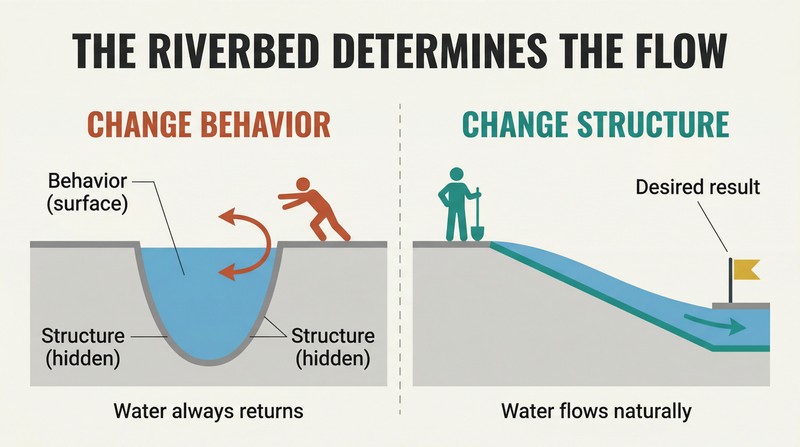
Boston's roads follow cow paths. Cows moved where the terrain was easiest, wearing grooves that became streets. Your life works identically — you follow the path of least resistance determined by underlying structures: your desires, beliefs, assumptions, and circumstances. If the riverbed stays the same, the water always flows the same route.
This is why diets, resolutions, and organizational change programs fail. Changing behavior without changing structure produces temporary results, then backsliding. But here's the breakthrough: you can redesign the underlying structure — like engineers redirecting a river — so the path of least resistance leads where you actually want to go. Once the new structure is in place, the current of your life surges naturally toward the results you want.
Creating brings things into being; problem solving just makes things go away
“The path of least resistance in problem solving is to move from worse to better and then from better to worse again.”
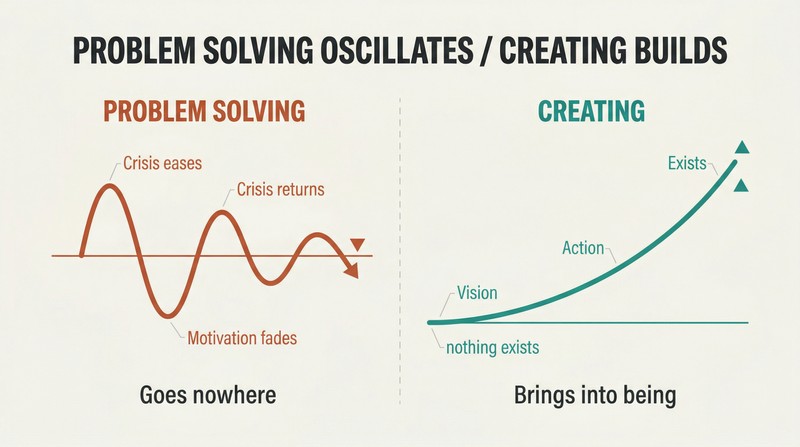
These are opposite intentions. Creating means taking action to bring something new into existence. Problem solving means taking action to eliminate something unwanted. The distinction matters because problem solving structurally oscillates: the problem drives action, action reduces the problem, reduced intensity means less motivation, less motivation means the problem returns.
Fritz contrasts two approaches to Third World development. Ethiopia received emergency food aid — classic problem solving. The crisis eased, media attention dropped, contributions slowed, and famine returned. Meanwhile, in Uganda, villagers were trained to envision and build the life they wanted through the creative process. Even amid political turmoil, those villages flourished — at a fraction of the cost. The greatest leaders in history were builders, not problem solvers.
Your yo-yo pattern isn't a character flaw — it's structural
“To attempt a psychological solution to what is really a structural phenomenon does nothing to change the underlying structure.”
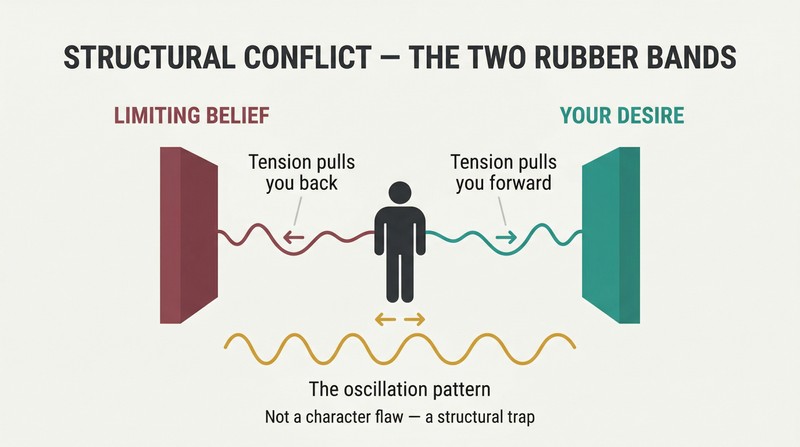
Imagine two rubber bands around your waist in a room. One stretches to the front wall (your desire), one to the back wall (the belief you can't have what you want). Move toward your goal: the back rubber band tightens, pulling you away. Move away: the front one pulls you back. This is structural conflict — two tension-resolution systems with mutually exclusive resolutions.
The dieter oscillates between hungry-eat and overweight-don't-eat. The relationship seeker gets close then retreats. This isn't self-sabotage, a failure complex, or fear of success. It's the physics of the structure in play. Words like "self-destructive" miss the real cause entirely. Anyone placed in the same structure would behave the same way.
Willpower, affirmations, and fear all reinforce what they fight
“As you put pressure on one part of a structure, the rest of the structure pushes back.”
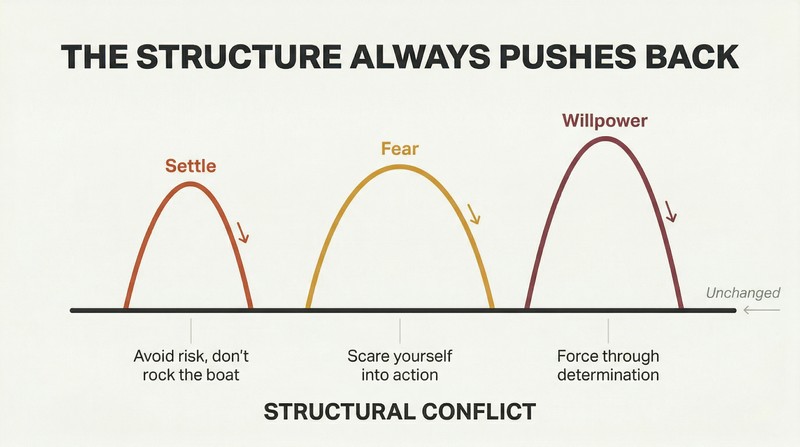
Fritz identifies three compensating strategies people use inside structural conflict — all of which fail:
1. Area of tolerable conflict: avoid risk and settle for mediocrity — the "don't rock the boat" approach
2. Conflict manipulation: scare yourself into action with visions of disaster — motivation fades as pressure drops
3. Willpower manipulation: force yourself through positive thinking, affirmations, and sheer determination
Each leaves the underlying structure unchanged. Affirmations like "The Universe supports me" actually reveal disbelief — who repeats something they already know to be true? The structure compensates for every push. This is why fear-based activism burns people out, New Year's resolutions collapse by February, and motivational seminars produce only temporary highs.
Hold vision and reality simultaneously to create structural tension
“The only time you know for sure whether creating a result is possible or not is when you have done it.”
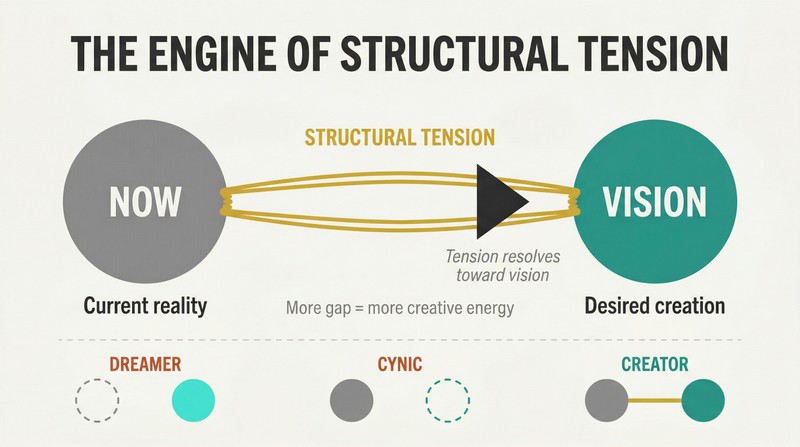
Structural tension is the engine of the creative process. It has two components: a clear vision of what you want to create, and an honest view of current reality. The gap between them creates tension that naturally seeks resolution — like a stretched rubber band pulling you toward your vision. Unlike structural conflict, which oscillates endlessly, structural tension resolves toward the result.
Weakening either side collapses the engine. Lowering your vision to seem "realistic" reduces the tension. Misrepresenting reality through positive spin does the same. Idle dreamers hold vision without reality; cynics hold reality without vision. Creators hold both simultaneously — and that discrepancy becomes their most powerful creative fuel. The more discrepancy, the more energy available.
Define what you want before figuring out how to get it
“If you ask the 'how' question before the 'what' question, all you can ever hope to create are variations of what you already have.”
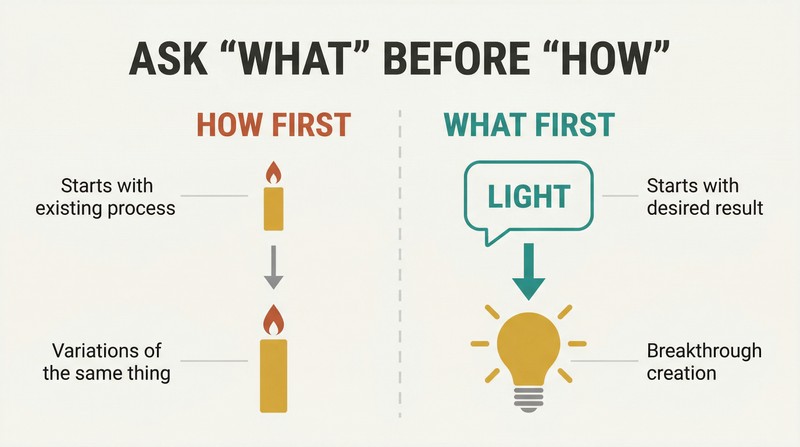
Edison wanted electric light, not a better candle. Every scientist before him had tried reducing resistance to electric current. By focusing on the result — light — Edison tried the opposite: increasing resistance. He tested countless materials until he found carbonized filament in a vacuum bulb. Frank Lloyd Wright wanted interior living space, not rearranged boxes — so he invented open floor plans and floor-to-ceiling windows.
Fritz argues that premature focus on process fatally limits what you can create. Our education system teaches procedures before anyone asks what the student actually wants. Aptitude tests at age fifteen channel people into careers they never cared about. The vital question isn't "What am I good at?" but "What result do I want to create?"
See reality as it actually is — not your concept of it
“Were you to impose any 'rose-colored' or otherwise synthetic views on your reality, you would obscure it.”
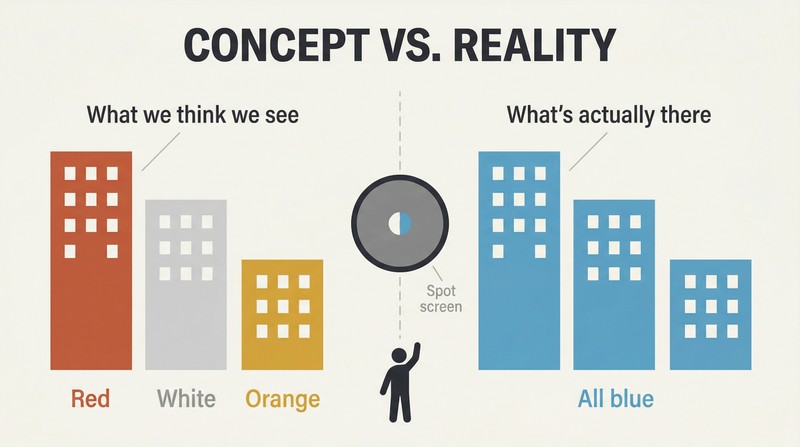
Art students viewing buildings across the Hudson River described them as red, white, and orange. When they looked through a small hole in a gray card — a device called a spot screen — they discovered all three buildings were actually blue, bathed in reflected light from sky and river. They'd been painting their concept of reality, not reality itself.
Fritz argues this extends far beyond art. Ideological, emotional, and psychological biases constantly distort our perception. Communists see class struggle everywhere; optimists minimize bad news; pessimists exaggerate it. Creators must develop the skill of observing what's actually there — good, bad, or indifferent — because accurate reality is the essential second component of structural tension. Truth is not dangerous; it sets you free to create.
Creators don't discover what to create — they invent it
“A common mistake people make when first entering the orientation of the creative is to seek to 'find out' what they want as if it were a deeply hidden treasure to be discovered and revealed.”
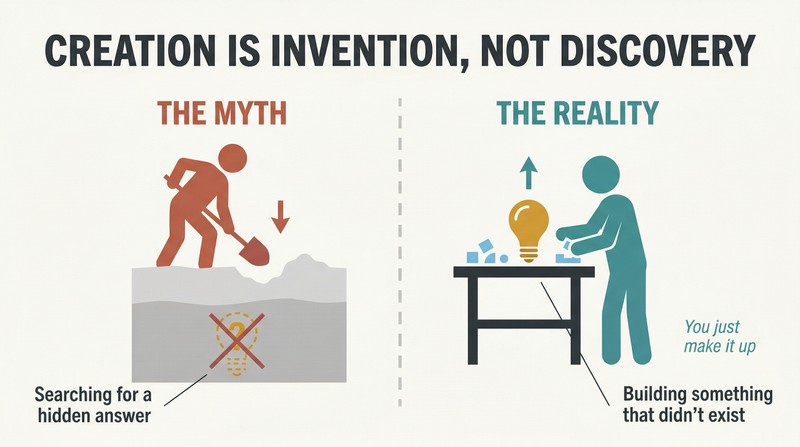
What you want isn't hidden inside you waiting for the right therapy or meditation to unlock it. Fritz's radical claim: you simply make it up. Engineers at a high-tech firm confirmed this with knowing grins — "That's exactly what we do. We make up what we create." Then they write technical articles explaining their invention in such a way that it doesn't seem made up.
This demolishes the myth of the magic formula for creativity. Beethoven didn't wait for divine inspiration — he methodically sketched and tested themes in "systematic and apparently cold-blooded fashion." Einstein made up relativity. Edison made up the light bulb. The creative process isn't revelation — it's invention. And the more you practice, the sharper your instinct becomes.
Make a fundamental choice about your life orientation
“Without making the fundamental choice to be the predominant creative force in your life… you will merely be finding more sophisticated ways of responding to circumstances.”
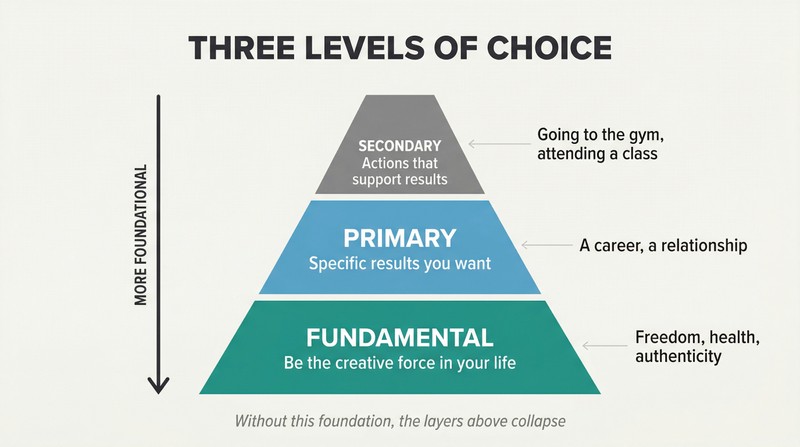
Fritz distinguishes three levels of choice. Primary choices target specific results — a career, a relationship. Secondary choices support those results — going to the gym, attending a class. Fundamental choices are about your basic state of being: choosing to be free, healthy, true to yourself, and the predominant creative force in your life.
Without fundamental choice, even perfect techniques fail. A woman with lifelong claustrophobia — triggered by being trapped in a trunk at age eight — had never flown. After making the fundamental choice to be the creative force in her life, her phobia vanished. She booked a flight to Spain. This isn't willpower. It's an orientation shift that reorganizes everything downstream. Convenience and comfort simply stop being the deciding factors.
Move to your next step before you've mastered the current one
“One powerful way to assimilate your present step is to move on to your next step, even if you feel inadequately prepared for it.”
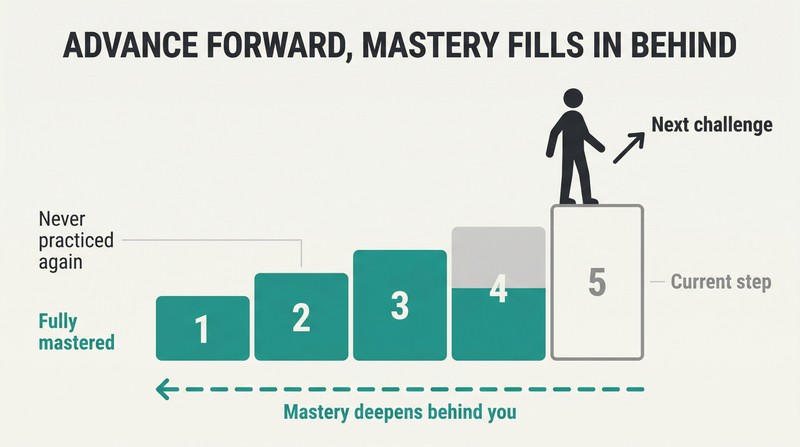
Fritz's clarinet teacher Attilio Poto assigned progressively harder exercises each week, never letting his student perfect one before moving on. After five weeks, the student could play the first exercise beautifully — without having practiced it in weeks. Moving forward incorporated earlier learning at a deeper level than repetition ever could.
This is the power of assimilation — the second stage of the creative cycle, sandwiched between germination's excitement and completion's fulfillment. It's the hidden, unglamorous phase where creation takes root. The danger is quitting here because "nothing seems to be happening." But momentum compounds: each creation makes the next easier. This is why creators rarely retire — Mozart's music grew more advanced the more he composed.
Analysis
Fritz's book operates at the intersection of systems thinking and personal development, predating Peter Senge's 'The Fifth Discipline' by several years. His central argument — that behavior is downstream of structure, not upstream — is essentially a systems dynamics insight applied to individual lives, placing him in conversation with Jay Forrester's work on feedback loops and compensating mechanisms at MIT.
What makes Fritz's contribution distinctive is his grounding in the arts rather than psychology or business. Where most self-help authors offer behavioral prescriptions, Fritz offers structural diagnosis. His distinction between creating and problem solving may be the book's most subversive claim: that the entire problem-solving paradigm — which dominates education, therapy, management, and politics — is structurally incapable of producing lasting change. This is a genuinely different lens from the habit-optimization paradigm that dominates modern personal development.
The book's weakness is significant repetition. Fritz makes his core points compellingly in the first third and spends the remaining two-thirds elaborating through increasingly similar examples. His dismissal of psychology is also overly broad — cognitive behavioral therapy does address structural patterns, and modern research on implementation intentions validates some process-oriented approaches he dismisses wholesale.
Nevertheless, Fritz's framework remains remarkably prescient. His concept of structural tension anticipated much of what would later be formalized in design thinking and agile methodology — vision-driven, iterative, comfortable with ambiguity. His analysis of conflict manipulation — how fear-based activism produces the opposite of its intended effect — anticipates decades of research on psychological reactance. For readers accustomed to the behavior-change paradigm of James Clear or Charles Duhigg, Fritz offers a genuinely orthogonal perspective: before designing better habits, examine whether the structure of your life can even sustain them.
Review Summary
The Path of Least Resistance receives mixed reviews, with many praising its insights on creativity and personal growth. Readers appreciate Fritz's perspective on structure determining behavior and the creative process. Some find the book transformative, while others criticize its repetitiveness and lack of practical advice. The concept of shifting from problem-solving to creation resonates with many. Critics note the book's length and self-promotional aspects. Overall, it's seen as thought-provoking, albeit sometimes dense and challenging to apply.
People Also Read
 Immersive
 Immersive

 Immersive
Glossary
Reactive-responsive orientation
Circumstances-driven life stanceA life orientation in which a person predominantly reacts against or responds to prevailing circumstances. The power is perceived as residing outside the individual—in situations, events, or conditions—leaving the person feeling fundamentally powerless. Most people are raised into this orientation through education and social conditioning.
Structural conflict
Competing tensions causing oscillationA structure composed of two or more tension-resolution systems whose points of resolution are mutually exclusive. The most common form: the desire for a result (resolved by having it) competes with the belief that you cannot have what you want (resolved by not having it). This structure produces oscillation—progress followed by backsliding—regardless of the specific desire involved.
Structural tension
Vision-reality gap driving creationThe senior structure in the creative process, formed by simultaneously holding a clear vision of the result you want to create and an accurate view of your current reality. The discrepancy between the two generates tension that naturally seeks resolution toward the vision. Unlike structural conflict, structural tension resolves rather than oscillates. It is the engine and armature of the creative process.
Compensating strategies
Futile tactics within structural conflictThree strategies people develop to cope with the unresolvability of structural conflict: (1) staying within an area of tolerable conflict to minimize oscillation, (2) conflict manipulation—using fear or negative visions to spur action, and (3) willpower manipulation—using forced determination or positive thinking. All three leave the underlying structure unchanged and ultimately reinforce powerlessness.
Fundamental choice
Life-orientation commitmentA choice about a basic state of being or life orientation, as distinct from choices about specific results (primary) or supporting actions (secondary). Examples include choosing to be free, healthy, true to yourself, or the predominant creative force in your life. Fundamental choices are not subject to changes in circumstance and serve as the foundation upon which primary and secondary choices rest.
Primary choice
Result chosen for itselfA choice about a major result that is desired for its own sake, not as a stepping-stone to something else. Painting a painting because you want it to exist, not to advance your career. Primary choices establish the vision component of structural tension and generate germinational energy that activates the creative process.
Secondary choice
Supports a primary choiceA choice that helps you take a step toward your primary choice result, even when that step might not be independently desirable. Going to the gym supports the primary choice of a healthy body. Secondary choices become obvious and easy once the primary choice is clear, because each one directly serves what matters most to you.
Creative cycle
Germination, assimilation, completionThe three sequential stages every complete creative process moves through. Germination is the exciting initiation—conceiving and choosing the result. Assimilation is the hidden internalization phase where the creation takes root and grows, often without visible progress. Completion is the full accomplishment, including receiving and acknowledging the result. Each completion generates energy for the next germination.
Pivotal technique
Four-step structural realignment toolA technique for using unwanted circumstances as a creative catalyst. Step 1: Describe current reality factually. Step 2: Describe the result you want. Step 3: Formally choose that result by saying 'I choose...' Step 4: Move on—shift focus and let structural tension work organically toward resolution. Especially useful during strategic moments when circumstances differ from expectations.
FAQ
What's The Path of Least Resistance about?
- Focus on Structure: The book explores how understanding structural dynamics can help individuals and organizations achieve their goals more effectively.
- Creative Process: It presents the creative process as a fundamental approach to achieving goals, emphasizing the importance of designing structures that facilitate advancement.
- Organizational Dynamics: Fritz introduces concepts like "structural tension" and "structural conflict" to explain how these dynamics influence success and failure.
Why should I read The Path of Least Resistance?
- Insightful Management Techniques: The book offers unique insights into why some organizations succeed while others fail, making it essential for leaders.
- Timeless Principles: Despite being published over two decades ago, its principles remain relevant in today’s rapidly changing business environment.
- Transformative Approach: Readers will learn to shift from a reactive problem-solving mindset to a proactive creative process, leading to sustainable success.
What are the key takeaways of The Path of Least Resistance?
- Understanding Structure: The underlying structure of an organization determines its path of least resistance, influencing behavior and outcomes.
- Structural Tension vs. Conflict: Distinguishing between these two is crucial for implementing successful change and avoiding oscillation.
- Practical Tools: Fritz provides tools like Structural Tension Charting to help managers visualize and implement their goals effectively.
What is "structural tension" as defined in The Path of Least Resistance?
- Dynamic Force: Structural tension is the difference between what an organization wants to achieve and its current reality, creating a natural drive toward resolution.
- Key to Advancement: It leads to advancement within the organization by aligning efforts toward achieving goals.
- Foundation for Planning: This concept serves as a foundation for effective planning and decision-making, bridging the gap between current reality and desired outcomes.
How does The Path of Least Resistance address organizational oscillation?
- Oscillation Explained: Oscillation occurs when organizations experience repeated cycles of success and failure due to structural conflicts.
- Identifying Conflicts: Leaders are encouraged to identify and understand structural conflicts that contribute to oscillation.
- Creating Stability: The goal is to create a stable environment where structural tension drives advancement, allowing organizations to achieve long-term goals.
What are "The Nine Laws of Organizational Structure" in The Path of Least Resistance?
- Framework for Success: These laws provide a framework for understanding how organizational structures influence behavior and outcomes.
- Key Principles: Each law addresses different aspects of organizational dynamics, such as the relationship between goals and current reality.
- Practical Application: They serve as guidelines for managers to assess and redesign their organizations, ensuring all parts work harmoniously toward common goals.
What is the significance of "structural conflict" in The Path of Least Resistance?
- Definition and Impact: Structural conflict arises when two competing tension-resolution systems exist, leading to oscillation and instability.
- Examples of Conflict: Common conflicts include the tension between growth and capacity or between short-term and long-term goals.
- Need for Redesign: Structural conflicts require redesigning the organization to eliminate these conflicts and create a more effective structure.
How can I apply the concepts from The Path of Least Resistance in my organization?
- Implement Structural Tension Charting: Use this method to define goals, current reality, and action plans, visualizing the path to desired outcomes.
- Focus on Alignment: Ensure all departments and teams are aligned with overarching goals, fostering collaboration and reducing conflicts.
- Encourage a Creative Process: Shift from problem-solving to a creative process that emphasizes building and achieving goals for innovative solutions.
What are some of the best quotes from The Path of Least Resistance and what do they mean?
- "Without a change of underlying structure, any change effort will eventually fail.": Highlights the importance of addressing foundational structures for successful change.
- "Organizations either oscillate or advance.": Emphasizes understanding structural dynamics to progress or avoid cycles of failure.
- "The path of least resistance leads us to predictable patterns that, in the end, are self-defeating.": Warns against stagnation without conscious design and understanding of structures.
How does The Path of Least Resistance differentiate between "problem-solving" and "structural redesign"?
- Problem-Solving Limitations: Traditional approaches often lead to oscillation and do not address underlying structural issues.
- Focus on Redesign: Structural redesign involves rethinking foundational elements to support desired outcomes, fostering sustainable success.
- Creating Structural Tension: Establishing structural tension aligns efforts toward achieving goals rather than merely reacting to problems.
What is the significance of the dynamic urge in The Path of Least Resistance?
- Intrinsic Motivation: Represents intrinsic desires driving individuals and organizations to create and achieve meaningful outcomes.
- Alignment with Purpose: Aligning goals with dynamic urges fosters shared purpose and commitment, enhancing success.
- Creativity and Innovation: Harnessing this urge leads to greater creativity and innovation, empowering individuals to contribute to success.
How does Fritz suggest organizations can avoid oscillation in The Path of Least Resistance?
- Establishing Hierarchies: Create hierarchies among competing goals to resolve conflicts and maintain focus on important objectives.
- Leadership Commitment: Strong leadership ensures direction and support for chosen goals, requiring effective communication.
- Continuous Assessment: Regularly assess current reality and desired outcomes to ensure alignment and address emerging conflicts.
About the Author
Other books by Robert Fritz
Download PDF
Download EPUB
.epub digital book format is ideal for reading ebooks on phones, tablets, and e-readers.








































