

Key Takeaways
Trade time for money and you'll never stop carrying buckets
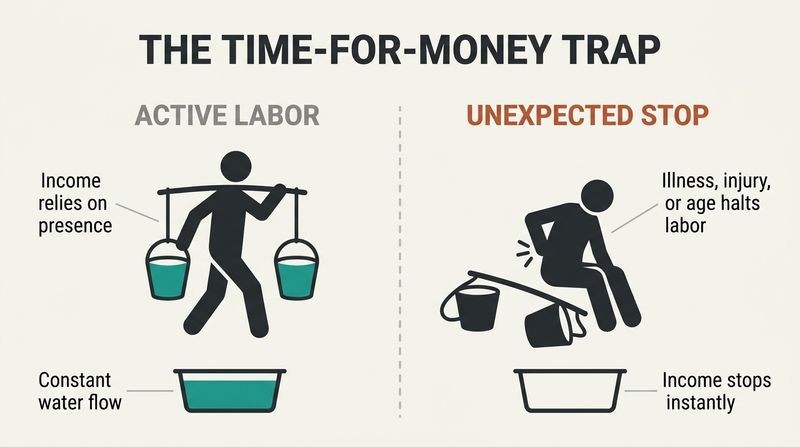
The core diagnosis of the book: Most people are trapped in what Hedges calls the Time-for-Money Trap. One hour of work equals one hour of pay. Stop working, and the money stops instantly.
The parable frames it perfectly: two Italian cousins, Pablo and Bruno, get hired to haul buckets of water from a river to their village cistern, earning a penny per bucket. Bruno celebrates his steady wage and buys new clothes and a donkey. But the income only flows while his back holds out. A real-world echo: Hedges describes a beloved dentist earning $100,000 a year working three days a week who developed arthritis before 40 and lost everything. Bucket carrying feels secure, but the security is an illusion because it depends entirely on your continued physical presence.
The Time-for-Money Trap predates Hedges by decades (it echoes Robert Kiyosaki's Rich Dad Poor Dad and even Marx's labor theory of value), but the bucket-and-pipeline metaphor makes the abstraction visceral. What's worth stress-testing is the framing of jobs as inherently fragile. Modern safety nets like disability insurance, 401(k) matching, and unemployment benefits blunt the catastrophe he describes. Still, the psychological point lands: linear income has a hard ceiling and zero resilience to interruption. The 2020 pandemic proved his thesis at scale, when millions who couldn't work suddenly couldn't eat. Wage labor is durable but brittle.
Build income that flows whether you show up or not
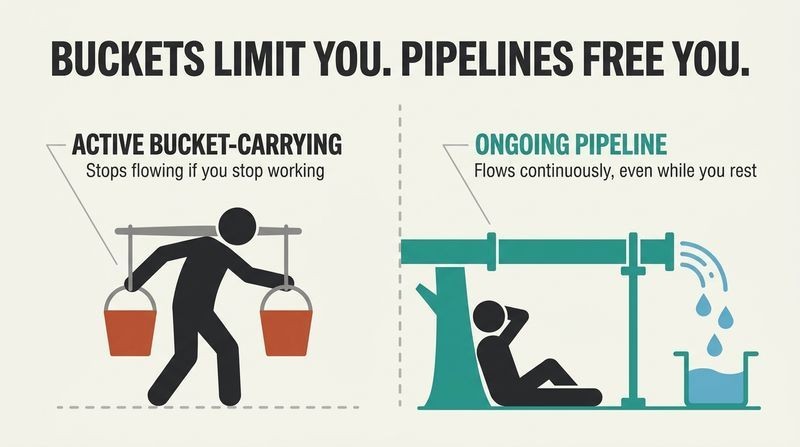
A pipeline is residual income: you do the work once and get paid repeatedly. In the parable, Pablo works the same bucket-hauling job by day but digs a pipeline from river to village on evenings and weekends. For a year or two he earns less and gets mocked as "Pablo the Pipeline Man." Then the pipe is finished. Water flows while he sleeps, eats, and plays, and money flows with it.
The kicker is timing: Pablo builds the pipeline while still carrying buckets. He doesn't quit his income to gamble. He funds the future from the present. Residual income means your earnings survive illness, layoffs, retirement, and emergencies. Hedges frames pipelines as lifelines precisely because they keep pumping when your body or your job can't.
The genius of the parable is sequencing. Pablo doesn't burn the boats. He runs two systems in parallel, letting the reliable one fund the speculative one. This is exactly what modern career strategists call the barbell approach or building a side business before quitting. Behavioral economics adds a caveat Hedges glosses over: most pipelines fail. Survivorship bias haunts the residual-income dream, since we hear about the Pablos and not the thousands whose ditches collapsed. The principle is sound and the discipline admirable, but readers should treat pipeline building as a portfolio of bets, not a single guaranteed dig.
A bigger paycheck won't save you if your spending grows with it
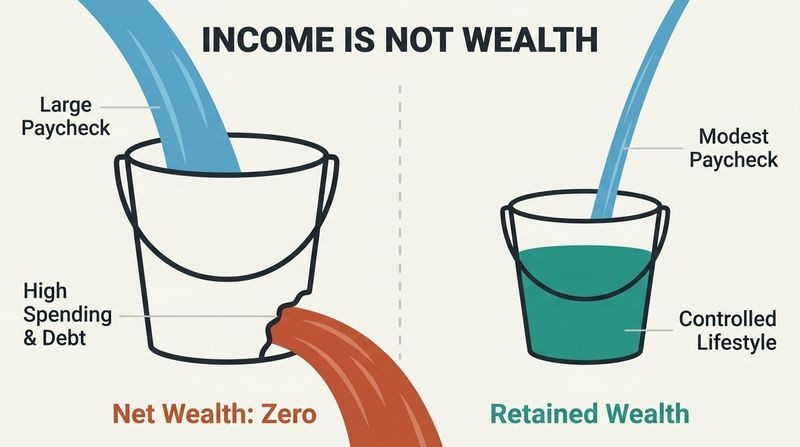
Big Hat, No Cattle: Hedges borrows this Texas phrase for people who look rich but own nothing. A physician's income bucket may be ten times a cook's, but doctors often spend ten times more: the $45,000 car, the $350,000 house, private schools, country clubs, Vail vacations. Both end up living paycheck to paycheck.
The Millionaire Next Door insight: Wealth is what you accumulate, not what you spend. Hedges cites Stanley and Danko's finding that over 80% of millionaires are ordinary people who built wealth in one generation, and four out of five never inherited more than $10,000. Income and wealth are different animals entirely. A high salary is just a large bucket, and buckets, no matter their size, eventually dry up when you stop lugging them.
This is the book's most empirically grounded claim, and it holds up. Lifestyle inflation, or hedonic adaptation, is well documented: raises get absorbed into new baseline expenses within months, leaving happiness and net worth roughly unchanged. The Stanley and Danko research remains a cornerstone of personal finance. What's striking is how counterintuitive it stays decades later, because status signaling is deeply wired. People read a Lexus as evidence of wealth when it may signal debt. The actionable inversion: measure yourself by savings rate, not salary. A teacher who saves outperforms a surgeon who spends.
Leverage breaks the one-hour-equals-one-result equation
Leverage means disproportionate returns. The word comes from a French root meaning to make lighter, and Hedges illustrates it with Gutenberg's printing press. Before 1440, monks hand-copied books one page per day. Gutenberg set the type once, then pressed 100 copies in a day. Same effort, a hundredfold result. By the mid-1600s, eight million printed books circulated in Europe, ten times everything produced in the previous thousand years.
Two flavors of leverage:
1. Time leverage: hire ten employees and capture the margin on all their hours, or duplicate your effort so one week produces a year of output.
2. Money leverage: invest and let capital multiply. A $300 stake in Berkshire Hathaway in 1965 became roughly $1 million by 1998.
Every pipeline runs on one or both.
Leverage is the engine beneath every fortune, and Hedges is right to center it. The printing press example is apt because it captures the fixed-cost, zero-marginal-cost dynamic that later made software the greatest wealth machine in history. Code, like type, is set once and copied infinitely. Naval Ravikant popularized this as products with no marginal cost of replication, adding that media and code are permissionless leverage requiring no employees or capital. The Berkshire figure, while dazzling, quietly relies on the rarest investor alive plus 33 years of patience. Leverage magnifies outcomes in both directions, and debt is leverage too.
Compounding is the eighth wonder: let money double undisturbed
The doubling concept, dramatized: An emperor rewards the inventor of chess, who asks only for one grain of rice on the first square, doubled on each subsequent square. By the 64th square the total exceeds all the rice in the world tenfold. Einstein reportedly called compounding the eighth wonder of the world.
The Rule of 72: divide 72 by your annual return to find the years it takes money to double. At 10%, $100,000 doubles to $200,000 in 7.2 years, then $400,000, then $800,000, and keeps climbing. Hedges calls this the Palm Beach Pipeline, the mechanism letting Rockefeller and Rothschild heirs live lavishly while their fortunes grow. The catch: it takes decades. Most self-made millionaires don't cross the line until their 50s or 60s.
The chessboard parable is the most memorable teaching device for exponential growth ever devised, and the second half of the board is where it turns absurd, a useful mental model for anything that compounds, from savings to pandemics to AI capability. The Rule of 72 is a genuinely handy shortcut worth memorizing. One honest tension: Hedges uses 10% and even 12% return assumptions that look aggressive against the long-run real return of stocks (closer to 6.5-7% after inflation). The mechanism is ironclad; the projected numbers deserve a haircut. Time in the market beats timing, but start early because the early squares look deceptively small.
Pay yourself first, then leave the money alone
The three-jar system: Hedges cites Michael Searls' method for teaching kids money, dividing every dollar into three jars.
1. Spend and give: immediate purchases and charity.
2. Save: bigger-ticket items.
3. Invest: never spent, ever, the seed for the pipeline.
For adults, the jars become accounts. The discipline is identical: automatically siphon 15-20% of gross income into investment accounts before you spend a dime, then let it compound. Hedges' most quotable illustration: invest $3.57 a day (roughly a pack of cigarettes in Florida) at 12% for 40 years and you become a millionaire. If every American smoker quit at 25 and invested the money, a third of the country would retire millionaires. The barrier isn't income. It's the habit of paying yourself last.
Pay yourself first is the most reliable wealth rule ever formulated, and automating it is the modern upgrade Hedges gestures toward. Behavioral science confirms why it works: default settings and forced deductions bypass willpower entirely, which is why automatic 401(k) enrollment dramatically raised participation rates in the studies behind Thaler and Sunstein's Nudge. The cigarette example is rhetorically brilliant but mathematically optimistic at 12%. Recalculated at a realistic 7%, the outcome is smaller yet still transformative, which arguably makes the honest version more persuasive. The deeper lesson survives any interest rate: small, ruthless consistency beats sporadic heroics.
Everyone gets the same 1,440 minutes; wealth is how you spend them
Time is the great equalizer. You don't start each day with equal money, but everyone wakes to the same 1,440 minutes (24 hours times 60). Hedges calls time leverage the People's Pipeline because it's the one resource distributed identically to Donald Trump and a dump-truck driver.
Reclaim the margins: Small increments compound into vast blocks. The average person spends six years of life just eating. Set aside two hours on weekdays plus three each weekend day and you generate 16 productive hours weekly, which over a year equals roughly 100 eight-hour days, or three extra months of full workdays. Hedges notes the top 10% of earners work about 52 hours weekly versus 45 for the bottom 10%, and crucially, they work smarter, refusing to trade time one-for-one for dollars.
The 1,440 framing reappears in countless productivity books because it reframes time as a budget you're spending whether you notice or not. The insight that spare hours are a hidden fortune connects to the concept of deep work: the difference between elite and average performers is often not talent but what they do with discretionary evenings. One nuance Hedges underplays is that time is not truly equal in practice. A single parent working two jobs has far less discretionary time than a childless executive, and decision fatigue erodes the quality of those leftover hours. The principle inspires; the playing field is flatter in minutes than in freedom.
The best time to build a lifeline is when you don't need one
Feather the nest while the sun shines. Hedges invokes Aesop's ant and grasshopper: the ant stores grain during summer while the grasshopper plays, and only one survives winter. The trap is comfort. When your job is fine and the economy booms, urgency evaporates and pipeline building feels unnecessary.
But cycles always turn. He tells the joke of a man falling past a 30th-floor window who calls out "Fine, so far." Millions of bucket carriers are fine so far, mistaking the current moment for permanence. Layoffs, illness, recessions, and elder care arrive without warning. Hedges' father, once worth $20 million in pre-revolution Cuba, lost everything to Castro overnight because he took his fortune for granted. Build safety nets before the recession, not during it. Pay a little now, or pay a lot later.
The prescription runs against powerful psychology. Normalcy bias, our tendency to assume tomorrow resembles today, is exactly why people skip the insurance and the emergency fund. Hedges' father's story gives the abstraction teeth, and it generalizes beyond dictators to any tail risk we discount because it hasn't happened yet. Nassim Taleb's antifragility frames the same idea: build slack and optionality in calm times so shocks become survivable or even advantageous. The falling-man joke is dark and perfect. The one critique: fear-based urgency can tip into paralysis or scam vulnerability, so the message works best paired with a concrete, boring plan rather than pure dread.
Choose the five-year climb, not just the fifty-year wait
Two paths up the oak tree. An Appalachian saying: you can reach the top by sitting on an acorn and waiting, or by climbing. The 50-Year Plan (money leverage through investing) works but demands patience most people lack. Hedges' answer is to run both, adding a 5-Year Plan built on time leverage through an active business.
Live for today, plan for tomorrow. His father's advice captures the strategy: long-term investment pipelines fund your eventual retirement, while a faster-building business pipeline lets you enjoy freedom now rather than at 70. He contrasts baseball star Darryl Strawberry, who earned an estimated $50 to $100 million and ended up broke, with teacher Margaret O'Donnell, who earned under $10,000 a year yet left nearly $2 million by investing consistently for decades. Diversify your pipelines; don't rely on a single lifeline.
The Strawberry-versus-O'Donnell contrast is the book's emotional core and a devastating natural experiment in behavior over income. It echoes the athlete-bankruptcy epidemic (studies suggest a large share of pro athletes face financial distress within years of retirement) driven by sudden wealth, lifestyle inflation, and short careers. O'Donnell embodies the tortoise. The diversification counsel (multiple pipelines, not one) is genuinely prudent and mirrors modern portfolio theory applied to income streams. Where readers should stay alert: the fast 5-Year Plan carries far higher variance than index investing, so pairing a speculative business with steady diversified investing is wiser than betting everything on the quick climb.
Get paid for the recommendations you already give away free
e-compounding, the Ultimate Pipeline: Hedges' signature concept fuses the doubling math of compounding with the reach of the internet. The web's flaw, he argues, is that it's too big and crowded, starving e-commerce sites of loyal, repeat customers. The fix is human trust: people buy movies, restaurants, and websites their friends recommend, not banner ads.
You talk, they tech. You form an affiliate partnership, directing people to a company's site and earning commission on their purchases; the company handles the website, orders, shipping, and accounting. Then you teach partners to do the same. Hedges' math: recruit one person monthly, each doing likewise, and a network can theoretically compound to 4,096 people in a year. If 4,000 buyers spend $100 monthly and you earn 1-3%, that's $4,000 to $12,000 a month.
Stripped of era-specific hype, this describes affiliate marketing and network marketing (MLM), and the honesty is mixed. The word-of-mouth insight is real; referral and creator economies now move enormous commerce, validating that trust converts better than ads. But the exponential recruitment math (1 to 4,096 in twelve months) is the same geometric fantasy the chessboard exposes, and in practice these networks saturate fast, leaving the vast majority earning little while a tiny top tier captures most income (FTC and consumer-protection data on MLMs are sobering). The durable, defensible version of this idea today is building a genuine audience and recommending things you actually use, not chain recruitment.
Becoming a millionaire is now a choice, not a chance
The book's thesis and promise. A century ago, wealth was nearly closed to ordinary people; in 1900, roughly 90% of Americans were poor, average wages were 22 cents an hour, and life expectancy was 47. Today, Hedges argues, three steps put a middle-class person within reach of a million dollars:
1. Understand how wealth is truly created and accumulated.
2. Copy proven systems rather than inventing your own.
3. Stay consistent over time.
Copycat, don't pioneer. Pablo kept notes so he could replicate and teach his pipeline. Self-made millionaires simply copied the compounding strategies once reserved for Rockefellers and Kennedys. The barrier is no longer cash or connections but vision and discipline. Wealth, in Hedges' telling, is a learnable skill, following time-tested strategies rather than waiting for luck, inheritance, or a winning lottery ticket.
Framing wealth as choice rather than chance is empowering and largely true at the margin, since savings rate and time are within most people's control. But it risks understating structural reality. The same century that democratized investing also produced widening inequality, stagnant real wages, and a cost of living (housing, healthcare, education) that consumes the very margins Hedges asks readers to invest. The claim that anyone above the poverty line can become a millionaire is arithmetically defensible over 40 years yet ignores income volatility, medical bankruptcy, and the compounding disadvantages of starting behind. The mindset shift is valuable; treating it as a guarantee is where optimism outruns the data.
Analysis
The Parable of the Pipeline is a fable-driven personal-finance manifesto, closer to a motivational sermon than an analytical treatise. Its power lies not in novel data but in a single sticky metaphor: bucket carriers trade time for money and stop earning the moment they stop working, while pipeline builders do the work once and get paid forever. Everything else (leverage, compounding, the Rule of 72, pay-yourself-first, time as the great equalizer) hangs off that frame. Hedges is a synthesizer, not an originator. He openly borrows from Kiyosaki's water-carrier story, Stanley and Danko's Millionaire Next Door, and Aesop, repackaging established wisdom into memorable narrative. That is the book's strength and its limitation.
The first two-thirds are genuinely useful and evergreen. The distinction between income and wealth, the danger of lifestyle inflation, the discipline of automated investing, and the exponential magic of compounding are among the most reliable truths in personal finance, and the parables make them unforgettable. The Strawberry-versus-O'Donnell juxtaposition is a masterclass in showing that behavior beats income.
The final third is where the book reveals its true purpose and its era. Written in 2001 at the peak of internet euphoria, e-compounding is essentially a pitch for affiliate and network marketing dressed in the parable's respectable clothing. The recruitment math (one person a month compounding to 4,096 in a year) recycles the very chessboard fantasy the book earlier used to teach humility, and it ignores market saturation and the dismal earnings distribution documented in MLM research. Readers should extract the durable principles (build residual income, leverage time and capital, automate savings, start early, diversify streams) and treat the specific business model as a period artifact. The mindset is transformative; the get-rich vehicle deserves skepticism. Read it for the metaphor, not the mechanism.
Review Summary
The Parable Of The Pipeline receives mostly positive reviews, with an average rating of 4.09/5. Readers praise its simple yet powerful message about building passive income streams. Many find the book eye-opening and recommend it for beginners in personal finance. The parable of Pablo and Bruno effectively illustrates the concept of creating long-term wealth. Some criticize its simplicity and lack of practical advice, while others appreciate its accessibility. A few reviewers note similarities to other finance books and outdated references to MLM strategies.
People Also Read





Glossary
Pipeline
Residual income built once, paid repeatedlyHedges' central metaphor for any income stream that keeps paying after the work is done: investments, businesses, royalties, or affiliate networks. Unlike a job, a pipeline is self-sustaining and survives illness, layoffs, and retirement. Named for the parable's Pablo, who dug a water pipeline instead of hauling buckets, letting money flow whether he worked or not.
Bucket Carrying
Trading time directly for moneyHedges' term for conventional wage or salary work, where income stops the instant you stop showing up. One hour of labor equals one hour of pay, making it inherently fragile regardless of paycheck size. Named for the parable's Bruno, who hauled water buckets for pennies and stayed dependent on his own physical effort.
Time-for-Money Trap
Linear income with no safety netThe predicament of bucket carriers who exchange units of time for units of money. Because earnings depend entirely on continued presence, any interruption (sickness, injury, layoff) halts income immediately. Hedges argues there is no true security in this arrangement no matter how large the salary.
Palm Beach Pipeline
Wealth from compounding invested moneyHedges' name for building residual income by leveraging money through long-term investing and letting it compound. Named for the wealthy Florida enclave whose residents live off returns rather than labor. Powered by the doubling concept and quantified by the Rule of 72, it typically takes decades to mature, which Hedges also calls the 50-Year Plan.
Rule of 72
Years to double an investmentA shortcut for estimating how long money takes to double: divide 72 by the annual percentage return. At 10% annual return, money doubles roughly every 7.2 years. Hedges uses it to show how patient investors turn modest sums into fortunes through repeated doublings over time.
e-compounding (Ultimate Pipeline)
Compounding referrals via internet affiliatesHedges' signature concept combining exponential compounding with internet commerce. You form affiliate partnerships (you recommend products, the company handles technology and fulfillment), earn commissions on referrals, then teach partners to recruit their own, aiming for a network that grows geometrically. Essentially affiliate and network marketing, buildable in two to five years rather than fifty.
Big Hat, No Cattle
Looks rich, owns nothingA Texas expression Hedges borrows from The Millionaire Next Door for high earners who spend everything on visible status symbols while accumulating little real wealth. It captures the difference between income (what you earn) and wealth (what you keep and grow).
Three-Jar System
Split income: spend, save, investA money-management method Hedges cites from Michael Searls, dividing every dollar into three jars: spend and give, save, and invest. The invest jar is never spent, forming the seed of a long-term pipeline. For adults, jars become bank and brokerage accounts funded automatically by paying yourself first.
FAQ
What's "The Parable of the Pipeline" about?
- Overview: "The Parable of the Pipeline" by Burke Hedges is a guide on building ongoing residual income in the new economy. It uses a parable to illustrate the difference between earning money through traditional jobs and creating wealth through pipelines.
- Parable Explanation: The book tells the story of two cousins, Pablo and Bruno, who are hired to carry water. While Bruno focuses on carrying buckets, Pablo builds a pipeline, which eventually provides him with ongoing income.
- Main Message: The book emphasizes the importance of creating systems that generate income continuously, even when you're not actively working, as opposed to trading time for money.
Why should I read "The Parable of the Pipeline"?
- Financial Freedom: The book provides insights into achieving financial independence by building income-generating systems.
- Practical Strategies: It offers practical strategies and proven methods for creating residual income, making it valuable for anyone looking to improve their financial situation.
- Mindset Shift: Reading this book can help shift your mindset from being a bucket carrier to a pipeline builder, encouraging long-term wealth creation.
What are the key takeaways of "The Parable of the Pipeline"?
- Residual Income: The book highlights the importance of building pipelines that generate ongoing income, rather than relying solely on active work.
- Leverage and Compounding: It explains how leveraging time and money can exponentially increase wealth through the power of compounding.
- Mindset and Consistency: The book stresses the need for a mindset shift towards long-term planning and the importance of consistency in building wealth.
What is the parable of Pablo and Bruno in "The Parable of the Pipeline"?
- Pablo's Vision: Pablo decides to build a pipeline to transport water, which eventually provides him with continuous income without the need for manual labor.
- Bruno's Approach: Bruno chooses to carry buckets, earning money only when he works, illustrating the limitations of trading time for money.
- Lesson Learned: The parable teaches the value of creating systems (pipelines) that work for you, providing financial security and freedom.
How does "The Parable of the Pipeline" define a pipeline?
- Pipeline Definition: A pipeline is a system or process that generates ongoing residual income, allowing you to earn money even when you're not actively working.
- Contrast with Bucket Carrying: Unlike bucket carrying, where income stops when work stops, pipelines continue to produce income over time.
- Examples: The book provides examples of pipelines, such as investments, businesses, and other income-generating systems.
What strategies does Burke Hedges suggest for building pipelines?
- Understand Wealth Creation: The first step is understanding how wealth is created and accumulated over time.
- Copy Proven Systems: Hedges advises copying proven systems of wealth creation that have worked for others.
- Consistency Over Time: Being consistent in your efforts is crucial for building a successful pipeline that generates ongoing income.
What is the role of leverage in "The Parable of the Pipeline"?
- Leverage Definition: Leverage involves using resources like time and money to multiply your efforts and results.
- Time and Money Leverage: The book explains how leveraging time and money can significantly increase productivity and income.
- Example of Leverage: The printing press is used as an example of how leverage can transform efforts into massive results.
How does "The Parable of the Pipeline" explain the concept of e-compounding?
- E-compounding Definition: E-compounding combines the exponential growth of compounding with the reach and speed of the Internet.
- Ultimate Pipeline: It is described as the ultimate pipeline, allowing individuals to build significant income streams through online networks.
- Potential for Growth: E-compounding leverages relationships and technology to create pipelines that can grow rapidly and provide substantial income.
What is the "50-Year Plan" vs. the "5-Year Plan" in "The Parable of the Pipeline"?
- 50-Year Plan: This plan involves long-term investing and compounding over decades to build wealth gradually.
- 5-Year Plan: The 5-year plan focuses on building pipelines quickly, using strategies like e-compounding to achieve financial freedom in a shorter time.
- Comparison: The book suggests that while long-term plans are essential, shorter-term pipelines can provide immediate benefits and financial security.
What are some of the best quotes from "The Parable of the Pipeline" and what do they mean?
- "Pipelines are your lifelines." This quote emphasizes the importance of creating systems that provide ongoing income and financial security.
- "Tomorrow's dreams are built on today's sacrifices." It highlights the need for short-term sacrifices to achieve long-term financial goals.
- "The only security is the security of a pipeline." This quote underscores the idea that true financial security comes from having income-generating systems in place.
How does "The Parable of the Pipeline" address the concept of financial security?
- Security Through Pipelines: The book argues that true financial security comes from building pipelines that generate income continuously.
- Vulnerability of Bucket Carriers: It highlights the vulnerability of relying solely on active work for income, as it stops when you stop working.
- Building Lifelines: By building pipelines, individuals can create lifelines that provide financial stability and freedom.
What is the significance of the Internet in "The Parable of the Pipeline"?
- Internet as a Tool: The Internet is presented as a powerful tool for building pipelines, offering unprecedented opportunities for income generation.
- E-commerce and Relationships: The book discusses how e-commerce and relationship-building can create loyal customers and ongoing income.
- Global Reach: The Internet's global reach allows individuals to build pipelines that can extend worldwide, providing significant financial potential.
About the Author
Other books by Burke Hedges

Download PDF
Download EPUB
.epub digital book format is ideal for reading ebooks on phones, tablets, and e-readers.








































