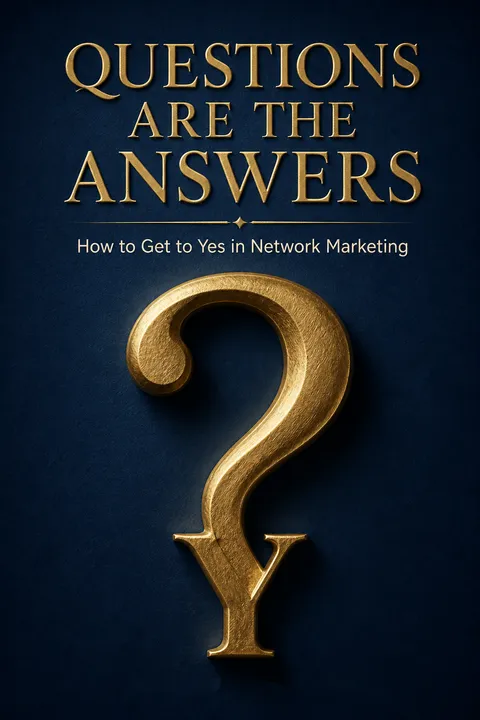


Key Takeaways
Stop pitching — ask five questions and let prospects sell themselves
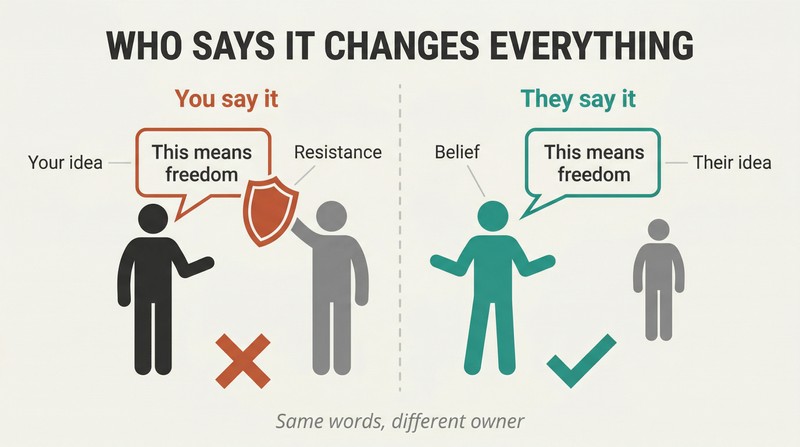
The book's core insight is counterintuitive: people resist what you tell them but believe what they tell you. If you say "This business gives you financial freedom," your prospect can object. But if they say those exact words, the statement becomes irrefutable — it was their idea. Pease's Four Keys Technique structures every conversation around this asymmetry:
1. Melt the Ice (build rapport and trust)
2. Find the Hot Button (uncover the prospect's Primary Motivating Factor — their deepest emotional reason to act)
3. Press the Hot Button (present the plan as their solution)
4. Get a Commitment
The entire system is designed so your prospect does most of the talking. You ask, listen, and reflect — never argue or persuade.
Double your presentations before you try to improve your pitch
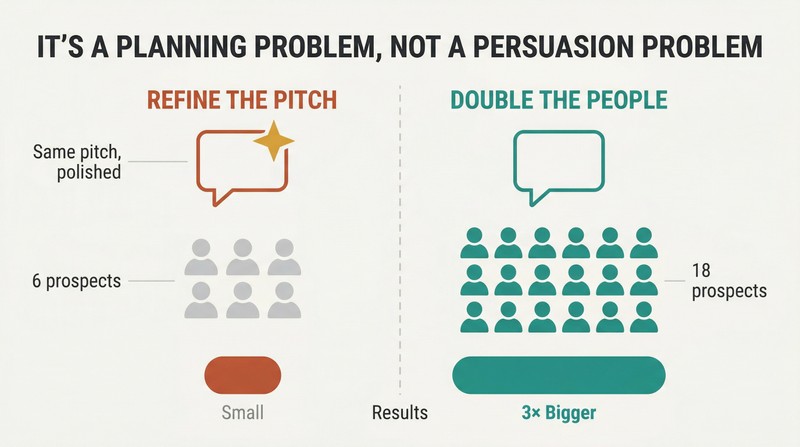
Pease's first three rules are identical: see more people, see more people, see more people. It's a planning problem, not a persuasion problem. By age 21, Pease had sold over a million dollars of insurance, owned a home, and drove a Mercedes — not through charisma, but through organizing his calendar to get five "yes" appointments as fast as humanly possible.
His prescription for every business ailment is the same: increased activity. Feeling depressed? Double your presentations. Growth stalling? See more prospects. Want to double your results immediately? See next year's prospects this year — call them now. Every problem yields to volume.
Assign a dollar value to every call and rejection stops hurting
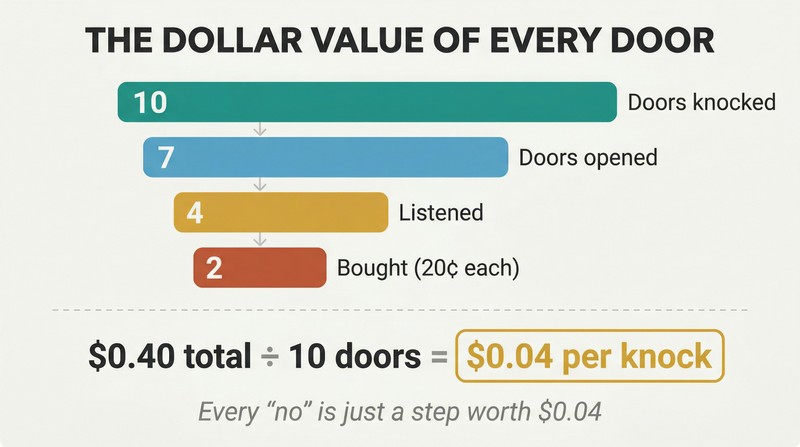
Rejection is just arithmetic. As an 11-year-old selling sponges door-to-door, Pease tracked his ratios: every 10 doors knocked yielded 7 opens, 4 listeners, and 2 buyers at 20 cents each — meaning every door-knock was worth 4 cents regardless of outcome. Later in insurance, his 10:5:4:3:1 ratio meant every phone answer earned $30. He taped a dollar sign beside his phone as a reminder.
The practical move: record your own ratios of calls, appointments, presentations, and sign-ups. Once you know each call has a fixed dollar value, a "no" stops feeling like failure. It's just a required step in the sequence. You stop chasing buyers and start making calls.
Never assume your prospect's top motivation matches yours
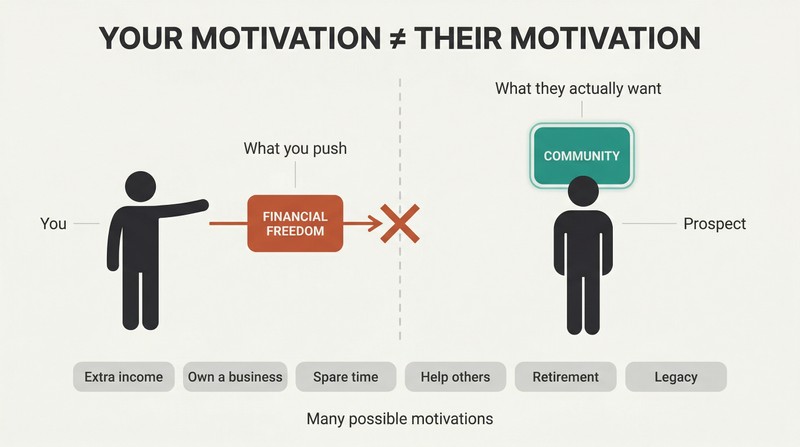
Your chocolate isn't everyone's flavor. A prospect's Primary Motivating Factor is their single deepest emotional reason to join — and common PMFs range widely: extra income, financial freedom, owning a business, spare time, personal development, helping others, meeting people, retirement, or leaving a legacy.
Albert passionately pitched financial freedom to Ron, who actually cared about community involvement. Ron never joined. Jan assumed her fifty-something prospect wanted retirement; he told her retirement felt like "an early death." Both lost recruits by projecting their own motivation. The twist: even a correct guess backfires, because it registers as the presenter's agenda rather than the prospect's own conviction.
Five escalating questions move prospects from indifferent to fired up
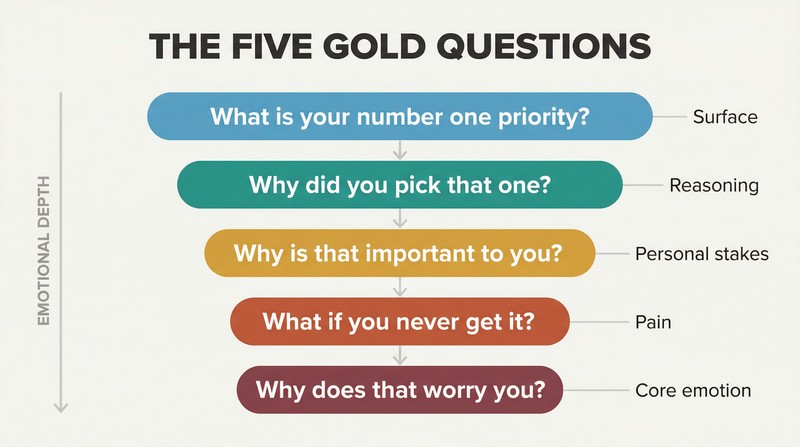
The Five Solid Gold Questions are the book's centerpiece, asked in strict order to progressively deepen emotional commitment:
1. "What is your number one priority?" (identifies the PMF)
2. "Why did you pick that one?" (first layer of reasoning)
3. "Why is that important to you?" (deeper personal stakes)
4. "What are the consequences of not having that opportunity?" (introduces pain)
5. "Why would that worry you?" (maximum emotional intensity)
Each question tightens the emotional screw. Pease's dentist Frank — wealthy, successful, miserable — realized during these questions that an 18-year-old's snap college decision had controlled his life for 26 years. Within months he'd abandoned his practice. Self-generated emotion is far more powerful than any pitch.
Echo their exact words back when you show the business plan
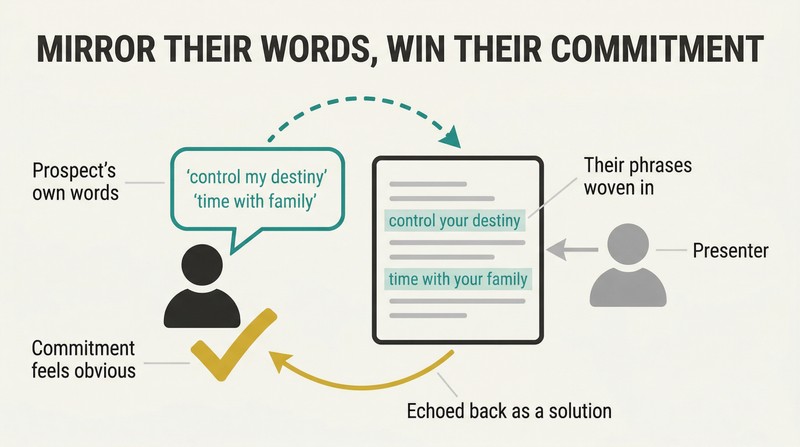
Make it their plan, not yours. Once the Five Solid Gold Questions have uncovered a prospect's deepest motivations, weave their specific language into your business presentation. Don't say generic benefits — say: "This means you can control your own destiny and have more time with your family," using the exact phrases they voiced minutes earlier.
This transforms an abstract pitch into a personal roadmap. When prospects hear their own goals, fears, and words reflected in a proposed solution, commitment feels like the obvious next step. Logic opens the mind, but hearing your own dreams articulated in a business plan opens the door. If the emotional groundwork is solid, asking for commitment becomes a formality, not a dramatic close.
Weak emotional answers predict weak business partners — plant strong seeds
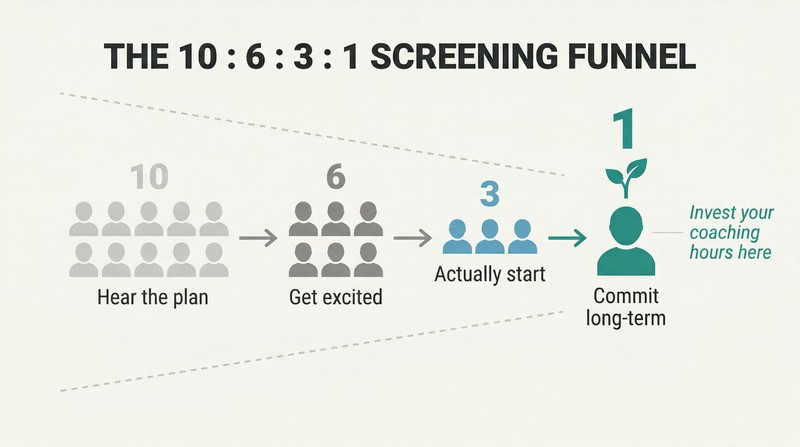
Treat the Five Gold Questions as a screening interview. If a prospect gives off-handed, vague, or unconvincing answers, they're signaling low long-term commitment. Pease compares network building to gardening: strong seeds grow regardless of the gardener, but weak seeds require constant propping and rarely become healthy plants. Don't fool yourself into believing encouragement alone can transform a disengaged recruit.
A typical network marketing ratio is 10:6:3:1 — of every 10 who hear the plan, 6 get excited, 3 actually start, and only 1 becomes a productive long-term distributor. Sponsor broadly, but invest your coaching hours with the prospects who showed genuine fire during the questions. Depth of emotional answers is your best predictor.
Use one-word bridges to crack open even the quietest prospects
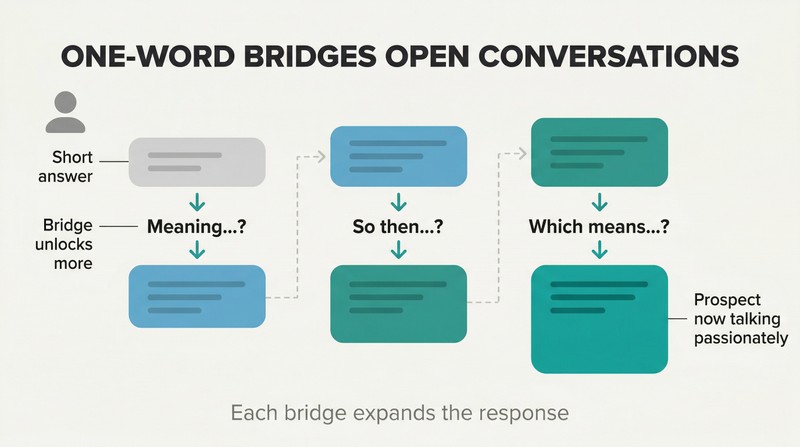
When prospects give short answers, don't fire another open-ended question — it sounds like an interrogation. Instead, use a "bridge ": a single word or phrase that hands the conversation back. Powerful bridges include: "Meaning...?", "For example...?", "Which means...?", "So then...?", and "Therefore...?"
Three steps make bridges work:
1. Lean forward with palm facing out
2. Stretch the last syllable of the bridge word
3. Lean back and stay completely silent
In one example, a tight-lipped engineer named Fred gave single-sentence answers until the presenter used bridges. Within three exchanges, Fred was talking passionately about his frustrations and ambitions — all without a single traditional question being asked.
Your body carries 60-80% of your message — words carry under 10%
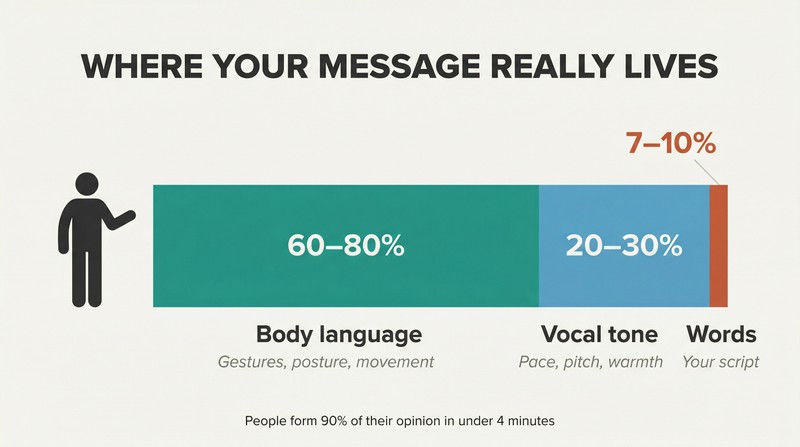
Words are a sideshow. Pease's body language research shows that in face-to-face presentations, body language accounts for 60-80% of total impact, vocal tone covers 20-30%, and actual words contribute just 7-10%. How you gesture, sit, and move matters six to eight times more than your script.
Key presentation adjustments:
1. Use Palm-Up gestures (non-threatening) rather than finger-pointing (listeners recall less of what finger-pointers say)
2. Keep your arms uncrossed — audience members with crossed arms retain 38% less information
3. Dress for your prospect's expectations, not your own comfort
4. Use an equal-pressure, straight-palm handshake to signal rapport rather than dominance
5. Hold drinks, folders, and bags in your left hand so your right is always free to greet
Mirror posture and match speech speed to build unconscious rapport
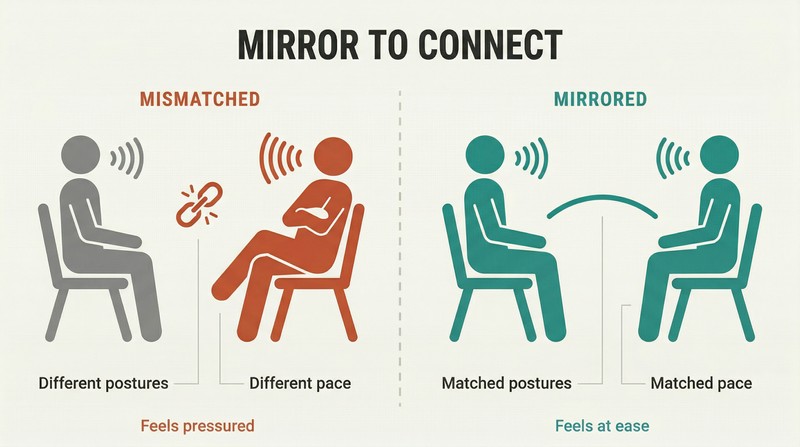
Rapport is physical before it's verbal. When two people are mentally in sync, their bodies naturally adopt matching postures — same gestures, same angles, even synchronized blinking. You can reverse-engineer this: consciously match someone's seating position, body angle, expressions, and tone. Before long, they'll describe you as "easy to be with" because they see themselves reflected in you.
Pacing — matching speech speed and inflection — is especially critical on phone calls where voice is your only medium. Speaking faster than your prospect triggers a feeling of being pressured. The Head Nod Technique amplifies this: nod during your prospect's answer, then continue nodding five extra times at one nod per second. Usually by the fourth second, they'll start talking again and reveal more information.
Analysis
Pease's book occupies an interesting niche at the intersection of sales psychology, body language research, and network marketing recruitment. The central insight — that people don't resist ideas, they resist being told ideas — predates motivational interviewing research but arrives at remarkably similar conclusions. People are far more compelled by self-generated reasons than by external persuasion, regardless of how enthusiastic or logical that persuasion may be.
The Five Solid Gold Questions function as an escalating emotional commitment funnel. They progress from cognitive ('What's your priority?') to deeply personal ('What are the consequences of not having it?') to emotionally acute ('Why would that worry you?'). This structure mirrors pain-agitation-solution frameworks used in copywriting, cognitive behavioral therapy, and Socratic questioning — making the methodology more universally applicable than its network marketing packaging suggests.
The book's relentless emphasis on volume (the first three rules are identically 'see more people') reflects network marketing's dependency on large prospecting pools, but contains a universal truth about probabilistic domains: sample size beats skill refinement up to a point. Pease's dollar-per-call framework is essentially a behavioral economics hack — reframing variable outcomes as expected value neutralizes loss aversion and transforms rejection from an emotional event into an accounting entry.
The body language material, drawn from Pease's earlier bestselling work, is practically rather than academically integrated. The finding that arm-crossing reduces audience retention by 38% transforms body language from cocktail party trivia into a presentation design variable. The mirroring and pacing techniques anticipated rapport-building methodologies that would later populate NLP and executive coaching curricula.
Where the book shows its age is in its binary gender essentialism and some MLM-specific assumptions about infinite prospect pools. But stripped to its structural chassis — ask instead of tell, track instead of hope, read bodies instead of just words — the framework remains surprisingly transferable to any persuasion context: B2B sales, fundraising, management conversations, and beyond.
Review Summary
Questions Are the Answers receives mixed reviews. Many find it useful for sales and networking, praising its practical tips on body language, asking questions, and creating positive impressions. Some appreciate its concise format and straightforward advice. However, critics argue it's outdated, manipulative, and too focused on network marketing. The book's effectiveness seems to depend on the reader's goals and experience level. While some consider it essential for sales professionals, others find it basic or irrelevant. Overall, it's viewed as a quick read that may offer valuable insights for those in sales or seeking to improve their communication skills.
Glossary
Primary Motivating Factor (PMF)
Prospect's deepest reason to joinThe single most important emotional reason a prospect would join a network marketing business. Common PMFs include extra income, financial freedom, owning a business, spare time, personal development, helping others, meeting new people, retirement, and leaving a legacy. The PMF differs from person to person and must be uncovered through questioning, never assumed.
Five Solid Gold Questions
Sequential questions uncovering the PMFA fixed sequence of five questions asked in strict order to progressively deepen a prospect's emotional commitment: (1) What is your number one priority? (2) Why did you pick that one? (3) Why is that important to you? (4) What are the consequences of not having that opportunity? (5) Why would that worry you? Each question intensifies emotional engagement.
Four Keys Technique
Four-stage framework for getting yesA structured progression for moving prospects from initial contact to commitment: (1) Melt the Ice—build rapport and trust; (2) Find the Hot Button—uncover the prospect's Primary Motivating Factor using the Five Solid Gold Questions; (3) Press the Hot Button—present the business plan as the solution to the prospect's stated desires and fears; (4) Get a Commitment—ask them to join.
Bridging
One-word prompts extending prospect responsesA conversational technique using short phrases like 'Meaning...?', 'For example...?', or 'Which means...?' to keep a prospect talking without asking traditional questions. Performed in three steps: lean forward with palm out, stretch the last syllable of the bridge word, then lean back and remain silent. Prevents the conversation from sounding like an interrogation.
Law of Averages
Consistent activity yields predictable ratiosThe principle that performing the same activity repeatedly under similar circumstances produces a constant statistical result. In Pease's framework, tracking personal ratios of calls-to-appointments-to-presentations-to-sales reveals a fixed dollar value per activity, removing emotional volatility from rejection and focusing effort on volume rather than individual outcomes.
Minimal Encouragers
Short verbal cues sustaining conversationBrief verbal prompts—such as 'I see...', 'Uh-huh...', 'Really?', and 'Tell me more...'—used while listening to encourage a prospect to continue speaking. When combined with head nodding and bridging, minimal encouragers can more than double the amount of information a prospect shares during a conversation.
Palm Power
Palm orientation signals authority levelA body language principle identifying three palm positions and their psychological effects: Palm-Up conveys openness and non-threat; Palm-Down communicates authority and dominance; Palm-Closed-Finger-Pointed acts as a symbolic club that irritates listeners. Research shows audiences rate finger-pointing speakers as more aggressive and recall less of what they said.
FAQ
What's "Questions Are the Answers" by Allan Pease about?
- Network Marketing Focus: The book is a guide to succeeding in network marketing by using effective communication techniques.
- Question-Based Approach: It emphasizes the power of asking the right questions to engage prospects and get them to say 'yes.'
- Practical Techniques: Allan Pease provides a system of techniques and principles that can be easily learned and applied.
- Personal Development: It also touches on personal growth and understanding human behavior to improve sales skills.
Why should I read "Questions Are the Answers"?
- Proven Techniques: The book offers tried-and-tested methods that have been successful in network marketing.
- Simple System: It provides a straightforward system that doesn't require you to be a high-powered salesperson.
- Personal Growth: Reading it can enhance your communication skills and understanding of human behavior.
- Financial Freedom: It offers insights into achieving financial success through network marketing.
What are the key takeaways of "Questions Are the Answers"?
- Ask Questions: The core strategy is to ask questions that lead prospects to express their own reasons for joining.
- Understand Motivations: Identifying a prospect's Primary Motivating Factor is crucial for success.
- Body Language: Understanding and using body language can significantly impact your presentations.
- Law of Averages: Success in network marketing is a numbers game; the more people you approach, the more successful you'll be.
How does the "Four Keys Technique" work in "Questions Are the Answers"?
- Melt the Ice: Build rapport with prospects by sharing about yourself and learning about them.
- Find the Hot Button: Discover the prospect's Primary Motivating Factor to join the business.
- Press the Hot Button: Use the prospect's own words and motivations to present the business plan.
- Get a Commitment: Ask for a commitment when the prospect is emotionally ready and motivated.
What is the "Law of Averages" in "Questions Are the Answers"?
- Numbers Game: The law states that the more people you approach, the more successful you'll be.
- Consistent Results: Doing the same thing repeatedly under the same conditions will yield consistent results.
- Motivation: Understanding this law helps maintain motivation despite rejections.
- Record Keeping: Keeping track of your averages can help you improve and stay focused.
What are the "Five Solid Gold Questions" in "Questions Are the Answers"?
- Identify Priorities: Ask prospects about their number one priority to join the business.
- Understand Importance: Inquire why they picked that priority and why it's important to them.
- Consequences: Ask about the consequences of not achieving that priority.
- Emotional Impact: Understand why those consequences would worry them.
- Prospect's Words: These questions help prospects verbalize their motivations, making them more likely to commit.
How does body language play a role in "Questions Are the Answers"?
- Non-Verbal Cues: Body language is a significant part of communication, impacting how messages are received.
- Reading Signals: Understanding gestures and expressions can help gauge a prospect's interest and emotions.
- Positive Impressions: Techniques like the handshake, smile, and eye contact can create positive impressions.
- Mirroring: Mirroring a prospect's body language can build rapport and make them feel comfortable.
What is the "Primary Motivating Factor" in "Questions Are the Answers"?
- Core Motivation: It's the main reason a prospect would join a network marketing business.
- Varied Reasons: Motivations can include financial freedom, extra income, personal development, etc.
- Personalized Approach: Understanding this factor allows for a tailored presentation that resonates with the prospect.
- Emotional Connection: Identifying and addressing this factor can lead to a stronger emotional connection and commitment.
What are some effective presentation skills from "Questions Are the Answers"?
- Bridging: Use bridges to keep conversations flowing and avoid sounding like an interrogation.
- Head Nod Technique: Nodding can encourage agreement and keep the conversation going.
- Minimal Encouragers: Use phrases like "I see" or "Tell me more" to encourage prospects to share more.
- Eye Control: Maintain eye contact to ensure your message is received effectively.
What are the best quotes from "Questions Are the Answers" and what do they mean?
- "Success is a game - the more times you play the more times you win.": This emphasizes the importance of persistence and activity in achieving success.
- "There are no uninterested prospects, only uninteresting presentations.": Highlights the need for engaging and relevant presentations to capture interest.
- "The Law of Averages will always work for you.": Reinforces the idea that consistent effort will yield results over time.
- "Find Hot Buttons and press them and building your network will be simple.": Stresses the importance of understanding and leveraging a prospect's motivations.
How can "Questions Are the Answers" help in personal development?
- Communication Skills: Enhances your ability to communicate effectively and persuasively.
- Self-Awareness: Encourages understanding of your own body language and presentation style.
- Confidence Building: Provides techniques that can boost confidence in sales and networking situations.
- Emotional Intelligence: Improves your ability to read and respond to others' emotions and motivations.
What is the promise made in "Questions Are the Answers"?
- Learn the Technique: The book promises that if you learn the technique by heart and practice it, the results will be beyond your wildest dreams.
- Two-Way Deal: It requires a commitment to practice and not change a word for the first 14 days.
- Proven Success: The system has been used to achieve significant success in various business ventures.
- Life-Changing Potential: The techniques can dramatically change your life if you stick to the system.
About the Author




Download PDF
Download EPUB
.epub digital book format is ideal for reading ebooks on phones, tablets, and e-readers.








































