

Key Takeaways
A derelict radar base allegedly hid America's secret time-travel program
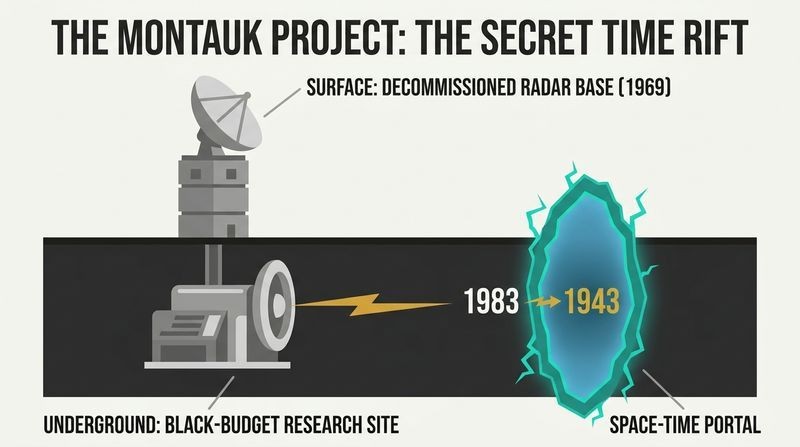
At the eastern tip of Long Island sits Montauk Point, home to a scenic lighthouse and, beside it, the abandoned Air Force station at Camp Hero. Officially decommissioned in 1969, the book claims it was quietly reactivated and run for over a decade with no traceable government funding, culminating in 1983 when the project supposedly tore a hole in space-time back to 1943.
The narrator is Preston Nichols, an electrical engineer specializing in electromagnetic phenomena. He stumbled onto the site while investigating a signal that jammed psychics, salvaged its abandoned equipment, and gradually recovered memories suggesting he himself had been the project's technical director. Locals, a homeless ex-technician, and psychics all recognized him, launching his decade-long inquiry.
The setup borrows the classic architecture of conspiracy narrative: a real, verifiable location (Camp Hero exists and was a genuine SAGE radar site), an untraceable money trail, and an insider whose credibility rests on recovered memory. What makes it compelling rather than dismissible is the mix of the checkable and the uncheckable. Folklorists call this ostension, where a community acts out and elaborates a legend until the legend leaves physical traces. Readers should notice how the strongest evidence offered is always social (people recognizing Preston) rather than documentary, a pattern that recurs throughout and quietly shifts the burden of proof onto the skeptic.
Radar invisibility that accidentally erased a ship from reality itself
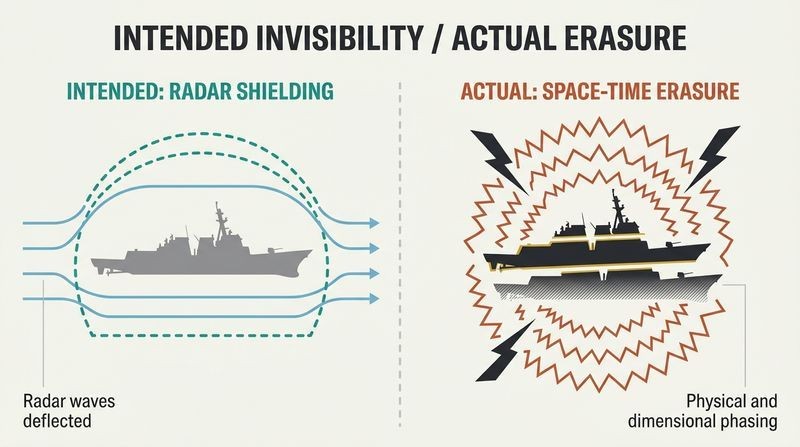
The origin story is the 1943 Philadelphia Experiment, code-named the Rainbow Project. The Navy allegedly tried to make the destroyer USS Eldridge invisible to radar by wrapping it in an electromagnetic bottle, a field meant to bend radar waves around the hull. Instead, the book claims, the ship vanished from sight entirely, left the space-time continuum, and briefly reappeared hundreds of miles away in Norfolk, Virginia.
The human cost was catastrophic. Crewmen returned disoriented and insane, and some were reportedly fused into the ship's steel bulkheads. Survivors were discharged as mentally unfit, conveniently discrediting their testimony. Mathematician John von Neumann led the work before being pulled to the Manhattan Project. This disaster supposedly seeded decades of follow-up research into why electromagnetic fields shatter the human mind.
The Philadelphia Experiment is itself a well-documented piece of modern folklore, traceable to letters from a man named Carlos Allende in the 1950s, with the Navy repeatedly denying any such test. The physics claim conflates radar cross-section reduction (real stealth technology) with teleportation and time displacement (not established science). The bulkhead-fusion image is a genuinely haunting piece of horror writing, and its narrative function is important: it explains why no survivors can corroborate anything. The book treats an unfalsifiable rumor as bedrock fact, then builds four decades of story atop it, a foundation-by-assertion move worth watching.
Tuned radio pulses can be a window straight into the human mind
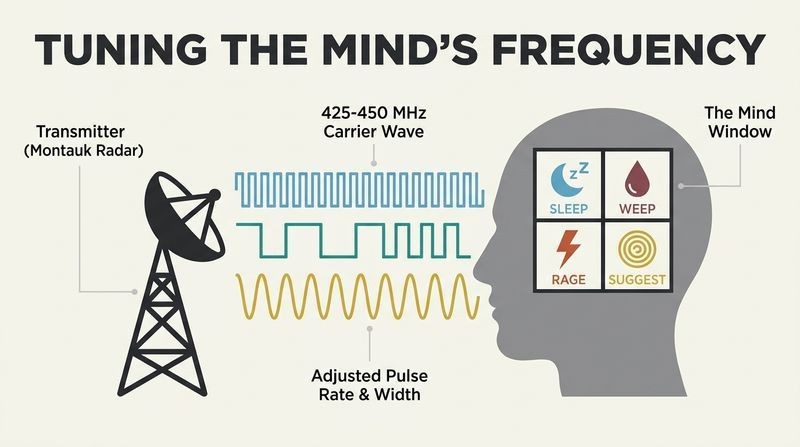
Preston's entry point was studying telepathy, which he claims behaves like a radio wave but does not fully obey normal wave physics. He noticed his psychics went mentally blank every day at the same hour, traced the interference to a 410-420 MHz signal, and followed it to Montauk's radar antenna.
The project allegedly weaponized this. Technicians found that altering the radar's pulse rate, pulse width, and frequency, especially in the 425-450 MHz band described as a window frequency into consciousness, could reliably make a person sleep, weep, rage, or become suggestible. They tested on soldiers lured to the base for free rest and relaxation, and on surrounding townspeople. The local police chief reportedly confirmed inexplicable crime and behavior occurring in neat two-hour cycles.
There is a real scientific kernel buried here. Research into the effects of electromagnetic fields on neural tissue exists, and the microwave auditory effect (the Frey effect) is genuine. But the leap from measurable biological effects to precise, remote emotional programming vastly outruns the evidence. The claim that emotions map cleanly onto specific pulse widths treats the brain like a radio receiver, an appealing but reductive metaphor. The two-hour crime cycles are the kind of pattern the human mind manufactures from noise, a phenomenon cognitive scientists call apophenia. Still, the fear it taps, that unseen signals steer our moods, is culturally potent and increasingly resonant in an era of algorithmic influence.
A psychic's imagination, amplified by computers, materialized objects from thin air
The centerpiece is the Montauk Chair, allegedly built from a 1950s ITT mind-reading device. A person sat inside a cage of coils that read their aura, or electromagnetic field; three receivers fed a Cray computer that translated raw thought into printed dialogue, images, and eventually 3-D representations of what the person imagined.
The team then ran the chair in reverse, turning a mind-reader into a transmitter. With psychic Duncan Cameron in the chair, they claim his concentration could precipitate solid objects out of the ether, project his sight through other people's eyes (the Seeing Eye), and implant thoughts into targets who would then obey. Duncan's conscious mind was reportedly bypassed through an induced orgasmic trance so his suggestible primitive mind could be programmed at will.
This is where the narrative moves from disputed history into pure metaphysics. The idea of an aura as a readable electromagnetic signature is not supported by physics; the human body's electromagnetic emissions are faint and carry no known semantic content. The vintage supercomputer name-dropping (Cray, IBM 360) lends technological texture, a rhetorical technique of specificity that makes fantastic claims feel grounded. Notably, the entire time-travel apparatus depends on one irreplaceable psychic, which conveniently means the machine cannot be tested without him. The sexualized trance detail echoes real controversies around hypnosis and coercive control, lending the account a lurid, MKUltra-adjacent atmosphere that the book leans into.
Time itself supposedly opens on a twenty-year planetary rhythm peaking August 12
To bend time, the project allegedly used a Delta T antenna, an octahedral (double-pyramid) structure buried underground and designed to warp the time field. Combined with a zero time reference generator (a Tesla-derived device that locks onto the rotation of the Earth) and white noise to make the transmitter coherent, it created stable time portals a person could walk through.
The crucial claim: Earth has a biorhythm that peaks every twenty years around August 12. The years 1943, 1963, and 1983 became anchor points, and the master vortex ran between 1943 and 1983. Travelers were reportedly sent into the future to a dead city in the year 6037, always to a square with a gold horse bearing mysterious inscriptions they were told to read.
The twenty-year cycle is narratively elegant because it retroactively links the Philadelphia Experiment (1943) to Montauk (1983) with numerological tidiness, exactly the kind of pattern that signals storytelling rather than data. Real geophysics knows no such planet-wide temporal pulse. The Tesla and zero-time material exploits the genuine mystique around Nikola Tesla, whose real genius is routinely conscripted into pseudoscience. The gold horse in the ruined future city is a striking image with no follow-through, characteristic of dream logic. What the section reveals is how the book generates awe: it names precise dates, coordinates, and hardware, then attaches them to events no instrument recorded.
When you claim to live two timelines, memory stops being evidence
The book openly grades its own claims: hard facts have documentation, soft facts are plausible but unproven, and gray facts sit between. It concedes that hard facts about Montauk are nearly impossible to obtain, and can be read as science fiction if the reader prefers.
Preston's proof of his double life is entirely experiential. Band-aids appeared on his hand with no memory of injury. He found a mahogany office at his defense employer with his own nameplate reading Assistant Project Director, then returned days later to find every trace erased. He concluded he had been shuttled between two time tracks, and only recovered his memories while soldering a Delta T antenna on his roof, which supposedly bent time enough to unblock him.
This is the book's most philosophically interesting move and its greatest vulnerability. By elevating recovered memory over documentation, it makes itself unfalsifiable: any missing evidence proves the cover-up, and any memory, however implausible, counts as data. This mirrors the recovered-memory controversies of the late 1980s and 1990s, when therapeutic techniques were shown to reliably generate vivid false memories (work by Elizabeth Loftus is definitive here). The self-erasing office is a perfect epistemic trap. The honesty of the soft-facts framing is genuinely disarming, yet it also functions as insurance, letting the authors claim nonfiction status while pre-excusing every gap.
Wilhelm Reich's orgone theory allegedly powered secret weather control
The book credits the controversial psychiatrist Wilhelm Reich, a former associate of Freud, with the foundational technology. Reich claimed to discover orgone (life energy) and its stagnant opposite DOR (dead orgone), and said violent storms accumulate DOR. His real-life persecution is invoked as evidence: the FDA did burn his books and destroy his lab equipment.
The government supposedly merged Reich's storm-busting device with its weather balloons to create the radiosonde, launching roughly 200 a day. Preston, a surplus-radio collector, argues the giveaway is that no matching receivers ever existed and the tubes were engineered to burn out in three hours, misinformation designed so amateurs would never discover the units' true function as orgone and DOR antennas for weather manipulation.
Reich is a tragic real figure whose persecution genuinely happened, which lends the section emotional legitimacy. But orgone energy has never been demonstrated to exist under controlled conditions, and the entire weather-control edifice rests on it. Preston's radiosonde argument is actually his most falsifiable and clever: it makes checkable claims about hardware, spec sheets, and missing receivers. That is a refreshing contrast to the psychic material. Yet absence of a receiver has mundane explanations (data telemetry standards changed, surplus markets are incomplete). The section shows the book at its most empirical, and reveals how a real historical injustice can be recruited to authenticate an unrelated fantastical claim.
They killed the project by unleashing a monster from a psychic's subconscious
By August 12, 1983, the equipment allegedly locked onto the USS Eldridge across forty years, connected by the twenty-year biorhythm and a witness effect (using objects, people, and the original zero-time generator to link the two eras). A dissenting faction of technicians had secretly planted a shutdown trigger.
The trigger was a whispered phrase to Duncan in the chair: the time is now. He then loosed a large, hairy beast from his subconscious that rampaged across the base, smashing buildings, described by different witnesses as anywhere from 9 to 30 feet tall. Preston finally stopped it only by cutting the transmitter's power cables with an acetylene torch. The beast faded, the portal closed, and the base was later sealed with truckloads of concrete.
The Beast is the narrative's climax and its most mythic element, a tulpa or thoughtform lifted straight from Tibetan mysticism and Forbidden Planet, whose monster from the id it closely resembles. That witnesses report wildly different sizes is presented as authenticating (fear distorts perception) but is equally consistent with a story retold and embellished. The saboteur subplot gives the tale a moral arc: insiders of conscience bring down the machine, echoing the whistleblower archetype. Sealing the underground in concrete is the perfect unfalsifiable ending, physically foreclosing verification. As pure storytelling, this is the book's most vivid and memorable set piece.
The follow-up investigation found real anomalies but no smoking gun
Part Two, by co-author Peter Moon, chronicles a twenty-five-year investigation split into two trails. The occult trail chased eerie coincidences around the surname Cameron, linking it to occultist Aleister Crowley (who really did visit Montauk and mention a Duncan Cameron in his writings) and to buried pyramids on sacred Montauket Indian land.
The journalistic trail is more concrete. Moon documents illegal transmissions from the supposedly abandoned base in the mind-control frequency range, a mysterious radar run by Cardion, a firm later owned by Siemens (the German company that supplied Nazi camps), strangely coordinated flocks of birds and mutilated deer, a suspicious quitclaim deed, and the bizarre imprisonment of UFO investigator John Ford on flimsy charges after he crossed powerful local politicians.
The investigation is genuinely the book's strongest section because it deals in checkable municipal reality: court cases, property deeds, corporate ownership, and FCC frequency violations. Long Island did host Nazi-sympathizer enclaves in the 1930s (Camp Siegfried was real), and local political corruption is a documented feature of the region. The problem is inference: real anomalies (illegal transmissions, opaque land deals) get folded into the grand time-travel thesis without independent linkage. This is the ecological fallacy of conspiracy thinking, where scattered true facts are assumed to share a single hidden cause. The John Ford case is a real, troubling story that deserves scrutiny on its own civil-liberties merits, independent of UFOs.
A modern scientist argues time travel needs only ordinary physics, not magic
The updated edition pivots to Dr. David Anderson and his Time Travel Research Center. His key claim is that time travel fits within standard relativity via the Invariance of the Space-Time Interval, the principle that the space-time separation between two events is identical for all observers regardless of motion. Because light speed lets time be expressed as distance, time becomes navigable geometry rather than mystery.
Using tipped light cones and Closed Time-like Curves (circular worldlines that loop back to their origin), Anderson claims his time reactor curves space-time to release space-time motive force, generating both abundant energy and time-warped fields. A demonstration video shows an amaryllis blooming in three minutes instead of four days. His patent was allegedly sequestered under the 1951 Invention Secrecy Act.
This section swaps psychic mysticism for the vocabulary of legitimate physics, and the underlying concepts are real: the invariant space-time interval, light cones, and Closed Time-like Curves (formalized by Kurt Godel in 1949) are genuine relativity. The rhetorical upgrade is significant, giving the sequel an air of respectability the original lacked. But real CTCs require extreme conditions (Godel's rotating universe, Tipler cylinders, traversable wormholes with exotic negative-energy matter), none of which a tabletop reactor provides. Space-time motive force is not a recognized quantity. The Invention Secrecy Act is real and has classified thousands of patents, which conveniently explains why Anderson's device cannot be found or tested.
Challenging the mind's fixed sense of time provokes fierce, telling denial
Moon proposes a psychology of space-time to explain the hostility the subject attracts. Humans, he argues, are consciously riveted to a regimented perception of time; when that scaffolding is threatened, the ego feels attacked and reacts with irrational anger, blankness, or dismissal. He reports professors declaring that if time travel were real they would have done it themselves, and journalists backing away once they discover the base was genuinely active.
He frames three forces at work: dimension, power, and censorship. The technology's sheer power, he claims, makes people emotionally seize ownership of it or lash out, while censorship operates not only through governments but through self-imposed mental limits that keep the possibility of time travel walled off from ordinary consciousness.
There is a shrewd insight buried here: paradigm-threatening claims do provoke disproportionate emotional responses, a phenomenon Thomas Kuhn documented in the sociology of science and Leon Festinger captured in cognitive dissonance theory. But the argument is a double-edged sword the book wields only one way. Treating skepticism as proof of a psychological wound is a classic thought-terminating move, immunizing the thesis against criticism by reframing all disbelief as denial rather than reasoned doubt. Genuine science invites falsification; this framing forecloses it. The most valuable takeaway for a reader is meta: notice when a claim explains away its critics instead of answering them.
Analysis
The Montauk Project is best understood not as a technical report but as a foundational text of late-twentieth-century American conspiracy folklore, a genre unto itself. Published in 1992 and expanded across twenty-five years, it fuses three real cultural anxieties: Cold War secrecy (MKUltra was genuinely exposed in 1977), the recovered-memory movement then cresting in clinical psychology, and New Age metaphysics. Its genius is architectural. It anchors each fantastical claim to something verifiable: Camp Hero exists, Wilhelm Reich was persecuted, von Neumann and Tesla were real geniuses, Crowley did visit Montauk, and Long Island did harbor Nazi sympathizers. This scaffolding of true facts bears a superstructure of unfalsifiable assertion.
Epistemically, the book is a masterclass in insulation. Its own soft-facts framing pre-excuses missing evidence; recovered memory trumps documentation; the base is literally entombed in concrete; the modern time reactor is classified by statute; and skepticism itself is reframed as psychological wounding. Every avenue of disconfirmation is sealed in advance, which is precisely why the account cannot function as science, however it dresses in relativity's vocabulary.
Yet dismissing it entirely misses why it endures. As narrative, it is inventive and genuinely eerie, spawning films, series, and the aesthetic DNA of Stranger Things. It dramatizes legitimate fears with uncanny prescience: that unseen electromagnetic signals shape our moods (now a live debate about algorithmic manipulation), that institutions run experiments on unwitting citizens (historically true), and that memory is fragile and manipulable (empirically established). The book's real value for a discerning reader is as a specimen. Study how it builds authority through specificity, how it converts absence of evidence into evidence of cover-up, and how it recruits real tragedy to authenticate invention. Read as literature and as a cautionary lesson in reasoning, it is far more instructive than it is as history.
People Also Read









Glossary
Philadelphia Experiment (Rainbow Project)
1943 Navy invisibility test gone wrongThe book's origin event: a 1943 attempt to make the destroyer USS Eldridge invisible to radar using an electromagnetic field. It allegedly caused the ship to vanish visibly, teleport to Norfolk, and leave the space-time continuum, driving the crew insane and fusing some into the ship's steel. It is presented as the seed of all later Montauk research.
Montauk Project (Phoenix II/III)
Secret Long Island time and mind experimentsThe colloquial name for alleged secret experiments at Camp Hero, Montauk Point, running roughly 1971 to 1983. The book claims it developed electromagnetic mind control, thought materialization, and eventually time travel, financed by untraceable (allegedly Nazi) money and operating outside government oversight after Congress refused to fund it.
Electromagnetic bottle
Field that isolates space from realityA claimed technology that surrounds a defined space with an electromagnetic field, creating a bottle effect that isolates people and objects inside from the normal space-time continuum. Said to explain both the Eldridge's invisibility and the disorientation of anyone caught within it, because the interior loses all normal time references.
Montauk Chair
Psychic thought-amplifying deviceA chair ringed with coils that allegedly read a person's aura and, via computers, translated their thoughts into images or printouts. Run in reverse as a transmitter, it supposedly let psychic Duncan Cameron materialize objects from the ether, see through others' eyes, implant thoughts, and open time portals.
Delta T antenna
Octahedral time-bending antennaDelta T means change in time. An octahedral (double-pyramid) antenna, often placed underground, claimed to bend or warp the time field when pulsed and powered. Combined with the Montauk Chair and a zero-time generator, it supposedly generated stable, walk-through time portals; even unpowered it allegedly exerts a subtle effect on time.
Orgone and DOR
Reich's life energy and its dead formConcepts borrowed from psychiatrist Wilhelm Reich. Orgone is a claimed life or sexual energy; DOR (Dead Orgone) is its stagnant, negative form said to accumulate in violent storms. The book claims the government harnessed both through radiosondes for weather control and possibly for influencing populations.
Radiosonde
Weather balloon as disguised orgone weaponA real weather-balloon instrument that the book reinterprets as a disguised orgone and DOR antenna for secret weather manipulation. Preston cites the apparent lack of matching receivers and deliberately short-lived tubes as evidence of a cover-up designed to keep amateurs from discovering the device's true function.
Zero time / twenty-year biorhythm
Planetary time cycle peaking August 12Zero time is described as the still center around which the universe rotates, used as a universal reference. The Earth allegedly has a biorhythm peaking every twenty years around August 12, making 1943, 1963, and 1983 anchor points that let the project link across time and stabilize its portals.
Witness effect
Occult object linking two eventsAn occult principle in which an object, person, or piece of technology connected to a target (like a lock of hair) can be used to link to or influence it. The book claims three levels of witnessing (people, hardware, and Earth's biorhythm) enabled the 1983 Montauk equipment to lock onto the 1943 Eldridge.
Invariance of the Space-Time Interval
Same event-separation for all observersA genuine relativity principle the sequel builds on: the space-time separation between two events is identical for every observer regardless of their motion. Because light speed lets time be expressed as distance, David Anderson argues time becomes navigable geometry, providing the theoretical basis for his claimed time-control technology.
Closed Time-like Curve
Worldline that loops to its originA real concept from general relativity (formalized by Kurt Godel in 1949): a path through space-time that curves back to its starting point, theoretically permitting time travel. The book presents it as a circular chain of tipped light cones and claims the Anderson time reactor produces such curves without exotic mass.
Space-time motive force
Anderson's coined free-energy sourceA term coined by David Anderson for energy allegedly released when two regions of slightly twisted space-time are coupled, supposedly yielding more energy out than in. He claims it powers a time reactor that generates both abundant clean energy and time-warped fields, and that his patent for it was classified under the Invention Secrecy Act.
FAQ
What is The Montauk Project: Experiments in Time by Preston B. Nichols about?
- Secret government experiments: The book investigates alleged secret experiments at Camp Hero, Montauk Point, focusing on time travel, mind control, and manipulation of reality.
- Origins in the Philadelphia Experiment: It traces the roots of these experiments to the infamous 1943 Philadelphia Experiment, which aimed for radar invisibility and resulted in unexpected time-space phenomena.
- Personal narrative and investigation: Preston B. Nichols shares his own memories and a 25-year investigation, blending firsthand accounts with scientific and metaphysical theories.
- Exploration of time and consciousness: The narrative delves into the nature of time, alternate realities, and the intersection of science, metaphysics, and the occult.
Why should I read The Montauk Project: Experiments in Time by Preston B. Nichols?
- Unique blend of science and metaphysics: The book combines scientific research, government conspiracy, and metaphysical insights, appealing to readers interested in the unknown.
- Reveals hidden history: It uncovers secret government projects and technologies that challenge conventional understanding of physics and reality.
- Inspiration for further research: The story encourages scientific, metaphysical, and journalistic exploration into the mysteries of time and consciousness.
- Detailed investigation and evidence: Supported by documents, interviews, and legal battles, the book provides a rich narrative for skeptics and believers alike.
What are the key takeaways from The Montauk Project: Experiments in Time by Preston B. Nichols?
- Time and reality are manipulable: The book suggests that time is not fixed but can be altered, looped, and accessed through technology and consciousness.
- Mind control and psychic phenomena: High-powered electromagnetic waves were allegedly used for mind control, mood manipulation, and even materializing objects from thought.
- Parallel realities and time loops: The narrative introduces the concept of alternate realities and time loops, accessible through advanced technology and psychic abilities.
- Intersection of science, occult, and politics: The story weaves together scientific theory, occult practices, and political intrigue, highlighting the complexity of secret projects.
What was the Philadelphia Experiment and how does it relate to The Montauk Project: Experiments in Time by Preston B. Nichols?
- Radar invisibility gone awry: The Philadelphia Experiment was a 1943 Navy project to make the USS Eldridge invisible to radar, which resulted in the ship disappearing from space-time.
- Human trauma and project suspension: Crew members suffered severe mental and physical effects, leading to the project's abrupt end.
- Foundation for Montauk: The Montauk Project is described as a direct continuation and expansion of the Philadelphia Experiment’s research into time and reality manipulation.
- Key scientific figures: Notable scientists like John von Neumann are linked to both projects, bridging the gap between early and later experiments.
What is the Montauk Chair and how was it used in The Montauk Project: Experiments in Time by Preston B. Nichols?
- Mind-reading technology: The Montauk Chair was developed to pick up electromagnetic signals from a person’s mind, translating thoughts into digital data.
- Computer and transmitter interface: Outputs from the chair were processed by advanced computers and used to modulate transmitters, projecting thought forms and influencing minds remotely.
- Central to time travel: The chair was crucial for synchronizing psychic input with electromagnetic fields, enabling the creation of time portals and manipulation of reality.
- Psychic operators: Individuals like Duncan Cameron used the chair to generate and stabilize time tunnels.
How does The Montauk Project: Experiments in Time by Preston B. Nichols explain time travel and time warping?
- Delta T antenna technology: A large underground antenna created distortions in the time field by phasing radio frequency signals with magnetic fields.
- Zero time reference: The project used a zero time generator and white noise modulation to synchronize transmissions with the universe’s fundamental time flow.
- Creation and stabilization of portals: Psychics generated time portals, which were initially unstable but later allowed for physical travel through time tunnels.
- Manipulation of time as a construct: Time is described as a hypnotic pulse that can be bent, looped, and altered through technology and consciousness.
What are the key scientific and metaphysical concepts in The Montauk Project: Experiments in Time by Preston B. Nichols?
- Time toroid and spheres: The book explains Einstein’s concept of the universe as a time toroid, with dynamic and static time particles forming alternate realities.
- Electromagnetic principles: It draws analogies between alternating current and parallel realities, suggesting electromagnetic fields can manipulate time and access other realities.
- Time reactor technology: Dr. David Anderson’s time reactor is discussed as a device that bends space-time, creating fields for time acceleration, deceleration, and travel.
- Quantum realities and consciousness: The narrative introduces quantum levels of existence, where consciousness and time operate on multiple dimensions.
Who was Duncan Cameron and what role did he play in The Montauk Project: Experiments in Time by Preston B. Nichols?
- Key psychic operator: Duncan Cameron was central to the project, generating thought forms, opening time portals, and traveling through time tunnels.
- Physical and psychic effects: He suffered severe brain and tissue damage from exposure to high-powered radio frequencies but survived due to his psychic abilities.
- Calibration and missions: Duncan’s mind was used to calibrate equipment, create time warps, and conduct missions, including exploring Mars and alternate realities.
- Instrumental in project outcomes: His psychic input was essential for the success and stability of the Montauk experiments.
How does The Montauk Project: Experiments in Time by Preston B. Nichols explain parallel realities and time loops?
- Alternate time loops: Parallel realities are described as alternate time loops or manifolds created by stresses on the time toroid.
- Coexistence and access: These realities coexist with the original and can be accessed through altered states, dreams, or technology like the Delta T antenna.
- Electromagnetic phase analogy: Parallel realities are ninety degrees out of phase with our normal reality, allowing potential energy to flow between them under certain conditions.
- Human perception and technology: While humans primarily perceive one reality, the Montauk Project allegedly enabled travel and interaction with others.
What is the connection between The Montauk Project: Experiments in Time by Preston B. Nichols and Mars missions?
- Exploration via time portals: The project used time portals to access underground areas beneath Martian pyramids, believed to be built by ancient civilizations.
- Remote viewing and physical entry: Psychics scouted Mars, and teams physically entered Martian complexes to investigate technology and defense systems.
- Science fiction parallels: The book notes similarities between these missions and popular culture, such as the movie Total Recall.
- Blending fact and speculation: These accounts highlight the book’s mix of investigative reporting and speculative fiction.
How does The Montauk Project: Experiments in Time by Preston B. Nichols relate to occult and secret societies?
- Occult connections: The book links the Montauk Project to figures like Aleister Crowley and the Wilson Brothers, suggesting occult practices influenced time manipulation experiments.
- Freemasonry and esoteric traditions: Freemasonry is described as codifying secret life processes, with hidden degrees and guarded knowledge influencing the project.
- Magical synchronicities: The investigation revealed “magical sympathies” and quantum affinities connecting names, places, and events.
- Parallel investigations: The occult thread runs alongside the scientific and journalistic narrative, adding a metaphysical dimension to the story.
What are the best quotes from The Montauk Project: Experiments in Time by Preston B. Nichols and what do they mean?
- “Synchronicity is the language of magick.” This highlights the authors’ belief that meaningful coincidences reveal hidden connections and guide investigations into secret knowledge.
- “In this world and time nothing happens by accident. If it happens, you can bet it was planned that way.” Encoded in a postcard from David Anderson, this suggests that time and events are orchestrated or influenced by unseen forces.
- “Life itself is a process of its own. Indigenous people... seek to imitate and harness this process... Freemasonry is completely patterned after such traditions.” This reflects the theme that secret societies attempt to control natural life forces, but life’s inherent unpredictability resists full control.
- Quotes as thematic anchors: These statements encapsulate the book’s blend of conspiracy, metaphysics, and the search for hidden truths.
Download PDF
Download EPUB
.epub digital book format is ideal for reading ebooks on phones, tablets, and e-readers.








































