

Key Takeaways
A committed UFO skeptic wakes to find something small in his bedroom
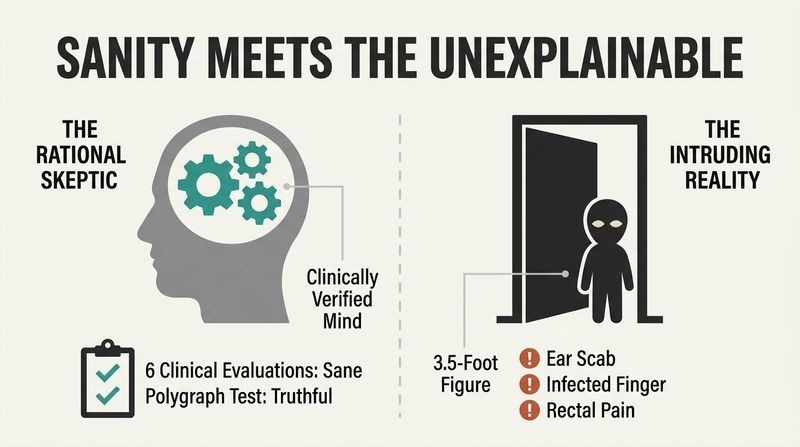
The story that upended a rational life. On December 26, 1985, Whitley Strieber, a successful novelist living a quiet life at a secluded New York cabin, woke to a strange whooshing sound. A compact figure roughly three and a half feet tall edged around his bedroom door. What followed was fragmented terror: being carried naked into the woods, a cramped round chamber, a needle described as aimed at his brain, and a probe.
He was no believer. Strieber had dismissed unidentified flying objects as misperceptions. Afterward, three psychologists and three psychiatrists examined him, plus a battery of tests and a polygraph, and found him sane and truthful. He also had physical aftereffects: an infected finger, rectal pain, a scab behind his right ear. Either something visited him, or the human mind manufactured something disturbingly close to physical reality.
The framing is shrewd: Strieber front-loads his credibility precisely because the content strains it. Sleep scientists would note his own honest admission of a hypnopompic state, the vivid hallucinations that occur at the border of sleep and waking, often featuring a felt presence and paralysis. Cross-culturally these produce remarkably consistent imagery, from the Old Hag to bedroom intruders. Yet Strieber anticipates this and points to witnesses and lesions as harder to explain. The genuine puzzle he poses is epistemological, not extraterrestrial: how does a stable, articulate person integrate an experience that feels more real than memory yet defies every category available to explain it?
Whatever visited him wanted the soul, not information
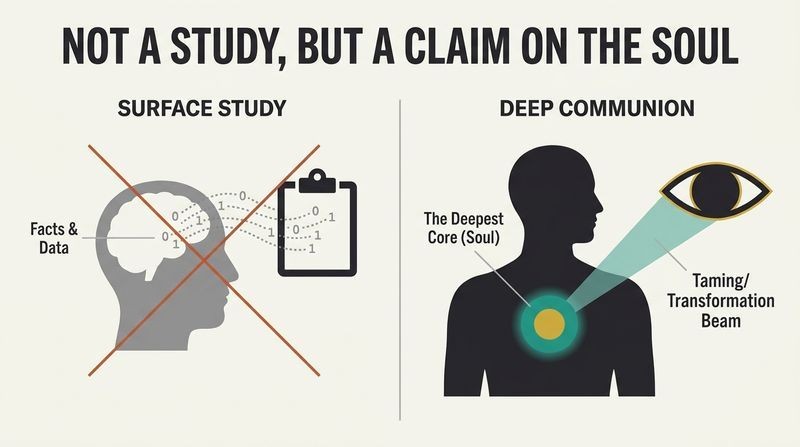
The title is the thesis. Strieber settles on the word communion because the encounter felt less like an exchange of facts and more like a demand aimed at the deepest core of his being. The eyes of the beings, he writes, seemed to ask for something beyond data. During a hypnosis session, the tall female being told him he was their "chosen one," and when he protested the operation, she insisted, "We do have a right," words he found stunning for their unquestioned authority.
A relationship, not a study. He becomes convinced they were not merely examining him but changing him, even taming him, the way humans domesticate wild animals over generations. The intimacy is what disturbs and fascinates: fear, awe, and something close to love coexisted in his response to a presence he could neither control nor comprehend.
The reframe from investigation to communion is the book's most original move, shifting the UFO narrative from spacecraft and technology toward mystical union and psychological penetration. It resonates with the phenomenology of religious ecstasy, where the numinous both terrifies and attracts, what Rudolf Otto called the mysterium tremendum et fascinans. Skeptics will note that "they sought my soul" is unfalsifiable and conveniently mirrors Strieber's lifelong spiritual searching through Gurdjieff and Zen. The claim that the beings assert a "right" over humans inverts humanity's casual dominion over animals, a genuinely unsettling ethical mirror the author holds up regardless of the encounter's ultimate origin.
The mind hides unbearable memories behind cozy false images
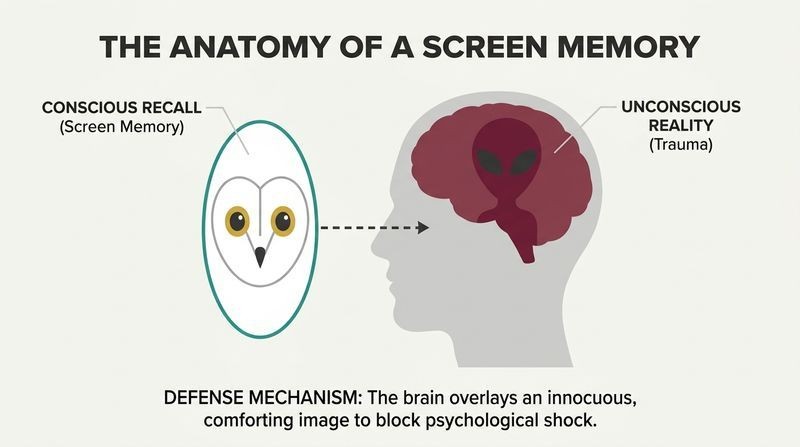
Screen memories mask trauma. After the December event, Strieber clung to a memory of a beautiful barn owl staring through his window. There were no owl tracks in the snow. He telephoned a friend in California specifically to insist on the owl, desperate to believe it. Only later did he recognize the owl as a screen memory, a term drawn from Freud for an innocuous image the mind substitutes for something too upsetting to recall.
A recurring pattern. He collects other cases: a woman who remembered a beautiful deer but had blood on her blouse and an unexplained scar; a man who recalled only rabbits. His own life was littered with such substitutions, including a lifelong memory of a howling wolf that never happened and stories of events he was never present for.
Screen memory is a legitimate psychoanalytic concept, but Strieber deploys it in a way that is epistemologically slippery: any comforting recollection can be recast as concealment of the traumatic "real" event, making the theory unfalsifiable. Modern memory science complicates his account further. Elizabeth Loftus's work on the misinformation effect and false-memory implantation shows that vivid, emotionally charged "recovered" memories can be wholly confabulated, especially under hypnosis and suggestive questioning. Strieber, to his credit, wrestles openly with this and cites the Science News study on hypnotically induced abduction narratives. The owl detail remains the book's most psychologically honest moment, capturing how fiercely we defend a soothing lie.
Stay balanced on the razor between belief and denial
Active agnosticism is the discipline. Strieber refuses both camps. Belief in benevolent space brothers is one form of madness; dogmatic debunking is another. He calls for a stance of eager unknowing, holding the question open without collapsing it into a comfortable answer. He deliberately chose a hypnotist, Dr. Donald Klein, with no prior UFO involvement, avoided reading abduction literature before his sessions, and even lied on two polygraph control questions to test the operator's skill.
The question outranks the answer. He lists many hypotheses (extraterrestrials, beings native to earth, another dimension, time travelers, projections of the unconscious, a natural electromagnetic effect) and insists none is provable. What matters is resisting the human urge to explain the enigma away, because premature certainty in either direction shuts down understanding.
This methodological humility is the book's intellectual backbone and its most defensible claim. It echoes the scientific ideal of holding a hypothesis loosely while gathering data, and anticipates later academic UFO work by figures like Jacques Vallee, who similarly resisted the simple nuts-and-bolts extraterrestrial thesis. The danger Strieber himself names, studying a "false unknown," is real: sociology of science shows how communities of belief manufacture consensus and confirmation. His self-administered polygraph trap is a nice touch of rigor. Yet sustaining true agnosticism is psychologically exhausting, and the book's later chapters on triangles and transformation suggest his own balance tilting toward mystical conviction.
Extreme strangeness can dissolve the self into raw animal panic
Terror can erase personality. In the round chamber, Strieber reports that "Whitley" ceased to exist, replaced by a body in raw fear so total it felt biological rather than mental. He describes his forebrain seeming severed from the rest of him, leaving a primitive creature. This helps explain a recurring oddity in his account: wildly inappropriate reactions. Hearing impossible sounds, he simply settled back into bed. Seeing an intruder, he sat frozen.
The mind tunes out the impossible. He argues that when something is strange enough, the response is nothing like what we imagine. Instead of fight or flight, there is a kind of paralysis and instinctive filtering. He grasped for an anchor by asking a being to let him smell it, and the distinct organic odor, faintly cinnamon and cardboard, became his most convincing memory.
The observation that overwhelming novelty produces dissociation rather than dramatic action is genuinely astute and matches trauma research on peritraumatic dissociation, where victims report depersonalization, time distortion, and a spectator's detachment during assaults. His "inappropriate" calm mirrors documented freeze responses mediated by the dorsal vagal system. The detail about smell as reality-anchor is neurologically plausible: olfaction routes directly to the limbic system, bypassing the thalamic filtering other senses undergo, which is why odors trigger memory and emotion so powerfully. Whether the beings were real or hallucinated, Strieber's portrait of consciousness fragmenting under impossible stress is one of the book's more credible psychological contributions.
Maybe they fear us because we think as free individuals
A hive that dreads independence. Strieber's most provocative hypothesis reverses the usual power dynamic. He noticed the beings moved as if choreographed, each action seemingly decided elsewhere and transmitted, like an insect colony. If they are a hive mind, a single slow intelligence spread across many bodies, then a fast-thinking, autonomous human might be genuinely dangerous to them. An unexpected move could cause the hive to "lose track" of a captive inside its own craft.
Awe, not contempt. He kept sensing the beings were afraid of him and in some way in awe. On March 15, he chose to smile rather than reach out, sensing that a sudden gesture might threaten them. This flips the humiliating idea that humans are inferior lab specimens: perhaps human individuality is a precious, threatening rarity in the cosmos.
The hive hypothesis is speculative but intellectually generative, drawing on real mysteries in social-insect cognition, including the eerie Princeton bee study Strieber cites where foragers anticipated a moving food source. Contemporary research on superorganisms and distributed cognition lends the metaphor surprising traction. The deeper appeal is philosophical: it reframes human free will and singular selfhood as evolutionarily rare and valuable rather than as a liability before superior minds. This is a hopeful inversion of the abduction genre's usual helplessness. Critics would counter that attributing fear and awe to the beings is projection, a way to restore dignity and agency to an experience defined by total powerlessness.
Modern alien encounters echo centuries of fairies, incubi, and airships
The phenomenon is ancient. Strieber argues that today's gray beings are the latest costume for something very old. He recounts an anchor dangling from a sky-ship snagging on an Irish church around 1211, an almost identical Texas airship tale from 1897, St. Anthony's encounter with a small horned figure around A.D. 300, and medieval French "Tyrants of the Air." Incubi and succubi, he notes, parallel modern reports of sexual intrusion aboard craft.
Only the packaging changes. He suggests that what evolves is not the visitors but how each culture installs them: fairies and gods once, gray technicians now. This is why, he speculates, the beings seem so oddly unfamiliar with our clothing and language yet somehow woven into folklore going back millennia, hinting they may operate outside our linear sense of time.
This is Strieber's strongest scholarly gesture, aligning him with Jacques Vallee's Passport to Magonia, which he cites, and with folklorists who trace the structural continuity of nocturnal-visitor legends. The parallels are real: sleep-paralysis entities, missing-time abductions, and reproductive interference appear across cultures and centuries. The interpretive fork, though, cuts both ways. A believer reads continuity as evidence of a persistent real phenomenon adapting its disguise. A skeptic reads the same continuity as proof that the human brain reliably generates the same archetypal imagery under the same neurological conditions, no visitors required. Strieber, characteristically, refuses to choose, which is both his honesty and his evasion.
Corroborating witnesses turned a private nightmare into a shared puzzle
Other people remembered too. What kept Strieber from dismissing everything as madness was independent testimony. On October 4, 1985, houseguests Jacques and Annie both recalled a blank they could not explain: Jacques woke to a room flooded with daylight-bright light at four-thirty in the morning. Strieber's young son spontaneously described "a bunch of little doctors" taking him onto the porch. His sister, decades later, independently confirmed a childhood "fireball" crossing a vacant lot. A visiting seven-year-old, wholly ignorant of UFOs, blurted at dinner that a lights-covered airplane had flown through the yard.
The uninformed witness matters most. Strieber argues that precisely because the child had no cultural frame for flying saucers (she asked "a what?"), her innocent report is powerful evidence that something external, not merely suggestion, was occurring.
Multiple-witness corroboration is the book's evidentiary crown jewel and its most contested claim. It genuinely raises the bar above solo hallucination. Yet the mechanism of collection undercuts it: family members were questioned by an emotionally invested Strieber, sometimes after he had discussed events, and memory-conformity research shows that co-witnesses unconsciously align their recollections, a phenomenon documented in eyewitness studies. The child's testimony is the cleanest, but children are highly suggestible and prone to fantasy. Still, the honest reader must sit with the discomfort that shared anomalous memory, whatever its cause, is harder to wave away than one man's dream, which is exactly Strieber's point.
The lasting damage is social ridicule, not the encounter itself
Scoffing is a second assault. Strieber met a support group of eleven ordinary New Yorkers, a cosmetologist, a scientist, a dancer, a museum curator, who described lifelong encounters. What united them was not psychosis but trauma, anxiety, and a shared performance anxiety on tests, as if long conditioned by hard questioning they could not remember. He compares mocking them to laughing at rape victims.
Society abandons the experiencers. He argues the real, documentable harm comes not from the visitors but from isolation: when respected institutions treat the experience as a joke and professional debunkers ridicule uninformed witnesses, sufferers are stranded when they most need support. His practical prescription is community, a network of mutual support and open, non-judgmental scientific study rather than dismissal.
This is the book's most humane and least contestable claim, and it aged well. Regardless of what abduction experiences are, the distress is real and clinically observable, and stigma compounds it, a pattern documented across contested illnesses from chronic fatigue to PTSD. Strieber essentially argues for trauma-informed care and peer support decades before those became standard. The tension is that legitimizing the experiences socially can also reinforce and elaborate them, the same dynamic seen in some recovered-memory therapy communities. The wise middle path he gestures toward, taking the suffering seriously without validating any particular explanation of its cause, remains genuinely difficult for clinicians and skeptics alike.
He read the triangle as a summons to transformation, not just a symbol
A recurring three. Strieber found the triangle everywhere in his and others' accounts: beings appearing in threes, triangular lights and craft, a triangle etched on his arm, a triangular rash on a French physician. Steeped for fifteen years in Gurdjieff's teaching, he links it to the triad, the idea that two opposed forces in balance generate a creative third, expressed in body-mind-heart, the Holy Trinity, and ancient goddesses like Ishtar.
Communion as mutual creation. He interprets the encounter as a potential triad between humanity and the visitors: an aggressive force meeting a resisting one, capable of birthing something new only if the two become equals. Transformation, he insists, means dying to the self, the terrifying fire behind the eagle in Betty Andreasson's vision, which he reads as the ancient symbol of rebirth.
Here Strieber's active agnosticism gives way to his esoteric commitments, and the analysis grows more associative than argued. The triangle's ubiquity is real but weakly evidential: it is the simplest closed polygon, statistically the first shape people draw, as he himself notes, and thus prone to pattern-seeking, or apophenia. His candor is disarming, he concedes he may find triads everywhere simply because they obsess him. Read charitably, the chapter reframes the whole ordeal as an initiatory rite, aligning the abduction with the shamanic dismemberment-and-rebirth motif studied by Mircea Eliade. Read critically, it is where a disciplined witness becomes a mystic assembling correspondences, trading the razor's edge for a system.
Analysis
Communion occupies a strange perch: part trauma memoir, part paranormal report, part esoteric treatise. Its enduring cultural power, it became a bestseller and cemented the now-iconic large-eyed gray face, lies in Strieber's refusal to deliver the reassurance either believers or skeptics crave. He is a professional novelist writing about the limits of narrative itself, and the book is most gripping precisely where it is least resolved.
Read through a contemporary lens, the text is a case study in the collision of phenomenology and epistemology. The experiences are phenomenologically undeniable: something happened to Strieber's nervous system, producing terror, dissociation, and vivid sensory memory. But the causal question, what happened, remains radically underdetermined by the evidence, and Strieber knows it. His honest cataloguing of alternative explanations, hypnopompic hallucination, temporal-lobe activity, screen memory, suggestion under hypnosis, exceeds what most in the genre attempt.
The book's weaknesses are also instructive. It predates the maturation of false-memory research, and its reliance on hypnotic recall now reads as a methodological red flag rather than a validation. The witness corroboration, its strongest card, is contaminated by an invested interviewer and known memory-conformity effects. And the late turn toward triads, Ishtar, and the tarot reveals an author whose stated agnosticism cannot fully contain his mystical yearnings.
Yet dismissing Communion as delusion misses its deeper achievement. Strieber articulates, better than most clinicians of his era, how overwhelming strangeness fractures the self, how the mind defends itself with soothing fictions, and how social ridicule compounds private suffering. Whether the visitors came from the stars, the temporal lobe, or the collective unconscious, the book documents a real human confrontation with the unbearable. Its final counsel, to face the unknown with curiosity rather than fear or contempt, remains its most valuable and transferable insight.
Review Summary
Communion received mixed reviews, with some readers finding it terrifying and compelling, while others dismissed it as unbelievable. Many praised Strieber's writing style and the book's ability to provoke thought about alien encounters. Critics questioned the reliance on hypnosis and the author's credibility. Some readers appreciated the philosophical aspects and connections to folklore, while others found parts boring or repetitive. The book's impact on popular culture and its exploration of unexplained phenomena were frequently mentioned.
People Also Read



Glossary
Communion
Visitors seeking the soul's depthsStrieber's chosen name for the phenomenon, capturing his sense that the beings sought not information but intimate contact with the deepest core of his being. The word also frames the encounter as a potential mutual creation between humanity and the visitors, a coming-together capable of transforming both, rather than a one-sided study or abduction.
The visitors
Strieber's neutral term for entitiesStrieber's deliberately non-committal label for the beings he encountered, chosen to avoid assuming they are extraterrestrials. He describes roughly four types: small robotlike figures, stocky beings in blue coveralls, a tall thin being with large black slanted eyes he perceived as female, and smaller round-eyed ones. Their origin, he insists, is genuinely unknown.
Screen memory
Innocuous image masking traumaA concept borrowed from Freud describing how the mind substitutes a harmless, often pleasant recollection for an experience too disturbing to recall directly. Strieber's key example is his false memory of a barn owl at the window, which concealed the traumatic December encounter. He argues many experiencers report animals or ordinary scenes that hide real events.
The good army
Stocky blue-clad helper beingsStrieber's phrase for the group of short, stocky beings in dark blue coveralls who moved and controlled him during the encounters. Despite handling him against his will, he perceived them as somehow benevolent or dutiful, a "good army" carrying out tasks without hostility, distinct from the more commanding thin being he called "her."
The triad
Two forces creating a thirdDrawn from Gurdjieff's teaching, the principle that two opposing forces held in balance generate a creative third force, and that the three together form a greater whole. Strieber links it to the recurring triangle symbol in abduction accounts and interprets the human-visitor encounter as a potential triad producing transformation.
Eidetic image
Vivid living mental pictureA photograph-like image held in the mind. After hypnosis, Strieber experienced an unusually vivid, seemingly living image of the female being that moved on command and let him observe every detail, which artist Ted Jacobs rendered for the book's cover. He noted it far exceeded ordinary eidetic memory, which is rare in adults.
FAQ
What is Communion: A True Story by Whitley Strieber about?
- Personal encounter narrative: The book details Whitley Strieber’s alleged real-life encounters with mysterious nonhuman visitors, beginning with a traumatic event at his upstate New York cabin in December 1985.
- Exploration of the unknown: Strieber uses his experiences to probe the nature of the unknown, encouraging readers to approach such mysteries with curiosity rather than fear.
- Psychological and physical impact: The narrative includes Strieber’s psychological struggles, physical symptoms, and the profound effects on his family, blending personal memoir with broader cultural and historical context.
Why should I read Communion: A True Story by Whitley Strieber?
- Unique firsthand testimony: The book offers an unusually candid and detailed account of alleged alien abduction, providing a rare window into a phenomenon often dismissed or sensationalized.
- Blend of science and narrative: Strieber incorporates scientific, psychological, and cultural perspectives, including input from psychiatrists and hypnotists, to give the story credibility and depth.
- Support and understanding: The book advocates for empathy and support for those who experience such encounters, highlighting the isolation and disbelief they often face.
What are the key takeaways from Communion: A True Story by Whitley Strieber?
- Confronting the unknown: Strieber emphasizes the importance of facing the unknown with openness, suggesting that fear can be transformed into understanding.
- Complexity of the phenomenon: The visitor experiences are presented as multifaceted, involving psychological, physical, and possibly spiritual dimensions.
- Historical and cultural continuity: The book draws connections between modern encounters and ancient myths, suggesting a long-standing human relationship with mysterious beings.
What are the main events and encounters described in Communion: A True Story by Whitley Strieber?
- December 26, 1985 incident: Strieber recounts being awakened by strange noises, paralyzed, and subjected to invasive procedures by nonhuman beings at his cabin.
- October 4, 1985 event: Earlier in the year, Strieber and his family experienced unexplained lights, noises, and phenomena, which were later linked to the December encounter.
- Hypnotic regressions: Through hypnosis, Strieber uncovers memories of similar encounters dating back to childhood, revealing a lifelong pattern of contact.
How does Whitley Strieber describe the visitors in Communion: A True Story?
- Physical appearance: The visitors are depicted as small, gray-skinned beings with large, black, slanted eyes and bald heads, sometimes wearing coveralls or masks.
- Behavior and communication: They move quickly and precisely, often in groups, and communicate through speech, telepathy, and symbolic imagery.
- Emotional impact: Strieber describes a mix of terror, awe, and a strange attachment, with the visitors’ eyes evoking a sense of deep, penetrating awareness.
What role does hypnosis play in Communion: A True Story by Whitley Strieber?
- Memory recovery: Hypnosis is used to access repressed or fragmented memories of the encounters, revealing vivid and detailed accounts.
- Scientific rigor: Sessions are conducted with care to avoid leading questions, maintaining the integrity of the recovered material.
- Emotional processing: Hypnosis brings intense emotions to the surface, helping Strieber process trauma and gain insight into his experiences.
What psychological and physical effects did Whitley Strieber experience after his encounters in Communion: A True Story?
- Physical symptoms: Strieber reports fatigue, infections, rectal pain, and unexplained injuries, with medical tests showing no clear cause.
- Psychological turmoil: He experiences fear, paranoia, confusion, and personality changes, including irritability and difficulty concentrating.
- Memory and perception changes: Strieber’s memories are initially fragmented, with “screen memories” masking the true events and a persistent sense of being watched.
How does Communion: A True Story by Whitley Strieber connect visitor experiences to historical and cultural phenomena?
- Ancient parallels: Strieber draws connections between the visitors and figures from mythology, folklore, and ancient religions, suggesting a deep-rooted presence in human culture.
- Symbolism and archetypes: Recurring symbols such as triangles, circles, and eyes are explored as possible attempts at communication or representations of psychological truths.
- Modern manifestation: The book suggests that the visitor phenomenon is a contemporary expression of an ancient mystery, adapting to fit modern understanding.
What hypotheses does Whitley Strieber explore about the nature and origin of the visitors in Communion: A True Story?
- Extraterrestrial origin: The possibility that the visitors are aliens from other planets or galaxies is considered but not confirmed.
- Psychological or internal phenomena: Strieber entertains ideas that the visitors may be manifestations of the unconscious mind or a new psychological process.
- Other dimensions or time: He speculates about visitors from other dimensions, time travelers, or even evolved forms of humanity, blending science fiction with myth.
What is the significance of the triangle and triad symbols in Communion: A True Story by Whitley Strieber?
- Central motif: The triangle recurs throughout Strieber’s experiences, linked to spiritual and mythological concepts of creation, balance, and transformation.
- Visitor self-identification: The visitors may see themselves as a triune species, using the triangle as a symbol of their nature and purpose.
- Path to transformation: Strieber connects the triad to spiritual evolution and the emergence of a “fourth force,” suggesting a deeper meaning behind the encounters.
What evidence does Whitley Strieber present in Communion: A True Story to support the reality of his experiences?
- Polygraph testing: Strieber passed a polygraph test, supporting the truthfulness of his reported memories.
- Family corroboration: His wife and son’s independent memories and hypnosis sessions provide partial confirmation of shared events.
- Physical and documentary evidence: The book references unexplained physical marks, medical anomalies, and government documents as supporting evidence.
What are the best quotes from Communion: A True Story by Whitley Strieber and what do they mean?
- “The enigmatic presence of the human mind winks back from the dark.” This quote highlights the book’s theme of confronting the unknown and the potential for understanding through consciousness.
- “We do have a right.” Spoken by a visitor, this phrase raises ethical questions about authority, consent, and control in the encounters.
- “You are our chosen one.” This recurring message embodies the ambiguous relationship between Strieber and the visitors, reflecting both a sense of specialness and manipulation.
Communion Series
About the Author
Other books by Whitley Strieber


Download PDF
Download EPUB
.epub digital book format is ideal for reading ebooks on phones, tablets, and e-readers.








































