

Plot Summary
Prologue
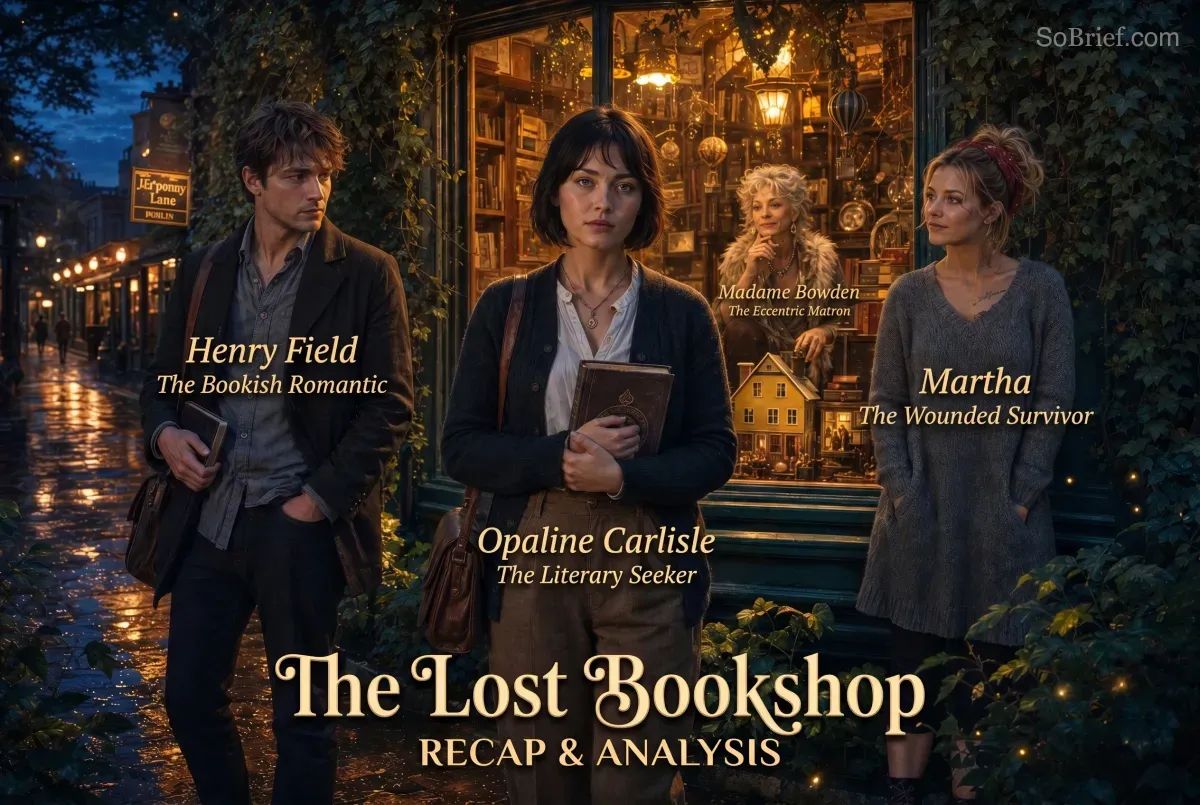
On a rainy Dublin morning, a young boy presses his nose against the window of the most fascinating bookshop he has ever seen — twinkling lights, miniature hot-air balloons, mechanical birds spinning on music boxes. The woman inside waves him in.
Her name is Martha,1 and she runs Opaline's Bookshop. The boy is supposed to be at school, but Martha1 offers him a story instead — about a woman who didn't like rules either. She sets him to work stuffing envelopes while she puts the kettle on. A good story, she tells him, always begins with tea.
Opaline Sells Her Inheritance
In 1921 London, twenty-one-year-old Opaline Carlisle2 clutches a rare first edition of Wuthering Heights while her brother Lyndon5 and their mother decree she must marry a stranger to salvage the family's crumbling finances.
Lyndon,5 eighteen years her elder and warped by shrapnel from Flanders, grips her wrist and promises worse if she disobeys. That night, Opaline2 visits a book dealer and sells her father's prized David Copperfield for twenty pounds, secretly pocketing the Wuthering Heights. The money buys a train ticket to Dover and a Channel crossing to France.
She boards the ship knowing she has traded her only inheritance for the unknown — and vowing to one day retrieve the Dickens. On deck, a Moroccan man named Armand Hassan6 catches a thief stealing her case and introduces himself with a kiss to her gloved hand.
Basement Refuge on Ha'penny Lane
Martha1 arrives in Dublin with a battered face, cracked ribs, and a suitcase. She fled her violent husband Shane7 from a small Irish village, boarding a bus to anywhere. An ad for a live-in housekeeper leads her to Madame Bowden,4 an eccentric former actress who wears feather boas and diamond earrings at 12 Ha'penny Lane.
The basement flat is dark and cramped, but Martha1 feels something she hasn't experienced in years — safety. Her first morning, she spots a pair of brown boots pacing outside her window. They belong to Henry,3 an English scholar who apologizes for lurking and explains he's searching for the remains of a building that should exist between numbers 10 and 12. Martha1 slams the window shut. His search has barely begun.
Apprentice at Shakespeare and Company
Jobless in Paris, Opaline2 stumbles upon Shakespeare and Company, the English-language bookshop run by the formidable American Sylvia Beach.10 Sylvia10 hires her as an apprentice, teaching her to authenticate provenance, spot missing pages, and recognize value others overlook.
On a quiet afternoon, Sylvia10 asks who Opaline's2 favorite author is. Emily Brontë, she answers instantly. Sylvia10 presses: isn't there a question about Emily that has always haunted her? Opaline2 admits she has always wondered whether Emily began a second novel before dying at thirty.
Sylvia10 tells her to start searching for the answer. Meanwhile, Opaline2 succumbs to Armand Hassan's6 persistent charm — the Moroccan antiquarian she met on the Channel crossing. She knows his roving eye will eventually wound her, yet she pockets his calling card instead of tossing it into the Seine.
The Story of the Black Suitcase
Henry3 confesses his mission: he found a letter at auction from the legendary American collector Abe Rosenbach to a Miss Opaline Gray,2 discussing a lost manuscript tied to a bookshop on Ha'penny Lane.
Martha1 thinks he's delusional but googles the name — and finds a photograph of a young woman at Shakespeare and Company, captioned Opaline Carlisle.2 Henry3 takes her to Trinity's Long Room, telling her she belongs in these halls. Over Guinness, he recounts Walter Benjamin, the Jewish intellectual who carried a manuscript across the Pyrenees rather than abandon it, only to die at the Spanish border.
Martha1 weeps and reaches for his hand. She tells him about Shane's7 violence — broken ribs, lost teeth, constant terror. They hold each other outside a church. Then Henry's3 phone rings. Isabelle.12 His fiancée.
Lyndon's Shadow Reaches Paris
A photograph in Cosmopolitan betrays Opaline's2 whereabouts. Lyndon5 arrives with Lord Bingley, the intended suitor, and corners her outside her lodgings. He forces her to a hotel room and shoves her into a wall. But Armand,6 who witnessed the abduction, knocks on every door until he finds her.
They sprint through the streets to Shakespeare and Company, where Sylvia10 and James Joyce improvise an escape. Joyce suggests Ireland — a friend named Fitzpatrick runs a shop in Dublin. Armand6 places a golden hamsa pendant around her neck for protection.
At the port, they embrace for the last time. In Dublin, Opaline2 discovers Fitzpatrick Senior has died, but his son Matthew8 offers her the shop and basement flat — a narrow building constructed from the wood of an old Italian library believed to house spirits.
Branches Through the Plaster
Dark lines creep across Martha's1 basement wall — not cracks, but wood. Branches push through the plaster, spreading like veins across blue paint. Madame Bowden4 dismisses the phenomenon as an old building's quirks. Then a shelf emerges from the wall bearing a single book: A Place Called Lost, by an anonymous author.
Martha,1 who has always been nervous around books, begins reading by candlelight. The story describes an Italian library whose wood was shipped to Ireland and rebuilt as a shop — a building that could sense what each visitor needed.
Meanwhile, Martha1 receives mysterious lines of text in her mind, which she has tattooed onto her back in sessions no one knows about. She cannot explain where the words come from. She only knows they demand permanence. The tree keeps growing, and more books appear on its branches.
Emily's Secret in the Sewing Box
During a trip to England, Opaline2 had purchased Charlotte Brontë's old sewing box from a bookseller's widow. Back in Dublin on a stormy night, she turns it over and discovers an invisible groove at the base. A hidden compartment slides open and out slips a tiny notebook the size of a playing card.
Dated 1846, it contains handwriting she recognizes from her studies: Emily Jane Brontë's. The draft describes an Anglo-Irish landowner named Egerton who falls obsessively in love with a flame-haired tenant girl named Rose during the Irish Famine — a dark, Gothic tale carrying Emily's unmistakable ferocity.
The initials EJB are signed inside. Opaline2 holds proof that Emily began a second novel. She copies every word by hand, savoring her discovery alone. She is also newly pregnant with Armand's6 child.
The Fall on the Stairs
Shane7 tracks Martha1 to Dublin after a friend spots her on Grafton Street. He arrives with wilted flowers and a lie — her mother has cancer. Madame Bowden4 intervenes, buying Martha1 one night. Days later, Shane7 returns drunk. He saw Martha1 kissing Henry3 on the street.
He punches her face and drags her by the hair. Martha1 asks why he wants her back when all they bring each other is pain. Then something pushes Shane7 — hard — through the wooden bannister. He crashes down the stairwell to the basement floor.
Madame Bowden4 calmly instructs Martha1 to go buy a roast and wine for dinner. When Martha1 returns, the stairs are repaired and Shane's7 body is gone. Police later report him pulled from the river. The death is ruled accidental. Martha1 carries the secret like a fracture that won't set.
Committed by Her Own Blood
A French visitor named Ravel, who befriended Opaline2 at an auction, steals a letter she wrote to Sylvia10 — revealing both the manuscript and her pregnancy. He is working for Lyndon.5
Opaline2 entrusts the sewing box to Matthew,8 but before she can flee to America, Lyndon5 drags her from bed and drives west to a lunatic asylum, where a compliant doctor signs committal papers for puerperal insanity. Opaline2 screams her sanity; the doctor smirks. She befriends Mary,11 a young woman imprisoned after her abusive father blamed her for a pregnancy caused by a priest.
Months later, Opaline2 gives birth on a bare mattress while nurses refuse to summon a hospital. They tell her the baby died — cord around the neck, born blue. Opaline2 stops eating. Mary11 keeps her alive with stolen oatmeal.
Henry Burns His Bridges
The night they kissed in a secondhand bookshop, Henry3 left Martha1 a letter on the doorstep explaining he was flying to London to end things with Isabelle12 face-to-face. In Pimlico, he confesses he has found something real with someone else.
Isabelle12 slams the door and hands him a bag of his belongings. His sister Lucinda has a baby; Henry3 visits his alcoholic father at a rehab center in Wales, beginning a fragile reconciliation. He returns to Dublin — but the man at the B&B told Martha1 he had left for good, and she never found the note.
She blocked his number. They collide at Sandycove beach, where Martha1 plunges into the freezing sea. She runs into his arms and kisses him — but when Henry3 mentions Opaline's2 name, she assumes the manuscript is all he returned for, and bolts onto a departing train.
Opaline's Knife and Josef's Kindness
After years of captivity — Mary11 dead from cold, her spirit hollowed — Opaline2 learns her mother has died but the funeral has passed. She seizes a fruit knife in the doctor's office and presses it to her own throat: if she dies, Lyndon's5 payments stop.
The terrified doctor opens a back door and she runs. Back at Ha'penny Lane, she finds the shop boarded up. When she later seeks the manuscript from Matthew's8 bank, she learns he was killed in the London Blitz — and the sewing box has vanished into whatever vault he chose.
Into this desolation walks Josef Wolffe,9 an Austrian prisoner of war who has been reading her abandoned books. Without questions, Josef9 brings food and firewood. On Christmas Eve, he brings candlelight. Over months, he repairs the shop's broken music boxes, and Opaline2 alongside them.
The Reaper Unmasked
Years later, armed with evidence of Lyndon's5 wartime executions of shell-shocked soldiers, Opaline2 feeds the story to a Times journalist and confronts her brother5 in their childhood home.
Cornered by tomorrow's headlines naming him The Reaper, Lyndon5 retaliates with a shattering confession: he is not her brother but her biological father, having impregnated a French girl during a Grand Tour at twenty. And her baby did not die in the asylum — Lyndon5 had the doctor sell the infant to adoptive parents named Clohessy. Opaline2 drops the article on the table and walks out.
Behind her, a gunshot. She does not turn back. Josef9 eventually returns from Austria after his own father's death, bringing with him Opaline's2 long-lost David Copperfield, found in a Salzburg bookshop. Her daughter is alive somewhere. That fact holds everything.
The Clohessy Certificate
Henry3 and Martha1 travel west by bus to the asylum, still operating decades later. Martha1 bluffs their way inside by claiming they are government health inspectors on an unannounced spot-check — an improvisation so convincing Henry3 can only gape. While a suspicious nurse fetches tea, Martha1 steals Opaline's2 file from the cabinets.
Inside are unsent letters, heartbreaking pleas to her friend Jane,13 and an unofficial adoption certificate for a baby girl named Rose, placed with a couple called Clohessy. Martha's1 mother had recently visited Dublin to reveal a family secret: Martha's1 grandmother was adopted by people named Clohessy.
The connection detonates quietly. Opaline's2 stolen daughter became Martha's1 grandmother. Martha1 is Opaline's2 great-granddaughter. The building, the book, the mysterious tattoo — everything that drew her to Ha'penny Lane was calling her home.
Martha Chooses Love
Back in Dublin, the dam breaks. Martha1 admits she hates fighting what she really wants, and when Henry3 asks what that is, she answers: him. They collide as though released from years of opposing gravity.
Afterward, Henry3 examines the tattoo covering Martha's entire back and reads a text dated 1846 about an Anglo-Irish estate called Wrenville Hall and a flame-haired girl — the same story Opaline2 discovered in the sewing box, signed EJB. Emily Brontë's lost manuscript, transmitted through the building's walls into Martha's1 consciousness and inked permanently onto her skin.
It matches what Opaline2 sewed into her asylum clothes with a needle and thread. The physical manuscript remains sealed in an Irish bank vault, its location lost with Matthew.8 But its words survive on the body of its author's unlikely guardian.
The Bookshop Reappears
Madame Bowden4 vanishes overnight. Martha1 realizes no one else has actually met her — not classmates, not even her own mother. A note waits in the attic in Madame Bowden's4 handwriting, telling Martha1 to believe in what her eyes cannot see and to bring the scholar.3
They follow a narrow passage through the walls, descending through what feels like the roots of a living tree, until they emerge not into the hallway of number 12 but into a sunlit room lined with green wooden shelves, mossy and ivy-draped, filled with antique books and curiosities.
Toy hot-air balloons float overhead. At the edge of a stained-glass panel, two figures are etched in colored light: a woman in trousers holding hands with a soldier. Martha1 has found her birthright. The bookshop has come home.
Epilogue
The boy asks if every word is true. Martha1 assures him it is. He wonders what happened to the old lady and the house — number 12 still stands, she tells him, but someone else lives there now. When he wishes for a book that could tell him what he's supposed to become, Martha1 smiles and says it already has.
His heart leaped, she noticed, at a particular moment in the story — when she described Matthew Fitzpatrick the magician.8 The boy admits his teacher calls it a silly notion. Martha1 tells him those are the best kind.
Henry3 sweeps into the shop, her husband now, and the boy departs with a free book tucked in his schoolbag, wearing something that might be a cape in the morning light. Emily Brontë's manuscript, Martha1 notes quietly, still lies hidden in an Irish bank vault — waiting to become part of someone else's story.
Analysis
The Lost Bookshop operates as a triple helix of women's silencing. Opaline2 is committed to an asylum not because she is insane but because she is inconveniently brilliant and pregnant. Martha1 is beaten into submission by a husband7 who cannot tolerate her gifts. Martha's mother1 chose voluntary muteness as survival in a household where women's voices were unwelcome. Each generation absorbs the wound differently, but the mechanism is identical: patriarchal authority redefining female agency as pathology.
The novel's magical realism is structural rather than decorative. The bookshop disappears because its owner was erased — institutionalized, discredited, struck from public record. It reappears only when someone arrives who can bear the full weight of its history: not merely the literary treasure inside, but the trauma embedded in its walls. Martha's tattoo — Emily Brontë's manuscript surfacing on her skin without volition — dramatizes how suppressed stories demand to be told, finding vessels even when the original medium is destroyed. The building itself becomes a metaphor for intergenerational memory: knowledge that bypasses official records and transmits through intuition, the body, and blood.
Woods draws a pointed parallel between the nineteenth-century erasure of Emily Brontë — whose authorship hid behind a male pseudonym, whose second novel may have been destroyed by her own sister — and the twentieth-century erasure of Opaline,2 whose career was stolen, whose child was taken, whose existence was bureaucratically deleted. Literary history and women's personal histories, the novel argues, are lost through identical mechanisms of power. Henry,3 the male scholar, can research Opaline's2 life but cannot feel it the way Martha1 does — through her skin, her gift, her ancestry. The most important discoveries in this story are not found through scholarship but through inheritance: emotional, spiritual, and bodily. The manuscript is never officially recovered, and that is precisely the point. Some truths survive not in archives but in the women who carry them forward.
Review Summary
The Lost Bookshop receives mixed reviews, with many praising its enchanting blend of historical fiction, magical realism, and bibliophilia. Readers appreciate the dual timeline, strong female characters, and atmospheric Dublin setting. However, some criticize the underdeveloped characters, plot inconsistencies, and rushed ending. While many find the book heartwarming and magical, others feel it falls short in execution. The audiobook narration is highly praised. Overall, the novel polarizes readers, with some considering it a delightful celebration of books and others finding it disappointing.
People Also Read




Characters
Martha
Abuse survivor turned custodianShe arrives in Dublin carrying the debris of a marriage that nearly killed her—broken ribs beneath a baggy jumper, a black eye under bleached bangs. Martha possesses an inexplicable gift: she can read people's hidden stories without them speaking a word. She also receives mysterious lines of text in her subconscious, which she has tattooed onto her back in private acts of defiance. Books have always made her nervous, an aversion she cannot explain. Beneath her guardedness lies startling intelligence and emotional courage, coexisting with a deep conviction that she deserves nothing better. Her arc traces the distance from a woman who hides in wardrobes to one who claims a legacy she never knew existed. Her greatest struggle is learning to trust herself enough to accept love.
Opaline
Defiant 1920s book dealerA twenty-one-year-old in 1921 London who refuses to be bartered in marriage, Opaline sells her father's most treasured book to fund an escape to Paris. Fiercely intellectual, she apprentices at Shakespeare and Company10 and builds a career in rare books—almost unheard-of for a woman of her era. She adopts a male pseudonym and men's trousers, navigating a world that treats her ambitions as symptoms of instability. Her love of literature is inherited from her father, whose death left her clinging to books as portals of survival. Romantic and pragmatic in equal measure, she falls for men who cannot fully reciprocate—a pattern rooted in the conditional love she received in a household that never quite wanted her. Every achievement is shadowed by the threat of her brother's5 control.
Henry
Rare book scholar seeking proofAn English rare book scholar whose career has been one long quest to prove himself worthy—of respect, of love, of his own regard. The son of an alcoholic father who humiliated him as a child and stole his first significant find, Henry retreated into libraries and learned to seek validation through dead authors rather than his own living heart. Charming in a self-deprecating, bumbling way—quick with literary references, hopeless at reading romantic signals—he proposed to the polished Isabelle12 because she represented what he thought he should want. Martha1 dismantles his defenses not through intellect but through raw honesty. His journey requires him to stop performing competence and start believing he is enough—choosing between the manuscript that could make his name and the woman who already sees him clearly.
Madame Bowden
Enigmatic employer and protectorMartha's1 elderly employer, a former actress who wears feather boas, claims three dead husbands, and speaks in theatrical declarations. Beneath her imperious manner lies a fierce protectiveness toward Martha1 that seems disproportionate to their employer-employee relationship. She is impossible to read—Martha's1 gift fails against her layered personas. Her true identity becomes the novel's deepest enigma, as no one besides Martha1 seems to have actually encountered her.
Lyndon Carlisle
Opaline's controlling brotherOpaline's2 domineering elder brother, scarred physically and psychologically by World War I. Nicknamed The Reaper for executing shell-shocked soldiers under his command, his trauma manifests as an absolute need for control. He views Opaline2 as property to be traded in marriage. Manipulative and violent, he represents the patriarchal machinery that can erase a woman's autonomy with the stroke of a pen and a compliant doctor's signature.
Armand Hassan
Charismatic Moroccan antiquarianA Moroccan book dealer who rescues Opaline2 on a Channel crossing and becomes her first lover. Exotically handsome and effortlessly charming, he moves through the rare book world with a predator's instinct for opportunity. He genuinely cares for Opaline2 but cannot resist using her discoveries for his own advancement. When she refuses to let him handle the Brontë manuscript, his polished facade cracks, revealing insecurity and a ruthlessness indistinguishable from the collectors he serves.
Shane
Martha's abusive husbandMartha's1 husband, whose violence escalated from a single slap during their college years to systematic physical abuse. He presents himself as everyone's friend at the pub while privately terrorizing his wife. His jealousy masks profound insecurity, and he wields isolation and shame as weapons. He represents the devastating ordinariness of domestic violence—how it hides behind closed doors and a community's willful silence.
Matthew Fitzpatrick
Kind landlord, reluctant bankerSon of the man who built the shop from Italian library wood, Matthew is Opaline's2 reserved landlord in Dublin. A banker by profession and a frustrated magician at heart, he represents quiet, decent love that Opaline2 can never fully claim. Married with a child, he and Opaline2 share a charged intimacy both know cannot be pursued. He becomes the guardian of her most valuable secret.
Josef Wolffe
Austrian POW, Opaline's soulmateAn Austrian prisoner of war interned in Ireland after his reconnaissance plane crashes in fog. A former church organ repairman, Josef possesses an almost spiritual patience. He enters Opaline's2 life at her lowest point and restores her through small, consistent acts of care—firewood, food, repaired music boxes. He asks nothing and expects nothing, the antithesis of every man who has tried to own her.
Sylvia Beach
Bookshop owner and mentorHistorical figure who ran Shakespeare and Company in 1920s Paris. Opaline's2 mentor in the rare book trade, she teaches her to authenticate editions and plants the seed of the Emily Brontë search that becomes Opaline's2 life's work.
Mary
Opaline's asylum companionA young Irish woman wrongly committed after her abusive father blamed her for a pregnancy. She becomes Opaline's2 lifeline in the asylum, teaching her to sew and sustaining her through stolen oatmeal and whispered stories in the dark.
Isabelle
Henry's polished fiancéeHenry's3 fiancée in London—a confident, ambitious life coach who represents everything he thinks he should aspire to. Their relationship is built on mutual performance rather than genuine connection.
Jane
Opaline's lifelong championOpaline's2 childhood best friend who never stops writing letters and campaigning for her release from the asylum. She embodies the stubborn endurance of unconditional friendship across decades and distance.
Plot Devices
Emily Brontë's Manuscript
Central literary treasureA tiny notebook the size of a playing card, hidden in a false compartment of Charlotte Brontë's sewing box, containing Emily's handwritten draft of a second novel. The Gothic story describes an Anglo-Irish landowner during the Famine who becomes obsessed with a tenant girl named Rose—signed with the initials EJB and dated 1846. Opaline2 discovers it in Dublin in 1922, but after her imprisonment, the physical manuscript is lost when its guardian Matthew8 dies in the London Blitz. The text survives in two extraordinary forms: sewn into Opaline's2 asylum clothing with needle and thread, and mysteriously transmitted onto Martha's1 skin as a tattoo generations later. The manuscript is never officially recovered; it remains sealed in a bank vault, its location lost with Matthew8.
A Place Called Lost
Prophecy disguised as fairy taleA children's book written by Opaline2, telling the story of an Italian library whose wood was shipped to Ireland to become a shop with the power to guide lost visitors to the books they need. The book materializes uninvited on a shelf growing from Martha's1 basement wall—placed there by no identifiable hand. As Martha1 reads it, the story mirrors her own situation with increasing precision, eventually describing an Englishwoman in trousers who becomes the shop's unlikely custodian. The book functions as both prophecy and key, gradually revealing that Martha1 was destined for Ha'penny Lane. Its final pages instruct the reader to believe in what they cannot see in order to unlock the building's hidden truth.
The Bookshop
Living, sentient buildingBuilt from the wood of an abandoned Italian library believed to house spirits, the shop occupies a sliver of land between two Georgian houses on Ha'penny Lane. It defies physical laws—doors resist opening, books tumble from shelves as invitations, stained-glass windows shift to depict scenes from its occupants' lives. The building appears and vanishes across decades: Henry3 walks into it his first drunken night in Dublin, then it evaporates. A dinner guest in the 1980s stumbled inside before finding it gone moments later. It manifests only when it senses a true custodian—someone who believes. The tree growing through Martha's1 basement wall is its root system reaching toward her through the adjacent house, bridging the gap between the hidden and the found.
Martha's Tattoo
Vessel for a lost manuscriptLines of text arrive in Martha's1 consciousness uninvited—fragments of a dark, archaic story she does not recognize. She has them tattooed onto her back in tiny script, treating each session as a private act of defiance. She never tells anyone about the words' mysterious origin. One night, the entire story appears completed on her skin without any tattoo session occurring. The text proves to be Emily Brontë's manuscript—the same words Opaline2 memorized during years of imprisonment and sewed into her asylum clothing. The tattoo represents the building's method of transmitting its treasures to its chosen custodian, bypassing the physical manuscript that remains locked away and undiscovered.
The Growing Tree
The bookshop reaching for MarthaBranches push through the plaster of Martha's1 basement wall shortly after her arrival, growing into an arching canopy over her bed. Roots emerge from the ceiling like a chandelier of living tendrils. Madame Bowden4 dismisses the growth as an old building's eccentricities. The tree is the bookshop's root system reaching toward its destined custodian through the walls of the adjacent house. It grows bolder as Martha1 draws closer to accepting her role—budding leaves, shelving books on its branches, carving the message 'What you seek is seeking you' into its bark. When the bookshop finally reappears and Martha1 crosses the threshold, the tree vanishes from the basement, having fulfilled its purpose as a bridge between hidden and found.
FAQ
Synopsis & Basic Details
What is The Lost Bookshop about?
- Intertwined lives, literary mystery: The Lost Bookshop follows the parallel stories of Opaline, a woman escaping societal constraints in the 1920s, and Martha, a modern woman fleeing an abusive past, both connected by a mysterious bookshop.
- A quest for a lost manuscript: Henry, a rare book enthusiast, searches for a lost manuscript linked to the bookshop, drawing him into the lives of Opaline and Martha.
- Themes of freedom and identity: The novel explores themes of female empowerment, the search for identity, and the transformative power of literature, all set against the backdrop of a magical bookshop.
Why should I read The Lost Bookshop?
- Intriguing mystery and historical fiction: The novel combines a compelling mystery with rich historical details, offering a captivating reading experience for fans of both genres.
- Strong female characters: The story features strong, independent female characters who defy societal expectations and forge their own paths, making it a powerful and inspiring read.
- Exploration of literary themes: The book delves into the magic of books, the power of stories, and the enduring impact of literature on our lives, appealing to book lovers and those interested in literary themes.
What is the background of The Lost Bookshop?
- 1920s London and Paris: Part of the story is set in the vibrant literary scene of 1920s London and Paris, exploring the bohemian culture and the challenges faced by women seeking independence.
- Modern-day Dublin: The other timeline is set in modern-day Dublin, where the characters grapple with contemporary issues while uncovering secrets from the past.
- Post-war societal shifts: The novel touches on the societal shifts after World War I, including the changing roles of women and the impact of war on individuals and families.
What are the most memorable quotes in The Lost Bookshop?
- "A book is never what it seems.": This quote, spoken by Opaline, encapsulates the novel's theme of hidden depths and the transformative power of stories.
- "Books are like portals.": This quote, attributed to Opaline's father, highlights the idea that books can transport us to other worlds and lives, a central theme in the novel.
- "You're on your own in this world. No one is coming to save you.": This quote, reflecting Martha's harsh experiences, underscores the theme of self-reliance and the need to take control of one's own destiny.
What writing style, narrative choices, and literary techniques does Evie Woods use?
- Dual timelines and alternating perspectives: Woods employs a dual timeline structure, alternating between Opaline's story in the past and Martha's in the present, creating a rich and layered narrative.
- Introspective and evocative prose: The writing style is introspective, delving into the characters' thoughts and emotions, while also being evocative, bringing the historical settings to life.
- Symbolism and foreshadowing: Woods uses symbolism and foreshadowing to create a sense of mystery and intrigue, hinting at connections between the characters and events across time.
Hidden Details & Subtle Connections
What are some minor details that add significant meaning?
- The recurring motif of the hamsa: The hamsa pendant given to Opaline by Armand reappears later, symbolizing protection and a connection to her past, highlighting the enduring nature of relationships.
- The names of the characters: The name "Opaline" itself, with its connection to opals, suggests hidden beauty and the play of light and shadow, reflecting the character's complex nature.
- The description of the bookshop: The Lost Bookshop's description as a place where "possibility became reality" foreshadows the magical and transformative events that occur within its walls.
What are some subtle foreshadowing and callbacks?
- Opaline's father's words: Her father's statement that "books are like portals" foreshadows the bookshop's ability to transport characters to different times and places.
- The mention of a second Brontë novel: The discussion of a lost Emily Brontë manuscript early in the story foreshadows Opaline's discovery and the central mystery of the book.
- Recurring phrases and images: The recurring image of a tree and its roots, and the phrase "a place called lost," create a sense of interconnectedness between the characters and their journeys.
What are some unexpected character connections?
- Martha's grandmother and Opaline: The revelation that Martha's grandmother was adopted and may have had a connection to Opaline's past creates a surprising link between the two women across time.
- Madame Bowden's knowledge: Madame Bowden's seemingly random stories and knowledge of the bookshop's history hint at a deeper connection to the past and the characters' lives.
- Henry's father and the lost letter: Henry's father's theft of the Tolkien letter mirrors the theme of lost manuscripts and the impact of personal history on the present.
Who are the most significant supporting characters?
- Sylvia Beach: As the owner of Shakespeare and Company, Sylvia provides mentorship and a sense of community for Opaline, shaping her career and personal growth.
- Madame Bowden: As Martha's employer, Madame Bowden offers a safe haven and a source of wisdom, guiding Martha on her journey of self-discovery.
- Mr. Hanna: As a fellow book dealer, Mr. Hanna provides a connection to the literary world for Opaline, offering support and guidance in her career.
Psychological, Emotional, & Relational Analysis
What are some unspoken motivations of the characters?
- Opaline's desire for control: Opaline's defiance of her family's expectations stems from a deep-seated desire for control over her own life and destiny.
- Martha's fear of vulnerability: Martha's initial reluctance to form connections is rooted in her fear of vulnerability and the pain of past relationships.
- Henry's need for validation: Henry's quest for the lost manuscript is driven by a need for validation and a desire to prove his worth in the world of rare books.
What psychological complexities do the characters exhibit?
- Opaline's internal conflict: Opaline struggles with the conflict between her desire for independence and her longing for love and connection, leading to complex emotional choices.
- Martha's trauma and resilience: Martha's character is marked by the psychological impact of her abusive past, as she grapples with fear, anger, and the need for self-preservation.
- Henry's self-doubt and ambition: Henry's character is defined by his self-doubt and his ambition, as he navigates the challenges of his career and personal life.
What are the major emotional turning points?
- Opaline's betrayal by Armand: Opaline's discovery of Armand's infidelity leads to a major emotional turning point, forcing her to confront her own vulnerability and make a decision about her future.
- Martha's confrontation with Shane: Martha's violent encounter with Shane forces her to confront her past and reclaim her autonomy, marking a turning point in her journey of self-discovery.
- Henry's honesty with Martha: Henry's decision to be honest with Martha about his engagement marks a turning point in their relationship, leading to a deeper connection and a reevaluation of his priorities.
How do relationship dynamics evolve?
- Opaline and Armand's romance: Their relationship evolves from a passionate affair to a complex dynamic marked by betrayal and disillusionment, highlighting the challenges of love and trust.
- Martha and Henry's connection: Their relationship evolves from initial skepticism to a deep connection based on shared experiences and mutual understanding, highlighting the transformative power of friendship and love.
- Martha and Madame Bowden's bond: Their relationship evolves from a formal employer-employee dynamic to a complex bond based on mutual respect and a shared understanding of life's challenges.
Interpretation & Debate
Which parts of the story remain ambiguous or open-ended?
- The true nature of Madame Bowden: The true nature of Madame Bowden and her connection to the bookshop remains ambiguous, leaving readers to wonder about her motivations and her role in the characters' lives.
- The fate of the manuscript: The ultimate fate of Emily Brontë's manuscript is left open-ended, allowing readers to ponder the enduring mystery of lost literary works.
- The future of the bookshop: The future of the Lost Bookshop and its role in the characters' lives is left somewhat open, inviting readers to imagine the possibilities that lie ahead.
What are some debatable, controversial scenes or moments in The Lost Bookshop?
- Opaline's relationship with Armand: Opaline's decision to engage in a relationship with Armand, despite his questionable behavior, raises questions about her judgment and the complexities of love.
- Martha's decision to return home: Martha's decision to return home after Shane's death, despite her past trauma, raises questions about the pull of family and the challenges of breaking free from abusive relationships.
- Henry's initial focus on the manuscript: Henry's initial focus on the manuscript over his relationship with Martha raises questions about his priorities and the nature of his ambition.
The Lost Bookshop Ending Explained: How It Ends & What It Means
- The bookshop's magic endures: The ending suggests that the Lost Bookshop's magic is not tied to a specific location or time, but rather to the power of stories and the connections they create.
- Martha's empowerment and self-discovery: Martha's journey culminates in her embracing her identity and her connection to the bookshop, symbolizing her empowerment and self-discovery.
- Opaline's legacy lives on: The ending implies that Opaline's legacy lives on through the bookshop and the stories it holds, highlighting the enduring impact of her life and work.
Download PDF
Download EPUB
.epub digital book format is ideal for reading ebooks on phones, tablets, and e-readers.








































