


Plot Summary
Death Checks Into a Wedding
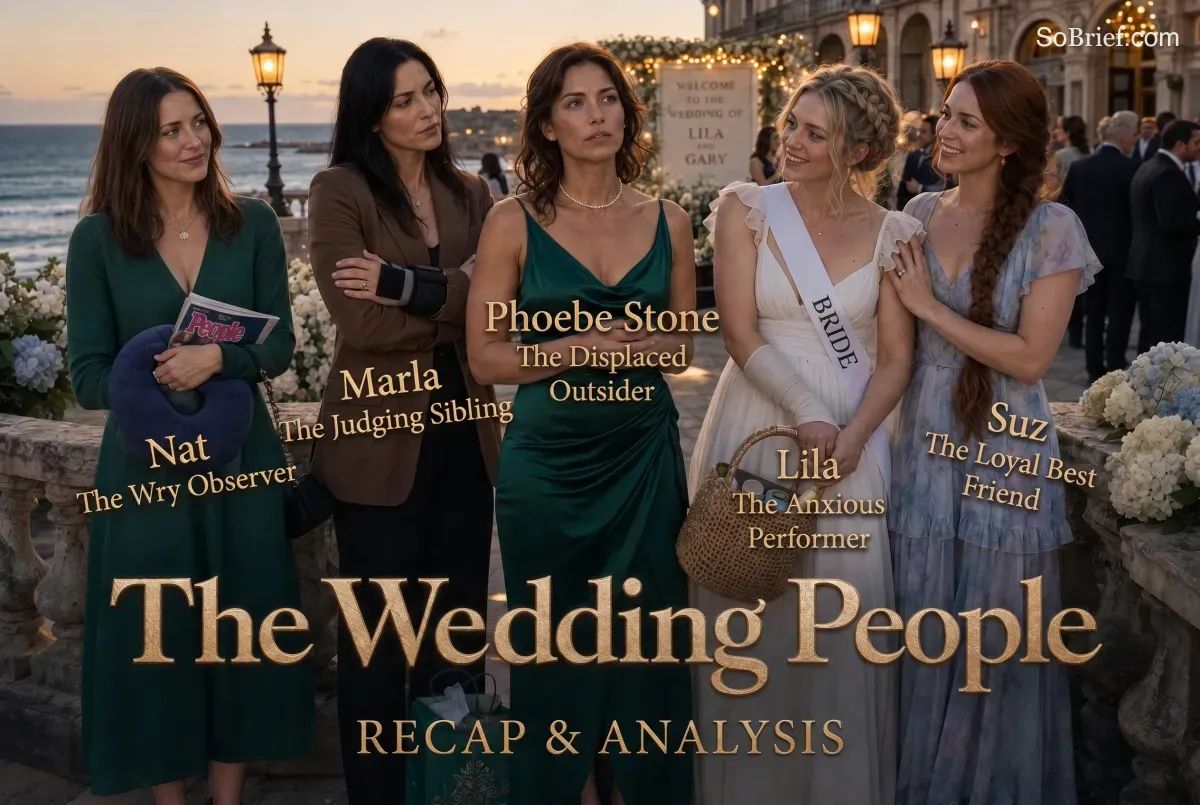
Phoebe Stone1 arrives at the Cornwall Inn in Newport wearing an emerald silk dress, gold wedding heels, and nothing else — no luggage, no plan to return. A forty-year-old Victorian literature professor from St. Louis, she has left behind a house with crumbs still on the counter and a dead cat she couldn't bury.
She chose this hotel from a fertility clinic magazine two years ago, when her therapist asked her to imagine her happy place. She booked it this morning, intending to take her cat Harry's1 painkillers at sunset and die on the canopy bed.
But the lobby teems with guests for Lila2 and Gary's3 week-long wedding. The line stretches past the staircase. The bride2 herself hands Phoebe1 a gift bag of German chocolate wine and gives her a practiced hug, mistaking her for family.
Confession Between Floors
The elevator doors crush Lila's2 hand when Phoebe1 presses them closed. Blood spreads through the tissue Phoebe1 offers, and Lila2 asks which family she belongs to. Neither, Phoebe1 says — and then, with the calm of someone stating a fact, tells the bride she has come to kill herself.
Lila2 pleads and bargains: not during her wedding week. But Phoebe1 has planned everything. She carries her dead cat's tuna-flavored painkillers and a Discman with a honeymoon CD called Sax for Lovers.
Behind the plan lies a collapsed life: five failed rounds of IVF, a miscarriage, her husband Matt4 who fell in love with her best friend Mia12 and left during the pandemic, a dissertation she never turned into a book, and a cat named Harry who died on her kitchen floor the morning she left.
The Speech That Saved Her
With no room service and no dinner, Phoebe1 swallows the pills. The sunset bleeds across the water. But through the open balcony door, she hears Patricia8 — Lila's2 mother — seize the microphone at the reception below.
Patricia8 tells a story about young Lila2 refusing to imagine what ducks were saying because they didn't speak English, a speech that starts cruel and builds toward tenderness. Patricia8 calls her daughter the most organized person she knows, a woman who once sold a painting by describing its dimensions and which SUV it would fit in.
Phoebe1 needs to hear the ending. The need is sharp, primal, undeniable. She runs to the bathroom and forces herself to vomit chocolate wine and bile until there is nothing left. She falls asleep on the marble floor, listening to the speeches like lullabies.
Strangers at Four A.M.
Unable to sleep, Phoebe1 descends to the hotel hot tub in black lace underwear and a fluffy robe. A bearded man steps in. They joke about pandemic beards — his is sincere, not ironic — and she confesses her dissertation was garbage.
Their honesty escalates: she admits she came here to kill herself but changed her mind, and he says he once came close himself. His foot brushes her leg underwater, an accident that electrifies her. She stands up in her lingerie and tells him she wants to sleep with him.
He pauses, then says he's with someone. She walks to the elevator feeling more alive than she has in years, carrying a copy of Mrs. Dalloway she pulled from the lobby shelf — a book she abandoned in graduate school after its character Septimus jumped from a window.
The Groom at the Wharf
Lila2 insists Phoebe1 join the wedding party's sailing trip. At Bowen's Wharf, Phoebe1 meets the bridesmaids Suz10 and Nat,11 Gary's3 sharp-tongued sister Marla,7 and his eleven-year-old daughter Juice6 — who insists on that nickname and refuses the ice cream Lila2 offers.
Then Lila2 shouts Gary's3 name, and the bearded man from the hot tub steps forward. The groom.3 He shakes Phoebe's1 hand as though they've never met. On the boat, their ease returns unbidden — they joke about Civil War battlefields and vacation cocktails while Lila2 watches from across the deck.
Phoebe1 can feel the wire of connection between them. But Gary3 puts his arm around Lila,2 and Phoebe1 understands she has walked into a story already underway, one where her role hasn't been written.
Funeral for Human Princess
Juice's6 virtual dog — a green plastic circle her dead mother Wendy13 gave her — stops working mid-sail. The girl transforms from sullen preteen to crying child. Gary3 kneels to comfort her, but it is Phoebe1 who asks how Human Princess died.
Lung cancer, Juice6 says, and Phoebe's1 own grief surfaces. She improvises a funeral: Juice6 speaks about carrying the dog in her pocket during school presentations, Jim5 — Gary's3 brother-in-law and best man — recalls when Wendy13 bought it, and Gary3 chokes up remembering how excited they all were.
When Phoebe1 says thank you to the tiny toy, she is also saying goodbye to Harry, to her unborn daughter, to her mother who died giving birth to her. Juice6 drops the dog overboard. It vanishes in white foam. The girl laughs, and something in both of them loosens.
The Accidental Maid of Honor
Lila2 bursts into Phoebe's1 bathroom without knocking and catches her mid-bath. Her real maid of honor Vivian can't come — her son has Covid. Phoebe1 yells at Lila2 for barging in, for never once asking how she's doing, for treating Phoebe's1 room like a confessional. Lila2 fires back that she knocked and got no answer, that she was worried Phoebe1 might be dead.
The anger cracks open something honest between them. Lila2 asks Phoebe1 to take over as maid of honor. Phoebe1 resists — she came here to die, not to source compostable dick-themed flatware. But Lila2 presents a binder of duties, orders room-service coffee, and shampoos Phoebe's1 hair while cataloguing her grievances about Marla.7 Phoebe1 submits. She is staying for the week.
Boots, Patricia, and Frank
Phoebe1 drives Juice6 in the vintage convertible to buy open-toed shoes. The girl declares Lila2 a bitch; Phoebe1 doesn't scold her, just asks why. Their bond deepens over footwear — Juice6 wears combat boots to be like her dead mother,13 not like Lila,2 and Phoebe1 confesses she fell in love with Matt4 because of his leather belt and what it revealed about who he was.
Later, Phoebe1 visits Patricia,8 who pours spicy margaritas and unspools her marriage to the Trash King of Rhode Island. After Henry's diagnosis, Patricia8 had an artist paint her nude — not for an affair, but to feel fully seen. At a pet shelter between errands, Juice6 holds a beagle while Phoebe1 cradles a yellow dog named Frank and imagines morning walks along the cliff.
The Bride Breaks at Midnight
The bachelorette party unfolds across a spa, a panda-mating lecture from a zookeeper-turned-sex-expert, dinner with penis straws at the oldest tavern in America, and dancing where even Marla7 takes shots.
During the sex workshop, every woman shares what turns her on — Marla7 confesses to being choked by a federal judge, Phoebe1 admits the last time she felt desire was talking to a total stranger — but Lila2 deflects, calling her sex life with Gary3 merely wonderful. After, stumbling drunk into Phoebe's1 room, Lila2 drops the performance.
She doesn't want to marry Gary.3 She's attracted to Jim.5 She hates Gary3 for promising her dying father would survive. She stands on the bed and shouts her confession. By morning, Lila2 reverses course. The wedding is back on.
Surfing and the Barbershop
Lila2 sends Phoebe1 to take Gary3 surfing with Juice.6 On the beach, they wrestle comically into wet suits, and Phoebe1 rides her first wave — standing on the ocean for a breathless instant before being swallowed whole. At a clam shack after, the three sit together like a small family. Then Phoebe1 and Gary3 visit a twenty-room mansion where a winter keeper position is open, complete with gargoyles and a view of the sea.
Geoffrey, the owner, is impressed by Phoebe's1 expertise in Victorian domestic spaces. At the barber, as clumps of his beard fall to the floor, Gary3 tells Phoebe1 he is drawn to her, that talking to her makes him feel like himself. The barber returns. In the car, Phoebe1 shuts the conversation down. She will not wreck this wedding.
Jim Takes the Microphone
At the Breakers rehearsal dinner, Lila2 cuts the speeches to make time for scheduled fireworks. Jim5 stands up anyway. He begins talking about Gary3 and everything they survived together but breaks down trying to say his sister Wendy's13 name.
The room claps until he composes himself. He calls Lila2 enchanting and bold — then slips in the truth: the day he brought Gary3 to her art gallery, he thought he was the one hitting on Lila.2 The crowd laughs, hearing it as a joke. Lila2 freezes, understanding it isn't.
Earlier, in Phoebe's1 room, Jim5 had confided the full story — how he met Lila2 first on the street outside the gallery, how he yielded her to Gary3 out of loyalty. A firework explodes behind his silhouette as the family absorbs what has been said.
Matt Finds the Cornwall
Gary3 arrives at Phoebe's1 door that night saying he thinks he is making a terrible mistake. Juice6 is asleep in Phoebe's1 bed after vomiting wine at dinner. Before Gary3 can finish, a voice in the hallway interrupts.
Matt4 — Phoebe's1 ex-husband — tracked her through their shared bank account when she vanished from St. Louis. Gary3 quietly carries his sleeping daughter away. Matt4 confesses he left Mia,12 that the affair was the worst mistake of his life, that he buried Harry in the backyard. He wants to try again.
Phoebe1 is furious, then tender, then confused. He kisses her, and she lets him, because he is familiar and she has been unspeakably lonely. They sleep together. In the morning, Phoebe1 wakes knowing she has made a mistake — but not the one Matt4 imagines.
The Bride on the Stoop
Phoebe1 helps Lila2 into her Victorian wedding dress and attaches the veil. But outside, the replacement car is an ordinary black Mercedes. Lila2 refuses to get in. She sits on the Cornwall's granite stoop in a cloud of white silk and finally says what she has been circling all week: she doesn't love Gary3 the way she wants to love someone.
She is glad something ruined the wedding because it gave her permission to stop. Phoebe1 tells her to go upstairs, take a bath, then go wherever she's never been.
Lila2 chooses Canada. Pauline9 — the hotel's resourceful young manager — books a flight to Montreal and a stone castle hotel. Lila2 eats one of the rescued palate cleansers Jim5 delivered that morning, checks her teeth one last time, and disappears into the hotel.
The Aisle Without a Bride
Phoebe1 drives the Mercedes alone to the Breakers, drinking champagne from the copper bucket. She walks down the aisle in her green dress toward Gary,3 who searches her face for information he already knows.
She whispers that Lila2 isn't coming, then turns to the assembled guests and announces the wedding is off. Gary3 nods like a soldier absorbing a wound and slips out a side door. In the car ride back with Matt,4 Phoebe1 tells him she is not returning to St. Louis.
She will sell the house, take a medical leave, become a winter keeper in a Newport mansion. Matt4 cries, jokes about grading, and drinks the bride's Veuve Clicquot. The champagne tastes good for every sip, not just the first — a distinction Phoebe1 has lived long enough to appreciate.
Where the Story Begins
Monday. The Cornwall empties. New wedding people arrive with fresh suitcases. Phoebe1 finds Gary3 in the hot tub — he spent the previous night at Wendy's13 grave, then returned to soak his ruined back in orange swim trunks so bright she can see them glowing underwater. They talk about butterflies that might orgasm on your forearm, unwashed backs, and medieval gargoyles that were originally just plumbing.
He enters his phone number into her contacts and tells her to call when she sees a ghost in the mansion. She puts the phone in her pocket like something precious. She packs her new suitcase, returns Mrs. Dalloway to the shelf spine-out, and walks through the velvet drapes of the Cornwall Inn into the daylight, tipping the doorman on her way.
Analysis
This novel reframes the marriage plot — the genre Phoebe1 has devoted her career to studying — by asking what happens when the story continues past the wedding. Every marriage plot promises the ceremony will solve the heroine's loneliness, but Espach demonstrates that weddings are beginnings of problems, not endings of them. Phoebe's1 own marriage ended in betrayal despite starting in a beautiful park. Lila's2 nearly begins without genuine love. Gary's3 first marriage was authentic but death-terminated. The novel argues that the nineteenth-century convention of ending at the altar was not celebration but avoidance of the harder question: what do you do with the rest of your life?
Phoebe's1 suicidal depression is rendered not as clinical abstraction but as the logical terminus of a woman who spent forty years performing an identity — normal, accommodating, invisible — that was never really hers. Her recovery begins not through medication or therapy but through being seen without performance: by Lila,2 too self-absorbed to be polite; by Gary,3 who recognizes her pain because he shares it; by Juice,6 who treats her like just another person in the car. The novel proposes that the antidote to depression is not happiness but radical honesty — with yourself, with others, about what you actually want and who you actually are.
Espach's most subversive achievement is making the cancelled wedding the story's happiest outcome. Lila's2 refusal to get in the car is not failure but the first autonomous decision of her adult life. Gary's3 abandonment at the altar liberates him from grief-paralysis disguised as contentment. And Phoebe's1 walk down the aisle — bride-less, empty-handed, headed toward a man she may or may not end up with — becomes the novel's true ceremony: a woman choosing to show up for an uncertain future, dressed magnificently, with nothing guaranteed except her own presence.
Review Summary
The Wedding People receives mostly positive reviews for its compelling characters, witty dialogue, and exploration of heavy themes like mental health and relationships. Many readers praise the author's writing style and the book's emotional depth. Some find the story heartwarming and thought-provoking, while others criticize its handling of sensitive topics. The novel follows Phoebe, a woman planning to end her life, who unexpectedly becomes involved with a wedding party at a hotel. Readers appreciate the character development and the novel's blend of humor and serious themes.
People Also Read










Characters
Phoebe Stone
Suicidal professor rebornA forty-year-old Victorian literature professor who has spent her life performing normalcy as armor against grief. Motherless from birth, raised by a depressed fisherman father, she found safety in nineteenth-century marriage plots that promised orphan girls eventual happiness. Her marriage to Matt4 became the culmination of that narrative—until IVF failures, his affair with Mia12, and the pandemic stripped her of every anchor: husband, fertility, career momentum, and finally her cat Harry. Phoebe's defining psychological tension is between compulsive self-erasure and a deep hunger to be fully seen. She apologizes for existing, defers to others' preferences, and fantasizes about violence she can't voice. Her intelligence is vast but weaponized inward, making her a brilliant critic of everything except her own diminishment.
Lila Rossi-Winthrop
The million-dollar brideThe twenty-eight-year-old bride orchestrating a million-dollar wedding funded by her dead father's money. Daughter of the Trash King of Rhode Island and a Mayflower-descended art curator, she lives between two inheritances—Catholic guilt and Protestant restraint—belonging fully to neither. Her compulsive planning masks a terror of emptiness: without events to organize, she confronts the hollow sensation that she has no authentic self. She talks without pause, decorates without rest, and manages her fiancé like a gallery installation. Her attraction to messier, less predictable people reveals her unconscious longing to break character. Beneath the bridal performance is a girl who never learned to grieve her father, trust her own desires, or sit still long enough to feel anything unscripted.
Gary
The widowed groomA forty-year-old gastroenterologist and widower who lost his first wife Wendy13 to lung cancer. He carries his grief like a medical chart he reviews daily but never discusses aloud. Father to Juice6, he is devoted, steady, and emotionally shut down—a man who discovered he could survive on the neutral autopilot of peeling potatoes and signing forms. His engagement to Lila2 was born from a coincidence he wanted to believe was destiny: she appeared at his office treating her dying father the same week he walked into her art gallery. Gary's pattern is to let others decide his life while he provides structural support—the house, the income, the calm. What draws him to Phoebe1 is that she demands nothing from him except honesty.
Matt Stone
The ex-husband who returnsPhoebe's1 ex-husband, a philosophy professor who could write thirty-four pages about a single word in Plato but couldn't articulate his own unhappiness. His affair with Mia12 was an implosion born from grief—five failed IVF cycles, a marriage weighed down by silence, and a creeping sense of vanishing. Beneath his tidy belt and careful manners, Matt is a man terrified of losing control, who only recognized what he had built by watching it collapse.
Jim
Best man building a seaplaneGary's3 brother-in-law—Wendy's13 brother—and the wedding's best man. An engineer who talks about building a seaplane but hasn't bought the parts, Jim is loud, flirtatious, and disarmingly sincere beneath the bravado. His grief for Wendy13 manifests as fierce loyalty to Gary3 and Juice6, and a restless energy he channels into jokes, Muscle Milk, and dreams of flight. His relationship with the wedding party carries undercurrents that run deeper than his easygoing manner suggests.
Juice
Grieving daughter in combat bootsGary's3 eleven-year-old daughter who insists on the nickname her dead mother Wendy13 used to call her. She communicates through silence, Wikipedia articles, and combat boots chosen specifically to resemble Wendy13, not Lila2. Her attachment to a virtual dog named Human Princess—a gift from her mother—is her most visible grief object. Beneath her preteen coolness is a child terrified of being forgotten by the adults rebuilding their lives around her.
Marla
The groom's caustic sisterGary's3 older sister, a lawyer-turned-mayor concealing an affair with a federal judge. Sarcastic and combative, she masks vulnerability with precision—correcting grammar, listing house prices, wearing wrist splints from competitive tennis. Her therapist-prescribed sexting campaign with her husband Robert is her awkward attempt to rebuild trust. She is both the wedding's antagonist and its most unexpectedly honest voice about the cost of keeping up appearances.
Patricia
The monologuing mother of the brideLila's2 mother, a sixty-something art gallery owner and widow who day-drinks spicy margaritas and delivers unsolicited lectures on Cubism. She commissioned a nude painting of herself after Henry's diagnosis—not for vanity but to feel fully seen by another human being. Her opening-night speech about Lila's2 literalness is both cruel and loving, mirroring a mother who can't stop performing wisdom long enough to simply grieve alongside her daughter.
Pauline
The unflappable hotel managerThe Cornwall Inn's enthusiastic young property manager, a Midwest transplant in the wrong dress who evolves from nervous new hire to poised professional across the wedding week. She fields impossible requests without blinking.
Suz
Bridesmaid and mother of the WormLila's2 bridesmaid from boarding school, now a nurse-turned-trainer who calls her baby the Little Worm. Relentlessly positive, perpetually amazed by ordinary things, fiercely loyal to Lila's2 narrative.
Nat
The experimental harpist bridesmaidLila's2 bridesmaid, an experimental harpist married to a woman named Laurel. The most direct of the friend group, she pushes Lila2 toward self-honesty about desire and identity.
Mia
The affair that ended Phoebe's marriagePhoebe's1 former colleague and Matt's4 affair partner. A tenured professor with three published books. Present only in Phoebe's1 memories and campus encounters as the woman who inherited her husband and her life.
Wendy
Gary's dead wife, ever-presentGary's3 first wife and Jim's5 sister, who died of lung cancer. An artist who once saw thirty shades of red in a single painting. She haunts the wedding in every avoided conversation and every nickname Juice6 clings to.
Plot Devices
The Cornwall Inn
Threshold between death and lifeThe Victorian hotel sits on a cliff—literally at the edge—and Phoebe1 chose it from a fertility clinic magazine as the only place she could imagine being happy, precisely because she'd never been there. Its themed rooms house different guests' transformations, and its rituals—turndown service, coconut pillows, brass platters presenting everything from floss to drain stoppers—become small acts of care that slowly convince Phoebe1 she is worth caring for. The hotel's staff, particularly Pauline9 and Carlson, demonstrate that showing up and performing kindness is its own form of grace. That the Cornwall is immediately overtaken by another wedding after Lila's2 collapses underscores the building's indifference to any single human drama—life cycles through it endlessly.
Mrs. Dalloway
The book she couldn't finishVirginia Woolf's novel about a society hostess planning a party while a veteran named Septimus contemplates suicide serves as Phoebe's1 mirror text. She abandoned it in graduate school after Septimus jumped from a window—she couldn't bear fiction confirming that marriage and art were insufficient to prevent self-destruction. Picking it up at the Cornwall, she reads past the suicide for the first time and discovers what follows: Mrs. Dalloway learns of the death at her party and feels not horror but recognition. For Phoebe1, finishing the novel represents willingness to read past the tragedy of her own story. Woolf's famous line—that it was dangerous to live even one day—becomes not a warning but a celebration of risk.
Human Princess
Proxy for unprocessed griefJuice's6 virtual dog—a green plastic circle from her dead mother13—dies of cancer mid-sail. The funeral Phoebe1 improvises becomes the mourning ritual she denied herself for Harry, for her unborn child, for her mother who died in childbirth. By helping an eleven-year-old say goodbye to something simultaneously plastic and priceless, Phoebe1 learns that grief doesn't require a worthy object. The moment she says thank you to the toy and cries is the first time she allows loss without shame. When Juice6 drops the dog overboard against Marla's7 protests about littering, both she and Phoebe1 choose ceremony over propriety. The device crystallizes the novel's argument that what we love need not be important to anyone else to be sacred to us.
The Wedding Week
External structure that keeps Phoebe aliveLila's2 six-day schedule—reception, sailing, bridal brunch, bachelorette, rehearsal dinner, ceremony—provides the framework that prevents Phoebe1 from retreating into isolation. Each event is a reason to get up, get dressed, and participate. The wedding's elaborate planning parallels Phoebe's1 own compulsive organizing (spreadsheets, IVF schedules) but redirects that energy outward toward other people. Ironically, the wedding Phoebe1 once feared she would ruin is ultimately cancelled not by death but by Lila's2 choice to live honestly—making the cancellation the wedding's truest success. The structure mirrors a recovery program: each day strips away another layer of performance until the participants confront who they really are underneath the decorations.
The Hot Tub
Space where masks dissolveThe hotel's hot tub appears at the story's beginning and end—first as the site of Phoebe1 and Gary's3 anonymous meeting at four in the morning, finally as the space where they acknowledge what they've become to each other. Submerged in warm water at unusual hours, stripped of clothing and social context, the characters are free to be honest in ways the wedding prohibits. Phoebe1 tells a stranger she wanted to die; Gary3 admits he once felt the same. Their first conversation establishes the intimacy the rest of the novel struggles to accommodate within the constraints of a wedding week. The tub is the novel's answer to the Victorian drawing room: a place where the real negotiations of love and identity happen off-script.
FAQ
Synopsis & Basic Details
What is The Wedding People about?
- Unexpected connections bloom: Phoebe Stone, reeling from a divorce, checks into a Newport hotel intending to end her life but encounters Lila, a bride overwhelmed by her upcoming wedding.
- Life-affirming disruptions occur: Their unlikely friendship and the chaotic wedding preparations force Phoebe to reconsider her plans and engage with life again.
- Exploration of human bonds: The novel explores themes of love, loss, and the search for meaning through the intertwined stories of Phoebe and the wedding guests.
Why should I read The Wedding People?
- Unconventional characters: The story features relatable, flawed characters grappling with complex emotions, offering a refreshing perspective on life's challenges.
- Humorous and heartfelt: Alison Espach balances dark themes with witty dialogue and poignant moments, creating a compelling and emotionally resonant reading experience.
- Exploration of self-discovery: The novel provides a thought-provoking exploration of self-discovery, resilience, and the transformative power of human connection.
What is the background of The Wedding People?
- Contemporary societal pressures: The novel reflects contemporary anxieties about marriage, societal expectations, and the search for individual fulfillment.
- Exploration of grief and loss: The story delves into the complexities of grief, divorce, and the struggle to find meaning after experiencing significant loss.
- Critique of wedding industry: The novel offers a satirical commentary on the extravagance and pressures associated with modern weddings.
What are the most memorable quotes in The Wedding People?
- "Love was an invisible wire, connecting them always.": This quote encapsulates the idealized vision of marriage that Phoebe initially held, highlighting the contrast with her later disillusionment.
- "I'm here to kill myself.": This stark statement, delivered without drama, defines Phoebe's initial state of despair and sets the stage for her transformative journey.
- "You definitely cannot kill yourself. This is my wedding week.": This darkly humorous line from Lila underscores the clash between individual suffering and societal expectations, driving the plot forward.
What writing style, narrative choices, and literary techniques does Alison Espach use?
- Character-driven narrative: The story is primarily driven by the internal thoughts and experiences of Phoebe, offering a deeply personal and introspective perspective.
- Witty and sardonic tone: Espach employs a sharp, often humorous tone to explore serious themes, creating a unique blend of dark comedy and emotional depth.
- Symbolism and motif: The novel utilizes recurring symbols and motifs, such as the ocean, the hotel, and the wedding itself, to enhance the thematic resonance and create layers of meaning.
Hidden Details & Subtle Connections
What are some minor details that add significant meaning?
- The Sax for Lovers CD: This CD, a honeymoon relic, symbolizes Phoebe's past happiness and the chasm that has grown between her and her former life, highlighting the theme of lost love.
- The German chocolate wine: The bride's gift of German chocolate wine represents the unexpected pleasures and connections that can arise from unlikely circumstances, challenging Phoebe's cynicism.
- The Pussy Fund jar: Joe's "Pussy Fund" jar reveals a casual sexism that Phoebe once overlooked, highlighting her evolving awareness of societal inequalities and her own complicity.
What are some subtle foreshadowing and callbacks?
- Phoebe's spreadsheet of fun: Her detailed spreadsheet foreshadows her inability to experience joy spontaneously, a key aspect of her depression and a barrier to connecting with Matt.
- The recurring image of Virginia Woolf: Woolf's suicide foreshadows Phoebe's initial intentions, while also serving as a point of contrast as Phoebe ultimately chooses life.
- The mention of the movie The Birds: This reference foreshadows the unsettling feeling Phoebe experiences as she becomes increasingly aware of the wedding people, hinting at the underlying anxieties and pressures of social expectations.
What are some unexpected character connections?
- Phoebe and Gary's shared vulnerability: Their candid conversation in the hot tub reveals a shared understanding of loss and despair, forging an unexpected connection that challenges their initial roles in the story.
- Lila and Patricia's strained relationship: The complex dynamic between Lila and her mother, Patricia, reveals a shared history of unmet expectations and unspoken resentments, adding depth to their individual struggles.
- Jim and Wendy's bond: The close relationship between Jim and his deceased sister, Wendy, influences his interactions with both Gary and Lila, highlighting the enduring impact of loss and the complexities of family dynamics.
Who are the most significant supporting characters?
- Pauline, the hotel employee: Pauline's genuine kindness and eagerness to please offer Phoebe a glimpse of human connection and challenge her cynicism, representing the potential for empathy in unexpected places.
- Jim, Gary's brother-in-law: Jim's presence as the best man and his complex relationship with Gary and Lila add layers of tension and humor to the story, highlighting the enduring impact of loss and the challenges of navigating family dynamics.
- Patricia, Lila's mother: Patricia's candidness and unconventional wisdom provide a counterpoint to Lila's anxieties, offering Phoebe a different perspective on life, love, and self-acceptance.
Psychological, Emotional, & Relational Analysis
What are some unspoken motivations of the characters?
- Phoebe's desire for control: Her initial plan to end her life stems from a desire to control her narrative and escape the pain of her divorce and infertility struggles.
- Gary's need for validation: His eagerness to please others and his attraction to Lila may stem from a need to fill the void left by his deceased wife and daughter.
- Lila's fear of inadequacy: Her obsession with perfection and her reliance on external validation may stem from a deep-seated fear of not being good enough, both in her career and in her relationships.
What psychological complexities do the characters exhibit?
- Phoebe's depressive realism: Her tendency to focus on the negative aspects of life and her struggle to find joy reflect the complexities of depression and the challenges of recovery.
- Gary's survivor's guilt: His feelings of guilt and responsibility for his wife's death contribute to his desire to please others and his difficulty embracing happiness.
- Lila's anxiety and perfectionism: Her need for control and her fear of failure manifest as anxiety and perfectionism, creating a constant pressure to meet unrealistic expectations.
What are the major emotional turning points?
- Phoebe's decision to live: Her decision to abandon her suicide plan marks a significant turning point, signaling her willingness to embrace life and seek new meaning.
- Gary's confession of unhappiness: His admission that he is not happy in his marriage challenges Phoebe's assumptions and forces her to confront her own feelings.
- Lila's realization of her true desires: Her decision to call off the wedding represents a moment of liberation and self-discovery, empowering her to pursue a more authentic path.
How do relationship dynamics evolve?
- Phoebe and Lila's friendship: Their initial connection based on shared vulnerability evolves into a supportive and empowering friendship, challenging societal expectations and fostering personal growth.
- Phoebe and Gary's connection: Their bond deepens throughout the week, blurring the lines between friendship and romantic interest, forcing them to confront their feelings and make difficult choices.
- Lila and Gary's relationship: Their relationship unravels as they confront their unspoken anxieties and realize that they are not truly compatible, leading to a difficult but ultimately liberating decision.
Interpretation & Debate
Which parts of the story remain ambiguous or open-ended?
- The nature of Phoebe and Gary's connection: The extent of their romantic feelings and the potential for a future relationship is left ambiguous, allowing readers to interpret their connection in different ways.
- Lila's future path: Her decision to call off the wedding opens up a range of possibilities for her future, leaving readers to imagine what she will do and who she will become.
- The long-term impact of the week's events: The novel concludes with Phoebe embarking on a new chapter, but the long-term impact of the week's events on her life and the lives of the other characters remains open to interpretation.
What are some debatable, controversial scenes or moments in The Wedding People?
- Phoebe's initial suicide plan: Her decision to end her life may be seen as a controversial or triggering topic, sparking debate about the portrayal of mental health and suicide in literature.
- The affair between Matt and Mia: The affair raises questions about morality, responsibility, and the complexities of human relationships, prompting readers to consider the motivations and consequences of their actions.
- The ending of Lila and Gary's relationship: Their decision to call off the wedding may be seen as either a courageous act of self-discovery or a selfish act that hurts those around them, sparking debate about the nature of love and commitment.
The Wedding People Ending Explained: How It Ends & What It Means
- Phoebe chooses life and self-discovery: Phoebe's decision to become a winter keeper signifies her commitment to embracing life and pursuing her own passions, rather than conforming to societal expectations.
- Lila embraces authenticity: Lila's decision to call off the wedding represents a rejection of societal pressures and a commitment to living a more authentic life, even if it means facing uncertainty and disapproval.
- Hope for the future: The ending offers a message of hope and resilience, suggesting that even in the face of loss and disappointment, new beginnings are always possible.
Download PDF
Download EPUB
.epub digital book format is ideal for reading ebooks on phones, tablets, and e-readers.








































