

Key Takeaways
The Fed printed a century's worth of money in one year
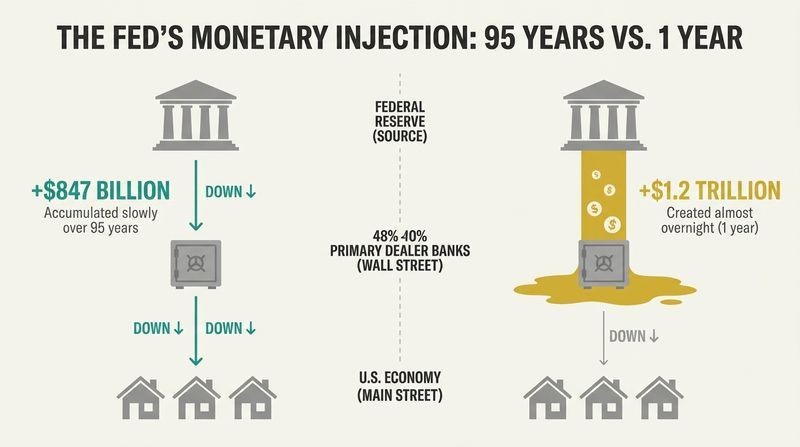
The 2008 crisis rewrote central banking. Between 1913 and 2008 the Federal Reserve grew the monetary base from roughly 5 billion to 847 billion dollars, a slow upward slope. Then, between late 2008 and early 2010, it created 1.2 trillion new dollars, more than doubling the base almost overnight. Excess reserves in the banking system exploded from 200 billion to 1.2 trillion.
How money is actually born. The Fed cannot hand cash to citizens. It creates dollars only by depositing them into the reserve accounts of about two dozen elite banks called primary dealers. This structural fact means every new dollar enters through Wall Street first, making the biggest banks the literal seedbed of the American money supply.
What's striking is how this mechanism inverts popular intuition about money. Most imagine the Fed as a printing press showering citizens; in reality it is a wholesale operation feeding a closed club of dealers. This design, traceable to the 1910 Jekyll Island compromise that kept Wall Street central, guarantees that monetary expansion reaches asset holders before wage earners. Economists like Thomas Piketty document how returns to capital outpacing wages widens inequality; Leonard's account supplies the plumbing that mechanically produces that gap. The insight reframes quantitative easing not as neutral stimulus but as a distributional choice baked into the Fed's architecture since its founding.
Cheap money for too long inflates asset bubbles, not just prices
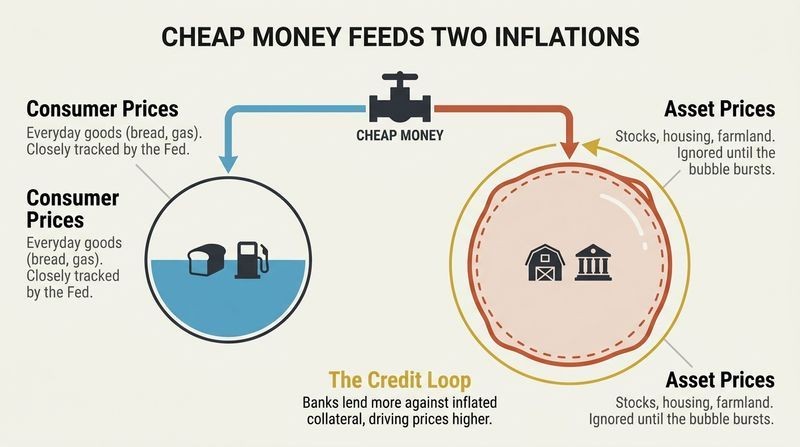
Two kinds of inflation, not one. Hoenig learned from the 1970s that the Fed watches consumer prices (bread, gas) but ignores asset prices (farmland, stocks, real estate). Paul Volcker called these inflation 'cousins.' Both are fueled when money stays cheap too long. Rising farmland prices in the 1970s Midwest let banks lend more against inflated collateral, which pushed prices higher still, a self-reinforcing loop.
The bust is inevitable. When Volcker jacked rates to 20% in 1981, farmland fell 27% and oil collapsed from over 120 dollars to 25 dollars a barrel. More than 1,600 banks failed between 1980 and 1994. The Fed got credit for ending inflation but caused the underlying bubble by keeping money cheap through the decade prior.
This dual-inflation framing is the book's analytical engine, and it exposes a genuine blind spot in mainstream monetary policy. Central banks target the Consumer Price Index precisely because asset inflation is harder to measure and politically painful to pop; nobody protests a rising 401(k). Hyman Minsky's financial instability hypothesis anticipated this: stability breeds risk-taking that breeds instability. The 2008 housing crash, the dot-com bust, and the 1980s farm collapse all fit the pattern. The nuance worth adding: distinguishing a healthy repricing from a dangerous bubble in real time remains genuinely hard, which is partly why the Fed defaults to watching only what it can cleanly quantify.
Zero rates force everyone into risk they cannot afford
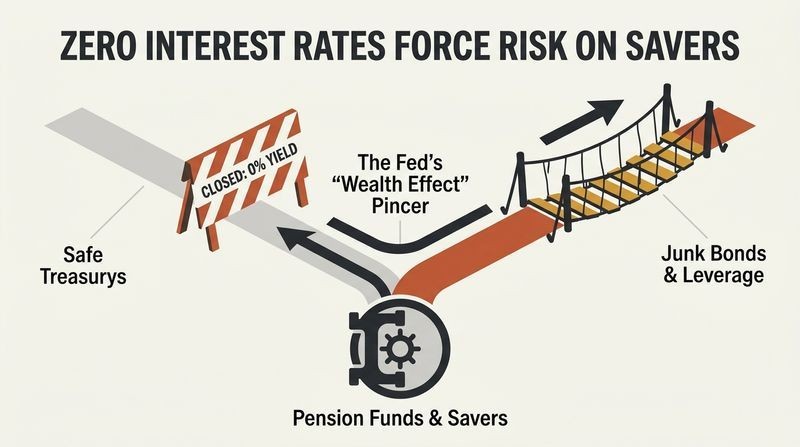
The search for yield. When the Fed pinned rates at zero (ZIRP, zero-interest-rate policy) and bought long-term Treasurys through quantitative easing, it deliberately removed the safe place to park money. A pension fund that once met its obligations with Treasurys earning 4% suddenly earned near nothing. So it hunted for yield in riskier territory: junk bonds, leveraged loans, fracking wells, luxury condos.
Risk becomes mandatory, not optional. Leonard describes a military pincer: new cash floods in from one side while low rates punish saving from the other. The strategy's explicit goal was pushing money into risky assets to create a 'wealth effect.' But since the richest 1% owned about 25% of all assets and the bottom half owned 6.5%, the benefits flowed overwhelmingly upward.
The phrase 'reach for yield' has become finance jargon, but Leonard grounds it in human terms: a conservative pension manager who must gamble to stay solvent. This is a subtle form of financial coercion rarely acknowledged in Fed communications. Behavioral finance research shows that forced risk-taking under duress produces worse decisions than voluntary risk appetite, which helps explain the erosion of lending standards. One challenge to the thesis: some argue ZIRP was the least-bad option given fiscal paralysis, and that mass unemployment would have hurt ordinary people more. Leonard's rebuttal is that the Fed treated symptoms while deepening structural fragility, trading a sharp crisis for a chronic one.
When Congress froze, the Fed became America's only economic engine
Overmighty citizen. Former Bank of England official Paul Tucker warned that democracies increasingly delegate hard problems to unelected bodies like courts and central banks. In November 2010, as the Tea Party won the House and Congress ground to a halt, the Fed became the central driver of economic policy by default. It had pushed roughly 1 trillion dollars out the door in 2008 before Congress even finished debating stimulus.
A dangerous feedback loop. Tucker noted the trap: the more central banks do, the less elected officials feel compelled to act, which pushes still more responsibility onto the central bank. Monetary policy became attractive precisely because it required no messy votes, no winners and losers on record, no political cost.
This is the book's most important political argument, and it resonates beyond economics. Political scientists describe a broader hollowing of legislative capacity, with agencies, courts, and executives filling the vacuum. The Fed is uniquely seductive because its tool (money creation) appears costless in the short run, unlike taxation or spending that create identifiable losers. Yet Tucker's insight cuts deep: delegation is self-reinforcing and corrosive to democratic muscle. A useful extension comes from public choice theory, which predicts that once politicians can offload hard tradeoffs to a technocratic body, they will, regardless of party. The Fed did not seize power so much as absorb what elected institutions abandoned.
Dissent inside the Fed is treated as betrayal, so consensus rules
The illusion of pure math. The FOMC (Federal Open Market Committee) prizes near-unanimous votes because they let the Fed appear to be neutral engineers solving equations rather than politicians choosing winners. When Hoenig voted no eleven times in 2010, colleagues asked if he was sure, media called him a crank, and Chairman Bernanke reserved unusual venom for him in his memoir.
Manufactured agreement. Bernanke privately lobbied governors between meetings to reach a pre-cooked 'Option B,' the middle choice engineered to satisfy everyone. He tolerated at most one regional-president dissent. Governor Kevin Warsh opposed QE but was persuaded to vote yes and publish his reservations only afterward. Powell, Duke, and Stein (the 'Three Amigos') privately resisted but never cast dissenting votes.
The sociology here is fascinating and underappreciated. Irving Janis coined 'groupthink' to describe how cohesive elite groups suppress dissent to preserve harmony, often with catastrophic results. The FOMC's culture of deference to the chair, the discomfort in the room when someone breaks ranks, is a textbook case. What makes it more insidious is that unanimity is a deliberate public-relations asset: it protects the Fed's mystique of apolitical expertise. The cost is intellectual monoculture at the exact moment diverse judgment matters most. Powell's arc, from sharp private critic to loyal yes-vote, illustrates how institutional gravity bends even skeptics. Dissent, Hoenig argued, is a duty, not disloyalty.
Obscure jargon quietly stripped money policy from democratic debate
Fedspeak as a shield. In the 1890s William Jennings Bryan could rile crowds over monetary policy with his 'cross of gold' speech. By the Greenspan era, the same issues were buried under language so dense it required a PhD to parse. Greenspan spoke more clearly inside FOMC meetings than in public testimony, where a 'cloudy veil' descended.
Incomprehension breeds passivity. Programs got deliberately opaque names: quantitative easing, TAF, TSLF, PDCF. When economist Carola Binder analyzed 300,000 news stories from 2007 to 2011, Bernanke was the lead newsmaker in just 0.13% of them versus 8% for Obama. Most Americans had no idea what QE even was, so one of the most consequential policies of the decade went essentially undebated.
Language as power is an old theme (Orwell dissected it), but Leonard applies it precisely to monetary governance. The obfuscation is not accidental; complexity manufactures deference. When citizens conclude a topic is too complicated to understand, they cede it to experts, which suits an institution that prizes insulation from voters. There is a genuine tension, though: monetary mechanics ARE technical, and dumbing them down risks demagoguery of the Beck variety, which Leonard skewers for being confidently wrong. The healthier path, which the book implies, is neither jargon nor conspiracy but honest plain-English accounting of who gains and who loses, the very thing Fedspeak is engineered to avoid.
Cheap debt funds buyouts and buybacks, not jobs or innovation
Rexnord as parable. Powell's private-equity firm Carlyle bought the Milwaukee manufacturer Rexnord in 2002, loaded it with debt, and flipped it to Apollo in 2006 for over 900 million dollars more. Each owner piled on leverage. By 2007 Rexnord paid 105 million in annual interest, more than it earned, for over a decade. The company's real 'product' became servicing its own debt.
Money chased financial engineering. In the ZIRP era firms borrowed to buy back their own stock, boosting share prices and executive pay without hiring or inventing. Texas Instruments borrowed 1.5 billion and told a Fed president plainly it would not create a single job. McDonald's borrowed to fund 35 billion in buybacks. Rexnord eventually shipped 300 Indianapolis jobs to Mexico, saving 15 million a year.
This is the book's most vivid demonstration that monetary policy has a factory-floor body count. The Rexnord-to-Feltner throughline, from boardroom leverage to a laid-off machine operator earning progressively less at each job, is Gladwellian storytelling in service of a macroeconomic argument. Research on the financialization of the firm supports it: William Lazonick's work shows S&P 500 companies spent the majority of profits on buybacks rather than investment. The counterargument deserves airing: buybacks can rationally return cash when a firm lacks good projects, and private equity sometimes rescues failing companies. But Leonard's point stands that zero rates systematically tilted incentives toward extraction over creation.
QE was designed to inflate asset prices, and it worked spectacularly
Not a side effect, the goal. Fed economists openly told the FOMC that ZIRP boosted growth through three channels: cheaper debt, higher asset prices (the wealth effect), and a weaker dollar. Higher asset prices were the intended mechanism, not collateral damage. The Dow rose 77% between 2010 and 2016 despite weak overall growth, stagnant wages, and the international crises the Fed cited to justify intervention.
Winners were predetermined. Because assets are concentrated at the top, boosting them necessarily helped the wealthy most. Dallas Fed president Richard Fisher said the plain truth in a 2013 meeting: the wealth effect flowed to 'the rich and the quick,' the Buffetts, the KKRs, the Carlyles, those who could borrow at nothing and ride assets higher, while savers on fixed incomes were punished.
The candor of internal Fed discussions, quoted here, is damning precisely because officials understood the distributional consequences in real time. This punctures the defense that inequality was an unforeseen accident. The trickle-down logic embedded in the wealth effect echoes supply-side economics, and the empirical record on trickle-down is famously weak. What's analytically sharp in Leonard's telling is the asymmetry: asset inflation is celebrated as a 'boom' while equivalent consumer inflation would trigger emergency rate hikes. That double standard reveals whose interests the institution instinctively protects. A fair caveat: mass unemployment also devastates the poor, so the honest debate is about tradeoffs the Fed never transparently put to the public.
A 2019 plumbing glitch exposed hedge funds hijacking the repo market
The 400 billion dollar quiet bailout. In September 2019, the repo market (where firms swap Treasurys for overnight cash) suddenly seized. Rates spiked from about 2% to over 9%. The Fed intervened instantly with hundreds of billions. The cause: hedge funds had doubled their repo borrowing to fund 'basis trades,' leveraging as much as 50 to 1 to exploit tiny price gaps between Treasury bills and futures.
Fragility masked as maintenance. These trades only worked in the enforced calm the Fed had manufactured. When repo rates jumped, the funds faced forced liquidation potentially twice the size of 2008. The Fed rescued them but described the whole thing as routine housekeeping. A 400 billion dollar emergency injection was no longer even news.
The repo episode is the book's smoking gun: a supposedly booming economy with 3.5% unemployment was so structurally brittle that a technical cash squeeze nearly triggered a crisis. This is the Minsky moment in miniature, financial fragility accumulating invisibly during good times. What deserves emphasis is the moral hazard flywheel: each rescue teaches sophisticated players that extreme leverage is safe because the Fed will backstop volatility, which invites more extreme leverage. The shadow banking system (hedge funds performing bank-like functions outside bank regulation) had grown to where the Fed effectively became its lender of last resort, a role never authorized by Congress or debated by voters.
Each Fed rescue makes the next one bigger and impossible to avoid
The trap tightens. Hoenig's core prediction was that QE would be nearly impossible to reverse. He was right. When the Fed tried to 'normalize' by selling bonds and raising rates in 2018, markets convulsed; the Dow fell 5% in two days. Powell reversed course entirely in early 2019, a shift traders dubbed the 'Powell Pivot.' The economy had reorganized itself around a zero rate.
COVID confirmed the pattern. In March 2020 the Fed did in one weekend what took months in 2008: cut rates to zero, relaunched massive QE, and for the first time bought corporate bonds and even junk debt. Its balance sheet ballooned toward 7.4 trillion dollars. Congress's CARES Act sent over half its money to businesses; more than half of PPP funds reached just 5% of recipients.
The ratchet dynamic is the book's grim conclusion: intervention is asymmetric, easy to start and agonizing to unwind, because an entire economic ecosystem calibrates itself to the new equilibrium. Hoenig's Swiss-central-banker maxim, that guarding the long run lets the short run take care of itself, is the road not taken. The deeper worry is institutional: a Fed that cannot normalize has lost optionality and becomes hostage to the markets it feeds. There is a steelman for Powell's pivots (avoiding a self-inflicted recession is defensible), but Leonard's framing holds that each rescue socializes downside risk for asset holders while the middle class, embodied by laid-off worker John Feltner, keeps sliding regardless.
Analysis
Christopher Leonard's book is a work of narrative economic journalism that argues a heterodox thesis: the Federal Reserve, through zero interest rates and quantitative easing, became the primary engine of American inequality and financial fragility over the 2010s. Its structural genius is the pairing of two protagonists. Thomas Hoenig, the lone dissenter, embodies the road not taken and supplies the analytical spine. Jerome Powell, the private-equity insider turned chairman, embodies the institution's capture, moving from private critic to loyal executor. Around them Leonard weaves the Rexnord-Feltner storyline, translating abstract monetary mechanics into a Milwaukee factory floor and a laid-off machinist. This is Gladwellian craft deployed for a Piketty-scale argument.
The book's intellectual contribution is reviving the distinction between consumer-price inflation and asset-price inflation, the Volcker 'cousins.' By showing that the Fed systematically watches one and ignores the other, Leonard explains why a decade of aggressive money creation produced no bread-and-gas inflation yet a spectacular boom in stocks, bonds, and real estate that accrued to the already-wealthy. This reframing is genuinely clarifying and predates the post-2021 inflation surge, which complicates but does not refute it.
The strongest counterargument, which Leonard underweights, is the counterfactual: absent aggressive intervention, mass unemployment might have inflicted greater harm on ordinary people than asset inflation did. Bernanke's 'courage to act' defense is not frivolous. Leonard's rebuttal is temporal: the Fed repeatedly chose to defer pain, converting acute crises into chronic fragility and moral hazard, so that each rescue guaranteed a larger next one. The 2019 repo seizure and the 2020 COVID bailout, executed in a single weekend, vindicate the fragility thesis. The book's lasting provocation is political rather than technical: when democratic institutions atrophy, an unelected, jargon-shrouded central bank fills the vacuum, and money creation becomes governance without accountability.
Review Summary
The Lords of Easy Money receives mixed reviews, with many praising its clear explanation of complex monetary policy and the Federal Reserve's role in asset bubbles and inequality. Critics argue it oversimplifies issues and lacks balanced perspectives. Readers appreciate the insights into quantitative easing and its effects on the economy. The book focuses on Thomas Hoenig's dissenting voice within the Fed, detailing debates around monetary policy since the 2008 financial crisis. While some find it engrossing, others criticize its repetitive nature and potential bias.
People Also Read

FAQ
What's The Long Crash about?
- Monetary Policy Focus: The Long Crash by Christopher Leonard examines the Federal Reserve's monetary policies, especially during and after the 2008 financial crisis, highlighting figures like Thomas Hoenig and Ben Bernanke.
- Dissent and Consequences: It emphasizes dissent within the Fed, particularly Hoenig's opposition to quantitative easing and low interest rates, and explores the long-term economic consequences of these policies.
- Economic Impact: The book discusses how these policies have led to wealth inequality and asset bubbles, affecting the broader economy and financial markets.
Why should I read The Long Crash?
- Economic Insight: The book provides a deep understanding of how monetary policy impacts everyday life and the economy, making complex concepts accessible.
- Historical Context: It offers historical context for financial crises and policy decisions, essential for understanding current economic debates.
- Engaging Narrative: Leonard combines economic theory with personal stories, making the material engaging and relatable.
Who is Thomas Hoenig in The Long Crash?
- Federal Reserve Role: Thomas Hoenig was the president of the Federal Reserve Bank of Kansas City and a member of the Federal Open Market Committee (FOMC).
- Dissenting Voice: He consistently voted against measures like quantitative easing, warning of long-term economic instability.
- Legacy of Warnings: Hoenig's concerns about monetary policy were prescient, as many issues he warned about materialized post-crisis.
What is quantitative easing as described in The Long Crash?
- Definition: Quantitative easing (QE) is a monetary policy where central banks buy government securities to inject money into the economy, aiming to lower interest rates and stimulate activity.
- Fed's Implementation: Under Bernanke, the Fed used QE to stabilize the banking system post-2008 crisis, marking a significant policy shift.
- Criticism: Critics like Hoenig argued QE could create asset bubbles and widen income inequality, benefiting the wealthy disproportionately.
How does The Long Crash explain the concept of ZIRP?
- Definition of ZIRP: Zero-interest-rate policy (ZIRP) involves keeping interest rates near zero to stimulate economic growth, implemented by the Fed post-2008 crisis.
- Consequences: ZIRP has led to asset price inflation, benefiting the wealthy while leaving the working class behind.
- Long-term Effects: It has distorted investment behavior, increasing risk-taking and the rise of "zombie companies."
What are the key takeaways of The Long Crash?
- Dissent Importance: Dissenting voices like Hoenig's are crucial in policymaking to prevent groupthink and consider diverse perspectives.
- Policy Consequences: Monetary policy decisions can have long-lasting effects, often not immediately apparent, warning against short-term thinking.
- Wealth Inequality: The Fed's policies, particularly QE, have increased wealth inequality, benefiting the rich while disadvantaging the working class.
How does The Long Crash address the COVID-19 pandemic's impact on the economy?
- Pandemic as Catalyst: The pandemic exposed economic fragility, worsened by years of ZIRP and QE, leading to unprecedented government interventions.
- Inequality Worsened: The pandemic disproportionately affected low-wage workers and small businesses, exacerbating existing inequalities.
- Long-term Changes: The pandemic will have lasting effects on labor markets and consumer behavior, with potential ongoing instability.
What role does corporate debt play in The Long Crash?
- Rising Debt Levels: Corporate debt has reached record highs due to cheap borrowing from ZIRP and QE, raising sustainability concerns.
- Zombie Companies: These are firms surviving only due to cheap borrowing, posing risks to economic productivity and stability.
- Financial Stability Impact: High corporate debt levels create vulnerabilities, with potential defaults threatening broader economic crises.
How does The Long Crash explain the relationship between the Fed and Wall Street?
- Interconnectedness: The Fed's policies directly influence Wall Street, encouraging risk-taking through mechanisms like QE and ZIRP.
- Corporate Behavior Impact: Fed actions have led to increased borrowing and riskier investments, with companies relying on cheap debt.
- Economic Consequences: This relationship can lead to asset bubbles and financial instability, necessitating a balanced monetary policy approach.
What are the risks associated with zero-interest-rate policies (ZIRP) as outlined in The Long Crash?
- Risky Behavior Encouragement: ZIRP incentivizes risk-taking, potentially leading to financial instability and asset bubbles.
- Wealth Inequality: It disproportionately benefits the wealthy, exacerbating income inequality and leaving lower-income individuals behind.
- Economic Distortions: Prolonged low rates can distort economic signals, leading to resource misallocation and long-term challenges.
What are the best quotes from The Long Crash and what do they mean?
- “Respectfully, no.”: Symbolizes Hoenig's dissent against Fed policies, emphasizing integrity and caution in monetary policy.
- “You’re trying to kill people.”: Reflects Hoenig's internal conflict, paralleling concerns about monetary policy's destructive potential.
- “The simple fact is there are times when it is wise not to jump on the bandwagon.”: Warns against herd mentality in finance, stressing critical thinking.
What lessons can be learned from The Long Crash regarding future monetary policy?
- Cautious Approach Needed: Emphasizes considering long-term consequences over short-term gains in monetary policy.
- Diverse Perspectives Importance: Highlights the value of dissenting opinions to prevent groupthink and ensure comprehensive risk understanding.
- Focus on Inflation Types: Suggests addressing both price and asset inflation to mitigate financial instability and promote sustainable growth.
Download PDF
Download EPUB
.epub digital book format is ideal for reading ebooks on phones, tablets, and e-readers.








































