

Key Takeaways
Sports betting is a multiplayer game — find the sucker or be one
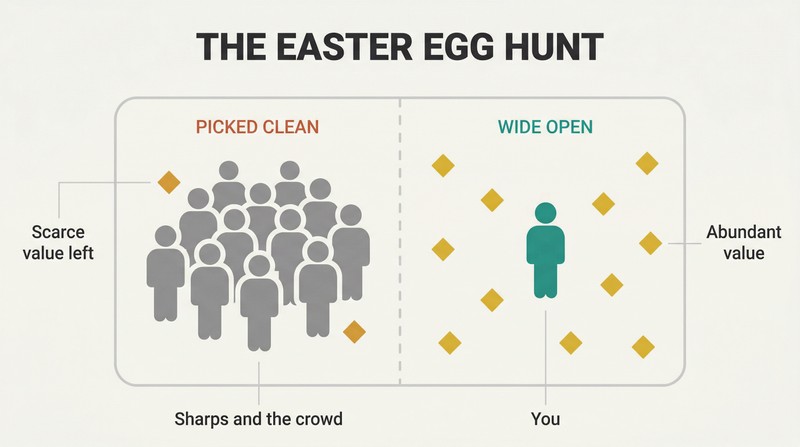
This isn't solitaire or Sudoku. Unlike blackjack where the player next to you is irrelevant, every sports bet has a human counterparty actively trying to beat you — sportsbook employees and hundreds of sharp bettors scanning the same lines you see. Miller compares opening lines to Black Friday doorbuster deals: market makers post lines, and within minutes a mob of sophisticated bettors hammers every mispriced number. By the time your favorite sportsbook app shows you an NFL spread on Sunday morning, thousands of smart, well-funded people have picked it clean.
If you think you've found something they all missed, you likely haven't. The winning approach isn't outsmarting the entire market — it's looking where nobody else is looking. Treat sports betting like an Easter egg hunt: when all the other kids run one direction, run the other.
Sportsbooks don't crunch numbers — they copy lines from market makers
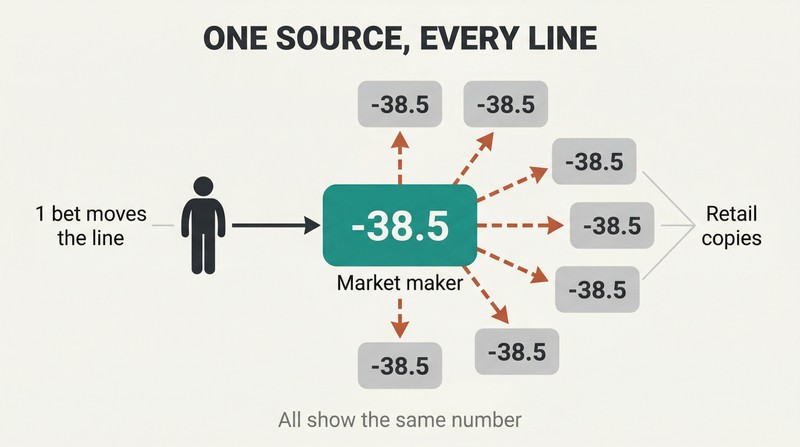
Lines come from three sources: analysts making rough openers (the smallest role), sportsbooks copying from each other, and price discovery — where a market maker posts a line, takes bets, and moves it on action. A market maker could know nothing about Alabama but open every game at zero, take bets, and watch Alabama settle naturally at -38.5 through customer action. No army of supernerds in a bunker is responsible for the hundreds of daily lines.
Once a market maker's lines stabilize, nearly every retail sportsbook copies them. This creates systemic fragility: one market maker moves a line based on a single bet, and dozens of books follow even though none of their own customers bet. The real market is often much thinner and less liquid than it appears.
'Cents of value' in American odds is a trap — think in percentages
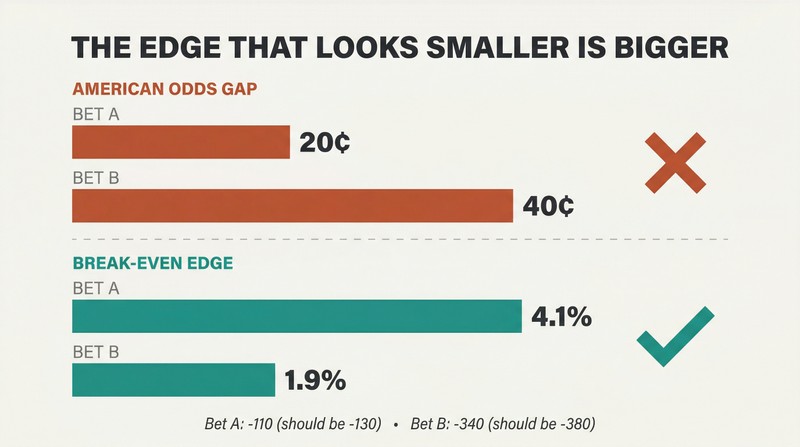
A break-even percentage tells you how often a bet must win to neither gain nor lose money: Risk ÷ (Risk + Win). A -110 bet breaks even at 52.4%; a +200 bet at 33.3%. Here's why the conversion matters: a bet "should" be -130 but you find it at -110 — that's "20 cents" of value. Another should be -380 but you find it at -340 — "40 cents." Intuitively 40 beats 20, but in break-even terms the first bet (56.5% vs. 52.4%) crushes the second (79.2% vs. 77.3%).
The hold on any market is calculated by adding both sides' break-even percentages and subtracting 100%. Standard -110/-110 equals a 4.5% hold. That number determines whether a market is beatable, and you should calculate it for every bet until it becomes second nature.
The hold kills you: one mistake in five bets erases your profit
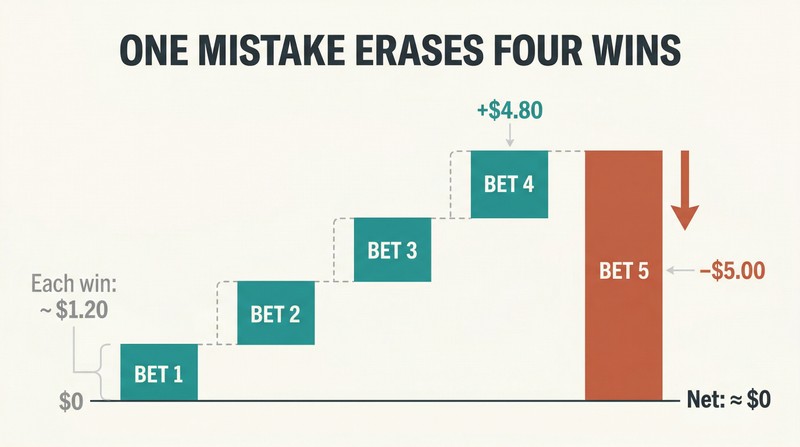
The hold destroys margin for error. Imagine five -110 bets, each with a true 53% win probability — except one where you missed a key injury and are effectively flipping a coin. The expected value across all five $110 bets comes to roughly $0.20. Four perfectly handicapped bets and one mistake, and the hold devoured everything. You must be "right" the vast majority of the time at standard hold, because each wrong bet costs you two or three good bets' worth of value.
If every sportsbook has the exact same price, that's terrible for you. But when prices start diverging across books, you can construct synthetic markets that approach 0% hold — where random betting breaks even and any real insight becomes profit. This is why eliminating the hold is the most fundamental skill.
Create zero-hold synthetic markets and bet your hunches for free
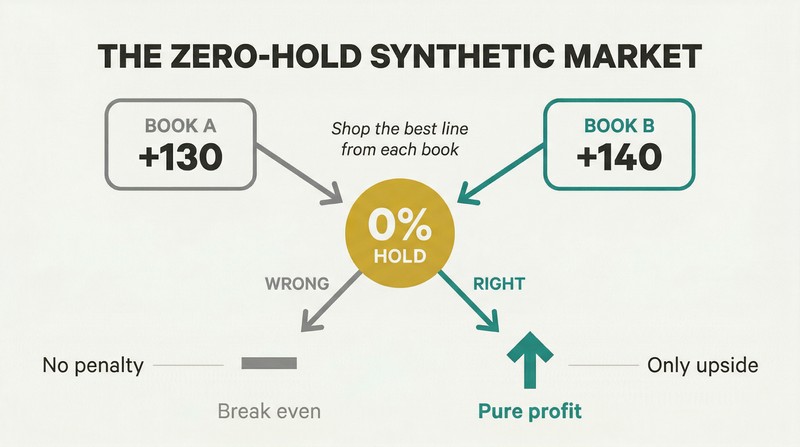
The core winning technique. If Sportsbook A has Diamondbacks +130 and B has +140, pair B's +140 with A's Rockies -140 for a 0% hold synthetic market. At zero hold, dart-throwing breaks even — any real insight you add is pure profit. You can also synthesize zero hold across related bets: pair a +5.5 point spread at one book with a moneyline at another, using historical push-rate data to convert between them. If the spread implies 68% and the moneyline prices at 67.7%, you've found your pair.
"Chasing steam" is a specific version: spot a price move at a market maker, then race to bet the stale line at a slow-to-update retail book before they copy the move. This creates a briefly negative-hold synthetic market. It wins reliably but gets you banned fastest.
Target the sportsbook's 'attack surface' — derivatives and props
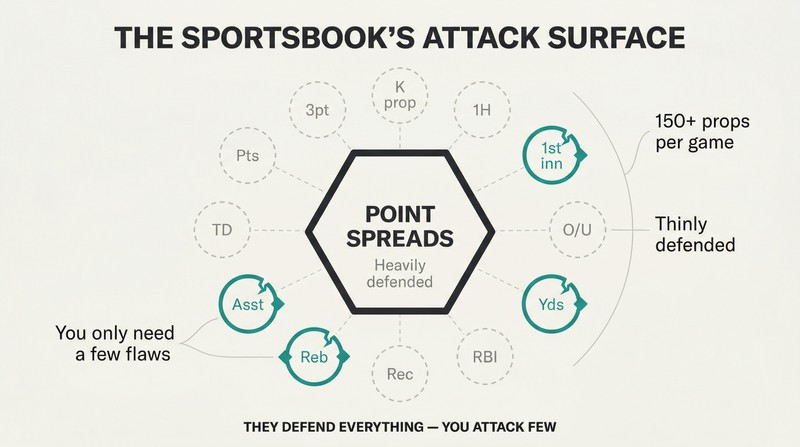
Attack surface is borrowed from computer security: the more software a server runs, the more hackable it becomes. Every derivative, prop, and in-play market a sportsbook adds is another surface to defend — and they can't defend them all. NFL point spreads are forged through millions in price discovery. A first-inning scoring prop? Opened using a six-year-old chart by a new hire who's never watched baseball, then never updated.
Props are especially fragile. When two bench players replace two power hitters, the opposing pitcher's strikeout prop stays put. A cornerback ruled out Thursday doesn't touch the receiver's yardage prop. Books want 150 markets per game to differentiate from competitors. Your specialization advantage means you only need to find flaws in a handful.
Line moves against your bet? Stop — don't load up on 'cheap' prices
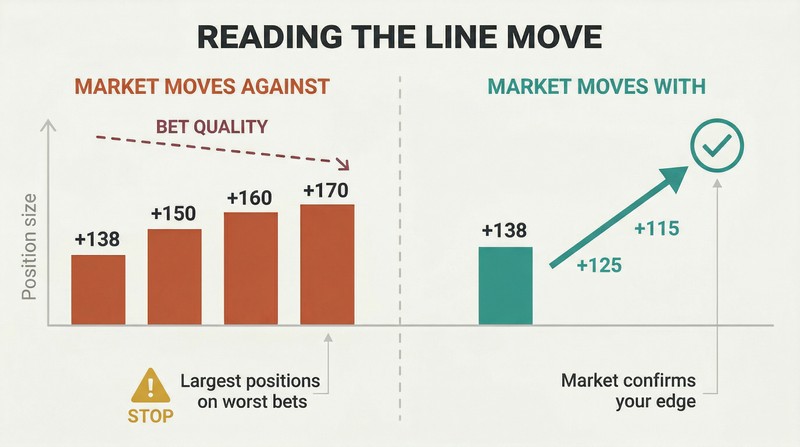
Market resistance is a massive red flag. If you bet the Reds at +138 (42% break-even) and the line moves to +170 (37%), other sharp bettors are telling you you're wrong. Many bettors see this as opportunity — "If I liked it at 42%, I should love it at 37%!" This is disastrous. You never get 17 cracks at your good bets — only at your stinkers.
Market agreement is the inverse: if your Reds +138 moves to +115, the serious betting community is confirming your read. Over hundreds of bets, your closing line value — the gap between your price and the closing price at market makers — reveals your true edge. Average CLV above half the hold signals you're on track. Failing to achieve that signals your process will lose.
Real angles glide — random trends with arbitrary constraints are noise
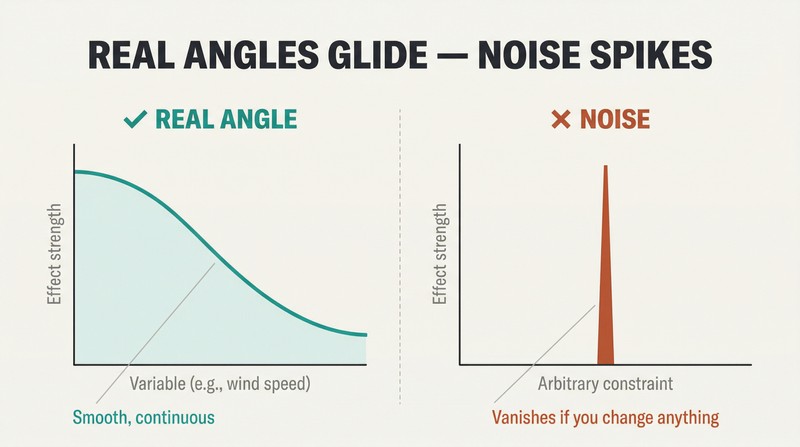
An angle must be three things: predictable, quantifiable, and unaccounted for in the line. "Unders hit 37-21 when wind exceeds 20 mph" is an angle — wind has a clear physical mechanism, and the effect should diminish gradually at lower speeds. It "glides." Meanwhile, "SEC 14-point favorites after non-conference losses go 22-9 ATS" is noise: why SEC? Why 14? Why non-conference? If the effect vanishes when you loosen any constraint, it's a Mad Libs betting theory.
Good angles also expire. NFL second-half scoring efficiency increased around 2017, briefly making first-quarter unders profitable at retail sportsbooks using outdated charts. But once sharps discovered and bet it, market makers updated their pricing. The moment an angle gets priced into the line, it's dead. Keep records and watch for fading profitability.
In-play, bet only during timeouts — you're 18+ seconds behind live
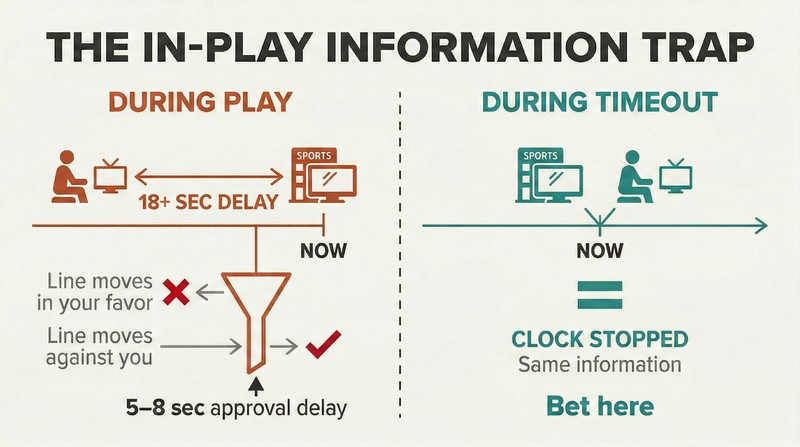
TV broadcasts run roughly 18 seconds behind live action. Sportsbooks price in-play markets using low-latency data feeds — they know the result of the next possession before you see it. Most books then add a 5-to-8-second "approval" delay after you click submit. If the line moves in your favor during those seconds, your bet gets rejected. If it moves against you, you're happily filled at a bad price. During timeouts, this asymmetry vanishes.
Look for three types of in-play mistakes:
1. Wrong game state (missed extra point, flipped yard line after penalty)
2. Missing game-specific factors (star pitcher removed, key player in foul trouble)
3. Fundamental modeling errors (constant scoring rates ignoring period-by-period variation in the NHL or NBA fourth-quarter pace effects)
Go for broke on deposit bonuses — busting the account pays more
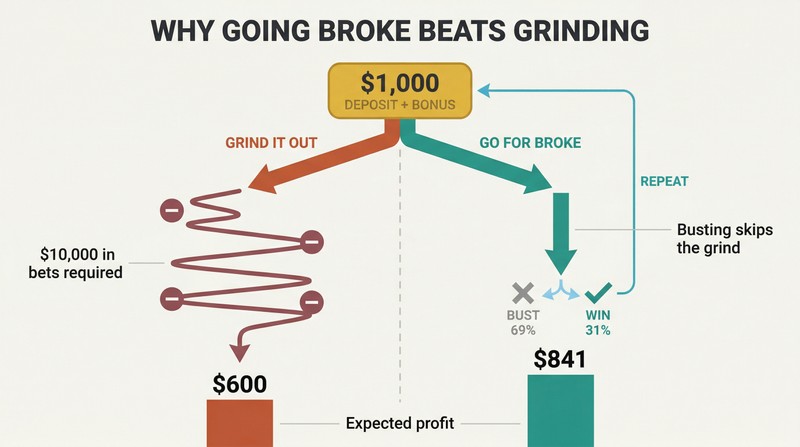
The math is counterintuitive. A $500 deposit with a matched $500 bonus and 20x wagering requirement means betting $10,000 before withdrawal — costing ~$400 in expected hold. Net profit: $100. Instead, bet the entire $1,000 on a +200 longshot. You'll bust 69% of the time, losing only ~$70 in theoretical hold. Win and repeat. This go-for-broke approach yields ~$841 on average versus $600 the safe way — because every time you bust, you skip thousands in wagering requirements.
Free play credits follow similar logic: always bet the biggest longshot available, since the sportsbook keeps the credit and you keep only winnings. A $100 free bet at +200 averages $60; the same at -200 averages just $35. While the industry is frothy with venture capital and marketing arms races, these promotions are everywhere. Get in front of the firehose now — it won't last.
Analysis
Miller and Davidow have written what is essentially an applied theory of market microstructure dressed in sports apparel. The book's deepest insight is structural rather than tactical: the sports betting industry's architecture — where a handful of market makers discover prices that hundreds of retail books blindly copy — creates predictable fault lines that a knowledgeable bettor can exploit. This mirrors concepts from financial economics (bid-ask spreads, information asymmetry, market fragmentation) applied to a domain where inefficiencies are far more pronounced because the 'securities' expire in hours and the 'exchanges' operate with wildly varying sophistication.
The attack surface concept is the book's most transferable idea. Any organization that expands its product offerings faster than its capacity to quality-control them creates exploitable vulnerabilities — a principle visible in cybersecurity, platform economics, and corporate strategy alike. Miller argues that competitive pressure drives sportsbooks into an arms race of menu proliferation, systematically outpacing their ability to price products correctly. The rational corporate decision to add more prop bets and derivatives paradoxically weakens the entire offering.
What distinguishes this from typical gambling literature is the complete absence of magical thinking. Miller never claims you can predict game outcomes better than the market. The winning edge comes from understanding market structure itself — knowing which lines were forged through millions of dollars in price discovery and which were slapped together by a recent hire using a six-year-old spreadsheet. The bettor's advantage is information about the marketplace, not about the sport.
The book's acknowledged limitation is its omission of data analytics and modeling, creating a gap between the recreational edge described and professional-level returns. The frothy expansion period Miller identifies as advantageous is inherently temporary. But as a framework for thinking about any adversarial marketplace with structural information asymmetry, this book offers surprising intellectual depth beneath its practical surface.
Review Summary
The Logic Of Sports Betting receives generally positive reviews, with readers praising its insightful analysis of sports betting mechanics and strategies. Many found it educational, particularly for novice bettors, though some noted its complexity. The book is commended for its detailed explanations of sportsbook operations, betting logic, and market inefficiencies. While some readers found it sobering about the difficulties of profitable betting, others appreciated its practical advice. A few reviewers mentioned the book's American-centric focus and lack of coverage on bankroll management.
People Also Read





Glossary
Break-even percentage
Required win rate to break evenThe percentage of the time a bet must win for the bettor to neither gain nor lose money over time. Calculated as Risk ÷ (Risk + Win). A -110 bet has a 52.4% break-even percentage. Miller argues this is the only correct unit for thinking about sports bets, replacing the misleading 'cents' framework of American odds.
Hold
Sportsbook's built-in margin on betsThe spread between what a sportsbook will buy a bet for and sell it for, expressed as a percentage. In a standard -110/-110 market, the hold is 4.5%. It represents the theoretical percentage of total bets the sportsbook would win with zero risk if action were perfectly balanced. Also called vig, juice, or the take.
Market maker
Sportsbook that discovers prices via actionA sportsbook that posts opening lines with low limits, takes bets from all comers (including sharp bettors), and moves its prices based on the action received. Market makers use price discovery rather than copying. They operate on high volume and low margins, and their settled lines become the reference prices that nearly all other sportsbooks copy.
Retail sportsbook
Copies lines and curates customersA sportsbook that sources its lines from market makers rather than making them through price discovery. Retail books focus on traditional business problems like marketing and customer acquisition. They protect margins by limiting or banning customers suspected of winning, maintaining higher holds, and pegging their lines to market makers rather than moving on their own action.
Price discovery
Finding correct prices through betting actionThe process by which a market maker arrives at accurate lines by posting opening numbers, accepting bets, and moving prices in response to action—particularly from sharp bettors. The process is analogous to how commodity exchanges discover prices for gold or oil. Most sportsbook lines originate from this process at a small number of market making books.
Attack surface
Exploitable range of offered marketsA concept borrowed from computer security describing the total number of potential vulnerabilities a sportsbook exposes by offering many markets. Every derivative, prop, and in-play bet added to the menu is another surface the sportsbook must defend. Because retail books expand their menus for competitive differentiation, they systematically create more attack surface than they can adequately price and monitor.
Synthetic market
Combined bets creating reduced holdA market constructed by pairing the best available prices across two or more sportsbooks (or across related markets at different books) to create a lower effective hold than either book offers individually. A zero-hold synthetic market occurs when the best prices on opposite sides of a bet combine to a 0% hold, allowing the bettor to wager with essentially no house edge.
Closing line value (CLV)
Your price vs. market closing priceThe difference between the break-even percentage at which you placed your bet and the break-even percentage available at market maker books when the market closed (game started). Consistently getting better prices than the closing line, averaged over hundreds of bets, is one of the strongest predictors of long-term profitability in sports betting.
Market agreement
Line moves confirming your betWhen the price at market maker books moves in the direction that makes your bet look better after you've placed it. For example, betting a team at +138 and seeing the line move to +115 indicates that other serious bettors are making similar bets. Consistent market agreement across many bets correlates strongly with long-term profitability.
Market resistance
Line moves contradicting your betWhen the price at market maker books moves against your bet after you've placed it—for example, betting at +138 and seeing the line move to +170. This signals that sharp bettors disagree with your assessment. Miller warns never to double down into market resistance, as doing so systematically concentrates your largest positions on your worst bets.
Chasing steam
Betting stale lines after market movesThe practice of monitoring market maker books for significant price movements, then quickly betting the old (stale) price at retail sportsbooks that haven't yet updated their lines to match. This creates a temporarily negative-hold synthetic market. Steam chasing wins reliably but is the fastest way to get limited or banned by retail sportsbooks.
Angle
Predictable unpriced factor affecting outcomesA factor that has a predictable and quantifiable effect on the outcome of a bet but is not accounted for in the sportsbook's line. Valid angles must meet three criteria: predictable (applies consistently), quantifiable (you can estimate its magnitude), and unpriced (not already reflected in the market). Distinguished from noise-driven 'trends' by having a realistic causal mechanism and an effect that 'glides' (diminishes gradually as constraints loosen).
Correlated parlay
Parlay legs where one helps anotherA parlay where two legs involve the same event and winning one leg makes the other more likely to win. For example, parlaying a big college football favorite with the over—both bets essentially wager on how many touchdowns the favorite scores. Standard parlay math assumes independence between legs, so correlated parlays systematically underpay the sportsbook and overpay the bettor.
FAQ
What's "The Logic Of Sports Betting" about?
- Overview: "The Logic Of Sports Betting" by Ed Miller and Matthew Davidow is a comprehensive guide to understanding the intricacies of sports betting. It delves into the mechanics of how bets are made, how sportsbooks operate, and how bettors can find an edge.
- Focus on Strategy: The book emphasizes the importance of understanding market dynamics and using logical strategies to identify profitable betting opportunities.
- Educational Approach: It aims to educate both novice and experienced bettors on the principles of betting, including odds, market making, and the role of sportsbooks.
Why should I read "The Logic Of Sports Betting"?
- Gain Insight: The book provides deep insights into the sports betting industry, helping readers understand how lines are set and how to identify value bets.
- Improve Betting Skills: It offers practical advice and strategies to improve betting skills, making it a valuable resource for anyone looking to bet more effectively.
- Avoid Common Pitfalls: By understanding the logic behind sports betting, readers can avoid common mistakes and misconceptions that lead to losses.
What are the key takeaways of "The Logic Of Sports Betting"?
- Market Dynamics: Understanding that sports betting is a multiplayer game where bettors compete against both the house and other bettors.
- Importance of Odds: Learning to convert odds into break-even percentages to assess the value of a bet.
- Identifying Weak Markets: Focusing on finding and exploiting weak markets where sportsbooks may not have set accurate lines.
How do Ed Miller and Matthew Davidow suggest finding value in sports betting?
- Line Shopping: Always look for the best price across different sportsbooks to minimize the hold and maximize potential profits.
- Related Markets: Use related markets to create synthetic zero-hold markets, allowing for more profitable betting opportunities.
- Market Agreement: Pay attention to market agreement and resistance to gauge whether a bet is likely to be profitable.
What are the best quotes from "The Logic Of Sports Betting" and what do they mean?
- "If you can’t spot the sucker...": This quote emphasizes the importance of understanding the dynamics of the betting market and recognizing when you have an edge.
- "Sports betting is a multiplayer game...": Highlights the competitive nature of sports betting, where bettors are not just against the house but also against each other.
- "Avoid strength. Attack weakness.": A strategic approach to focus on markets where sportsbooks are vulnerable and avoid those where they are strong.
How do sportsbooks set their lines according to "The Logic Of Sports Betting"?
- Market Making: Some sportsbooks act as market makers, setting initial lines and adjusting them based on betting action.
- Copying Lines: Many sportsbooks copy lines from market makers, especially for major markets, to ensure they are competitive.
- Price Discovery: Lines are often adjusted through a process of price discovery, where sportsbooks take bets and move lines to balance action.
What is the role of the hold in sports betting as explained in "The Logic Of Sports Betting"?
- Definition of Hold: The hold is the percentage of all bets a sportsbook expects to win, acting as their profit margin.
- Impact on Bettors: A higher hold means bettors need to win more often to be profitable, making it crucial to find low-hold markets.
- Chopping the Hold: Bettors can reduce the hold by line shopping and finding synthetic markets with lower or zero hold.
How do Ed Miller and Matthew Davidow define and use "market agreement and resistance"?
- Market Agreement: When the market moves in favor of a bet after it's placed, indicating that other bettors agree with the bet's value.
- Market Resistance: When the market moves against a bet, suggesting that the bet may not be as valuable as initially thought.
- Importance: Understanding these concepts helps bettors assess the quality of their bets and adjust their strategies accordingly.
What strategies do Ed Miller and Matthew Davidow recommend for betting derivatives?
- Understanding Derivatives: Derivatives are bets related to the main markets, such as first half or quarter lines, and can offer value if priced incorrectly.
- Modeling and Analysis: Use data and models to understand the relationship between derivatives and main markets to find mispriced bets.
- Exploiting Weaknesses: Focus on derivatives that are less frequently bet and therefore more likely to be mispriced by sportsbooks.
How can bettors take advantage of parlays according to "The Logic Of Sports Betting"?
- Volume Increase: Parlays increase betting volume, which can be advantageous if the bettor has an edge on the individual bets.
- Correlated Parlays: Look for opportunities where the outcomes of parlayed bets are correlated, increasing the likelihood of winning.
- Circumventing Limits: Use parlays to circumvent betting limits on individual games, allowing for larger overall bets.
What are multiway markets and how can they be profitable as per "The Logic Of Sports Betting"?
- Definition: Multiway markets offer more than two betting options, such as futures or props, and often have higher holds.
- Finding Value: Despite the high hold, these markets can be profitable if bettors can identify mispriced options among the many choices.
- Complexity in Pricing: The difficulty sportsbooks face in accurately pricing all options in a multiway market creates opportunities for savvy bettors.
How do Ed Miller and Matthew Davidow suggest using in-play betting to find profitable opportunities?
- Identifying Mistakes: Look for mistakes in the in-play lines, such as incorrect game state information or failure to account for game-specific factors.
- Betting During Timeouts: Focus on betting during timeouts when both the bettor and sportsbook have the same information about the game.
- Avoiding Delays: Be cautious of sportsbooks that impose delays on in-play bets, as this can disadvantage the bettor.
Download PDF
Download EPUB
.epub digital book format is ideal for reading ebooks on phones, tablets, and e-readers.








































